Russian Current
Dr Sreeraj S R, Ph.D.
2
Burst Mode Alternating Current (BMAC).
The credit for the early work in this field is ascribed to
Dr Yakov Kots, based in Russia, in the late 1970s.
● The term 'Russian currents' refers to sinusoidal AC of
frequency 2.5 kHz which is burst-modulated at 50 Hz.
● The pulsing or bursting is at a 'low' frequency, and as
a result, nerves will respond.
● It is primarily employed to generating a motor
response.
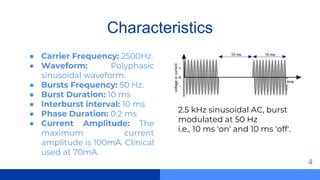
● It consists of 10 ms bursts of AC separated by 10 ms
'off' periods. The waveform repeats every 20 ms
(1/50th sec) so the burst or modulation frequency is 50
Hz.
3
Overview
Characteristics
● Carrier Frequency: 2500Hz.
● Waveform: Polyphasic
sinusoidal waveform.
● Bursts Frequency: 50 Hz.
● Burst Duration: 10 ms
● Interburst interval: 10 ms
● Phase Duration: 0.2 ms
● Current Amplitude: The
maximum current
amplitude is 100mA. Clinical
used at 70mA.
4
2.5 kHz sinusoidal AC, burst
modulated at 50 Hz
i.e., 10 ms 'on' and 10 ms 'off'.
5
Physiologic Effects
Sensory nerve stimulation leads to moderate
prickling sensation.
Motor nerve depolarization of fast type II motor
units causing tetanic muscle contraction.
6
Indications
Muscle strengthening
in healthy athletes.
Post-traumatic /
surgical cases.
Reduce oedema
Improve / maintain
muscle strength
To reduce muscle
spasm.
7
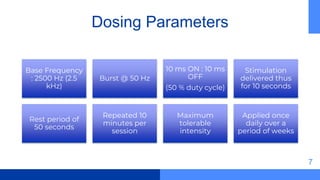
Dosing Parameters
Base Frequency
: 2500 Hz (2.5
kHz)
Burst @ 50 Hz
10 ms ON : 10 ms
OFF
(50 % duty cycle)
Stimulation
delivered thus
for 10 seconds
Rest period of
50 seconds
Repeated 10
minutes per
session
Maximum
tolerable
intensity
Applied once
daily over a
period of weeks
8
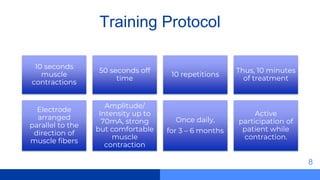
Training Protocol
10 seconds
muscle
contractions
50 seconds off
time
10 repetitions
Thus, 10 minutes
of treatment
Electrode
arranged
parallel to the
direction of
muscle fibers
Amplitude/
Intensity up to
70mA, strong
but comfortable
muscle
contraction
Once daily,
for 3 – 6 months
Active
participation of
patient while
contraction.
9
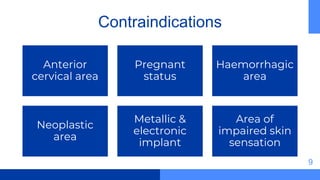
Contraindications
Anterior
cervical area
Pregnant
status
Haemorrhagic
area
Neoplastic
area
Metallic &
electronic
implant
Area of
impaired skin
sensation

Russian Current / Burst Mode Alternating Current (BMAC)

  • 1.
  • 2.
    2 Burst Mode AlternatingCurrent (BMAC). The credit for the early work in this field is ascribed to Dr Yakov Kots, based in Russia, in the late 1970s.
  • 3.
    ● The term'Russian currents' refers to sinusoidal AC of frequency 2.5 kHz which is burst-modulated at 50 Hz. ● The pulsing or bursting is at a 'low' frequency, and as a result, nerves will respond. ● It is primarily employed to generating a motor response. ● It consists of 10 ms bursts of AC separated by 10 ms 'off' periods. The waveform repeats every 20 ms (1/50th sec) so the burst or modulation frequency is 50 Hz. 3 Overview
  • 4.
    Characteristics ● Carrier Frequency:2500Hz. ● Waveform: Polyphasic sinusoidal waveform. ● Bursts Frequency: 50 Hz. ● Burst Duration: 10 ms ● Interburst interval: 10 ms ● Phase Duration: 0.2 ms ● Current Amplitude: The maximum current amplitude is 100mA. Clinical used at 70mA. 4 2.5 kHz sinusoidal AC, burst modulated at 50 Hz i.e., 10 ms 'on' and 10 ms 'off'.
  • 5.
    5 Physiologic Effects Sensory nervestimulation leads to moderate prickling sensation. Motor nerve depolarization of fast type II motor units causing tetanic muscle contraction.
  • 6.
    6 Indications Muscle strengthening in healthyathletes. Post-traumatic / surgical cases. Reduce oedema Improve / maintain muscle strength To reduce muscle spasm.
  • 7.
    7 Dosing Parameters Base Frequency :2500 Hz (2.5 kHz) Burst @ 50 Hz 10 ms ON : 10 ms OFF (50 % duty cycle) Stimulation delivered thus for 10 seconds Rest period of 50 seconds Repeated 10 minutes per session Maximum tolerable intensity Applied once daily over a period of weeks
  • 8.
    8 Training Protocol 10 seconds muscle contractions 50seconds off time 10 repetitions Thus, 10 minutes of treatment Electrode arranged parallel to the direction of muscle fibers Amplitude/ Intensity up to 70mA, strong but comfortable muscle contraction Once daily, for 3 – 6 months Active participation of patient while contraction.
  • 9.