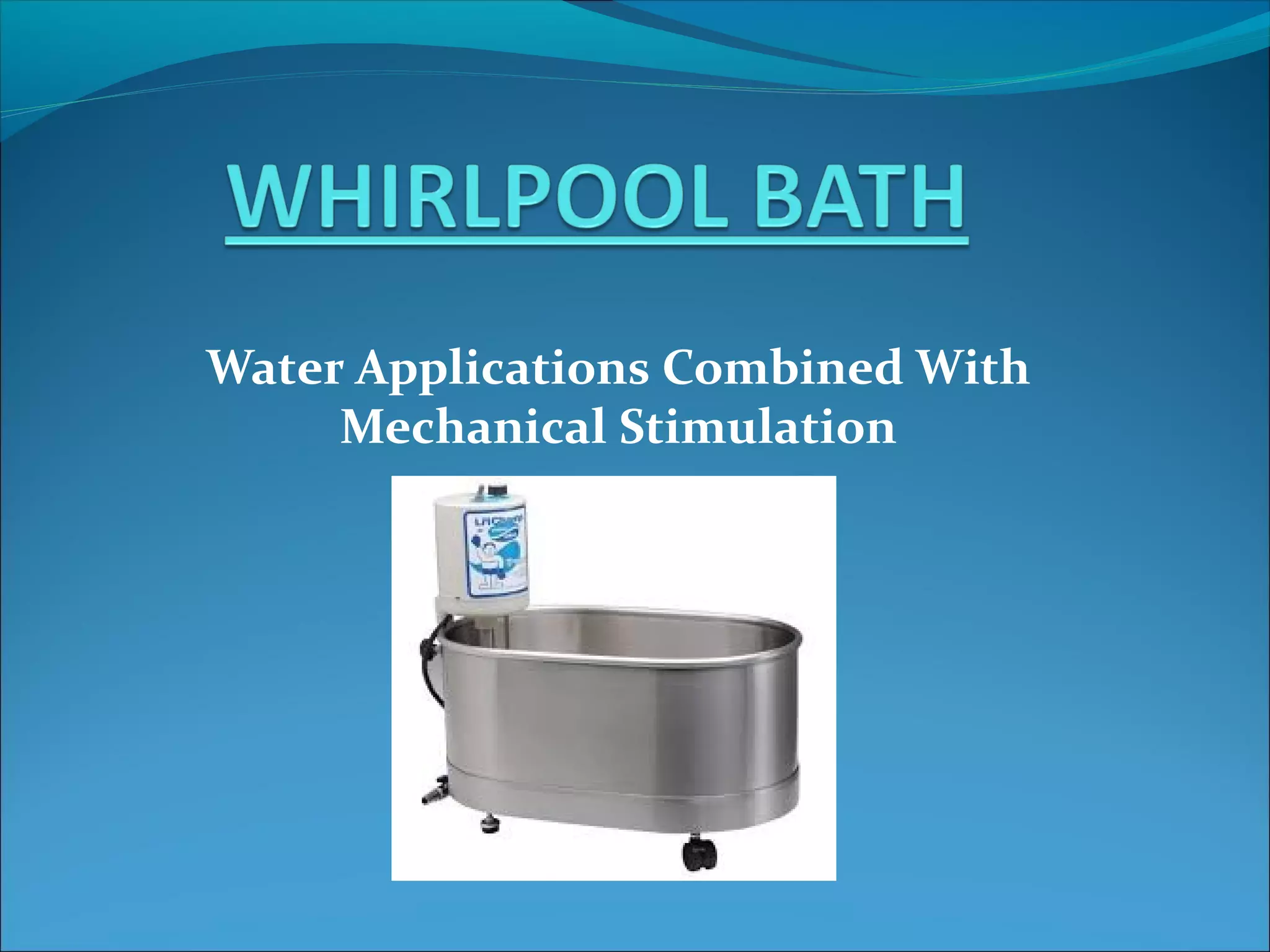
Water Applications Combined With
Mechanical Stimulation
USAGE OF WATER FOR THERAPEUTIC PURPOSES
USE OF WHIRLPOOL BATH HAS BECOME
INCREASINGLY VALUABLE MEANS OF
PHYSIOTHERAPEUTIC TREATMENT
Principle of application
THE PRINCIPLE OF WHIRLPOOL THERAPY IS TO
COMBINE THE EFFECTS OF TEMPERATURE WITH
THE MECHANICAL EFFECTS OF WATER
WARM WHIRLPOOL CONTAINS WATER AT
TEMPERATURE RANGES BETWEEN 36-45 DEGREE
CELECIUS AND A JET OF WATER OR AIR STREAM
ALLOWED TO PRODUCE TURBULENCE IN WATER
THIS TURBULENCE IS PRODUCED BY A
ELECTRICAL MOTOR INCORPORATED INTO THE
APPARATUS
DEPENDING UPON THE
APPARATUS,WHIRLPOOL BATH CAN BE USED
FOR THE TREATMENT OF LIMBS OR WHOLE
BODY
Types of Whirlpool Baths
Low boy tank
High boy tank
Hubbard tank
Extrimity tank
Low boy tank- The Low Boy Tank can be used to
allow an adult to sit in the tank and can range in
capacity from 75 to 105 gallons
High boy tank-
sometimes referred to as a
hip or leg tank, can allow
for the immersion of both
lower extremities
Capacity can range from
60 to 105 gallons
Full body immersion/Hubbard tank- The Hubbard
Tank has a greater potential for exercise during
treatment due to it's size and can accomodate a full
body treatment
Capacity can range anywhere from 200 gallons to
more than 400 gallons
Full body immersion/Hubbard tank- figure 8 pattern.
The pattern can allow for easy access to the patient.
Note that the larger tanks can also have more than
one turbine for agitation.
•Full body immersion/Hubbard tank-
•Butterfly shape
•Underwater exercises
Hubbard tank
8 feet long * 6 feet wide * 4 feet deep
425 gallons of water
Turbines, stretcher, hoist
Chances of contamination
Expensive secondary to amount of water, time to
clean
Extrimity tank- The Extremity Tank is usually used
for the upper or lower extremities and has a capacity
of 10 to 45 gallons of water
Temperature Range
Cold: 55-65 degrees F acute inflammation
Cool: 65-80 degrees F acute inflammation
Tepid: 80-95 degrees F exercise, acute inflammation
if cold not tolerated, open wound, dec tone
Warm: 96-99 degrees F mobility, burns
Hot: 99-104 degrees F pain, ROM, soft tissue
extensibility
Very Hot: 104-110 degrees F-chronic conditions
Technique of application
1. The whirlpool tank is filled with water
2. The water temperature is checked by hand and
thermometer
3. Adjust the patient’s position in accordance to the treated
body part and considering both comfort and security.
4. Explain the procedure and reassure the patient
5. Place the body part in the water
6. Encourage the patient to move while keeping the body
part under water during the treatment in case of joint
involvement
7. After completion of treatment, dry the body part and
wrap it keeping it warm
Therapeutic effects
The whirlpool bath combines the values of
conductive heat and gentle massage
A sedative action.
A relief of pain by stimuli which act through the pain
gait mechanism.
A relaxation of muscle spasms.
Actions
1. Producing vasodilatation
2. Improving local arterial and lymphatic circulation.
3. Softening of scar tissue.
4. Breaking down old adhesions after fractures of sprains.
5. Cleaning and stimulation of wounds.
6. Mechanically removing dirt, dead tissue and pus.
7. Causing regression of the inflammatory process.
8. Diminution of edema and effusion.
THE PART TO BE TREATED IS IMMERSED INTO
THE WATER AND JET OF STREAM IS ALLOWED
TO PRODUCE TURBULENCE IN THE HOT WATER
TREATMENT IS USUALLY GIVEN FOR 15-20
MINUTES
WHIRLPOOL BATHS IS USED IN RHEUMATIC
DISORDERS,POST TRAUMATIC STIFFNESS AND
JOINT PAIN
IT IS EFFECTIVELY USED IN SPORTS MEDICINE
FOR RELAXATION AFTER PRACTICE OR
COMPETITION
USES
Burns if no agitation is used
Open wounds for debridment purposes
Post-operative orthopedic conditions where the water
will add a bouyancy element to eliminate the weight
of the extrmity for movement
As a resistance force for exercise
BEWARE OF
Any adverse conditions that may appear
Skin pallor
Shivering
Dizziness
Rapid , weak pulse
Headache
Increase in edema
Decrease in ROM
Hyperventilation
“Seasickness".
Indications
1. Poor circulation
2. Chronic edema
3. Separate dead tissue
4. Pain relief in amputations ( phantom pain)
5. After removal of plaster cast (fractures)
6. Stiff joints
7. Infected wounds with added antiseptic agent→
8. Arthritis with stiff and swollen joints
9. Polyomyelitis and paraplegia to improve circulation
10. Traumatic and chronic inflammatory conditions
11. Weak and painful feet
12. As preparation to massage, passive stretching and exercises
CONTRAINDICATIONS
FVERISH PATIENT
RECENT SKIN GRAFTS
CIRCULATORY IMPAIRMENT
ACTIVE BLEEDING
OPEN WOUNDS
HAEMMORHAGE
SKIN ALLERGY
Whirlpool Bath Dr. Rashi

Whirlpool Bath Dr. Rashi

  • 1.
    Water Applications CombinedWith Mechanical Stimulation
  • 2.
    USAGE OF WATERFOR THERAPEUTIC PURPOSES USE OF WHIRLPOOL BATH HAS BECOME INCREASINGLY VALUABLE MEANS OF PHYSIOTHERAPEUTIC TREATMENT
  • 3.
    Principle of application THEPRINCIPLE OF WHIRLPOOL THERAPY IS TO COMBINE THE EFFECTS OF TEMPERATURE WITH THE MECHANICAL EFFECTS OF WATER WARM WHIRLPOOL CONTAINS WATER AT TEMPERATURE RANGES BETWEEN 36-45 DEGREE CELECIUS AND A JET OF WATER OR AIR STREAM ALLOWED TO PRODUCE TURBULENCE IN WATER
  • 4.
    THIS TURBULENCE ISPRODUCED BY A ELECTRICAL MOTOR INCORPORATED INTO THE APPARATUS DEPENDING UPON THE APPARATUS,WHIRLPOOL BATH CAN BE USED FOR THE TREATMENT OF LIMBS OR WHOLE BODY
  • 5.
    Types of WhirlpoolBaths Low boy tank High boy tank Hubbard tank Extrimity tank
  • 6.
    Low boy tank-The Low Boy Tank can be used to allow an adult to sit in the tank and can range in capacity from 75 to 105 gallons
  • 7.
    High boy tank- sometimesreferred to as a hip or leg tank, can allow for the immersion of both lower extremities Capacity can range from 60 to 105 gallons
  • 8.
    Full body immersion/Hubbardtank- The Hubbard Tank has a greater potential for exercise during treatment due to it's size and can accomodate a full body treatment Capacity can range anywhere from 200 gallons to more than 400 gallons
  • 9.
    Full body immersion/Hubbardtank- figure 8 pattern. The pattern can allow for easy access to the patient. Note that the larger tanks can also have more than one turbine for agitation.
  • 10.
    •Full body immersion/Hubbardtank- •Butterfly shape •Underwater exercises
  • 11.
    Hubbard tank 8 feetlong * 6 feet wide * 4 feet deep 425 gallons of water Turbines, stretcher, hoist Chances of contamination Expensive secondary to amount of water, time to clean
  • 12.
    Extrimity tank- TheExtremity Tank is usually used for the upper or lower extremities and has a capacity of 10 to 45 gallons of water
  • 13.
    Temperature Range Cold: 55-65degrees F acute inflammation Cool: 65-80 degrees F acute inflammation Tepid: 80-95 degrees F exercise, acute inflammation if cold not tolerated, open wound, dec tone Warm: 96-99 degrees F mobility, burns Hot: 99-104 degrees F pain, ROM, soft tissue extensibility Very Hot: 104-110 degrees F-chronic conditions
  • 14.
    Technique of application 1.The whirlpool tank is filled with water 2. The water temperature is checked by hand and thermometer 3. Adjust the patient’s position in accordance to the treated body part and considering both comfort and security. 4. Explain the procedure and reassure the patient 5. Place the body part in the water 6. Encourage the patient to move while keeping the body part under water during the treatment in case of joint involvement 7. After completion of treatment, dry the body part and wrap it keeping it warm
  • 15.
    Therapeutic effects The whirlpoolbath combines the values of conductive heat and gentle massage A sedative action. A relief of pain by stimuli which act through the pain gait mechanism. A relaxation of muscle spasms.
  • 16.
    Actions 1. Producing vasodilatation 2.Improving local arterial and lymphatic circulation. 3. Softening of scar tissue. 4. Breaking down old adhesions after fractures of sprains. 5. Cleaning and stimulation of wounds. 6. Mechanically removing dirt, dead tissue and pus. 7. Causing regression of the inflammatory process. 8. Diminution of edema and effusion.
  • 17.
    THE PART TOBE TREATED IS IMMERSED INTO THE WATER AND JET OF STREAM IS ALLOWED TO PRODUCE TURBULENCE IN THE HOT WATER TREATMENT IS USUALLY GIVEN FOR 15-20 MINUTES
  • 19.
    WHIRLPOOL BATHS ISUSED IN RHEUMATIC DISORDERS,POST TRAUMATIC STIFFNESS AND JOINT PAIN IT IS EFFECTIVELY USED IN SPORTS MEDICINE FOR RELAXATION AFTER PRACTICE OR COMPETITION
  • 21.
    USES Burns if noagitation is used Open wounds for debridment purposes Post-operative orthopedic conditions where the water will add a bouyancy element to eliminate the weight of the extrmity for movement As a resistance force for exercise
  • 22.
    BEWARE OF Any adverseconditions that may appear Skin pallor Shivering Dizziness Rapid , weak pulse Headache Increase in edema Decrease in ROM Hyperventilation “Seasickness".
  • 23.
    Indications 1. Poor circulation 2.Chronic edema 3. Separate dead tissue 4. Pain relief in amputations ( phantom pain) 5. After removal of plaster cast (fractures) 6. Stiff joints 7. Infected wounds with added antiseptic agent→ 8. Arthritis with stiff and swollen joints 9. Polyomyelitis and paraplegia to improve circulation 10. Traumatic and chronic inflammatory conditions 11. Weak and painful feet 12. As preparation to massage, passive stretching and exercises
  • 24.
    CONTRAINDICATIONS FVERISH PATIENT RECENT SKINGRAFTS CIRCULATORY IMPAIRMENT ACTIVE BLEEDING OPEN WOUNDS HAEMMORHAGE SKIN ALLERGY