Genetics: Analysis and Principles Robert J. Brooker Copyright ©The McGraw-Hill Companies, Inc. Permission required for reproduction or display CHAPTER 12 GENE TRANSCRIPTION  AND RNA MODIFICATION (processing)
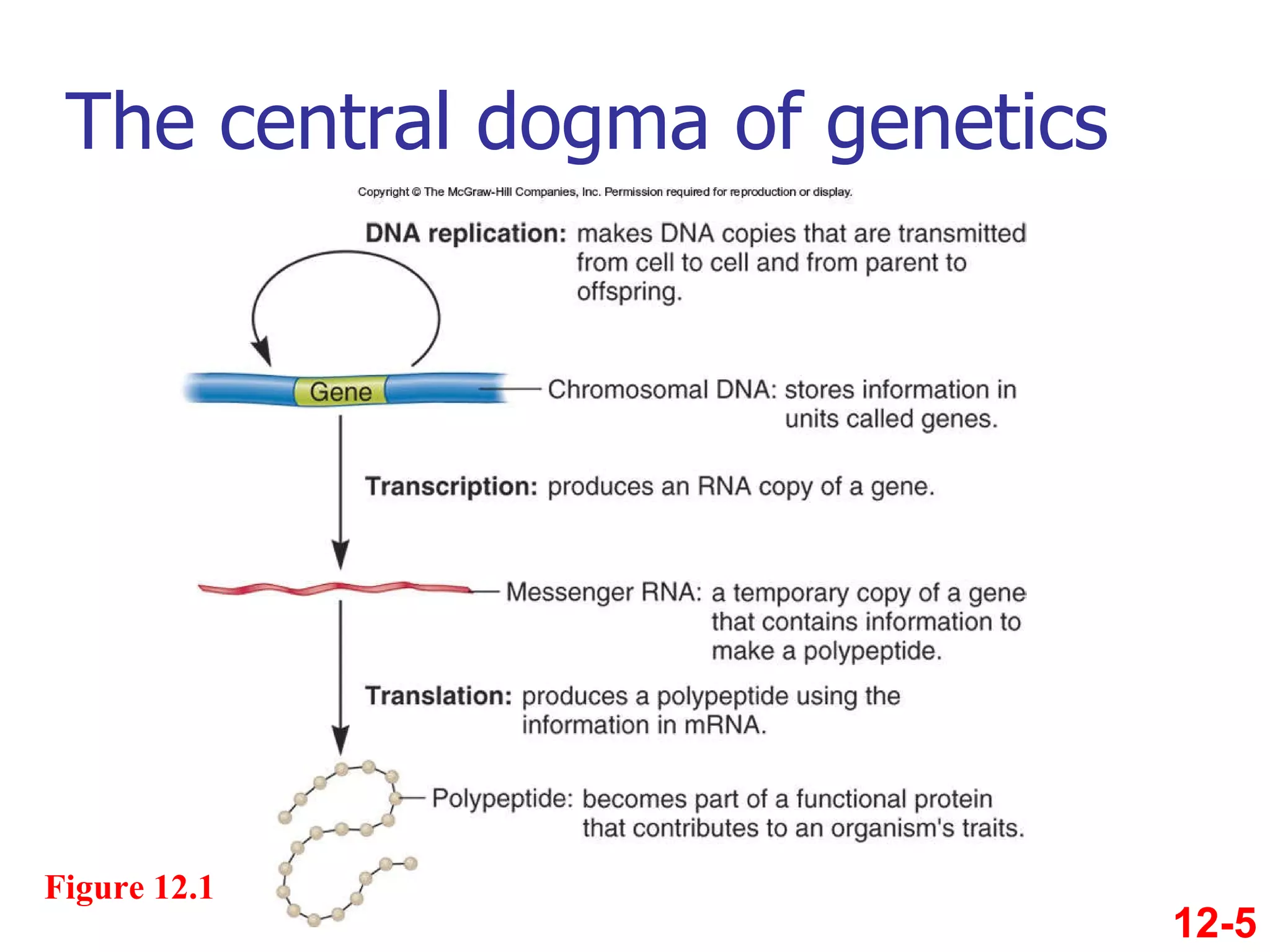
The central dogma of genetics Figure 12.1 12-5
A key concept is that DNA base sequences define the beginning and end of a gene and regulate the level of RNA synthesis Gene expression  is the overall process by which the information within a gene is used to produce a functional product which can determine a trait in play with the environment 12.1  OVERVIEW OF TRANSCRIPTION Copyright ©The McGraw-Hill Companies, Inc. Permission required for reproduction or display 12-6
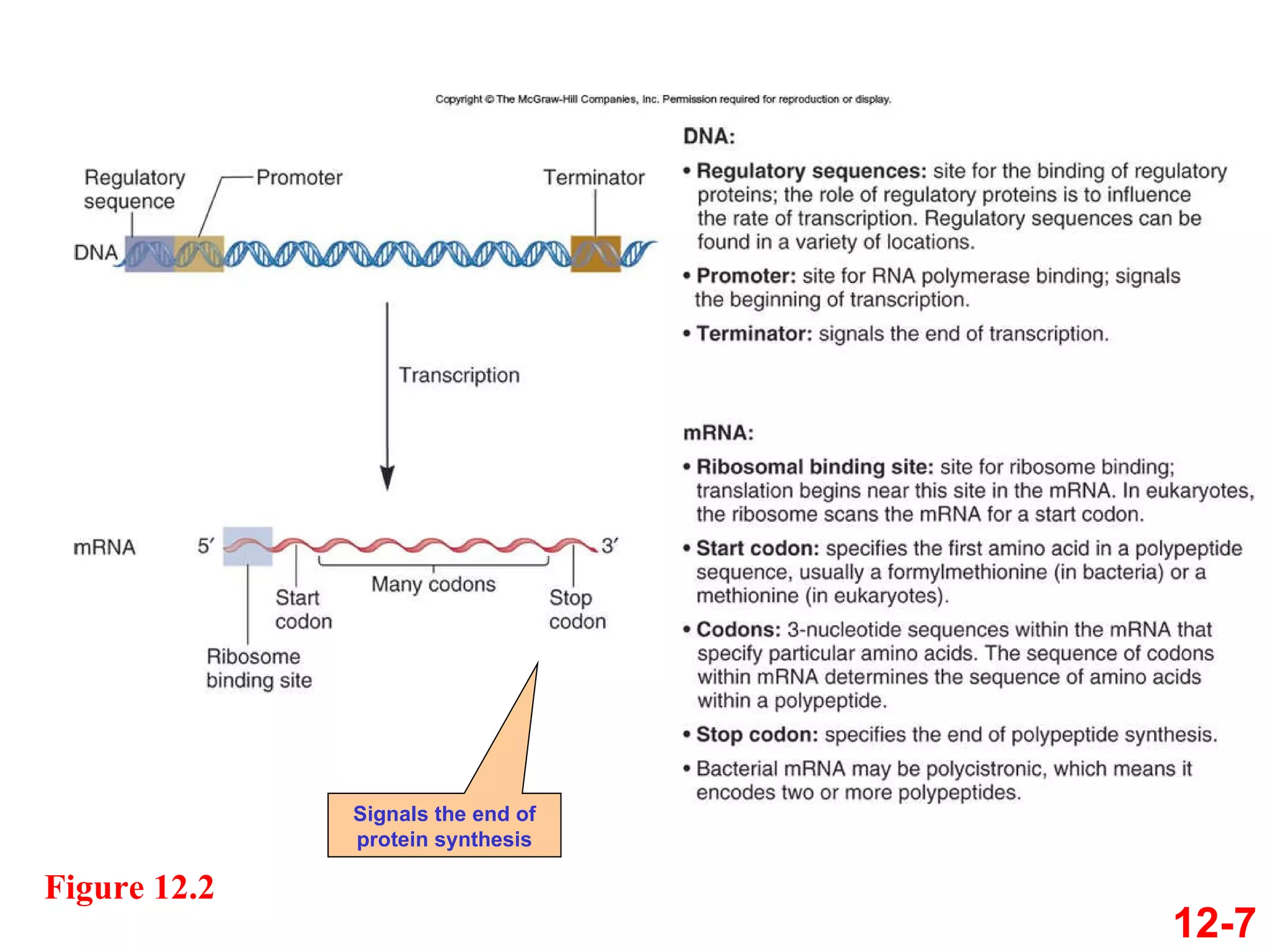
Figure 12.2 12-7 Signals the end of protein synthesis
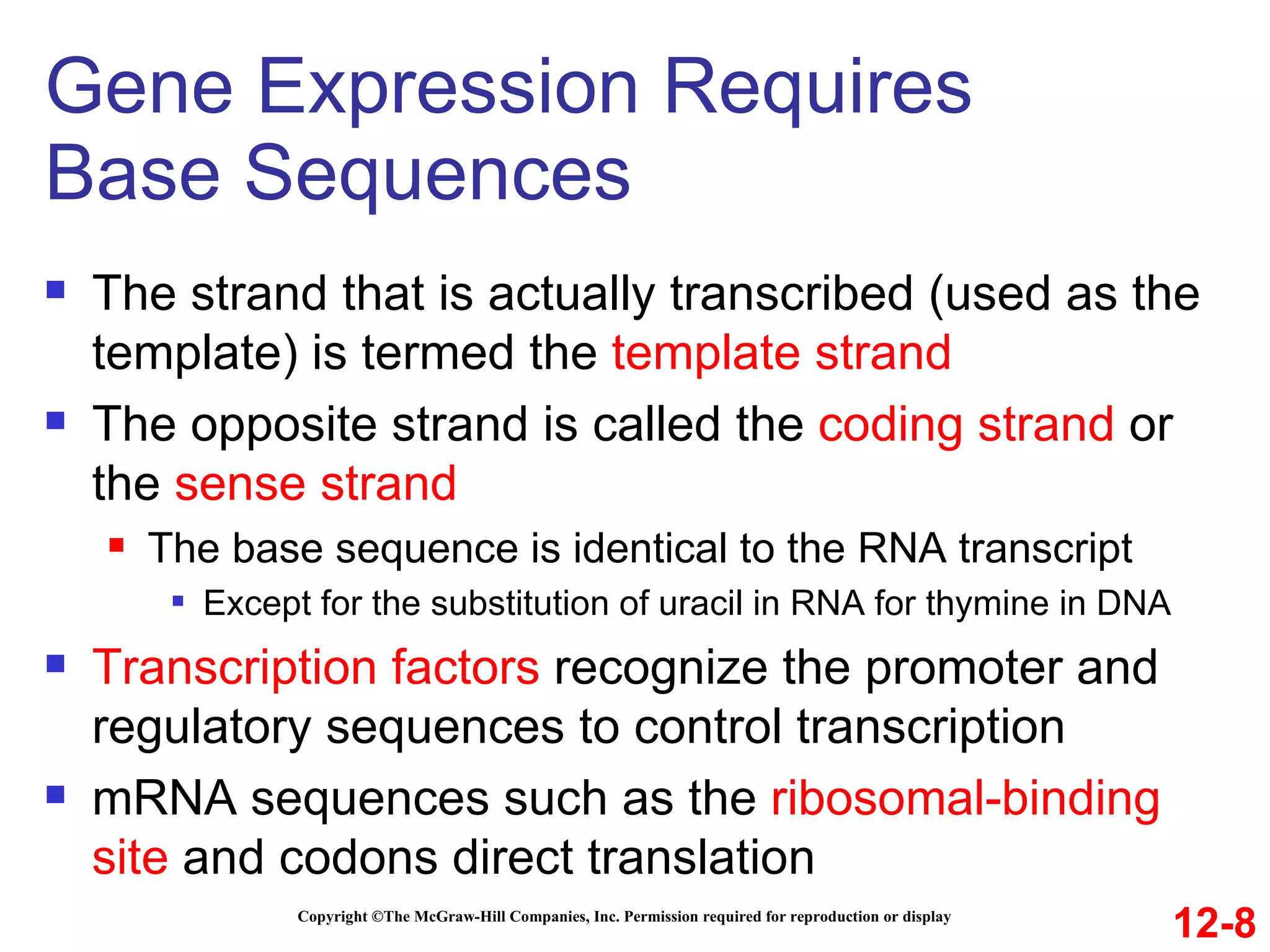
Gene Expression Requires  Base Sequences Copyright ©The McGraw-Hill Companies, Inc. Permission required for reproduction or display The strand that is actually transcribed (used as the template) is termed the  template strand The opposite strand is called the  coding strand  or the  sense strand The base sequence is identical to the RNA transcript Except for the substitution of uracil in RNA for thymine in DNA Transcription factors  recognize the promoter and regulatory sequences to control transcription mRNA sequences such as the  ribosomal-binding site  and codons direct translation 12-8
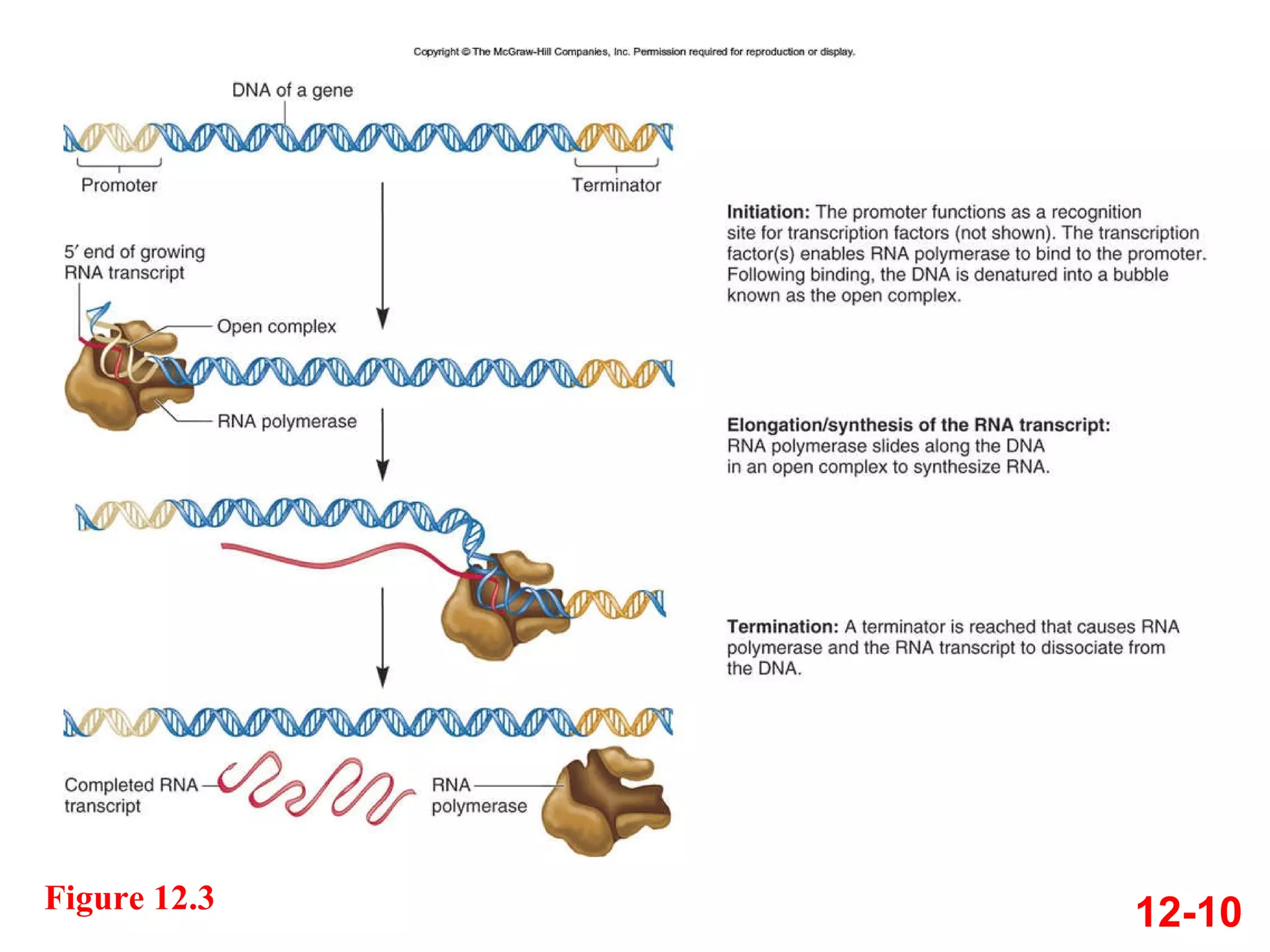
The Stages of Transcription Copyright ©The McGraw-Hill Companies, Inc. Permission required for reproduction or display Transcription occurs in three stages Initiation Elongation Termination These steps involve protein-DNA interactions  Proteins such as RNA polymerase interact with DNA sequences Transcription factors that control transcription bind directly or indirectly to DNA 12-9
12-10 Figure 12.3
RNA Transcripts Have Different Functions Copyright ©The McGraw-Hill Companies, Inc. Permission required for reproduction or display Once they are made, RNA transcripts play different functional roles Well over 90% of all genes are structural genes producing mRNA The other RNA molecules are never translated: This collection appears much greater that initially believed; Some RNAs are 20-25 nts long that have important functions! 12-11
RNA Transcripts Have Different Functions Copyright ©The McGraw-Hill Companies, Inc. Permission required for reproduction or display The RNA transcripts from nonstructural genes are not translated They do have various important cellular functions They can still confer traits In some cases, the RNA transcript becomes part of a complex that contains protein subunits For example Ribosomes Spliceosomes Signal recognition particles 12-12
Our molecular understanding of gene transcription came from studies involving bacteria and bacteriophages Indeed, much of our knowledge comes from studies of a single bacterium E. coli , of course In this section we will examine the three steps of transcription as they occur in bacteria 12.2  TRANSCRIPTION IN BACTERIA Copyright ©The McGraw-Hill Companies, Inc. Permission required for reproduction or display 12-14
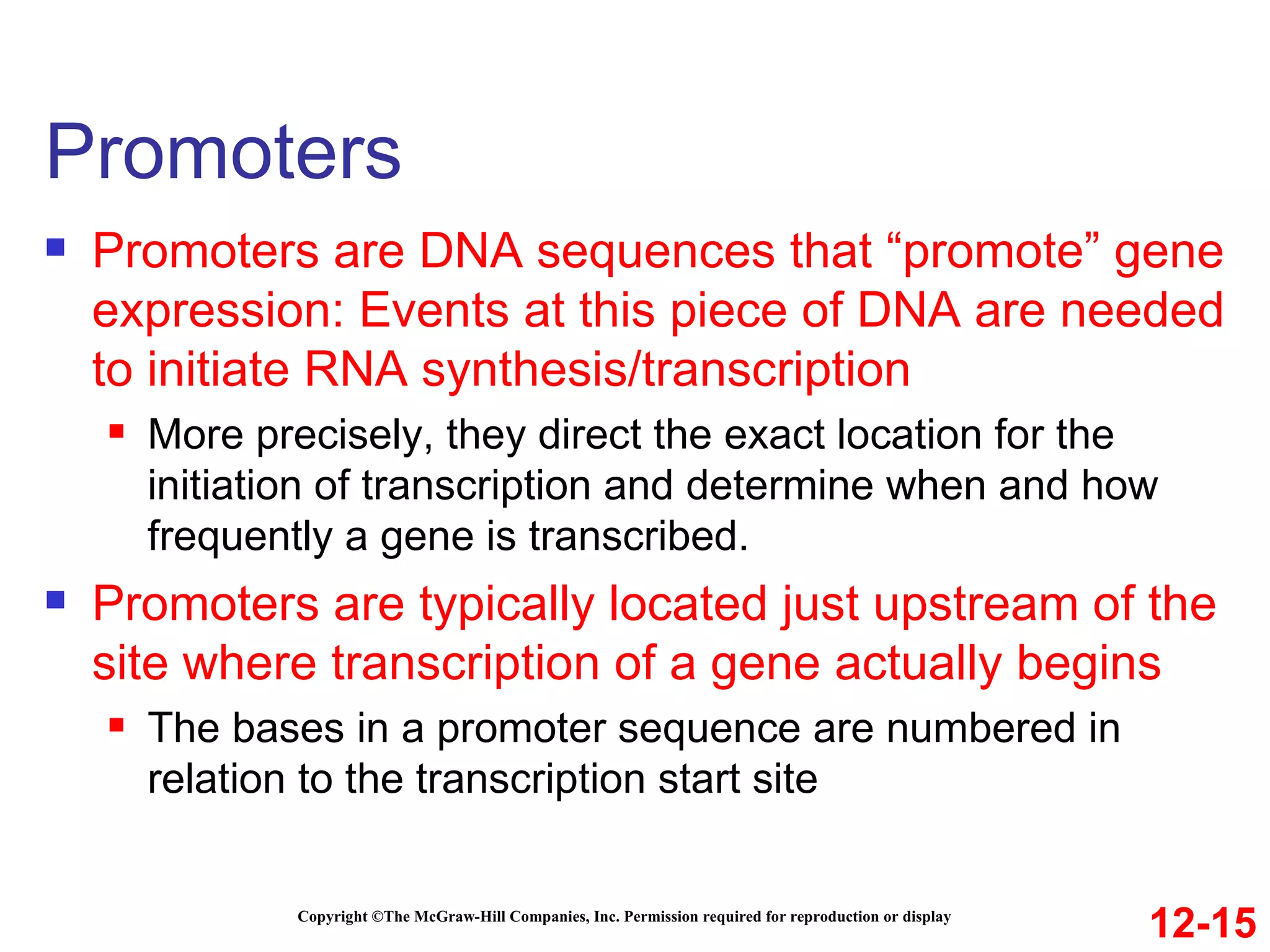
Promoters Copyright ©The McGraw-Hill Companies, Inc. Permission required for reproduction or display Promoters   are DNA sequences   that “promote” gene expression: Events at this piece of DNA are needed to initiate RNA synthesis/transcription More precisely, they direct the exact location for the initiation of transcription and determine when and how frequently a gene is transcribed. Promoters are typically located just upstream of the site where transcription of a gene actually begins The bases in a promoter sequence are numbered in relation to the transcription start site 12-15
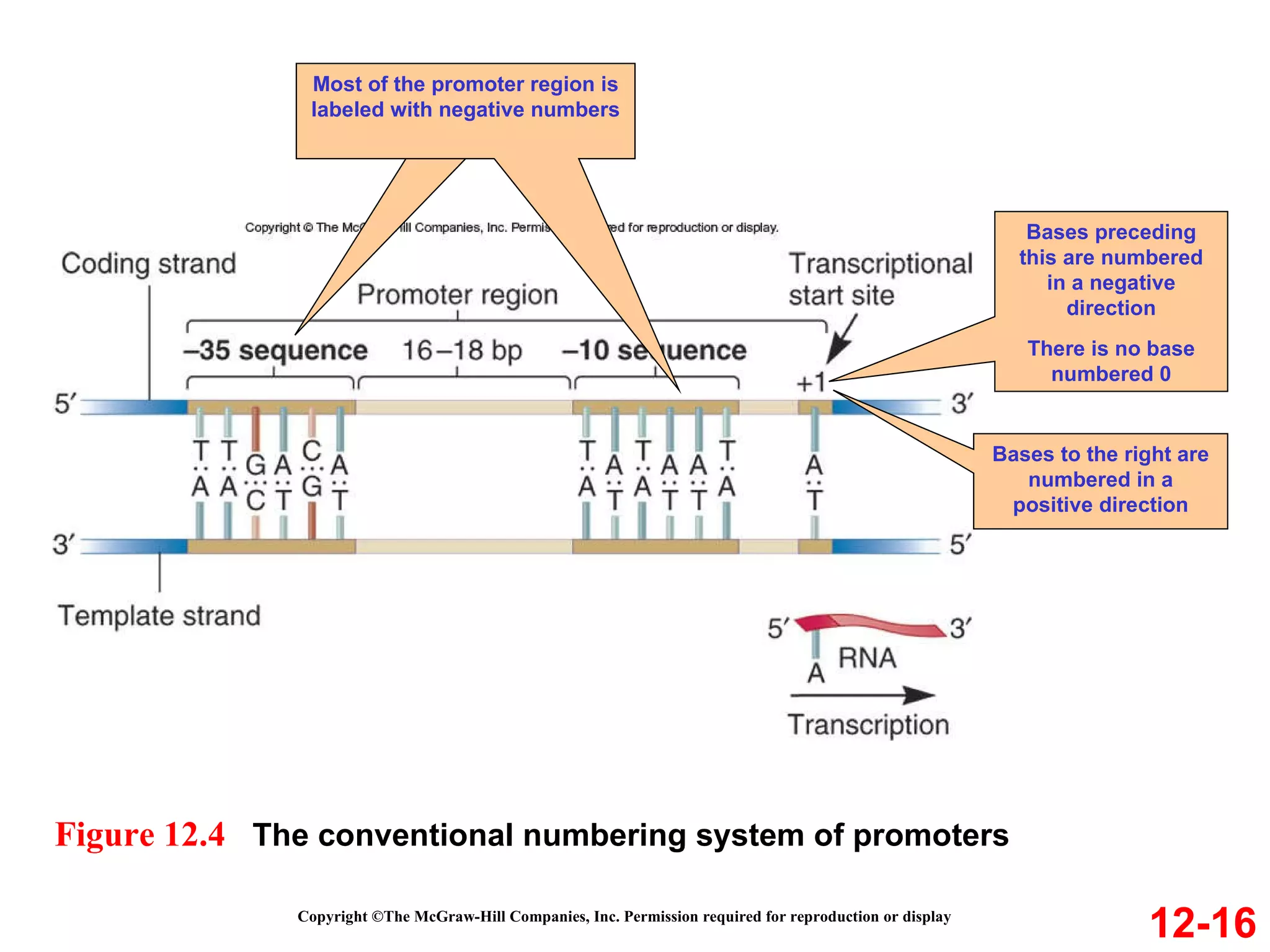
Copyright ©The McGraw-Hill Companies, Inc. Permission required for reproduction or display 12-16 Figure 12.4  The conventional numbering system of promoters Bases preceding this are numbered in a negative direction There is no base numbered 0 Bases to the right are numbered in a positive direction Most of the promoter region is labeled with negative numbers
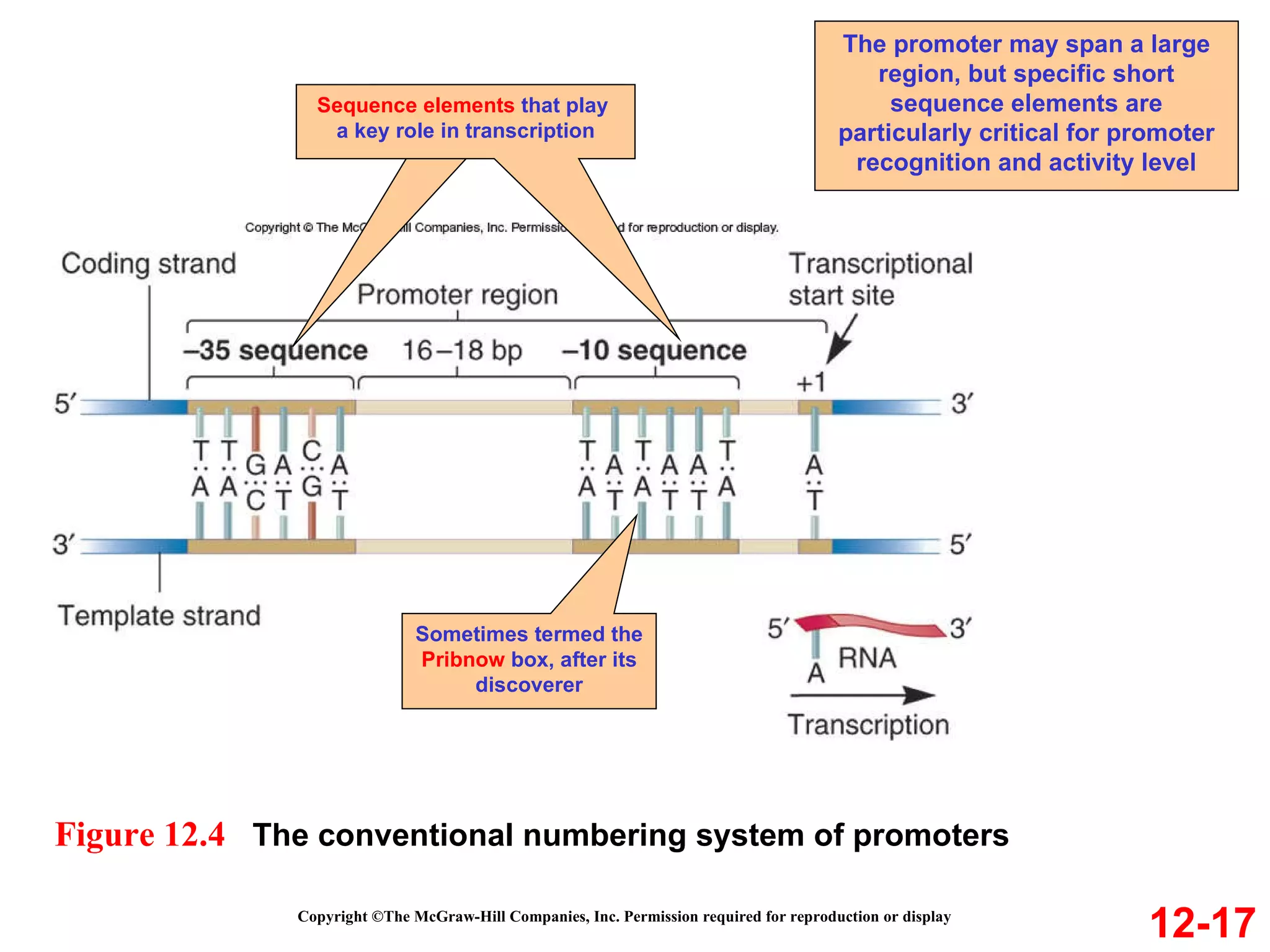
Copyright ©The McGraw-Hill Companies, Inc. Permission required for reproduction or display 12-17 Figure 12.4  The conventional numbering system of promoters The promoter may span a large region, but specific short sequence elements are particularly critical for promoter recognition and activity level Sometimes termed the  Pribnow  box, after its discoverer Sequence elements  that play  a key role in transcription
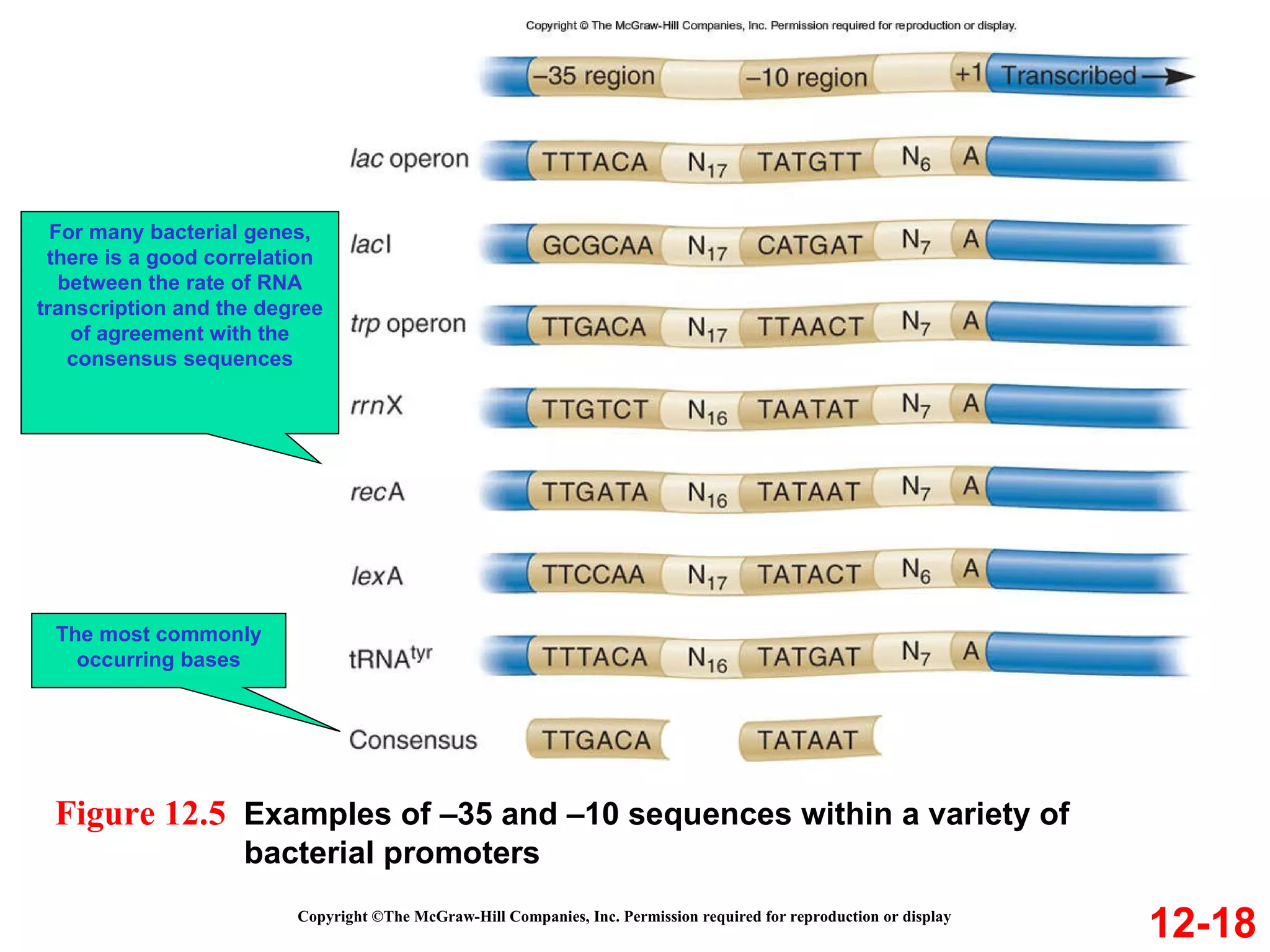
Copyright ©The McGraw-Hill Companies, Inc. Permission required for reproduction or display 12-18 Figure 12.5  Examples of –35 and –10 sequences within a variety of    bacterial promoters The most commonly occurring bases For many bacterial genes, there is a good correlation between the rate of RNA transcription and the degree of agreement with the consensus sequences
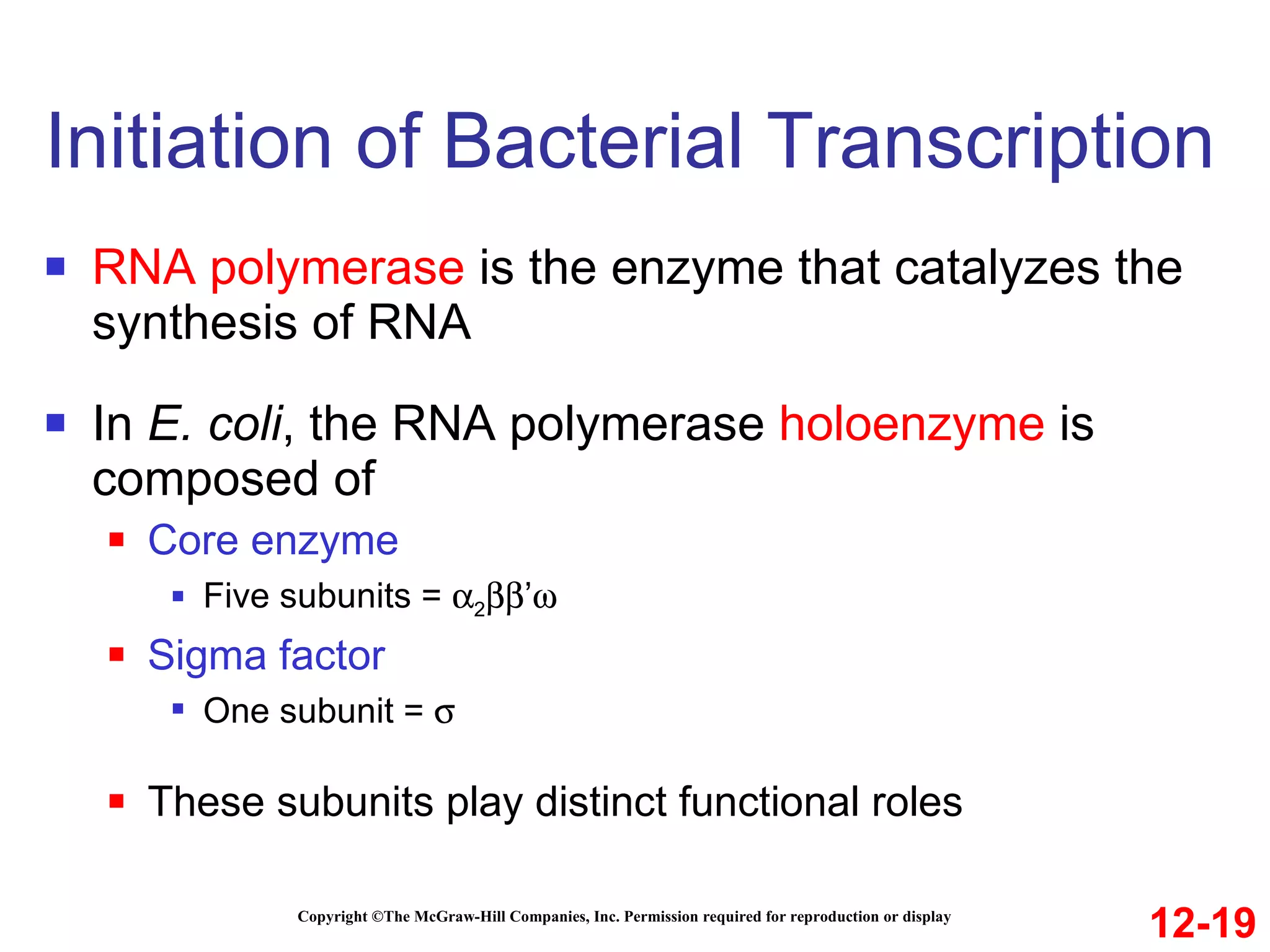
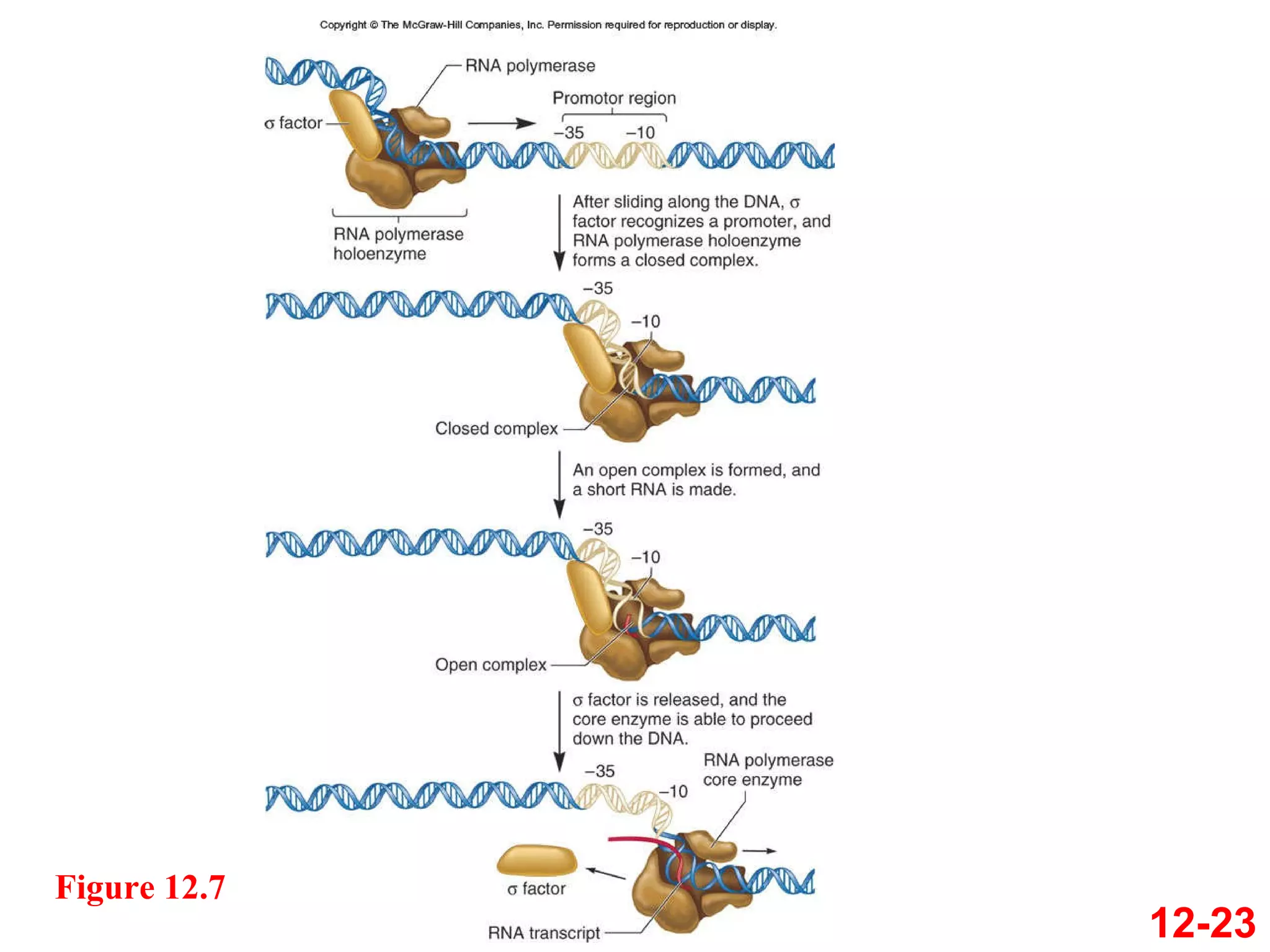
Initiation of Bacterial Transcription Copyright ©The McGraw-Hill Companies, Inc. Permission required for reproduction or display RNA polymerase  is the enzyme that catalyzes the synthesis of RNA In  E. coli , the RNA polymerase  holoenzyme  is composed of Core enzyme Five subunits =   2  ’  Sigma factor One subunit =   These subunits play distinct functional roles 12-19
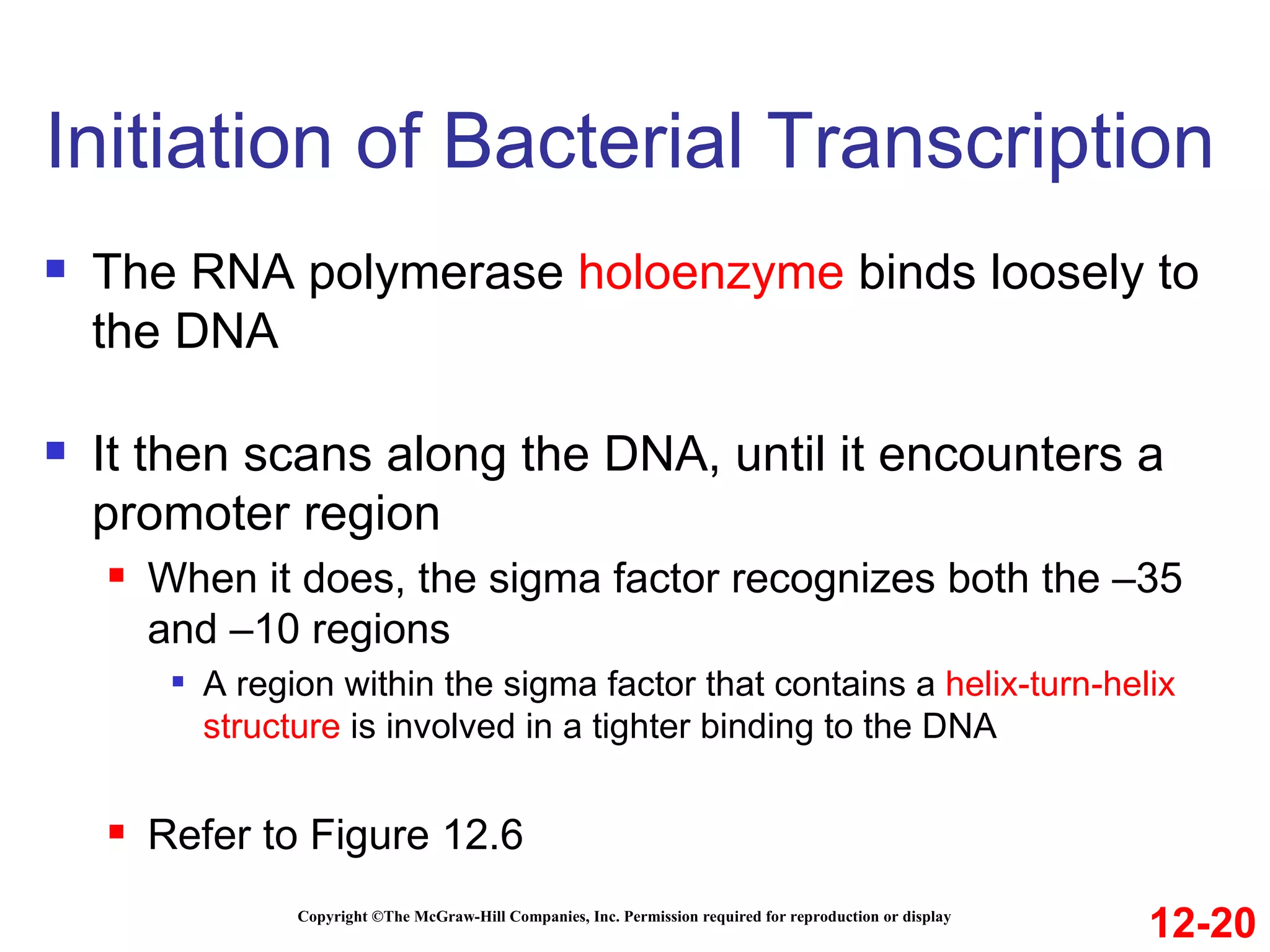
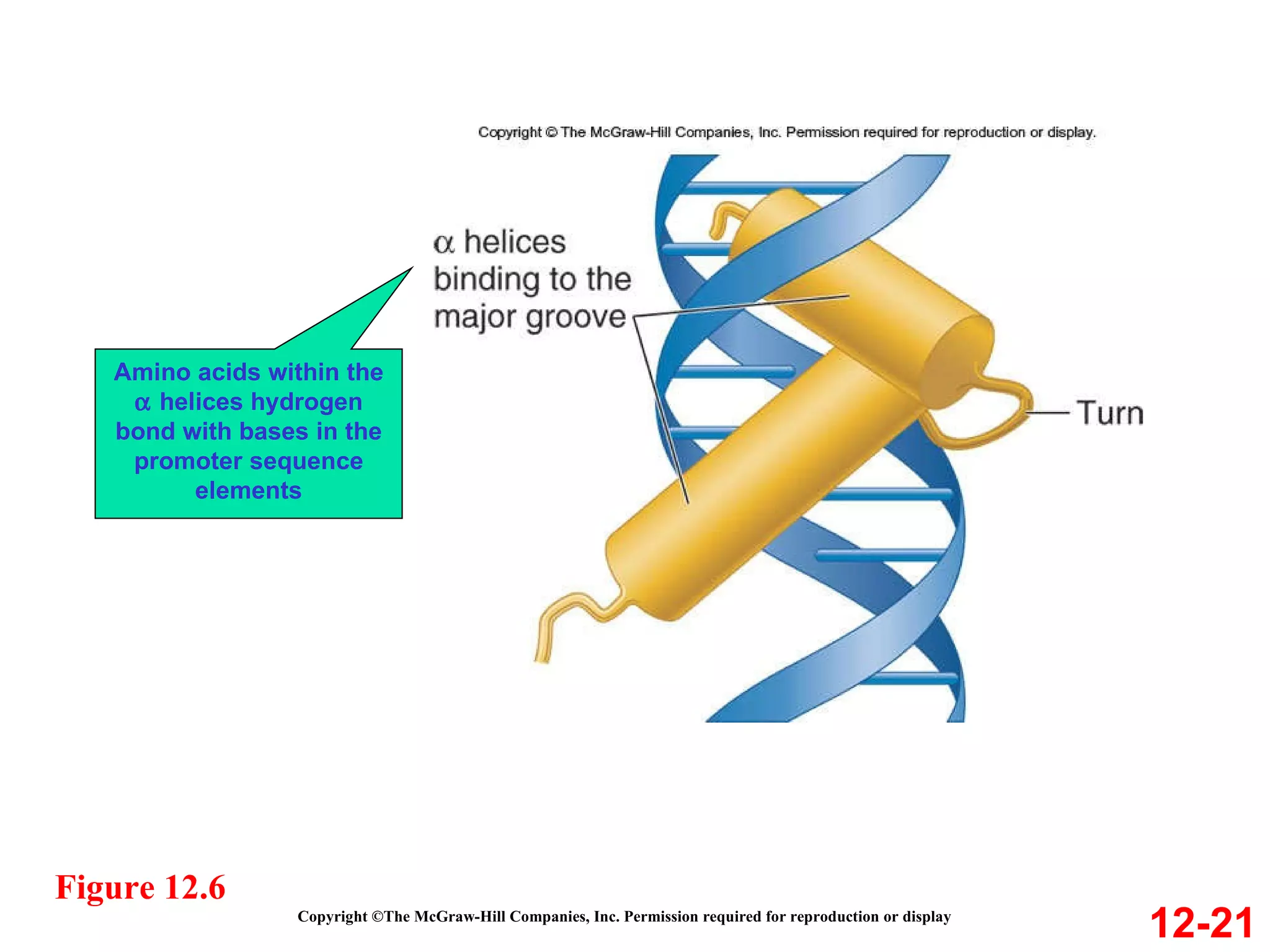
Initiation of Bacterial Transcription Copyright ©The McGraw-Hill Companies, Inc. Permission required for reproduction or display The RNA polymerase  holoenzyme  binds loosely to the DNA It then scans along the DNA, until it encounters a promoter region When it does, the sigma factor recognizes both the –35 and –10 regions A region within the sigma factor that contains a  helix-turn-helix structure  is involved in a tighter binding to the DNA Refer to Figure 12.6 12-20
Copyright ©The McGraw-Hill Companies, Inc. Permission required for reproduction or display 12-21 Figure 12.6 Amino acids within the    helices hydrogen bond with bases in the promoter sequence elements
12-23 Figure 12.7
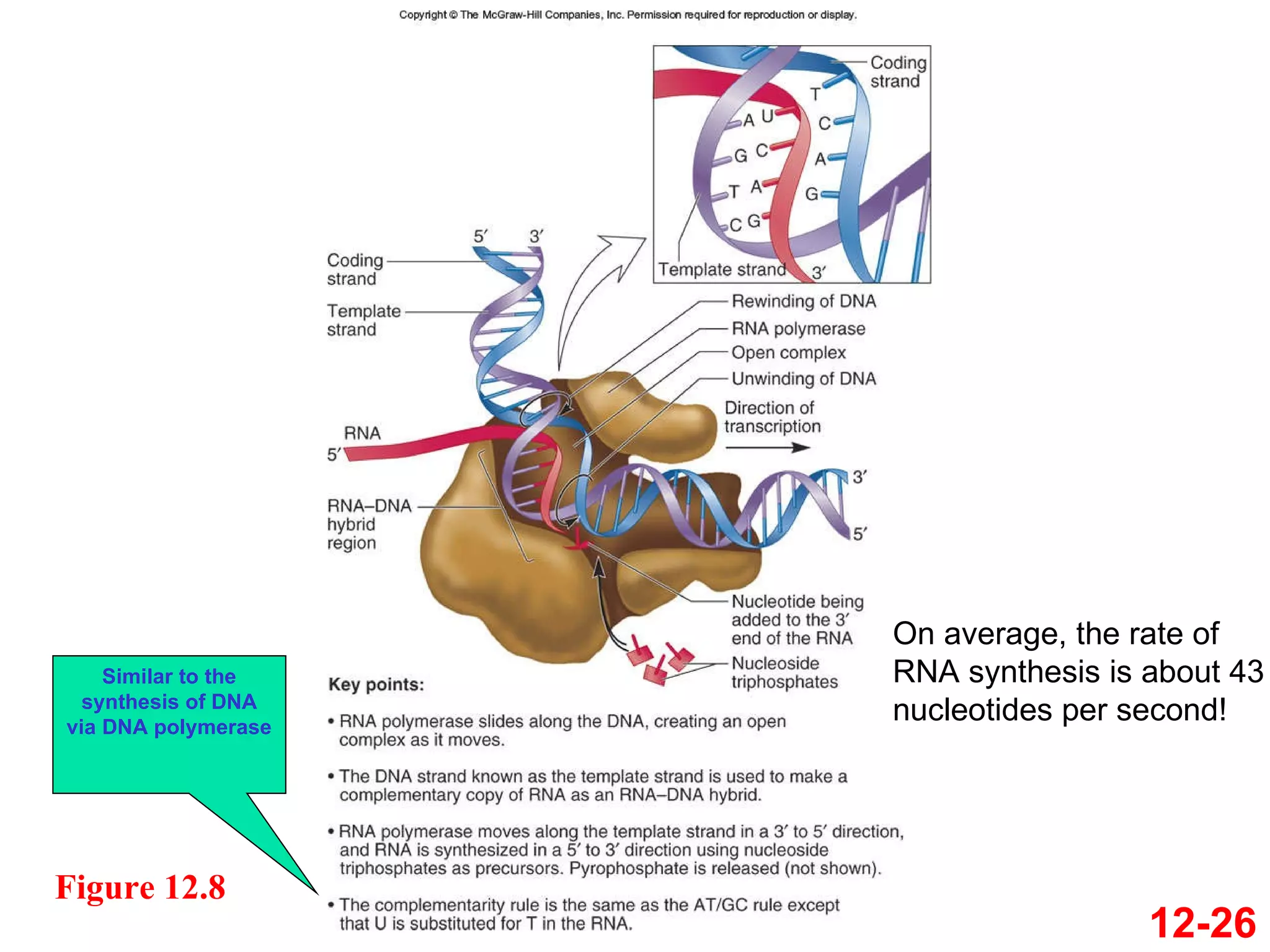
12-26 Similar to the synthesis of DNA via DNA polymerase Figure 12.8 On average, the rate of RNA synthesis is about 43 nucleotides per second!
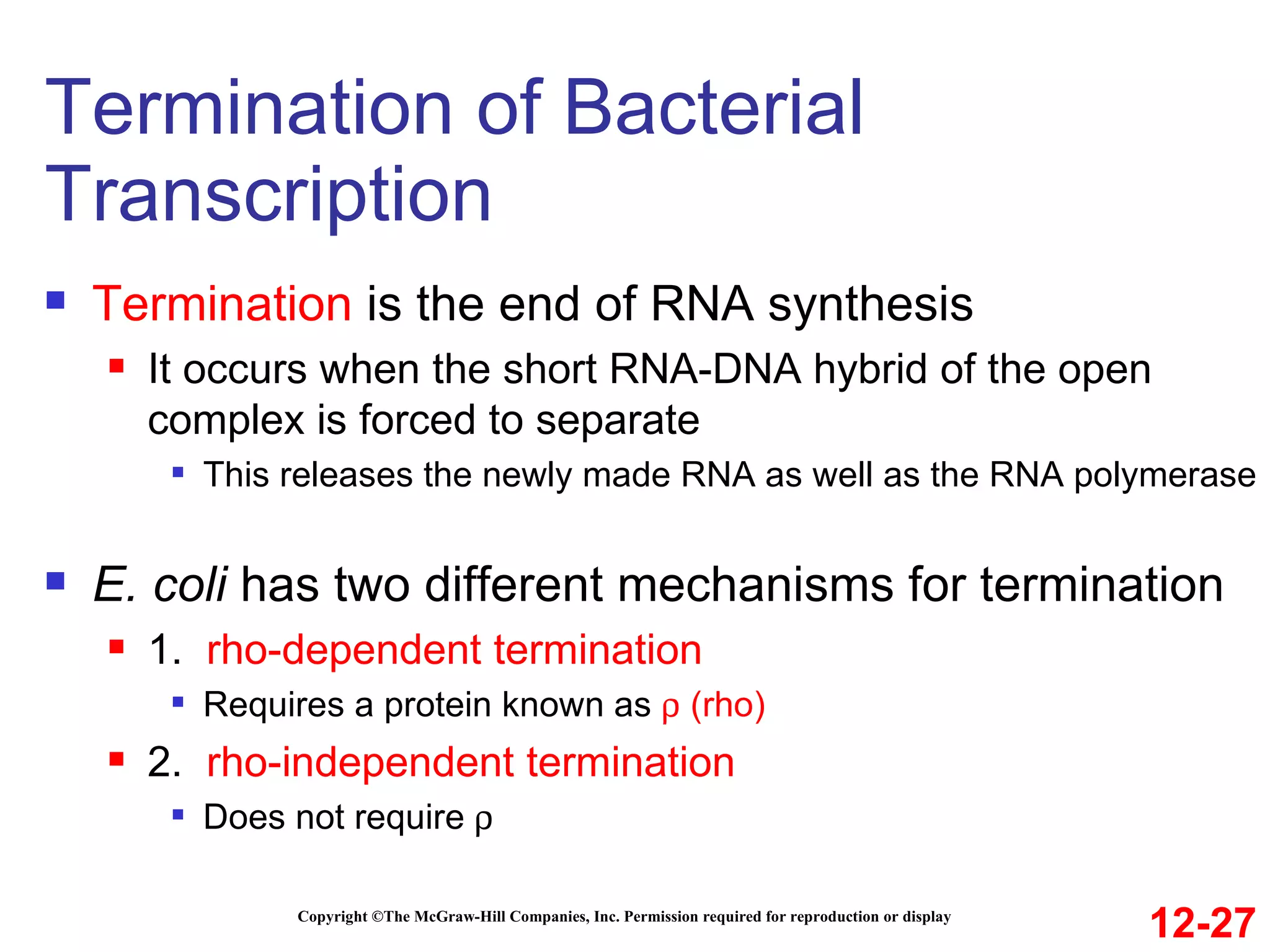
Termination of Bacterial Transcription Copyright ©The McGraw-Hill Companies, Inc. Permission required for reproduction or display Termination  is the end of RNA synthesis  It occurs when the short RNA-DNA hybrid of the open complex is forced to separate This releases the newly made RNA as well as the RNA polymerase E. coli  has two different mechanisms for termination 1.  rho-dependent termination Requires a protein known as    (rho) 2.   rho-independent termination Does not require   12-27
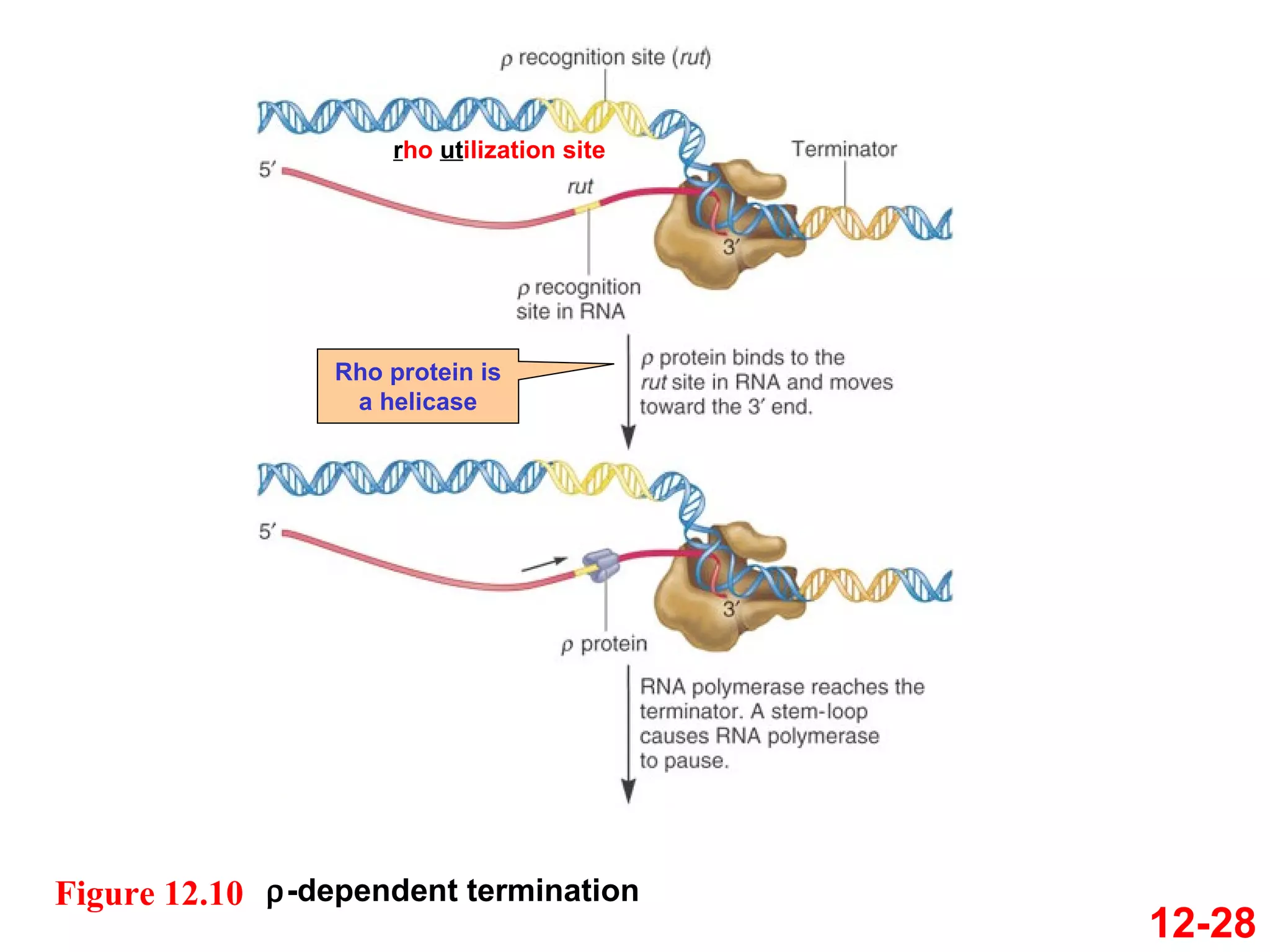
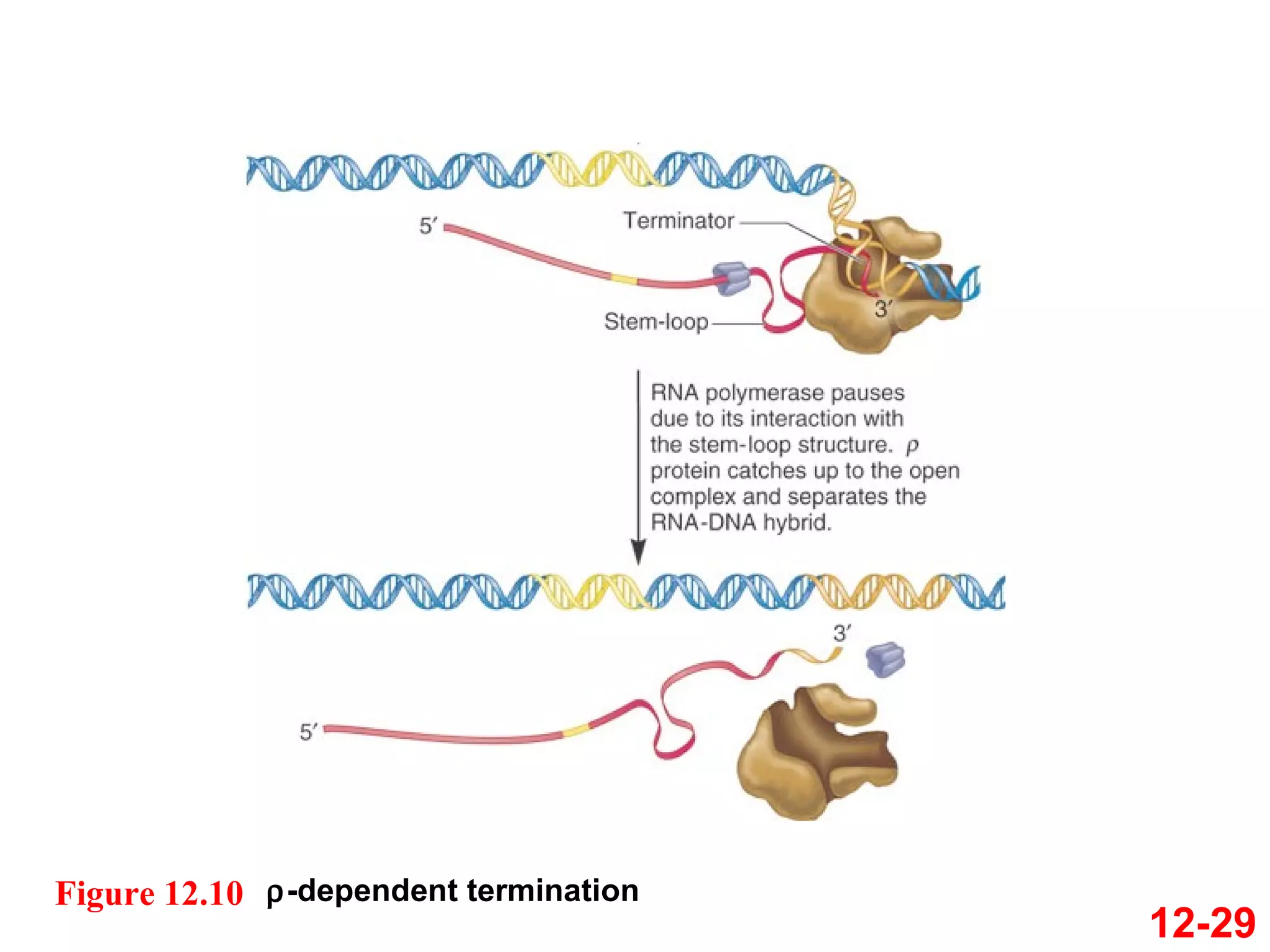
12-28 r ho  ut ilization site Rho protein is a helicase  -dependent termination Figure 12.10
12-29  -dependent termination Figure 12.10
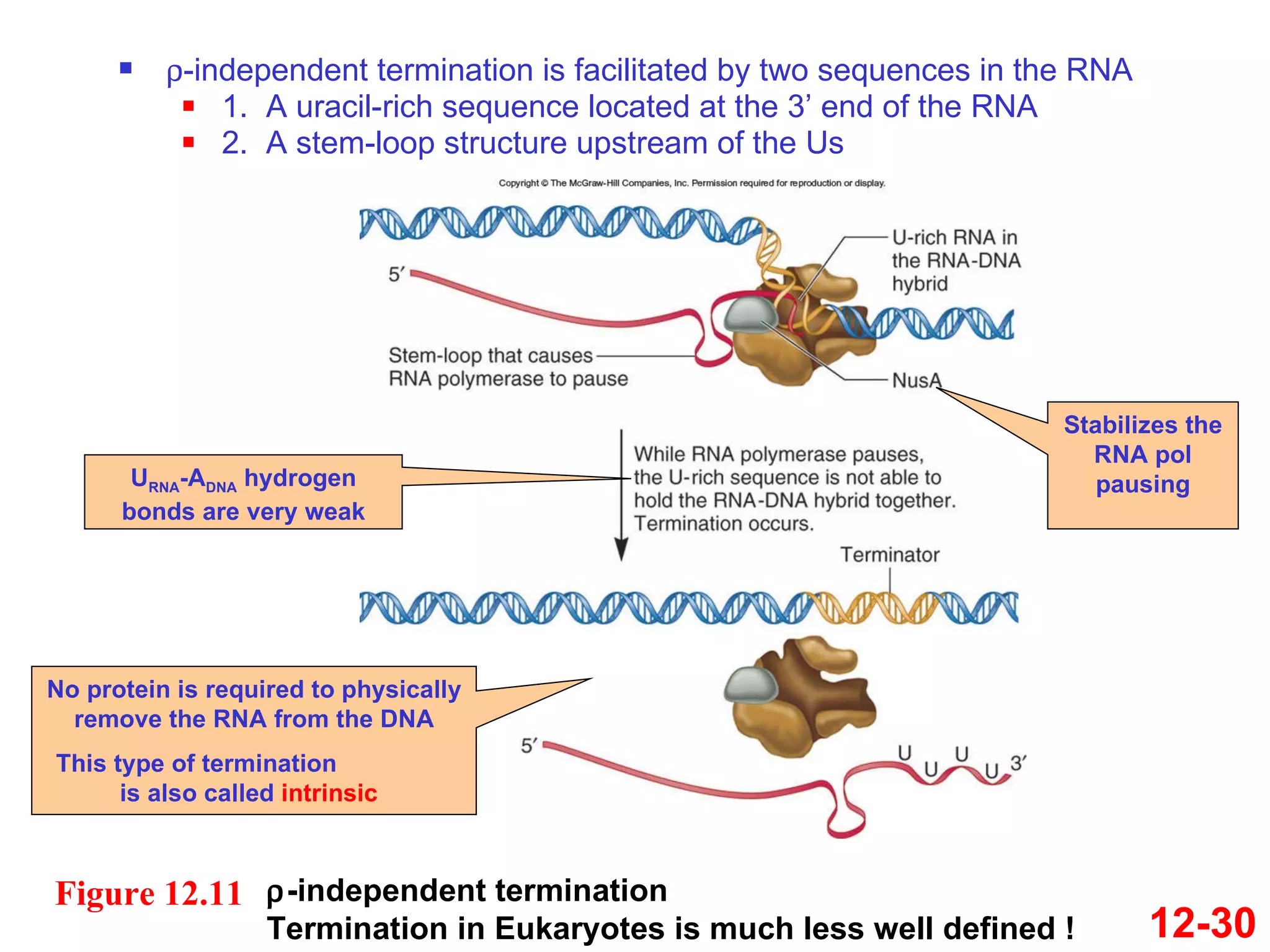
 -independent termination is facilitated by two sequences in the RNA 1.  A uracil-rich sequence located at the 3’ end of the RNA 2.  A stem-loop structure upstream of the Us 12-30 U RNA -A DNA  hydrogen bonds are very weak No protein is required to physically remove the RNA from the DNA This type of termination  is also called  intrinsic Stabilizes the RNA pol pausing  -independent termination Termination in Eukaryotes is much less well defined ! Figure 12.11
Many of the basic features of gene transcription are very similar in bacteria and eukaryotes However, gene transcription in eukaryotes is more complex Larger organisms and cells Cellular complexity such as organelles added complexity means more genes Multicellularity: many different cell types  increased regulation to express only in right cells at right time 12.3  TRANSCRIPTION IN EUKARYOTES Copyright ©The McGraw-Hill Companies, Inc. Permission required for reproduction or display 12-31
Eukaryotic RNA Polymerases Copyright ©The McGraw-Hill Companies, Inc. Permission required for reproduction or display Nuclear DNA is transcribed by three different RNA polymerases RNA pol I Transcribes all rRNA genes (except for the 5S rRNA) RNA pol II Transcribes all structural genes Thus, synthesizes all mRNAs  Transcribes some snRNA genes RNA pol III Transcribes all tRNA genes And the 5S rRNA gene 12-32
Sequences of Eukaryotic Structural Genes Copyright ©The McGraw-Hill Companies, Inc. Permission required for reproduction or display Eukaryotic promoter sequences are more variable and often much more complex than those of bacteria For structural genes, at least three features are found in most promoters Regulatory elements  TATA box (present in ~20 % of our genes) and other short sequences in TATA-promoters that have a similar function  Transcriptional start site Refer to Figure 12.13 12-34
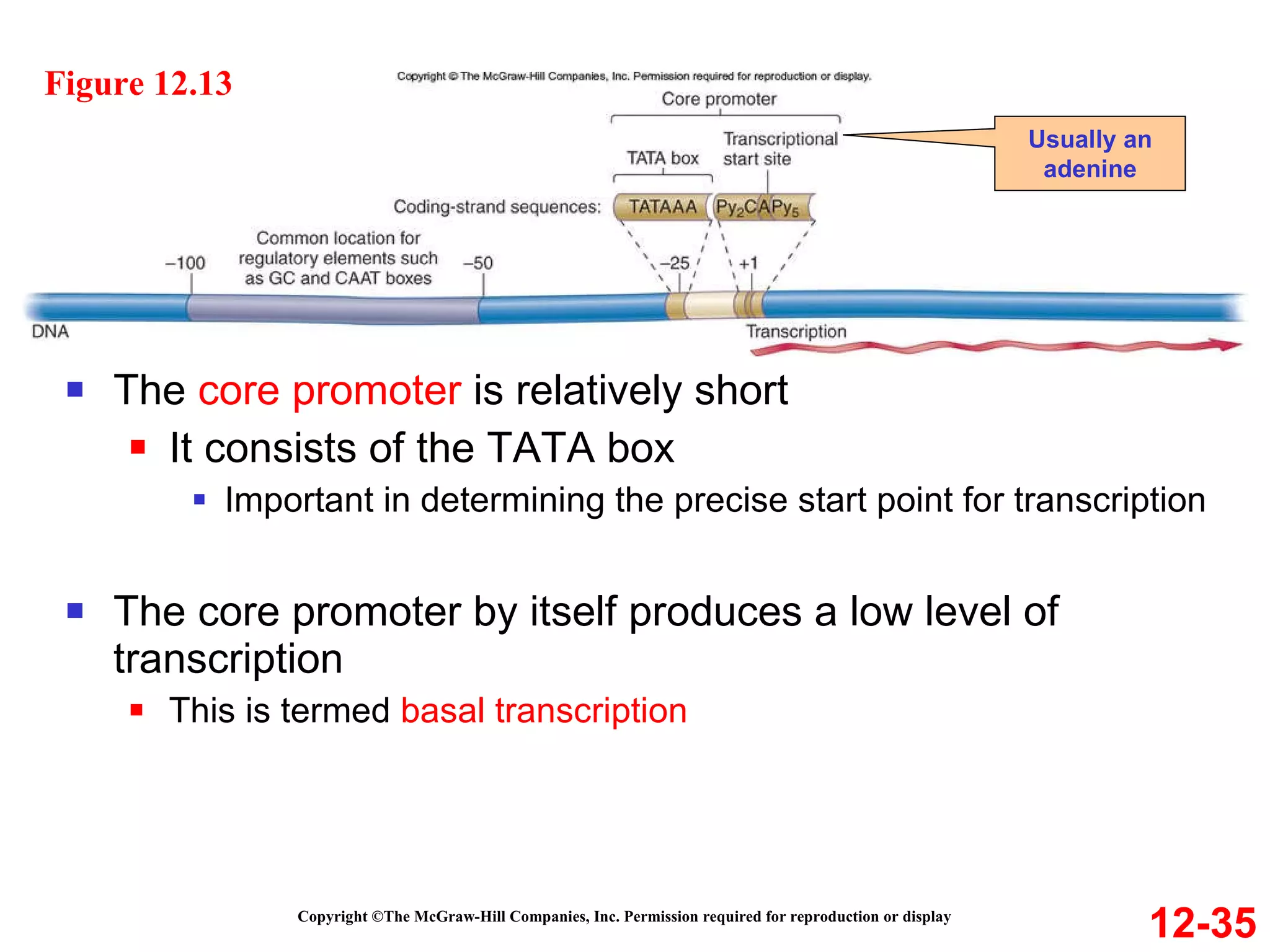
The  core promoter  is relatively short It consists of the TATA box Important in determining the precise start point for transcription The core promoter by itself produces a low level of transcription This is termed  basal transcription 12-35 Usually an adenine Figure 12.13 Copyright ©The McGraw-Hill Companies, Inc. Permission required for reproduction or display
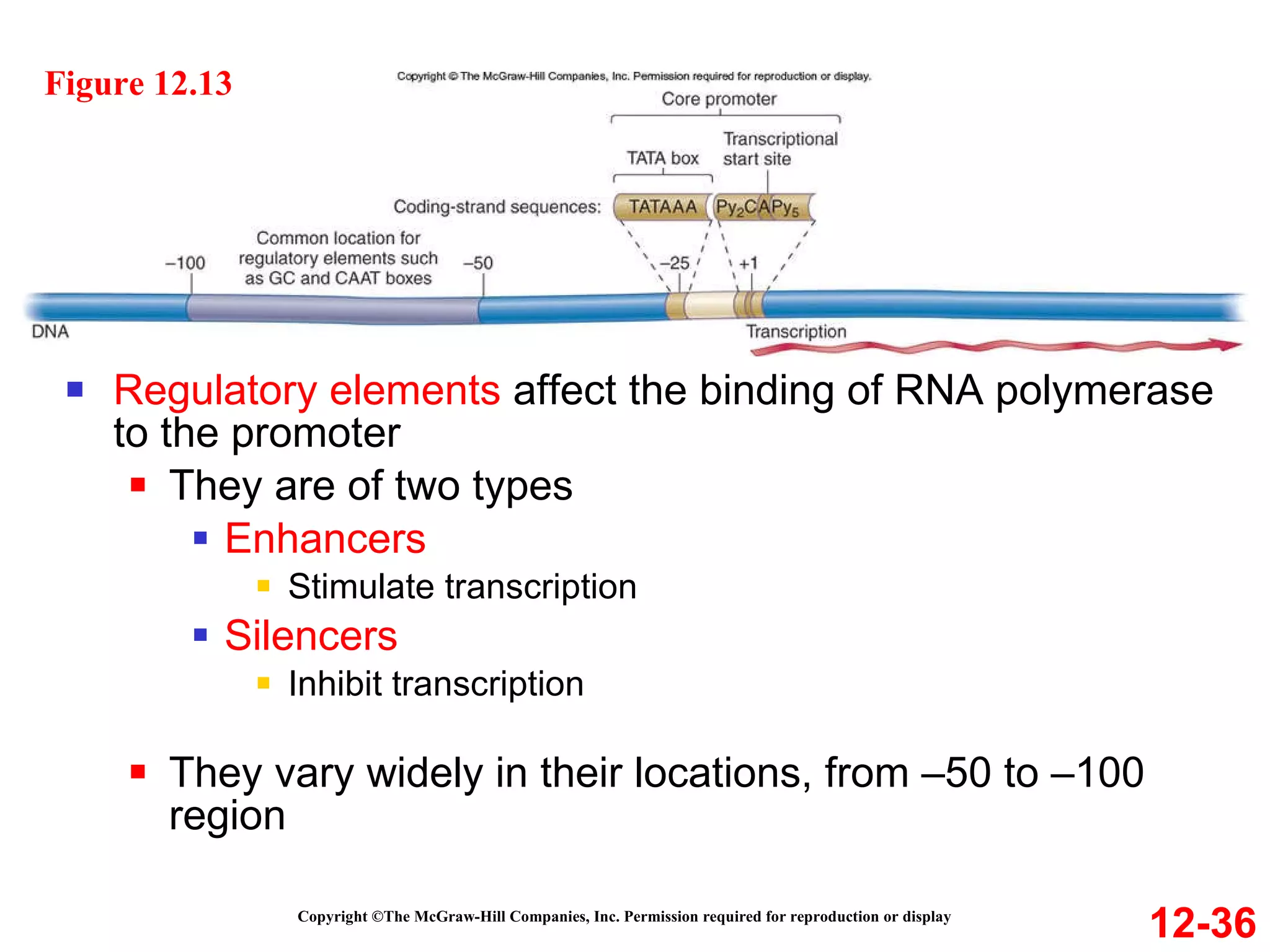
Regulatory elements  affect the binding of RNA polymerase to the promoter  They are of two types Enhancers Stimulate transcription Silencers Inhibit transcription They vary widely in their locations, from –50 to –100 region 12-36 Figure 12.13 Copyright ©The McGraw-Hill Companies, Inc. Permission required for reproduction or display
Sequences of Eukaryotic Structural Genes Copyright ©The McGraw-Hill Companies, Inc. Permission required for reproduction or display Factors that control gene expression can be divided into two types, based on their “location” cis -acting elements DNA sequences that exert their effect only over a particular gene Example: TATA box, enhancers and silencers  trans -acting elements Regulatory proteins that bind to such DNA sequences 12-37
RNA Polymerase II and its Transcription Factors Copyright ©The McGraw-Hill Companies, Inc. Permission required for reproduction or display Three categories of proteins are required for basal transcription to occur at the promoter RNA polymerase II Five different proteins called  general transcription factors   (GTFs) A protein complex called  mediator 12-38
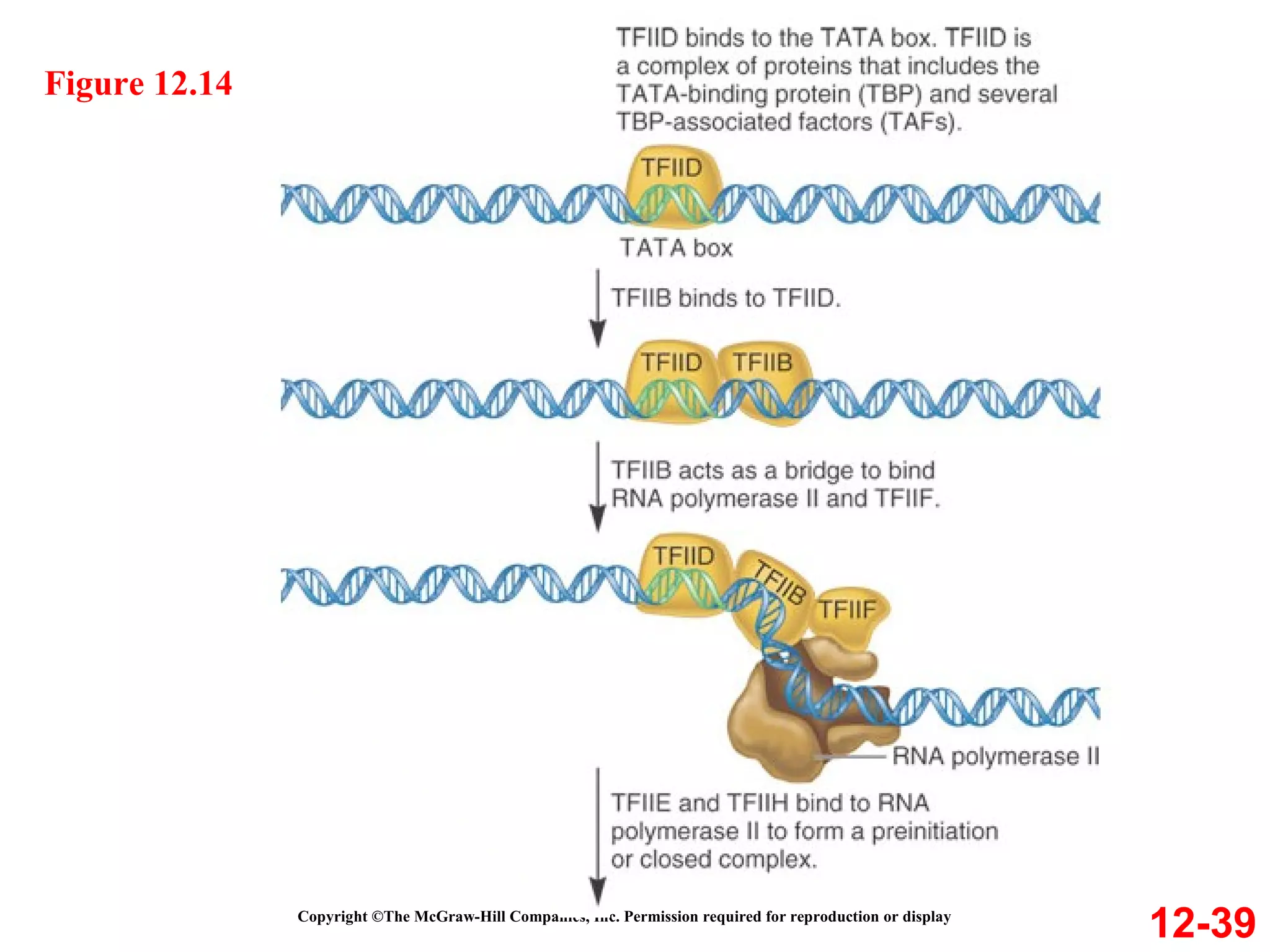
12-39 Figure 12.14 Copyright ©The McGraw-Hill Companies, Inc. Permission required for reproduction or display
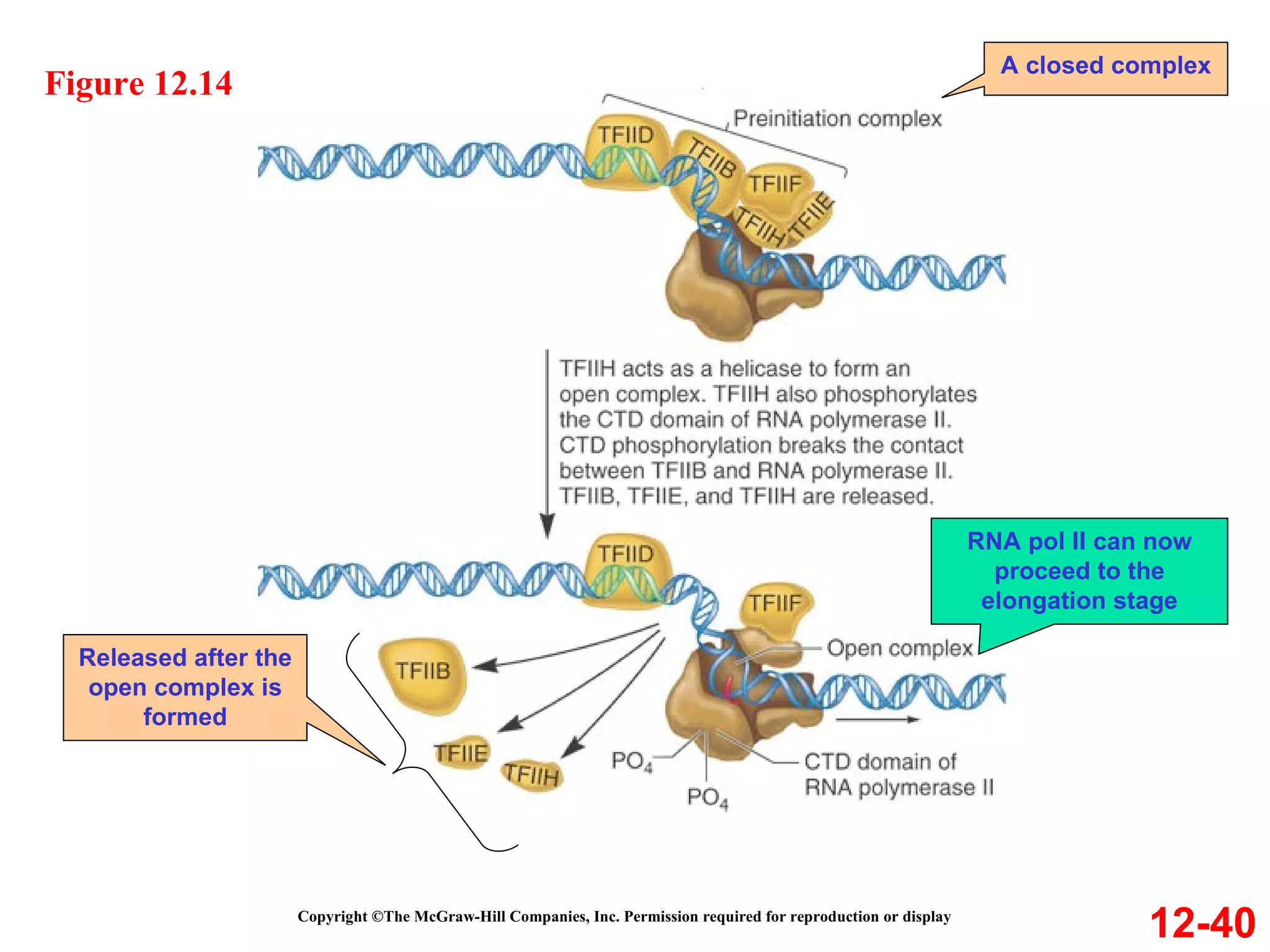
12-40 Figure 12.14 Copyright ©The McGraw-Hill Companies, Inc. Permission required for reproduction or display A closed complex Released after the open complex is formed RNA pol II can now proceed to the elongation stage
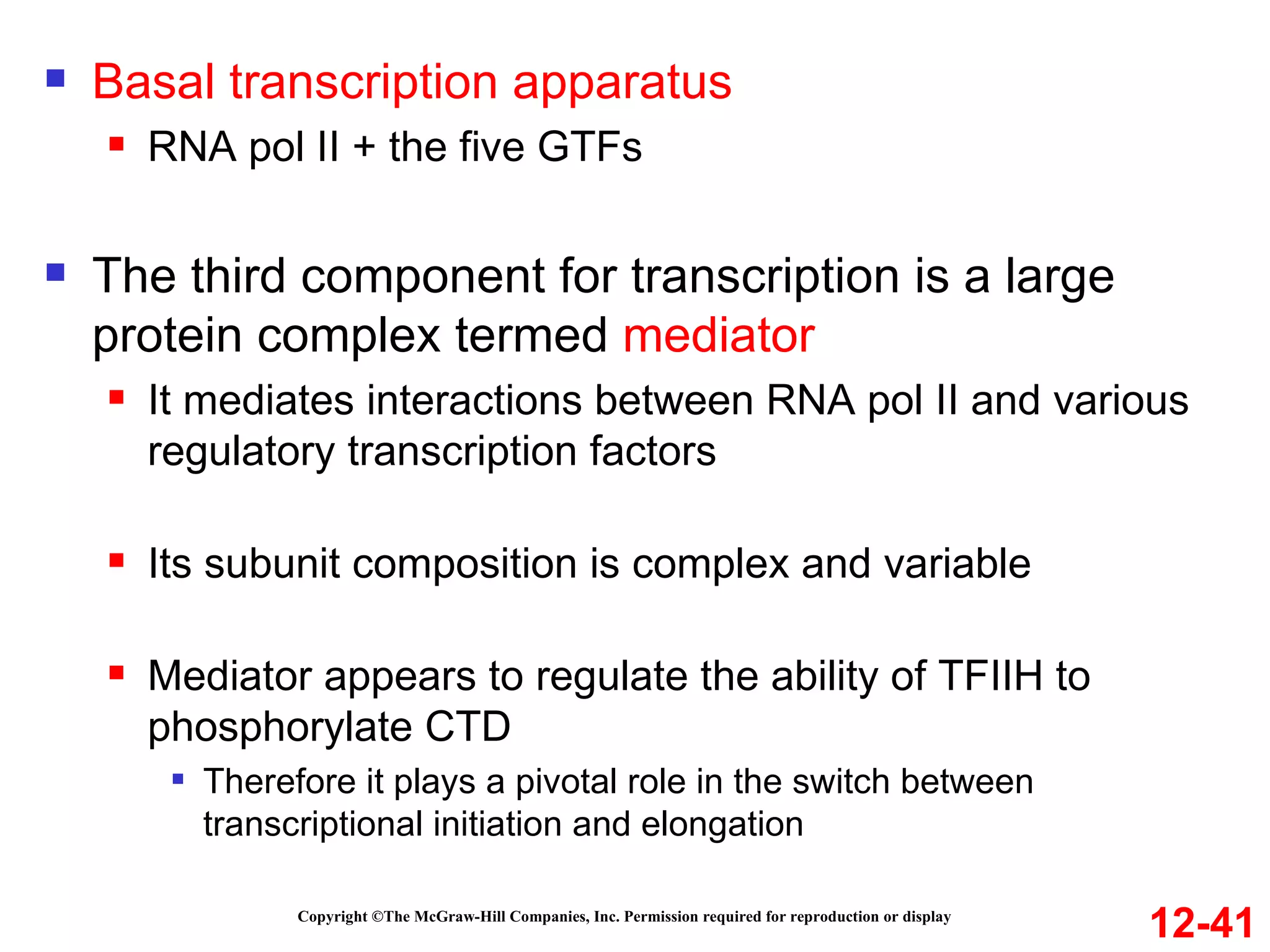
Copyright ©The McGraw-Hill Companies, Inc. Permission required for reproduction or display Basal transcription apparatus RNA pol II + the five GTFs The third component for transcription is a large protein complex termed  mediator It mediates interactions between RNA pol II and various regulatory transcription factors Its subunit composition is complex and variable Mediator appears to regulate the ability of TFIIH to phosphorylate CTD Therefore it plays a pivotal role in the switch between transcriptional initiation and elongation 12-41
Chromatin Structure and Transcription Copyright ©The McGraw-Hill Companies, Inc. Permission required for reproduction or display The compaction of DNA to form chromatin can be an obstacle to the transcription process Most transcription occurs in interphase Then, chromatin is found in 30 nm fibers that are organized into radial loop domains Within the 30 nm fibers, the DNA is wound around histone octamers to form nucleosomes 12-43
Chromatin Structure and Transcription Copyright ©The McGraw-Hill Companies, Inc. Permission required for reproduction or display The histone octamer is roughly five times smaller than the complex of RNA pol II and the GTFs The tight wrapping of DNA within the nucleosome inhibits the function of RNA pol To circumvent this problem, the chromatin structure is significantly loosened during transcription Two common mechanisms alter chromatin structure 12-44
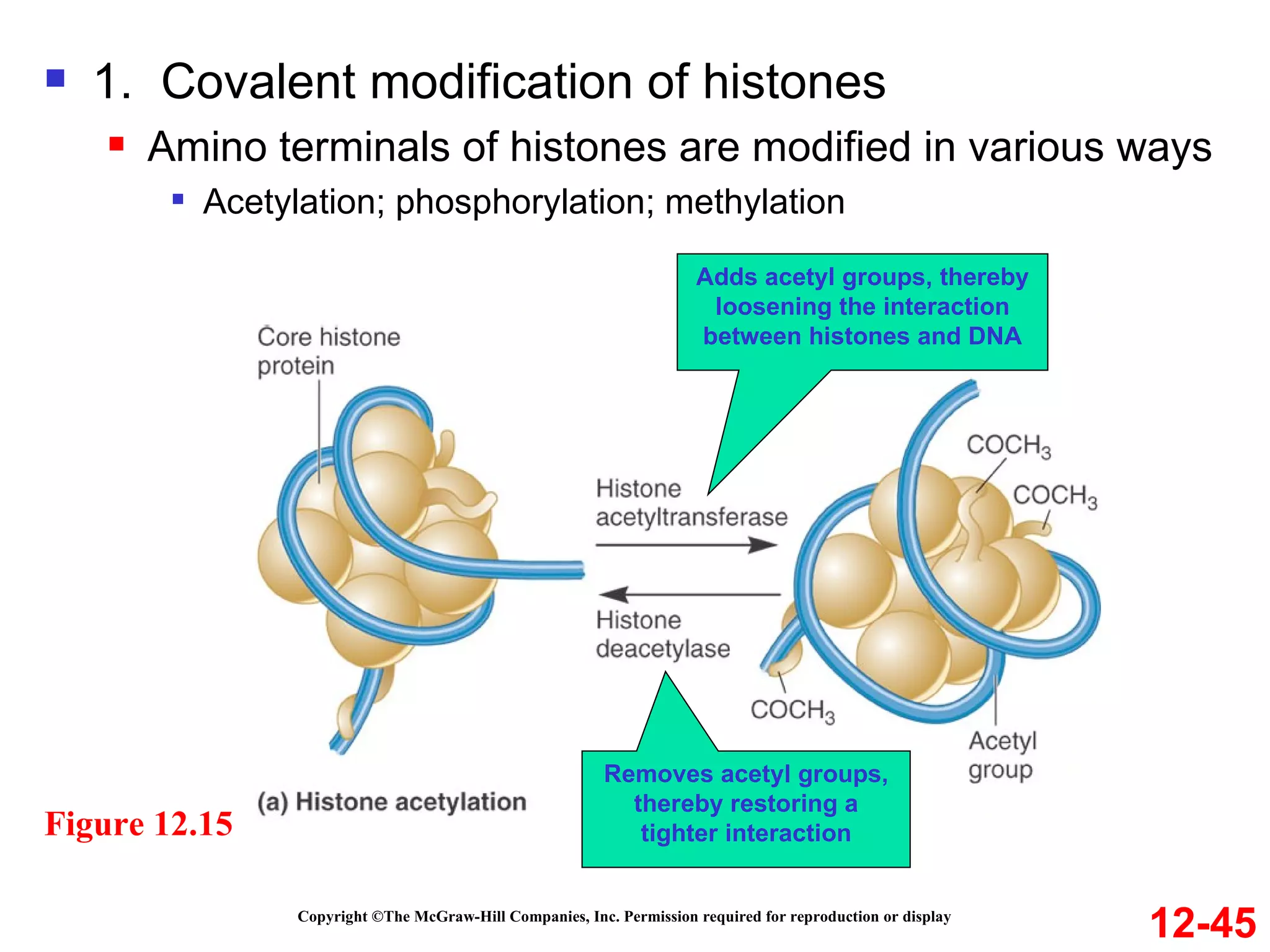
Copyright ©The McGraw-Hill Companies, Inc. Permission required for reproduction or display 1.  Covalent modification of histones Amino terminals of histones are modified in various ways Acetylation; phosphorylation; methylation  12-45 Figure 12.15 Adds acetyl groups, thereby loosening the interaction between histones and DNA Removes acetyl groups, thereby restoring a tighter interaction
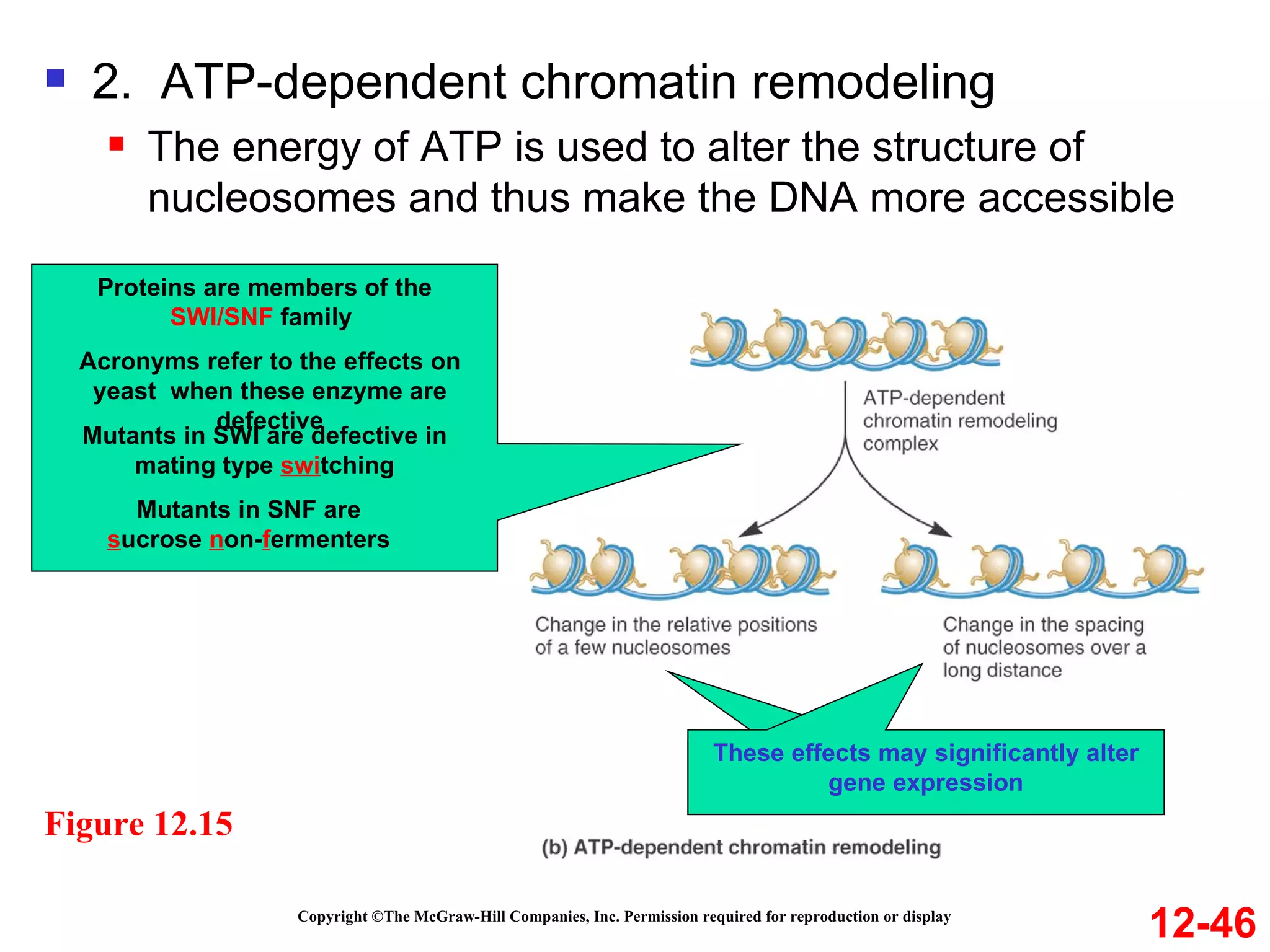
Copyright ©The McGraw-Hill Companies, Inc. Permission required for reproduction or display 2.  ATP-dependent chromatin remodeling The energy of ATP is used to alter the structure of nucleosomes and thus make the DNA more accessible  12-46 Figure 12.15 Proteins are members of the  SWI/SNF  family  Acronyms refer to the effects on yeast  when these enzyme are defective Mutants in SWI are defective in mating type  swi tching Mutants in SNF are  s ucrose  n on- f ermenters These effects may significantly alter gene expression
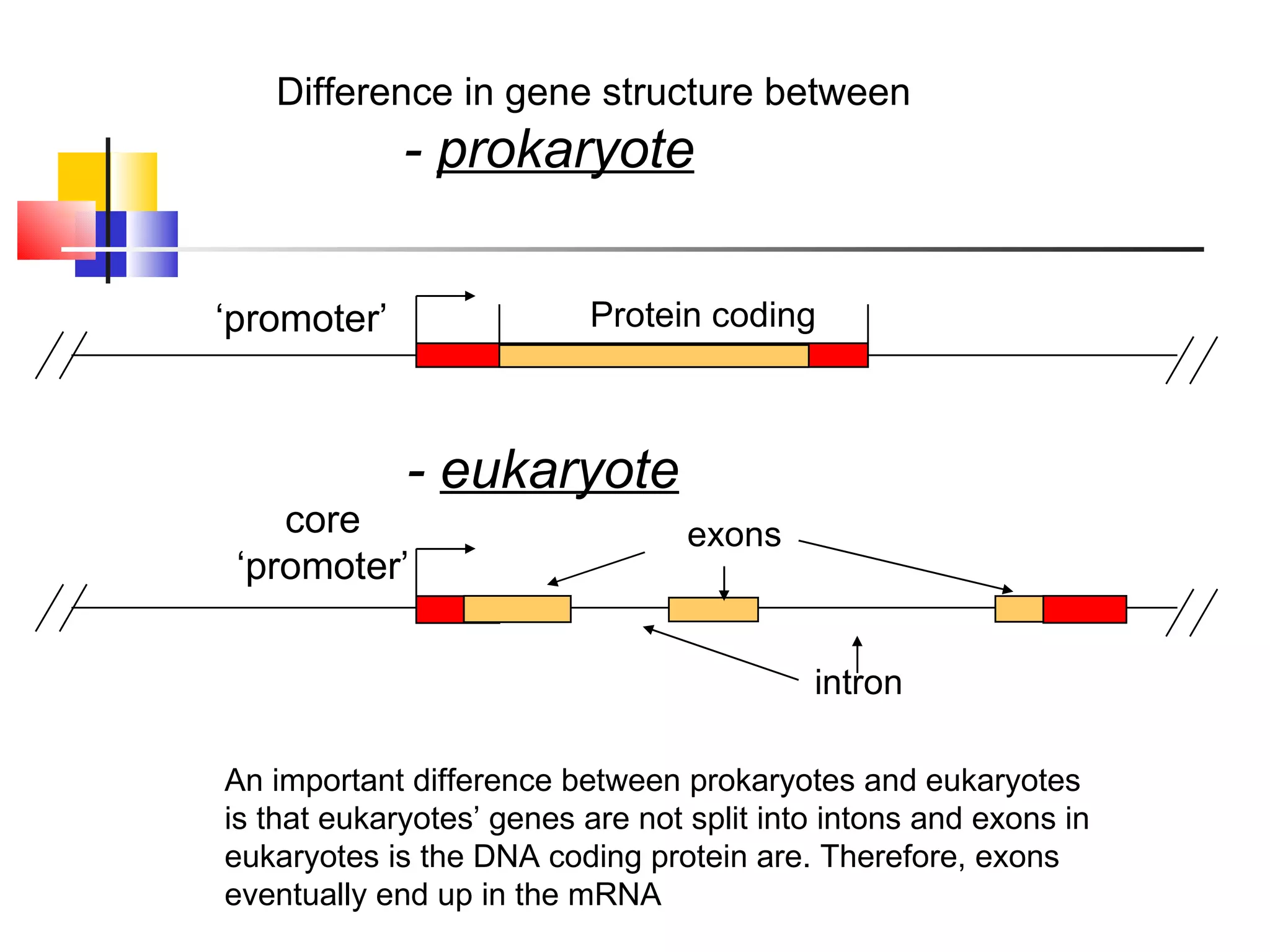
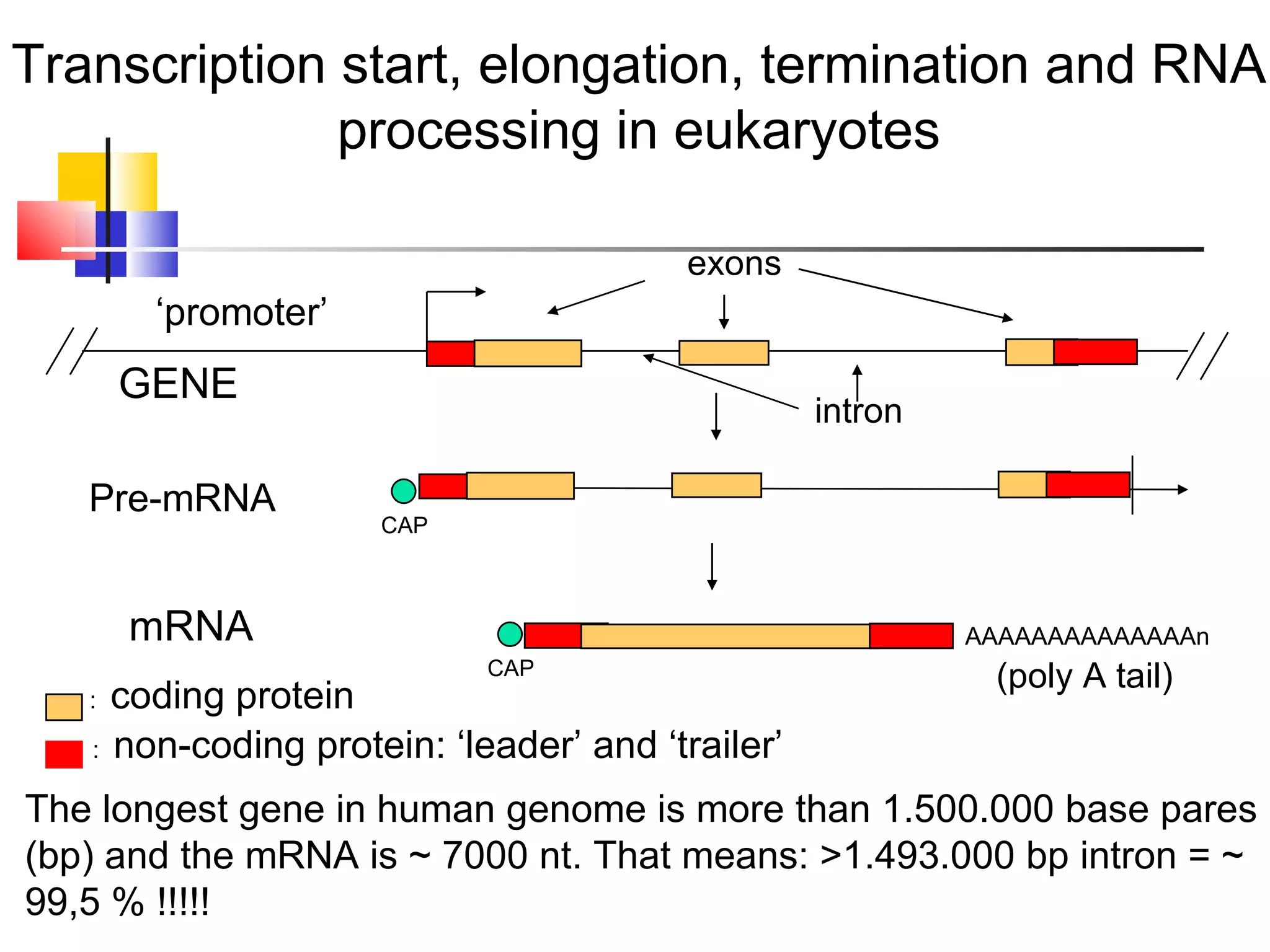
‘ promoter’ Protein coding Difference in gene structure between -  prokaryote -  eukaryote core ‘ promoter’ An important difference between prokaryotes and eukaryotes is that eukaryotes’ genes are not split into intons and exons in eukaryotes is the DNA coding protein are. Therefore, exons eventually end up in the mRNA intron exons
Pre-mRNA Transcription start, elongation, termination and RNA processing in eukaryotes :  coding protein :  non-coding protein: ‘leader’ and ‘trailer’ CAP CAP (poly A tail) The longest gene in human genome is more than 1.500.000 base pares (bp) and the mRNA is ~ 7000 nt. That means: >1.493.000 bp intron = ~ 99,5 % !!!!! ‘ promoter’ intron exons GENE mRNA AAAAAAAAAAAAAAn
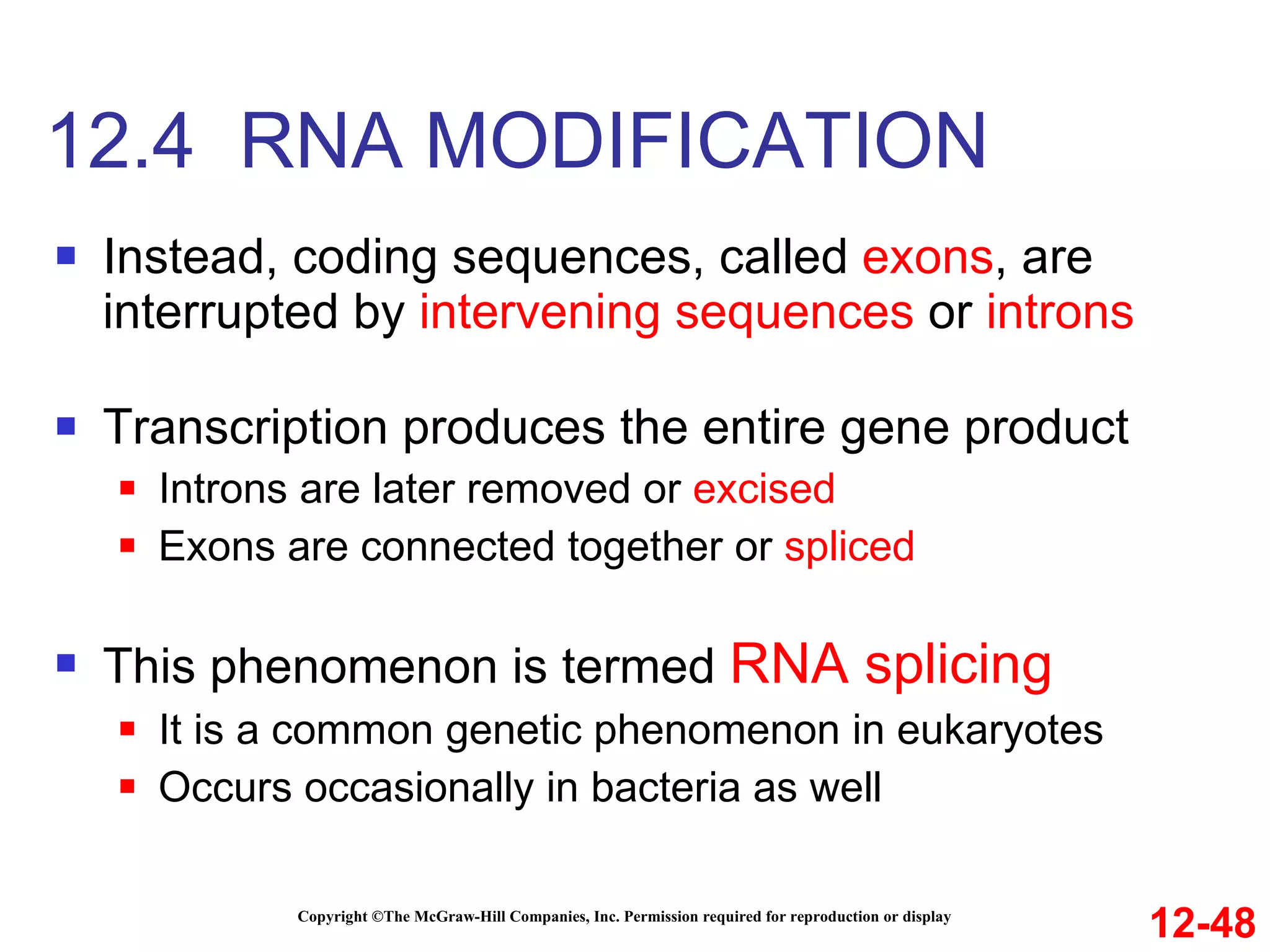
Instead, coding sequences, called  exons , are interrupted by  intervening sequences  or  introns Transcription produces the entire gene product Introns are later removed or  excised Exons are connected together or  spliced This phenomenon is termed   RNA splicing It is a common genetic phenomenon in eukaryotes Occurs occasionally in bacteria as well 12.4  RNA MODIFICATION Copyright ©The McGraw-Hill Companies, Inc. Permission required for reproduction or display 12-48
Aside from splicing, RNA transcripts can be modified in several ways For example Trimming  of rRNA and tRNA transcripts 5’ Capping  and  3’   polyA tailing  of mRNA transcripts 12.4  RNA MODIFICATION Copyright ©The McGraw-Hill Companies, Inc. Permission required for reproduction or display 12-49
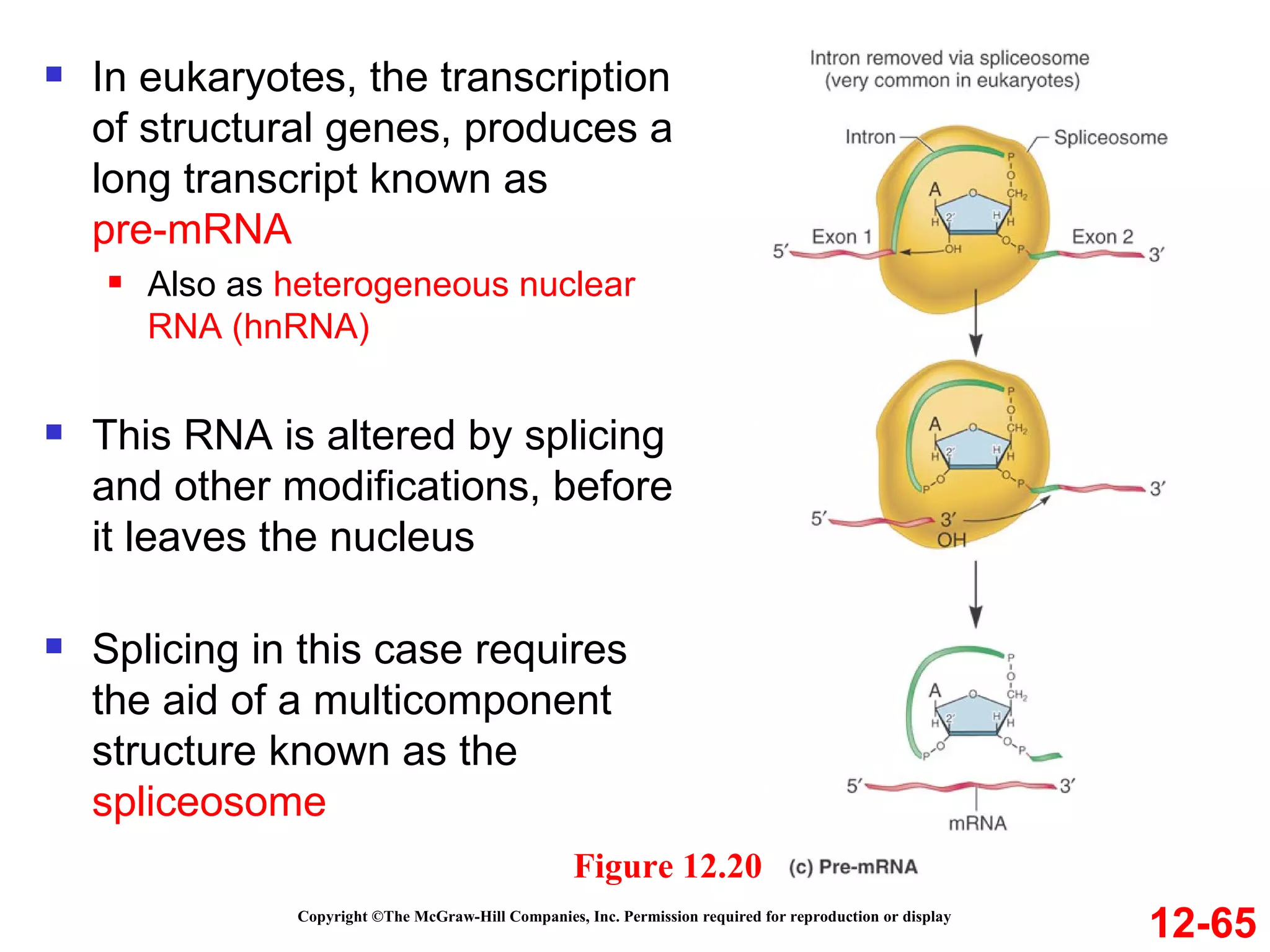
Copyright ©The McGraw-Hill Companies, Inc. Permission required for reproduction or display 12-65 Figure 12.20 In eukaryotes, the transcription of structural genes, produces a long transcript known as  pre-mRNA Also as  heterogeneous nuclear RNA (hnRNA) This RNA is altered by splicing and other modifications, before it leaves the nucleus Splicing in this case requires the aid of a multicomponent structure known as the  spliceosome
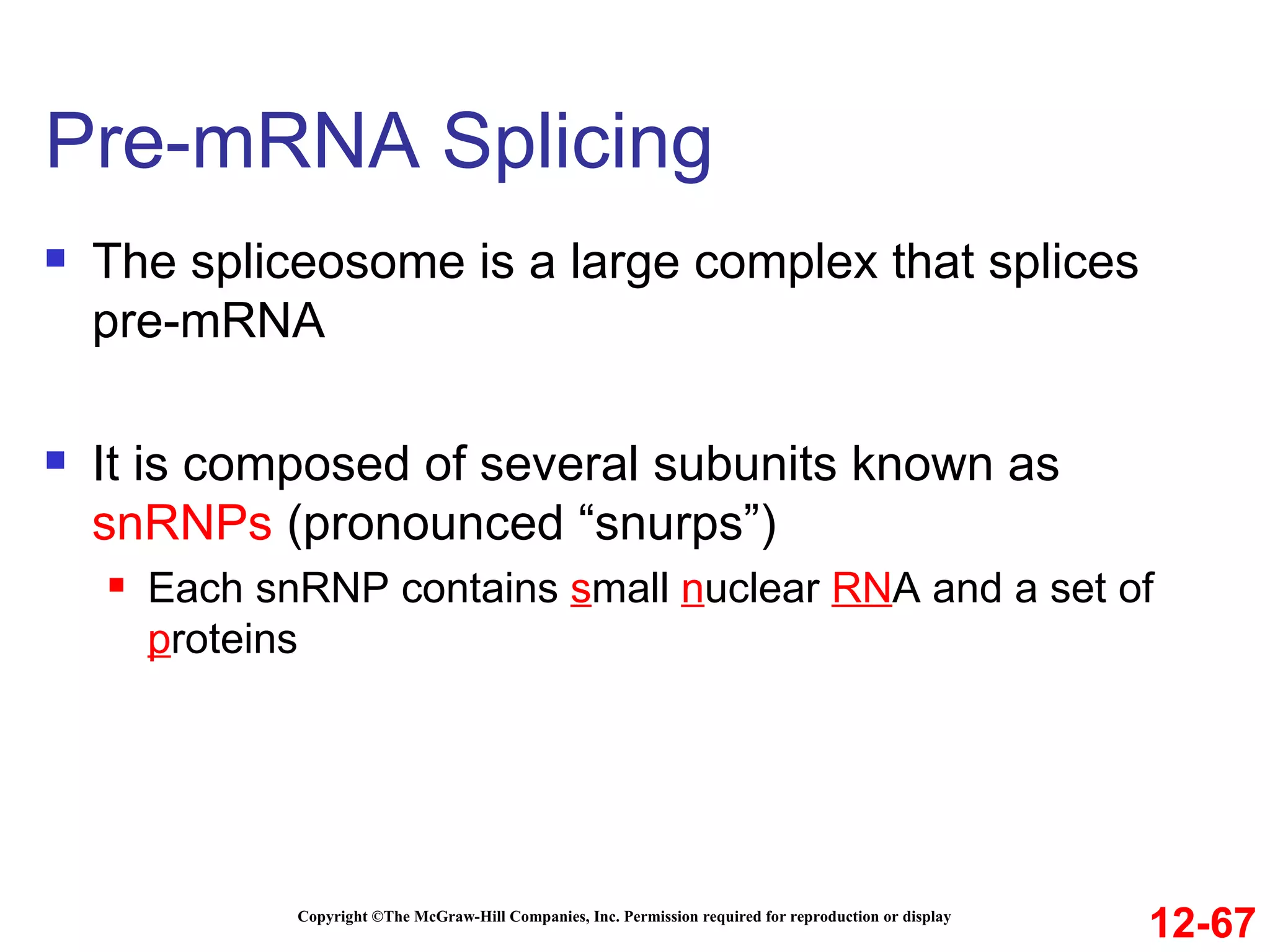
Pre-mRNA Splicing  Copyright ©The McGraw-Hill Companies, Inc. Permission required for reproduction or display The spliceosome is a large complex that splices pre-mRNA It is composed of several subunits known as  snRNPs  (pronounced “snurps”) Each snRNP contains  s mall  n uclear  RN A and a set of  p roteins 12-67
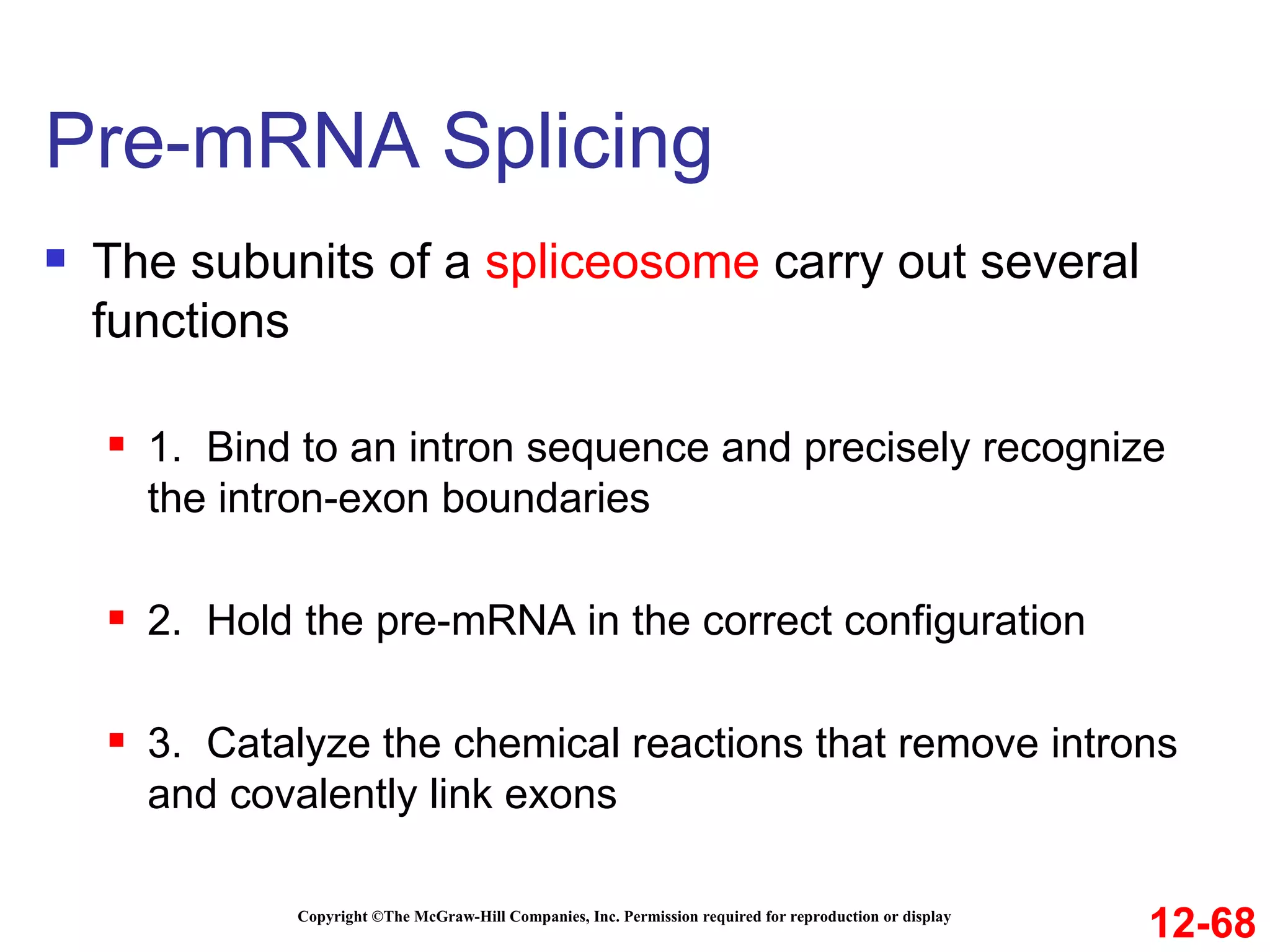
Pre-mRNA Splicing  Copyright ©The McGraw-Hill Companies, Inc. Permission required for reproduction or display The subunits of a  spliceosome  carry out several functions 1.  Bind to an intron sequence and precisely recognize the intron-exon boundaries 2.  Hold the pre-mRNA in the correct configuration 3.  Catalyze the chemical reactions that remove introns and covalently link exons 12-68
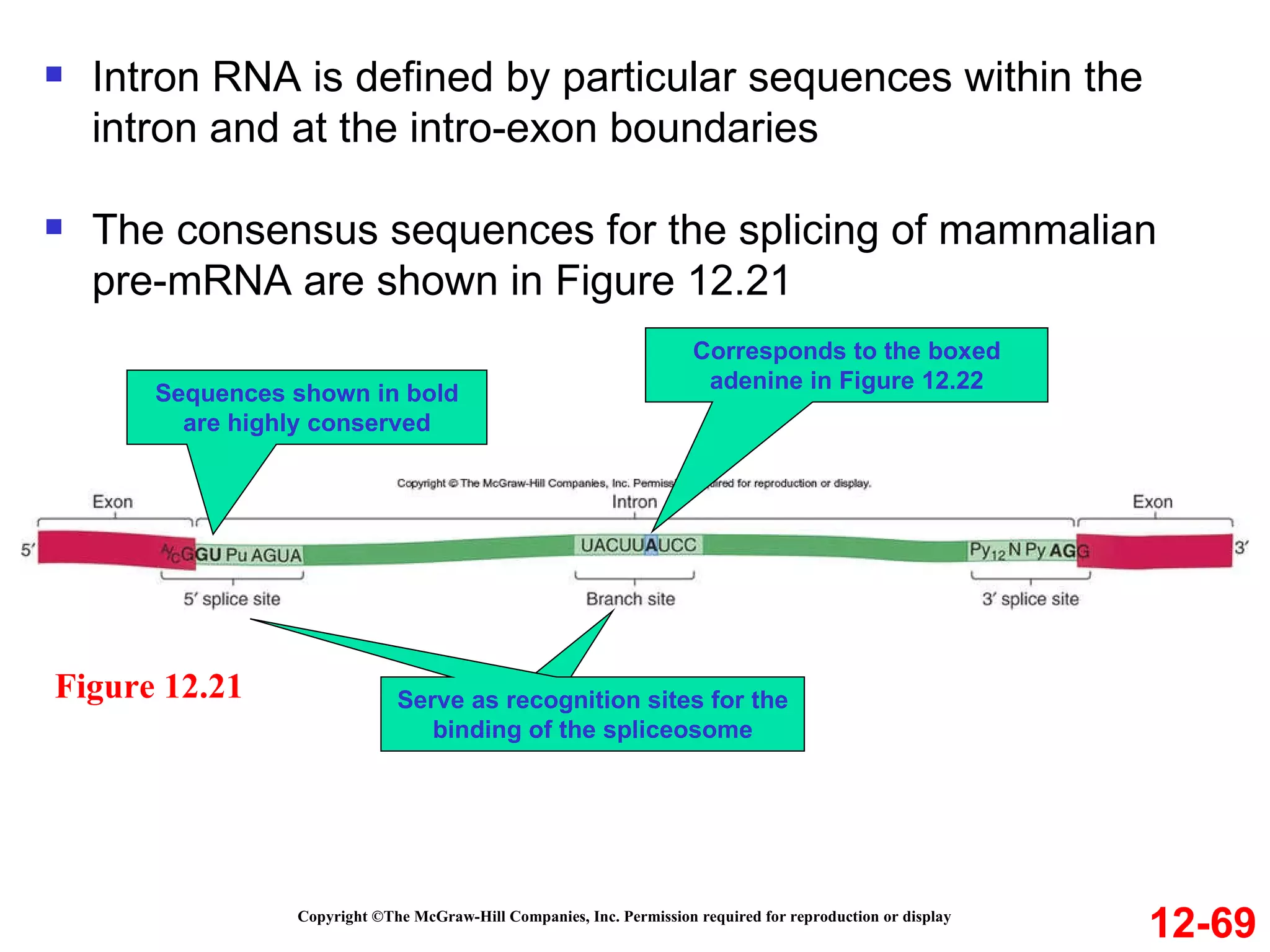
Copyright ©The McGraw-Hill Companies, Inc. Permission required for reproduction or display 12-69 Figure 12.21 Intron RNA is defined by particular sequences within the intron and at the intro-exon boundaries The consensus sequences for the splicing of mammalian pre-mRNA are shown in Figure 12.21 Sequences shown in bold are highly conserved Corresponds to the boxed adenine in Figure 12.22 Serve as recognition sites for the binding of the spliceosome
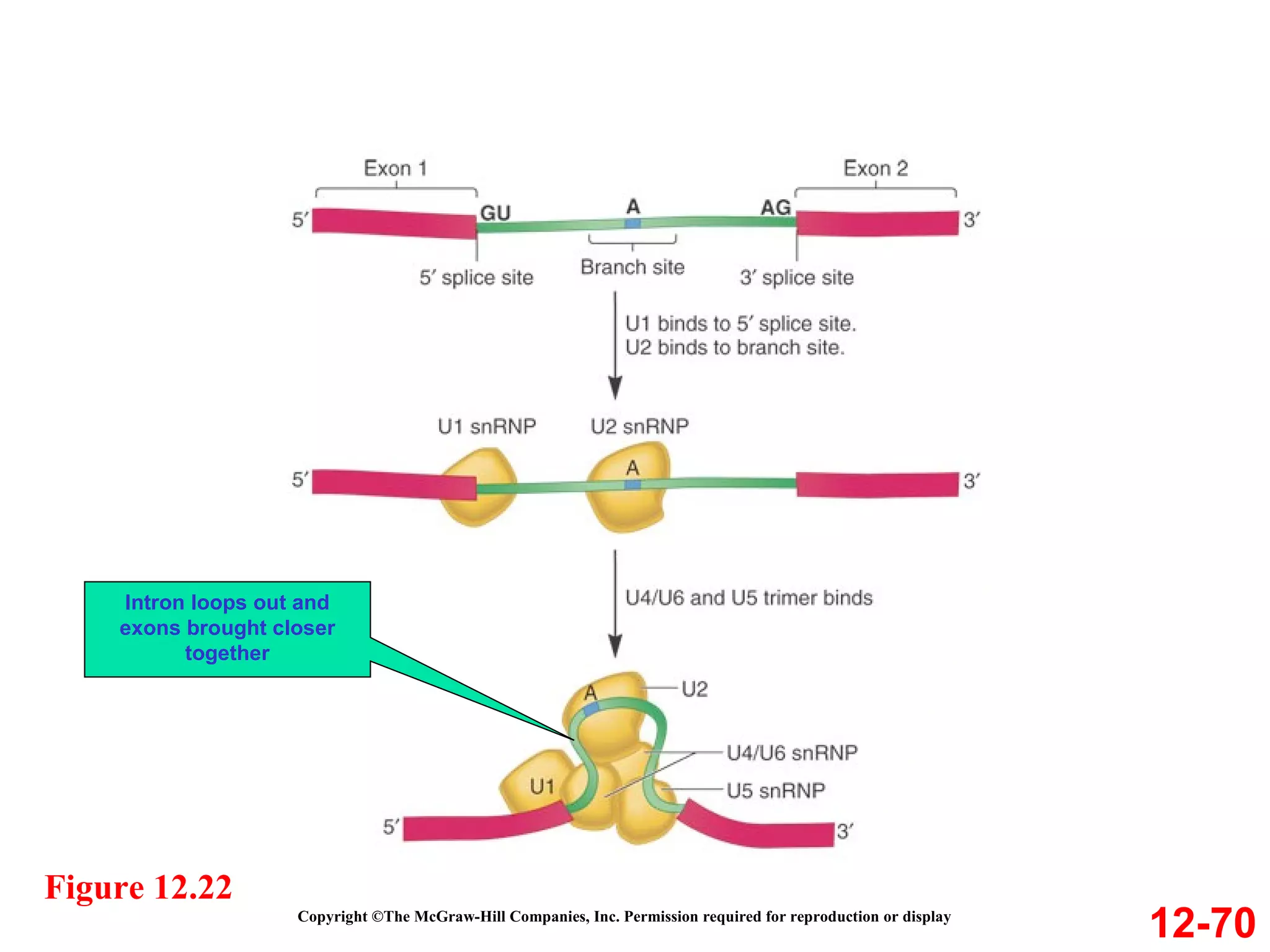
12-70 Intron loops out and exons brought closer together Figure 12.22 Copyright ©The McGraw-Hill Companies, Inc. Permission required for reproduction or display
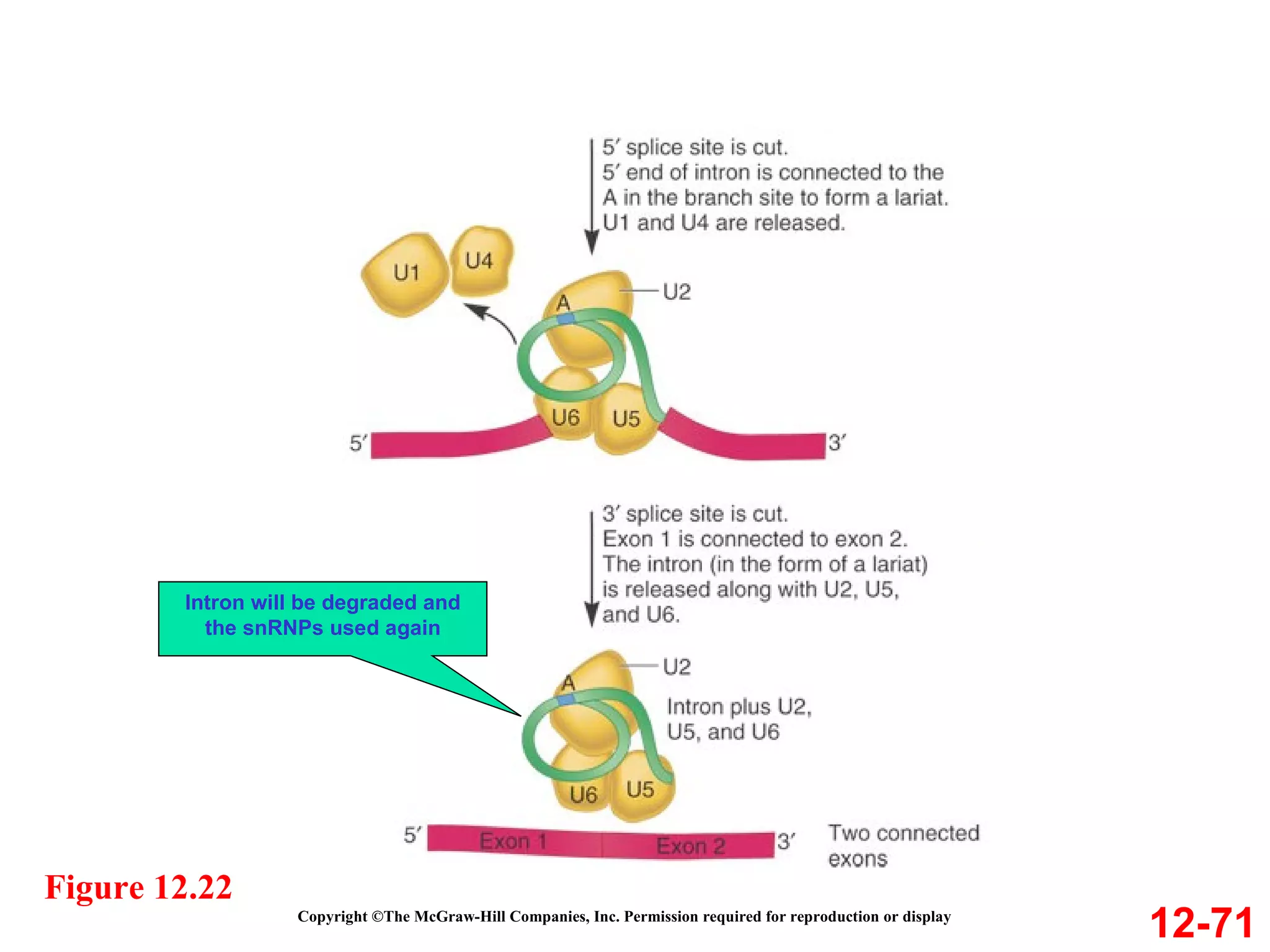
Copyright ©The McGraw-Hill Companies, Inc. Permission required for reproduction or display 12-71 Figure 12.22 Intron will be degraded and the snRNPs used again
Intron Advantage?  Copyright ©The McGraw-Hill Companies, Inc. Permission required for reproduction or display One benefit of genes with introns is a phenomenon called  alternative splicing A pre-mRNA with multiple introns can be spliced in different ways This will generate mature mRNAs with different combinations of exons This variation in splicing can occur in different cell types or during different stages of development 12-72
Intron Advantage?  Copyright ©The McGraw-Hill Companies, Inc. Permission required for reproduction or display The biological advantage of alternative splicing is that two (or more) polypeptides can be derived from a single gene This allows an organism to carry fewer genes in its genome 12-73
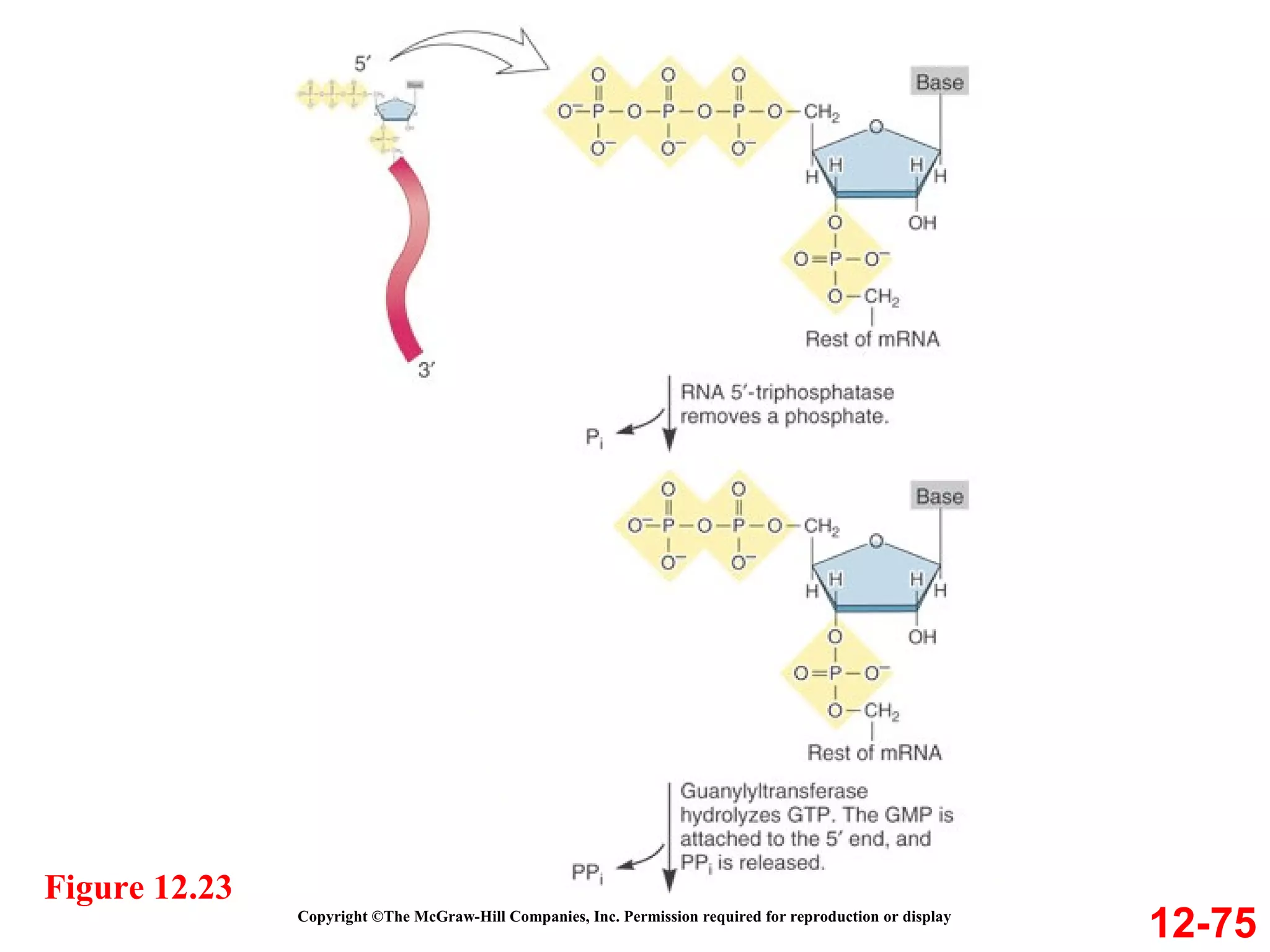
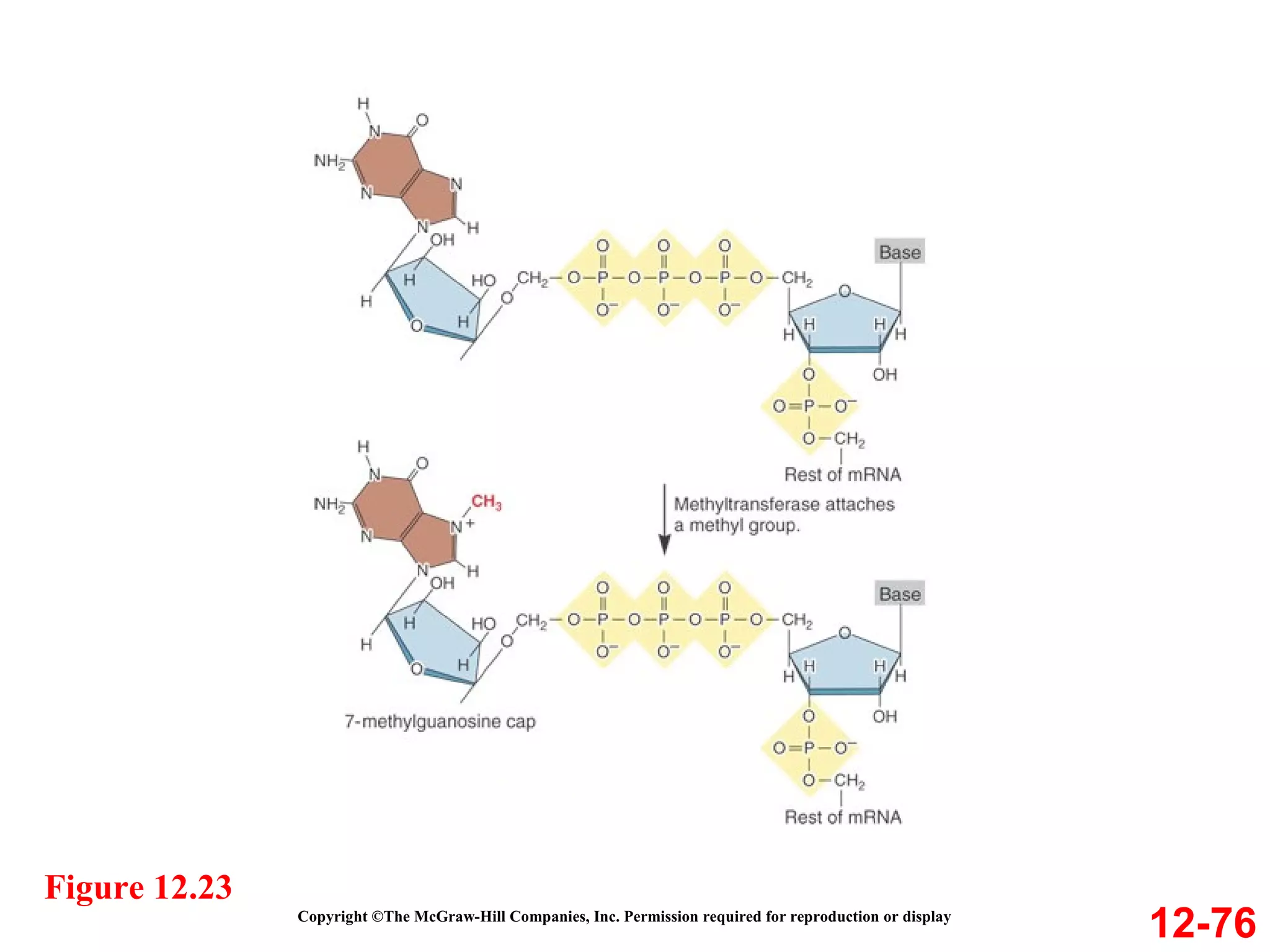
Capping:  marking 5’ends of mRNAs  Copyright ©The McGraw-Hill Companies, Inc. Permission required for reproduction or display Most mature mRNAs have a 7-methyl guanosine covalently attached at their 5’ end This event is known as  capping Capping occurs as the pre-mRNA is being synthesized by RNA pol II Usually when the transcript is only 20 to 25 bases long 12-74
Copyright ©The McGraw-Hill Companies, Inc. Permission required for reproduction or display 12-75 Figure 12.23
Copyright ©The McGraw-Hill Companies, Inc. Permission required for reproduction or display 12-76 Figure 12.23
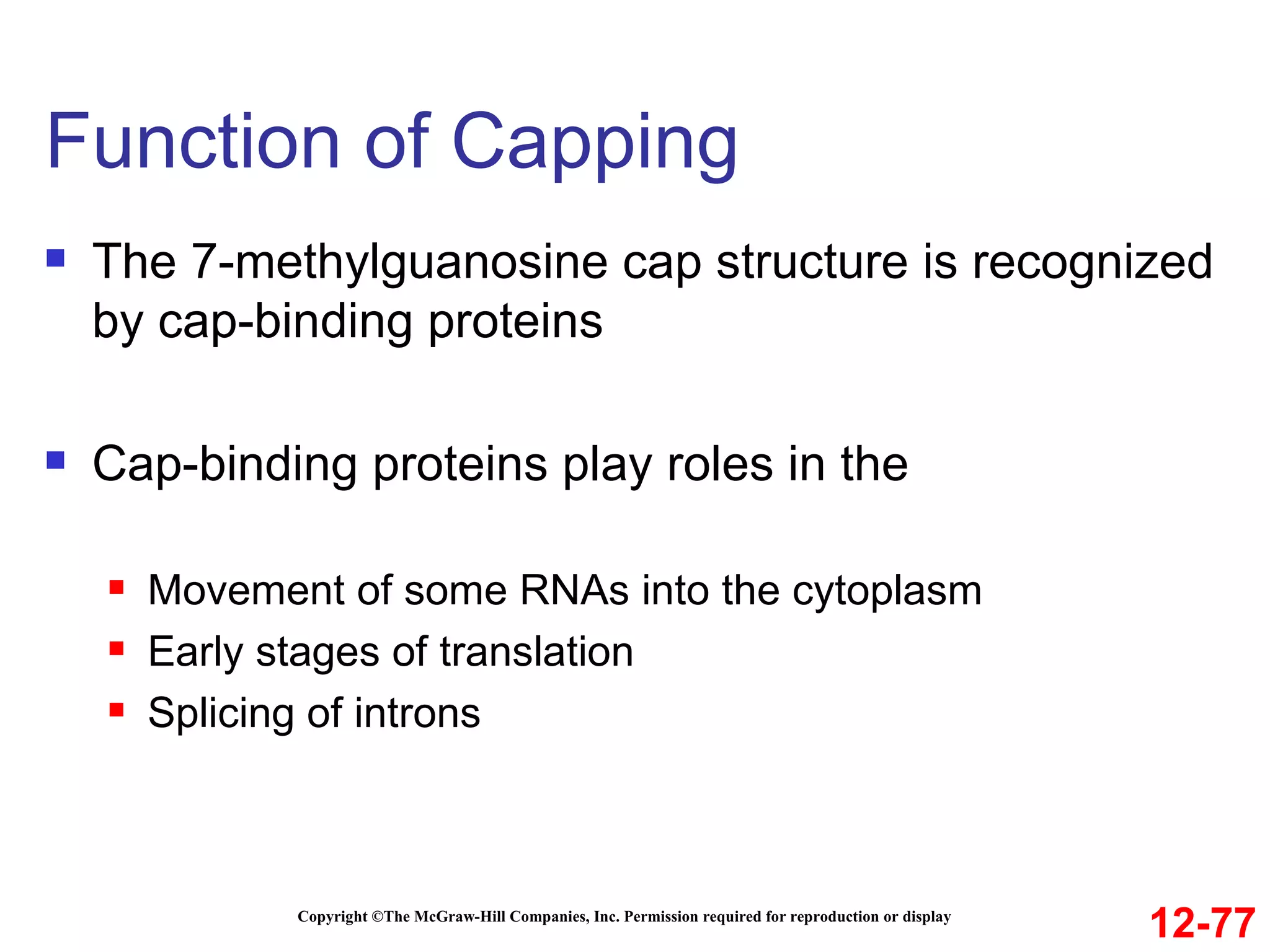
Function of Capping  Copyright ©The McGraw-Hill Companies, Inc. Permission required for reproduction or display The 7-methylguanosine cap structure is recognized by cap-binding proteins Cap-binding proteins play roles in the Movement of some RNAs into the cytoplasm Early stages of translation Splicing of introns 12-77
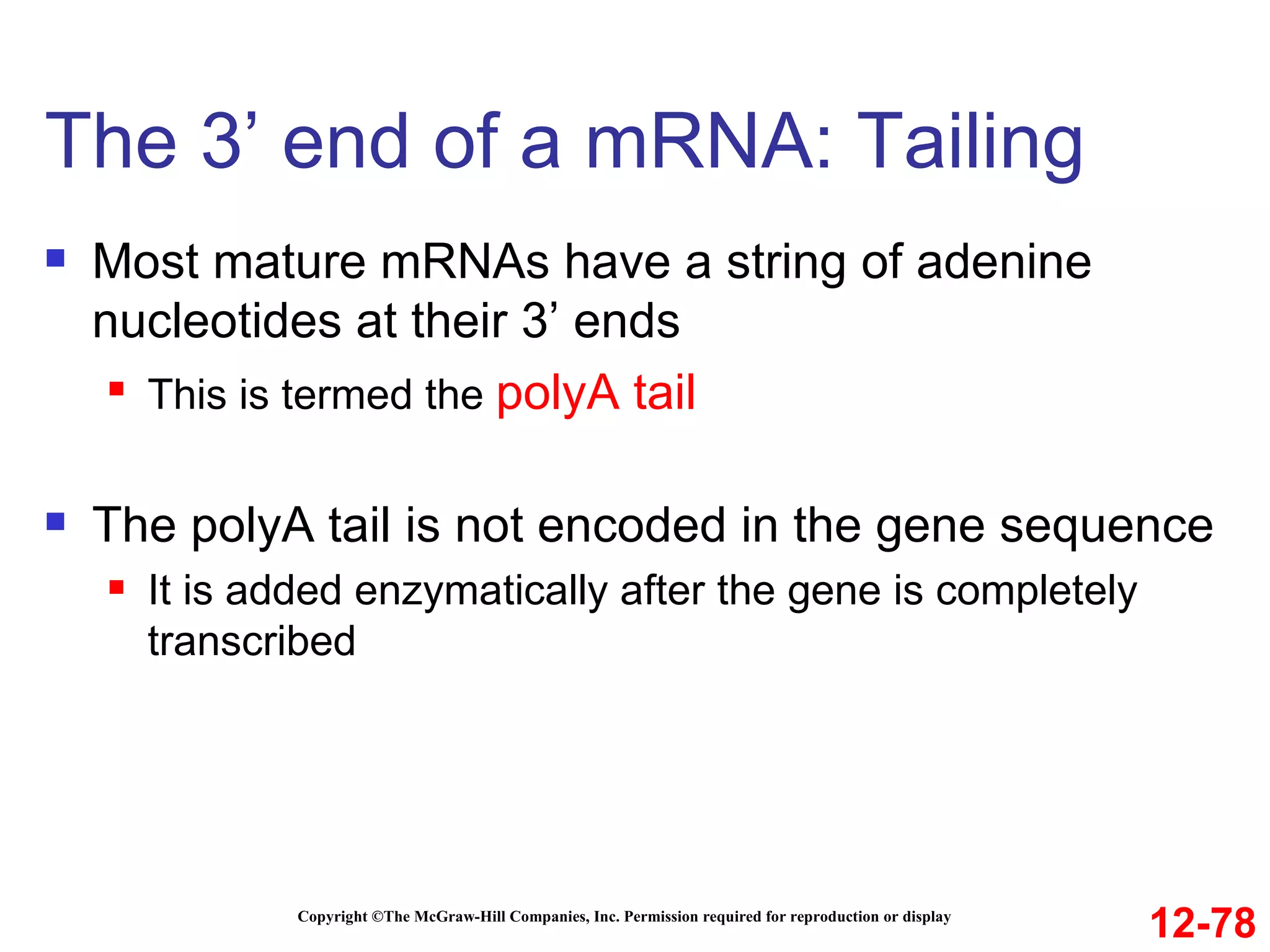
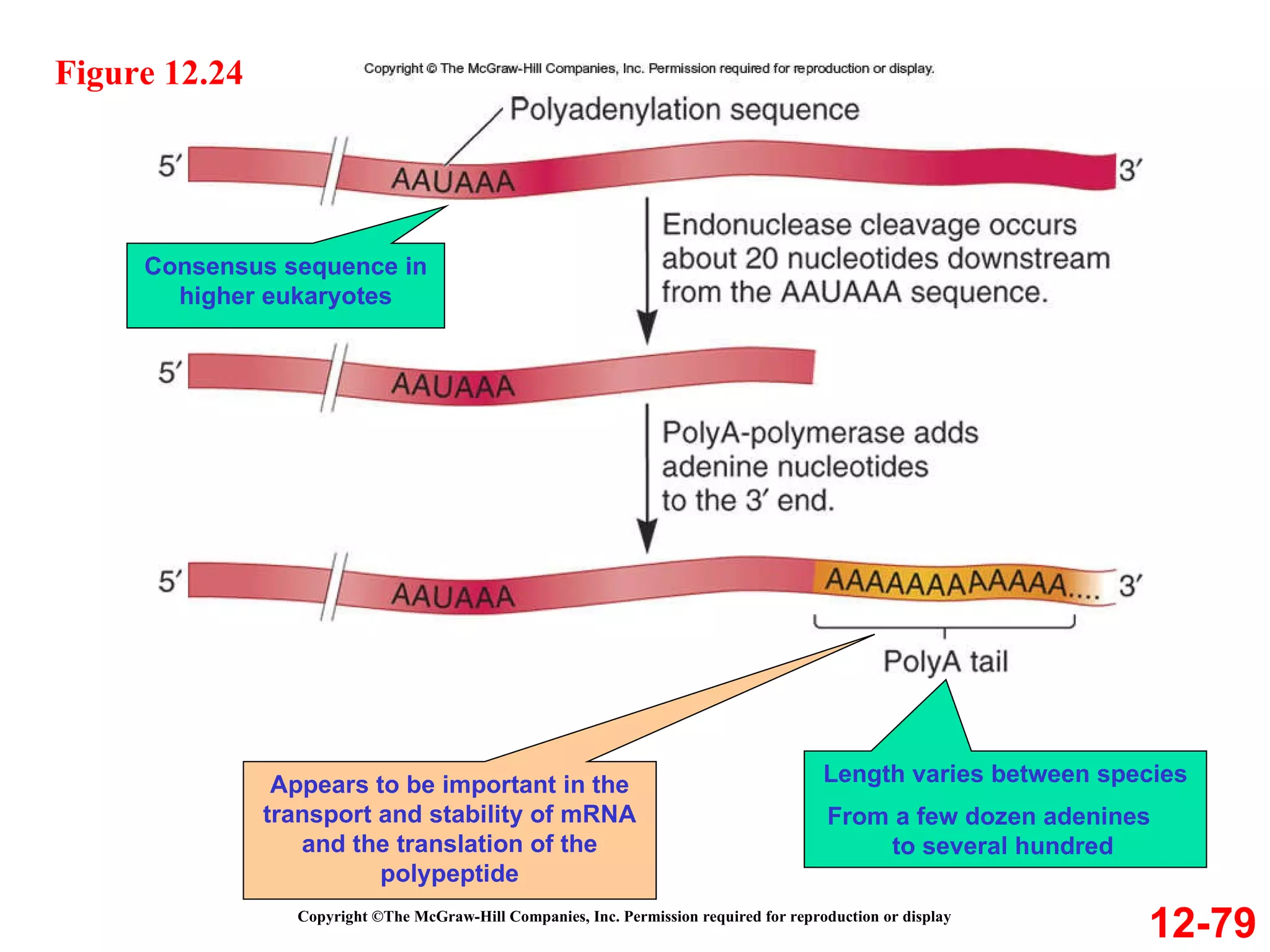
The 3’ end of a mRNA: Tailing  Copyright ©The McGraw-Hill Companies, Inc. Permission required for reproduction or display Most mature mRNAs have a string of adenine nucleotides at their 3’ ends This is termed the  polyA tail The polyA tail is not encoded in the gene sequence It is added enzymatically after the gene is completely transcribed 12-78
Copyright ©The McGraw-Hill Companies, Inc. Permission required for reproduction or display 12-79 Figure 12.24 Consensus sequence in higher eukaryotes Appears to be important in the transport and stability of mRNA and the translation of the polypeptide Length varies between species From a few dozen adenines  to several hundred

Transcription and splicing.

  • 1.
    Genetics: Analysis andPrinciples Robert J. Brooker Copyright ©The McGraw-Hill Companies, Inc. Permission required for reproduction or display CHAPTER 12 GENE TRANSCRIPTION AND RNA MODIFICATION (processing)
  • 2.
    The central dogmaof genetics Figure 12.1 12-5
  • 3.
    A key conceptis that DNA base sequences define the beginning and end of a gene and regulate the level of RNA synthesis Gene expression is the overall process by which the information within a gene is used to produce a functional product which can determine a trait in play with the environment 12.1 OVERVIEW OF TRANSCRIPTION Copyright ©The McGraw-Hill Companies, Inc. Permission required for reproduction or display 12-6
  • 4.
    Figure 12.2 12-7Signals the end of protein synthesis
  • 5.
    Gene Expression Requires Base Sequences Copyright ©The McGraw-Hill Companies, Inc. Permission required for reproduction or display The strand that is actually transcribed (used as the template) is termed the template strand The opposite strand is called the coding strand or the sense strand The base sequence is identical to the RNA transcript Except for the substitution of uracil in RNA for thymine in DNA Transcription factors recognize the promoter and regulatory sequences to control transcription mRNA sequences such as the ribosomal-binding site and codons direct translation 12-8
  • 6.
    The Stages ofTranscription Copyright ©The McGraw-Hill Companies, Inc. Permission required for reproduction or display Transcription occurs in three stages Initiation Elongation Termination These steps involve protein-DNA interactions Proteins such as RNA polymerase interact with DNA sequences Transcription factors that control transcription bind directly or indirectly to DNA 12-9
  • 7.
  • 8.
    RNA Transcripts HaveDifferent Functions Copyright ©The McGraw-Hill Companies, Inc. Permission required for reproduction or display Once they are made, RNA transcripts play different functional roles Well over 90% of all genes are structural genes producing mRNA The other RNA molecules are never translated: This collection appears much greater that initially believed; Some RNAs are 20-25 nts long that have important functions! 12-11
  • 9.
    RNA Transcripts HaveDifferent Functions Copyright ©The McGraw-Hill Companies, Inc. Permission required for reproduction or display The RNA transcripts from nonstructural genes are not translated They do have various important cellular functions They can still confer traits In some cases, the RNA transcript becomes part of a complex that contains protein subunits For example Ribosomes Spliceosomes Signal recognition particles 12-12
  • 10.
    Our molecular understandingof gene transcription came from studies involving bacteria and bacteriophages Indeed, much of our knowledge comes from studies of a single bacterium E. coli , of course In this section we will examine the three steps of transcription as they occur in bacteria 12.2 TRANSCRIPTION IN BACTERIA Copyright ©The McGraw-Hill Companies, Inc. Permission required for reproduction or display 12-14
  • 11.
    Promoters Copyright ©TheMcGraw-Hill Companies, Inc. Permission required for reproduction or display Promoters are DNA sequences that “promote” gene expression: Events at this piece of DNA are needed to initiate RNA synthesis/transcription More precisely, they direct the exact location for the initiation of transcription and determine when and how frequently a gene is transcribed. Promoters are typically located just upstream of the site where transcription of a gene actually begins The bases in a promoter sequence are numbered in relation to the transcription start site 12-15
  • 12.
    Copyright ©The McGraw-HillCompanies, Inc. Permission required for reproduction or display 12-16 Figure 12.4 The conventional numbering system of promoters Bases preceding this are numbered in a negative direction There is no base numbered 0 Bases to the right are numbered in a positive direction Most of the promoter region is labeled with negative numbers
  • 13.
    Copyright ©The McGraw-HillCompanies, Inc. Permission required for reproduction or display 12-17 Figure 12.4 The conventional numbering system of promoters The promoter may span a large region, but specific short sequence elements are particularly critical for promoter recognition and activity level Sometimes termed the Pribnow box, after its discoverer Sequence elements that play a key role in transcription
  • 14.
    Copyright ©The McGraw-HillCompanies, Inc. Permission required for reproduction or display 12-18 Figure 12.5 Examples of –35 and –10 sequences within a variety of bacterial promoters The most commonly occurring bases For many bacterial genes, there is a good correlation between the rate of RNA transcription and the degree of agreement with the consensus sequences
  • 15.
    Initiation of BacterialTranscription Copyright ©The McGraw-Hill Companies, Inc. Permission required for reproduction or display RNA polymerase is the enzyme that catalyzes the synthesis of RNA In E. coli , the RNA polymerase holoenzyme is composed of Core enzyme Five subunits =  2  ’  Sigma factor One subunit =  These subunits play distinct functional roles 12-19
  • 16.
    Initiation of BacterialTranscription Copyright ©The McGraw-Hill Companies, Inc. Permission required for reproduction or display The RNA polymerase holoenzyme binds loosely to the DNA It then scans along the DNA, until it encounters a promoter region When it does, the sigma factor recognizes both the –35 and –10 regions A region within the sigma factor that contains a helix-turn-helix structure is involved in a tighter binding to the DNA Refer to Figure 12.6 12-20
  • 17.
    Copyright ©The McGraw-HillCompanies, Inc. Permission required for reproduction or display 12-21 Figure 12.6 Amino acids within the  helices hydrogen bond with bases in the promoter sequence elements
  • 18.
  • 19.
    12-26 Similar tothe synthesis of DNA via DNA polymerase Figure 12.8 On average, the rate of RNA synthesis is about 43 nucleotides per second!
  • 20.
    Termination of BacterialTranscription Copyright ©The McGraw-Hill Companies, Inc. Permission required for reproduction or display Termination is the end of RNA synthesis It occurs when the short RNA-DNA hybrid of the open complex is forced to separate This releases the newly made RNA as well as the RNA polymerase E. coli has two different mechanisms for termination 1. rho-dependent termination Requires a protein known as  (rho) 2. rho-independent termination Does not require  12-27
  • 21.
    12-28 r ho ut ilization site Rho protein is a helicase  -dependent termination Figure 12.10
  • 22.
    12-29  -dependenttermination Figure 12.10
  • 23.
     -independent terminationis facilitated by two sequences in the RNA 1. A uracil-rich sequence located at the 3’ end of the RNA 2. A stem-loop structure upstream of the Us 12-30 U RNA -A DNA hydrogen bonds are very weak No protein is required to physically remove the RNA from the DNA This type of termination is also called intrinsic Stabilizes the RNA pol pausing  -independent termination Termination in Eukaryotes is much less well defined ! Figure 12.11
  • 24.
    Many of thebasic features of gene transcription are very similar in bacteria and eukaryotes However, gene transcription in eukaryotes is more complex Larger organisms and cells Cellular complexity such as organelles added complexity means more genes Multicellularity: many different cell types increased regulation to express only in right cells at right time 12.3 TRANSCRIPTION IN EUKARYOTES Copyright ©The McGraw-Hill Companies, Inc. Permission required for reproduction or display 12-31
  • 25.
    Eukaryotic RNA PolymerasesCopyright ©The McGraw-Hill Companies, Inc. Permission required for reproduction or display Nuclear DNA is transcribed by three different RNA polymerases RNA pol I Transcribes all rRNA genes (except for the 5S rRNA) RNA pol II Transcribes all structural genes Thus, synthesizes all mRNAs Transcribes some snRNA genes RNA pol III Transcribes all tRNA genes And the 5S rRNA gene 12-32
  • 26.
    Sequences of EukaryoticStructural Genes Copyright ©The McGraw-Hill Companies, Inc. Permission required for reproduction or display Eukaryotic promoter sequences are more variable and often much more complex than those of bacteria For structural genes, at least three features are found in most promoters Regulatory elements TATA box (present in ~20 % of our genes) and other short sequences in TATA-promoters that have a similar function Transcriptional start site Refer to Figure 12.13 12-34
  • 27.
    The corepromoter is relatively short It consists of the TATA box Important in determining the precise start point for transcription The core promoter by itself produces a low level of transcription This is termed basal transcription 12-35 Usually an adenine Figure 12.13 Copyright ©The McGraw-Hill Companies, Inc. Permission required for reproduction or display
  • 28.
    Regulatory elements affect the binding of RNA polymerase to the promoter They are of two types Enhancers Stimulate transcription Silencers Inhibit transcription They vary widely in their locations, from –50 to –100 region 12-36 Figure 12.13 Copyright ©The McGraw-Hill Companies, Inc. Permission required for reproduction or display
  • 29.
    Sequences of EukaryoticStructural Genes Copyright ©The McGraw-Hill Companies, Inc. Permission required for reproduction or display Factors that control gene expression can be divided into two types, based on their “location” cis -acting elements DNA sequences that exert their effect only over a particular gene Example: TATA box, enhancers and silencers trans -acting elements Regulatory proteins that bind to such DNA sequences 12-37
  • 30.
    RNA Polymerase IIand its Transcription Factors Copyright ©The McGraw-Hill Companies, Inc. Permission required for reproduction or display Three categories of proteins are required for basal transcription to occur at the promoter RNA polymerase II Five different proteins called general transcription factors (GTFs) A protein complex called mediator 12-38
  • 31.
    12-39 Figure 12.14Copyright ©The McGraw-Hill Companies, Inc. Permission required for reproduction or display
  • 32.
    12-40 Figure 12.14Copyright ©The McGraw-Hill Companies, Inc. Permission required for reproduction or display A closed complex Released after the open complex is formed RNA pol II can now proceed to the elongation stage
  • 33.
    Copyright ©The McGraw-HillCompanies, Inc. Permission required for reproduction or display Basal transcription apparatus RNA pol II + the five GTFs The third component for transcription is a large protein complex termed mediator It mediates interactions between RNA pol II and various regulatory transcription factors Its subunit composition is complex and variable Mediator appears to regulate the ability of TFIIH to phosphorylate CTD Therefore it plays a pivotal role in the switch between transcriptional initiation and elongation 12-41
  • 34.
    Chromatin Structure andTranscription Copyright ©The McGraw-Hill Companies, Inc. Permission required for reproduction or display The compaction of DNA to form chromatin can be an obstacle to the transcription process Most transcription occurs in interphase Then, chromatin is found in 30 nm fibers that are organized into radial loop domains Within the 30 nm fibers, the DNA is wound around histone octamers to form nucleosomes 12-43
  • 35.
    Chromatin Structure andTranscription Copyright ©The McGraw-Hill Companies, Inc. Permission required for reproduction or display The histone octamer is roughly five times smaller than the complex of RNA pol II and the GTFs The tight wrapping of DNA within the nucleosome inhibits the function of RNA pol To circumvent this problem, the chromatin structure is significantly loosened during transcription Two common mechanisms alter chromatin structure 12-44
  • 36.
    Copyright ©The McGraw-HillCompanies, Inc. Permission required for reproduction or display 1. Covalent modification of histones Amino terminals of histones are modified in various ways Acetylation; phosphorylation; methylation 12-45 Figure 12.15 Adds acetyl groups, thereby loosening the interaction between histones and DNA Removes acetyl groups, thereby restoring a tighter interaction
  • 37.
    Copyright ©The McGraw-HillCompanies, Inc. Permission required for reproduction or display 2. ATP-dependent chromatin remodeling The energy of ATP is used to alter the structure of nucleosomes and thus make the DNA more accessible 12-46 Figure 12.15 Proteins are members of the SWI/SNF family Acronyms refer to the effects on yeast when these enzyme are defective Mutants in SWI are defective in mating type swi tching Mutants in SNF are s ucrose n on- f ermenters These effects may significantly alter gene expression
  • 38.
    ‘ promoter’ Proteincoding Difference in gene structure between - prokaryote - eukaryote core ‘ promoter’ An important difference between prokaryotes and eukaryotes is that eukaryotes’ genes are not split into intons and exons in eukaryotes is the DNA coding protein are. Therefore, exons eventually end up in the mRNA intron exons
  • 39.
    Pre-mRNA Transcription start,elongation, termination and RNA processing in eukaryotes : coding protein : non-coding protein: ‘leader’ and ‘trailer’ CAP CAP (poly A tail) The longest gene in human genome is more than 1.500.000 base pares (bp) and the mRNA is ~ 7000 nt. That means: >1.493.000 bp intron = ~ 99,5 % !!!!! ‘ promoter’ intron exons GENE mRNA AAAAAAAAAAAAAAn
  • 40.
    Instead, coding sequences,called exons , are interrupted by intervening sequences or introns Transcription produces the entire gene product Introns are later removed or excised Exons are connected together or spliced This phenomenon is termed RNA splicing It is a common genetic phenomenon in eukaryotes Occurs occasionally in bacteria as well 12.4 RNA MODIFICATION Copyright ©The McGraw-Hill Companies, Inc. Permission required for reproduction or display 12-48
  • 41.
    Aside from splicing,RNA transcripts can be modified in several ways For example Trimming of rRNA and tRNA transcripts 5’ Capping and 3’ polyA tailing of mRNA transcripts 12.4 RNA MODIFICATION Copyright ©The McGraw-Hill Companies, Inc. Permission required for reproduction or display 12-49
  • 42.
    Copyright ©The McGraw-HillCompanies, Inc. Permission required for reproduction or display 12-65 Figure 12.20 In eukaryotes, the transcription of structural genes, produces a long transcript known as pre-mRNA Also as heterogeneous nuclear RNA (hnRNA) This RNA is altered by splicing and other modifications, before it leaves the nucleus Splicing in this case requires the aid of a multicomponent structure known as the spliceosome
  • 43.
    Pre-mRNA Splicing Copyright ©The McGraw-Hill Companies, Inc. Permission required for reproduction or display The spliceosome is a large complex that splices pre-mRNA It is composed of several subunits known as snRNPs (pronounced “snurps”) Each snRNP contains s mall n uclear RN A and a set of p roteins 12-67
  • 44.
    Pre-mRNA Splicing Copyright ©The McGraw-Hill Companies, Inc. Permission required for reproduction or display The subunits of a spliceosome carry out several functions 1. Bind to an intron sequence and precisely recognize the intron-exon boundaries 2. Hold the pre-mRNA in the correct configuration 3. Catalyze the chemical reactions that remove introns and covalently link exons 12-68
  • 45.
    Copyright ©The McGraw-HillCompanies, Inc. Permission required for reproduction or display 12-69 Figure 12.21 Intron RNA is defined by particular sequences within the intron and at the intro-exon boundaries The consensus sequences for the splicing of mammalian pre-mRNA are shown in Figure 12.21 Sequences shown in bold are highly conserved Corresponds to the boxed adenine in Figure 12.22 Serve as recognition sites for the binding of the spliceosome
  • 46.
    12-70 Intron loopsout and exons brought closer together Figure 12.22 Copyright ©The McGraw-Hill Companies, Inc. Permission required for reproduction or display
  • 47.
    Copyright ©The McGraw-HillCompanies, Inc. Permission required for reproduction or display 12-71 Figure 12.22 Intron will be degraded and the snRNPs used again
  • 48.
    Intron Advantage? Copyright ©The McGraw-Hill Companies, Inc. Permission required for reproduction or display One benefit of genes with introns is a phenomenon called alternative splicing A pre-mRNA with multiple introns can be spliced in different ways This will generate mature mRNAs with different combinations of exons This variation in splicing can occur in different cell types or during different stages of development 12-72
  • 49.
    Intron Advantage? Copyright ©The McGraw-Hill Companies, Inc. Permission required for reproduction or display The biological advantage of alternative splicing is that two (or more) polypeptides can be derived from a single gene This allows an organism to carry fewer genes in its genome 12-73
  • 50.
    Capping: marking5’ends of mRNAs Copyright ©The McGraw-Hill Companies, Inc. Permission required for reproduction or display Most mature mRNAs have a 7-methyl guanosine covalently attached at their 5’ end This event is known as capping Capping occurs as the pre-mRNA is being synthesized by RNA pol II Usually when the transcript is only 20 to 25 bases long 12-74
  • 51.
    Copyright ©The McGraw-HillCompanies, Inc. Permission required for reproduction or display 12-75 Figure 12.23
  • 52.
    Copyright ©The McGraw-HillCompanies, Inc. Permission required for reproduction or display 12-76 Figure 12.23
  • 53.
    Function of Capping Copyright ©The McGraw-Hill Companies, Inc. Permission required for reproduction or display The 7-methylguanosine cap structure is recognized by cap-binding proteins Cap-binding proteins play roles in the Movement of some RNAs into the cytoplasm Early stages of translation Splicing of introns 12-77
  • 54.
    The 3’ endof a mRNA: Tailing Copyright ©The McGraw-Hill Companies, Inc. Permission required for reproduction or display Most mature mRNAs have a string of adenine nucleotides at their 3’ ends This is termed the polyA tail The polyA tail is not encoded in the gene sequence It is added enzymatically after the gene is completely transcribed 12-78
  • 55.
    Copyright ©The McGraw-HillCompanies, Inc. Permission required for reproduction or display 12-79 Figure 12.24 Consensus sequence in higher eukaryotes Appears to be important in the transport and stability of mRNA and the translation of the polypeptide Length varies between species From a few dozen adenines to several hundred