PROKARYOTIC
TRANSCRIPTION
Introduction
 RNA molecules are synthesised by using a
portion of one strand of DNA as template in a
polymerization reaction.
 Catalyzed by RNA polymerases
 Process by which RNA molecules are initiated,
elongated and terminated – Transcription
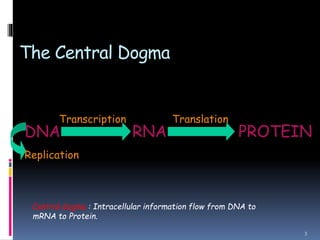
The Central Dogma
3
DNA RNA PROTEIN
Transcription Translation
Replication
Central dogma : Intracellular information flow from DNA to
mRNA to Protein.
RNA Polymerases
 Principal enzyme in transcription
 Catalyzes polymerization of ribonucleotides as
directed by DNA template
 Catalyses growth of RNA chains in 5'  3'
direction
 Preformed primer is not required
 Transcription initiates denovo at specific sites at
the beginning of gene

 RNA POLYEMERASE:
 Complex enzyme – made up of multiple polypeptide chain
 6 subunits :
 2α subunit – binding of enzyme to promoter region
 β – nucleotide addition
 β‘ – part of core enzyme , keeps the RNA bound to DNA template
 ω – part of enzyme, but no specific function
 σ – sigma factor, recognize promoter region binds to it. weakly
bound, which dissociates from enzyme during elongation
[ Core enzyme : σ free unit , ie., α2ββ‘ Holoenzyme : the complete enzyme,
ie., α2ββ‘σ ]
 One of the largest enzyme (mw – 465,000Da) ,contact with many
DNA bases simultaneously
Selection of site – The Promoter
 DNA sequence to which the RNA polymerase binds to initiate
transcription of gene – Promoter
 2 types of regions important in promoter function :
 Pribnow – Schaller box : (prokaryotes)
 Located about 10 bp upstream from start of transcription
 Goldberg – Hogness box : (eukayotes)
 Located 20-30 bp upstream from start of transcription
 Also termed as TATA box.
 Both are A-T rich regions.
 Concensus sequences : basic sequence derived from a large set of
observed similar sequence
Steps : Transcription
 Initiation of transcription
 RNA chain elongation
 Termination and release of newly synthesised RNA
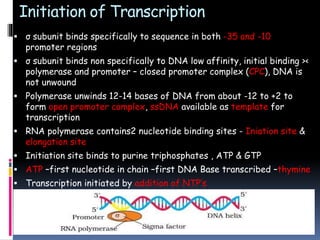
Initiation of Transcription
 σ subunit binds specifically to sequence in both -35 and -10
promoter regions
 σ subunit binds non specifically to DNA low affinity, initial binding ><
polymerase and promoter – closed promoter complex (CPC), DNA is
not unwound
 Polymerase unwinds 12-14 bases of DNA from about -12 to +2 to
form open promoter complex, ssDNA available as template for
transcription
 RNA polymerase contains2 nucleotide binding sites - Iniation site &
elongation site
 Initiation site binds to purine triphosphates , ATP & GTP
 ATP –first nucleotide in chain –first DNA Base transcribed –thymine
 Transcription initiated by addition of NTP’s
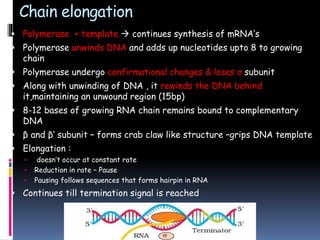
Chain elongation
 Polymerase + template  continues synthesis of mRNA‘s
 Polymerase unwinds DNA and adds up nucleotides upto 8 to growing
chain
 Polymerase undergo confirmational changes & loses σ subunit
 Along with unwinding of DNA , it rewinds the DNA behind
it,maintaining an unwound region (15bp)
 8-12 bases of growing RNA chain remains bound to complementary
DNA
 β and β‘ subunit – forms crab claw like structure –grips DNA template
 Elongation :
 doesn’t occur at constant rate
 Reduction in rate – Pause
 Pausing follows sequences that forms hairpin in RNA
 Continues till termination signal is reached
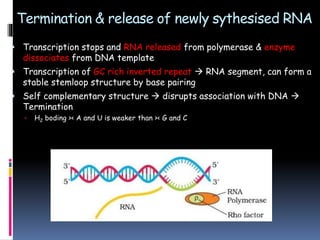
Termination & release of newly sythesised RNA
 Transcription stops and RNA released from polymerase & enzyme
dissociates from DNA template
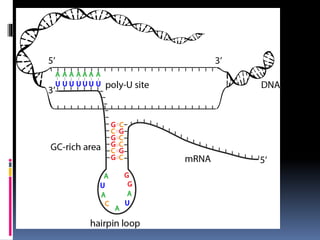
 Transcription of GC rich inverted repeat  RNA segment, can form a
stable stemloop structure by base pairing
 Self complementary structure  disrupts association with DNA 
Termination
 H2 boding >< A and U is weaker than >< G and C
 TWO TYPES OF TERMINATION :
 Rho(ρ) – dependent
 Rho – independent
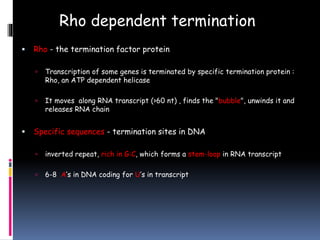
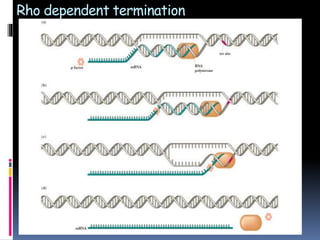
Rho dependent termination
 Rho - the termination factor protein
 Transcription of some genes is terminated by specific termination protein :
Rho, an ATP dependent helicase
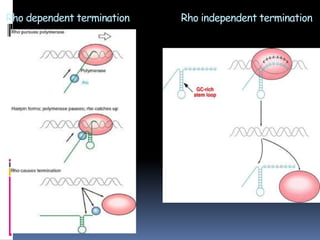
 It moves along RNA transcript (>60 nt) , finds the "bubble", unwinds it and
releases RNA chain
 Specific sequences - termination sites in DNA
 inverted repeat, rich in G:C, which forms a stem-loop in RNA transcript
 6-8 A’s in DNA coding for U’s in transcript
Rho dependent termination
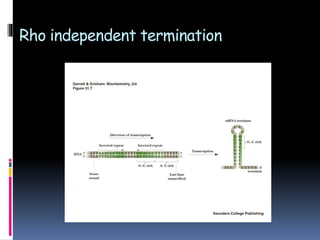
Rho independent termination
 Termination occurs in absence of Rho protein
 Terminator consist of:
 A short inverted repeat followed by a stretch of A : T basepairs (about 8)
 When polymerase transcribes inverted sequence , a stem and loop structure is
formed
 mRNA moves away from DNA template as a A-U bp. it detaches and so RNA
polymerase cannot move forward by formation of such structre  transcription
ends
Rho independent termination
Rho dependent termination Rho independent termination

Unit 7 prok transcription

  • 1.
  • 2.
    Introduction  RNA moleculesare synthesised by using a portion of one strand of DNA as template in a polymerization reaction.  Catalyzed by RNA polymerases  Process by which RNA molecules are initiated, elongated and terminated – Transcription
  • 3.
    The Central Dogma 3 DNARNA PROTEIN Transcription Translation Replication Central dogma : Intracellular information flow from DNA to mRNA to Protein.
  • 4.
    RNA Polymerases  Principalenzyme in transcription  Catalyzes polymerization of ribonucleotides as directed by DNA template  Catalyses growth of RNA chains in 5'  3' direction  Preformed primer is not required  Transcription initiates denovo at specific sites at the beginning of gene 
  • 5.
     RNA POLYEMERASE: Complex enzyme – made up of multiple polypeptide chain  6 subunits :  2α subunit – binding of enzyme to promoter region  β – nucleotide addition  β‘ – part of core enzyme , keeps the RNA bound to DNA template  ω – part of enzyme, but no specific function  σ – sigma factor, recognize promoter region binds to it. weakly bound, which dissociates from enzyme during elongation [ Core enzyme : σ free unit , ie., α2ββ‘ Holoenzyme : the complete enzyme, ie., α2ββ‘σ ]  One of the largest enzyme (mw – 465,000Da) ,contact with many DNA bases simultaneously
  • 6.
    Selection of site– The Promoter  DNA sequence to which the RNA polymerase binds to initiate transcription of gene – Promoter  2 types of regions important in promoter function :  Pribnow – Schaller box : (prokaryotes)  Located about 10 bp upstream from start of transcription  Goldberg – Hogness box : (eukayotes)  Located 20-30 bp upstream from start of transcription  Also termed as TATA box.  Both are A-T rich regions.  Concensus sequences : basic sequence derived from a large set of observed similar sequence
  • 7.
    Steps : Transcription Initiation of transcription  RNA chain elongation  Termination and release of newly synthesised RNA
  • 8.
    Initiation of Transcription σ subunit binds specifically to sequence in both -35 and -10 promoter regions  σ subunit binds non specifically to DNA low affinity, initial binding >< polymerase and promoter – closed promoter complex (CPC), DNA is not unwound  Polymerase unwinds 12-14 bases of DNA from about -12 to +2 to form open promoter complex, ssDNA available as template for transcription  RNA polymerase contains2 nucleotide binding sites - Iniation site & elongation site  Initiation site binds to purine triphosphates , ATP & GTP  ATP –first nucleotide in chain –first DNA Base transcribed –thymine  Transcription initiated by addition of NTP’s
  • 9.
    Chain elongation  Polymerase+ template  continues synthesis of mRNA‘s  Polymerase unwinds DNA and adds up nucleotides upto 8 to growing chain  Polymerase undergo confirmational changes & loses σ subunit  Along with unwinding of DNA , it rewinds the DNA behind it,maintaining an unwound region (15bp)  8-12 bases of growing RNA chain remains bound to complementary DNA  β and β‘ subunit – forms crab claw like structure –grips DNA template  Elongation :  doesn’t occur at constant rate  Reduction in rate – Pause  Pausing follows sequences that forms hairpin in RNA  Continues till termination signal is reached
  • 10.
    Termination & releaseof newly sythesised RNA  Transcription stops and RNA released from polymerase & enzyme dissociates from DNA template  Transcription of GC rich inverted repeat  RNA segment, can form a stable stemloop structure by base pairing  Self complementary structure  disrupts association with DNA  Termination  H2 boding >< A and U is weaker than >< G and C
  • 12.
     TWO TYPESOF TERMINATION :  Rho(ρ) – dependent  Rho – independent
  • 13.
    Rho dependent termination Rho - the termination factor protein  Transcription of some genes is terminated by specific termination protein : Rho, an ATP dependent helicase  It moves along RNA transcript (>60 nt) , finds the "bubble", unwinds it and releases RNA chain  Specific sequences - termination sites in DNA  inverted repeat, rich in G:C, which forms a stem-loop in RNA transcript  6-8 A’s in DNA coding for U’s in transcript
  • 14.
  • 15.
    Rho independent termination Termination occurs in absence of Rho protein  Terminator consist of:  A short inverted repeat followed by a stretch of A : T basepairs (about 8)  When polymerase transcribes inverted sequence , a stem and loop structure is formed  mRNA moves away from DNA template as a A-U bp. it detaches and so RNA polymerase cannot move forward by formation of such structre  transcription ends
  • 16.
  • 17.
    Rho dependent terminationRho independent termination