Training and Development
1. Training vs. Development.
2. Importance of Training.
3. Types of Training.
4. Training Process Model.
5. Learning Principles.
6. Training Methods.
1. Difference Between Training
Training focuses on
specific job
knowledge and skill
that is to be applied in
the short run.
Development focuses on
broad knowledge and
insights that may be
required for adaptation
to environmental
demands in the future.
1. Training vs. Development
1. Respond to technology changes affecting
job requirements.
2. Respond to organizational restructuring.
3. Adapt to increased diversity of the
workforce.
4. Support career development.
5. Fulfill employee need for growth.
2. Importance of Training
3. Types of Training
1. Skills Training.
2. Retraining.
3. Cross-Functional.
4. Team Training.
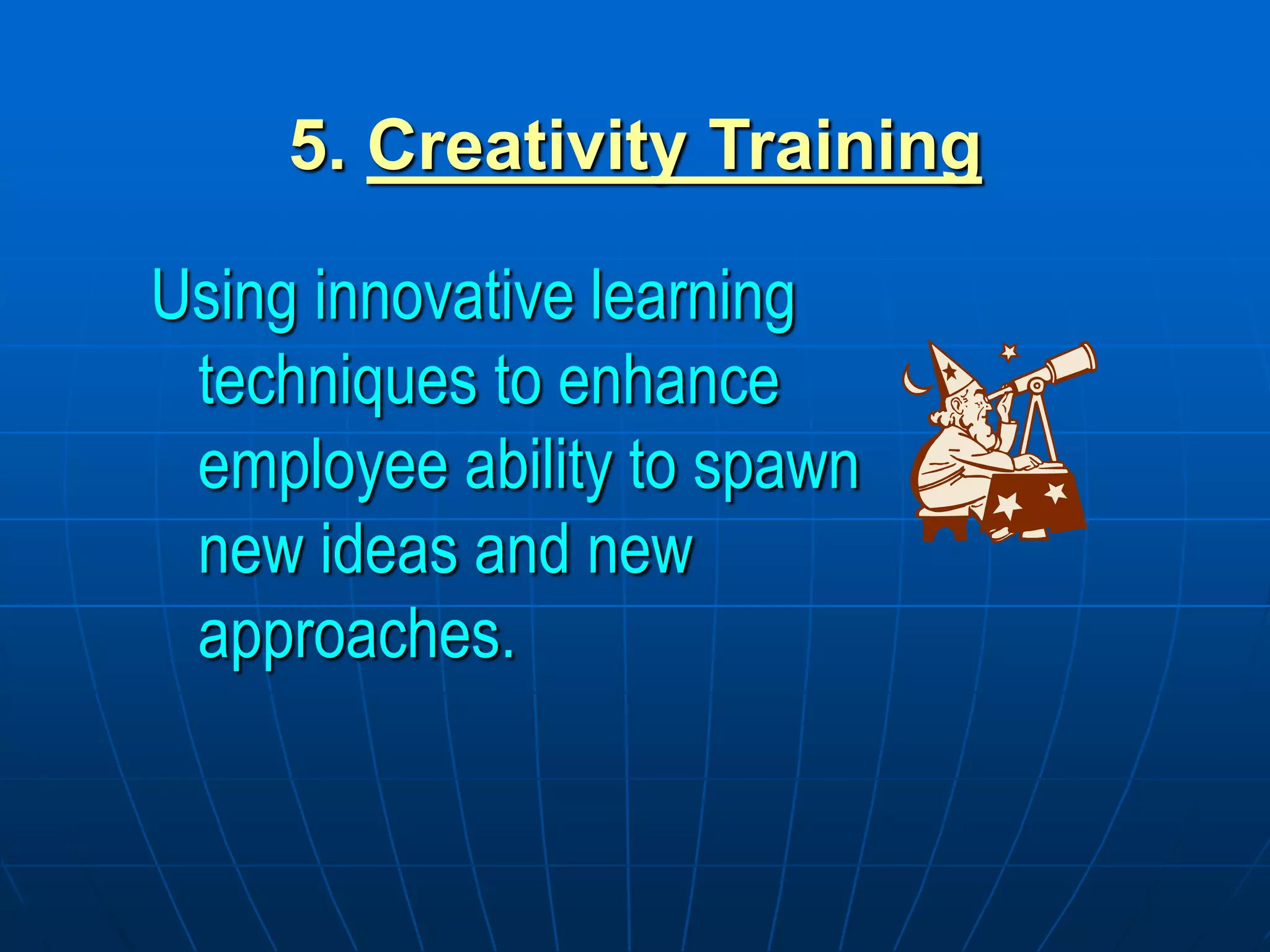
5. Creativity Training.
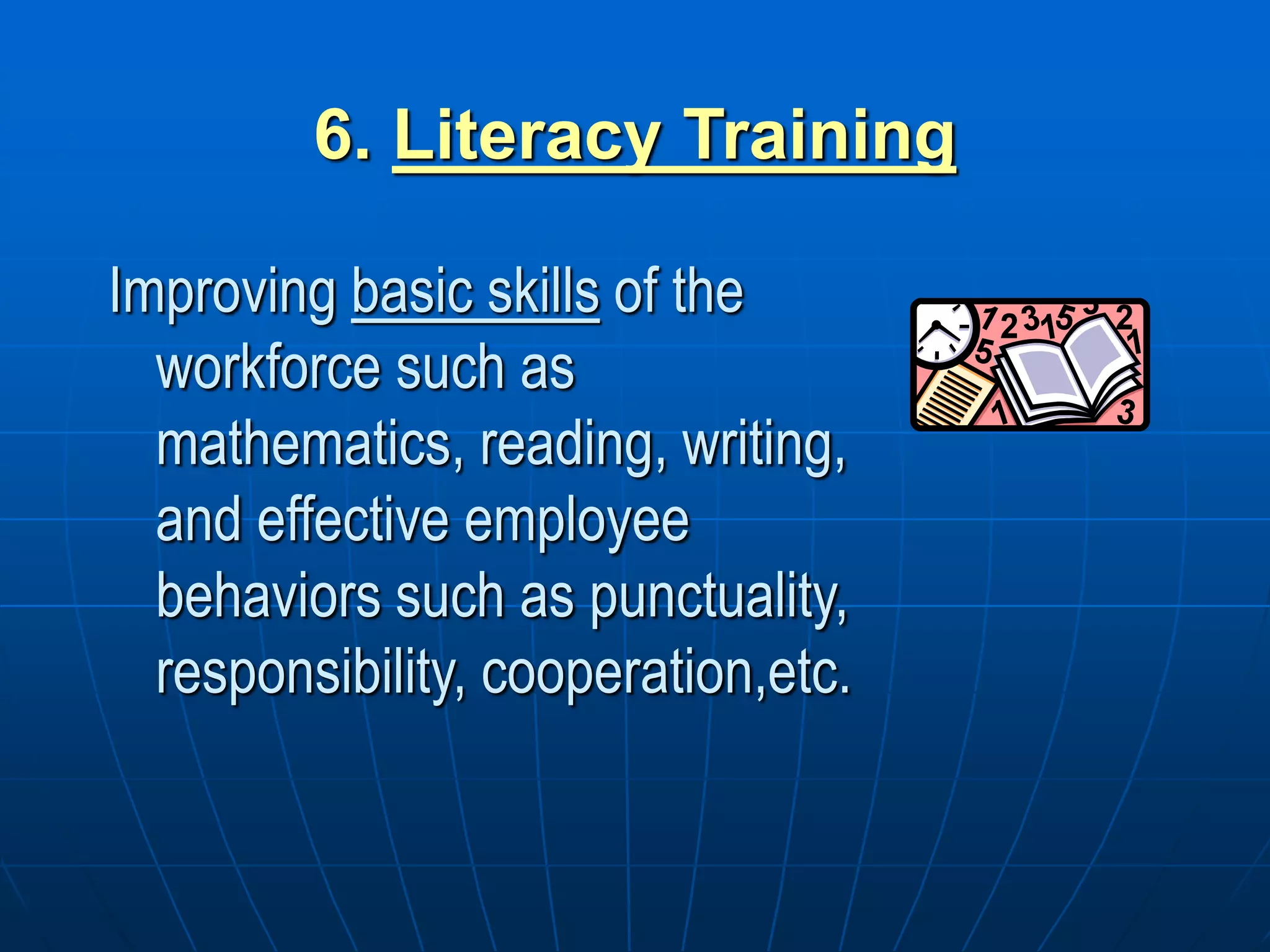
6. Literacy Training.
7. Diversity Training.
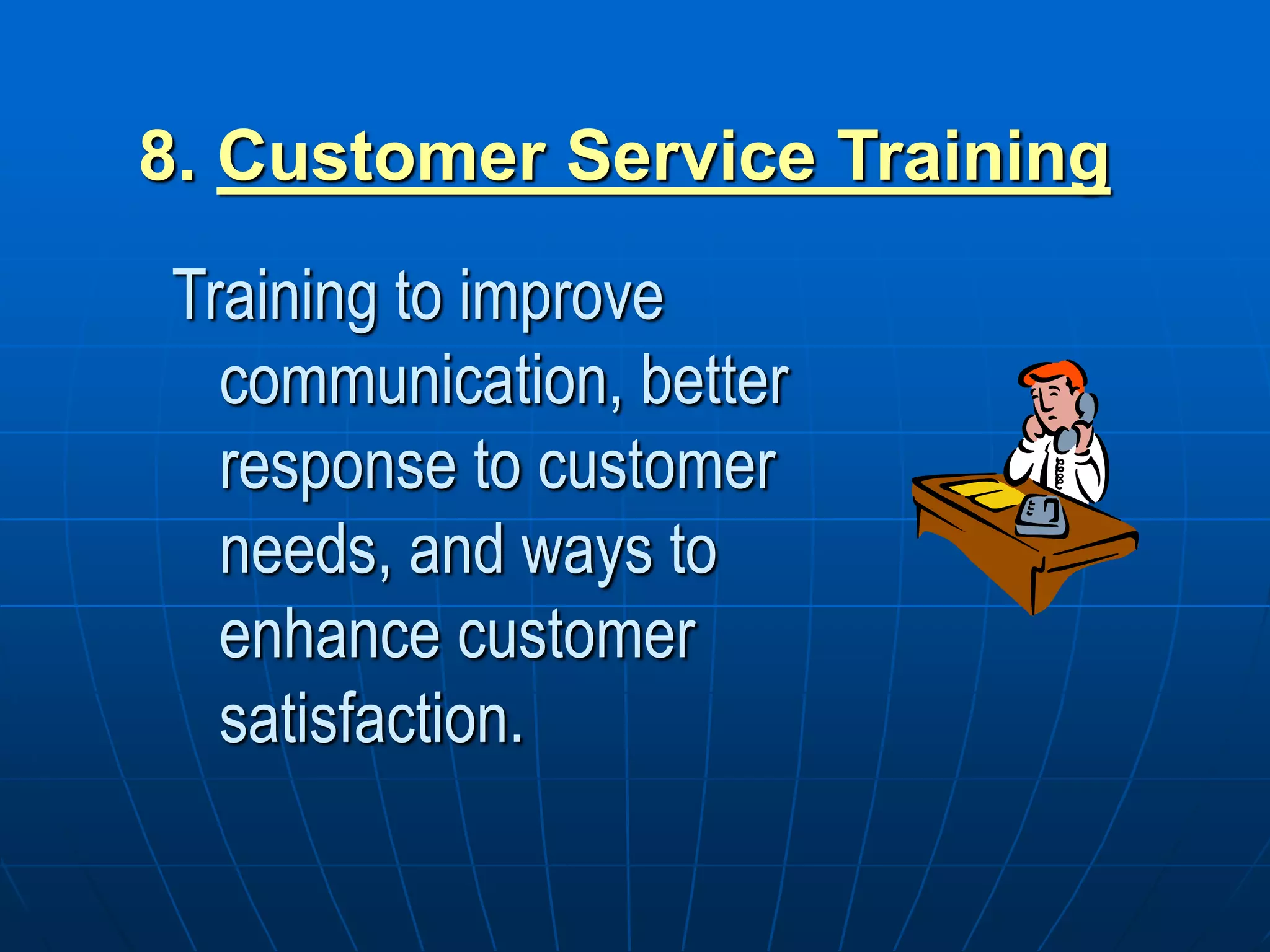
8. Customer Service.
3. Types of Training
1. SKILLS TRAINING
Focus on job knowledge
and skill for:
 Instructing new hires.
 Overcoming performance
deficits of the workforce.
2. Retraining
Maintaining worker knowledge and
skill as job requirements change due
to:
 Technological innovation
 Organizational restructuring
3. Cross-Functional Training
Training employees to perform a
wider variety of tasks in order to
gain:
 Flexibility in work scheduling.
 Improved coordination.
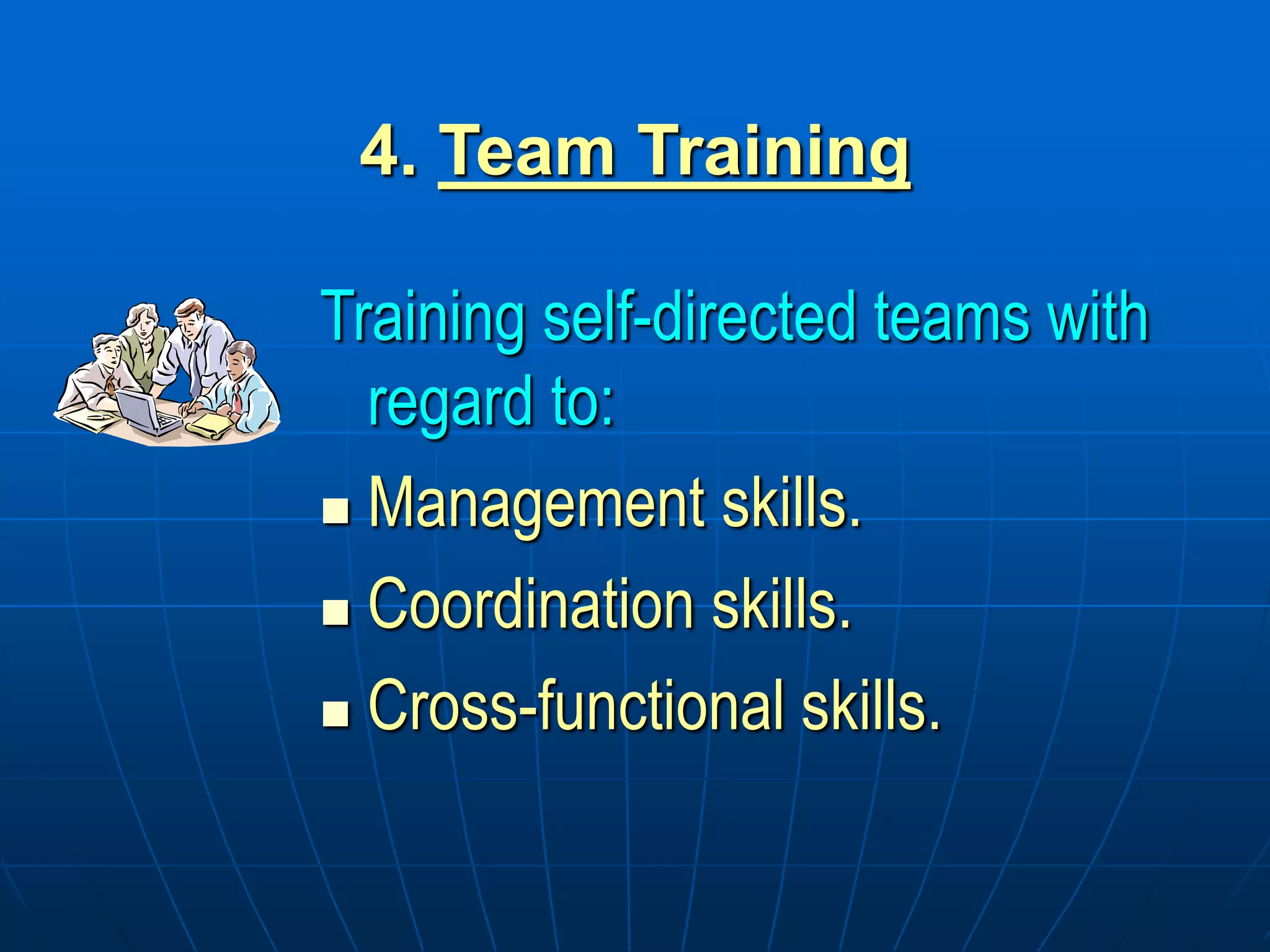
4. Team Training
Training self-directed teams with
regard to:
 Management skills.
 Coordination skills.
 Cross-functional skills.
5. Creativity Training
Using innovative learning
techniques to enhance
employee ability to spawn
new ideas and new
approaches.
6. Literacy Training
Improving basic skills of the
workforce such as
mathematics, reading, writing,
and effective employee
behaviors such as punctuality,
responsibility, cooperation,etc.
7. Diversity Training
Instituting a variety of programs
to instill awareness, tolerance,
respect, and acceptance of
persons of different race,
gender, etc. and different
backgrounds.
8. Customer Service Training
Training to improve
communication, better
response to customer
needs, and ways to
enhance customer
satisfaction.
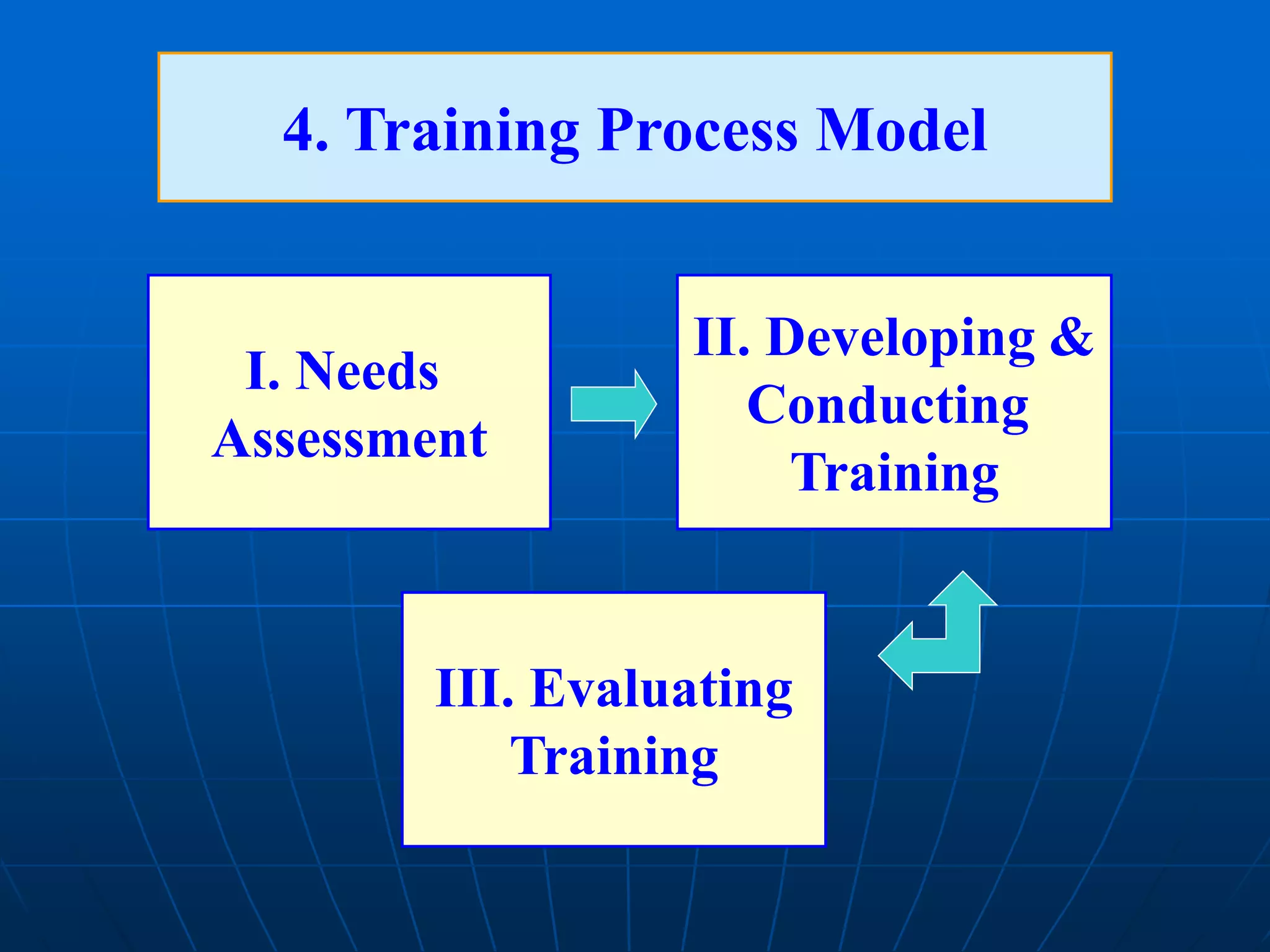
I. Needs
Assessment
II. Developing &
Conducting
Training
III. Evaluating
Training
4. Training Process Model
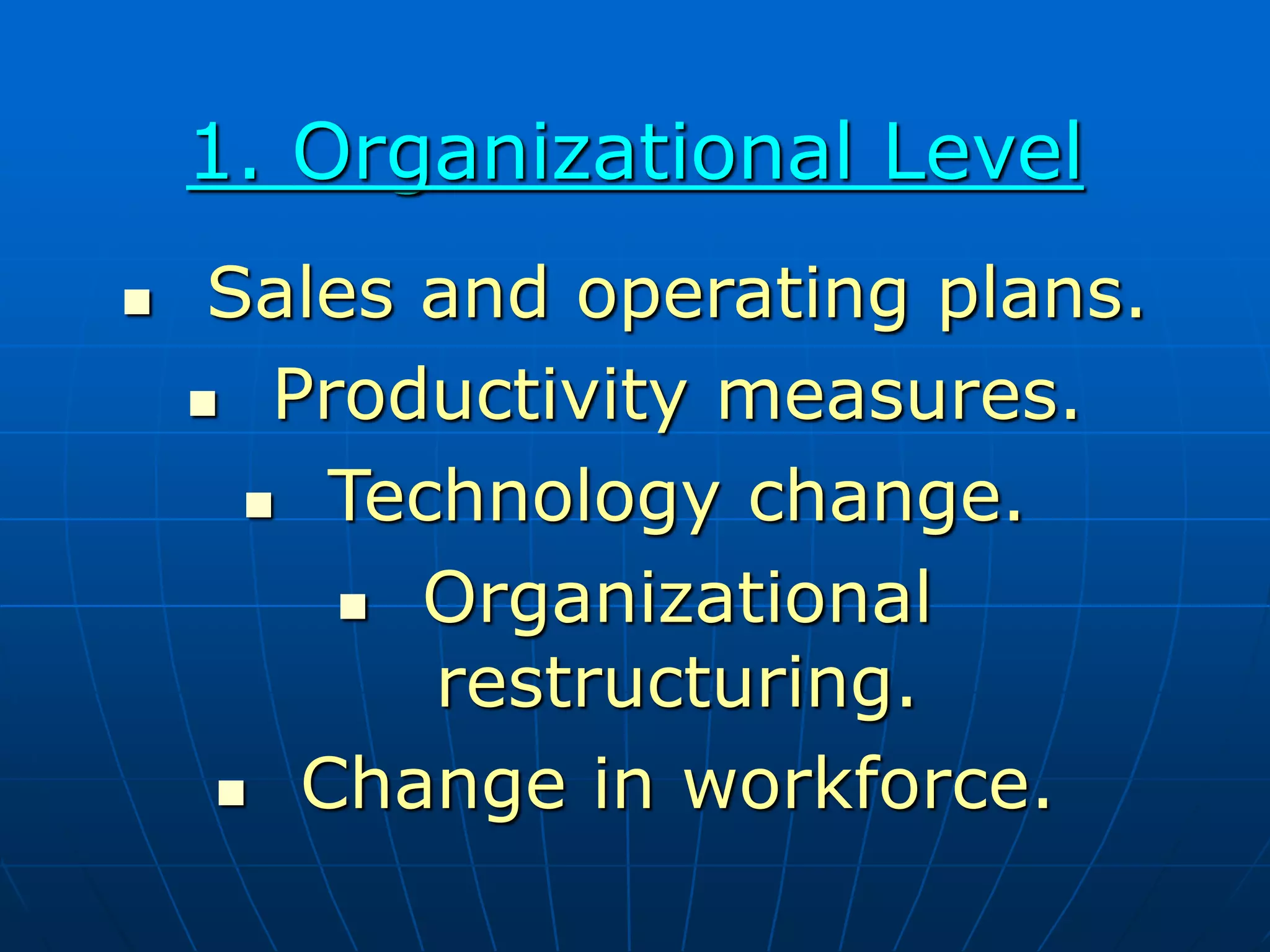
1. Organizational Level
 Sales and operating plans.
 Productivity measures.
 Technology change.
 Organizational
restructuring.
 Change in workforce.
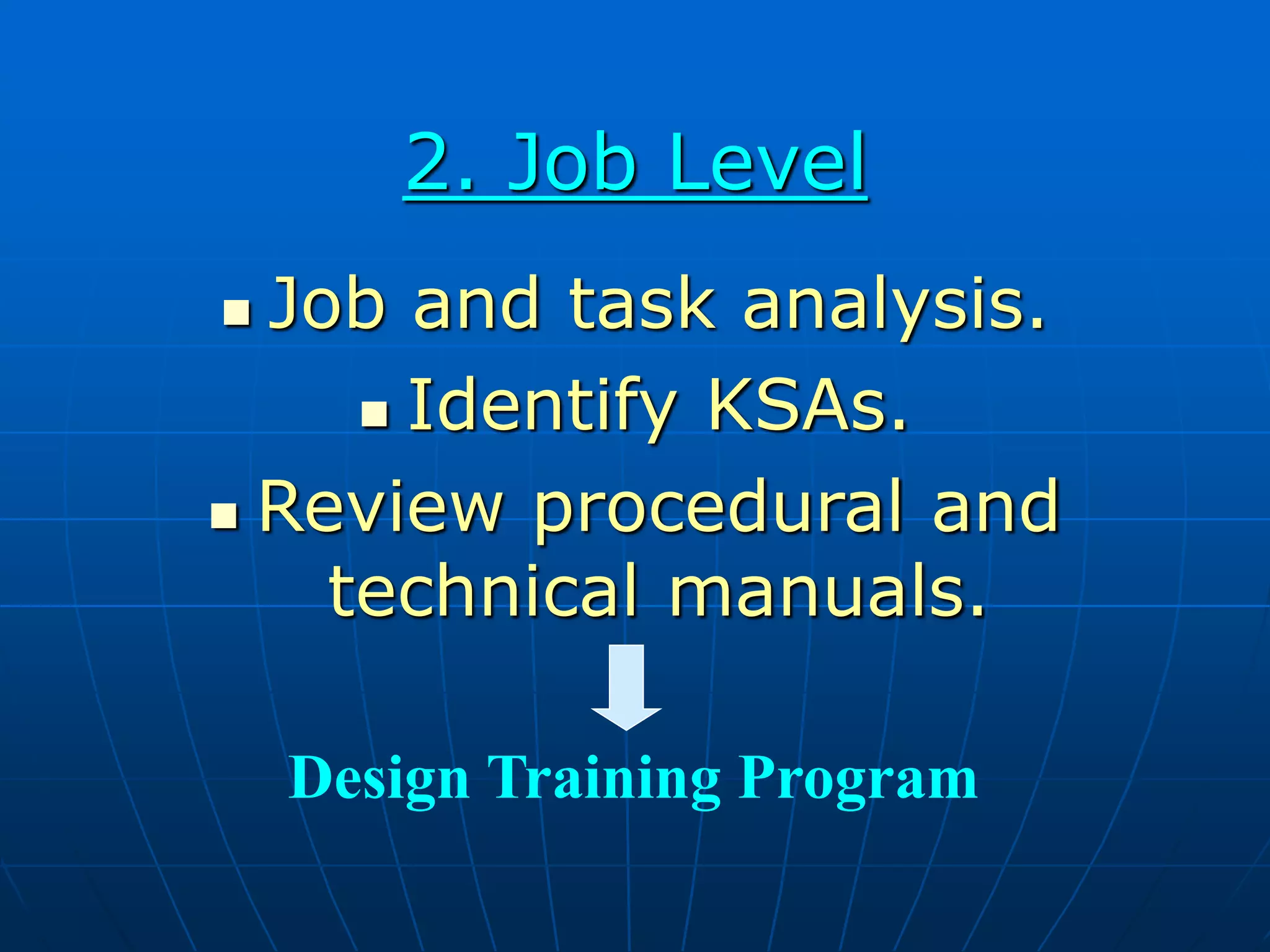
2. Job Level
 Job and task analysis.
 Identify KSAs.
 Review procedural and
technical manuals.
Design Training Program
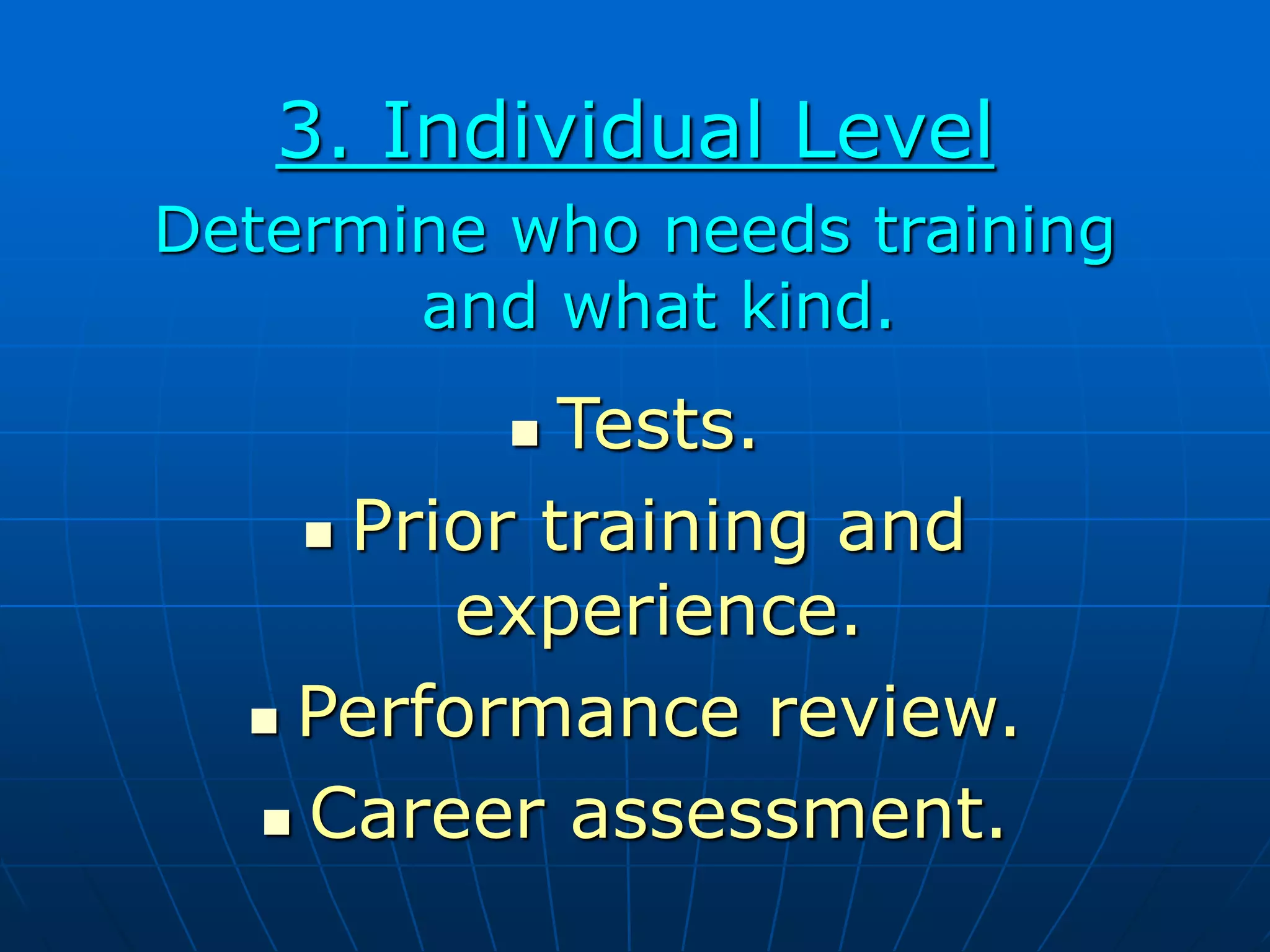
3. Individual Level
Determine who needs training
and what kind.
 Tests.
 Prior training and
experience.
 Performance review.
 Career assessment.
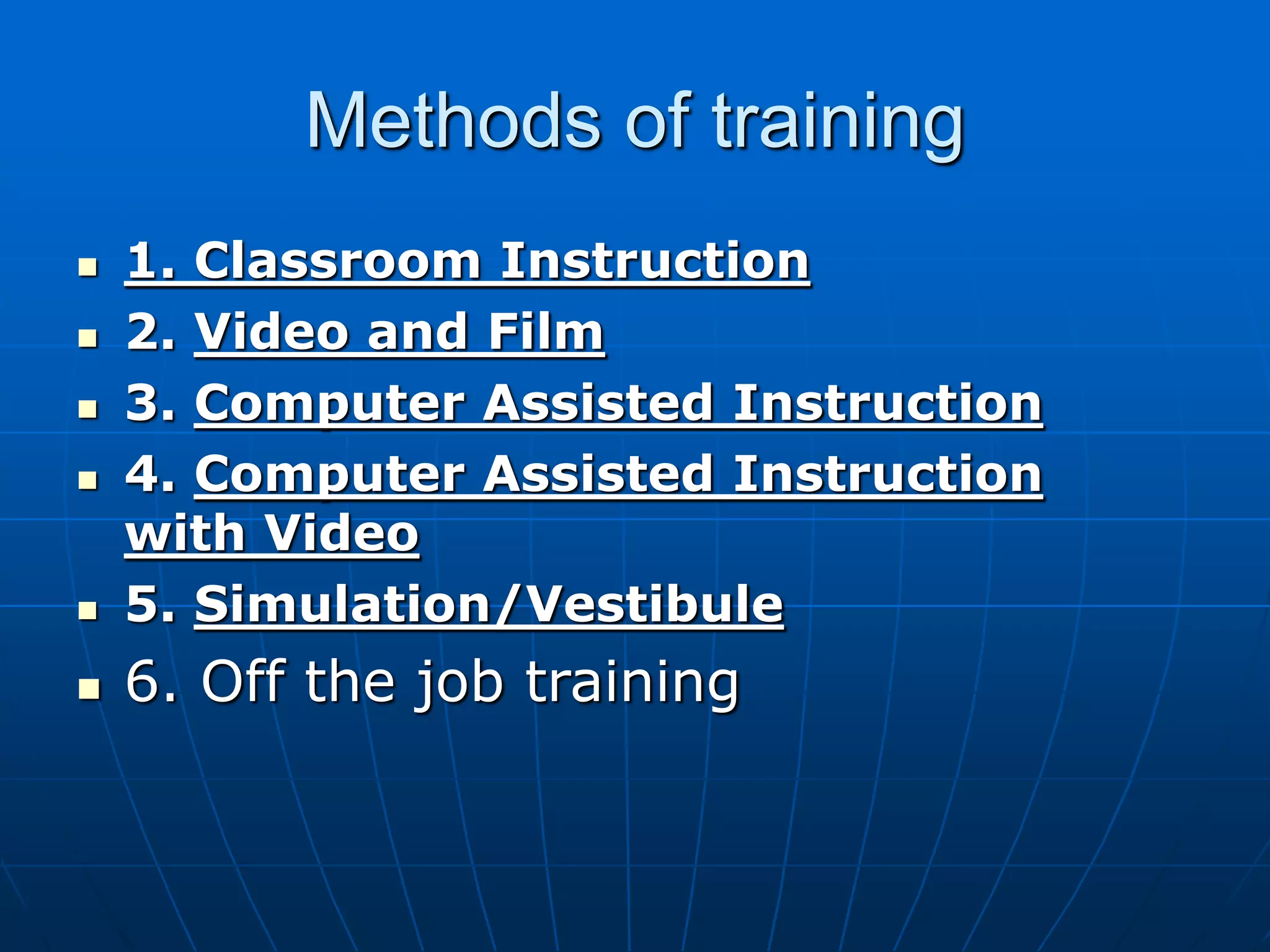
Methods of training
 1. Classroom Instruction
 2. Video and Film
 3. Computer Assisted Instruction
 4. Computer Assisted Instruction
with Video
 5. Simulation/Vestibule
 6. Off the job training
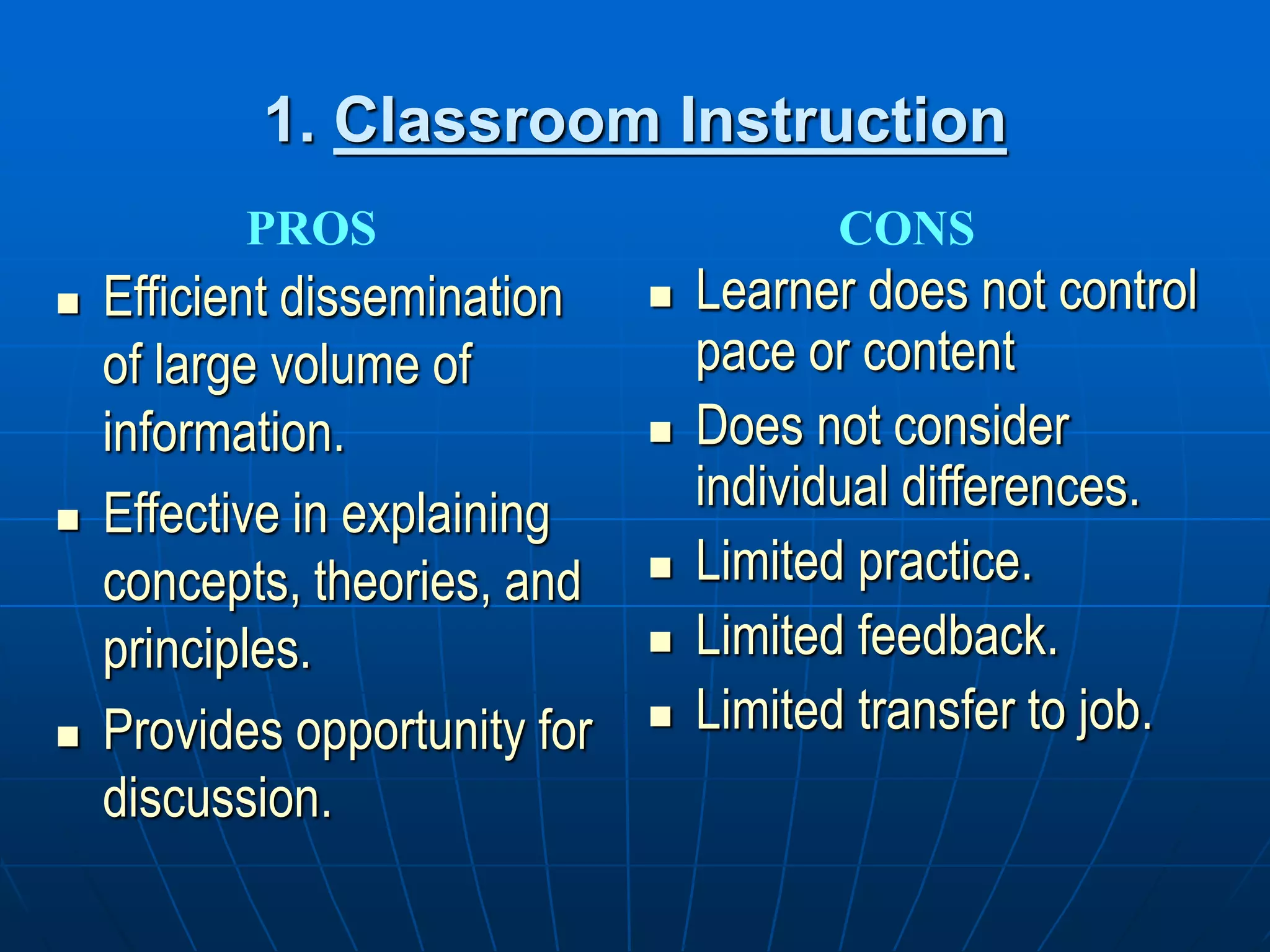
1. Classroom Instruction
 Efficient dissemination
of large volume of
information.
 Effective in explaining
concepts, theories, and
principles.
 Provides opportunity for
discussion.
 Learner does not control
pace or content
 Does not consider
individual differences.
 Limited practice.
 Limited feedback.
 Limited transfer to job.
PROS CONS
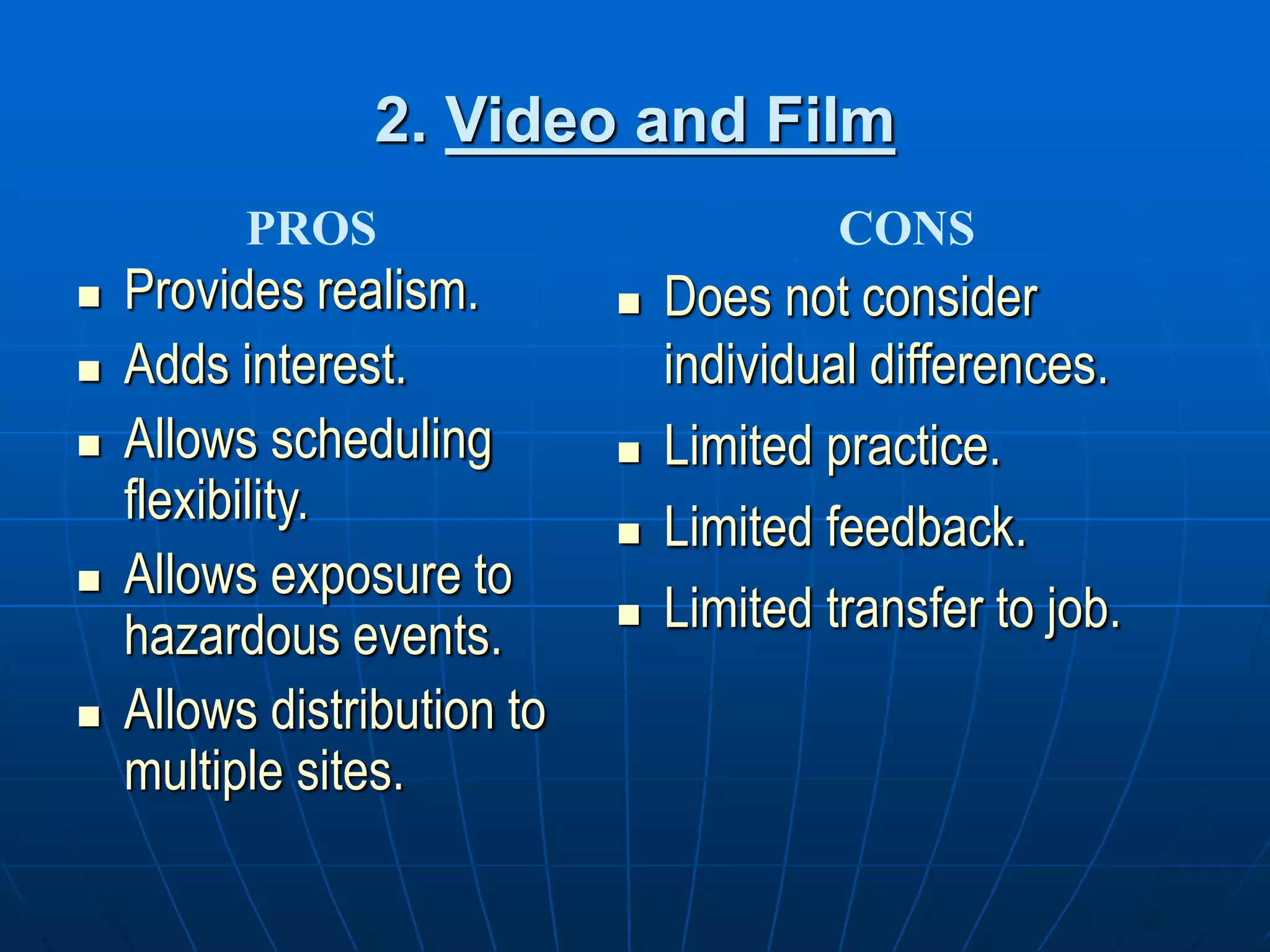
2. Video and Film
 Provides realism.
 Adds interest.
 Allows scheduling
flexibility.
 Allows exposure to
hazardous events.
 Allows distribution to
multiple sites.
 Does not consider
individual differences.
 Limited practice.
 Limited feedback.
 Limited transfer to job.
PROS CONS
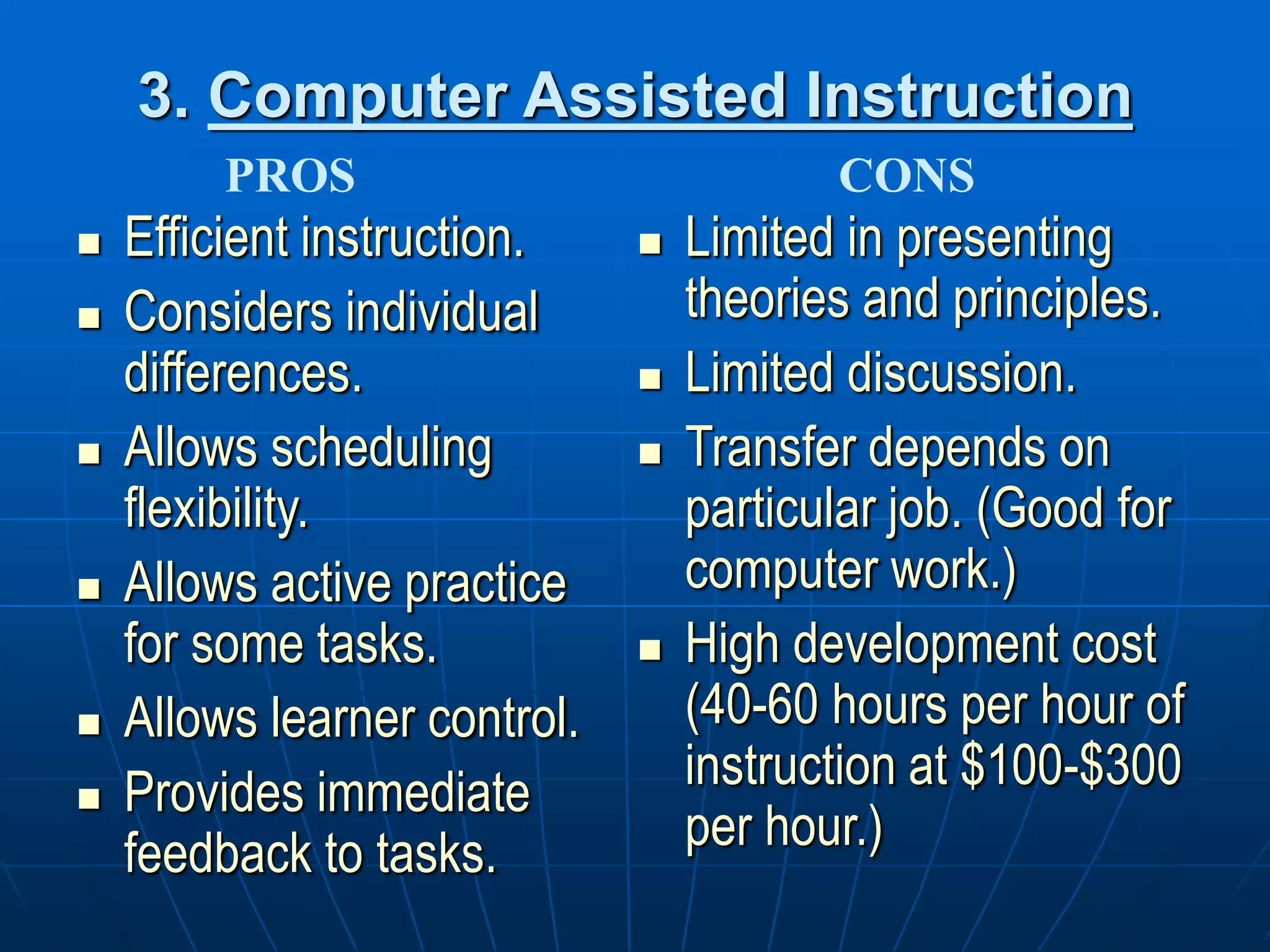
3. Computer Assisted Instruction
 Efficient instruction.
 Considers individual
differences.
 Allows scheduling
flexibility.
 Allows active practice
for some tasks.
 Allows learner control.
 Provides immediate
feedback to tasks.
 Limited in presenting
theories and principles.
 Limited discussion.
 Transfer depends on
particular job. (Good for
computer work.)
 High development cost
(40-60 hours per hour of
instruction at $100-$300
per hour.)
PROS CONS
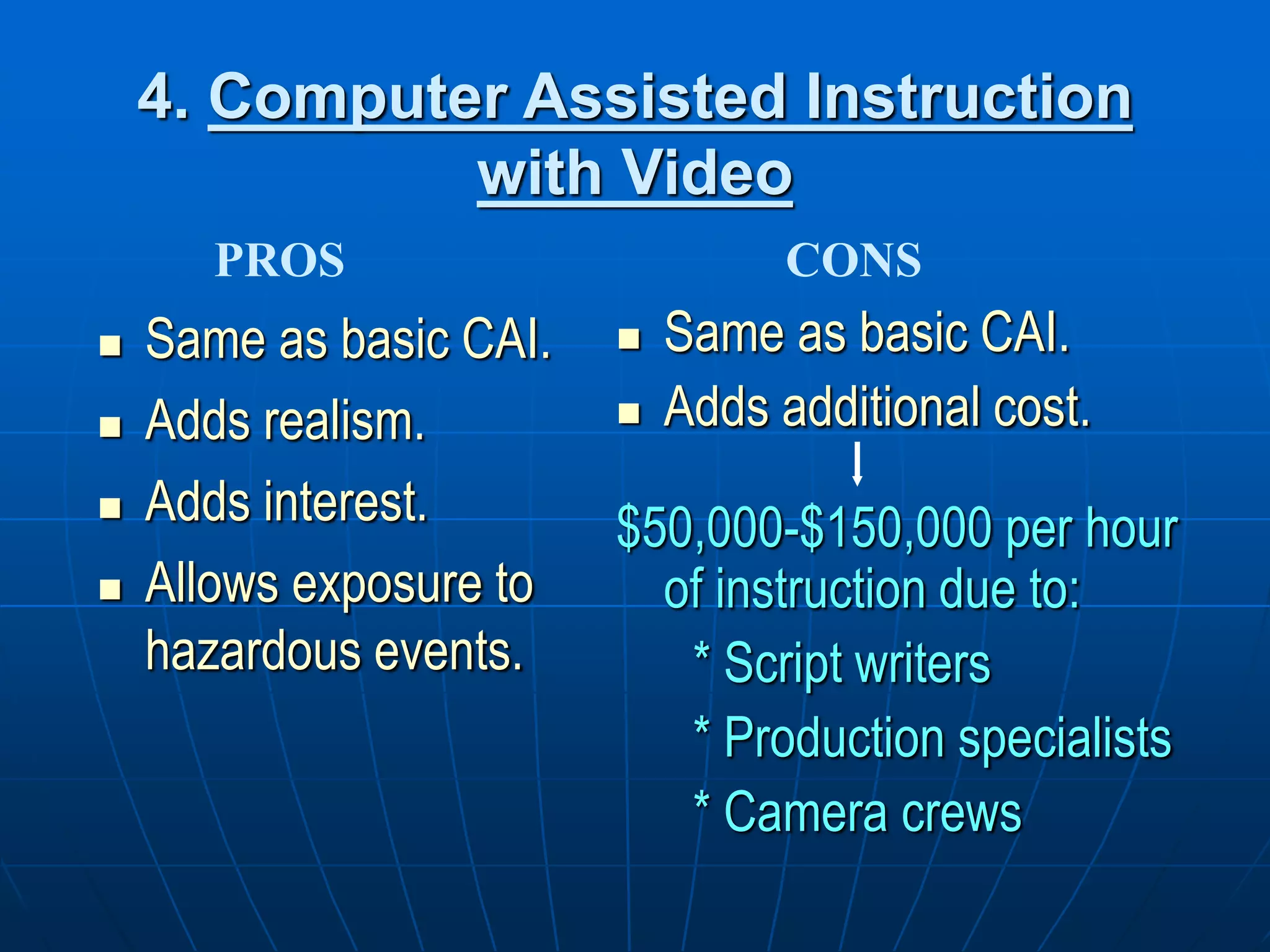
4. Computer Assisted Instruction
with Video
 Same as basic CAI.
 Adds realism.
 Adds interest.
 Allows exposure to
hazardous events.
 Same as basic CAI.
 Adds additional cost.
$50,000-$150,000 per hour
of instruction due to:
* Script writers
* Production specialists
* Camera crews
PROS CONS
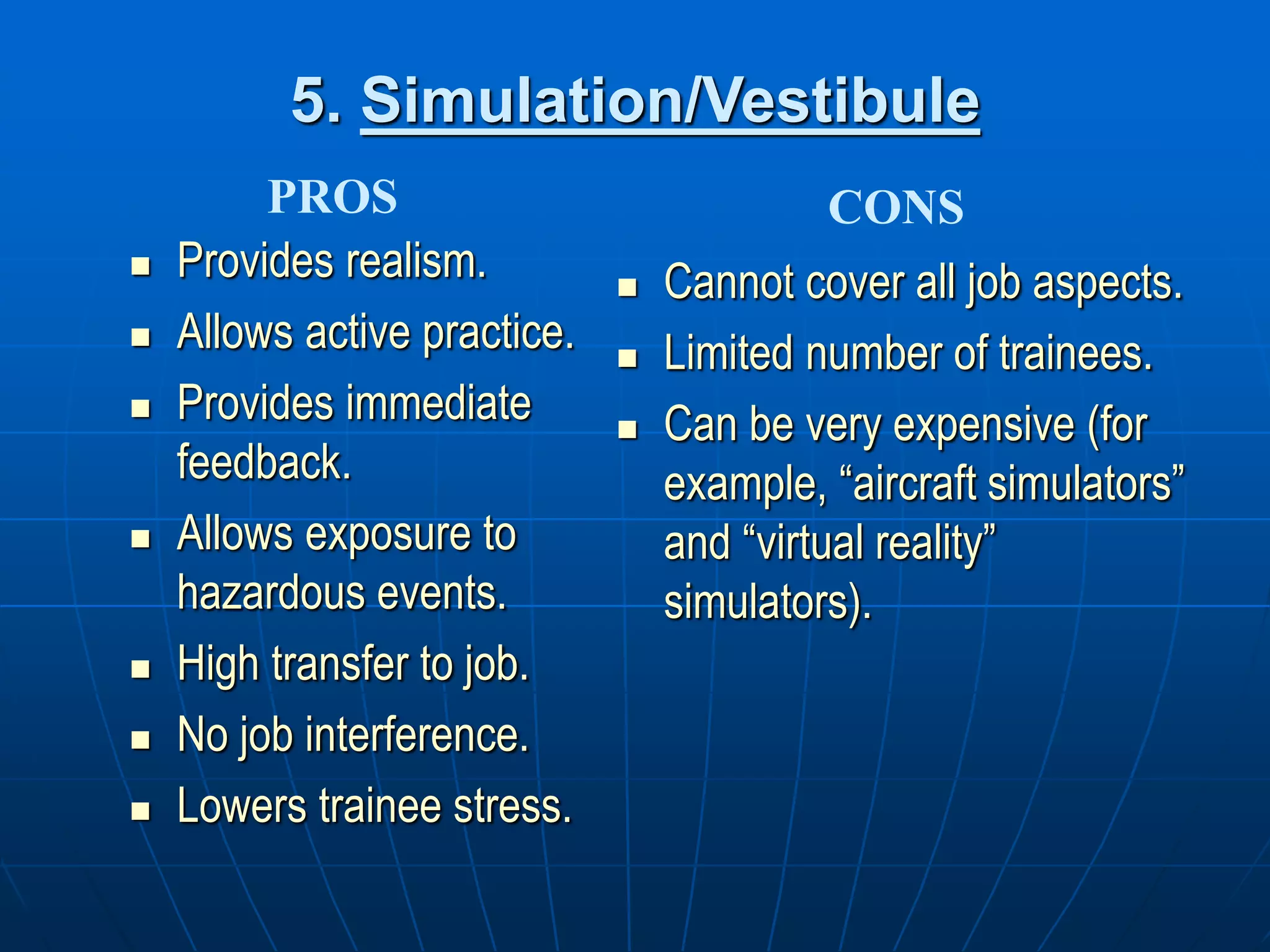
5. Simulation/Vestibule
 Provides realism.
 Allows active practice.
 Provides immediate
feedback.
 Allows exposure to
hazardous events.
 High transfer to job.
 No job interference.
 Lowers trainee stress.
 Cannot cover all job aspects.
 Limited number of trainees.
 Can be very expensive (for
example, “aircraft simulators”
and “virtual reality”
simulators).
PROS CONS
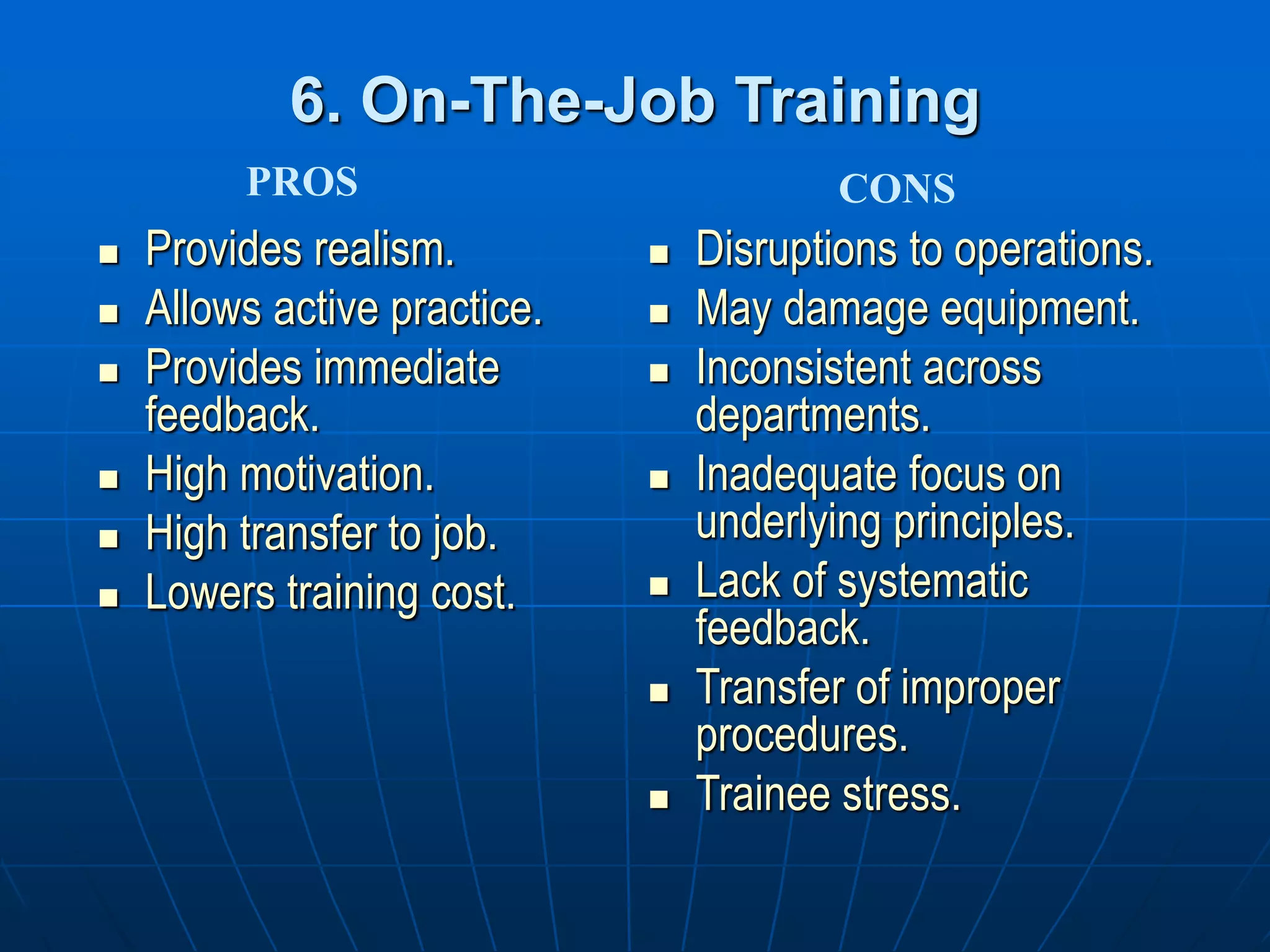
6. On-The-Job Training
 Provides realism.
 Allows active practice.
 Provides immediate
feedback.
 High motivation.
 High transfer to job.
 Lowers training cost.
 Disruptions to operations.
 May damage equipment.
 Inconsistent across
departments.
 Inadequate focus on
underlying principles.
 Lack of systematic
feedback.
 Transfer of improper
procedures.
 Trainee stress.
PROS CONS
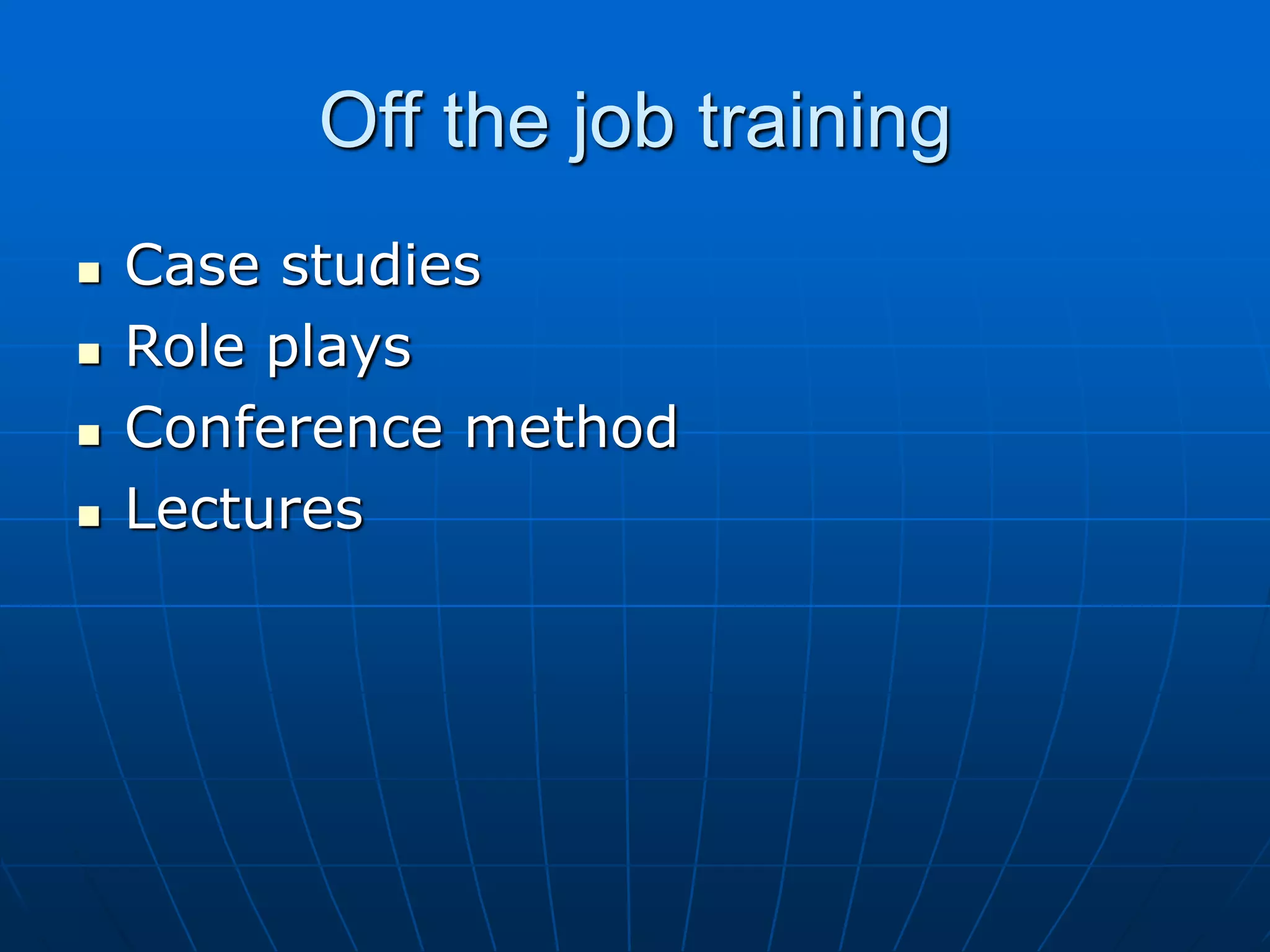
Off the job training
 Case studies
 Role plays
 Conference method
 Lectures
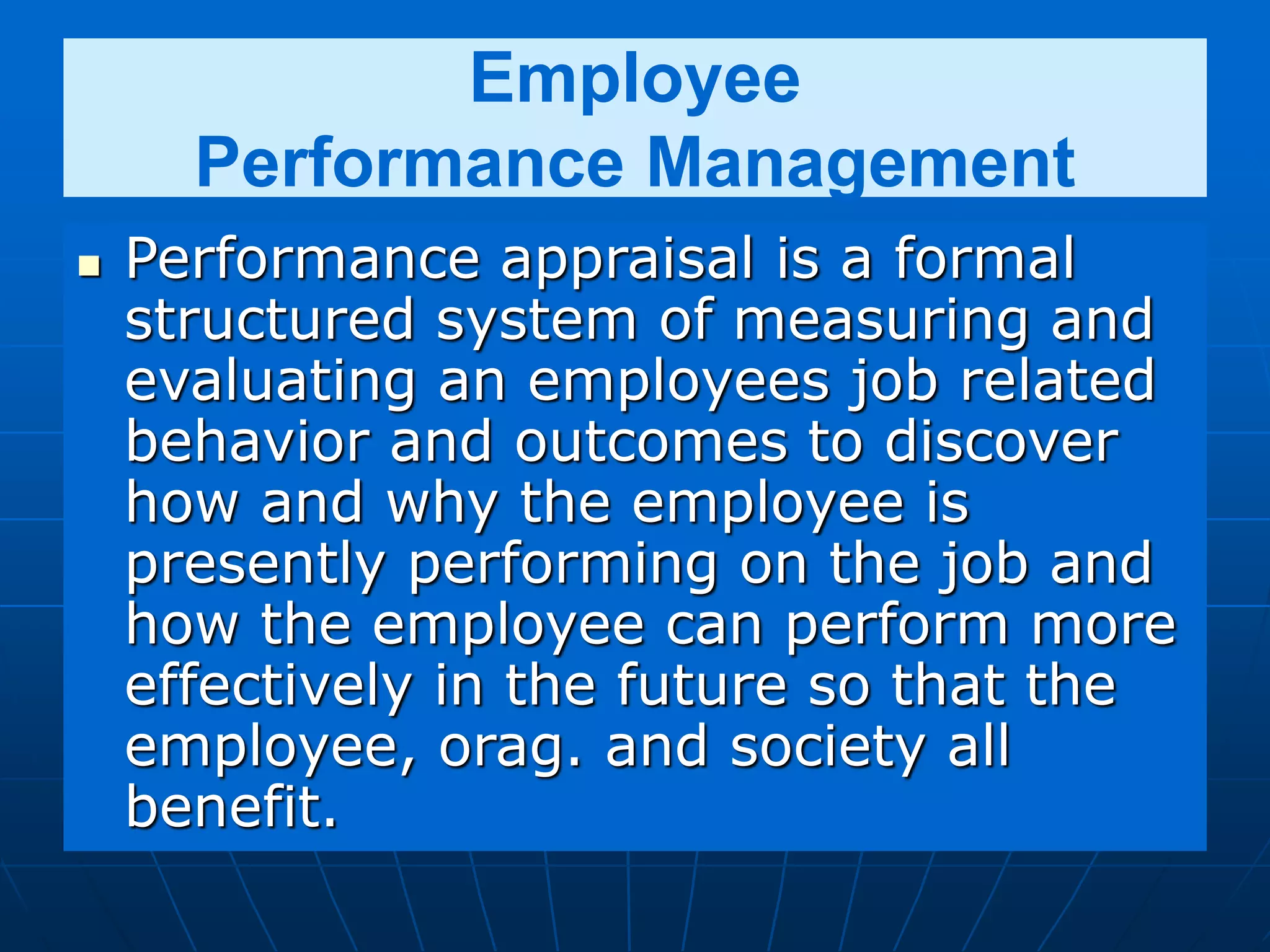
Employee
Performance Management
 Performance appraisal is a formal
structured system of measuring and
evaluating an employees job related
behavior and outcomes to discover
how and why the employee is
presently performing on the job and
how the employee can perform more
effectively in the future so that the
employee, orag. and society all
benefit.
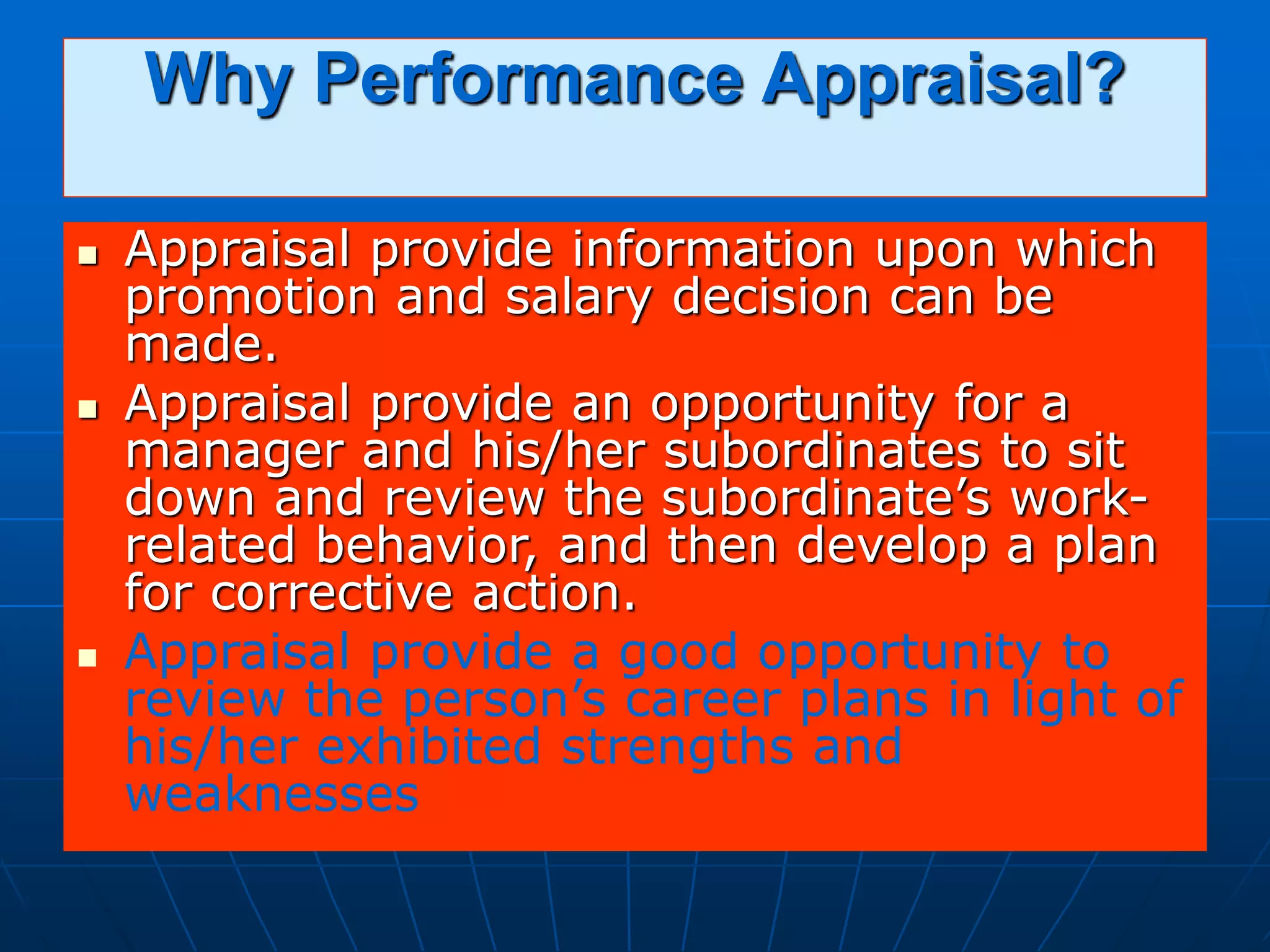
Why Performance Appraisal?
 Appraisal provide information upon which
promotion and salary decision can be
made.
 Appraisal provide an opportunity for a
manager and his/her subordinates to sit
down and review the subordinate’s work-
related behavior, and then develop a plan
for corrective action.
 Appraisal provide a good opportunity to
review the person’s career plans in light of
his/her exhibited strengths and
weaknesses
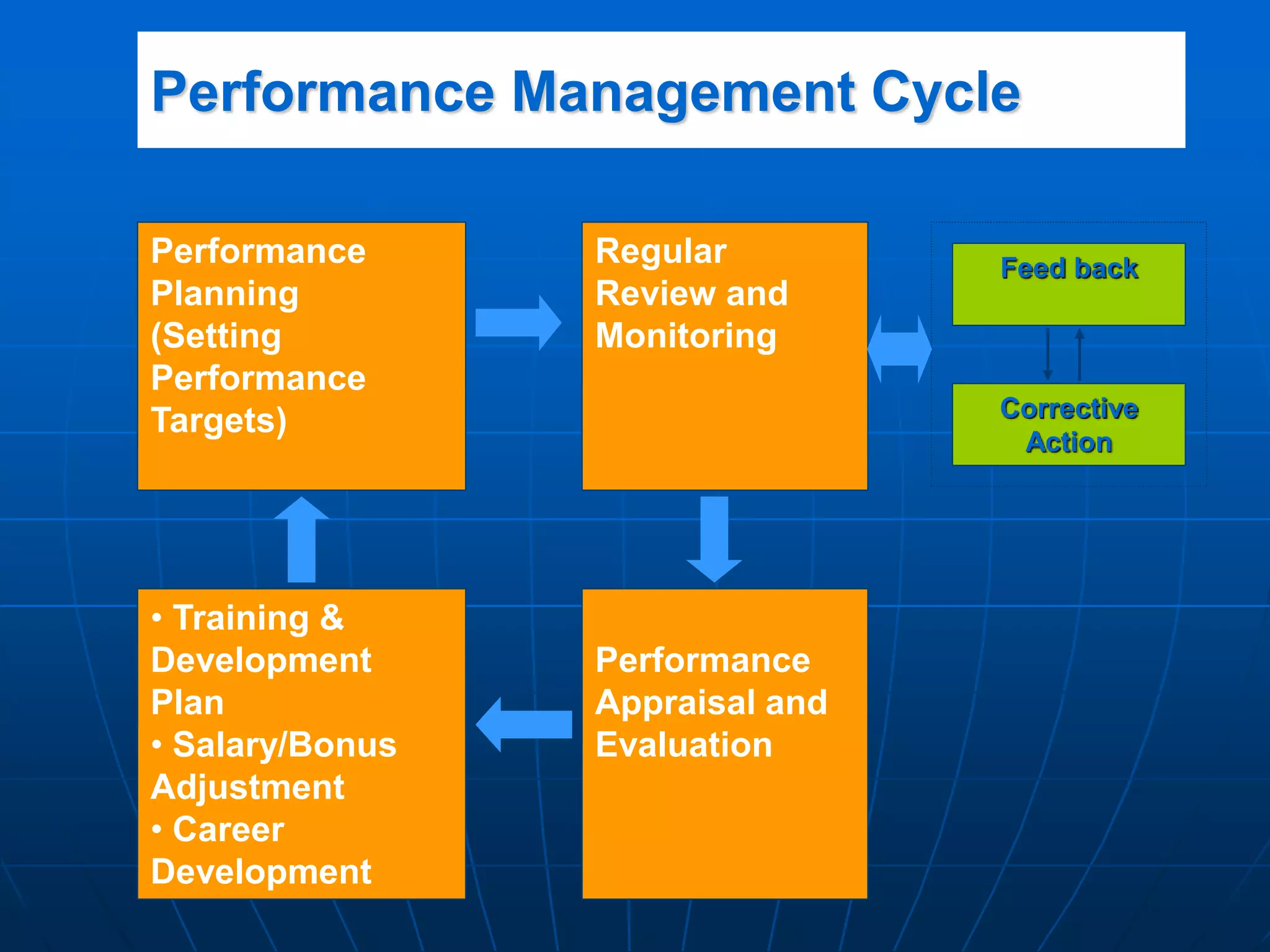
Performance Management Cycle
Performance
Planning
(Setting
Performance
Targets)
Regular
Review and
Monitoring
Feed back
Corrective
Action
Performance
Appraisal and
Evaluation
• Training &
Development
Plan
• Salary/Bonus
Adjustment
• Career
Development
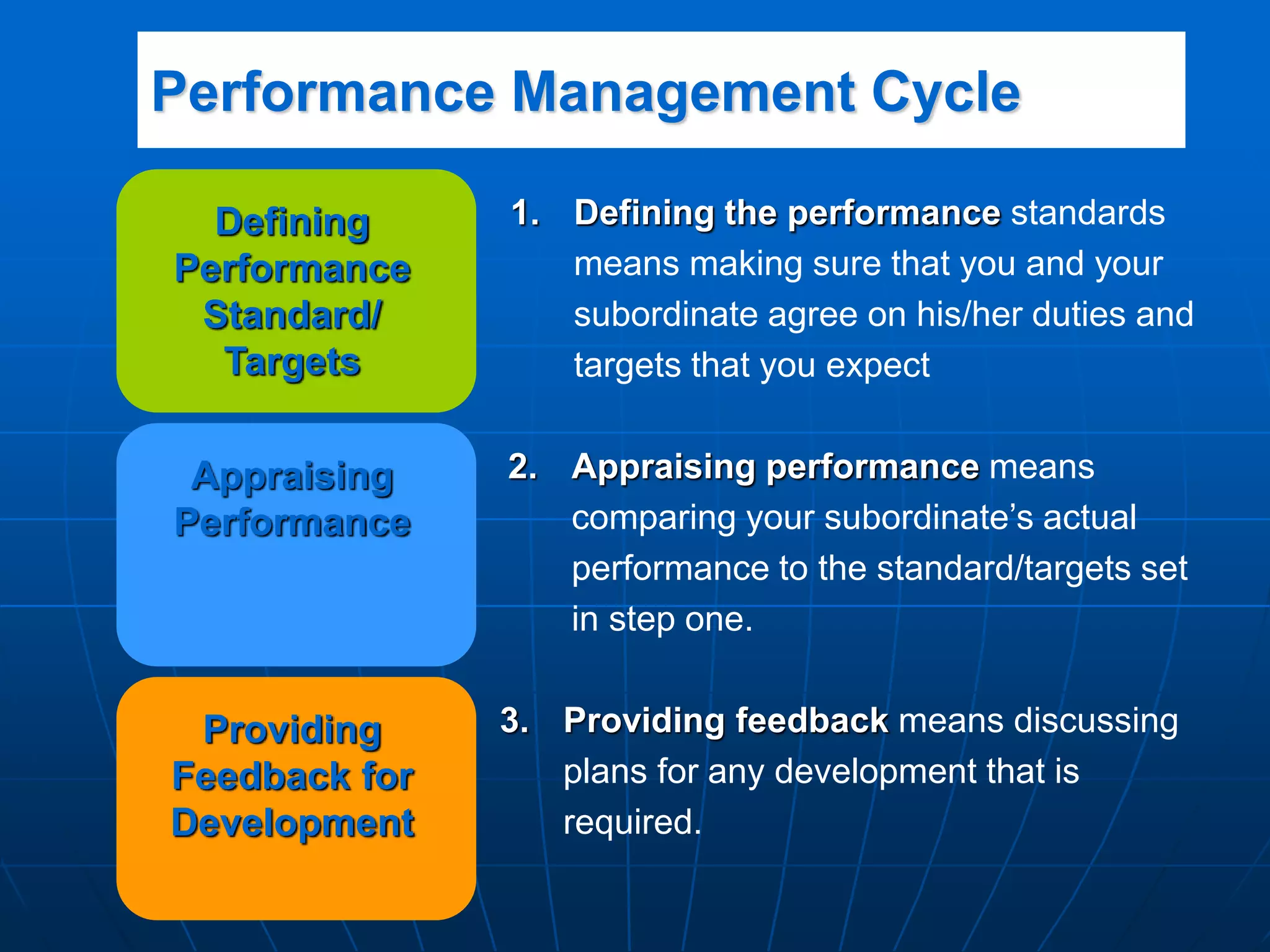
Performance Management Cycle
Defining
Performance
Standard/
Targets
Appraising
Performance
Providing
Feedback for
Development
1. Defining the performance standards
means making sure that you and your
subordinate agree on his/her duties and
targets that you expect
2. Appraising performance means
comparing your subordinate’s actual
performance to the standard/targets set
in step one.
3. Providing feedback means discussing
plans for any development that is
required.
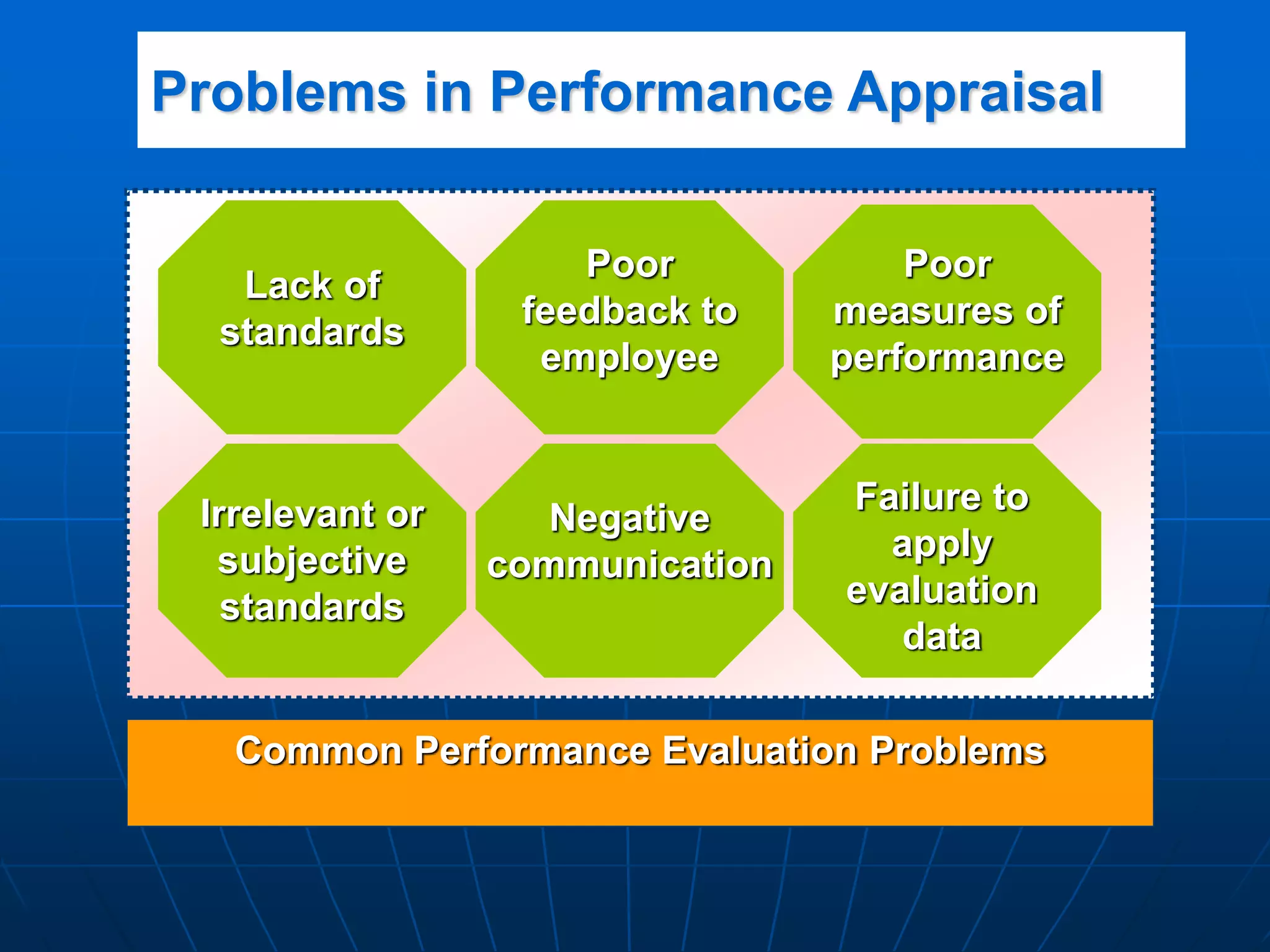
Problems in Performance Appraisal
Lack of
standards
Irrelevant or
subjective
standards
Poor
measures of
performance
Poor
feedback to
employee
Negative
communication
Failure to
apply
evaluation
data
Common Performance Evaluation Problems
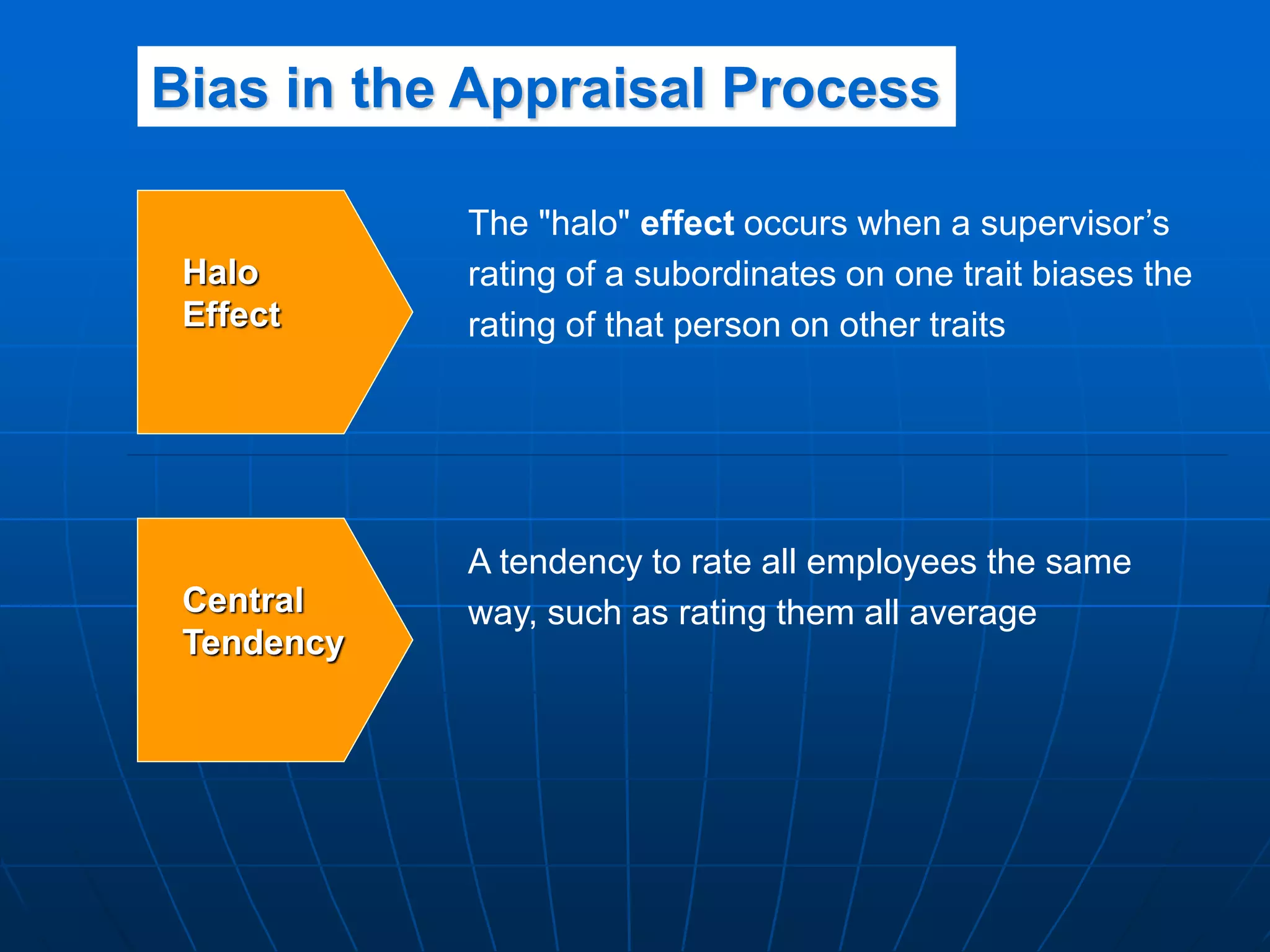
Bias in the Appraisal Process
Halo
Effect
The "halo" effect occurs when a supervisor’s
rating of a subordinates on one trait biases the
rating of that person on other traits
Central
Tendency
A tendency to rate all employees the same
way, such as rating them all average
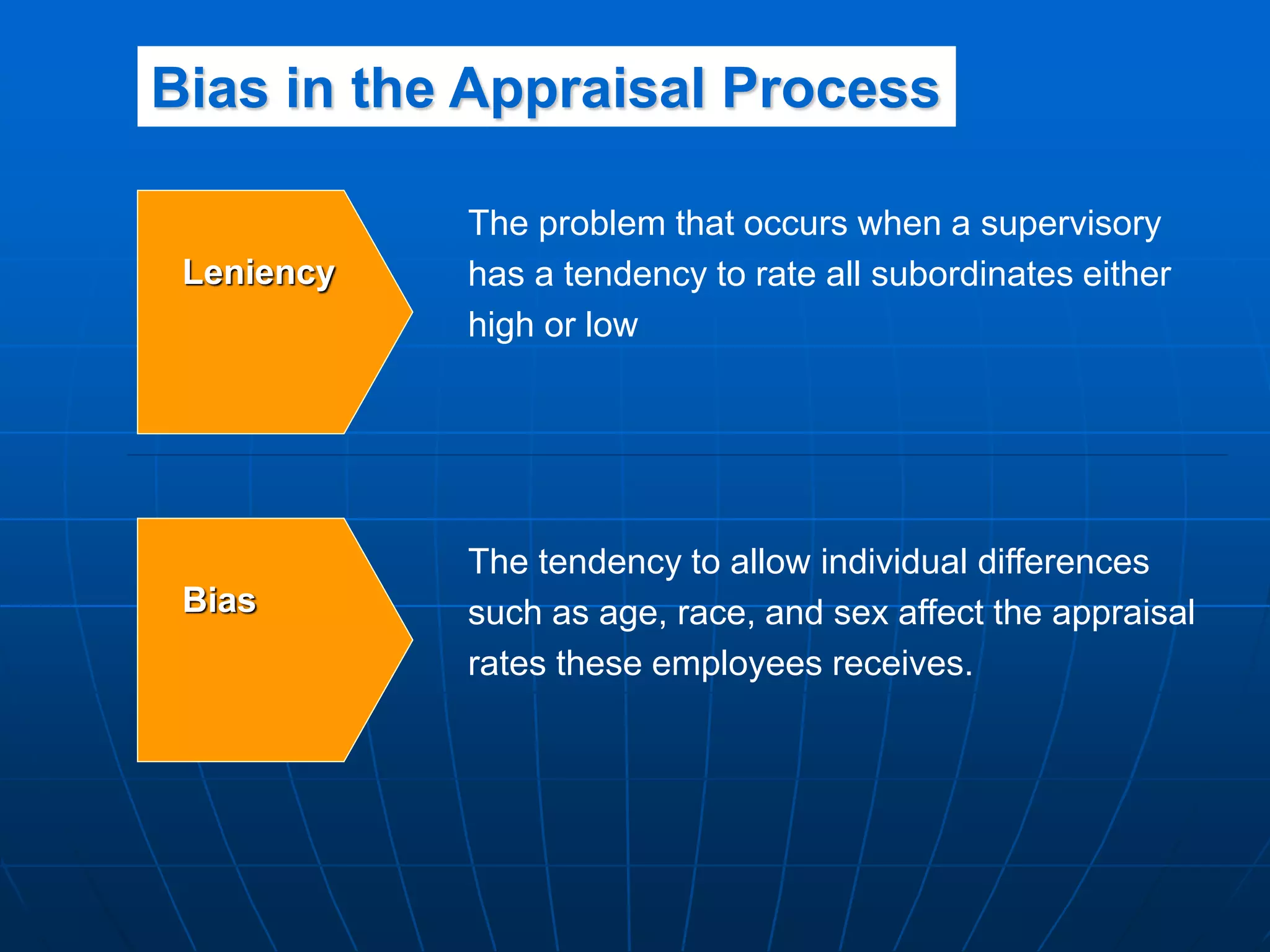
Leniency
The problem that occurs when a supervisory
has a tendency to rate all subordinates either
high or low
Bias
The tendency to allow individual differences
such as age, race, and sex affect the appraisal
rates these employees receives.
Bias in the Appraisal Process
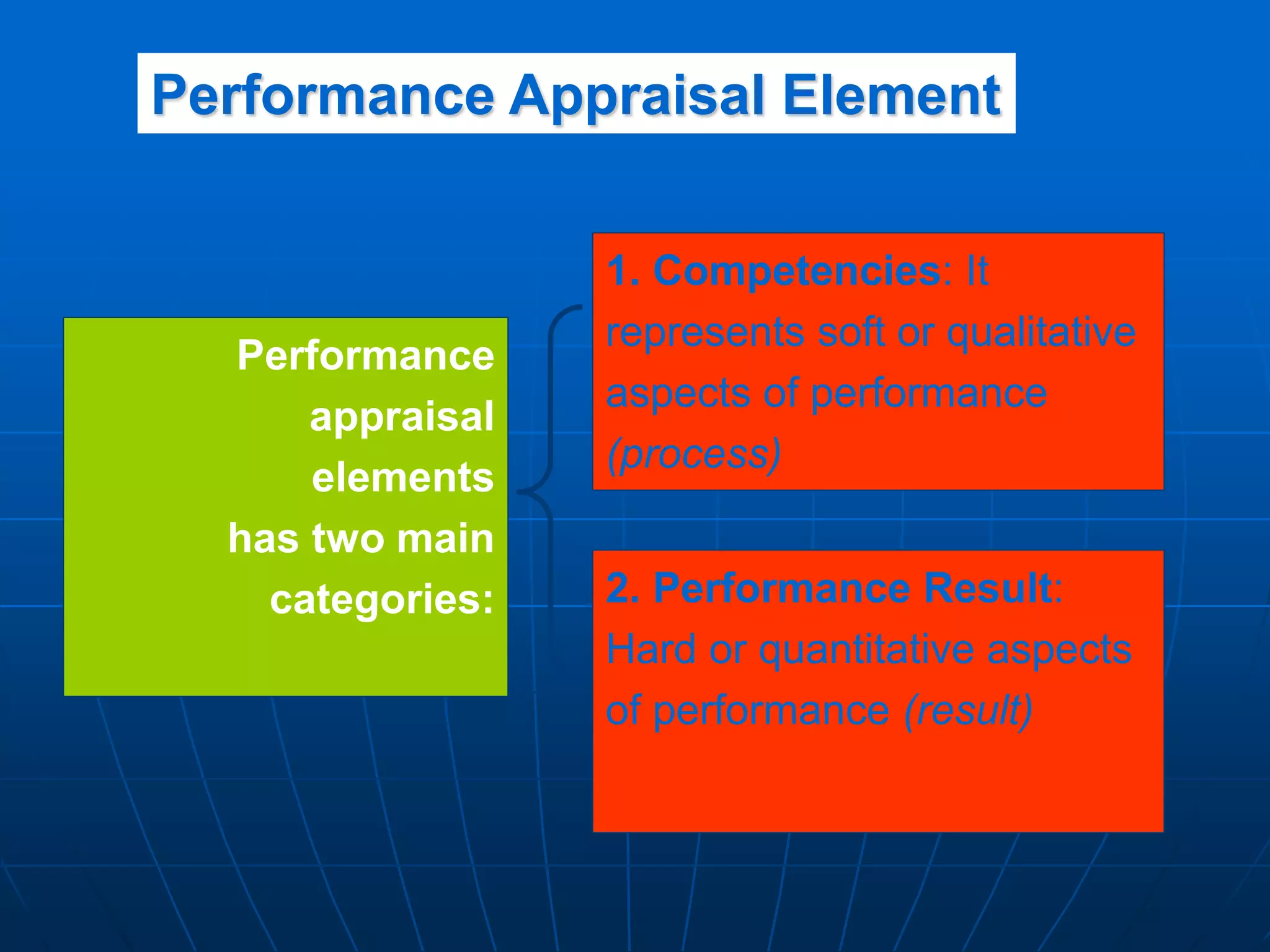
Performance
appraisal
elements
has two main
categories: 2. Performance Result:
Hard or quantitative aspects
of performance (result)
1. Competencies: It
represents soft or qualitative
aspects of performance
(process)
Performance Appraisal Element
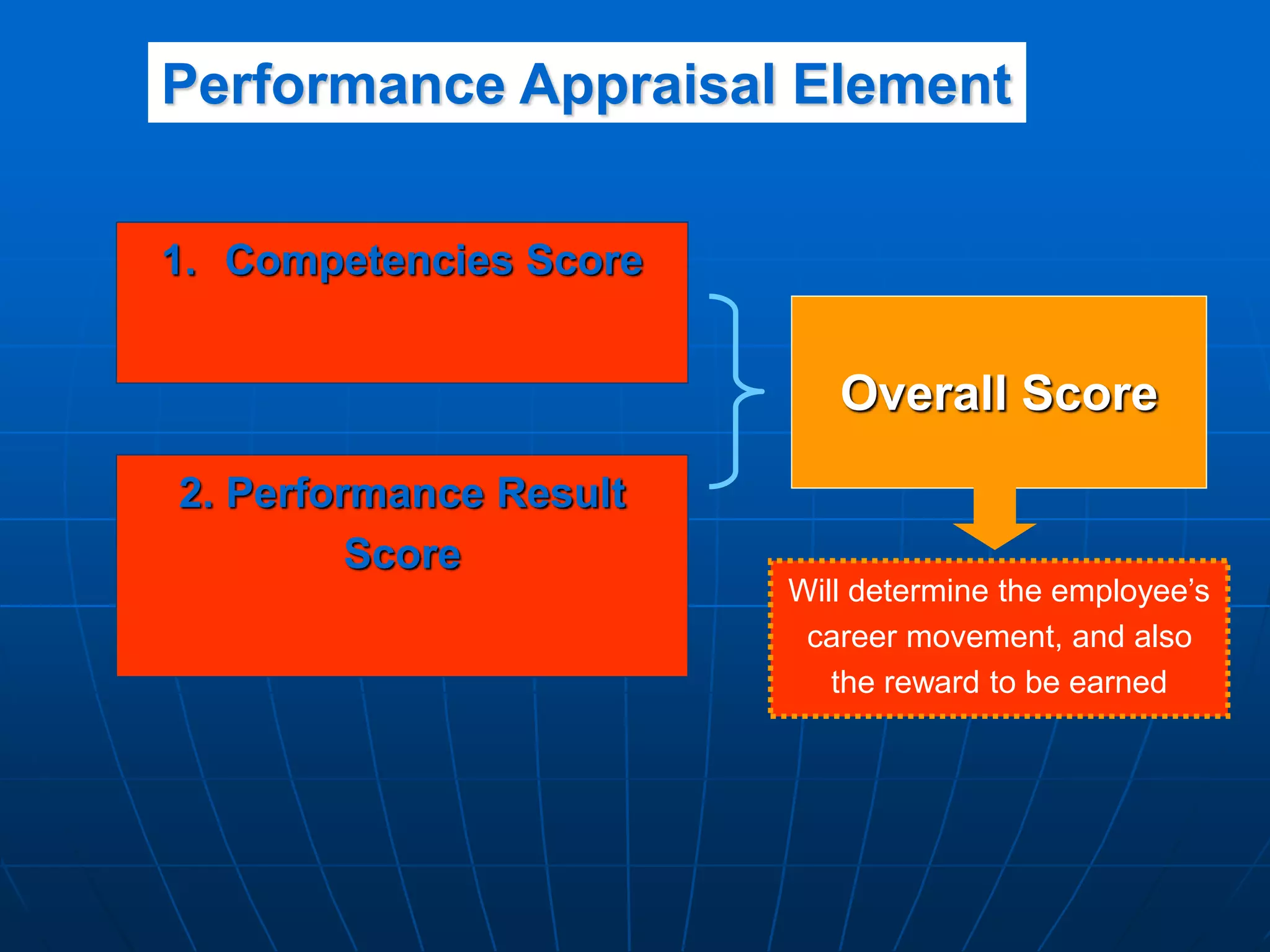
1. Competencies Score
2. Performance Result
Score
Overall Score
Will determine the employee’s
career movement, and also
the reward to be earned
Performance Appraisal Element
Employee Career
Management
Training ppt

Training ppt

  • 1.
    Training and Development 1.Training vs. Development. 2. Importance of Training. 3. Types of Training. 4. Training Process Model. 5. Learning Principles. 6. Training Methods.
  • 2.
    1. Difference BetweenTraining Training focuses on specific job knowledge and skill that is to be applied in the short run. Development focuses on broad knowledge and insights that may be required for adaptation to environmental demands in the future. 1. Training vs. Development
  • 3.
    1. Respond totechnology changes affecting job requirements. 2. Respond to organizational restructuring. 3. Adapt to increased diversity of the workforce. 4. Support career development. 5. Fulfill employee need for growth. 2. Importance of Training
  • 4.
    3. Types ofTraining 1. Skills Training. 2. Retraining. 3. Cross-Functional. 4. Team Training. 5. Creativity Training. 6. Literacy Training. 7. Diversity Training. 8. Customer Service. 3. Types of Training
  • 5.
    1. SKILLS TRAINING Focuson job knowledge and skill for:  Instructing new hires.  Overcoming performance deficits of the workforce.
  • 6.
    2. Retraining Maintaining workerknowledge and skill as job requirements change due to:  Technological innovation  Organizational restructuring
  • 7.
    3. Cross-Functional Training Trainingemployees to perform a wider variety of tasks in order to gain:  Flexibility in work scheduling.  Improved coordination.
  • 8.
    4. Team Training Trainingself-directed teams with regard to:  Management skills.  Coordination skills.  Cross-functional skills.
  • 9.
    5. Creativity Training Usinginnovative learning techniques to enhance employee ability to spawn new ideas and new approaches.
  • 10.
    6. Literacy Training Improvingbasic skills of the workforce such as mathematics, reading, writing, and effective employee behaviors such as punctuality, responsibility, cooperation,etc.
  • 11.
    7. Diversity Training Institutinga variety of programs to instill awareness, tolerance, respect, and acceptance of persons of different race, gender, etc. and different backgrounds.
  • 12.
    8. Customer ServiceTraining Training to improve communication, better response to customer needs, and ways to enhance customer satisfaction.
  • 13.
    I. Needs Assessment II. Developing& Conducting Training III. Evaluating Training 4. Training Process Model
  • 14.
    1. Organizational Level Sales and operating plans.  Productivity measures.  Technology change.  Organizational restructuring.  Change in workforce.
  • 15.
    2. Job Level Job and task analysis.  Identify KSAs.  Review procedural and technical manuals. Design Training Program
  • 16.
    3. Individual Level Determinewho needs training and what kind.  Tests.  Prior training and experience.  Performance review.  Career assessment.
  • 17.
    Methods of training 1. Classroom Instruction  2. Video and Film  3. Computer Assisted Instruction  4. Computer Assisted Instruction with Video  5. Simulation/Vestibule  6. Off the job training
  • 18.
    1. Classroom Instruction Efficient dissemination of large volume of information.  Effective in explaining concepts, theories, and principles.  Provides opportunity for discussion.  Learner does not control pace or content  Does not consider individual differences.  Limited practice.  Limited feedback.  Limited transfer to job. PROS CONS
  • 19.
    2. Video andFilm  Provides realism.  Adds interest.  Allows scheduling flexibility.  Allows exposure to hazardous events.  Allows distribution to multiple sites.  Does not consider individual differences.  Limited practice.  Limited feedback.  Limited transfer to job. PROS CONS
  • 20.
    3. Computer AssistedInstruction  Efficient instruction.  Considers individual differences.  Allows scheduling flexibility.  Allows active practice for some tasks.  Allows learner control.  Provides immediate feedback to tasks.  Limited in presenting theories and principles.  Limited discussion.  Transfer depends on particular job. (Good for computer work.)  High development cost (40-60 hours per hour of instruction at $100-$300 per hour.) PROS CONS
  • 21.
    4. Computer AssistedInstruction with Video  Same as basic CAI.  Adds realism.  Adds interest.  Allows exposure to hazardous events.  Same as basic CAI.  Adds additional cost. $50,000-$150,000 per hour of instruction due to: * Script writers * Production specialists * Camera crews PROS CONS
  • 22.
    5. Simulation/Vestibule  Providesrealism.  Allows active practice.  Provides immediate feedback.  Allows exposure to hazardous events.  High transfer to job.  No job interference.  Lowers trainee stress.  Cannot cover all job aspects.  Limited number of trainees.  Can be very expensive (for example, “aircraft simulators” and “virtual reality” simulators). PROS CONS
  • 23.
    6. On-The-Job Training Provides realism.  Allows active practice.  Provides immediate feedback.  High motivation.  High transfer to job.  Lowers training cost.  Disruptions to operations.  May damage equipment.  Inconsistent across departments.  Inadequate focus on underlying principles.  Lack of systematic feedback.  Transfer of improper procedures.  Trainee stress. PROS CONS
  • 24.
    Off the jobtraining  Case studies  Role plays  Conference method  Lectures
  • 25.
    Employee Performance Management  Performanceappraisal is a formal structured system of measuring and evaluating an employees job related behavior and outcomes to discover how and why the employee is presently performing on the job and how the employee can perform more effectively in the future so that the employee, orag. and society all benefit.
  • 26.
    Why Performance Appraisal? Appraisal provide information upon which promotion and salary decision can be made.  Appraisal provide an opportunity for a manager and his/her subordinates to sit down and review the subordinate’s work- related behavior, and then develop a plan for corrective action.  Appraisal provide a good opportunity to review the person’s career plans in light of his/her exhibited strengths and weaknesses
  • 27.
    Performance Management Cycle Performance Planning (Setting Performance Targets) Regular Reviewand Monitoring Feed back Corrective Action Performance Appraisal and Evaluation • Training & Development Plan • Salary/Bonus Adjustment • Career Development
  • 28.
    Performance Management Cycle Defining Performance Standard/ Targets Appraising Performance Providing Feedbackfor Development 1. Defining the performance standards means making sure that you and your subordinate agree on his/her duties and targets that you expect 2. Appraising performance means comparing your subordinate’s actual performance to the standard/targets set in step one. 3. Providing feedback means discussing plans for any development that is required.
  • 29.
    Problems in PerformanceAppraisal Lack of standards Irrelevant or subjective standards Poor measures of performance Poor feedback to employee Negative communication Failure to apply evaluation data Common Performance Evaluation Problems
  • 30.
    Bias in theAppraisal Process Halo Effect The "halo" effect occurs when a supervisor’s rating of a subordinates on one trait biases the rating of that person on other traits Central Tendency A tendency to rate all employees the same way, such as rating them all average
  • 31.
    Leniency The problem thatoccurs when a supervisory has a tendency to rate all subordinates either high or low Bias The tendency to allow individual differences such as age, race, and sex affect the appraisal rates these employees receives. Bias in the Appraisal Process
  • 32.
    Performance appraisal elements has two main categories:2. Performance Result: Hard or quantitative aspects of performance (result) 1. Competencies: It represents soft or qualitative aspects of performance (process) Performance Appraisal Element
  • 33.
    1. Competencies Score 2.Performance Result Score Overall Score Will determine the employee’s career movement, and also the reward to be earned Performance Appraisal Element
  • 34.