CONCEPT OF TRAININGAND
DEVELOPMENT
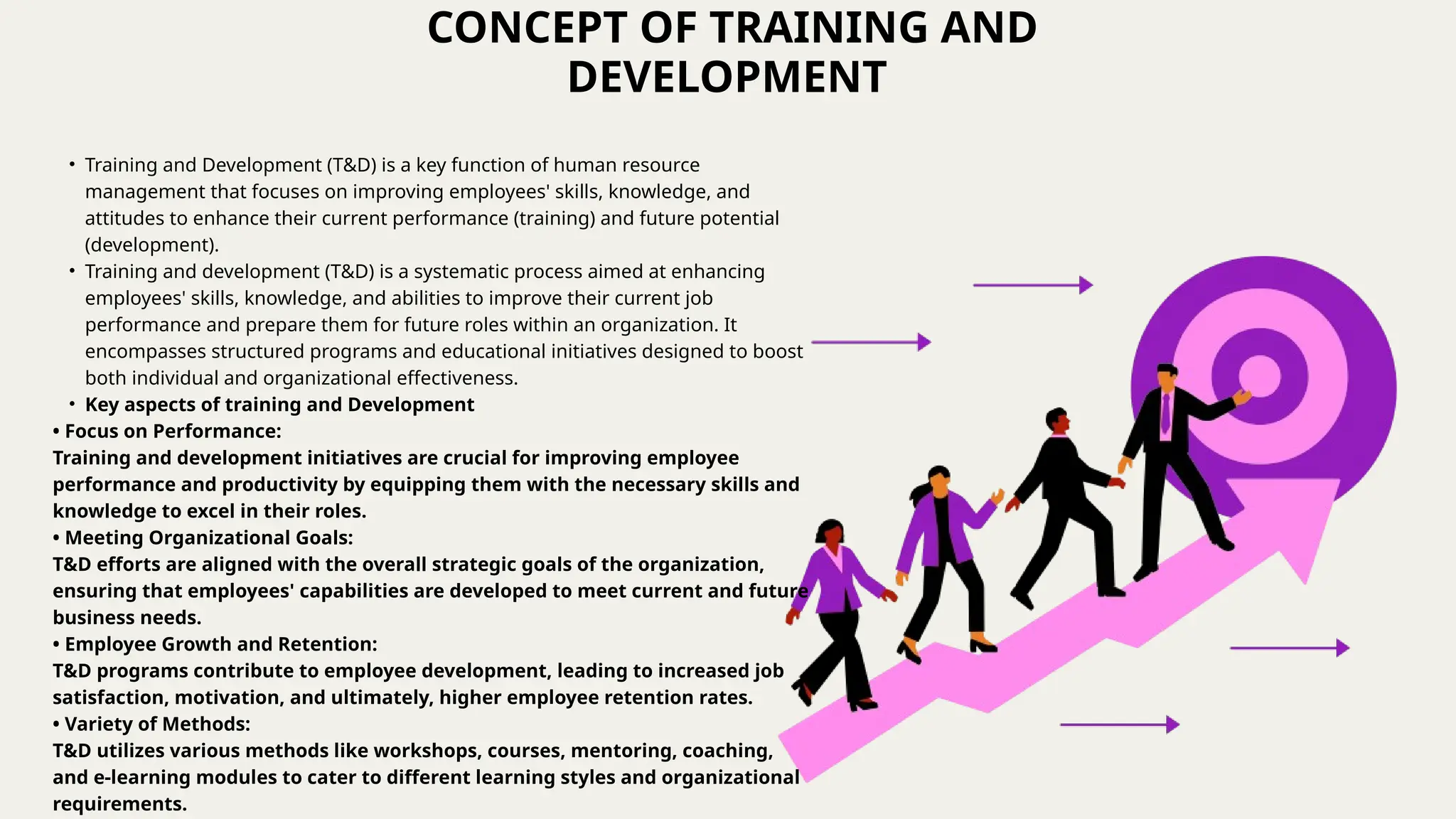
• Training and Development (T&D) is a key function of human resource
management that focuses on improving employees' skills, knowledge, and
attitudes to enhance their current performance (training) and future potential
(development).
• Training and development (T&D) is a systematic process aimed at enhancing
employees' skills, knowledge, and abilities to improve their current job
performance and prepare them for future roles within an organization. It
encompasses structured programs and educational initiatives designed to boost
both individual and organizational effectiveness.
• Key aspects of training and Development
• Focus on Performance:
Training and development initiatives are crucial for improving employee
performance and productivity by equipping them with the necessary skills and
knowledge to excel in their roles.
• Meeting Organizational Goals:
T&D efforts are aligned with the overall strategic goals of the organization,
ensuring that employees' capabilities are developed to meet current and future
business needs.
• Employee Growth and Retention:
T&D programs contribute to employee development, leading to increased job
satisfaction, motivation, and ultimately, higher employee retention rates.
• Variety of Methods:
T&D utilizes various methods like workshops, courses, mentoring, coaching,
and e-learning modules to cater to different learning styles and organizational
requirements.
3.
MEANING OF TRAINING
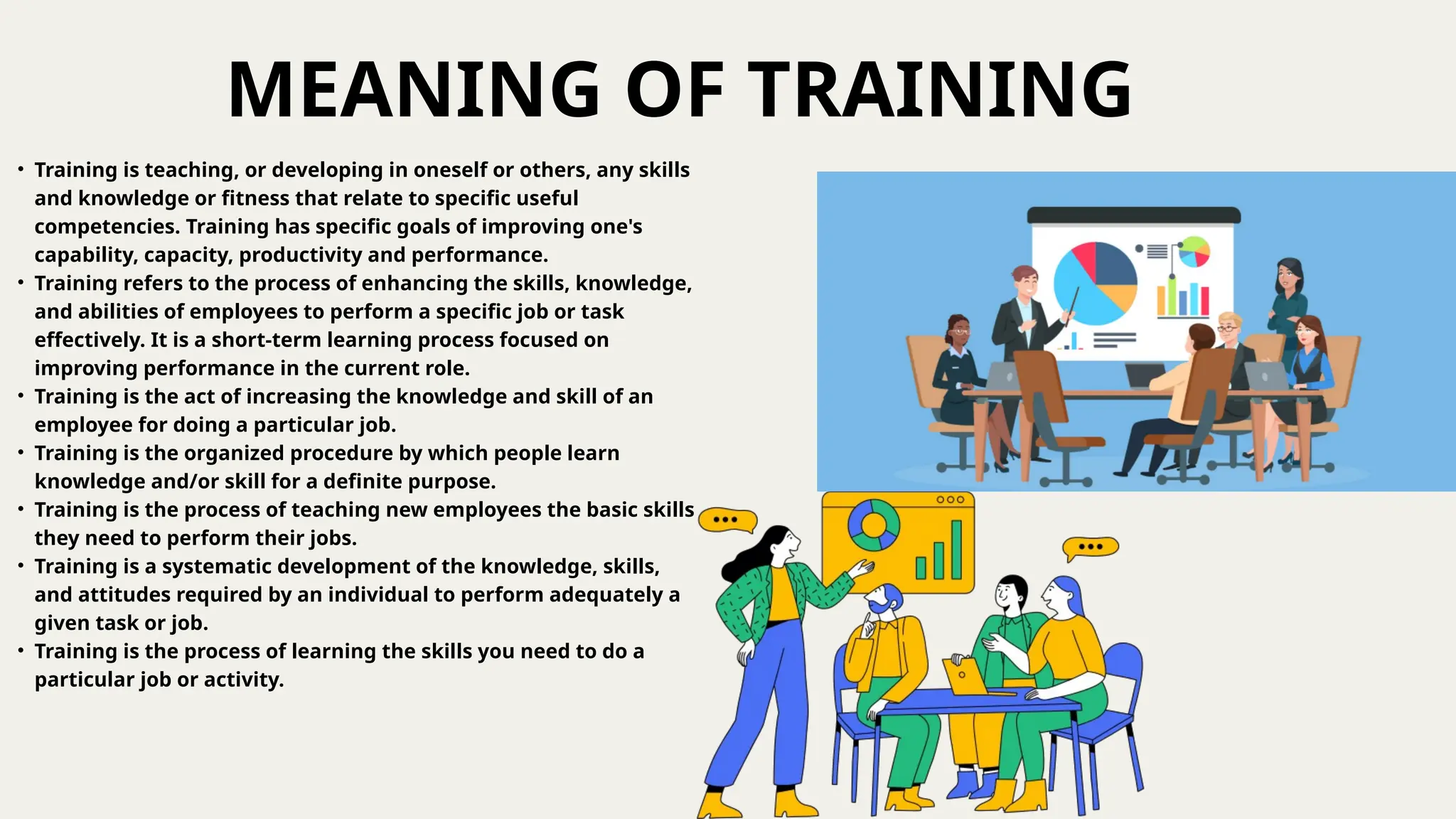
•Training is teaching, or developing in oneself or others, any skills
and knowledge or fitness that relate to specific useful
competencies. Training has specific goals of improving one's
capability, capacity, productivity and performance.
• Training refers to the process of enhancing the skills, knowledge,
and abilities of employees to perform a specific job or task
effectively. It is a short-term learning process focused on
improving performance in the current role.
• Training is the act of increasing the knowledge and skill of an
employee for doing a particular job.
• Training is the organized procedure by which people learn
knowledge and/or skill for a definite purpose.
• Training is the process of teaching new employees the basic skills
they need to perform their jobs.
• Training is a systematic development of the knowledge, skills,
and attitudes required by an individual to perform adequately a
given task or job.
• Training is the process of learning the skills you need to do a
particular job or activity.
4.
KEY ELEMENTS OFTRAINING
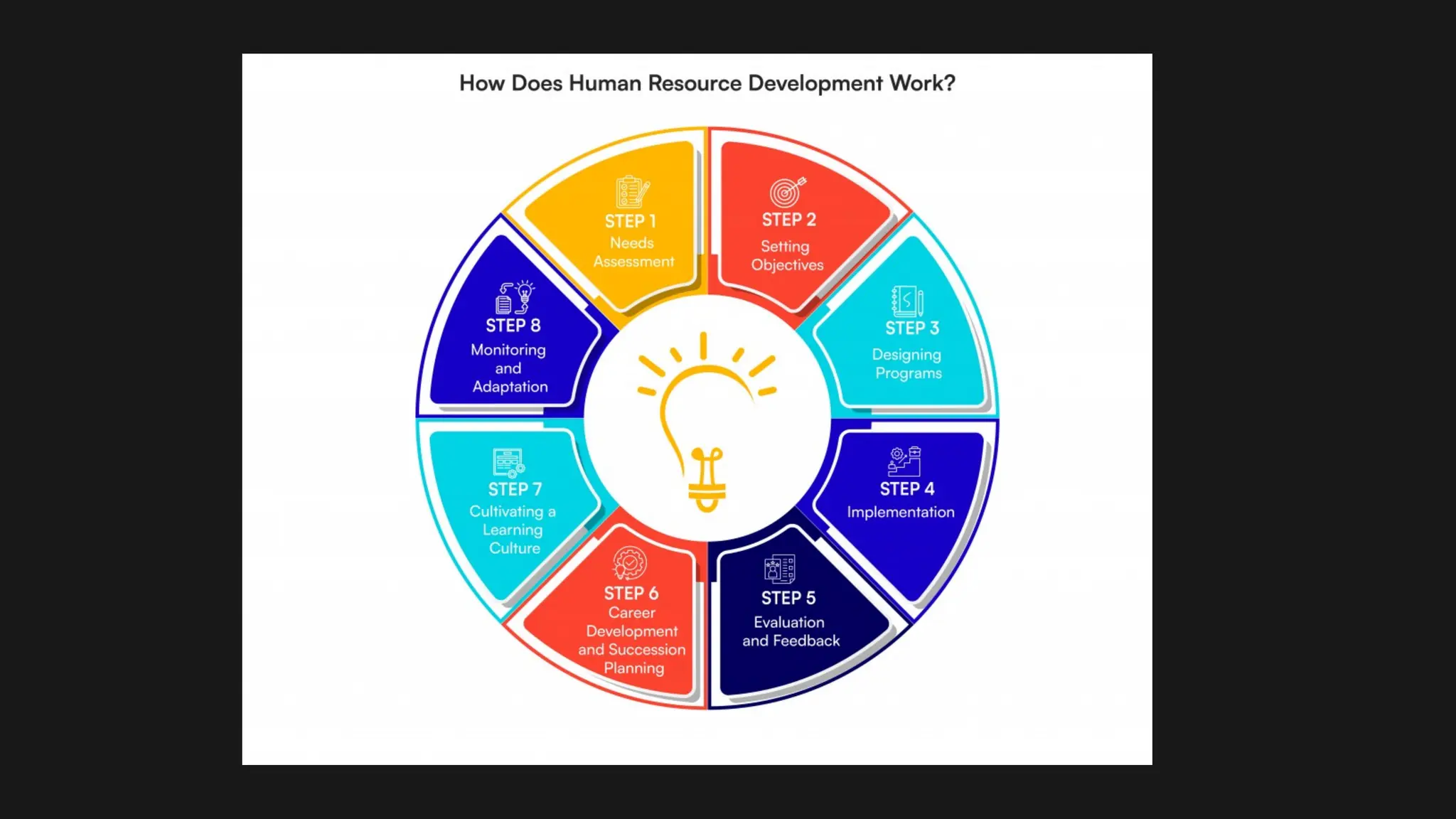
1. Needs Assessment
• Identifying the skills
gap or performance
issues.
2. Clear Objectives
• Setting specific and
measurable goals for
what the training
should achieve.
3. Effective Delivery
Methods
• Choosing the right
training techniques,
such as: On-the-job
training
4. Evaluation and
Feedback
• Measuring the
effectiveness of
training using tests,
surveys, or
performance data.
5.
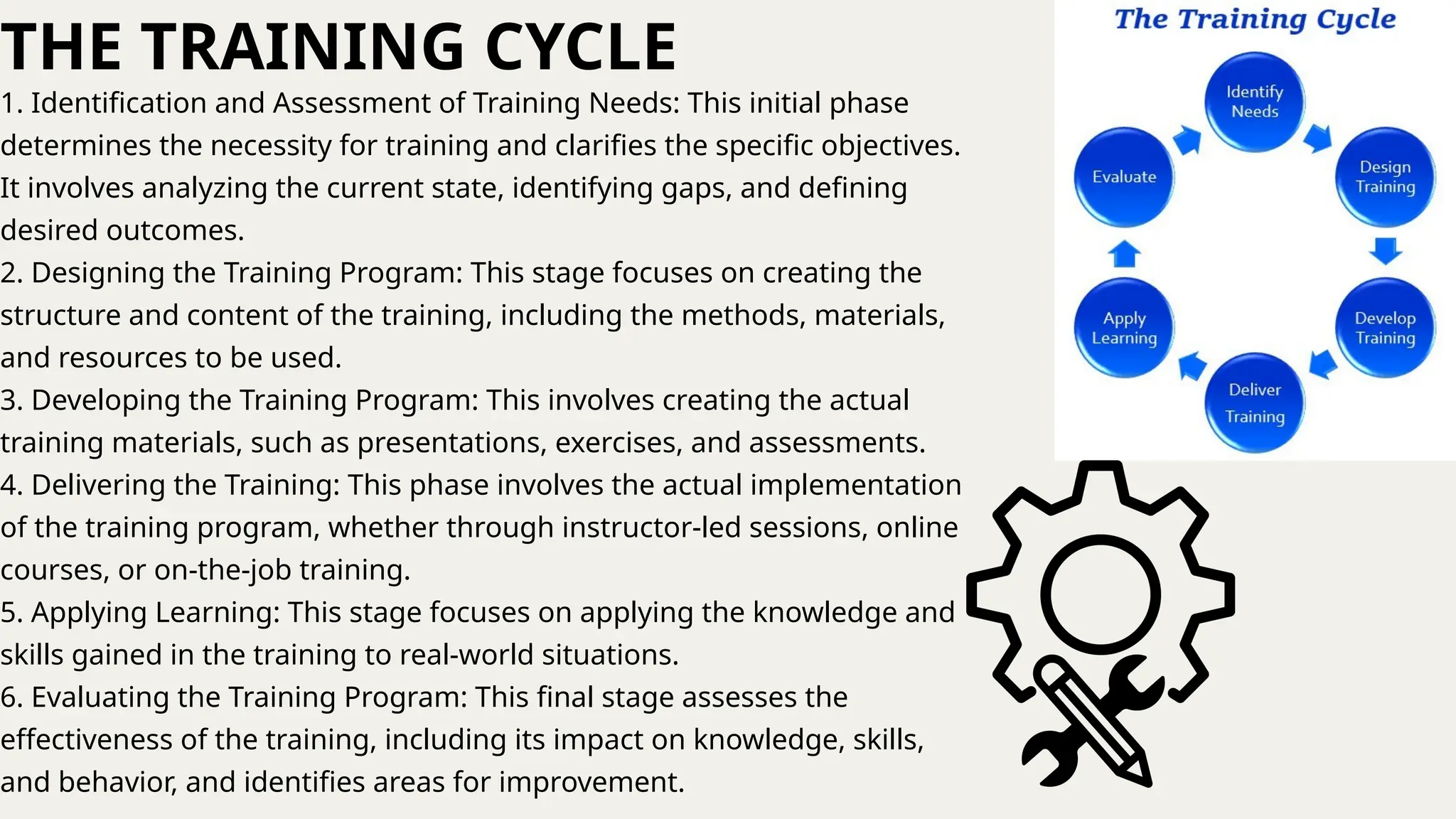
1. Identification andAssessment of Training Needs: This initial phase
determines the necessity for training and clarifies the specific objectives.
It involves analyzing the current state, identifying gaps, and defining
desired outcomes.
2. Designing the Training Program: This stage focuses on creating the
structure and content of the training, including the methods, materials,
and resources to be used.
3. Developing the Training Program: This involves creating the actual
training materials, such as presentations, exercises, and assessments.
4. Delivering the Training: This phase involves the actual implementation
of the training program, whether through instructor-led sessions, online
courses, or on-the-job training.
5. Applying Learning: This stage focuses on applying the knowledge and
skills gained in the training to real-world situations.
6. Evaluating the Training Program: This final stage assesses the
effectiveness of the training, including its impact on knowledge, skills,
and behavior, and identifies areas for improvement.
THE TRAINING CYCLE
6.
🔹 1. Plannedand Systematic Process
• Training is not random; it follows a structured approach involving
planning, execution, and evaluation.
• Ensures learning is aligned with job and organizational needs.
🔹 2. Job-Oriented
• Focuses on specific skills and knowledge required to perform current job
tasks efficiently.
• Aims to reduce errors and increase productivity.
🔹 3. Short-Term Focus
• Designed to meet immediate learning needs.
• Often targeted at improving performance in the present role, not future
career growth.
🔹 4. Skill Development
• Primary goal is to enhance technical, functional, and behavioral skills
needed for the job.
• May include both hard skills (e.g., machine operation) and soft skills (e.g.,
communicatio
FEATURES OF TRAINING
7.
5. Performance Improvement
•Training is aimed at enhancing employee effectiveness, speed, and
accuracy.
• Leads to better quality of work and higher output.
🔹 6. Need-Based
• Based on Training Needs Analysis (TNA) to ensure relevance.
• Targets actual skill or knowledge gaps among employees.
🔹 7. Practical and Realistic
• Emphasizes hands-on learning and real-life job scenarios.
• Increases applicability and retention of skills.
🔹 8. Conducted by Experts
• Delivered by experienced trainers or subject matter experts with the
ability to engage and instruct effectively.
🔹 9. Measured for Effectiveness
• Includes evaluation tools like quizzes, performance reviews, or feedback
to measure success.
• Ensures training outcomes are quantifiable.
FEATURES OF TRAINING
8.
FFEATURES OF
TRAINING
🔹 10.Flexible Methods
• Delivered through various formats such
as:
• On-the-job training
• Classroom sessions
• E-learning
• Workshops and seminars
9.
IMPORTANCE OF
TRAINING
🔹 1.Enhances Employee Performance
• Improves job-related skills and knowledge.
• Employees become more competent, confident, and efficient.
🔹 2. Increases Productivity and Efficiency
• Well-trained employees work faster with fewer errors.
• Leads to better output and lower operational costs.
🔹 3. Promotes Job Satisfaction and Motivation
• Employees feel valued when invested in.
• Results in higher morale and motivation levels.
🔹 4. Reduces Employee Turnover
• Opportunities for learning and development increase employee
retention.
• Reduces hiring and onboarding costs.
🔹 5. Encourages Innovation and Creativity
• Training helps employees think critically and solve problems.
• Leads to innovation in processes, products, and services.
10.
IMPORTANCE OF
TRAINING
🔹 6.Improves Customer Service
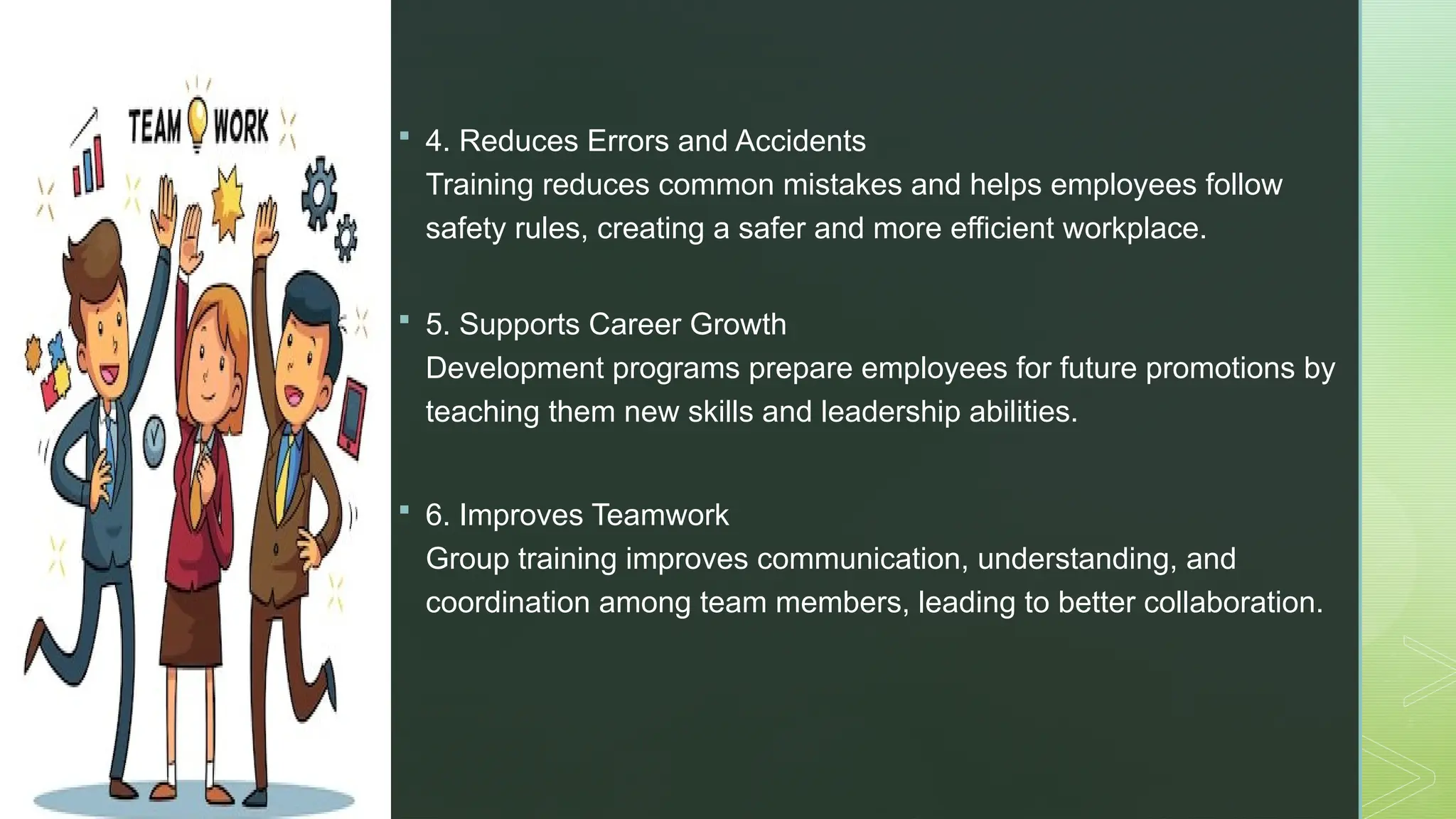
• Employees trained in communication and problem-solving can
serve customers better.
• Results in higher customer satisfaction and loyalty.
🔹 7. Ensures Safety and Compliance
• Safety training minimizes workplace accidents.
• Legal compliance training reduces the risk of regulatory violations.
🔹 8. Supports Career Growth and Succession Planning
• Prepares employees for future roles and promotions.
• Builds a strong leadership pipeline.
🔹 9. Adapts to Technological and Market Changes
• Regular training ensures employees stay current with new tools,
trends, and technologies.
• Increases organizational agility and competitiveness.
🔹 10. Improves Organizational Reputation
• Skilled and knowledgeable employees contribute to higher
standards and brand image.
11.
SCOPE OF
TRAINING
The scopeof training refers to the wide range of areas and activities
that training covers within an organization. It includes training at all
levels, across various functions, and for different purposes — from
technical skills to soft skills and leadership development.
🔹 1. Orientation/Induction Training
• For new employees to familiarize them with the organization's
culture, policies, and job roles.
• Helps them settle quickly and reduce adjustment time.
🔹 2. Job/Technical Training
• Improves specific skills required for a particular job (e.g.,
machinery, software, systems).
• Ensures employees can perform tasks efficiently and safely.
🔹 3. Soft Skills Training
• Covers areas like communication, teamwork, time management,
negotiation, and leadership.
• Essential for employee behavior, collaboration, and customer
service.
12.
SCOPE OF
TRAINING
4. SafetyTraining
• Ensures employees are aware of health and safety procedures,
risk management, and emergency responses.
• Mandatory in industries like manufacturing, construction,
healthcare, etc.
🔹 5. Managerial and Leadership Development
• Prepares individuals for supervisory and leadership roles.
• Focuses on decision-making, strategic thinking, delegation, and
conflict resolution.
🔹 6. Compliance Training
• Ensures employees understand and follow legal regulations,
company policies, ethical standards, and industry norms.
• Reduces legal and reputational risks.
🔹 7. Cross-Functional Training
• Enables employees to work in multiple departments or roles.
• Increases flexibility and improves team coordination.
13.
SCOPE OF
TRAINING
🔹 8.E-Learning and Digital Training
• Delivered through online
platforms, allowing remote access,
self-paced learning, and cost
savings.
• Suitable for tech-savvy and
geographically dispersed teams.
🔹 9. Behavioral and Attitudinal
Training
• Aims to improve attitudes, values,
discipline, emotional intelligence,
and workplace ethics.
• Strengthens organizational culture
and employee engagement.
🔹 10. Succession and Career
Development Training
• Prepares employees for future
roles or promotions.
• Part of long-term talent
development and succession
planning strategies.
MEANING OF DEVELOPMENT
Theprocess of enhancing employees' skills, knowledge, and abilities to
improve their performance, productivity, and contribution to the
organization.
It's a continuous process aimed at fostering individual and
organizational growth, encompassing training, development
programs, and other initiatives that contribute to employee and
overall organizational effectiveness.
Examples:HR development activities can include formal training
programs, on-the-job training, mentorship programs,leadership
development programs, and opportunities for employees to take on new
challenges and responsibilities.
17.
DEFINITIONS:
1). Development isthe process of your employees discovering and
evolving into the person they want to be through an examination of their
personality, skills, and abilities, as well as their hopes and ambitions.
Employees improve physically, psychologically, socially, and creatively as
personal growth and progress are prioritized.
2). It is a collection of training programmes for new employees, with a
goal to help them adjust to their new roles and learn more about the
organisation and its culture.
3).Leonard Nadler: Defined HRD as a series of organized activities within
a specific timeframe, aimed at producing behavioral change.
18.
Lussier: Differentiated betweentraining, which focuses on
acquiring job-specific skills, and development, which focuses on
preparing employees for both current and future roles.
McLagan: Defined training and development as focused on
identifying, assuring, and developing key competencies for current
and future jobs.
Pearson: Defined development as an improvement, either
qualitative or quantitative, in the use of available resources.
19.
IMPORTANCE OF HRD
HumanResource Development (HRD) is crucial for organizations because it:
Enhances Employee Capabilities
1. *Improves performance*: HRD helps employees develop new skills and knowledge,
leading to improved job performance.
2. *Increases productivity*: Well-trained and developed employees are more
efficient and productive.
Supports Organizational Growth
1. *Competitive advantage*: Organizations with a strong HRD system can attract
and retain top talent, gaining a competitive edge.
2. *Adaptability*: HRD helps organizations adapt to changing business environments and stay
relevant.
20.
Fosters Employee Engagement
1.*Increased job satisfaction*: Employees who feel invested in
are more likely to be satisfied with their jobs.
2. *Improved morale*: HRD demonstrates an organization's
commitment to employee growth and development.yee
Engagement
Supports Succession Planning
1. *Develops future leaders*: HRD helps identify and develop
future leaders, ensuring a smooth transition of power.
2. *Reduces talent gaps*: HRD helps organizations develop the
skills and competencies needed to fill talent gaps.
21.
Improves Overall Performance
1.*Better decision-making*: HRD helps employees
develop critical thinking and problem-solving skills.
2. *Increased innovation*: HRD fosters a culture of
innovation and creativity.
By investing in HRD, organizations can reap numerous
benefits, including improved employee performance,
increased productivity, and enhanced
competitiveness.
22.
NEED OF HRD
Theneed for Human Resource Development (HRD)
arises from several factors:
Changing Business Environment
1. *Globalization*: HRD helps organizations adapt
to global market trends and competition.
2. *Technological advancements*: HRD enables
employees to develop new skills and stay relevant in
a rapidly changing technological landscape.
Employee Development
1. *Skill gaps*: HRD helps bridge skill gaps and
develop employees' competencies.
2. *Career growth*: HRD supports employees'
career aspirations and growth.
23.
Organizational Performance
1. *Improvedproductivity*: HRD enhances employee
performance and productivity.
2. *Competitive advantage*: Organizations with a strong
HRD system can attract and retain top talent, gaining a
competitive edge.
Succession Planning
1. *Future leaders*: HRD helps identify and develop future
leaders, ensuring a smooth transition of power.
2. *Talent pipeline*: HRD ensures a steady supply of skilled
and competent employees.
24.
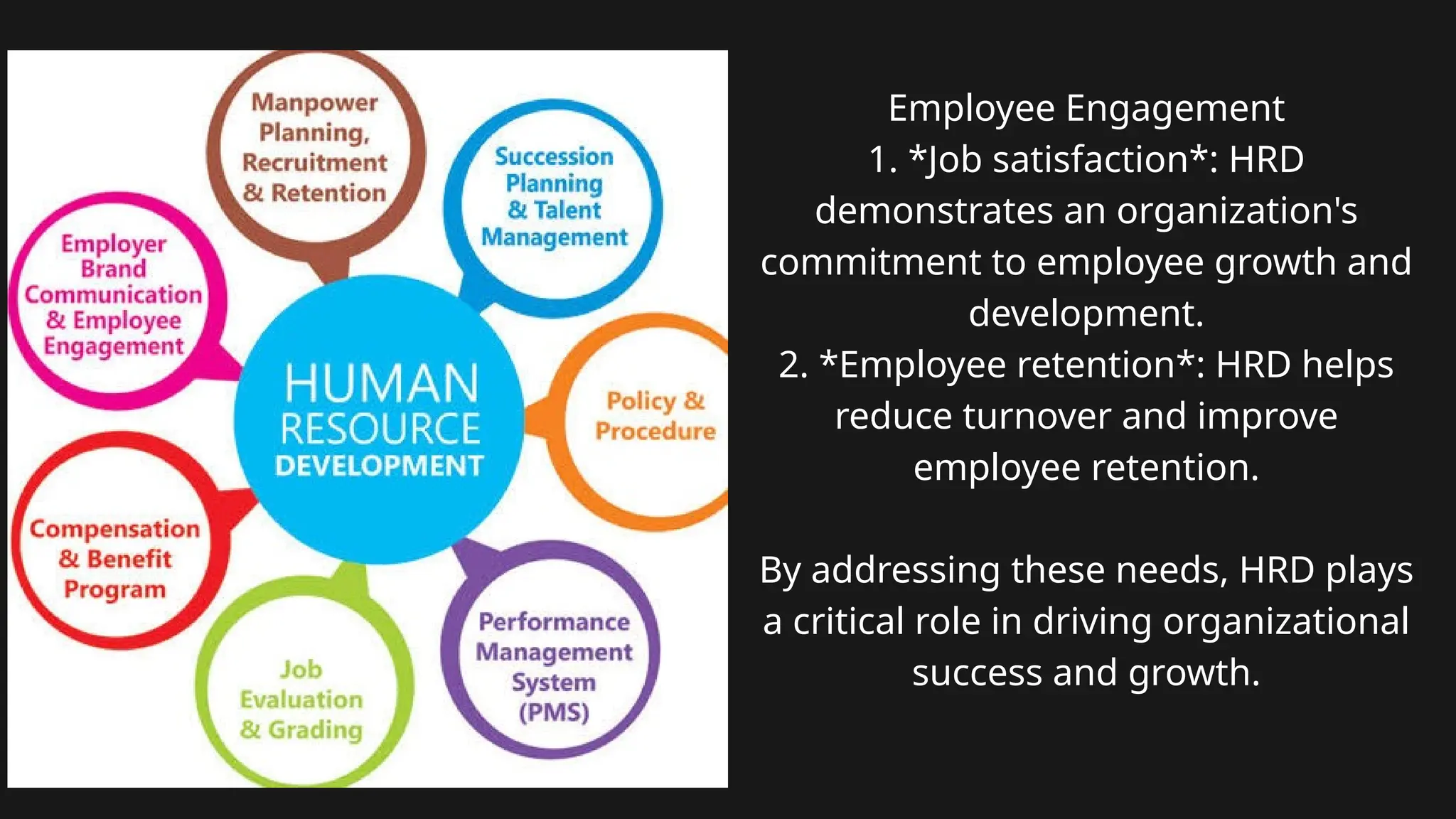
Employee Engagement
1. *Jobsatisfaction*: HRD
demonstrates an organization's
commitment to employee growth and
development.
2. *Employee retention*: HRD helps
reduce turnover and improve
employee retention.
By addressing these needs, HRD plays
a critical role in driving organizational
success and growth.
25.
DEVELOPMENTAL
INTERVENTIONS
Developmental interventions inHRD are strategies or programs designed to enhance
employee skills, knowledge, and performance.Developmental interventions are planned
activities or programs designed to enhance employee skills, knowledge, and
performance.
Types of Developmental Interventions
1. Training and Development Programs: Formal programs to enhance specific skills or
knowledge.
2. Mentoring and Coaching: Guidance and support from experienced employees or
coaches.
3. Job Rotation and Cross-Training: Rotating employees through different roles or
functions to broaden their experience.
26.
4. Leadership DevelopmentPrograms: Programs designed to develop leadership
skills and competencies.
5. Feedback and Evaluation: Regular feedback and evaluation to identify areas for
improvement.
6. Action Learning: Learning through real-world projects and challenges.
7. Stretch Assignments: Assigning employees to challenging projects or roles to
develop new skills.
Examples
1. Training programs: Formal programs to enhance specific skills or
knowledge.
2. Mentoring and coaching: Guidance and support from experienced
employees or coaches.
3. Job rotation and cross-training: Rotating employees through different roles
or functions.
4. Leadership development programs: Programs designed to develop
leadership skills and competencies.
27.
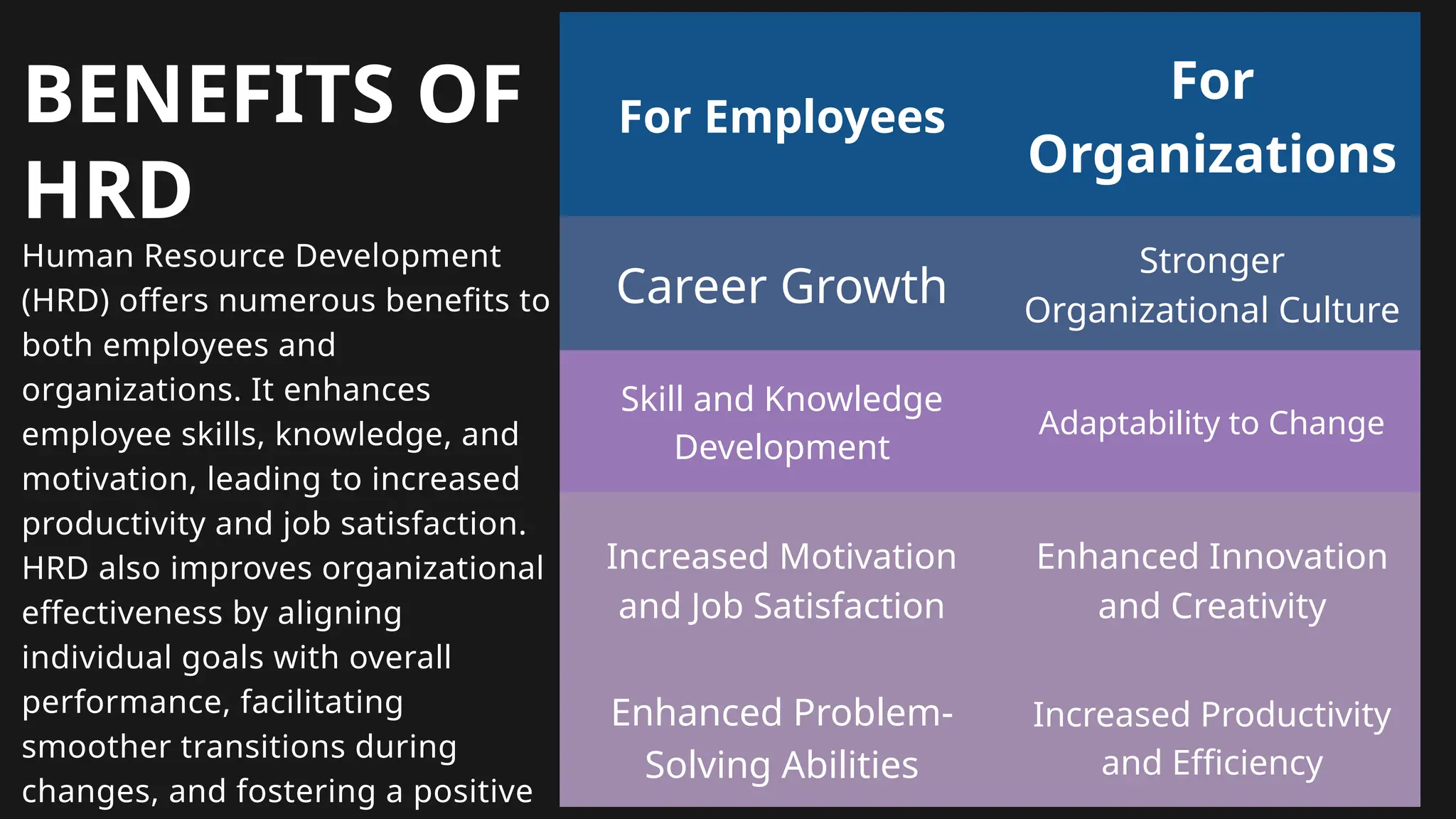
Human Resource Development
(HRD)offers numerous benefits to
both employees and
organizations. It enhances
employee skills, knowledge, and
motivation, leading to increased
productivity and job satisfaction.
HRD also improves organizational
effectiveness by aligning
individual goals with overall
performance, facilitating
smoother transitions during
changes, and fostering a positive
BENEFITS OF
HRD
For Employees
For
Organizations
Career Growth
Stronger
Organizational Culture
Skill and Knowledge
Development
Adaptability to Change
Increased Motivation
and Job Satisfaction
Enhanced Innovation
and Creativity
Enhanced Problem-
Solving Abilities
Increased Productivity
and Efficiency
29.
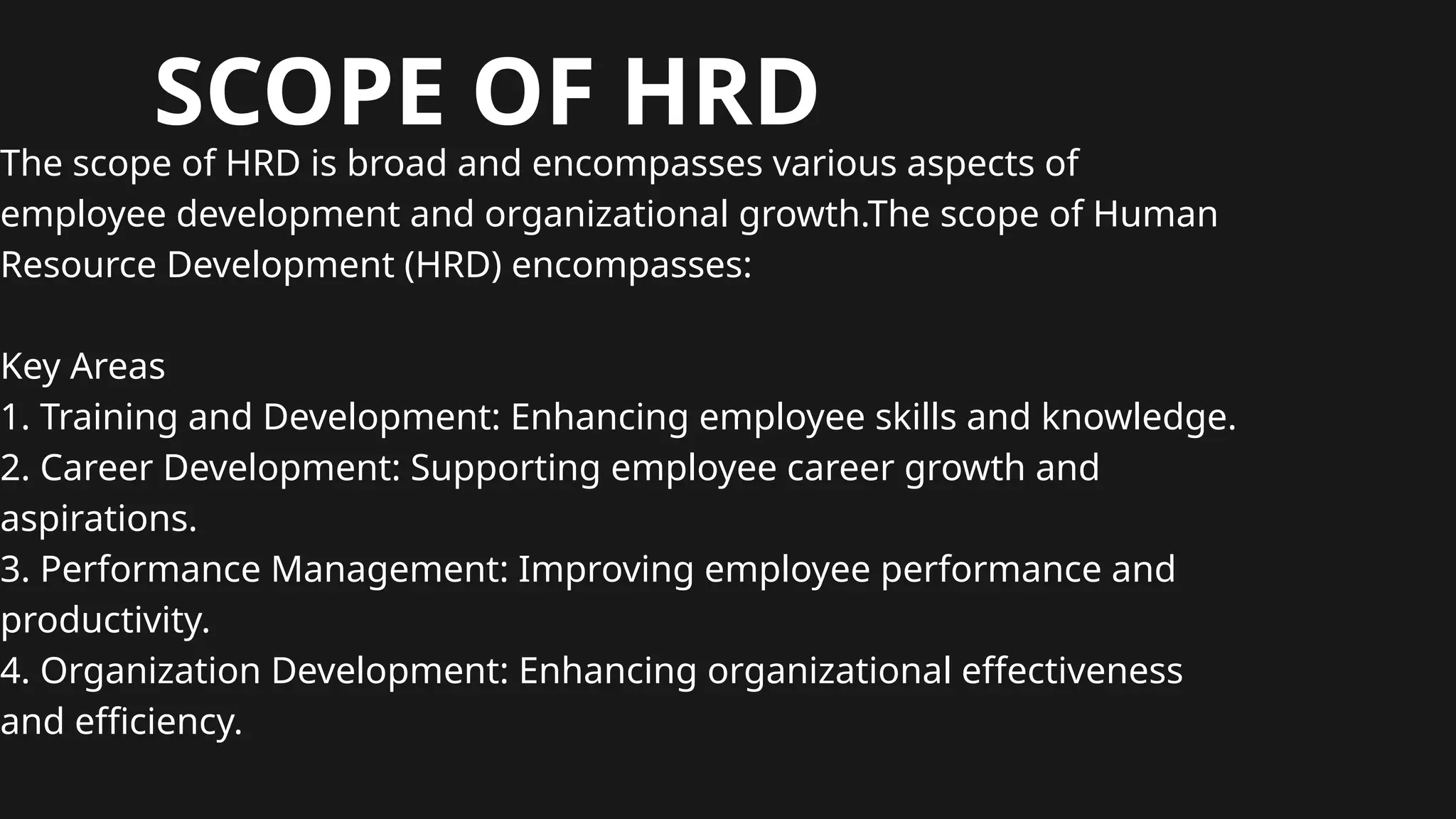
SCOPE OF HRD
Thescope of HRD is broad and encompasses various aspects of
employee development and organizational growth.The scope of Human
Resource Development (HRD) encompasses:
Key Areas
1. Training and Development: Enhancing employee skills and knowledge.
2. Career Development: Supporting employee career growth and
aspirations.
3. Performance Management: Improving employee performance and
productivity.
4. Organization Development: Enhancing organizational effectiveness
and efficiency.
32.
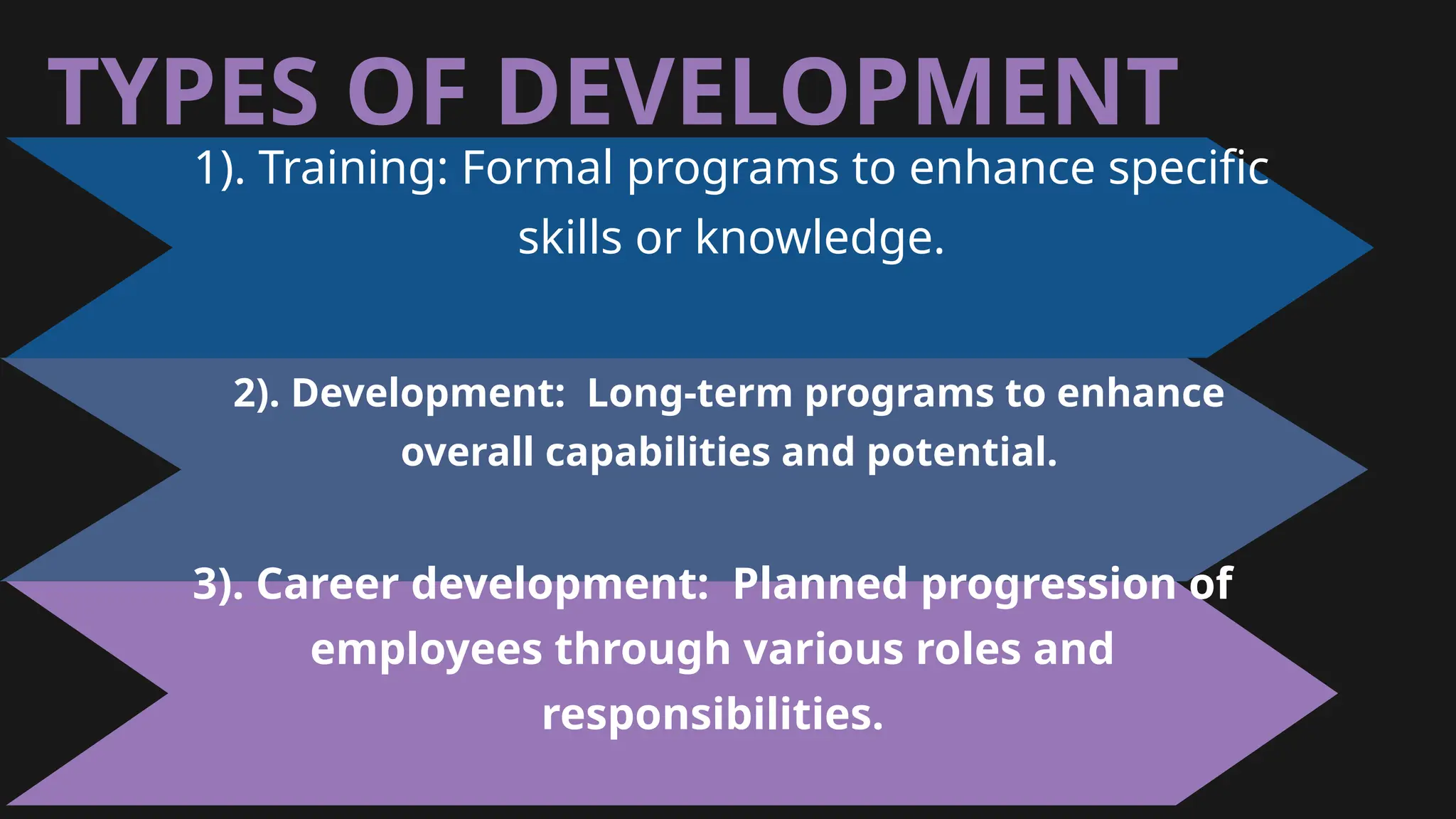
2). Development: Long-termprograms to enhance
overall capabilities and potential.
3). Career development: Planned progression of
employees through various roles and
responsibilities.
TYPES OF DEVELOPMENT
1). Training: Formal programs to enhance specific
skills or knowledge.
33.
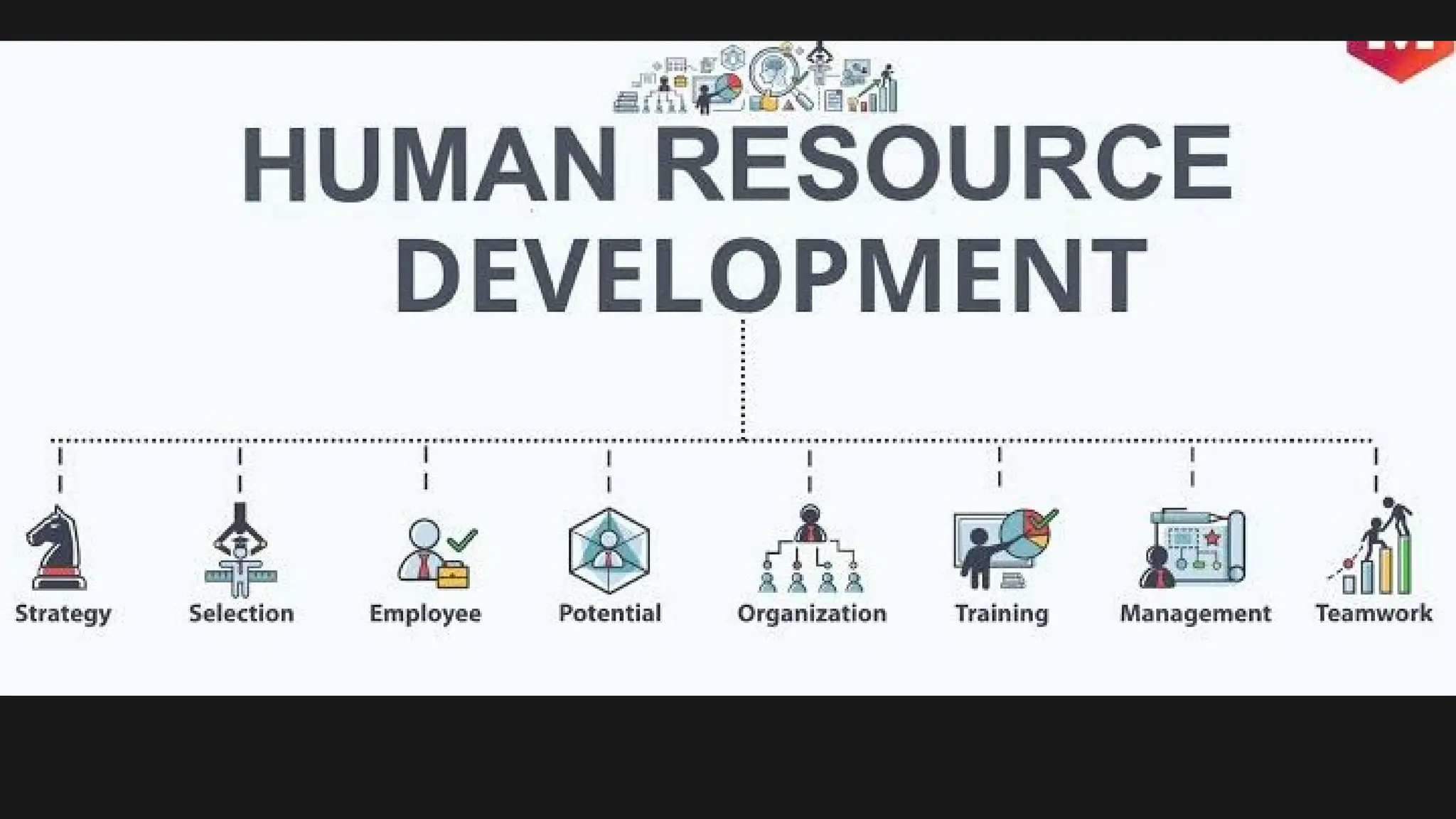
TYPES OF HRD
Thereare several types of development in Human Resource Management
(HRM), including:
1. Training and Development: Formal programs to enhance specific
skills or knowledge. Examples: technical training, soft skills training,
leadership development.
2. Career Development: Planning and managing employee careers within
the organization. Examples: career planning, succession planning, talent
development.
3. Professional Development: Enhancing employees' professional skills
and knowledge. Examples: certifications, workshops, conferences.
34.
.
Add a littlebit of body text
4. Personal Development: Enhancing employees' personal skills and well-
being.Examples: stress management, time management, wellness programs.
5. Organizational Development: Improving organizational performance and
effectiveness.Examples: change management, team building, culture development.
6. Leadership Development: Developing leaders' skills and abilities.Examples:
leadership training, mentoring, coaching.
7. Succession Planning: Identifying and developing future
leaders.Examples: talent identification, development programs, succession
planning.
These types of development help organizations improve employee performance,
increase engagement, and achieve strategic objectives.
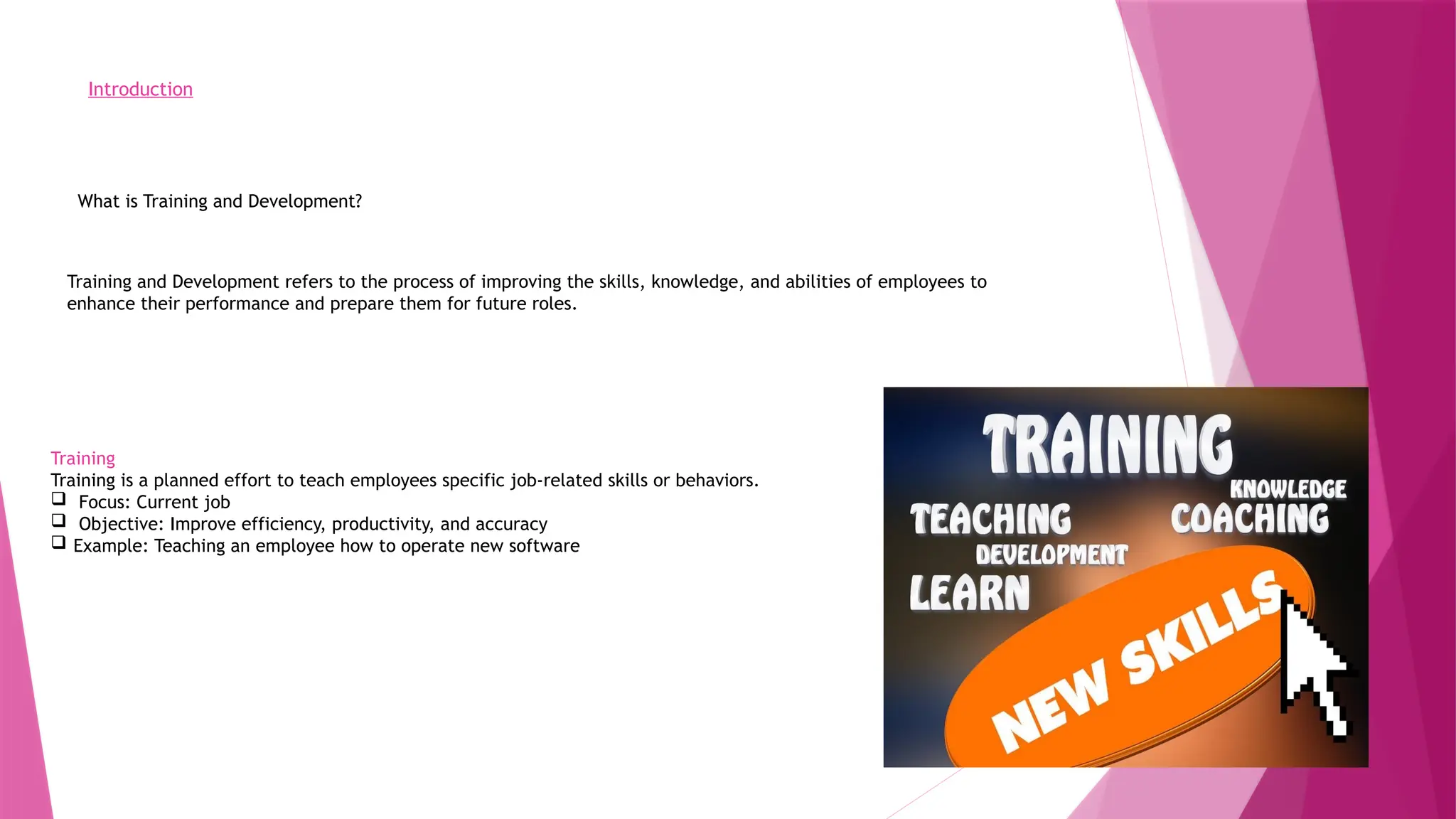
Introduction
What is Trainingand Development?
Training and Development refers to the process of improving the skills, knowledge, and abilities of employees to
enhance their performance and prepare them for future roles.
Training
Training is a planned effort to teach employees specific job-related skills or behaviors.
Focus: Current job
Objective: Improve efficiency, productivity, and accuracy
Example: Teaching an employee how to operate new software
37.
Development
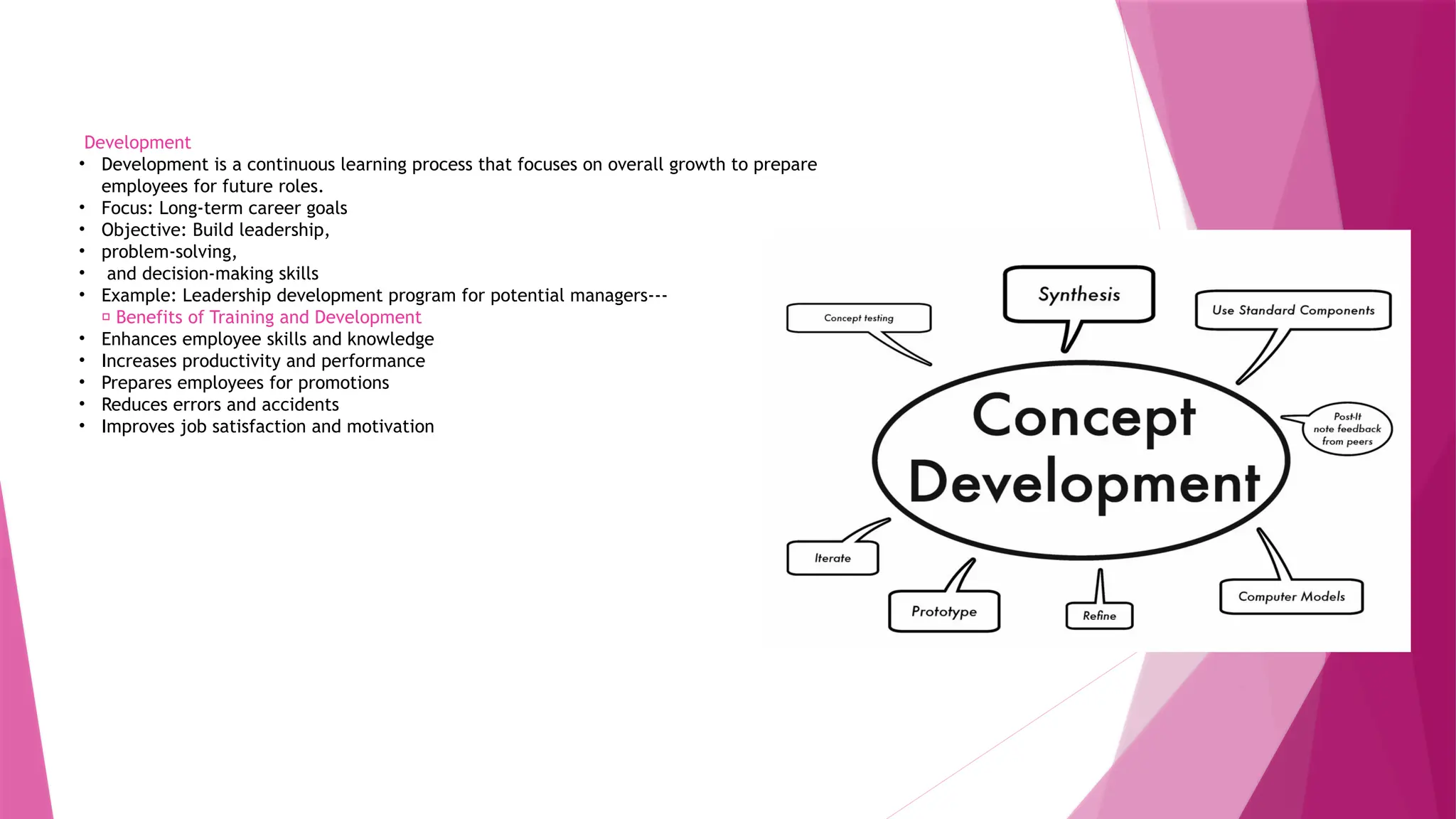
• Development isa continuous learning process that focuses on overall growth to prepare
employees for future roles.
• Focus: Long-term career goals
• Objective: Build leadership,
• problem-solving,
• and decision-making skills
• Example: Leadership development program for potential managers---
✅ Benefits of Training and Development
• Enhances employee skills and knowledge
• Increases productivity and performance
• Prepares employees for promotions
• Reduces errors and accidents
• Improves job satisfaction and motivation
38.
TYPES OF TRAINING
Thereare several types of training that can be used to develop employees' skills and knowledge
1. On-the-Job Training
Hands-on experience: Employees learn by doing the job and receiving feedback from supervisors or
colleagues.
Mentorship: Experienced employees guide and support new employees.
2. Classroom Training
Instructor-led: Training sessions led by an instructor in a classroom setting.
Interactive learning: Employees can ask questions, participate in discussions, and engage with the material.
39.
3. Online Training
E-learning: Training delivered through digital platforms, such as online courses or webinars.
Self-paced: Employees can complete training at their own pace and convenience.
4. Simulation-Based Training
Realistic scenarios: Training simulations mimic real-world scenarios, allowing employees to practice and
learn in a safe environment.
2 Improved retention: Simulation-based training can improve knowledge retention and application.
40.
5. Cross-Training
Multipleskills: Employees learn multiple skills or tasks to increase their versatility and value to the
organization.
Improved flexibility: Cross-training enables employees to adapt to changing business needs.
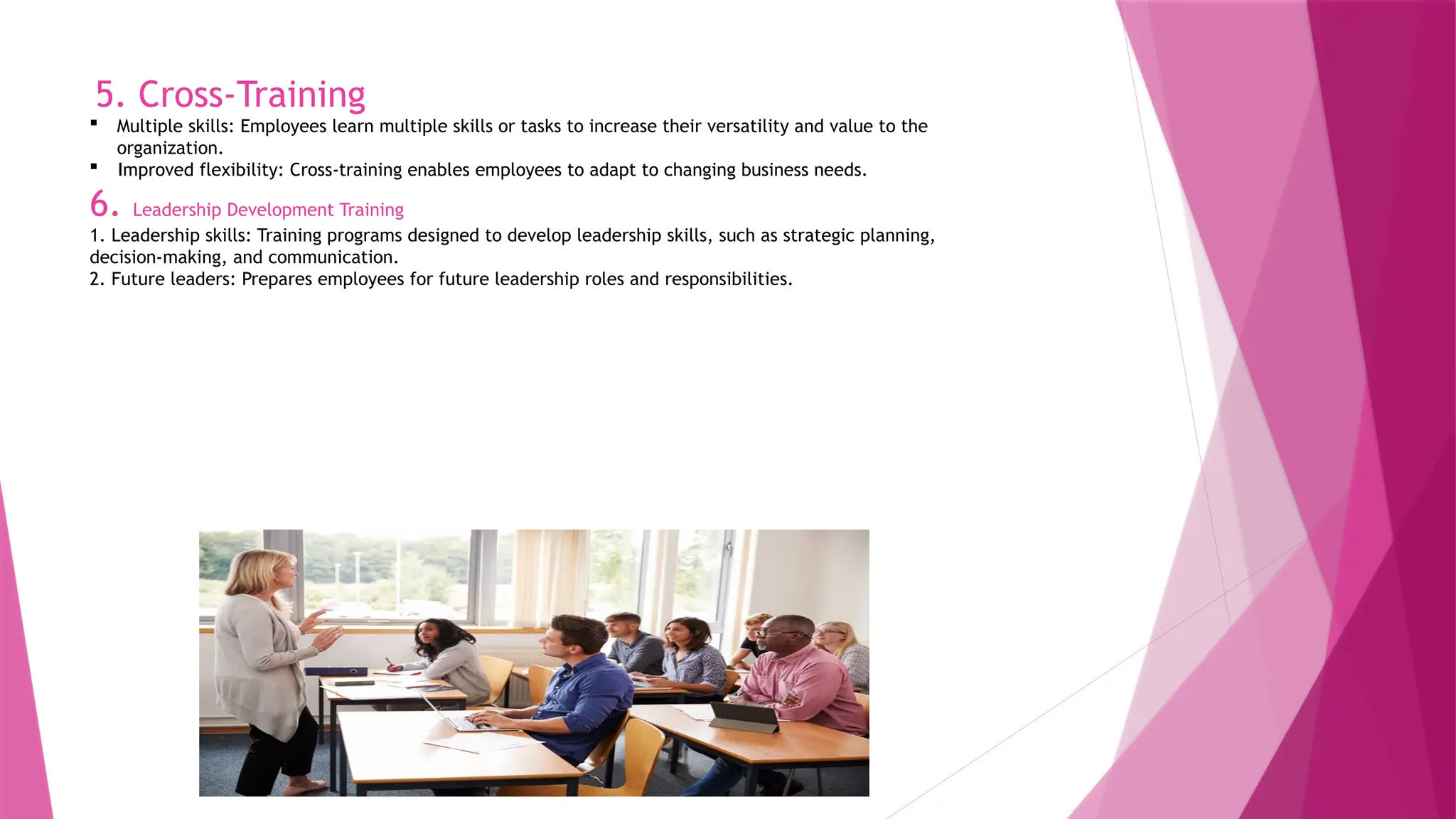
6. Leadership Development Training
1. Leadership skills: Training programs designed to develop leadership skills, such as strategic planning,
decision-making, and communication.
2. Future leaders: Prepares employees for future leadership roles and responsibilities.
41.
TYPES OF DEVELOPMENTIN HR
In HR, development refers to the process of improving employees' skills, knowledge, and abilities to enhance their
performance and contribute to organizational success. Here are some types of development in HR:
1. Career Development
Career planning: Helping employees plan and manage their careers.
2. Career advancement: Providing opportunities for employees to advance in their careers.
2. Leadership Development
Leadership training: Developing leadership skills, such as strategic planning, decision-making,
and communication.
Succession planning: Identifying and developing future leaders.
42.
3. Professional Development
Skill development: Enhancing employees' technical, business, or soft skills.
2. Knowledge sharing: Sharing knowledge and best practices across the organization.
43.
4. Personal Development
Self-awareness: Helping employees understand their strengths, weaknesses, and interests.
2. Personal growth: Supporting employees' personal growth and well-being.
5. Organizational Development
Change management: Helping organizations adapt to change and improve their overall performance.
Culture development: Shaping organizational culture and values.
These types of development can help HR professionals create
effective development programs that support employee growth and
organizational success.
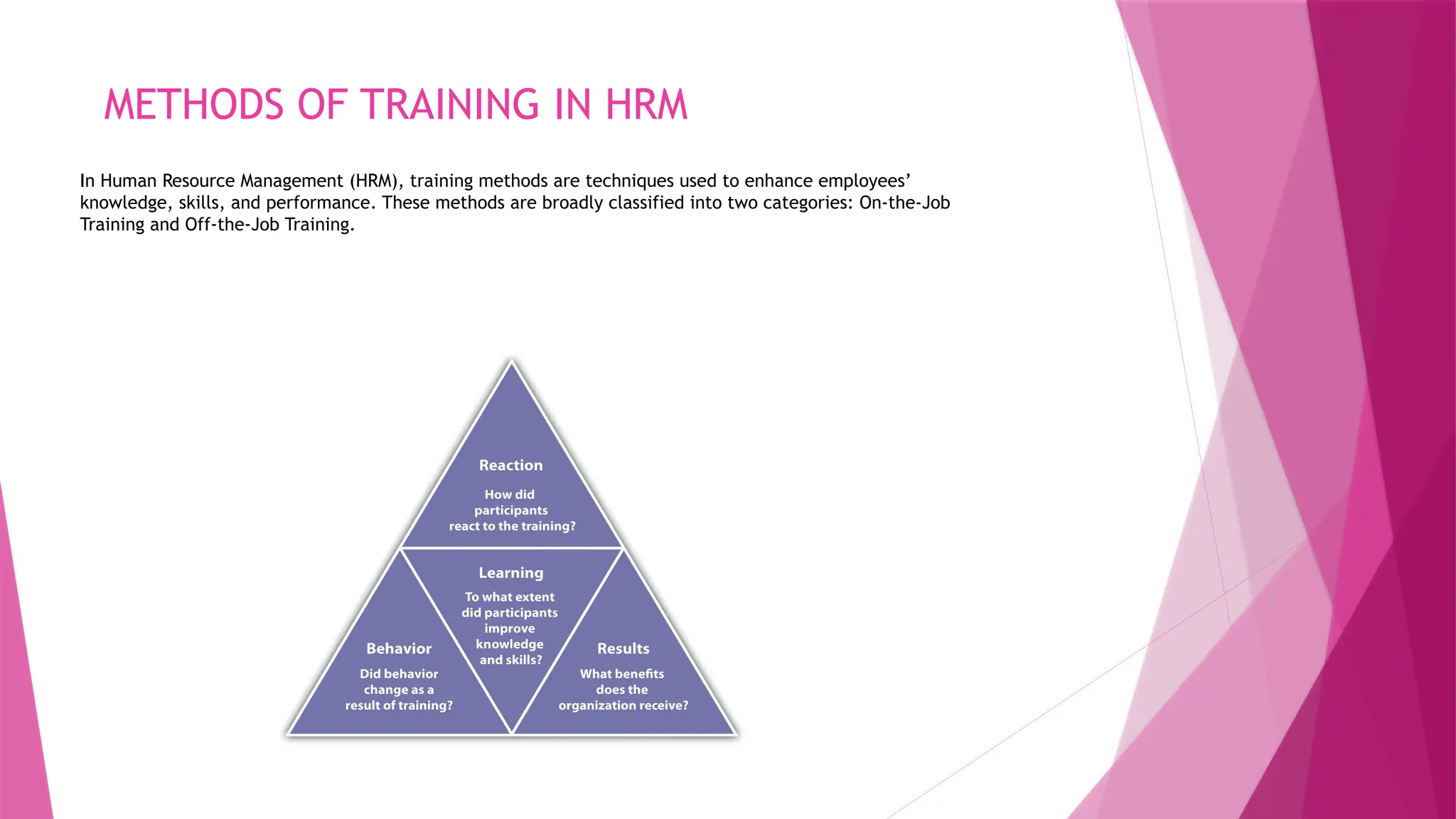
44.
In Human ResourceManagement (HRM), training methods are techniques used to enhance employees’
knowledge, skills, and performance. These methods are broadly classified into two categories: On-the-Job
Training and Off-the-Job Training.
METHODS OF TRAINING IN HRM
45.
1. On-the-Job TrainingMethods
These are conducted at the workplace while the employee is doing the job.
1. Job Rotation
Employees are shifted from one job to another to learn different skills.
2. Coaching
A senior or experienced employee guides the trainee.
3. Mentoring
Long-term relationship where a mentor provides career and personal guidance.
4. Apprenticeship
A combination of classroom instruction and on-the-job experience (common in technical jobs).
5. Job Instruction Training (JIT)
Step-by-step instructions are given to perform specific tasks.
46.
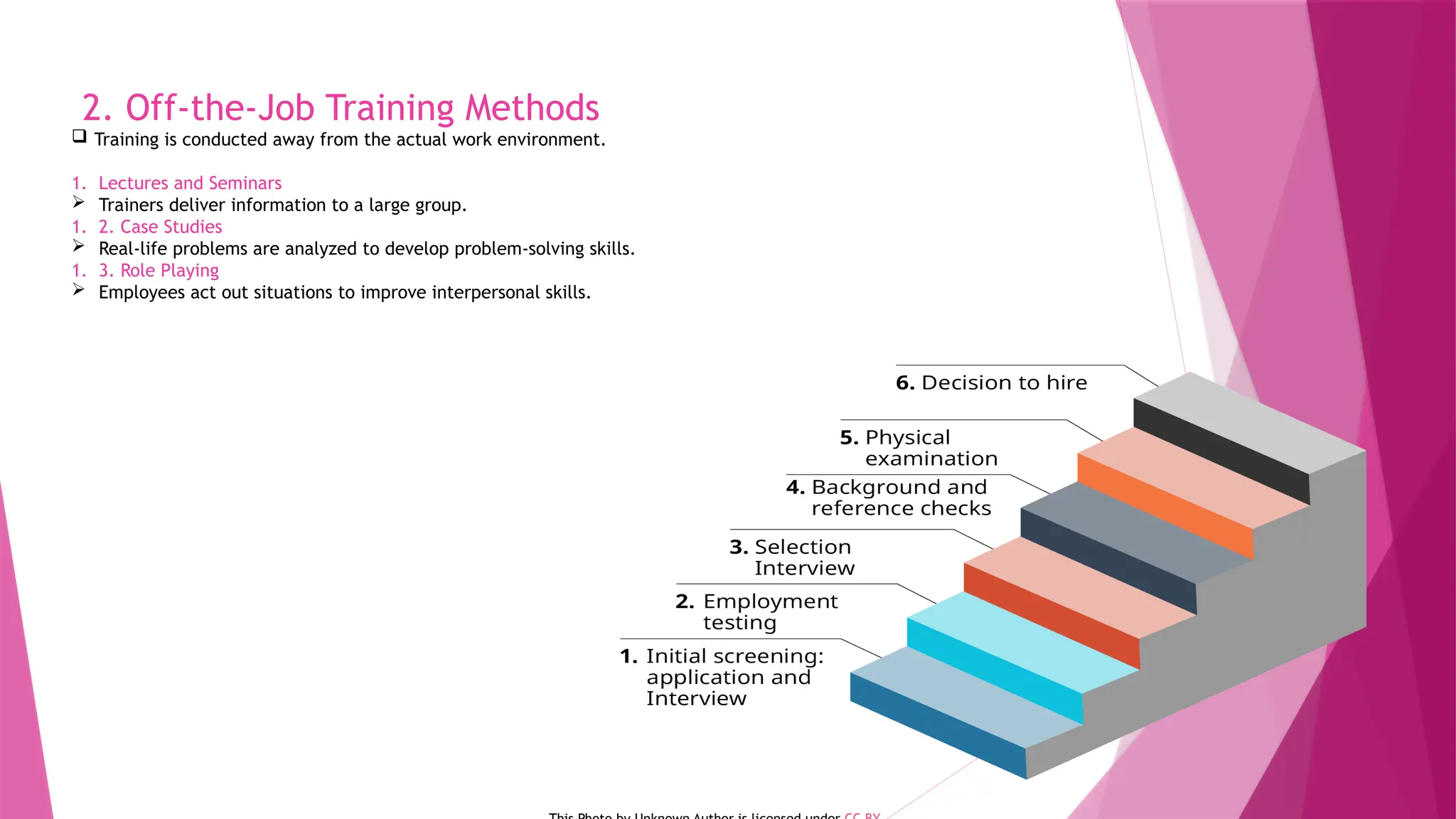
2. Off-the-Job TrainingMethods
Training is conducted away from the actual work environment.
1. Lectures and Seminars
Trainers deliver information to a large group.
1. 2. Case Studies
Real-life problems are analyzed to develop problem-solving skills.
1. 3. Role Playing
Employees act out situations to improve interpersonal skills.
47.
4. SimulationReplicates realjob scenarios using virtual or physical models (e.g., flight simulators).5. Group
DiscussionsEnhances communication and decision-making through team discussion.6. E-Learning / Online
TrainingTraining through digital platforms, especially useful for remote learning.
48.
III. Development Methods(for Future Leadership Roles)
1. Management Games
Simulate real business decisions.
Enhance strategic thinking.
2. Conference and Workshops
Group discussions and activities on specific topics.
Encourages collaboration and innovation
3. Succession Planning
Preparing internal employees for future leadership roles.
4. Executive Coaching
Personalized coaching for top-level executives.
49.
Conclusion :
Training anddevelopment play a vital role in improving employee performance and
organizational growth.
Various types such as on-the-job, off-the-job, induction, and technical training serve
different purposes.
Methods like lectures, role plays, case studies, and simulations help enhance learning
effectiveness.
They equip employees with the necessary skills, knowledge, and attitudes for their roles.
Proper training boosts productivity, motivation, and job satisfaction.
It also reduces errors, absenteeism, and employee turnover.
Overall, effective training and development strengthen both employees and the organization.
Career planning
In general:-
Careerplanning is a deliberate process of
defining career goals and outlining the steps
needed to achieve them.
In reference to HRM
●Career planning in HRM is a strategic process
that involves assisting employees in setting and
achieving career goals within an organization.
52.
●It aligns individualaspirations with
organizational needs, ensuring skill
development, growth opportunities, and
employee engagement.
●Career planning helps employees
navigate their professional journey,
contributing to personal satisfaction
and organizational success.
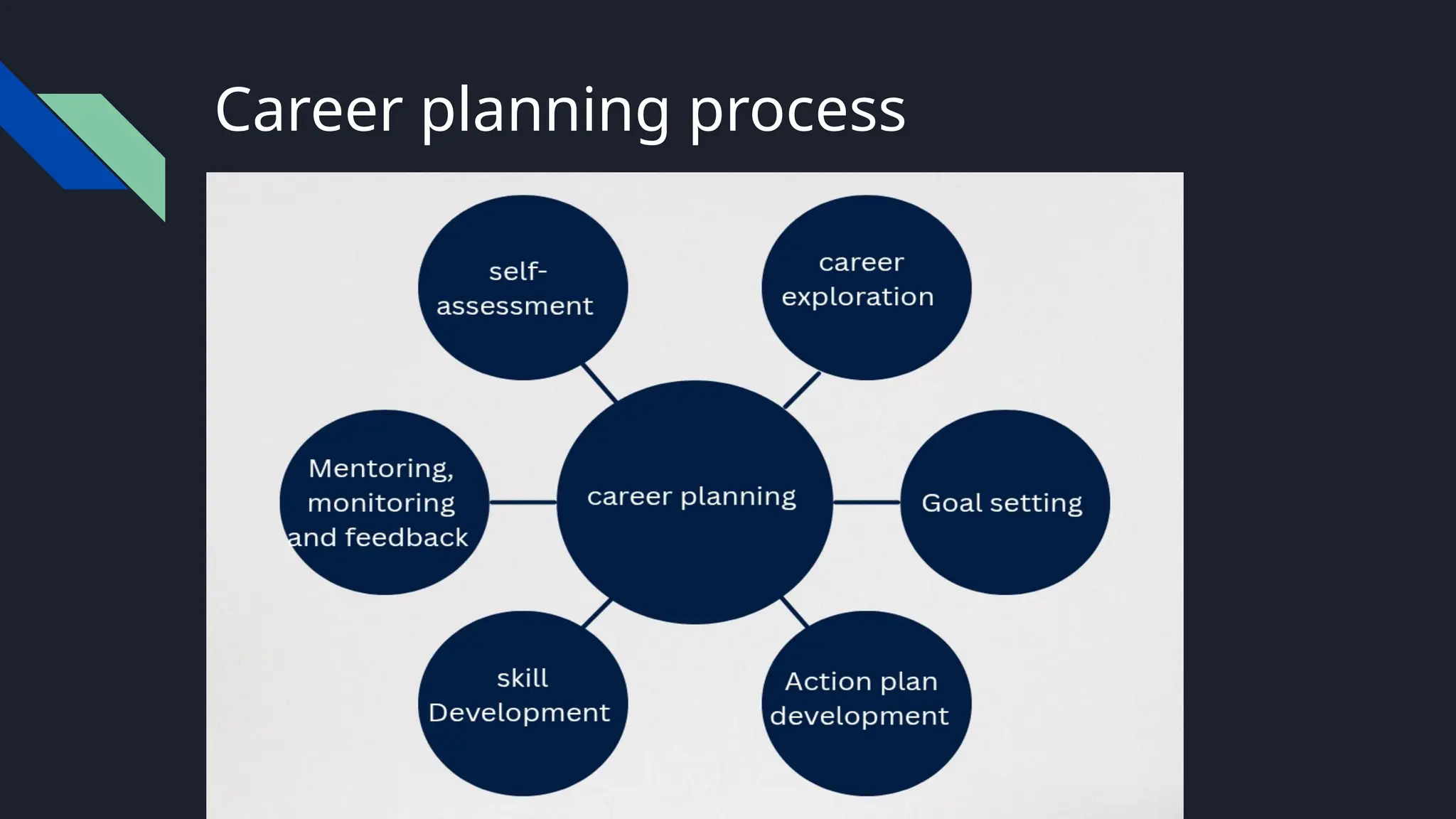
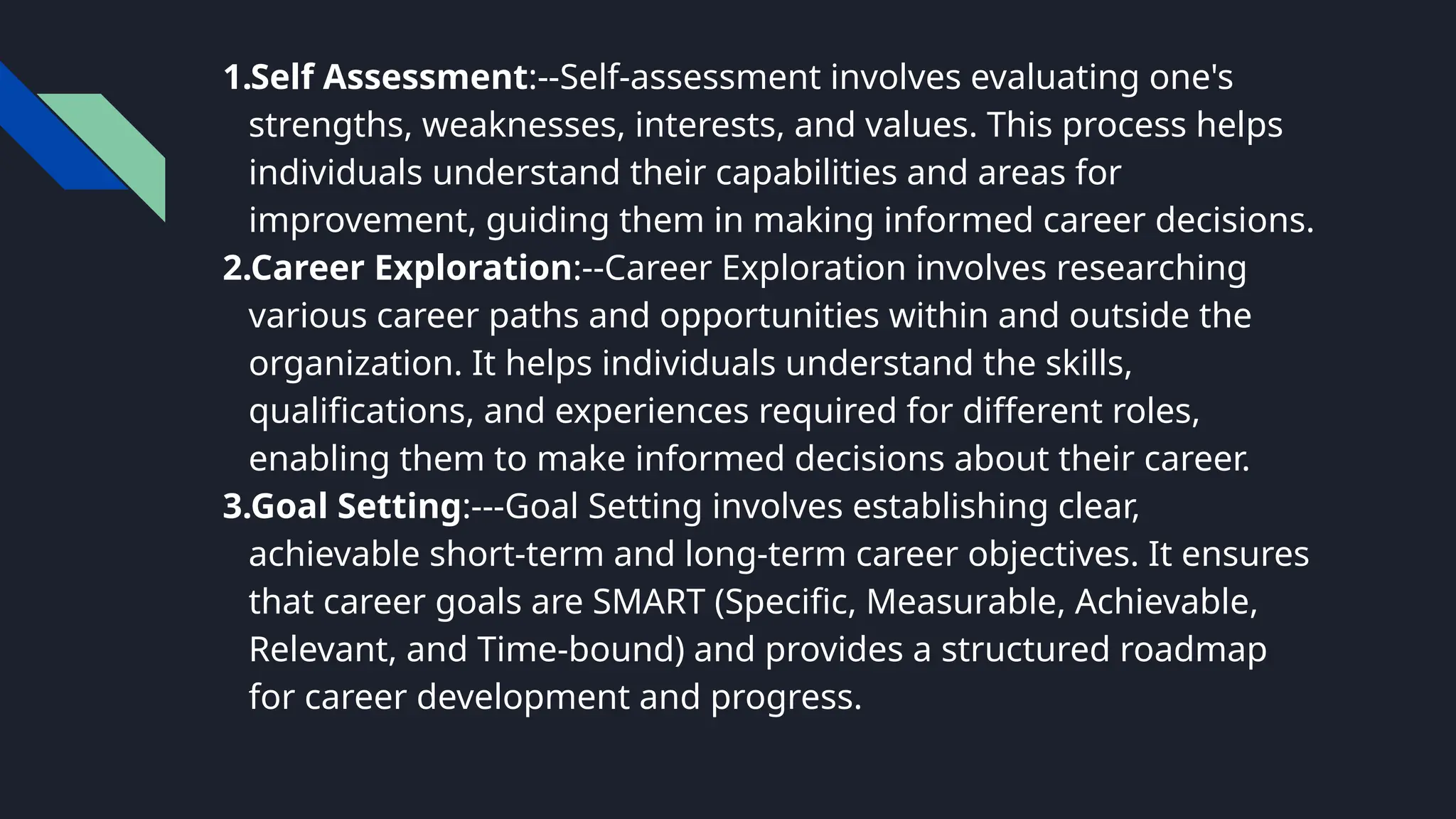
1.Self Assessment:--Self-assessment involvesevaluating one's
strengths, weaknesses, interests, and values. This process helps
individuals understand their capabilities and areas for
improvement, guiding them in making informed career decisions.
2.Career Exploration:--Career Exploration involves researching
various career paths and opportunities within and outside the
organization. It helps individuals understand the skills,
qualifications, and experiences required for different roles,
enabling them to make informed decisions about their career.
3.Goal Setting:---Goal Setting involves establishing clear,
achievable short-term and long-term career objectives. It ensures
that career goals are SMART (Specific, Measurable, Achievable,
Relevant, and Time-bound) and provides a structured roadmap
for career development and progress.
55.
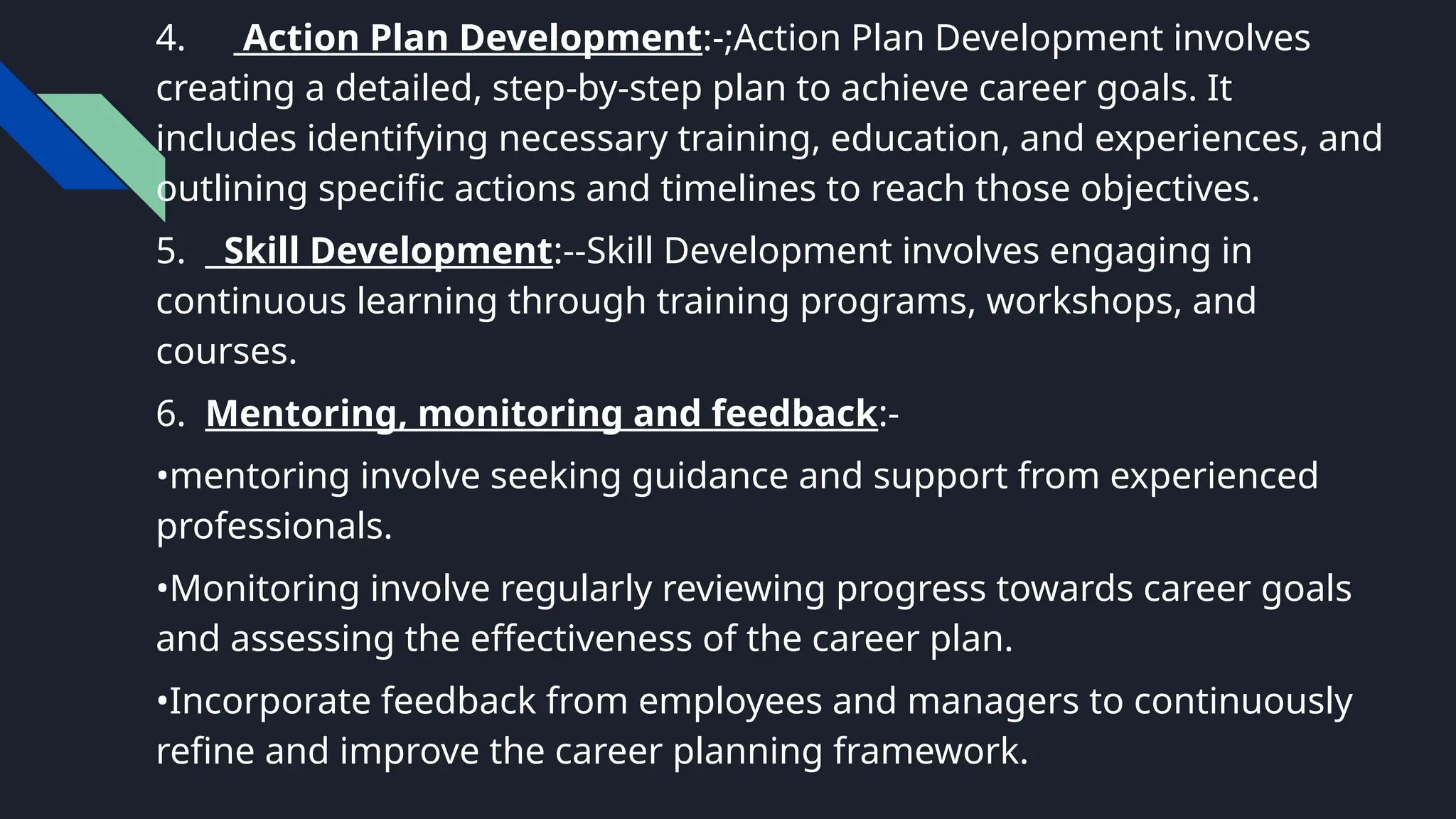
4. Action PlanDevelopment:-;Action Plan Development involves
creating a detailed, step-by-step plan to achieve career goals. It
includes identifying necessary training, education, and experiences, and
outlining specific actions and timelines to reach those objectives.
5. Skill Development:--Skill Development involves engaging in
continuous learning through training programs, workshops, and
courses.
6. Mentoring, monitoring and feedback:-
•mentoring involve seeking guidance and support from experienced
professionals.
•Monitoring involve regularly reviewing progress towards career goals
and assessing the effectiveness of the career plan.
•Incorporate feedback from employees and managers to continuously
refine and improve the career planning framework.
56.
Why career planningis important:--
1. Provides Direction and Focus:
A career plan helps you identify your career goals and the steps
needed to achieve them, providing a roadmap for your
professional journey
2. Enhances Employability:
Career planning helps you identify the skills and experience you
need to develop to become more attractive to employers.
3. Improves Decision-Making:
Career planning helps you make informed decisions about your
career path by considering your interests, skills, and values.
57.
4. Promotes JobSatisfaction and Work-Life Balance:
●A career plan helps you find a job that aligns with your
passions and values, leading to greater job satisfaction.
●By intentionally planning your career, you can create a
healthier work-life balance and avoid burnout.
5. Facilitates Career Advancement:
Career planning helps you identify opportunities for growth and
development within your chosen field.
58.
HRM’s key rolesin Career planning
1. Strategic Alignment and Planning:
●HRM collaborates with leadership to design development
frameworks aligned with the organization's overall objectives and
talent needs.
●This ensures that career paths within the company are not only
beneficial for employees but also contribute to the organization's
strategic goals.
2. Skills Development and Training:
●HRM identifies skill gaps through assessments and provides
targeted training programs, workshops, and mentorship to help
employees develop necessary competencies.
●By investing in employee development, HRM enhances individual
skills and boosts overall organizational performance
59.
3. Creating aCulture of Growth:
●HRM creates a supportive environment that encourages
continuous learning and development.
●This includes providing access to resources like e-learning
platforms, career development programs, and opportunities
to attend conferences and events.
4. Performance Management and Feedback:
●HRM utilizes performance appraisals and feedback
mechanisms to provide employees with insights into their
strengths and areas for improvement.
●This feedback is crucial for guiding employees in their career
development journey and ensuring alignment with
organizational goals.
60.
5. Employee Retentionand Engagement:
●A well-structured career planning process within HRM
enhances employee engagement and reduces turnover.
●When employees feel supported in their career growth, they
are more likely to be satisfied and committed to the
organization.
61.
Communicating Career PlanningInitiatives
●Transparency
●Success Stories
●Continuous Engagement
●Evaluating the Impact
●Measuring Success
●Reporting Outcomes
62.
Conclusion:-
Career planning inHRM is essential for aligning
individual aspirations with organizational goals.
It fosters employee growth, enhances job
satisfaction, and ensures leadership continuity.
Organizations can retain top talent, boost
productivity, and achieve long-term success by
implementing a structured career planning
process
63.
Promotion and Demotion:
NavigatingCareer
Transitions
This presentation offers a comprehensive exploration of promotion
and demotion within an organisational context, crucial elements of
human resource management and organisational behaviour. We
will delve into their definitions, objectives, types, criteria, and the
multifaceted impacts on employees and the organisation as a
whole.
64.
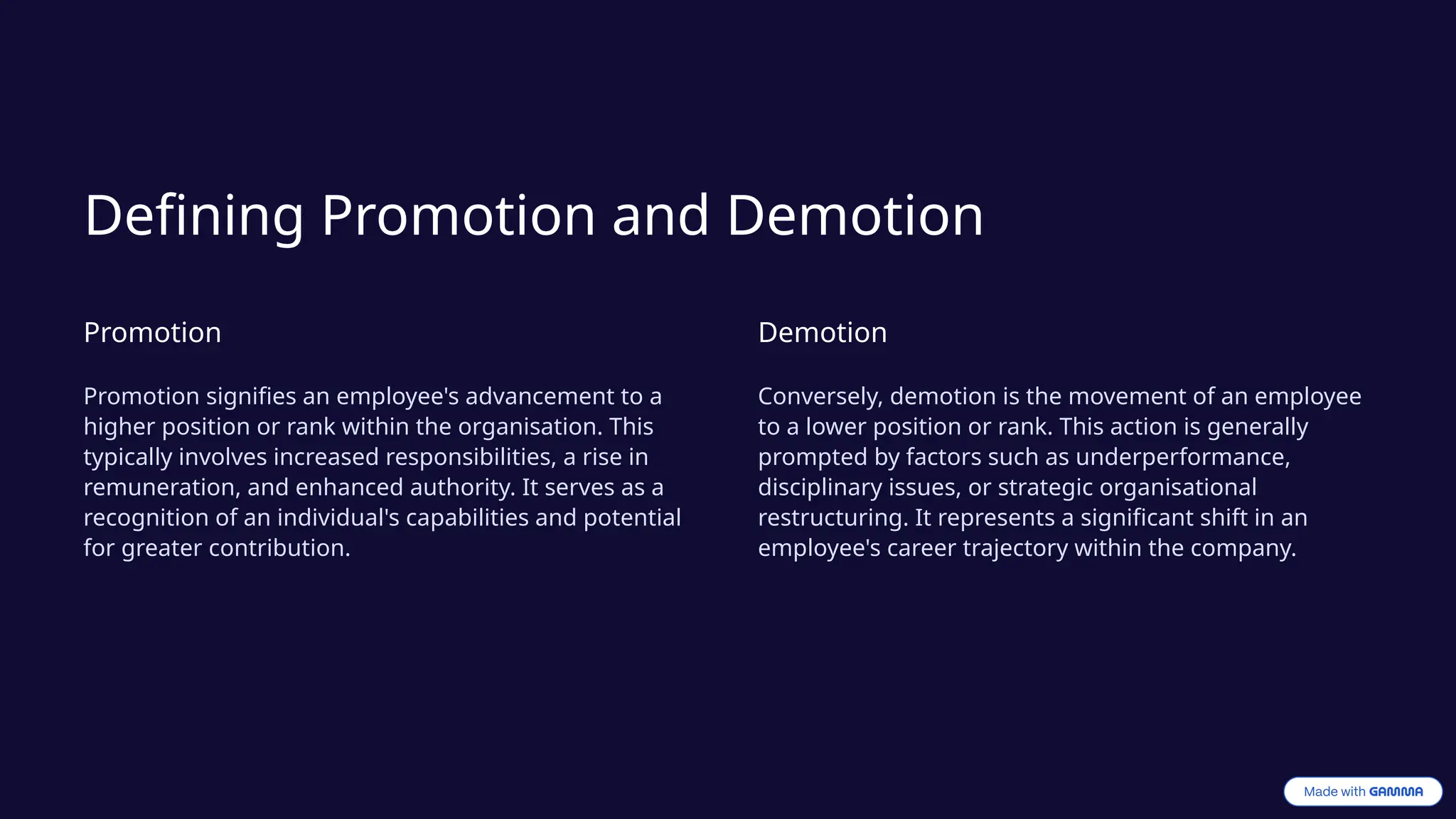
Defining Promotion andDemotion
Promotion
Promotion signifies an employee's advancement to a
higher position or rank within the organisation. This
typically involves increased responsibilities, a rise in
remuneration, and enhanced authority. It serves as a
recognition of an individual's capabilities and potential
for greater contribution.
Demotion
Conversely, demotion is the movement of an employee
to a lower position or rank. This action is generally
prompted by factors such as underperformance,
disciplinary issues, or strategic organisational
restructuring. It represents a significant shift in an
employee's career trajectory within the company.
65.
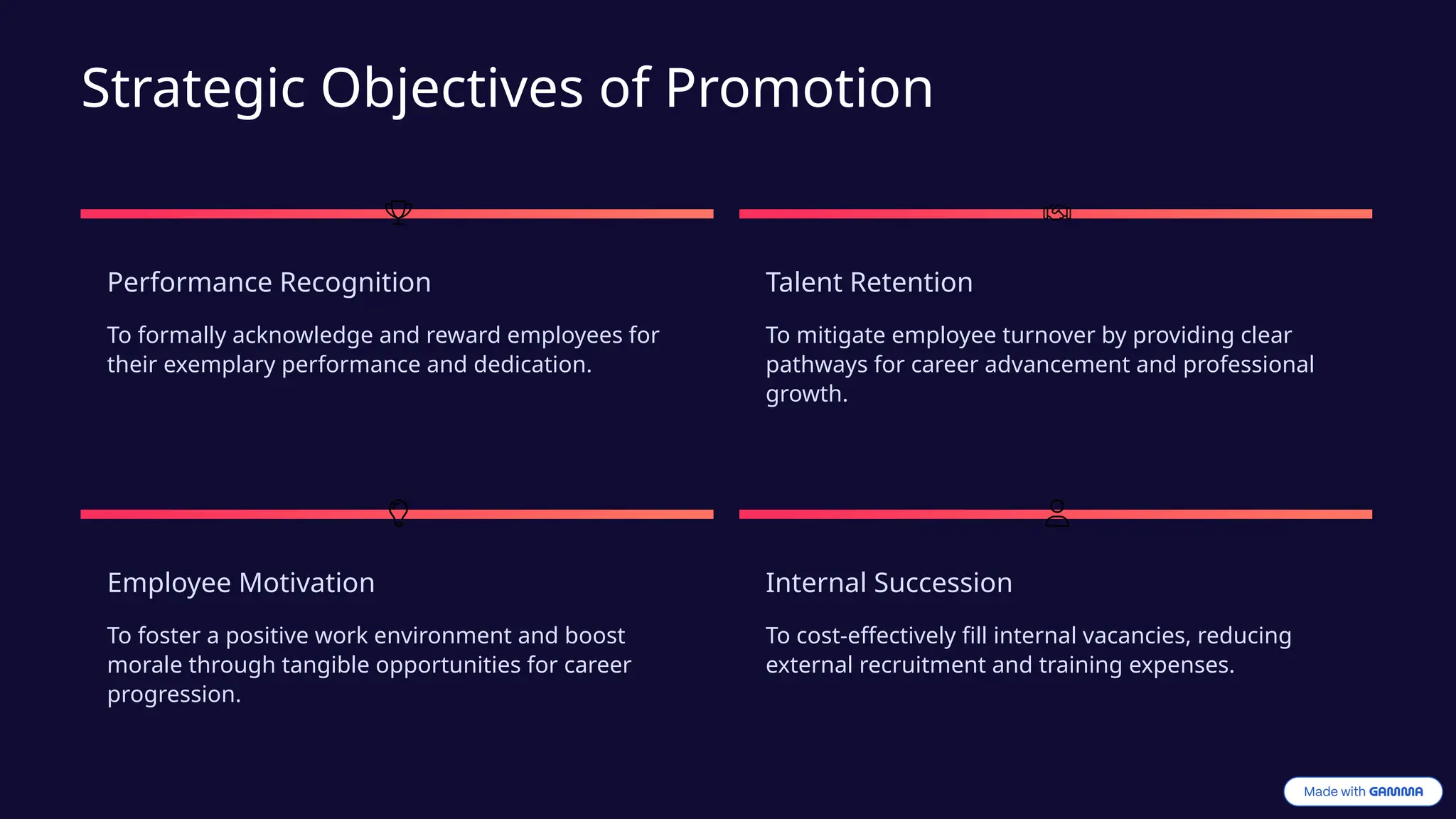
Strategic Objectives ofPromotion
Performance Recognition
To formally acknowledge and reward employees for
their exemplary performance and dedication.
Talent Retention
To mitigate employee turnover by providing clear
pathways for career advancement and professional
growth.
Employee Motivation
To foster a positive work environment and boost
morale through tangible opportunities for career
progression.
Internal Succession
To cost-effectively fill internal vacancies, reducing
external recruitment and training expenses.
66.
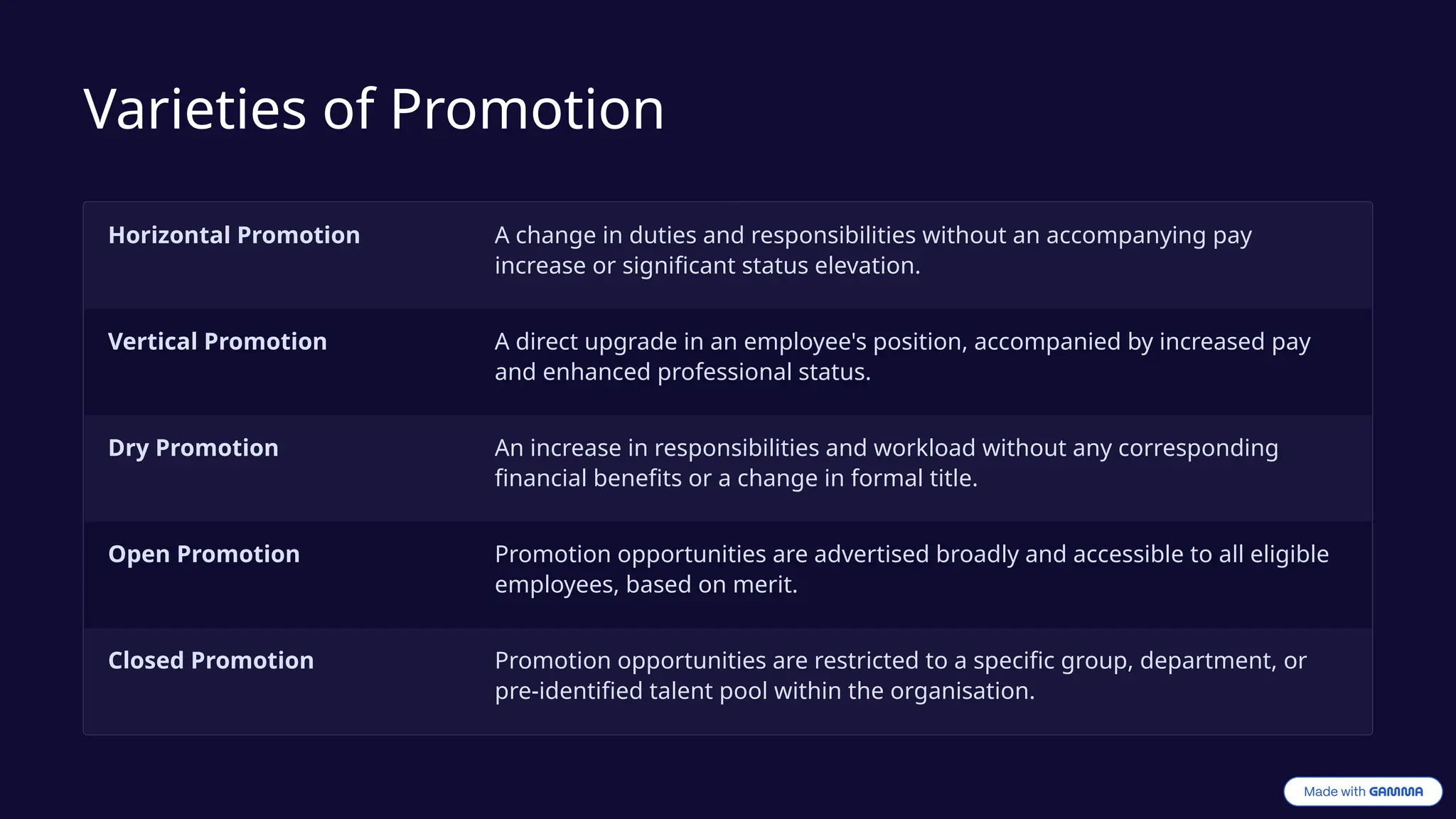
Varieties of Promotion
HorizontalPromotion A change in duties and responsibilities without an accompanying pay
increase or significant status elevation.
Vertical Promotion A direct upgrade in an employee's position, accompanied by increased pay
and enhanced professional status.
Dry Promotion An increase in responsibilities and workload without any corresponding
financial benefits or a change in formal title.
Open Promotion Promotion opportunities are advertised broadly and accessible to all eligible
employees, based on merit.
Closed Promotion Promotion opportunities are restricted to a specific group, department, or
pre-identified talent pool within the organisation.
67.
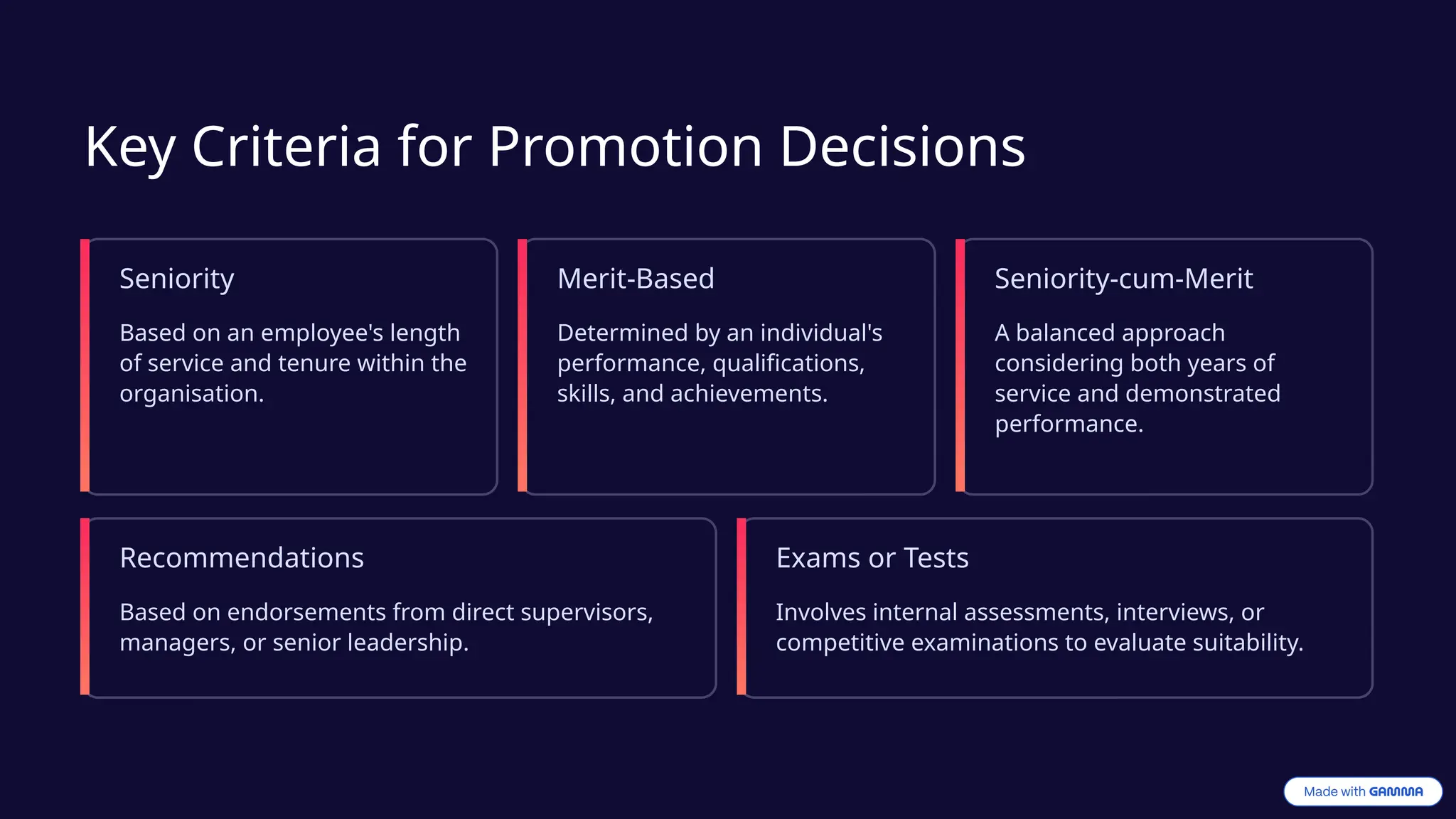
Key Criteria forPromotion Decisions
Seniority
Based on an employee's length
of service and tenure within the
organisation.
Merit-Based
Determined by an individual's
performance, qualifications,
skills, and achievements.
Seniority-cum-Merit
A balanced approach
considering both years of
service and demonstrated
performance.
Recommendations
Based on endorsements from direct supervisors,
managers, or senior leadership.
Exams or Tests
Involves internal assessments, interviews, or
competitive examinations to evaluate suitability.
68.
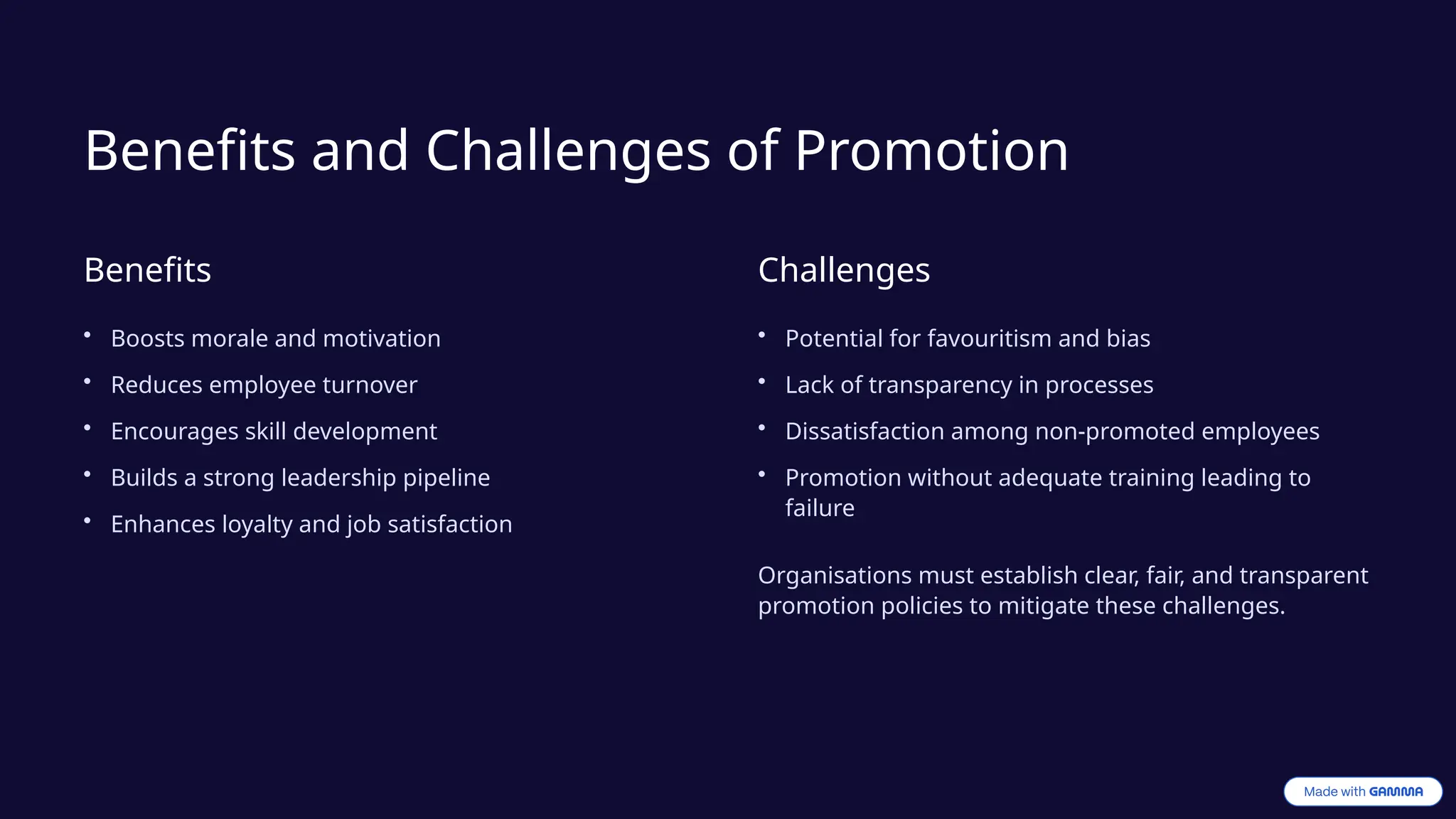
Benefits and Challengesof Promotion
Benefits
• Boosts morale and motivation
• Reduces employee turnover
• Encourages skill development
• Builds a strong leadership pipeline
• Enhances loyalty and job satisfaction
Challenges
• Potential for favouritism and bias
• Lack of transparency in processes
• Dissatisfaction among non-promoted employees
• Promotion without adequate training leading to
failure
Organisations must establish clear, fair, and transparent
promotion policies to mitigate these challenges.
69.
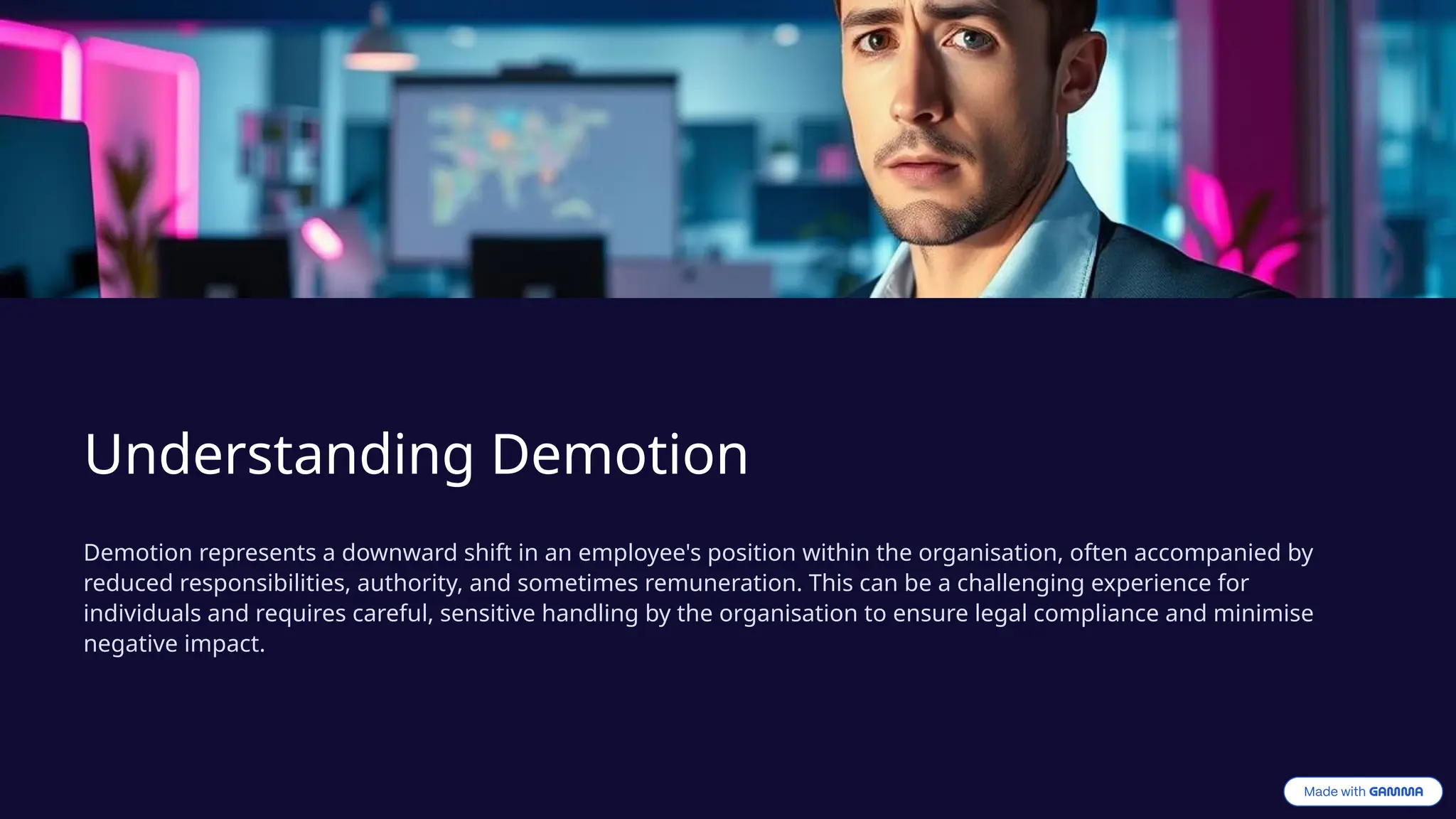
Understanding Demotion
Demotion representsa downward shift in an employee's position within the organisation, often accompanied by
reduced responsibilities, authority, and sometimes remuneration. This can be a challenging experience for
individuals and requires careful, sensitive handling by the organisation to ensure legal compliance and minimise
negative impact.
70.
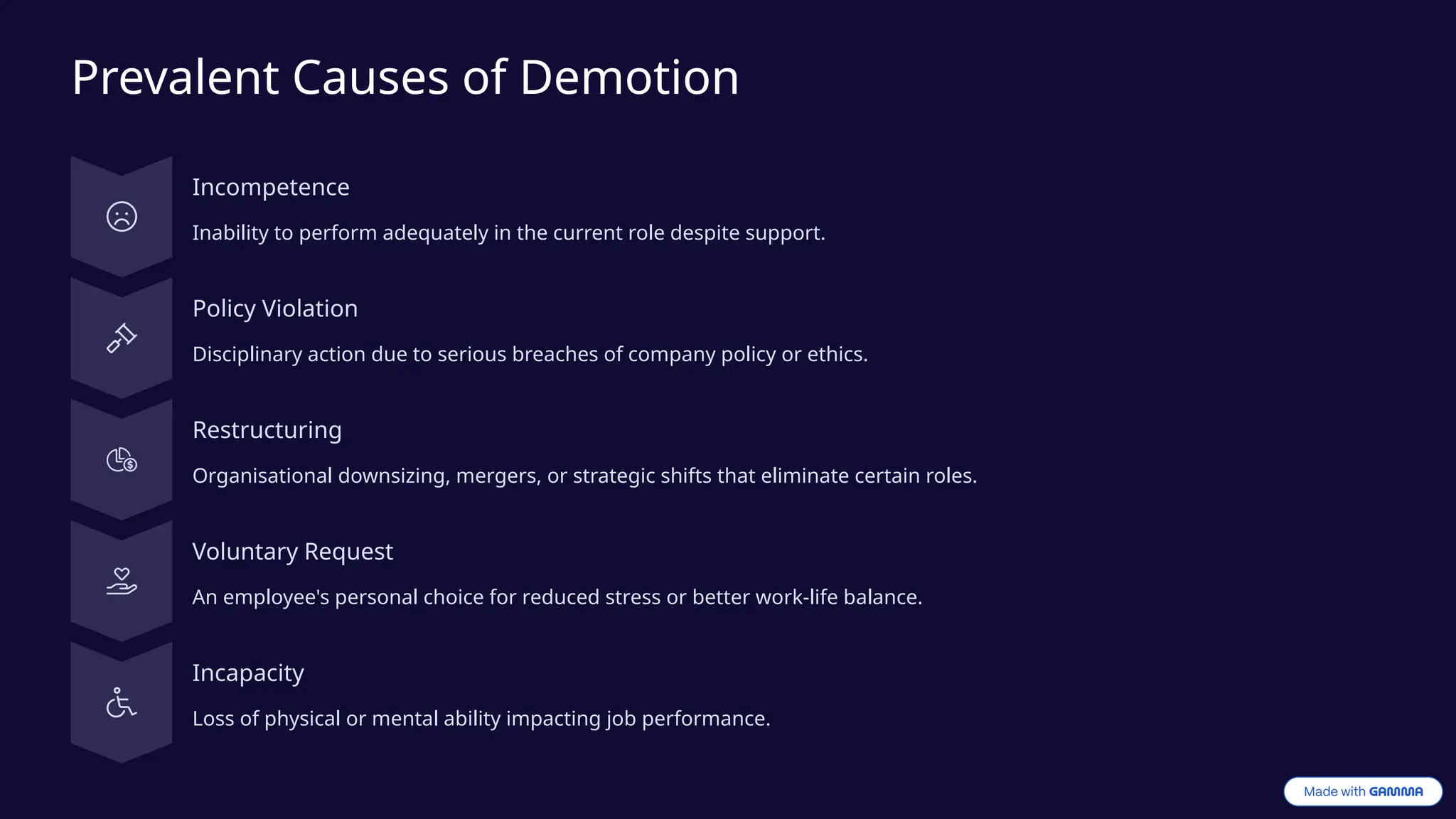
Prevalent Causes ofDemotion
Incompetence
Inability to perform adequately in the current role despite support.
Policy Violation
Disciplinary action due to serious breaches of company policy or ethics.
Restructuring
Organisational downsizing, mergers, or strategic shifts that eliminate certain roles.
Voluntary Request
An employee's personal choice for reduced stress or better work-life balance.
Incapacity
Loss of physical or mental ability impacting job performance.
71.
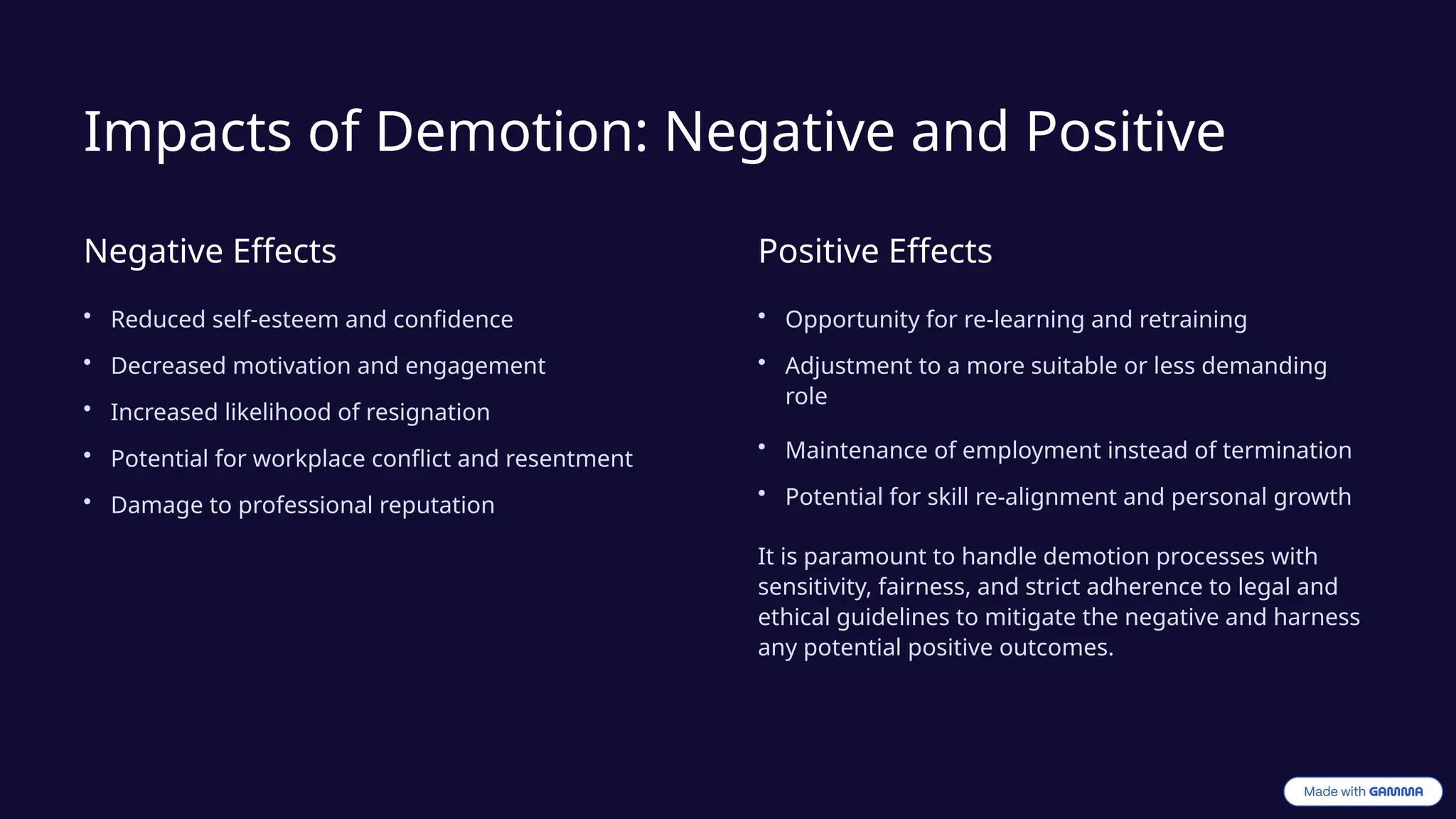
Impacts of Demotion:Negative and Positive
Negative Effects
• Reduced self-esteem and confidence
• Decreased motivation and engagement
• Increased likelihood of resignation
• Potential for workplace conflict and resentment
• Damage to professional reputation
Positive Effects
• Opportunity for re-learning and retraining
• Adjustment to a more suitable or less demanding
role
• Maintenance of employment instead of termination
• Potential for skill re-alignment and personal growth
It is paramount to handle demotion processes with
sensitivity, fairness, and strict adherence to legal and
ethical guidelines to mitigate the negative and harness
any potential positive outcomes.
72.
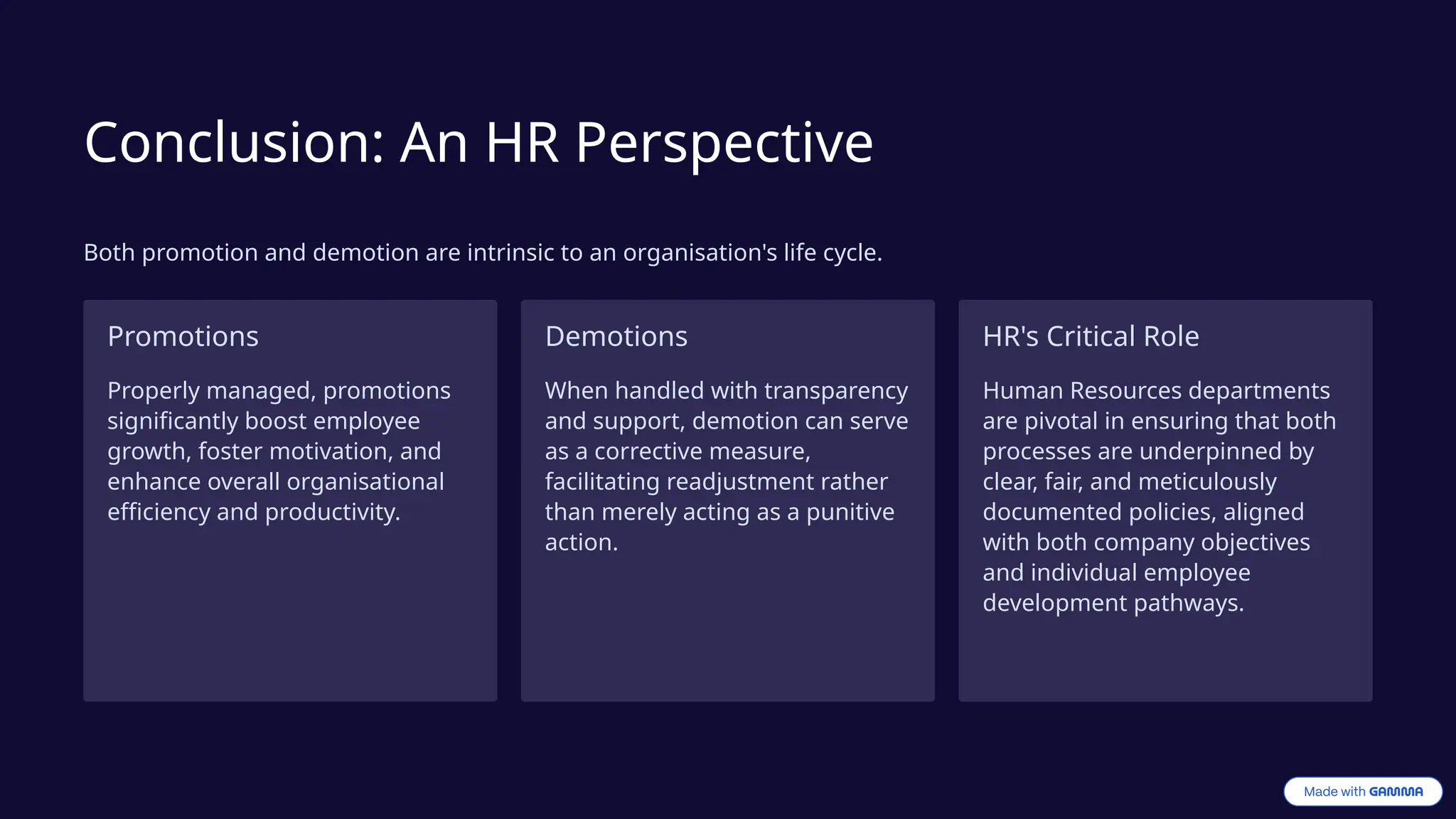
Conclusion: An HRPerspective
Both promotion and demotion are intrinsic to an organisation's life cycle.
Promotions
Properly managed, promotions
significantly boost employee
growth, foster motivation, and
enhance overall organisational
efficiency and productivity.
Demotions
When handled with transparency
and support, demotion can serve
as a corrective measure,
facilitating readjustment rather
than merely acting as a punitive
action.
HR's Critical Role
Human Resources departments
are pivotal in ensuring that both
processes are underpinned by
clear, fair, and meticulously
documented policies, aligned
with both company objectives
and individual employee
development pathways.
74.
INTRODUCTION
• Employee Transfermeans a shift of an employee from one job,
department, or location to another within the same organization.
• Transfers are lateral movements — no major change in salary or
hierarchy.
• Purpose: balancing workforce, skill utilization, employee growth, and
organizational need.
75.
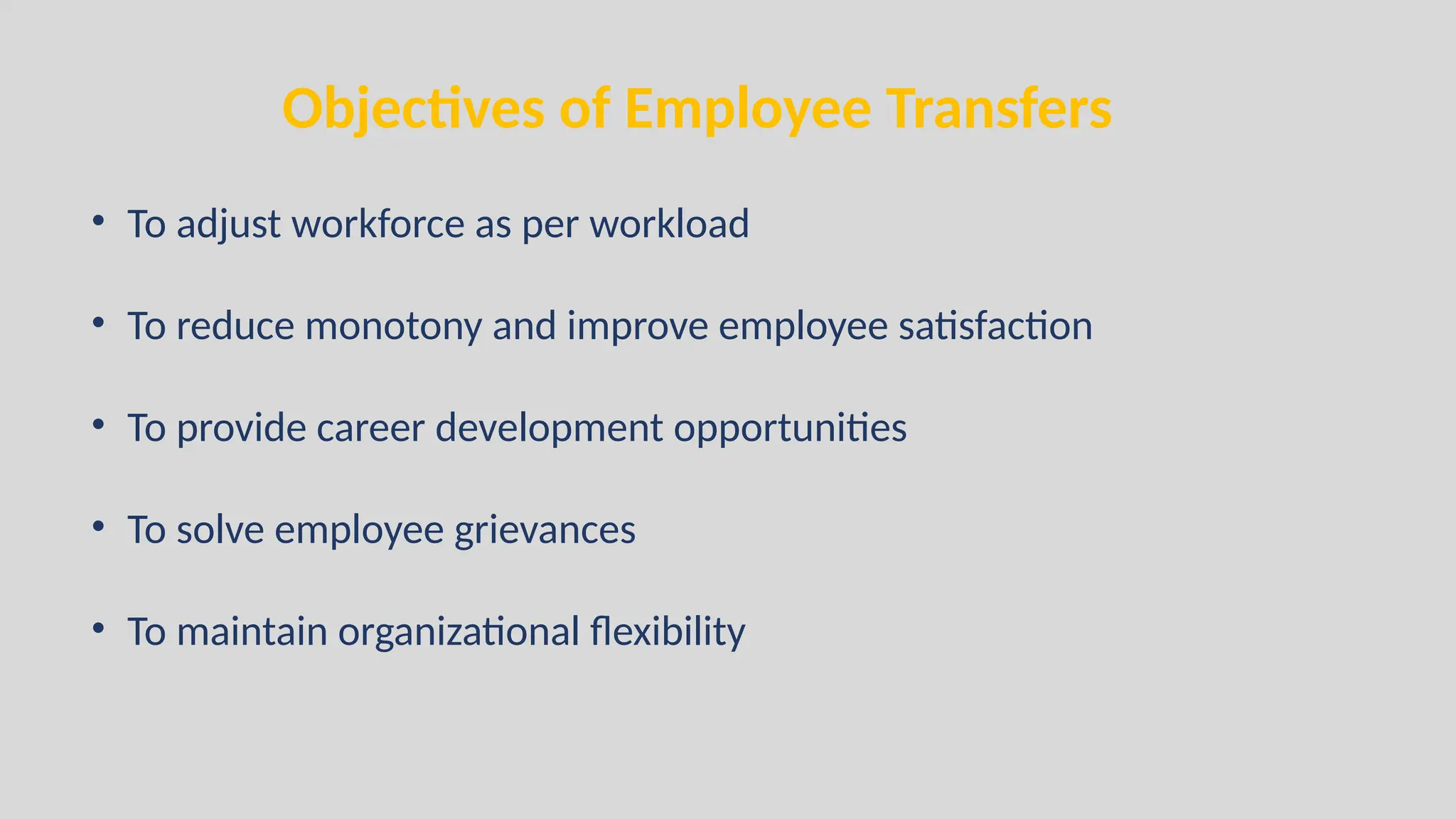
Objectives of EmployeeTransfers
• To adjust workforce as per workload
• To reduce monotony and improve employee satisfaction
• To provide career development opportunities
• To solve employee grievances
• To maintain organizational flexibility
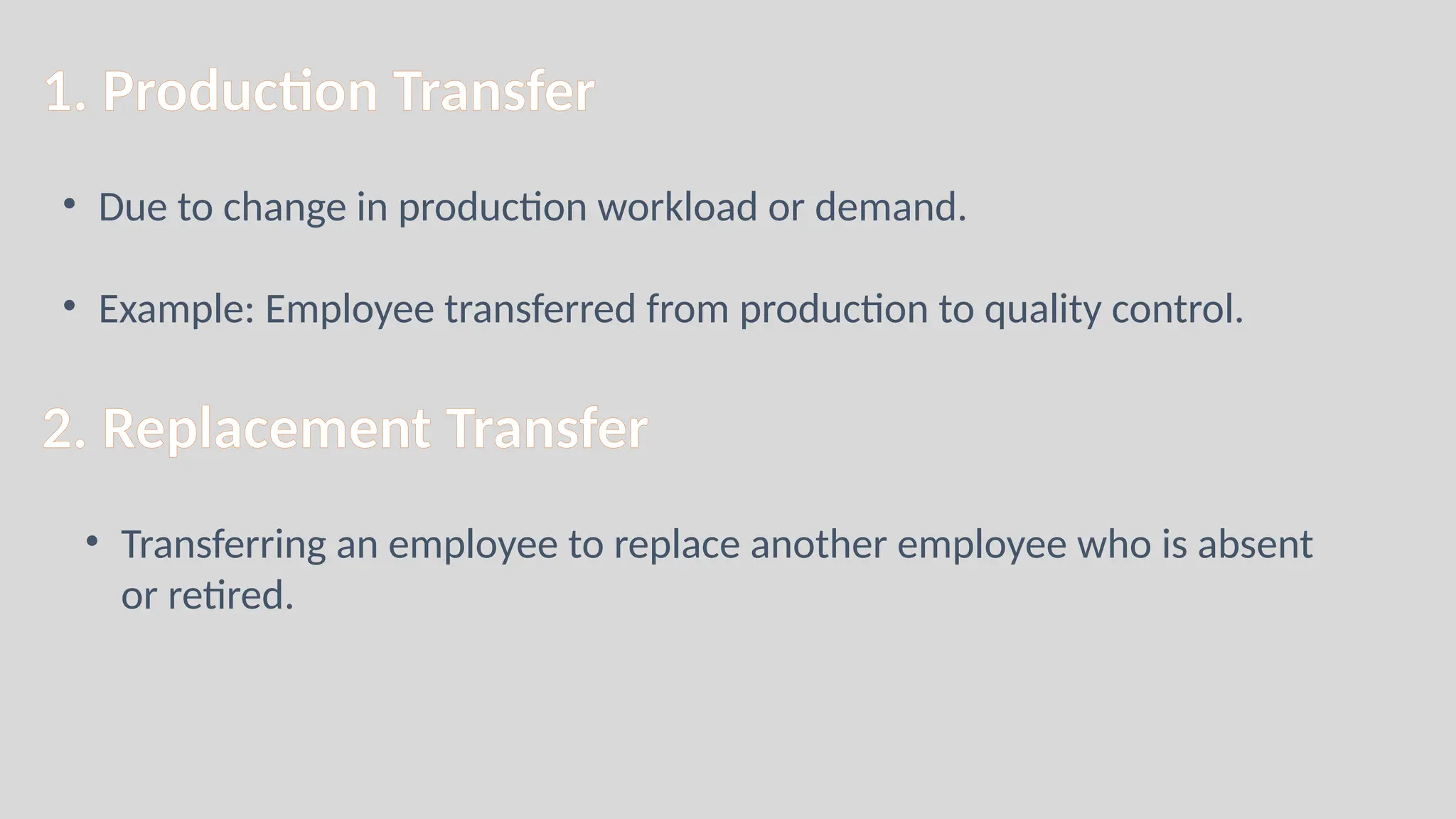
1. Production Transfer
•Due to change in production workload or demand.
• Example: Employee transferred from production to quality control.
2. Replacement Transfer
• Transferring an employee to replace another employee who is absent
or retired.
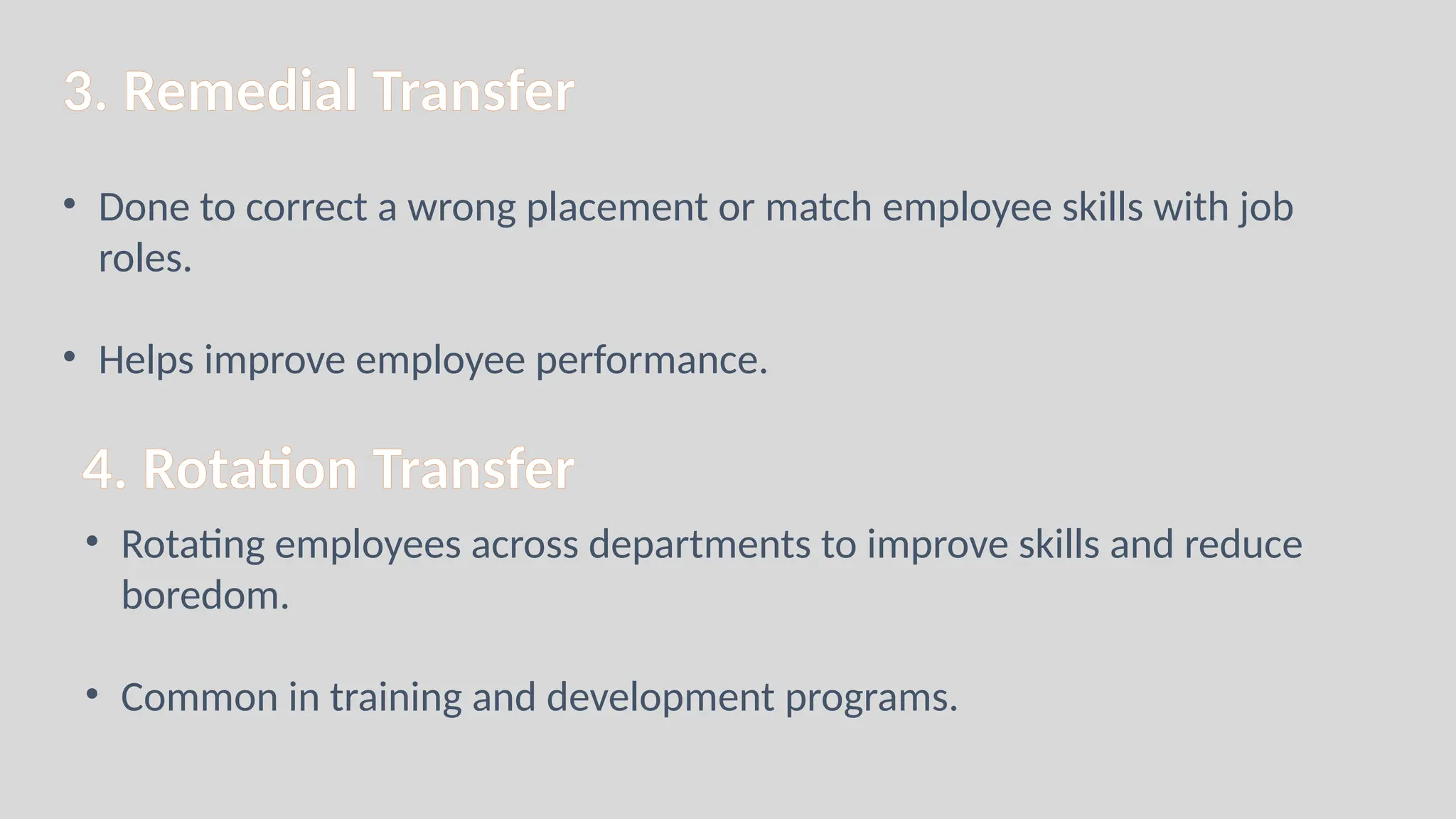
78.
3. Remedial Transfer
•Done to correct a wrong placement or match employee skills with job
roles.
• Helps improve employee performance.
4. Rotation Transfer
• Rotating employees across departments to improve skills and reduce
boredom.
• Common in training and development programs.
79.
5. Shift Transfer
•Changing employee shift timings as per business needs.
• Common in manufacturing and BPO industries.
6. Location/Geographical Transfer
• Transfer from one city or branch to another.
• Can be temporary or permanent.
80.
HR’s Role inTransfers
• Frame and implement transfer policies
• Communicate clearly with employees
• Maintain fairness and transparency
• Handle documentation and approvals
• Monitor employee adjustment after transfer
81.
Advantages of Transfers
•Balances manpower across departments
• Develops employee skills and flexibility
• Increases job satisfaction and motivation
• Reduces attrition and boredom
82.
Challenges in Transfers
•Resistance from employees or families
• Adjustment issues in new role/location
• Possible drop in productivity during transition
• Emotional and logistical concerns
83.
Conclusion
• Transfers area strategic HR tool.
• When handled well, they benefit both the organization and
employees.
• HR should ensure policies are clear, fair, and employee-friendly.
85.
Introduction
• Separation isthe process through which an employee leaves the
organization.
• It can be voluntary or involuntary.
• HR plays a key role in managing separation professionally and legally.
1. Resignation
• Voluntaryseparation initiated by the employee.
• Usually due to better opportunities, personal reasons, or
dissatisfaction.
• HR must ensure notice period compliance and smooth handover.
2. Termination
• Involuntary removal of an employee due to performance issues,
misconduct, or policy violations.
• Needs strong documentation and legal compliance.
88.
3. Retirement
• Employeeleaves after reaching the age of superannuation.
Can be:
• Normal Retirement
• Voluntary Retirement Scheme (VRS)
HR conducts retirement planning, benefits calculation, and farewell
process.
89.
4. Layoff
• Temporaryor permanent separation due to:
• Lack of work
• Cost-cutting
• Business slowdown
• HR must follow Industrial Disputes Act regulations in India.
90.
5. Retrenchment
• Terminationdue to redundancy of position, often during restructuring.
• Compensation must be provided as per law.
6. Dismissal
• Permanent separation due to serious misconduct.
• Requires proper inquiry and fair hearing before action.
91.
CHR's Role inSeparation Process
• Ensure legal compliance and documentation
• Conduct Exit Interviews
• Process final settlement, PF
• Ensure knowledge transfer/handover
• Maintain employee records for future reference
92.
Conclusion
• Employee separationis an inevitable part of HRM.
• A structured and respectful approach ensures smooth transitions.
• HR should handle every separation with fairness and transparency.
What is PerformanceAppraisal?
Definition:
Performance appraisal is a method used by organizations to evaluate an
employee’s work performance over a period of time.
In simple words:
It is a way to check how well an employee is doing their job.
Example:
A company reviews an employee's work every 6 months and gives
feedback.
95.
Key Features ofPerformance Appraisal
Planned process
Done regularly (e.g., every 6 months or yearly)
Includes feedback, ratings, and sometimes rewards
Based on goals and targets
Improving Employee Performance
Appraisalhelps employees understand what they are doing well and where
they need to improve.
Example:
If a salesperson is not reaching their target, the manager gives tips to improve.
Promotions and Salary Increases
Appraisals help decide who should get a promotion or a salary raise, based on
performance.
Example:
An employee who performs well may get a 10% salary hike.
98.
Identifying Training Needs
Ifan employee is not good at some tasks, appraisal shows that they may
need training.
Example:
If a cashier makes billing errors, training in software can be given.
Better Communication
It creates a chance for employees and managers to talk openly about
work.
Example:
An employee shares their challenges, and the manager offers support.
99.
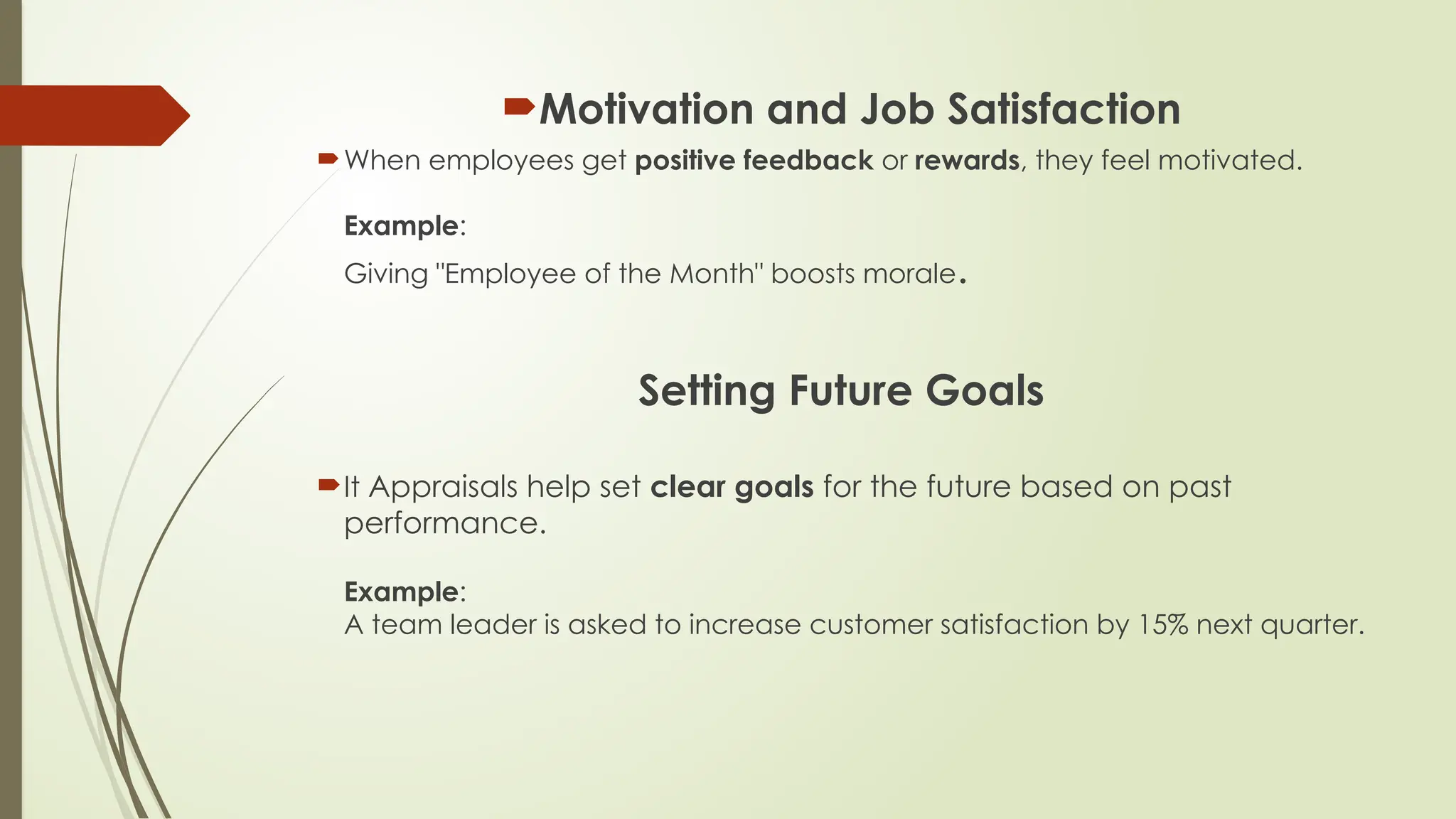
Motivation and JobSatisfaction
When employees get positive feedback or rewards, they feel motivated.
Example:
Giving "Employee of the Month" boosts morale.
Setting Future Goals
It Appraisals help set clear goals for the future based on past
performance.
Example:
A team leader is asked to increase customer satisfaction by 15% next quarter.
100.
Conclusion
Performance appraisal helpsboth the employee and the organization.
It is important for growth, improvement, and success.
Right feedback at the right time can make a big difference.
What is 360-DegreeFeedback?
Definition:
360-degree feedback is a system where an employee receives feedback
from all directions – like managers, peers, team members, and even
customers.
In simple words:
It’s a way to get feedback from everyone around you at work.
104.
Who Gives Feedback?
Manager / Supervisor
Team members / Colleagues
Subordinates (if any)
Customers / Clients
Self (self-assessment)
Example:
A team leader gets feedback from their manager, their team, and
themselves.
105.
Why Use 360-DegreeFeedback?
To get a complete view of performance
To find strengths and weaknesses
To improve communication
To develop leadership skills
106.
USES
Employee Development
Feedback fromall sides helps employees grow professionally and personally.
Example:
A manager learns from team feedback that they need to improve listening skills.
Leadership Training
Future leaders can use feedback to become more effective and supportive.
Example:
An employee aiming for promotion gets feedback to build leadership qualities
107.
USES
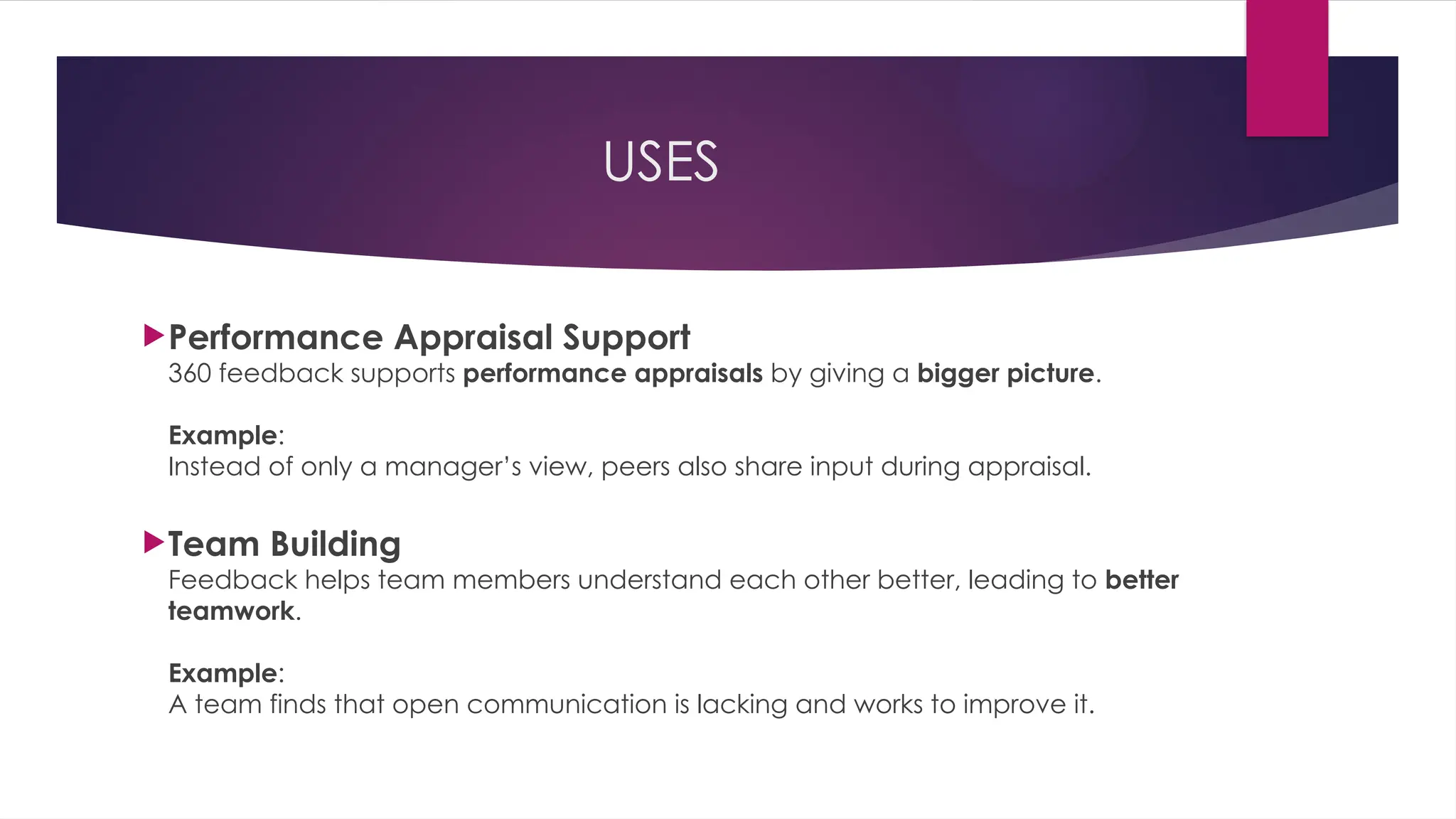
Performance Appraisal Support
360feedback supports performance appraisals by giving a bigger picture.
Example:
Instead of only a manager’s view, peers also share input during appraisal.
Team Building
Feedback helps team members understand each other better, leading to better
teamwork.
Example:
A team finds that open communication is lacking and works to improve it.
108.
Applications in Organizations
Usedin MNCs, corporates, startups, and government
offices
Popular for leadership reviews, promotions, and
development
Common in HR practices to improve organizational
culture
109.
Limitations / Thingsto Remember
Feedback must be honest and respectful
May cause confusion if not handled properly
Needs confidentiality and clear process
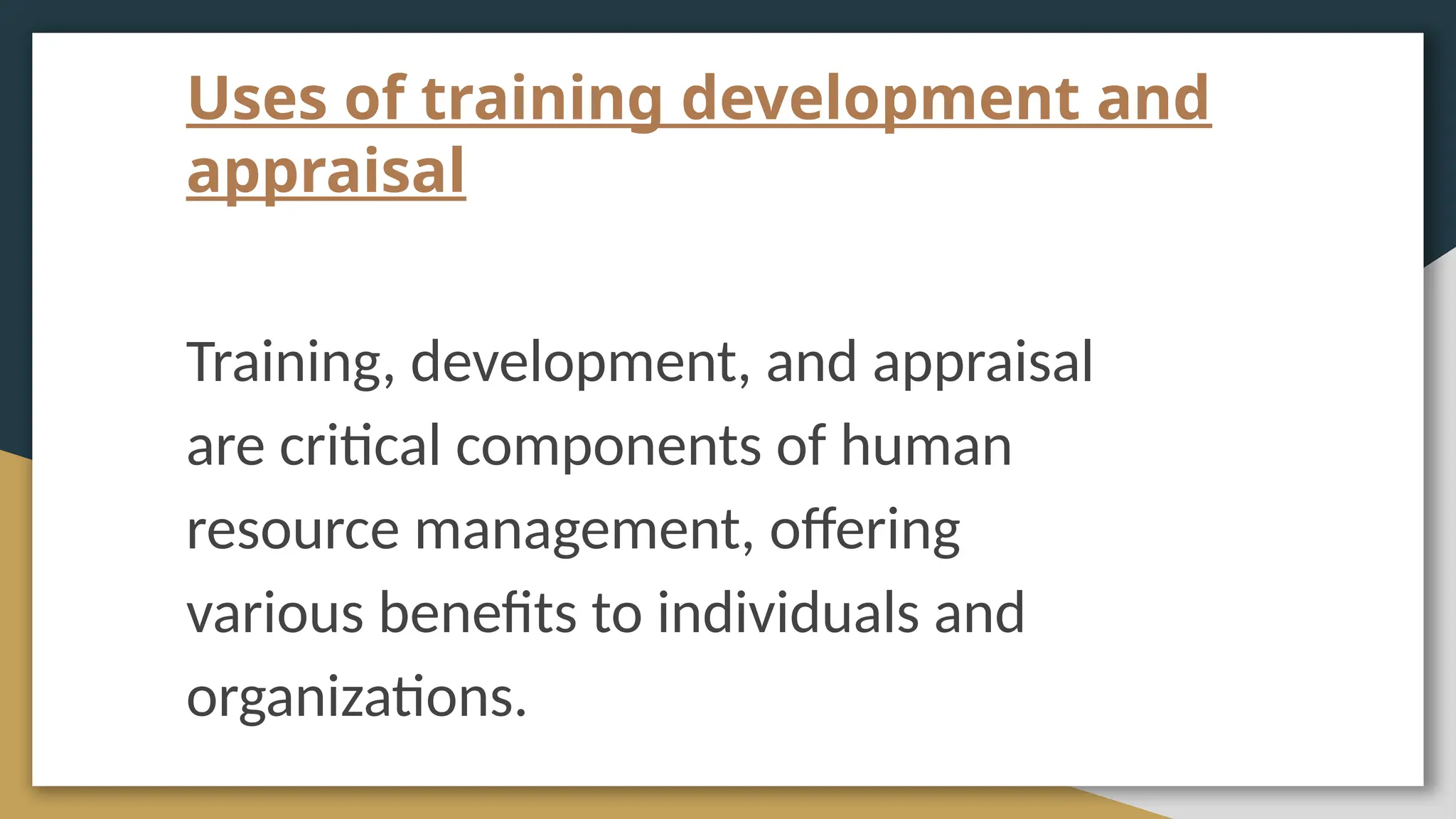
Uses of trainingdevelopment and
appraisal
Training, development, and appraisal
are critical components of human
resource management, offering
various benefits to individuals and
organizations.
114.
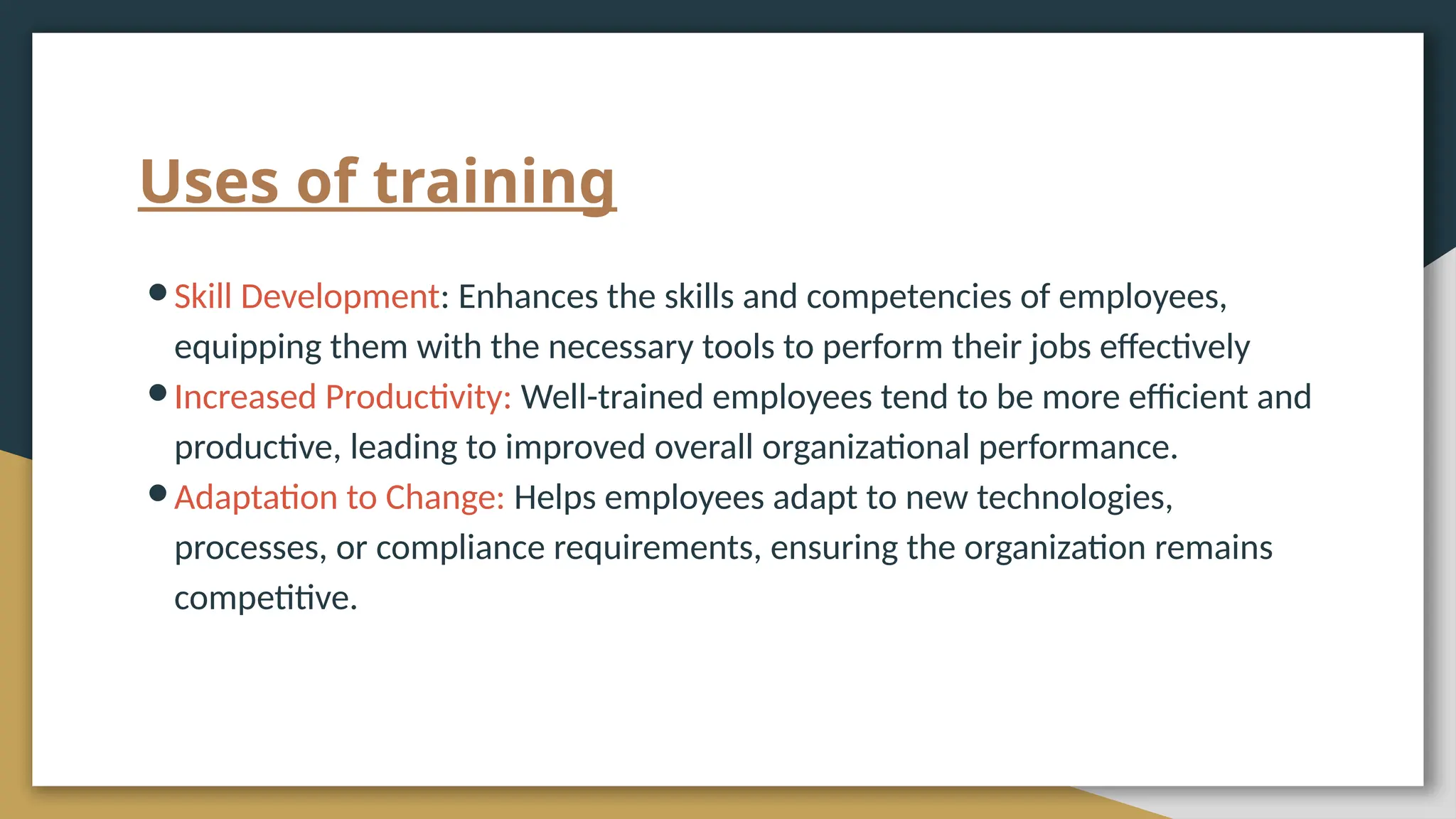
Uses of training
●SkillDevelopment: Enhances the skills and competencies of employees,
equipping them with the necessary tools to perform their jobs effectively
●Increased Productivity: Well-trained employees tend to be more efficient and
productive, leading to improved overall organizational performance.
●Adaptation to Change: Helps employees adapt to new technologies,
processes, or compliance requirements, ensuring the organization remains
competitive.
115.
●Employee Satisfaction: Ongoingtraining opportunities can lead
to higher job satisfaction, as employees feel valued and
invested in.
●Reducing Errors: Proper training reduces the likelihood of
mistakes and accidents, improving the quality of work and
safety in the workplace.
116.
Uses of development
●CareerGrowth: Focuses on the long-term development of
employees, preparing them for future roles and responsibilities
within the organization.
●Leadership Preparation: Prepares potential leaders by equipping
them with essential management skills, ensuring a smooth
succession plan.
●Organizational Culture: Promotes a culture of continuous learning
and improvement, fostering innovation and adaptability within
the workforce.
117.
●Retention: Investing inemployee development can enhance
loyalty and retention, as employees are more likely to stay with
an organization that supports their growth.
●Performance Enhancements: Development programs help in
aligning employees' goals with organizational objectives,
leading to improved performance outcomes.
118.
Uses of appraisal
●PerformanceMeasurement: Evaluates individual employee
performance against set goals and standards, providing a clear
picture of contributions to the organization.
●Feedback Mechanism: Serves as a key tool for delivering constructive
feedback to employees, helping them understand their strengths and
areas for improvement.
●Training Needs Identification: Appraisals can highlight areas where
additional training or development is needed, enabling targeted
employee development initiatives.
119.
●Motivation and Incentives:Effective appraisal systems can
motivate employees by recognizing their achievements,
which can lead to increased morale and job satisfaction.
●Promotion and Succession Planning: Provides critical
information for making informed decisions about promotions,
role changes, and succession planning based on individual
performance.
z
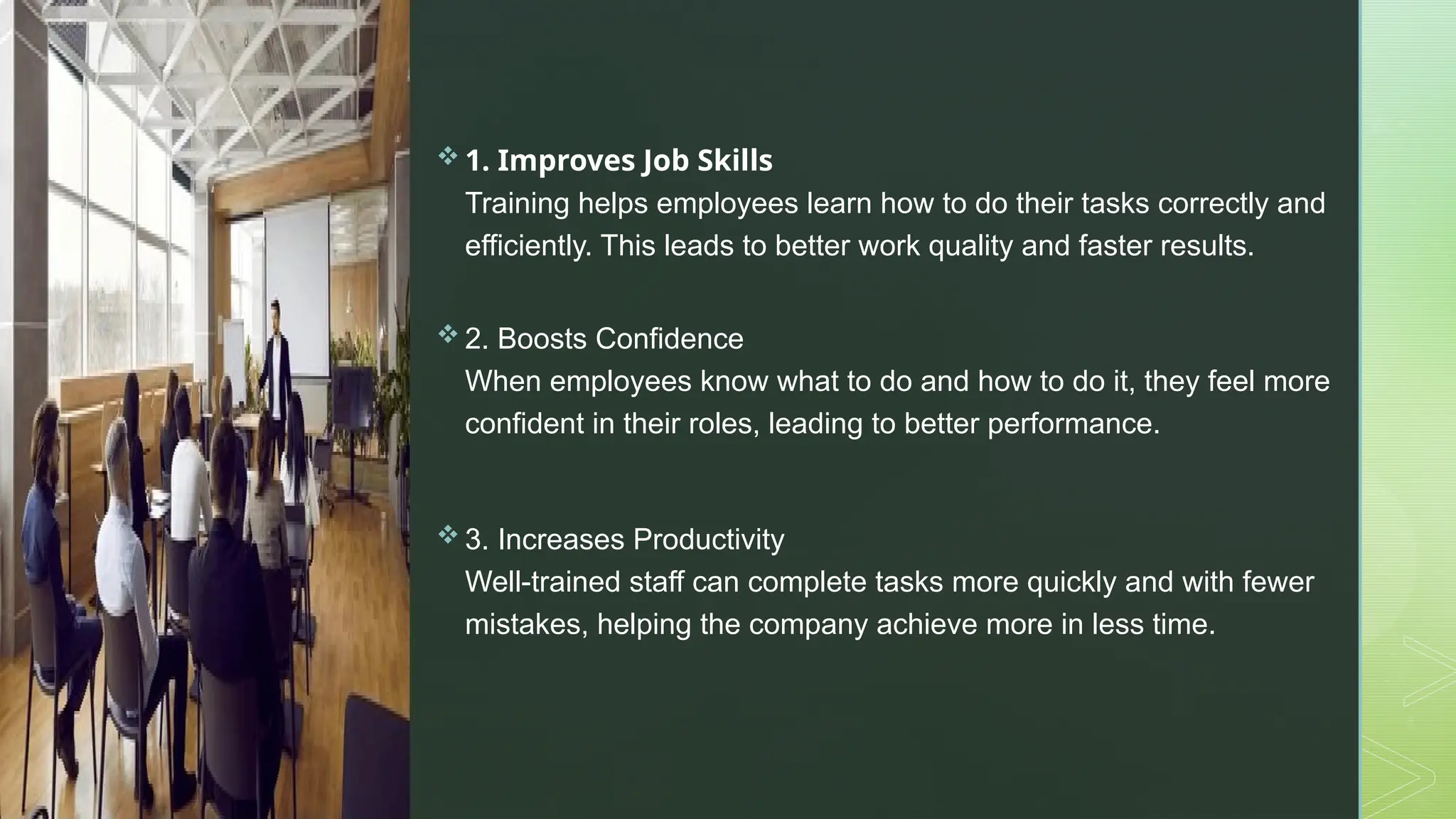
1. ImprovesJob Skills
Training helps employees learn how to do their tasks correctly and
efficiently. This leads to better work quality and faster results.
2. Boosts Confidence
When employees know what to do and how to do it, they feel more
confident in their roles, leading to better performance.
3. Increases Productivity
Well-trained staff can complete tasks more quickly and with fewer
mistakes, helping the company achieve more in less time.
124.
z
4. ReducesErrors and Accidents
Training reduces common mistakes and helps employees follow
safety rules, creating a safer and more efficient workplace.
5. Supports Career Growth
Development programs prepare employees for future promotions by
teaching them new skills and leadership abilities.
6. Improves Teamwork
Group training improves communication, understanding, and
coordination among team members, leading to better collaboration.
125.
z
7. HelpsAdapt to New Technology or Processes
Training helps employees learn how to use new machines, software,
or methods, so they can stay updated with changes.
8. Enhances Customer Service
Trained employees can better understand customer needs and
respond in a helpful and professional manner.
z
Applications of PerformanceAppraisal
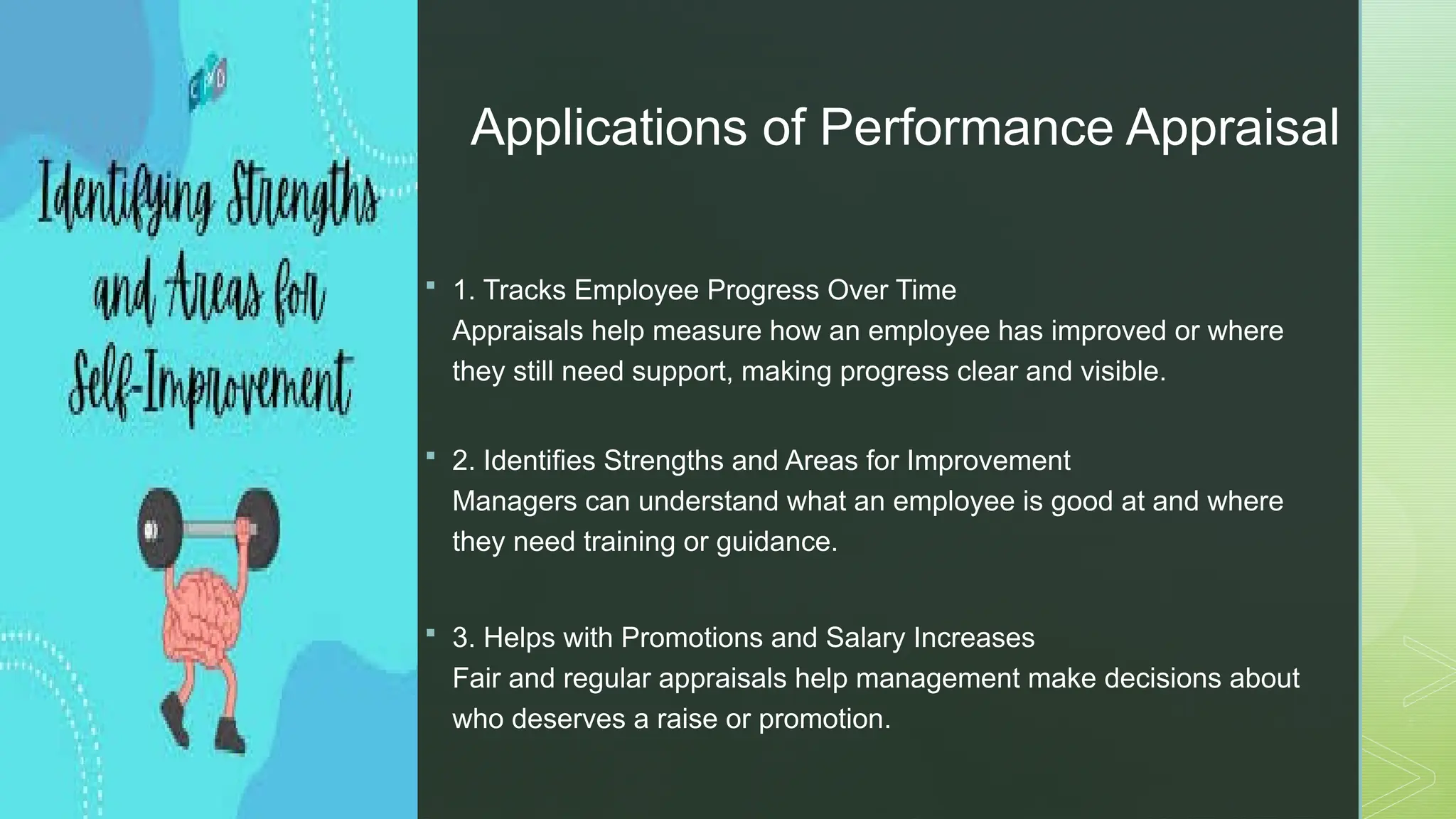
1. Tracks Employee Progress Over Time
Appraisals help measure how an employee has improved or where
they still need support, making progress clear and visible.
2. Identifies Strengths and Areas for Improvement
Managers can understand what an employee is good at and where
they need training or guidance.
3. Helps with Promotions and Salary Increases
Fair and regular appraisals help management make decisions about
who deserves a raise or promotion.
128.
z
4. ImprovesCommunication between Manager and Employee
Appraisals encourage open discussion, which helps build better
understanding and trust.
5. Identifies Training Needs
When an employee is weak in a certain area, the appraisal helps
point it out so training can be given to improve it.
6. Motivates Employees to Perform Better
When employees see their efforts are being recognized, they feel
motivated to work harder and smarter.
129.
z
7. Sets ClearGoals and Expectations
Appraisals help set specific goals for employees to achieve in the
next period, giving them a clear path forward.
8. Helps the Company Improve Overall Performance
When all employees improve, the company performs better as a
whole — leading to growth and success.

![1
MEANING &
CONCEPT
2
IMPORTANCE
& NEED
3
DEVELOPMEN
TAL
INTERVENTIO
NS
4
BENEFITS
AND SCOPE
Human Resource
Development [HRD]](https://image.slidesharecdn.com/trainningdevelopmentandappraisal-250817150843-40894655/75/TRAINNING-DEVELOPMENT-AND-APPRAISAL-pptx-15-2048.jpg)