The major competencies that are required to
be present in a trainer are:

•Presentation Skills

•Business Skills i.e. budgeting, time
management, negotiation, etc.

•Content Development i.e. material
production, graphics, layouts, etc

•Self development i.e. interpersonal skills,
good listening skills, flexible, accepting the
share of accountability, etc
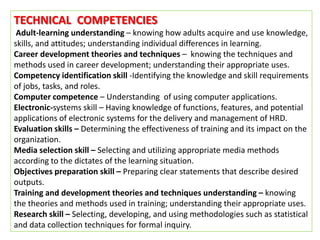
TECHNICAL COMPETENCIES
 Adult-learning understanding – knowing how adults acquire and use knowledge,
skills, and attitudes; understanding individual differences in learning.
Career development theories and techniques – knowing the techniques and
methods used in career development; understanding their appropriate uses.
Competency identification skill -Identifying the knowledge and skill requirements
of jobs, tasks, and roles.
Computer competence – Understanding of using computer applications.
Electronic-systems skill – Having knowledge of functions, features, and potential
applications of electronic systems for the delivery and management of HRD.
Evaluation skills – Determining the effectiveness of training and its impact on the
organization.
Media selection skill – Selecting and utilizing appropriate media methods
according to the dictates of the learning situation.
Objectives preparation skill – Preparing clear statements that describe desired
outputs.
Training and development theories and techniques understanding – knowing
the theories and methods used in training; understanding their appropriate uses.
Research skill – Selecting, developing, and using methodologies such as statistical
and data collection techniques for formal inquiry.
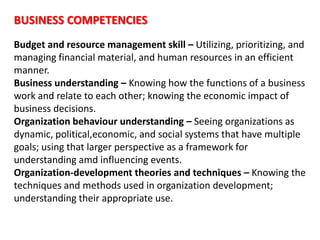
BUSINESS COMPETENCIES
Budget and resource management skill – Utilizing, prioritizing, and
managing financial material, and human resources in an efficient
manner.
Business understanding – Knowing how the functions of a business
work and relate to each other; knowing the economic impact of
business decisions.
Organization behaviour understanding – Seeing organizations as
dynamic, political,economic, and social systems that have multiple
goals; using that larger perspective as a framework for
understanding amd influencing events.
Organization-development theories and techniques – Knowing the
techniques and methods used in organization development;
understanding their appropriate use.
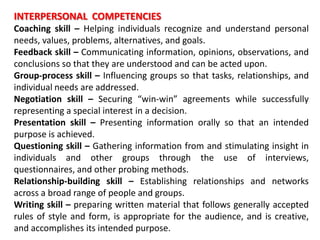
INTERPERSONAL COMPETENCIES
Coaching skill – Helping individuals recognize and understand personal
needs, values, problems, alternatives, and goals.
Feedback skill – Communicating information, opinions, observations, and
conclusions so that they are understood and can be acted upon.
Group-process skill – Influencing groups so that tasks, relationships, and
individual needs are addressed.
Negotiation skill – Securing “win-win” agreements while successfully
representing a special interest in a decision.
Presentation skill – Presenting information orally so that an intended
purpose is achieved.
Questioning skill – Gathering information from and stimulating insight in
individuals and other groups through the use of interviews,
questionnaires, and other probing methods.
Relationship-building skill – Establishing relationships and networks
across a broad range of people and groups.
Writing skill – preparing written material that follows generally accepted
rules of style and form, is appropriate for the audience, and is creative,
and accomplishes its intended purpose.
INTELLECTUAL COMPETENCIES
Data-reduction skill – Scanning, synthesizing, and drawing
conclusion from data.
Information-search skill – Gathering information from printed
and other recorded sources; identifying and using information
specialists and reference services and aids.
Visioning skill – Projecting trends and visualizing possible and
probable futures and their implications.
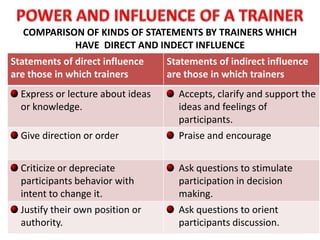
COMPARISON OF KINDS OF STATEMENTS BY TRAINERS WHICH
           HAVE DIRECT AND INDECT INFLUENCE
Statements of direct influence     Statements of indirect influence
are those in which trainers        are those in which trainers
  Express or lecture about ideas     Accepts, clarify and support the
  or knowledge.                      ideas and feelings of
                                     participants.
  Give direction or order            Praise and encourage


  Criticize or depreciate            Ask questions to stimulate
  participants behavior with         participation in decision
  intent to change it.               making.
  Justify their own position or      Ask questions to orient
  authority.                         participants discussion.
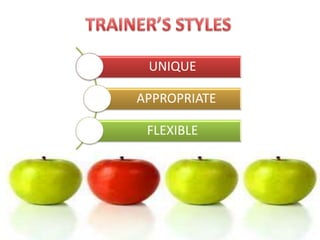
UNIQUE

APPROPRIATE

 FLEXIBLE
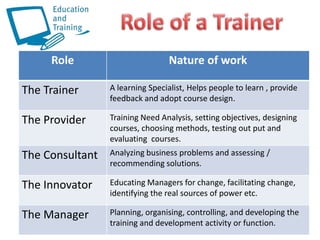
Role                        Nature of work

The Trainer      A learning Specialist, Helps people to learn , provide
                 feedback and adopt course design.

The Provider     Training Need Analysis, setting objectives, designing
                 courses, choosing methods, testing out put and
                 evaluating courses.
The Consultant   Analyzing business problems and assessing /
                 recommending solutions.

The Innovator    Educating Managers for change, facilitating change,
                 identifying the real sources of power etc.

The Manager      Planning, organising, controlling, and developing the
                 training and development activity or function.
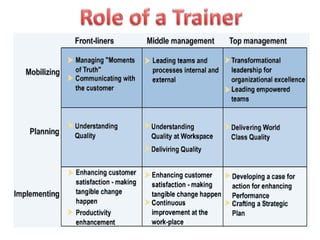
Role of a trainer
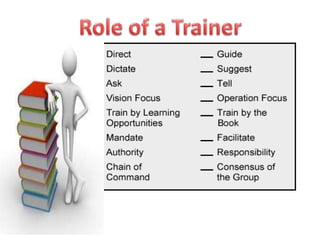
Role of a trainer
Role of a trainer

Role of a trainer

  • 2.
    The major competenciesthat are required to be present in a trainer are: •Presentation Skills •Business Skills i.e. budgeting, time management, negotiation, etc. •Content Development i.e. material production, graphics, layouts, etc •Self development i.e. interpersonal skills, good listening skills, flexible, accepting the share of accountability, etc
  • 3.
    TECHNICAL COMPETENCIES Adult-learningunderstanding – knowing how adults acquire and use knowledge, skills, and attitudes; understanding individual differences in learning. Career development theories and techniques – knowing the techniques and methods used in career development; understanding their appropriate uses. Competency identification skill -Identifying the knowledge and skill requirements of jobs, tasks, and roles. Computer competence – Understanding of using computer applications. Electronic-systems skill – Having knowledge of functions, features, and potential applications of electronic systems for the delivery and management of HRD. Evaluation skills – Determining the effectiveness of training and its impact on the organization. Media selection skill – Selecting and utilizing appropriate media methods according to the dictates of the learning situation. Objectives preparation skill – Preparing clear statements that describe desired outputs. Training and development theories and techniques understanding – knowing the theories and methods used in training; understanding their appropriate uses. Research skill – Selecting, developing, and using methodologies such as statistical and data collection techniques for formal inquiry.
  • 4.
    BUSINESS COMPETENCIES Budget andresource management skill – Utilizing, prioritizing, and managing financial material, and human resources in an efficient manner. Business understanding – Knowing how the functions of a business work and relate to each other; knowing the economic impact of business decisions. Organization behaviour understanding – Seeing organizations as dynamic, political,economic, and social systems that have multiple goals; using that larger perspective as a framework for understanding amd influencing events. Organization-development theories and techniques – Knowing the techniques and methods used in organization development; understanding their appropriate use.
  • 5.
    INTERPERSONAL COMPETENCIES Coaching skill– Helping individuals recognize and understand personal needs, values, problems, alternatives, and goals. Feedback skill – Communicating information, opinions, observations, and conclusions so that they are understood and can be acted upon. Group-process skill – Influencing groups so that tasks, relationships, and individual needs are addressed. Negotiation skill – Securing “win-win” agreements while successfully representing a special interest in a decision. Presentation skill – Presenting information orally so that an intended purpose is achieved. Questioning skill – Gathering information from and stimulating insight in individuals and other groups through the use of interviews, questionnaires, and other probing methods. Relationship-building skill – Establishing relationships and networks across a broad range of people and groups. Writing skill – preparing written material that follows generally accepted rules of style and form, is appropriate for the audience, and is creative, and accomplishes its intended purpose.
  • 6.
    INTELLECTUAL COMPETENCIES Data-reduction skill– Scanning, synthesizing, and drawing conclusion from data. Information-search skill – Gathering information from printed and other recorded sources; identifying and using information specialists and reference services and aids. Visioning skill – Projecting trends and visualizing possible and probable futures and their implications.
  • 7.
    COMPARISON OF KINDSOF STATEMENTS BY TRAINERS WHICH HAVE DIRECT AND INDECT INFLUENCE Statements of direct influence Statements of indirect influence are those in which trainers are those in which trainers Express or lecture about ideas Accepts, clarify and support the or knowledge. ideas and feelings of participants. Give direction or order Praise and encourage Criticize or depreciate Ask questions to stimulate participants behavior with participation in decision intent to change it. making. Justify their own position or Ask questions to orient authority. participants discussion.
  • 8.
  • 10.
    Role Nature of work The Trainer A learning Specialist, Helps people to learn , provide feedback and adopt course design. The Provider Training Need Analysis, setting objectives, designing courses, choosing methods, testing out put and evaluating courses. The Consultant Analyzing business problems and assessing / recommending solutions. The Innovator Educating Managers for change, facilitating change, identifying the real sources of power etc. The Manager Planning, organising, controlling, and developing the training and development activity or function.