Chapter 10
Appraising and Managing Performance
Lecture Overview
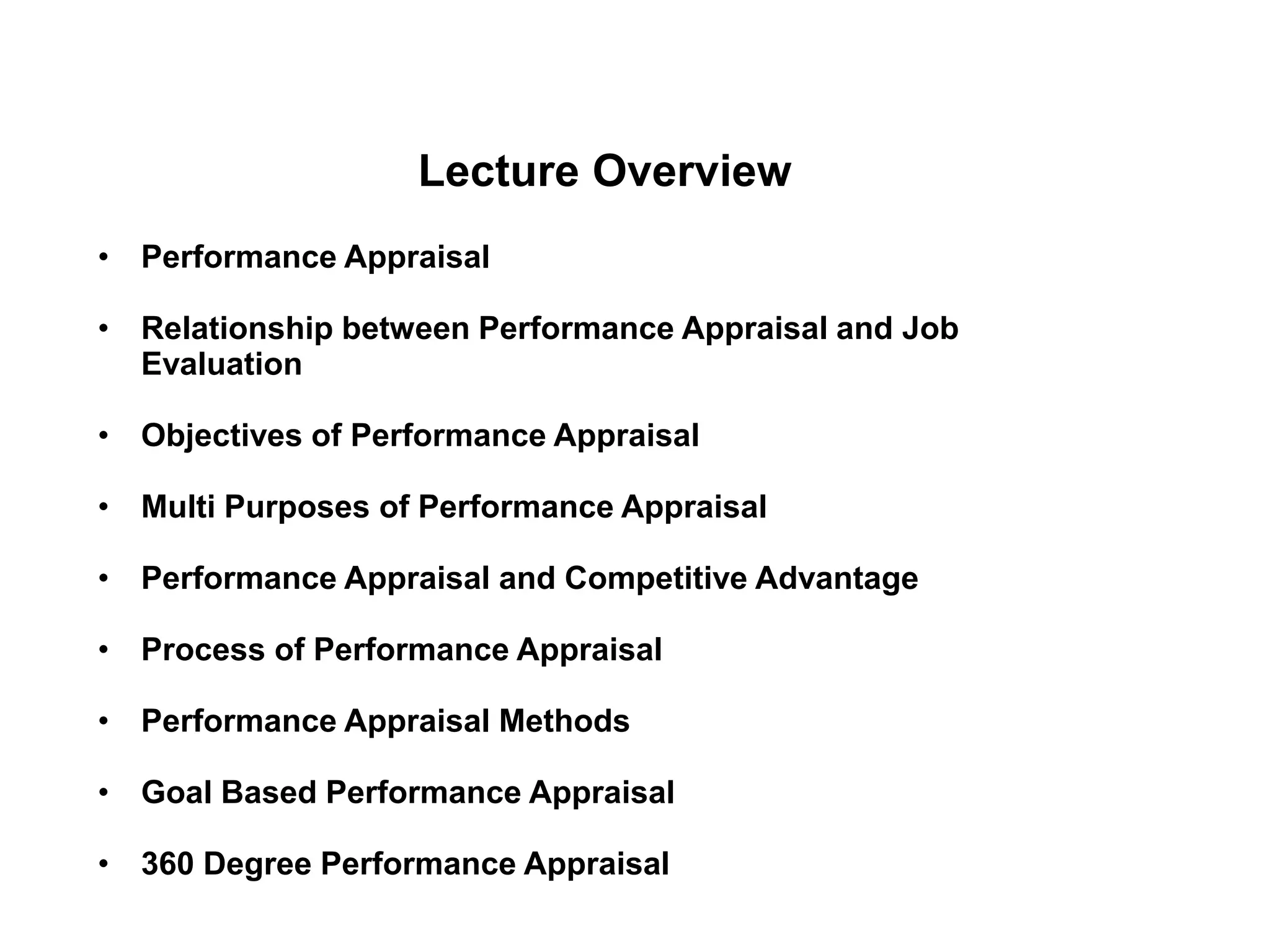
• Performance Appraisal
• Relationship between Performance Appraisal and Job
Evaluation
• Objectives of Performance Appraisal
• Multi Purposes of Performance Appraisal
• Performance Appraisal and Competitive Advantage
• Process of Performance Appraisal
• Performance Appraisal Methods
• Goal Based Performance Appraisal
• 360 Degree Performance Appraisal
Recap of Previous Lecture
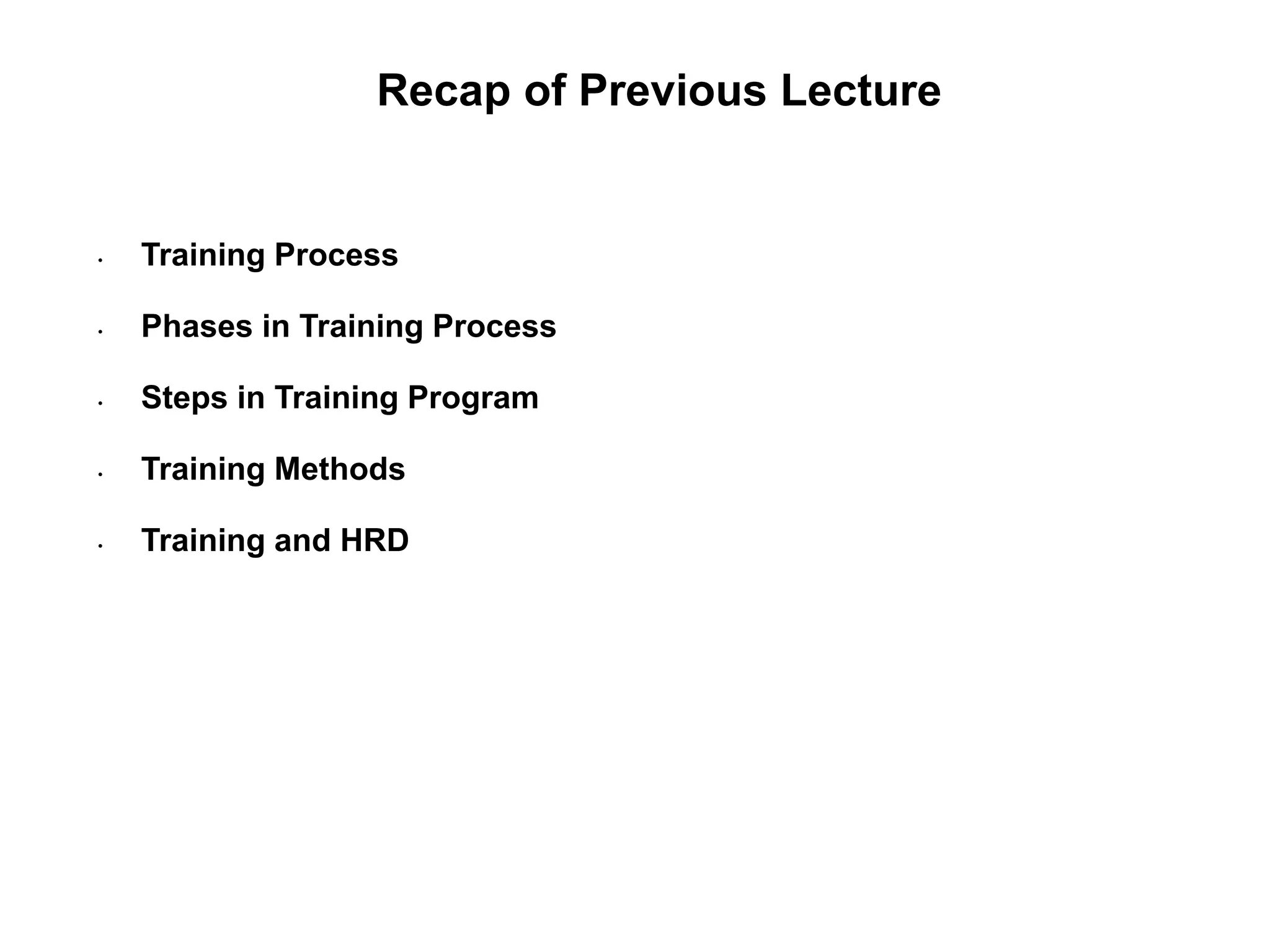
• Training Process
• Phases in Training Process
• Steps in Training Program
• Training Methods
• Training and HRD
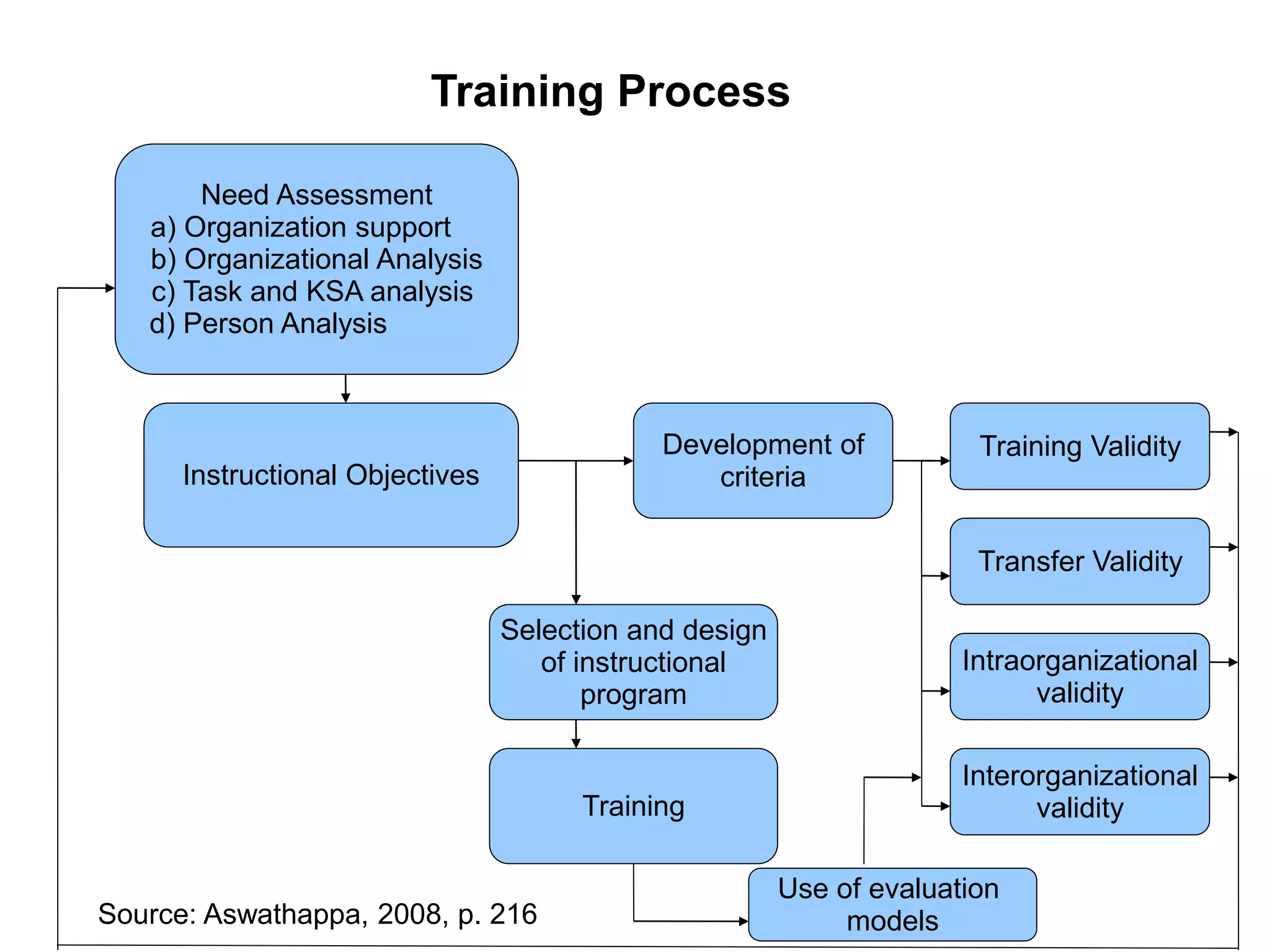
Training Process
Need Assessment
a) Organization support
b) Organizational Analysis
c) Task and KSA analysis
d) Person Analysis
Instructional Objectives
Development of
criteria
Training Validity
Transfer Validity
Intraorganizational
validity
Interorganizational
validity
Selection and design
of instructional
program
Training
Use of evaluation
modelsSource: Aswathappa, 2008, p. 216
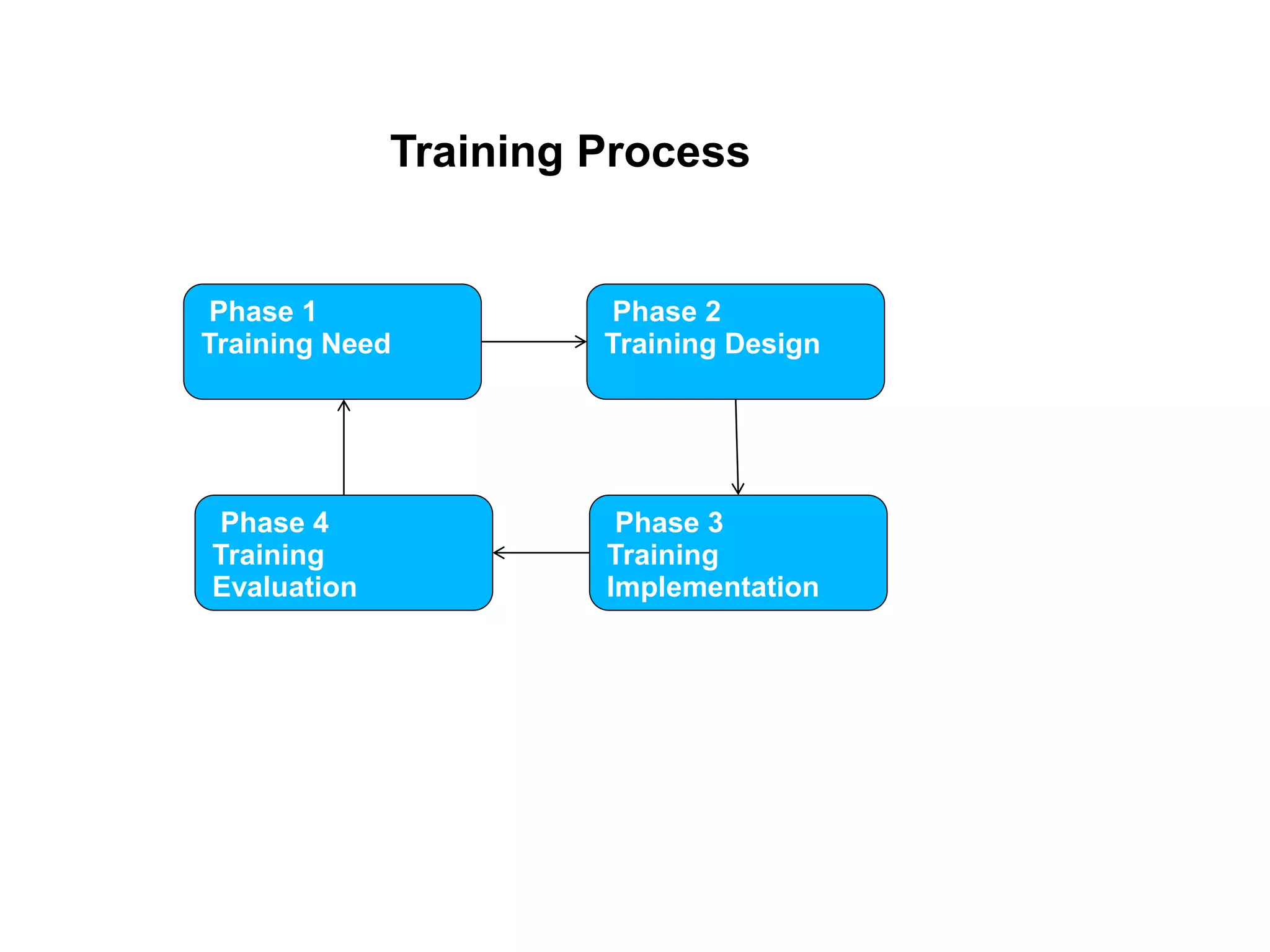
Training Process
Phase 1
Training Need
Phase 2
Training Design
Phase 3
Training
Implementation
Phase 4
Training
Evaluation
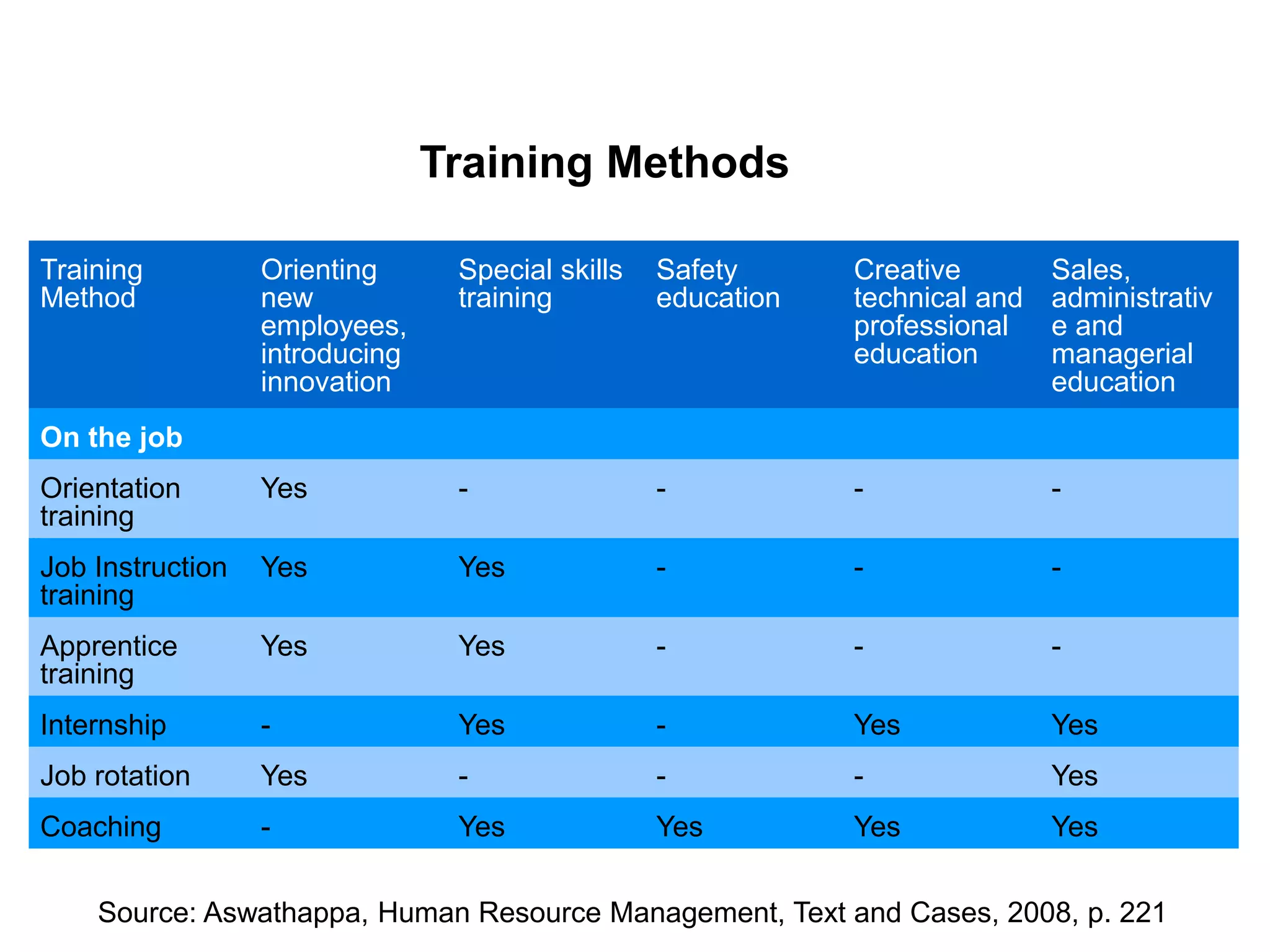
Training Methods
Source: Aswathappa, Human Resource Management, Text and Cases, 2008, p. 221
Training
Method
Orienting
new
employees,
introducing
innovation
Special skills
training
Safety
education
Creative
technical and
professional
education
Sales,
administrativ
e and
managerial
education
On the job
Orientation
training
Yes - - - -
Job Instruction
training
Yes Yes - - -
Apprentice
training
Yes Yes - - -
Internship - Yes - Yes Yes
Job rotation Yes - - - Yes
Coaching - Yes Yes Yes Yes
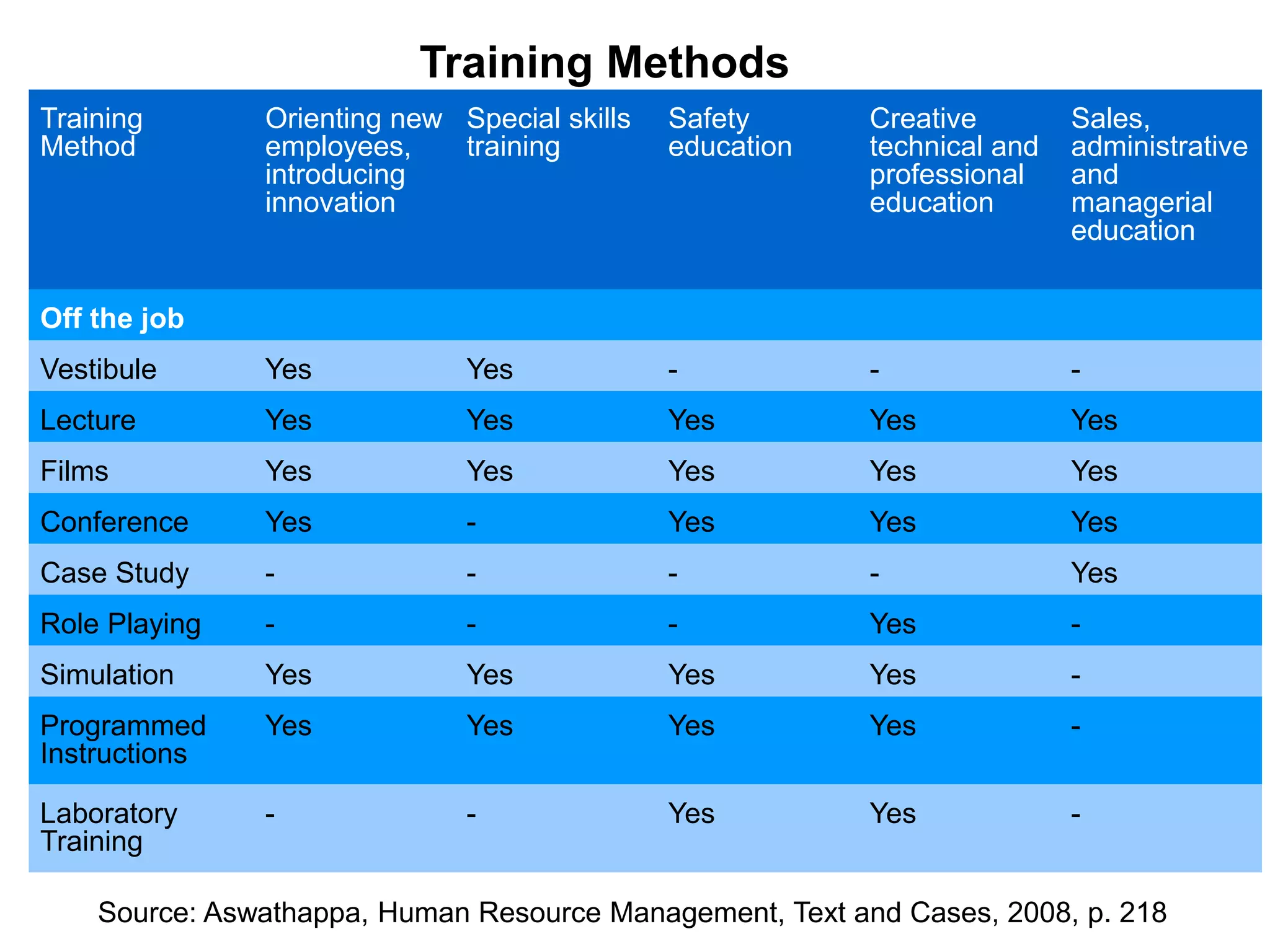
Training Methods
Source: Aswathappa, Human Resource Management, Text and Cases, 2008, p. 218
Training
Method
Orienting new
employees,
introducing
innovation
Special skills
training
Safety
education
Creative
technical and
professional
education
Sales,
administrative
and
managerial
education
Off the job
Vestibule Yes Yes - - -
Lecture Yes Yes Yes Yes Yes
Films Yes Yes Yes Yes Yes
Conference Yes - Yes Yes Yes
Case Study - - - - Yes
Role Playing - - - Yes -
Simulation Yes Yes Yes Yes -
Programmed
Instructions
Yes Yes Yes Yes -
Laboratory
Training
- - Yes Yes -
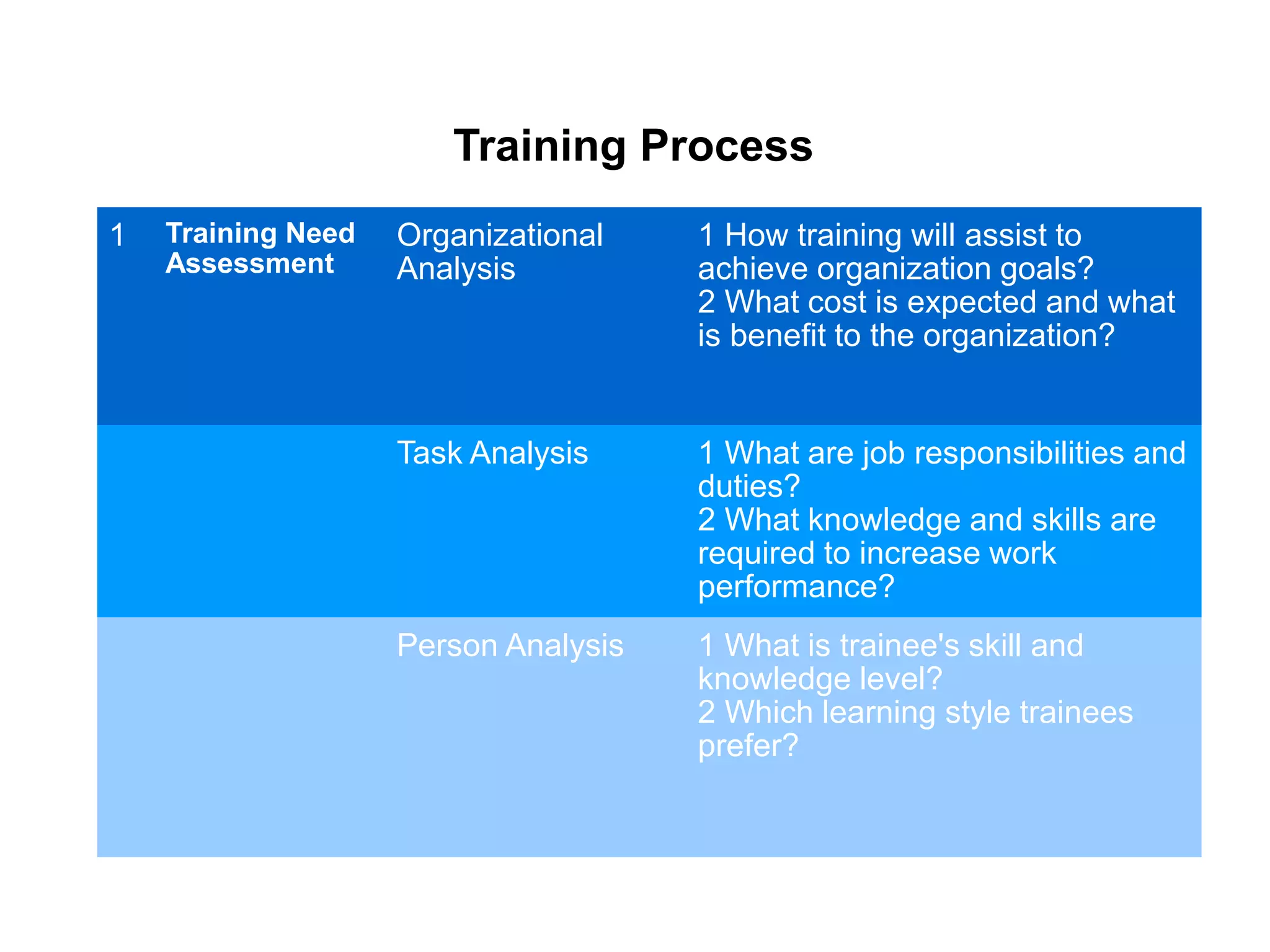
1 Training Need
Assessment
Organizational
Analysis
1 How training will assist to
achieve organization goals?
2 What cost is expected and what
is benefit to the organization?
Task Analysis 1 What are job responsibilities and
duties?
2 What knowledge and skills are
required to increase work
performance?
Person Analysis 1 What is trainee's skill and
knowledge level?
2 Which learning style trainees
prefer?
Training Process
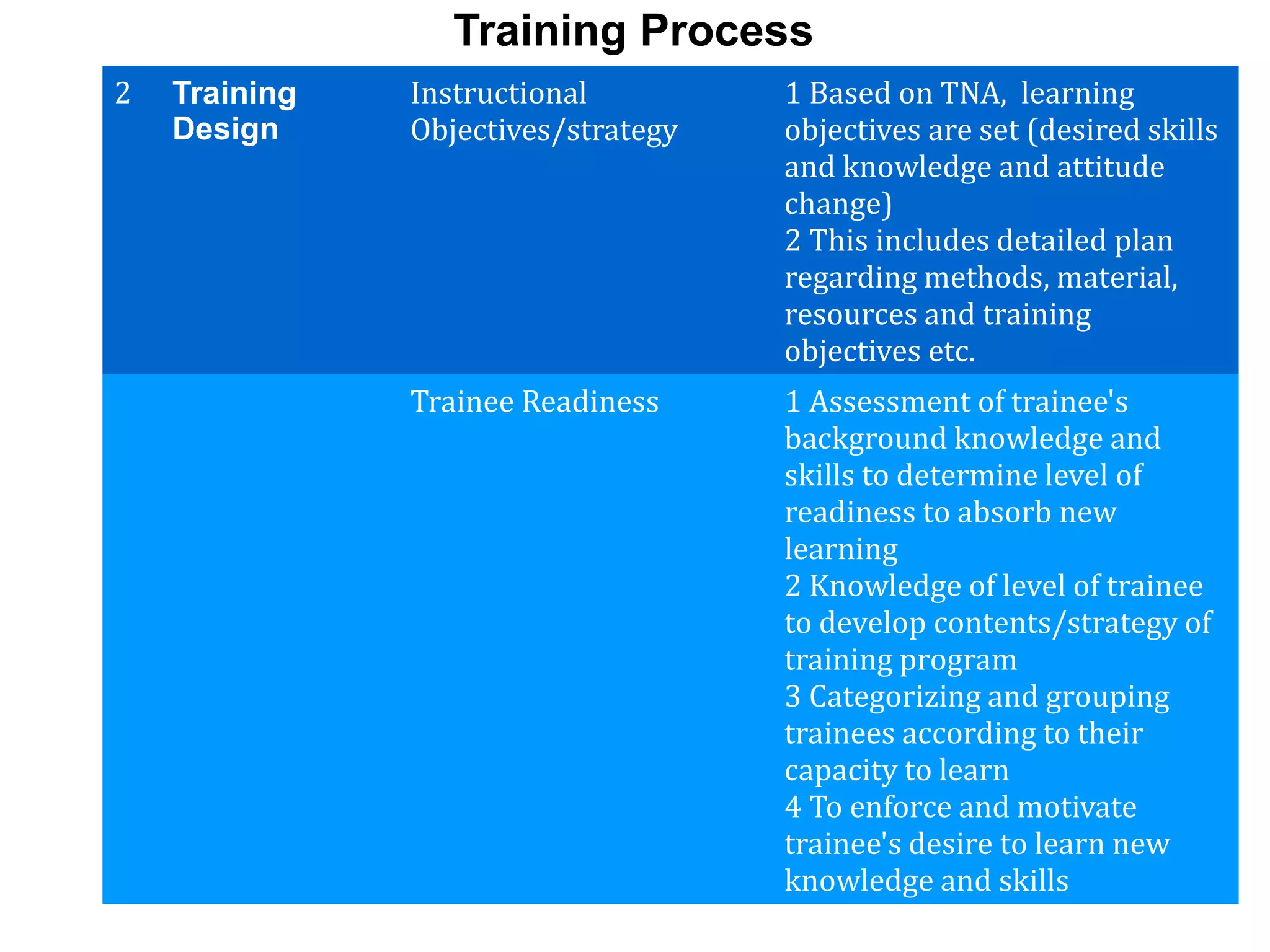
2 Training
Design
Instructional
Objectives/strategy
1 Based on TNA, learning
objectives are set (desired skills
and knowledge and attitude
change)
2 This includes detailed plan
regarding methods, material,
resources and training
objectives etc.
Trainee Readiness 1 Assessment of trainee's
background knowledge and
skills to determine level of
readiness to absorb new
learning
2 Knowledge of level of trainee
to develop contents/strategy of
training program
3 Categorizing and grouping
trainees according to their
capacity to learn
4 To enforce and motivate
trainee's desire to learn new
knowledge and skills
Training Process
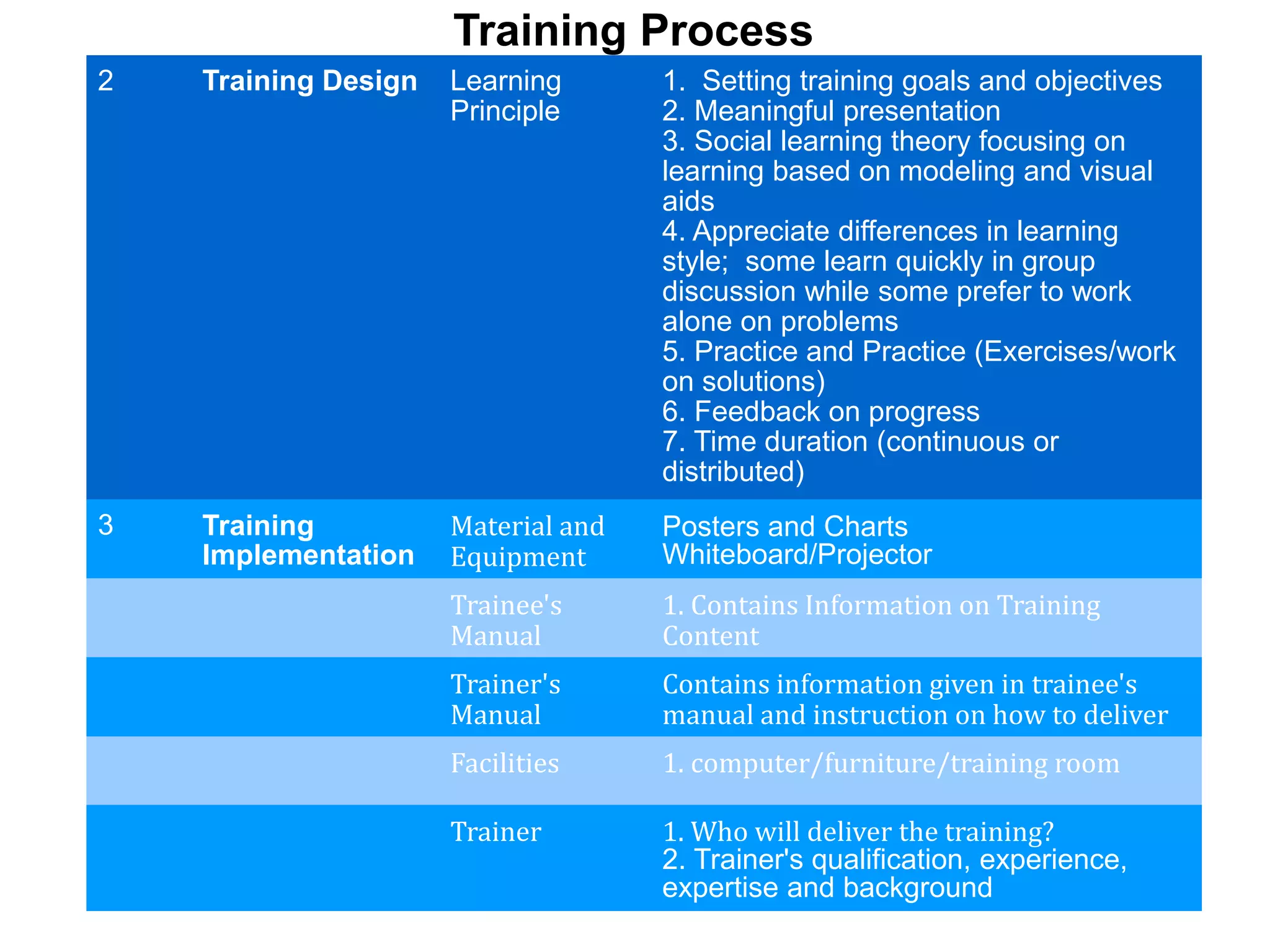
2 Training Design Learning
Principle
1. Setting training goals and objectives
2. Meaningful presentation
3. Social learning theory focusing on
learning based on modeling and visual
aids
4. Appreciate differences in learning
style; some learn quickly in group
discussion while some prefer to work
alone on problems
5. Practice and Practice (Exercises/work
on solutions)
6. Feedback on progress
7. Time duration (continuous or
distributed)
3 Training
Implementation
Material and
Equipment
Posters and Charts
Whiteboard/Projector
Trainee's
Manual
1. Contains Information on Training
Content
Trainer's
Manual
Contains information given in trainee's
manual and instruction on how to deliver
Facilities 1. computer/furniture/training room
Trainer 1. Who will deliver the training?
2. Trainer's qualification, experience,
expertise and background
Training Process
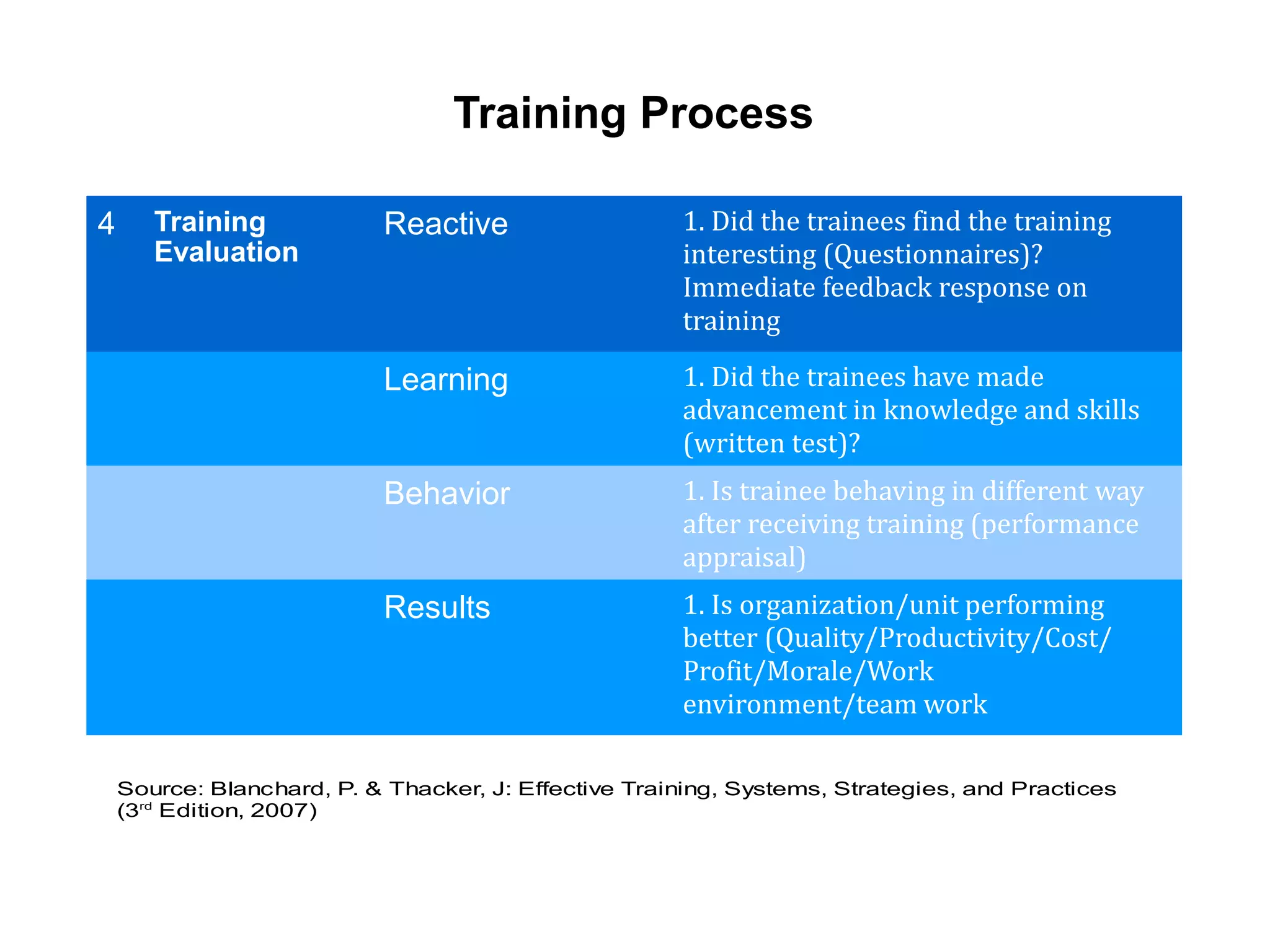
4 Training
Evaluation
Reactive 1. Did the trainees find the training
interesting (Questionnaires)?
Immediate feedback response on
training
Learning 1. Did the trainees have made
advancement in knowledge and skills
(written test)?
Behavior 1. Is trainee behaving in different way
after receiving training (performance
appraisal)
Results 1. Is organization/unit performing
better (Quality/Productivity/Cost/
Profit/Morale/Work
environment/team work
Training Process
Source: Blanchard, P. & Thacker, J: Effective Training, Systems, Strategies, and Practices
(3rd
Edition, 2007)
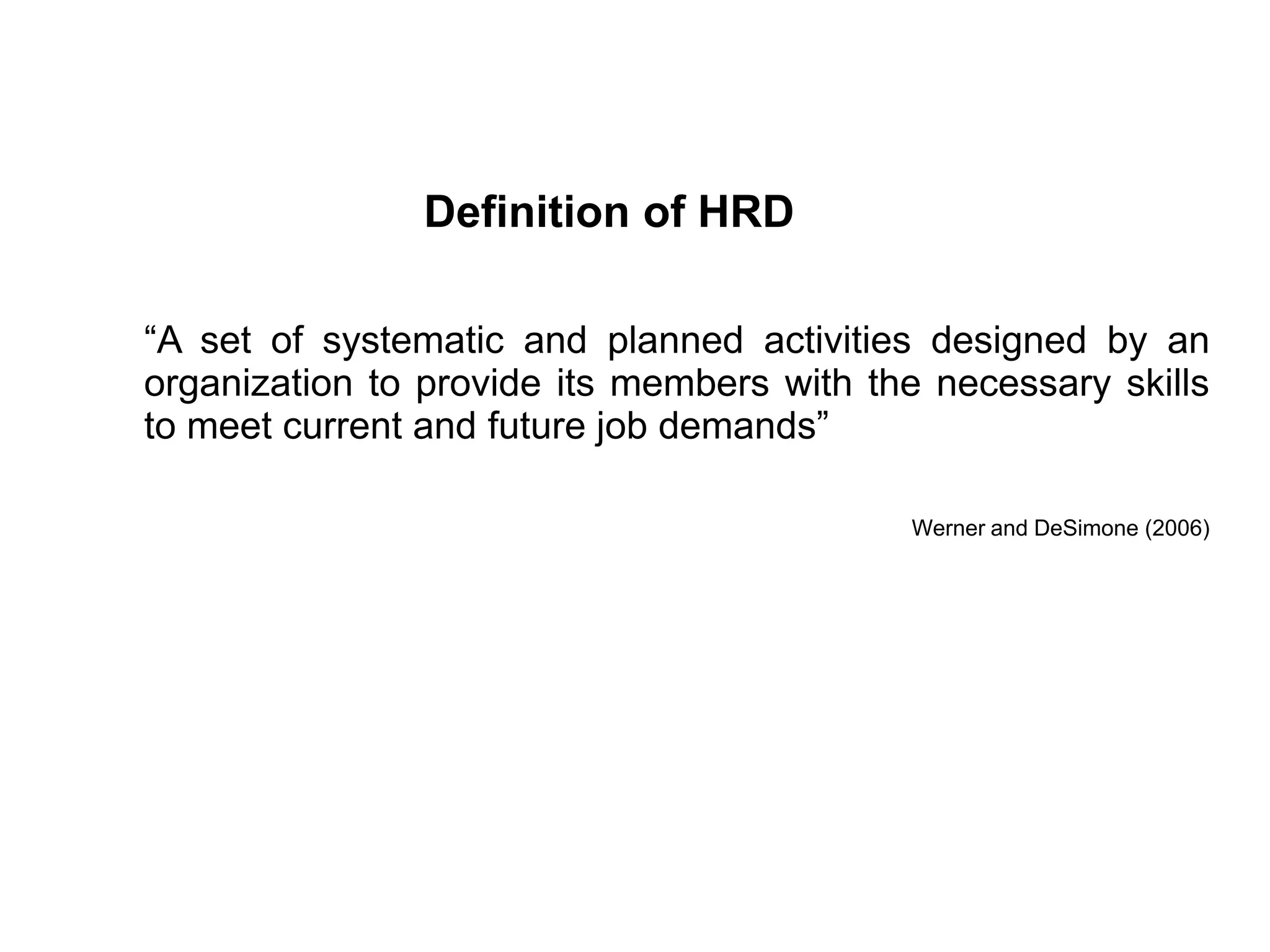
“A set of systematic and planned activities designed by an
organization to provide its members with the necessary skills
to meet current and future job demands”
Werner and DeSimone (2006)
Definition of HRD
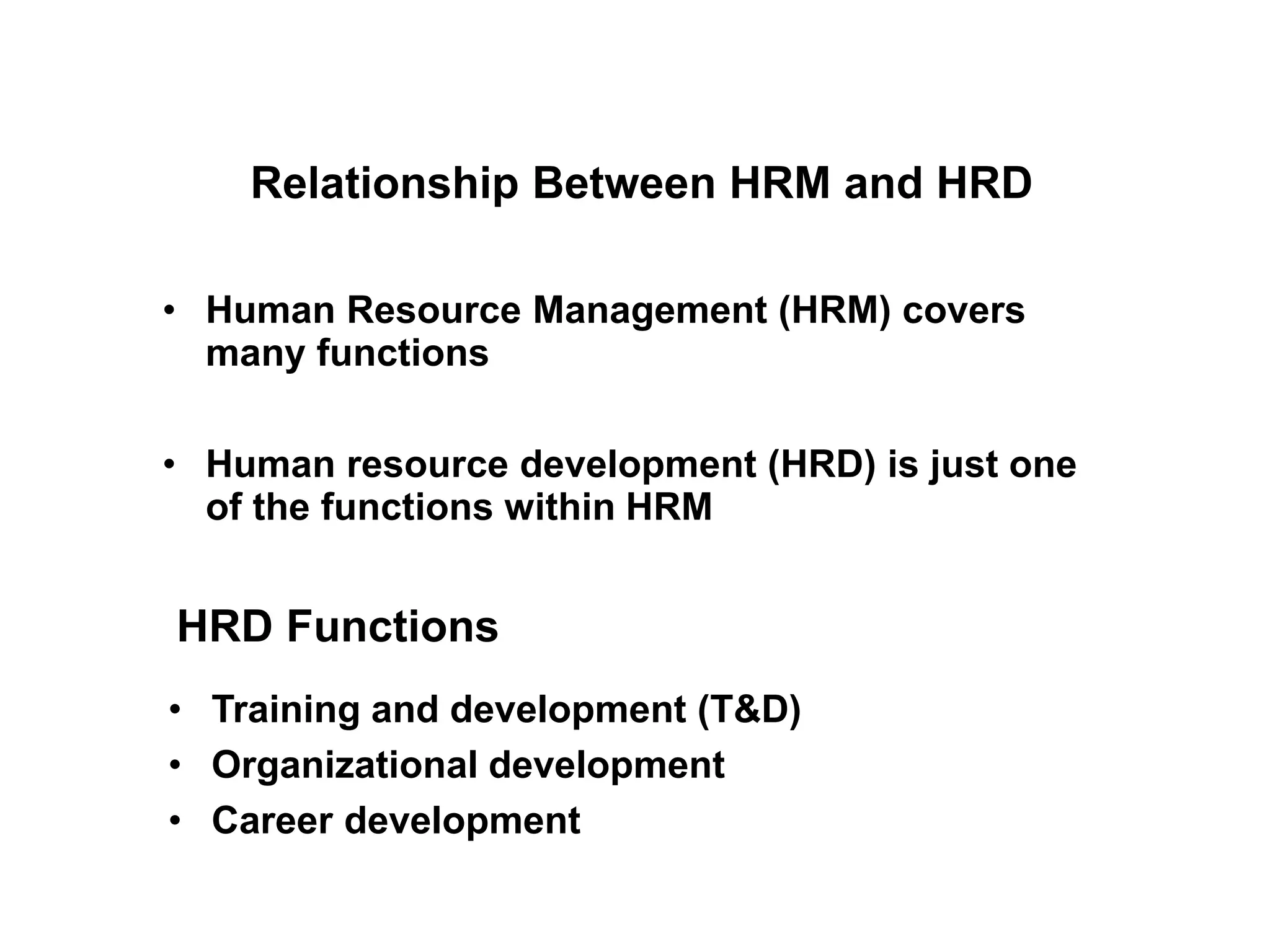
• Human Resource Management (HRM) covers
many functions
• Human resource development (HRD) is just one
of the functions within HRM
Relationship Between HRM and HRD
• Training and development (T&D)
• Organizational development
• Career development
HRD Functions
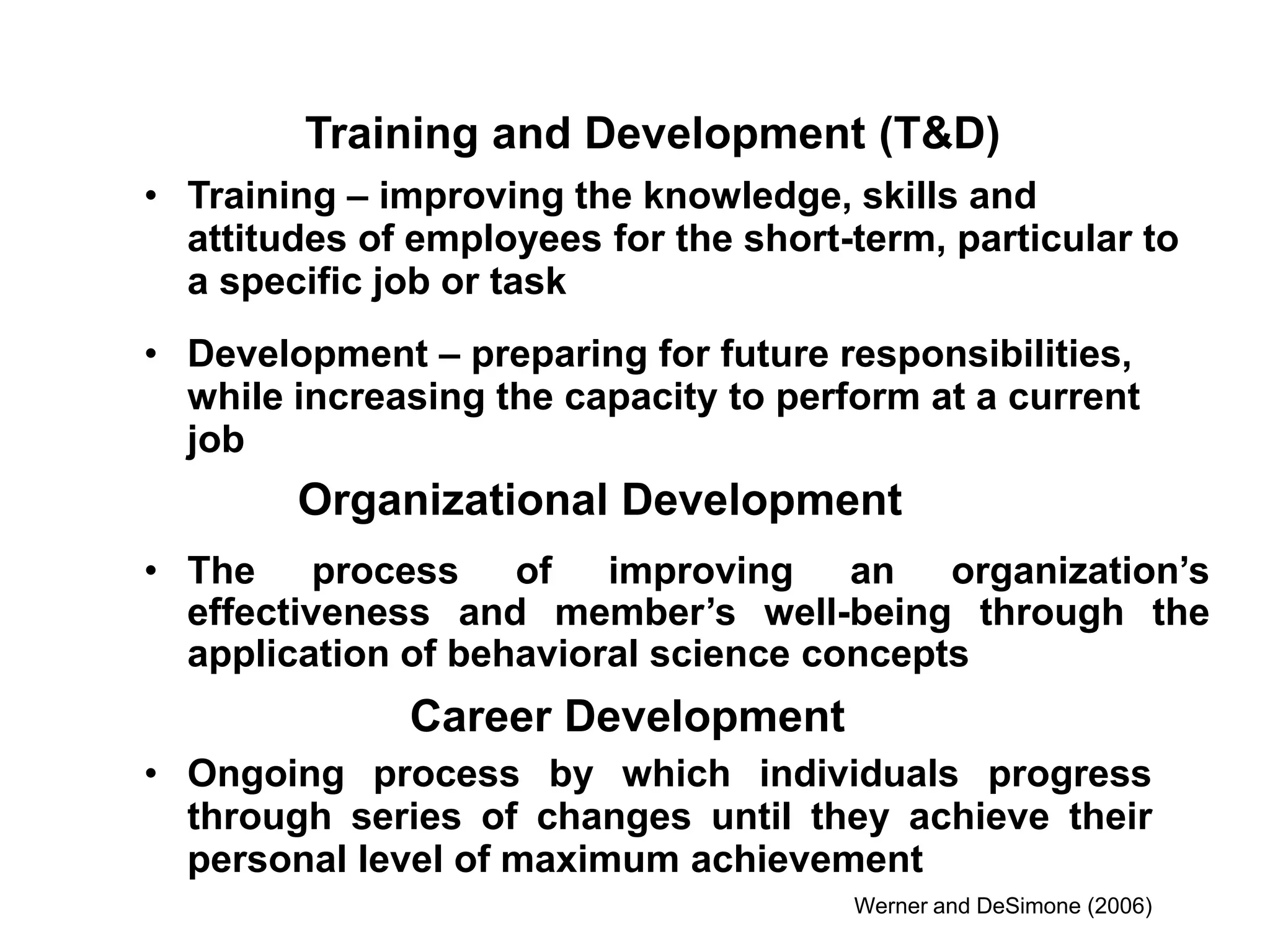
• The process of improving an organization’s
effectiveness and member’s well-being through the
application of behavioral science concepts
Organizational Development
• Training – improving the knowledge, skills and
attitudes of employees for the short-term, particular to
a specific job or task
• Development – preparing for future responsibilities,
while increasing the capacity to perform at a current
job
Training and Development (T&D)
• Ongoing process by which individuals progress
through series of changes until they achieve their
personal level of maximum achievement
Werner and DeSimone (2006)
Career Development
Appraising and Managing Performance
Performance Appraisal
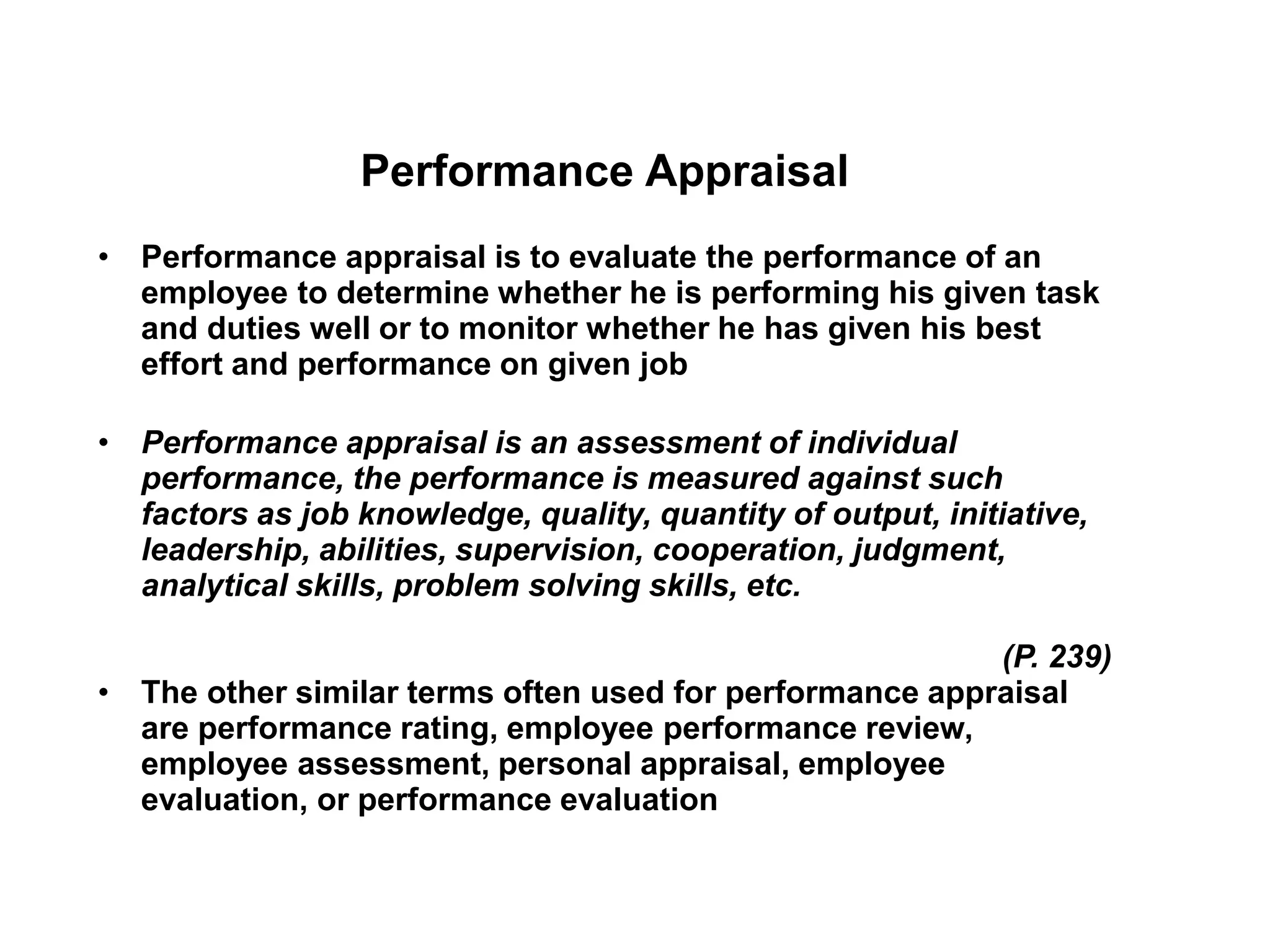
• Performance appraisal is to evaluate the performance of an
employee to determine whether he is performing his given task
and duties well or to monitor whether he has given his best
effort and performance on given job
• Performance appraisal is an assessment of individual
performance, the performance is measured against such
factors as job knowledge, quality, quantity of output, initiative,
leadership, abilities, supervision, cooperation, judgment,
analytical skills, problem solving skills, etc.
(P. 239)
• The other similar terms often used for performance appraisal
are performance rating, employee performance review,
employee assessment, personal appraisal, employee
evaluation, or performance evaluation
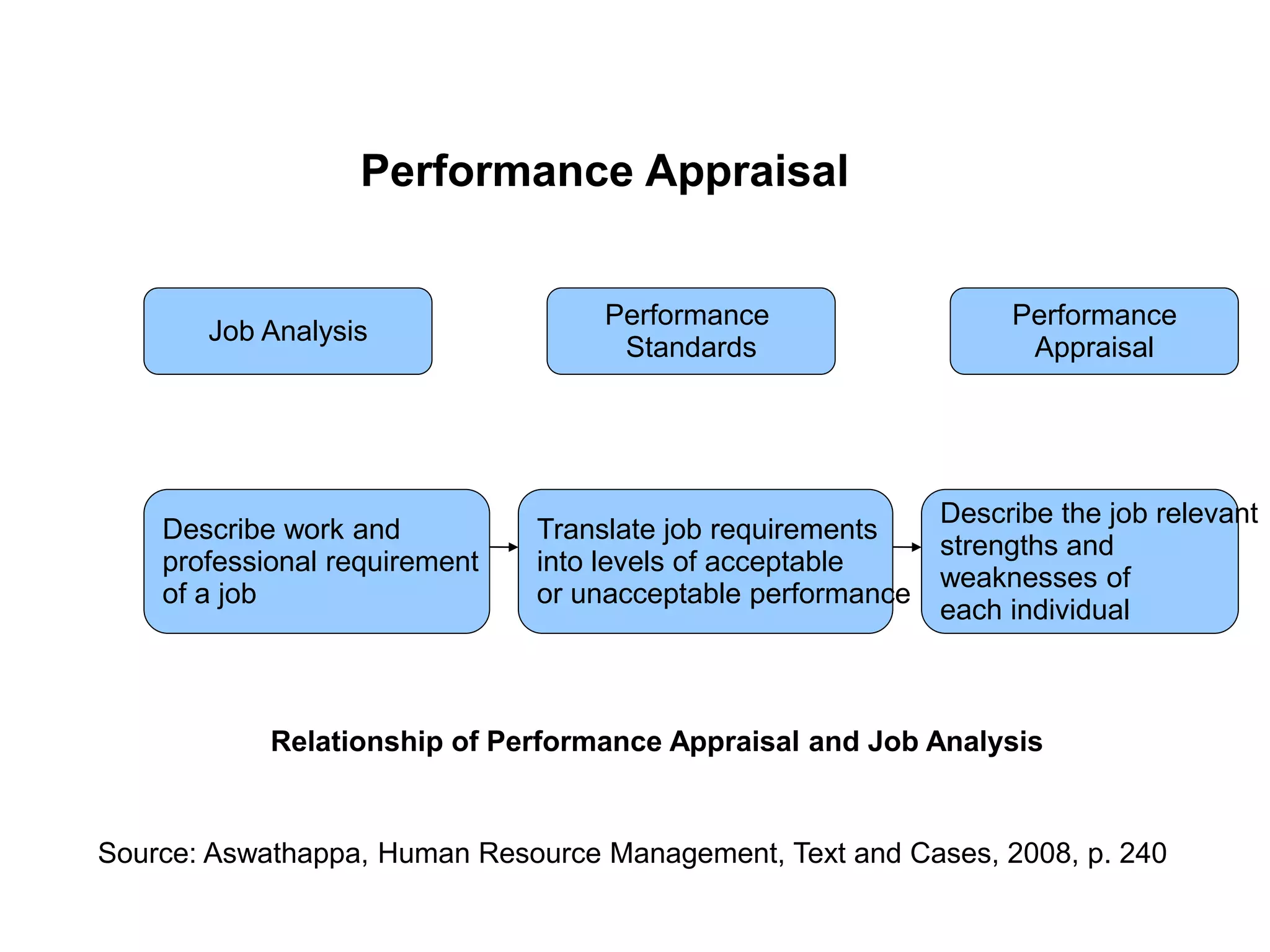
Performance Appraisal
Job Analysis
Performance
Appraisal
Performance
Standards
Describe work and
professional requirement
of a job
Describe the job relevant
strengths and
weaknesses of
each individual
Translate job requirements
into levels of acceptable
or unacceptable performance
Relationship of Performance Appraisal and Job Analysis
Source: Aswathappa, Human Resource Management, Text and Cases, 2008, p. 240
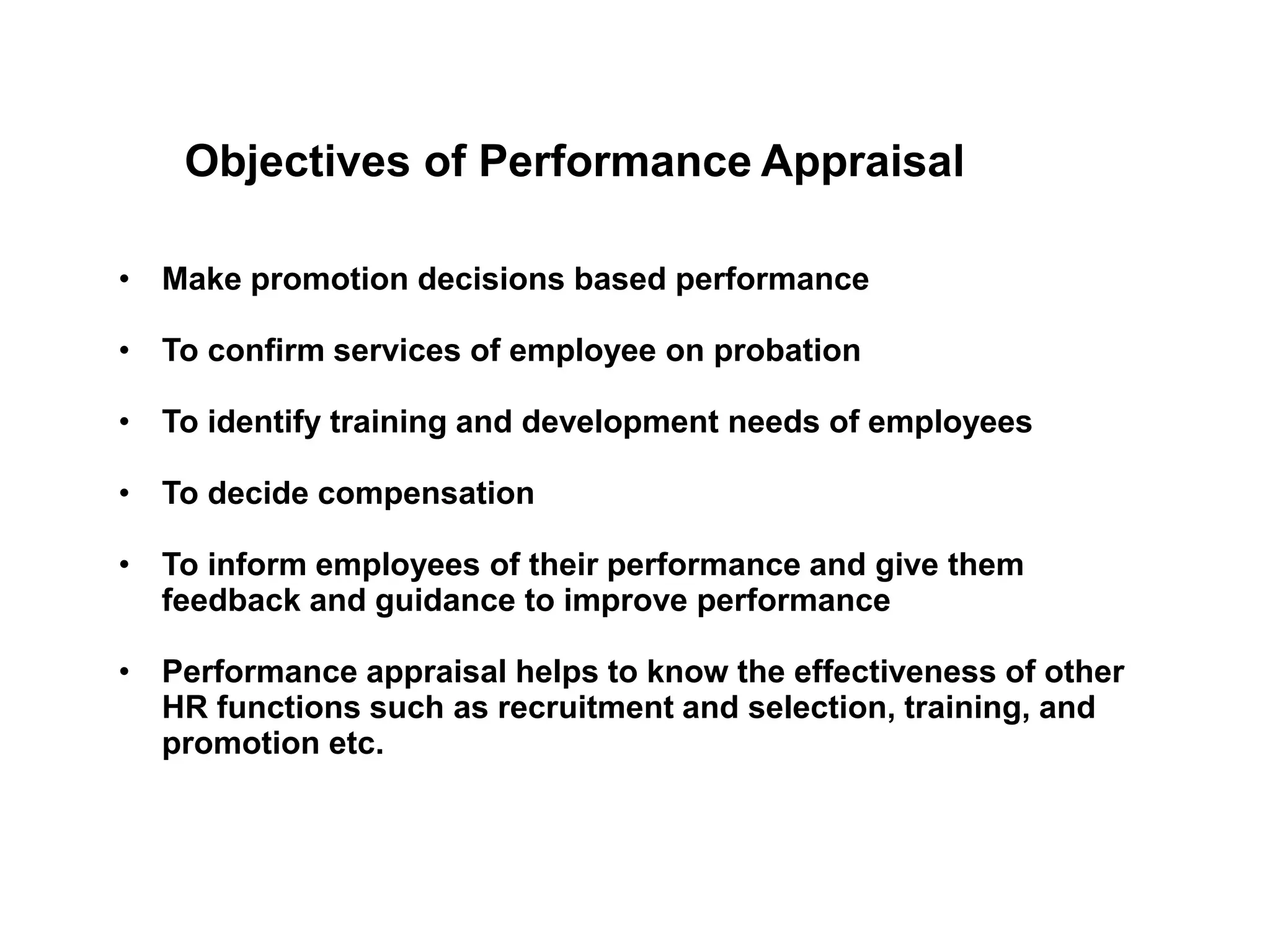
Objectives of Performance Appraisal
• Make promotion decisions based performance
• To confirm services of employee on probation
• To identify training and development needs of employees
• To decide compensation
• To inform employees of their performance and give them
feedback and guidance to improve performance
• Performance appraisal helps to know the effectiveness of other
HR functions such as recruitment and selection, training, and
promotion etc.
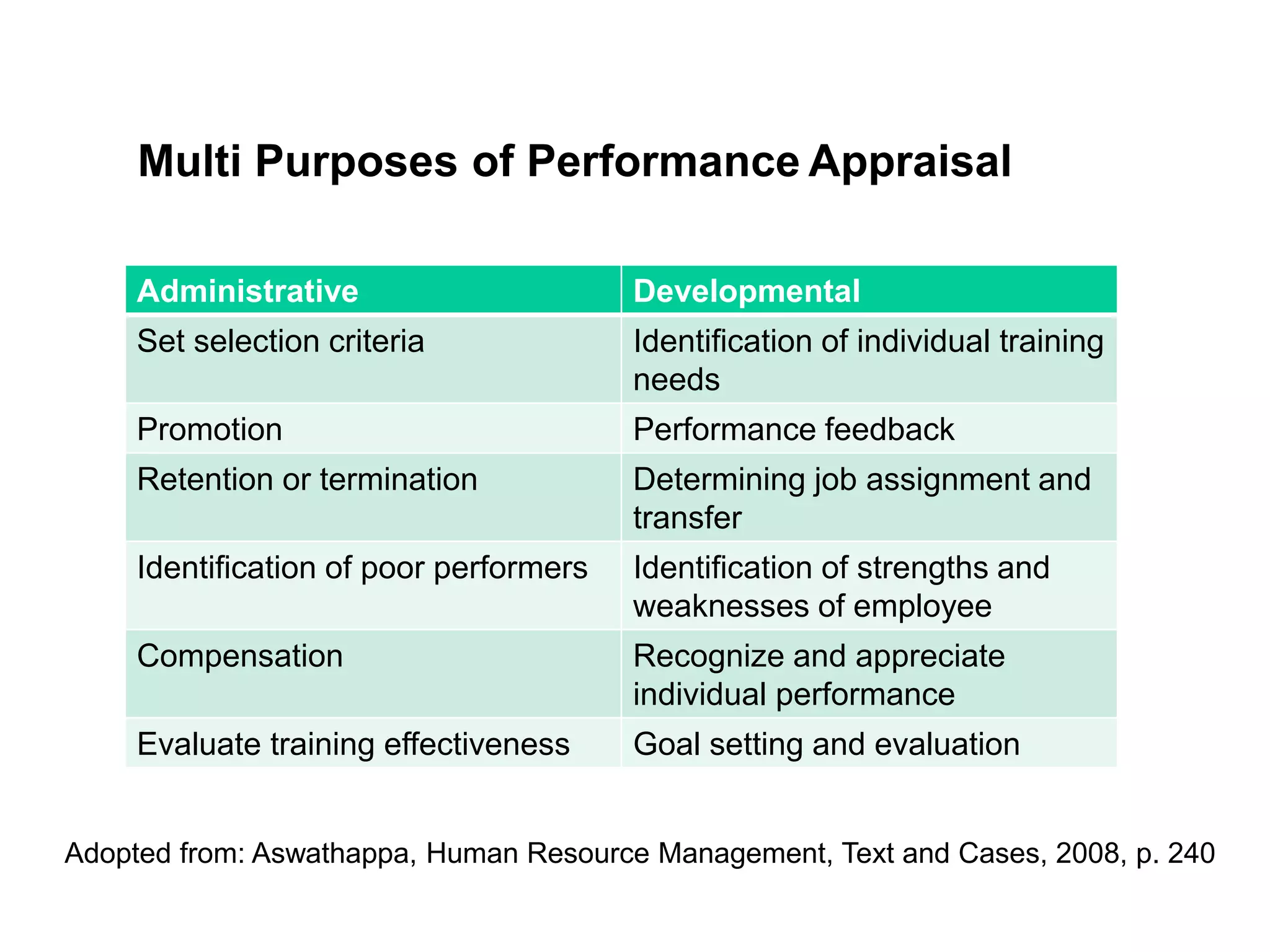
Multi Purposes of Performance Appraisal
Administrative Developmental
Set selection criteria Identification of individual training
needs
Promotion Performance feedback
Retention or termination Determining job assignment and
transfer
Identification of poor performers Identification of strengths and
weaknesses of employee
Compensation Recognize and appreciate
individual performance
Evaluate training effectiveness Goal setting and evaluation
Adopted from: Aswathappa, Human Resource Management, Text and Cases, 2008, p. 240
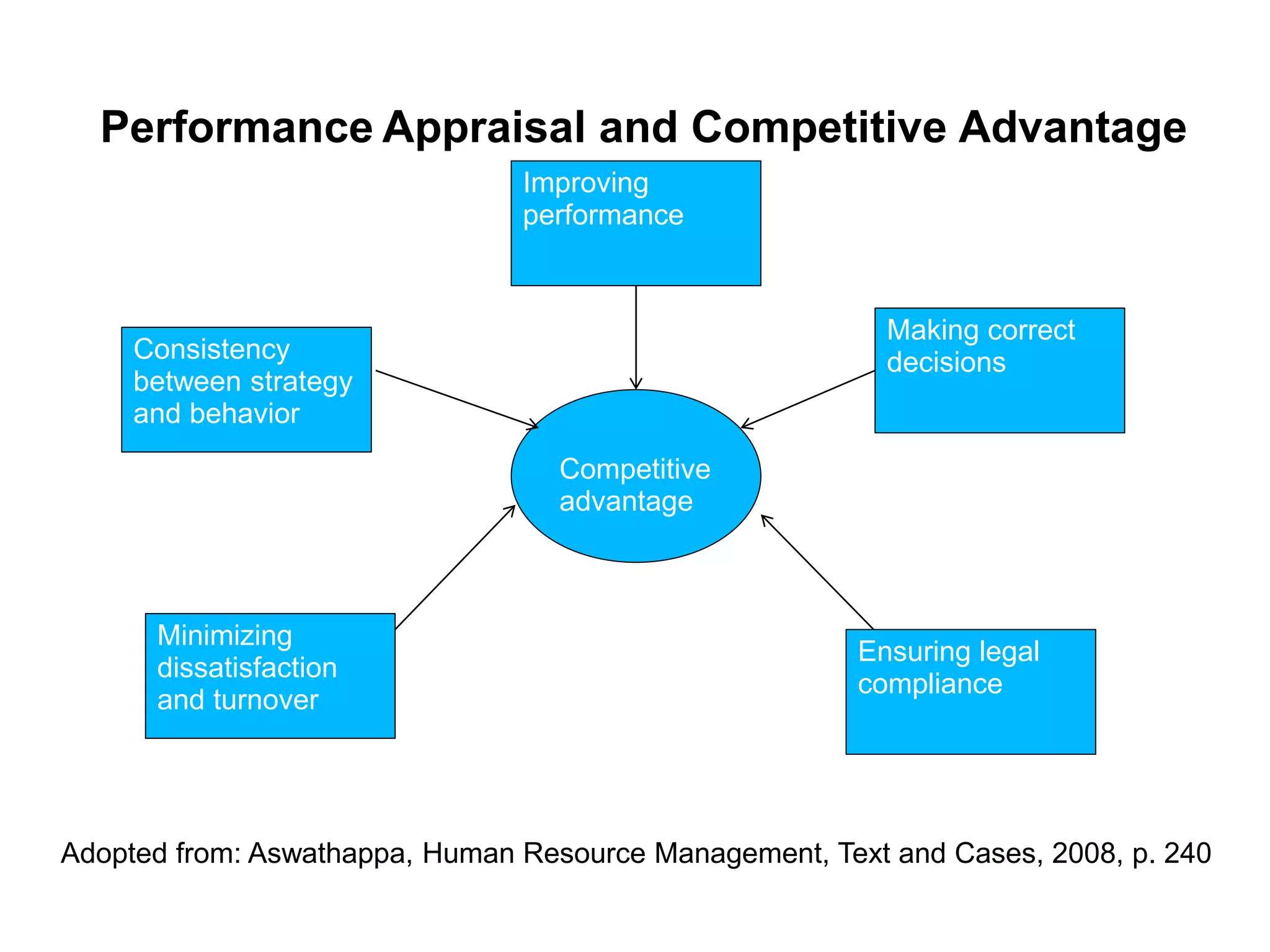
Performance Appraisal and Competitive Advantage
Adopted from: Aswathappa, Human Resource Management, Text and Cases, 2008, p. 240
Competitive
advantage
Consistency
between strategy
and behavior
Improving
performance
Minimizing
dissatisfaction
and turnover
Ensuring legal
compliance
Making correct
decisions

Lecture 15

  • 1.
    Chapter 10 Appraising andManaging Performance
  • 2.
    Lecture Overview • PerformanceAppraisal • Relationship between Performance Appraisal and Job Evaluation • Objectives of Performance Appraisal • Multi Purposes of Performance Appraisal • Performance Appraisal and Competitive Advantage • Process of Performance Appraisal • Performance Appraisal Methods • Goal Based Performance Appraisal • 360 Degree Performance Appraisal
  • 3.
    Recap of PreviousLecture • Training Process • Phases in Training Process • Steps in Training Program • Training Methods • Training and HRD
  • 4.
    Training Process Need Assessment a)Organization support b) Organizational Analysis c) Task and KSA analysis d) Person Analysis Instructional Objectives Development of criteria Training Validity Transfer Validity Intraorganizational validity Interorganizational validity Selection and design of instructional program Training Use of evaluation modelsSource: Aswathappa, 2008, p. 216
  • 5.
    Training Process Phase 1 TrainingNeed Phase 2 Training Design Phase 3 Training Implementation Phase 4 Training Evaluation
  • 6.
    Training Methods Source: Aswathappa,Human Resource Management, Text and Cases, 2008, p. 221 Training Method Orienting new employees, introducing innovation Special skills training Safety education Creative technical and professional education Sales, administrativ e and managerial education On the job Orientation training Yes - - - - Job Instruction training Yes Yes - - - Apprentice training Yes Yes - - - Internship - Yes - Yes Yes Job rotation Yes - - - Yes Coaching - Yes Yes Yes Yes
  • 7.
    Training Methods Source: Aswathappa,Human Resource Management, Text and Cases, 2008, p. 218 Training Method Orienting new employees, introducing innovation Special skills training Safety education Creative technical and professional education Sales, administrative and managerial education Off the job Vestibule Yes Yes - - - Lecture Yes Yes Yes Yes Yes Films Yes Yes Yes Yes Yes Conference Yes - Yes Yes Yes Case Study - - - - Yes Role Playing - - - Yes - Simulation Yes Yes Yes Yes - Programmed Instructions Yes Yes Yes Yes - Laboratory Training - - Yes Yes -
  • 8.
    1 Training Need Assessment Organizational Analysis 1How training will assist to achieve organization goals? 2 What cost is expected and what is benefit to the organization? Task Analysis 1 What are job responsibilities and duties? 2 What knowledge and skills are required to increase work performance? Person Analysis 1 What is trainee's skill and knowledge level? 2 Which learning style trainees prefer? Training Process
  • 9.
    2 Training Design Instructional Objectives/strategy 1 Basedon TNA, learning objectives are set (desired skills and knowledge and attitude change) 2 This includes detailed plan regarding methods, material, resources and training objectives etc. Trainee Readiness 1 Assessment of trainee's background knowledge and skills to determine level of readiness to absorb new learning 2 Knowledge of level of trainee to develop contents/strategy of training program 3 Categorizing and grouping trainees according to their capacity to learn 4 To enforce and motivate trainee's desire to learn new knowledge and skills Training Process
  • 10.
    2 Training DesignLearning Principle 1. Setting training goals and objectives 2. Meaningful presentation 3. Social learning theory focusing on learning based on modeling and visual aids 4. Appreciate differences in learning style; some learn quickly in group discussion while some prefer to work alone on problems 5. Practice and Practice (Exercises/work on solutions) 6. Feedback on progress 7. Time duration (continuous or distributed) 3 Training Implementation Material and Equipment Posters and Charts Whiteboard/Projector Trainee's Manual 1. Contains Information on Training Content Trainer's Manual Contains information given in trainee's manual and instruction on how to deliver Facilities 1. computer/furniture/training room Trainer 1. Who will deliver the training? 2. Trainer's qualification, experience, expertise and background Training Process
  • 11.
    4 Training Evaluation Reactive 1.Did the trainees find the training interesting (Questionnaires)? Immediate feedback response on training Learning 1. Did the trainees have made advancement in knowledge and skills (written test)? Behavior 1. Is trainee behaving in different way after receiving training (performance appraisal) Results 1. Is organization/unit performing better (Quality/Productivity/Cost/ Profit/Morale/Work environment/team work Training Process Source: Blanchard, P. & Thacker, J: Effective Training, Systems, Strategies, and Practices (3rd Edition, 2007)
  • 12.
    “A set ofsystematic and planned activities designed by an organization to provide its members with the necessary skills to meet current and future job demands” Werner and DeSimone (2006) Definition of HRD
  • 13.
    • Human ResourceManagement (HRM) covers many functions • Human resource development (HRD) is just one of the functions within HRM Relationship Between HRM and HRD • Training and development (T&D) • Organizational development • Career development HRD Functions
  • 14.
    • The processof improving an organization’s effectiveness and member’s well-being through the application of behavioral science concepts Organizational Development • Training – improving the knowledge, skills and attitudes of employees for the short-term, particular to a specific job or task • Development – preparing for future responsibilities, while increasing the capacity to perform at a current job Training and Development (T&D) • Ongoing process by which individuals progress through series of changes until they achieve their personal level of maximum achievement Werner and DeSimone (2006) Career Development
  • 15.
  • 16.
    Performance Appraisal • Performanceappraisal is to evaluate the performance of an employee to determine whether he is performing his given task and duties well or to monitor whether he has given his best effort and performance on given job • Performance appraisal is an assessment of individual performance, the performance is measured against such factors as job knowledge, quality, quantity of output, initiative, leadership, abilities, supervision, cooperation, judgment, analytical skills, problem solving skills, etc. (P. 239) • The other similar terms often used for performance appraisal are performance rating, employee performance review, employee assessment, personal appraisal, employee evaluation, or performance evaluation
  • 17.
    Performance Appraisal Job Analysis Performance Appraisal Performance Standards Describework and professional requirement of a job Describe the job relevant strengths and weaknesses of each individual Translate job requirements into levels of acceptable or unacceptable performance Relationship of Performance Appraisal and Job Analysis Source: Aswathappa, Human Resource Management, Text and Cases, 2008, p. 240
  • 18.
    Objectives of PerformanceAppraisal • Make promotion decisions based performance • To confirm services of employee on probation • To identify training and development needs of employees • To decide compensation • To inform employees of their performance and give them feedback and guidance to improve performance • Performance appraisal helps to know the effectiveness of other HR functions such as recruitment and selection, training, and promotion etc.
  • 19.
    Multi Purposes ofPerformance Appraisal Administrative Developmental Set selection criteria Identification of individual training needs Promotion Performance feedback Retention or termination Determining job assignment and transfer Identification of poor performers Identification of strengths and weaknesses of employee Compensation Recognize and appreciate individual performance Evaluate training effectiveness Goal setting and evaluation Adopted from: Aswathappa, Human Resource Management, Text and Cases, 2008, p. 240
  • 20.
    Performance Appraisal andCompetitive Advantage Adopted from: Aswathappa, Human Resource Management, Text and Cases, 2008, p. 240 Competitive advantage Consistency between strategy and behavior Improving performance Minimizing dissatisfaction and turnover Ensuring legal compliance Making correct decisions