HR.com
Donna DiMenna, Psy.D
DiMenna Consulting Group
Nov.19, 2013
.
“ If the rate of change outside the
organization is greater than the
rate of change inside the
organization,that organization will
become obsolete”
Jack Welch
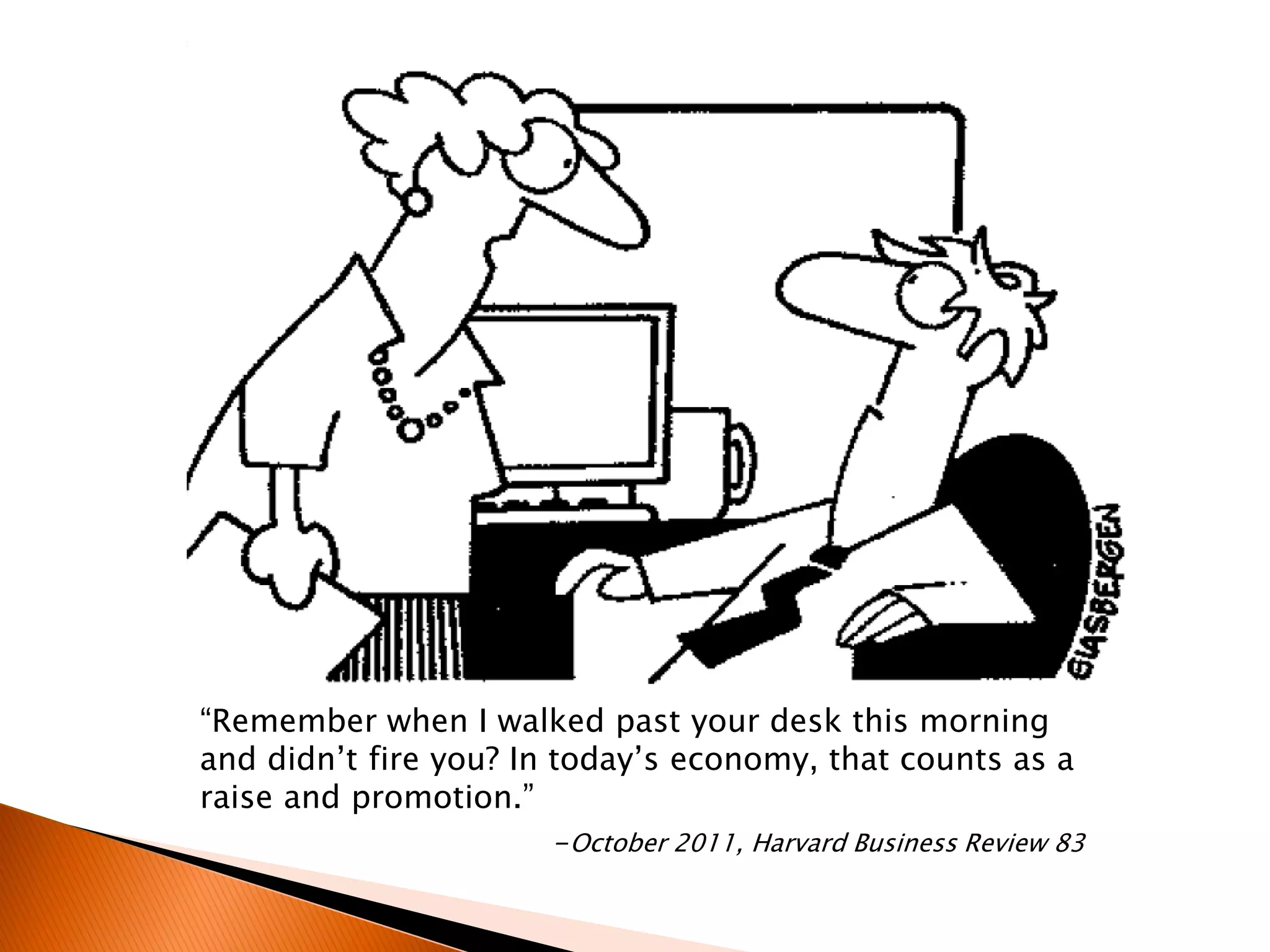
“Remember when I walked past your desk this morning
and didn’t fire you? In today’s economy, that counts as a
raise and promotion.”
–October 2011, Harvard Business Review 83
 Emerging markets
 Widening the gap between
have’s and have not’s
 Disruptive Innovation
As emerging market countries gain in stature, new
companies are taking center stage. The rise of these
emerging market leaders will constitute one of the
fastest-growing global trends of this decade.
These emerging market companies will continue to
be critical competitors in their home markets while
increasingly making outbound investments into
other emerging and developed economies.
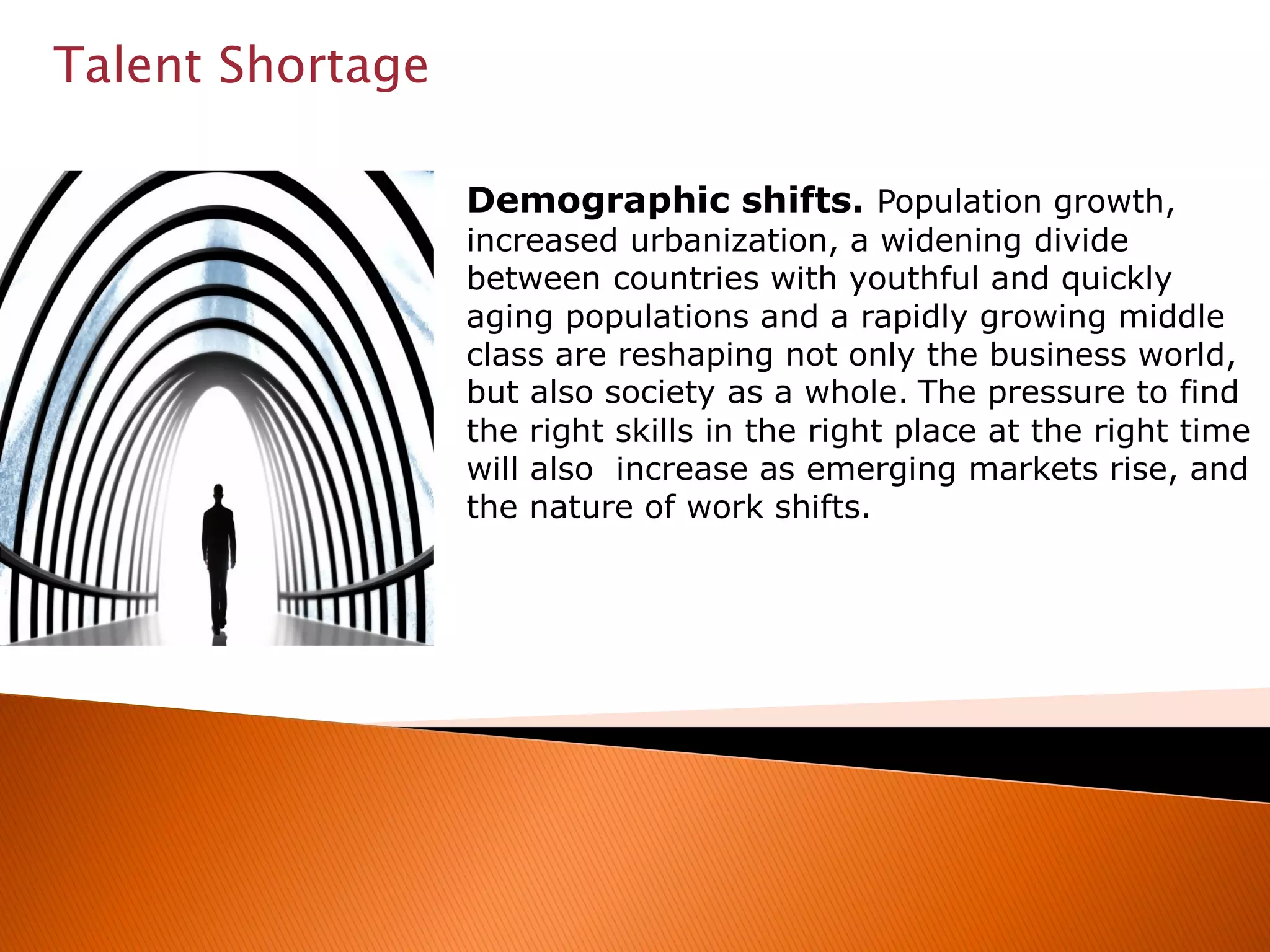
Talent is the New
Constraint
In this new and complex environment, talent is increasingly
the key competitive differentiator. In less than a decade,
people with high-demand skills will be the scarcest
resource for companies.
Talent Shortage
Demographic shifts. Population growth,
increased urbanization, a widening divide
between countries with youthful and quickly
aging populations and a rapidly growing middle
class are reshaping not only the business world,
but also society as a whole. The pressure to find
the right skills in the right place at the right time
will also increase as emerging markets rise, and
the nature of work shifts.
 Despite projected growth in the global population from
6.9 billion in 2010 to 7.6 billion in 2020, the working-
age population is expected to decline in many
countries. Japan already has more people exiting the
workforce than there are workers prepared to enter it.
 In the European labor market, 2010 marked the first
time more workers retired than joined the workforce.
While this labor gap is a relatively manageable 200,000,
it will surge to 8.3 million by 2030.
 By the end of this decade, other large economies such
as Russia, Canada, South Korea and China will also have
more people at retirement age than are entering the
workforce.
Interestingly, other, younger countries stand to
profit from those trends:
One-third of India’s population is now under the
age of 15. Other emerging market economies with
young labor forces such as Brazil, Mexico and
Indonesia may benefit from a demographic
dividend, a surge in productivity and growth as
those workers join the labor pool.
But the dividend pays off only if the country
provides its youth with adequate educational and
economic opportunities to develop their skills.
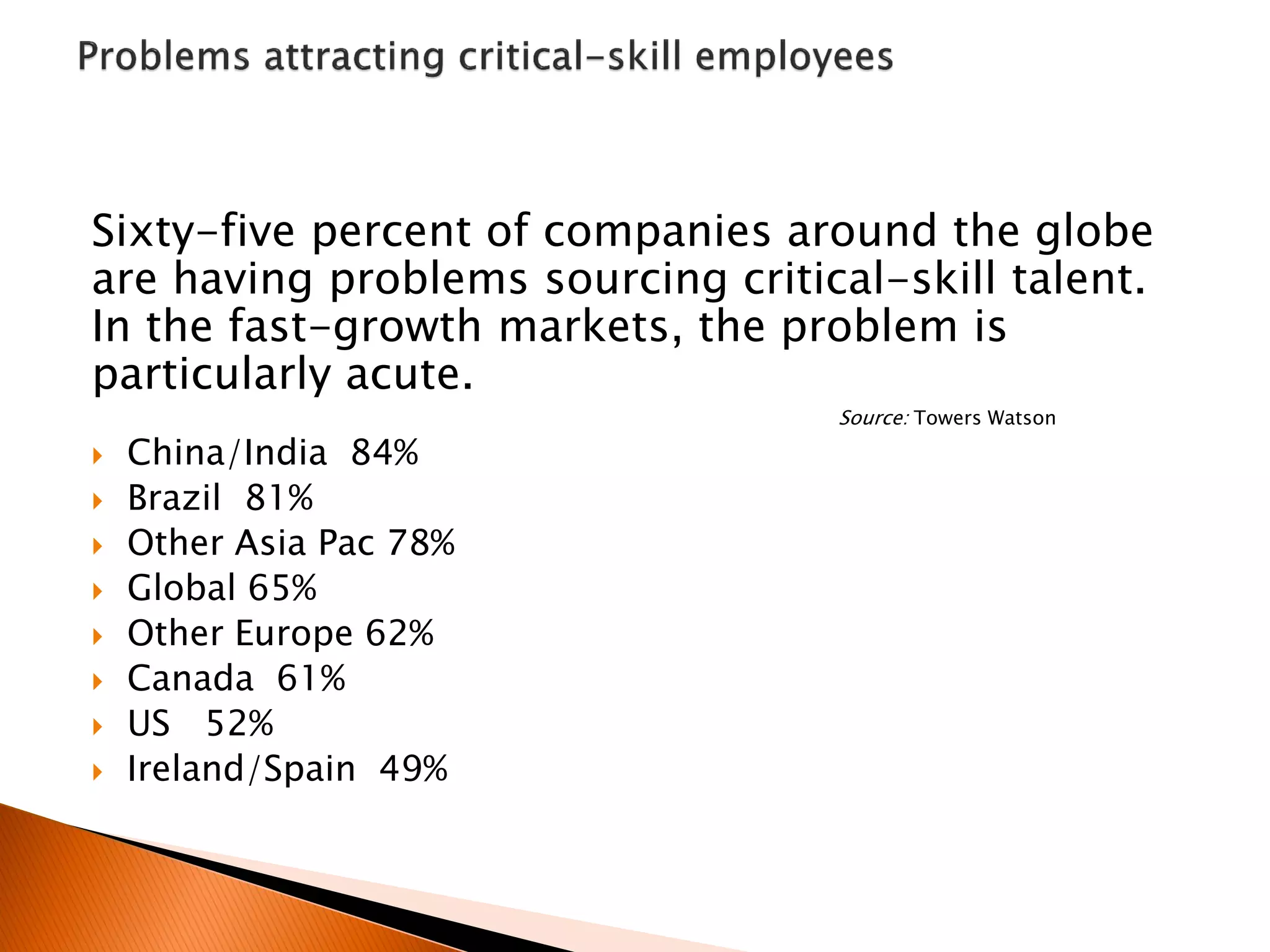
Sixty-five percent of companies around the globe
are having problems sourcing critical-skill talent.
In the fast-growth markets, the problem is
particularly acute.
Source: Towers Watson
 China/India 84%
 Brazil 81%
 Other Asia Pac 78%
 Global 65%
 Other Europe 62%
 Canada 61%
 US 52%
 Ireland/Spain 49%
Why can’t companies find the right talent
despite the growing ranks of college-educated
workers and the high unemployment in some
of the best-educated markets?
 Desperate for workers, many companies will
become more accepting of diverse employees,
particularly older workers and women.
 The leading US advocacy group for retired
people, the AARP, believes that 80% of baby
boomers will keep working full- or part-time
past their current retirement age.
 The Pew Research Center predicts that
Generation U (unretired) workers will fuel 93% of
the growth in the US labor market through 2016.
 Women, an increasingly well-educated source of talent, have entered the
workforce in ever greater numbers in recent decades. However, their talents
are still often underutilized.
 This is particularly true in societies with traditional views of gender roles,
including many fast-growing economies.
 Better use of the world’s female population could increase economic
growth, reduce poverty, enhance societal well-being, and help ensure
sustainable development in all countries,” OECD
(Organization of Economic Cooperation and Development)
 “The facts are clear: For countries and companies to flourish, women must
play a bigger role in the workforce. With the talent shortage sure to gain
urgency as the global economy recovers, failure to attract more women into
the ranks of the employed could lead to crisis. But we can avoid this
predicament if we move now to address the barriers that discourage women
from participating. Contemporary work practice must embrace true flexibility
to expand the labor pool. “ Manpower 2012
 Over the past 20 or 30 years, the bond
between company and employee has
weakened, even in corporate cultures where
loyalty was once prized.
 Fast-changing company needs and a desire
to cut costs led first to more frequent layoffs,
and then to nontraditional relationships
where the expectation was not decades of
service, but only a few years.
In a period of high unemployment, this new social contract is an
advantage for the employer. But as the market turns, skilled
employees will benefit. They will want a better understanding of
their employment options and a greater say in how work is
assigned, assessed and rewarded.
The employer will no longer define the workplace; rather,
employees’ priorities and preferences will dictate what the
future workplace will look like, particularly now that technology
makes it easier than ever to design a variety of flexible
arrangements.
Companies operating in aging societies will
have to craft methods to engage or re-engage
the experienced base of talent. Companies that
fail to respond to this change and do not
succeed in redefining their employee value
proposition will fail to attract, retain or develop
talent effectively
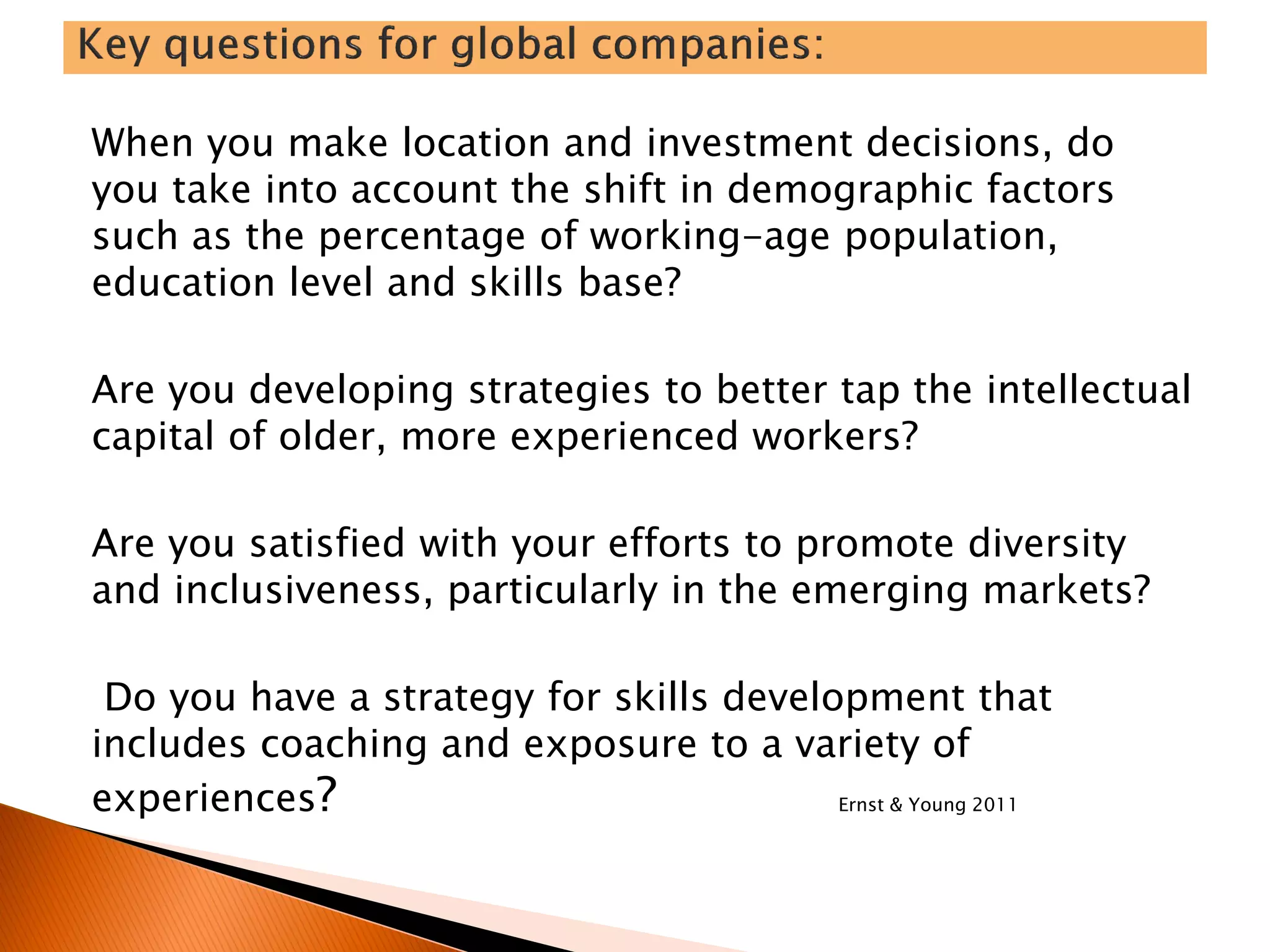
When you make location and investment decisions, do
you take into account the shift in demographic factors
such as the percentage of working-age population,
education level and skills base?
Are you developing strategies to better tap the intellectual
capital of older, more experienced workers?
Are you satisfied with your efforts to promote diversity
and inclusiveness, particularly in the emerging markets?
Do you have a strategy for skills development that
includes coaching and exposure to a variety of
experiences? Ernst & Young 2011
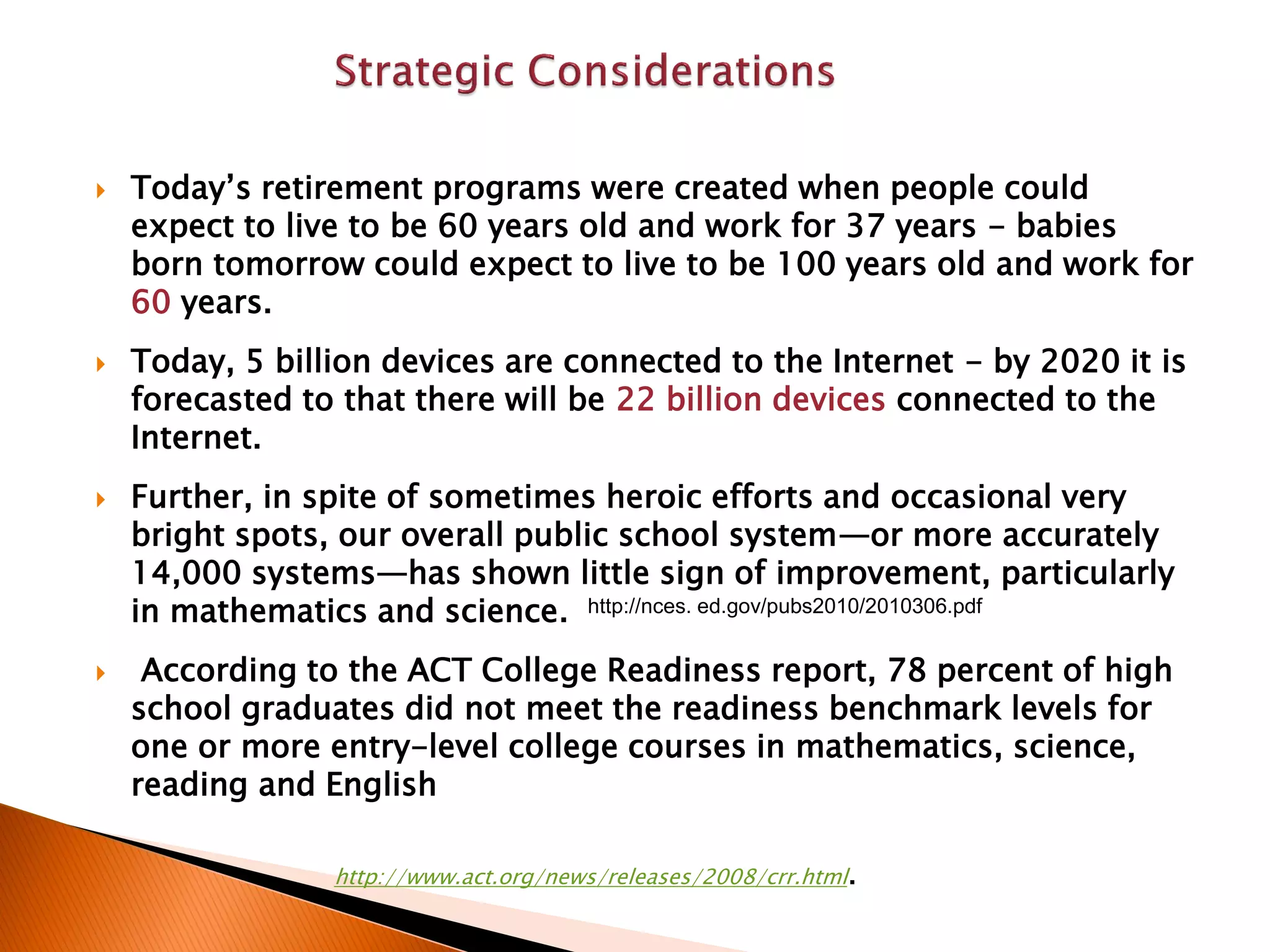
 Today’s retirement programs were created when people could
expect to live to be 60 years old and work for 37 years - babies
born tomorrow could expect to live to be 100 years old and work for
60 years.
 Today, 5 billion devices are connected to the Internet - by 2020 it is
forecasted to that there will be 22 billion devices connected to the
Internet.
 Further, in spite of sometimes heroic efforts and occasional very
bright spots, our overall public school system—or more accurately
14,000 systems—has shown little sign of improvement, particularly
in mathematics and science.
 According to the ACT College Readiness report, 78 percent of high
school graduates did not meet the readiness benchmark levels for
one or more entry-level college courses in mathematics, science,
reading and English
http://www.act.org/news/releases/2008/crr.html.
http://nces. ed.gov/pubs2010/2010306.pdf
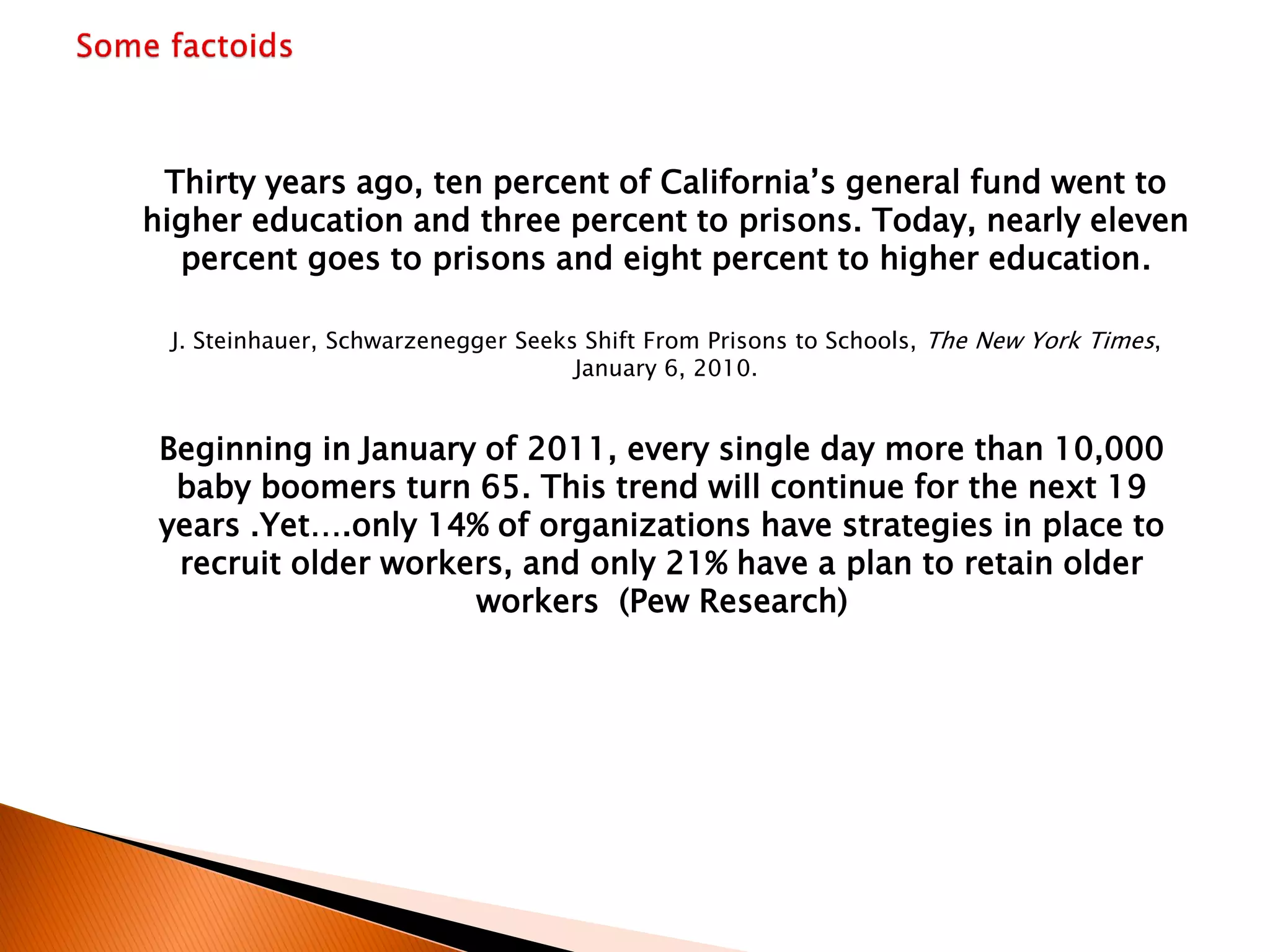
Thirty years ago, ten percent of California’s general fund went to
higher education and three percent to prisons. Today, nearly eleven
percent goes to prisons and eight percent to higher education.
J. Steinhauer, Schwarzenegger Seeks Shift From Prisons to Schools, The New York Times,
January 6, 2010.
Beginning in January of 2011, every single day more than 10,000
baby boomers turn 65. This trend will continue for the next 19
years .Yet….only 14% of organizations have strategies in place to
recruit older workers, and only 21% have a plan to retain older
workers (Pew Research)
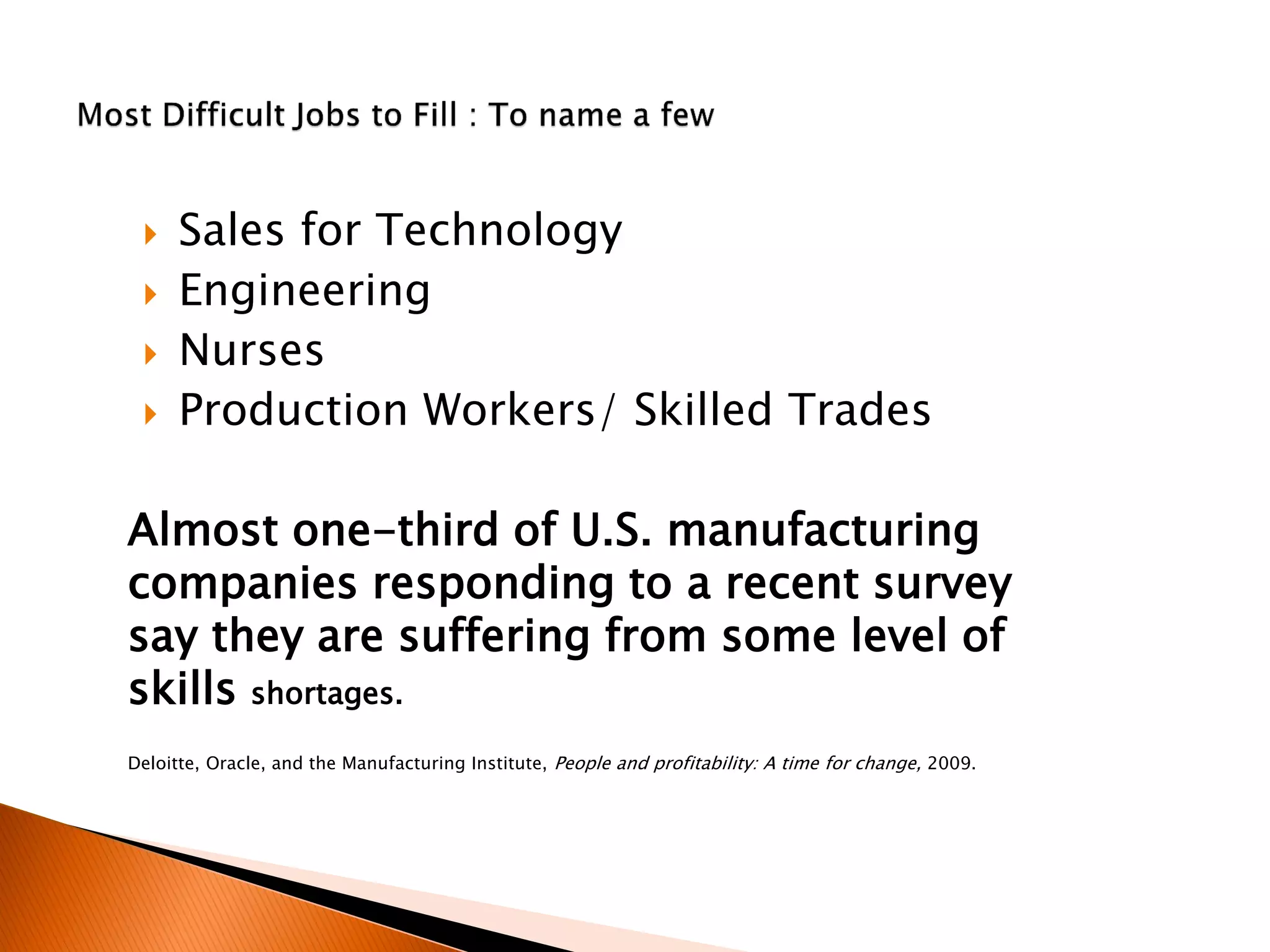
 Sales for Technology
 Engineering
 Nurses
 Production Workers/ Skilled Trades
Almost one-third of U.S. manufacturing
companies responding to a recent survey
say they are suffering from some level of
skills shortages.
Deloitte, Oracle, and the Manufacturing Institute, People and profitability: A time for change, 2009.
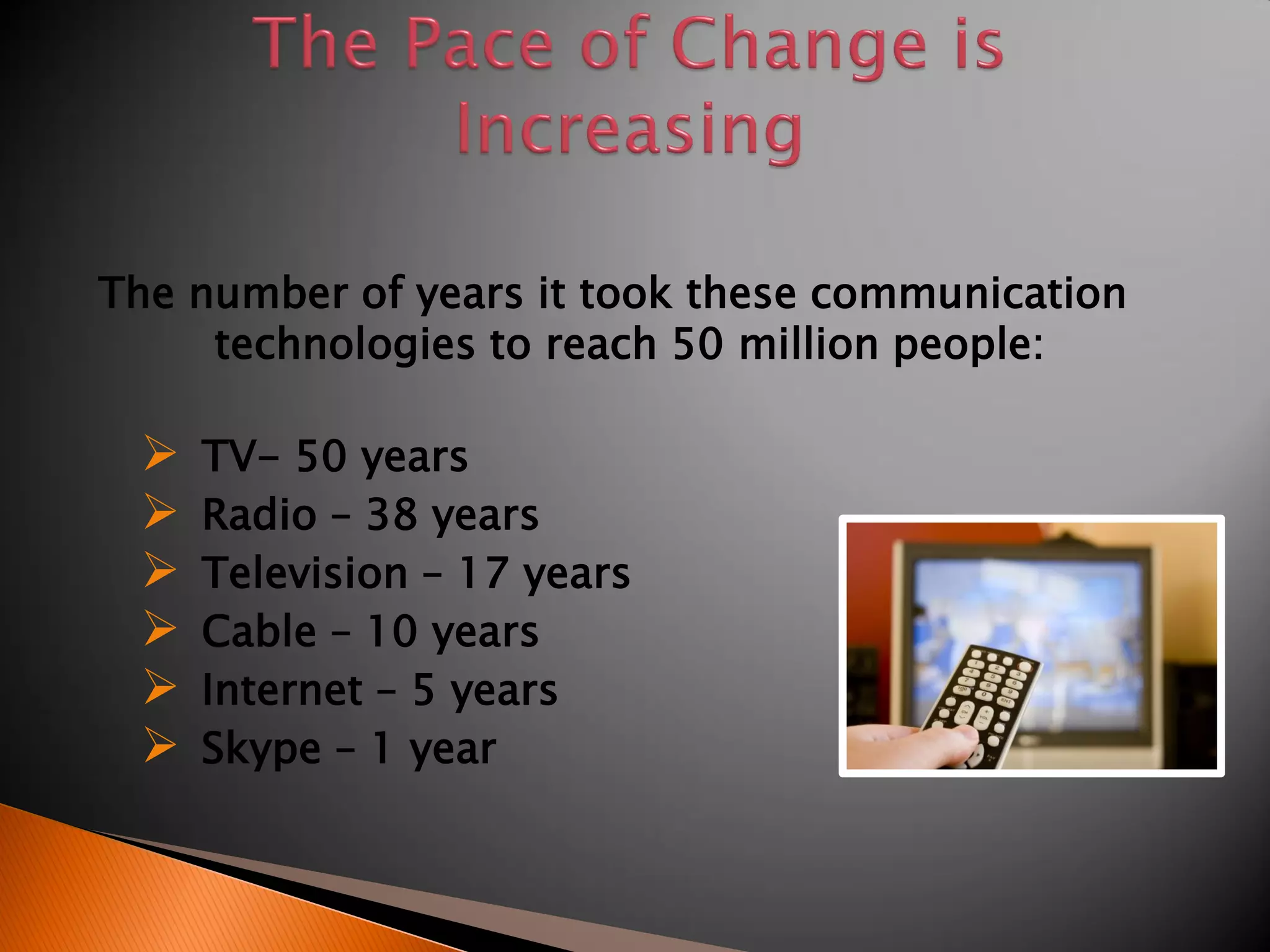
The number of years it took these communication
technologies to reach 50 million people:
 TV- 50 years
 Radio – 38 years
 Television – 17 years
 Cable – 10 years
 Internet – 5 years
 Skype – 1 year
Innovations in technology continue to have
massive effects on business and society. We’re
now seeing emerging markets become hotbeds
of innovation, especially in efforts to reach the
growing middle class and low income
consumers around the globe.
 By 2020, demographics point to five generations working
side by side that use social media to communicate,
collaborate, and learn.
 A few examples:
◦ Facebook: 800 million users
◦ YouTube: Over 3 billion views a day
◦ Google: Over 4.7 billion searches per day
◦ Wikipedia: Over 17 million articles a day
◦ iTunes U: Over 300 million downloads
 Swarming, Big data, gaming tools, transparency, hyper
specialization, social networks, virtual work, crowd sourcing
Are you developing innovations faster than your competitors?
If not, how serious is the risk of losing your competitive
advantage if a competitor provides a disruptive offering?
Are you satisfied with your ability to leverage newer
technologies such as social media and cloud-based services,
analytics, security and privacy and virtualization solutions?
Are you confident you have the right level of investment in
intelligent data-mining capabilities, such as business and
behavioral analytics? Do you have a strategy for gaining
competitive advantage through better data use?
Are you developing products and services for multiple mobile
platforms? If so, are your stakeholders aware of the added
financial and operational costs involved?
Have you reassessed your training tools and requirements to
make sure that your people understand how technology affects
operations, marketing and strategy.
Ernst & Young 2011
Today’s student will have 10-14 jobs by age 38
Heidrick & Struggles
This next generation is more demanding- fickle- and sophisticated.
Sophisticated talent demands sophisticated talent management.
Is your organization prepared to accommodate a new demand for flexibility
from your most skilled employees?
People Have Choices
As many as 84% say they want to leave
their jobs this year, up from
60% in 2010 Manpower 2011
Every company - whether it is trying to
build one or not - has a culture
A great culture can make the critical difference
between organizational success and dismal failure. It
impacts just about every business metric we have,
from customer service to productivity to profitability. It
is the key to retention because employees don’t want
to leave a great culture.
It is the key to recruitment because applicants are
clamoring to get in. Intel, which is renowned for its
iconic culture, has a turnover rate of only 2% and
Google gets an estimated 7,000 unsolicited
applications for jobs every day.
Culture Eats Strategy for Breakfast
 Stay twice as long in their jobs as their least happy colleagues
 Believe they are achieving their potential 2x as much
 Spend 65% more time feeling energized
 Are 58% more likely to go out of the way to help their
colleagues
 Identify 98% more strongly with the values of their
organization
 Are 100 % more likely to recommend their organization to a
friend
Wall Street Journal 2009
Happy and engaged employees across culture and time:
“HR leaders must help the organization align workforce strategy
to business strategy in order to drive business performance,
”says Libby Sartain, former Chief People Officer, Yahoo! and
Southwest Airlines.
“They need to facilitate the discussion with the leadership team
around what the business needs from its workforce in the short
term and in the long term, in order to close the gap between
what the workforce can do and what the business needs them
to do.”
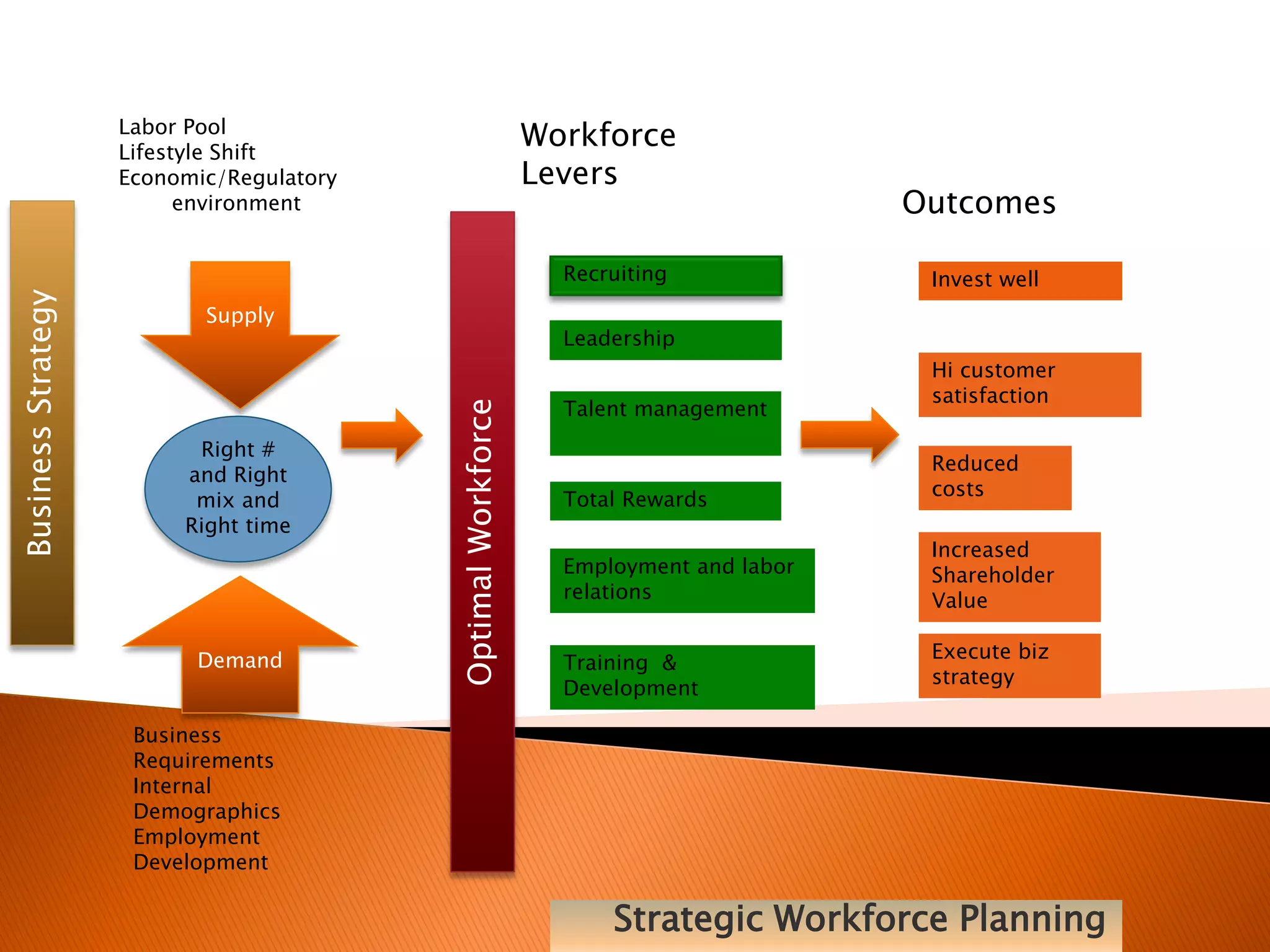
Strategic Workforce Planning
Business
Strategy
Labor Pool
Lifestyle Shift
Economic/Regulatory
environment
Demand
Supply
Business
Requirements
Internal
Demographics
Employment
Development
Right #
and Right
mix and
Right time
Optimal
Workforce
Workforce
Levers
Recruiting
Leadership
Talent management
Total Rewards
Employment and labor
relations
Training &
Development
Outcomes
Invest well
Hi customer
satisfaction
Reduced
costs
Increased
Shareholder
Value
Execute biz
strategy
31
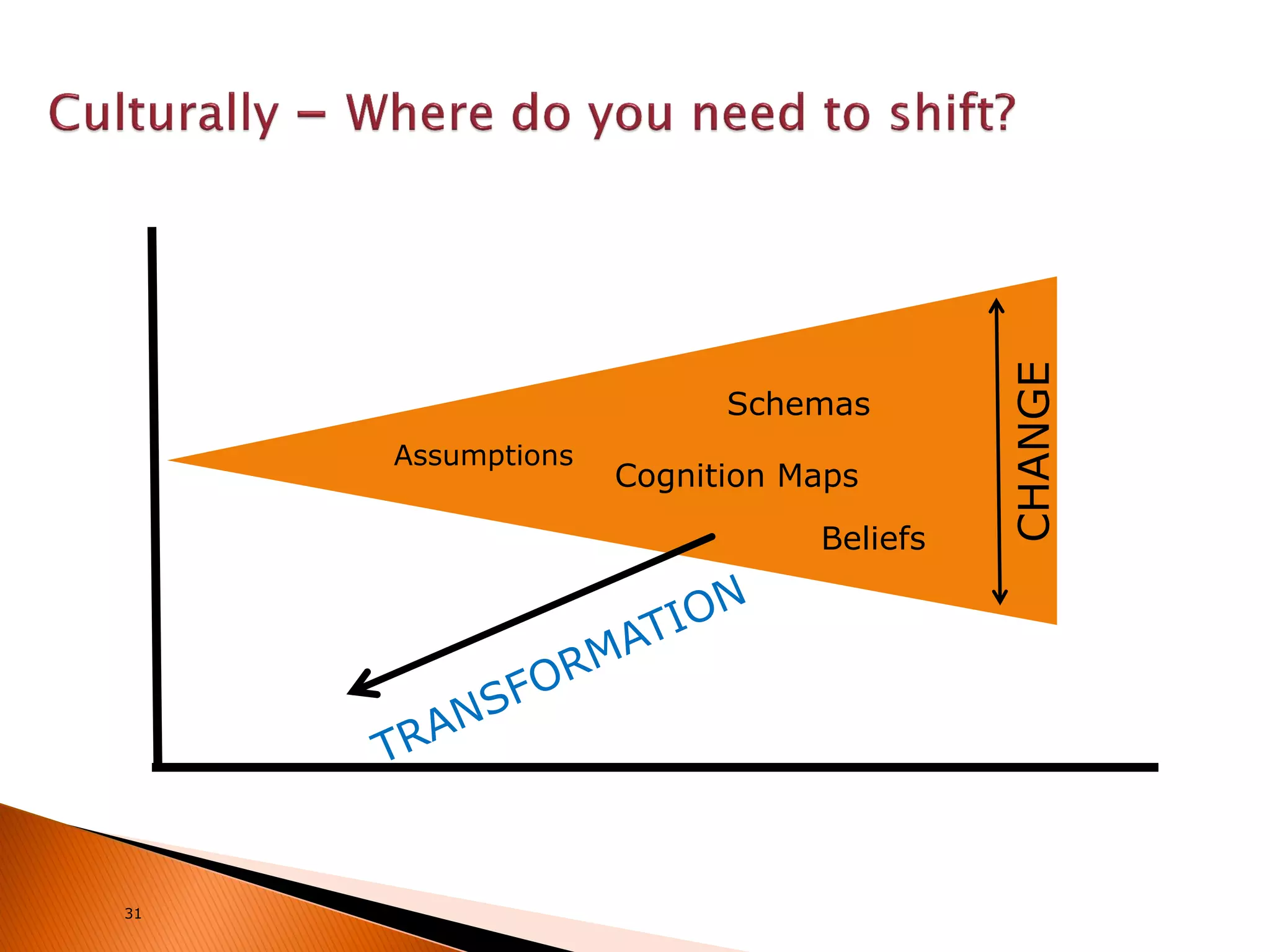
Assumptions
Schemas
Beliefs
CHANGE
Cognition Maps
Which trends are most problematic for your organization?
What are the talent implications for your organization?
Where would you start?
Does your workforce strategy confidently
answer questions about your
organization’s workforce priorities, trade-
offs and investments that will enable your
organization to accelerate your business
strategy?
 Leaders must focus on coaching and developing workers to best
optimize workforce performance
 A leader must leverage technology as an enabler; and with a human
approach, not only be aware of work but be ready to quickly curate
relevant information, in a way that empowers his/her people
 Organizations can no longer afford to rely on outdated people
practices, work models, or less than optimized talent.
 Development must serve both the employee and the company.
Companies that pinpoint weaknesses faster than their competitors can
take measures more quickly to fix these shortcomings.
 Organizations must have a customized approach to engaging and
retaining the multigenerational workforce that is also nimble and
contemporary
 Organizations must stop using development practices based on 20th
century paradigms rather than 21st century realities
DiMenna Consulting Group
Donna DiMenna, Psy.D
www.donnadimenna.com
donna.dimenna@gmail.com
651.226.4660

Implications to talent strategy due to global transformation

  • 1.
    HR.com Donna DiMenna, Psy.D DiMennaConsulting Group Nov.19, 2013 .
  • 2.
    “ If therate of change outside the organization is greater than the rate of change inside the organization,that organization will become obsolete” Jack Welch
  • 3.
    “Remember when Iwalked past your desk this morning and didn’t fire you? In today’s economy, that counts as a raise and promotion.” –October 2011, Harvard Business Review 83
  • 4.
     Emerging markets Widening the gap between have’s and have not’s  Disruptive Innovation
  • 5.
    As emerging marketcountries gain in stature, new companies are taking center stage. The rise of these emerging market leaders will constitute one of the fastest-growing global trends of this decade. These emerging market companies will continue to be critical competitors in their home markets while increasingly making outbound investments into other emerging and developed economies.
  • 6.
    Talent is theNew Constraint In this new and complex environment, talent is increasingly the key competitive differentiator. In less than a decade, people with high-demand skills will be the scarcest resource for companies.
  • 7.
    Talent Shortage Demographic shifts.Population growth, increased urbanization, a widening divide between countries with youthful and quickly aging populations and a rapidly growing middle class are reshaping not only the business world, but also society as a whole. The pressure to find the right skills in the right place at the right time will also increase as emerging markets rise, and the nature of work shifts.
  • 8.
     Despite projectedgrowth in the global population from 6.9 billion in 2010 to 7.6 billion in 2020, the working- age population is expected to decline in many countries. Japan already has more people exiting the workforce than there are workers prepared to enter it.  In the European labor market, 2010 marked the first time more workers retired than joined the workforce. While this labor gap is a relatively manageable 200,000, it will surge to 8.3 million by 2030.  By the end of this decade, other large economies such as Russia, Canada, South Korea and China will also have more people at retirement age than are entering the workforce.
  • 9.
    Interestingly, other, youngercountries stand to profit from those trends: One-third of India’s population is now under the age of 15. Other emerging market economies with young labor forces such as Brazil, Mexico and Indonesia may benefit from a demographic dividend, a surge in productivity and growth as those workers join the labor pool. But the dividend pays off only if the country provides its youth with adequate educational and economic opportunities to develop their skills.
  • 10.
    Sixty-five percent ofcompanies around the globe are having problems sourcing critical-skill talent. In the fast-growth markets, the problem is particularly acute. Source: Towers Watson  China/India 84%  Brazil 81%  Other Asia Pac 78%  Global 65%  Other Europe 62%  Canada 61%  US 52%  Ireland/Spain 49%
  • 11.
    Why can’t companiesfind the right talent despite the growing ranks of college-educated workers and the high unemployment in some of the best-educated markets?
  • 12.
     Desperate forworkers, many companies will become more accepting of diverse employees, particularly older workers and women.  The leading US advocacy group for retired people, the AARP, believes that 80% of baby boomers will keep working full- or part-time past their current retirement age.  The Pew Research Center predicts that Generation U (unretired) workers will fuel 93% of the growth in the US labor market through 2016.
  • 13.
     Women, anincreasingly well-educated source of talent, have entered the workforce in ever greater numbers in recent decades. However, their talents are still often underutilized.  This is particularly true in societies with traditional views of gender roles, including many fast-growing economies.  Better use of the world’s female population could increase economic growth, reduce poverty, enhance societal well-being, and help ensure sustainable development in all countries,” OECD (Organization of Economic Cooperation and Development)  “The facts are clear: For countries and companies to flourish, women must play a bigger role in the workforce. With the talent shortage sure to gain urgency as the global economy recovers, failure to attract more women into the ranks of the employed could lead to crisis. But we can avoid this predicament if we move now to address the barriers that discourage women from participating. Contemporary work practice must embrace true flexibility to expand the labor pool. “ Manpower 2012
  • 14.
     Over thepast 20 or 30 years, the bond between company and employee has weakened, even in corporate cultures where loyalty was once prized.  Fast-changing company needs and a desire to cut costs led first to more frequent layoffs, and then to nontraditional relationships where the expectation was not decades of service, but only a few years.
  • 15.
    In a periodof high unemployment, this new social contract is an advantage for the employer. But as the market turns, skilled employees will benefit. They will want a better understanding of their employment options and a greater say in how work is assigned, assessed and rewarded. The employer will no longer define the workplace; rather, employees’ priorities and preferences will dictate what the future workplace will look like, particularly now that technology makes it easier than ever to design a variety of flexible arrangements.
  • 16.
    Companies operating inaging societies will have to craft methods to engage or re-engage the experienced base of talent. Companies that fail to respond to this change and do not succeed in redefining their employee value proposition will fail to attract, retain or develop talent effectively
  • 17.
    When you makelocation and investment decisions, do you take into account the shift in demographic factors such as the percentage of working-age population, education level and skills base? Are you developing strategies to better tap the intellectual capital of older, more experienced workers? Are you satisfied with your efforts to promote diversity and inclusiveness, particularly in the emerging markets? Do you have a strategy for skills development that includes coaching and exposure to a variety of experiences? Ernst & Young 2011
  • 18.
     Today’s retirementprograms were created when people could expect to live to be 60 years old and work for 37 years - babies born tomorrow could expect to live to be 100 years old and work for 60 years.  Today, 5 billion devices are connected to the Internet - by 2020 it is forecasted to that there will be 22 billion devices connected to the Internet.  Further, in spite of sometimes heroic efforts and occasional very bright spots, our overall public school system—or more accurately 14,000 systems—has shown little sign of improvement, particularly in mathematics and science.  According to the ACT College Readiness report, 78 percent of high school graduates did not meet the readiness benchmark levels for one or more entry-level college courses in mathematics, science, reading and English http://www.act.org/news/releases/2008/crr.html. http://nces. ed.gov/pubs2010/2010306.pdf
  • 19.
    Thirty years ago,ten percent of California’s general fund went to higher education and three percent to prisons. Today, nearly eleven percent goes to prisons and eight percent to higher education. J. Steinhauer, Schwarzenegger Seeks Shift From Prisons to Schools, The New York Times, January 6, 2010. Beginning in January of 2011, every single day more than 10,000 baby boomers turn 65. This trend will continue for the next 19 years .Yet….only 14% of organizations have strategies in place to recruit older workers, and only 21% have a plan to retain older workers (Pew Research)
  • 20.
     Sales forTechnology  Engineering  Nurses  Production Workers/ Skilled Trades Almost one-third of U.S. manufacturing companies responding to a recent survey say they are suffering from some level of skills shortages. Deloitte, Oracle, and the Manufacturing Institute, People and profitability: A time for change, 2009.
  • 21.
    The number ofyears it took these communication technologies to reach 50 million people:  TV- 50 years  Radio – 38 years  Television – 17 years  Cable – 10 years  Internet – 5 years  Skype – 1 year
  • 22.
    Innovations in technologycontinue to have massive effects on business and society. We’re now seeing emerging markets become hotbeds of innovation, especially in efforts to reach the growing middle class and low income consumers around the globe.
  • 23.
     By 2020,demographics point to five generations working side by side that use social media to communicate, collaborate, and learn.  A few examples: ◦ Facebook: 800 million users ◦ YouTube: Over 3 billion views a day ◦ Google: Over 4.7 billion searches per day ◦ Wikipedia: Over 17 million articles a day ◦ iTunes U: Over 300 million downloads  Swarming, Big data, gaming tools, transparency, hyper specialization, social networks, virtual work, crowd sourcing
  • 24.
    Are you developinginnovations faster than your competitors? If not, how serious is the risk of losing your competitive advantage if a competitor provides a disruptive offering? Are you satisfied with your ability to leverage newer technologies such as social media and cloud-based services, analytics, security and privacy and virtualization solutions? Are you confident you have the right level of investment in intelligent data-mining capabilities, such as business and behavioral analytics? Do you have a strategy for gaining competitive advantage through better data use? Are you developing products and services for multiple mobile platforms? If so, are your stakeholders aware of the added financial and operational costs involved? Have you reassessed your training tools and requirements to make sure that your people understand how technology affects operations, marketing and strategy. Ernst & Young 2011
  • 25.
    Today’s student willhave 10-14 jobs by age 38 Heidrick & Struggles This next generation is more demanding- fickle- and sophisticated. Sophisticated talent demands sophisticated talent management. Is your organization prepared to accommodate a new demand for flexibility from your most skilled employees? People Have Choices
  • 26.
    As many as84% say they want to leave their jobs this year, up from 60% in 2010 Manpower 2011 Every company - whether it is trying to build one or not - has a culture
  • 27.
    A great culturecan make the critical difference between organizational success and dismal failure. It impacts just about every business metric we have, from customer service to productivity to profitability. It is the key to retention because employees don’t want to leave a great culture. It is the key to recruitment because applicants are clamoring to get in. Intel, which is renowned for its iconic culture, has a turnover rate of only 2% and Google gets an estimated 7,000 unsolicited applications for jobs every day. Culture Eats Strategy for Breakfast
  • 28.
     Stay twiceas long in their jobs as their least happy colleagues  Believe they are achieving their potential 2x as much  Spend 65% more time feeling energized  Are 58% more likely to go out of the way to help their colleagues  Identify 98% more strongly with the values of their organization  Are 100 % more likely to recommend their organization to a friend Wall Street Journal 2009 Happy and engaged employees across culture and time:
  • 29.
    “HR leaders musthelp the organization align workforce strategy to business strategy in order to drive business performance, ”says Libby Sartain, former Chief People Officer, Yahoo! and Southwest Airlines. “They need to facilitate the discussion with the leadership team around what the business needs from its workforce in the short term and in the long term, in order to close the gap between what the workforce can do and what the business needs them to do.”
  • 30.
    Strategic Workforce Planning Business Strategy LaborPool Lifestyle Shift Economic/Regulatory environment Demand Supply Business Requirements Internal Demographics Employment Development Right # and Right mix and Right time Optimal Workforce Workforce Levers Recruiting Leadership Talent management Total Rewards Employment and labor relations Training & Development Outcomes Invest well Hi customer satisfaction Reduced costs Increased Shareholder Value Execute biz strategy
  • 31.
  • 32.
    Which trends aremost problematic for your organization? What are the talent implications for your organization? Where would you start? Does your workforce strategy confidently answer questions about your organization’s workforce priorities, trade- offs and investments that will enable your organization to accelerate your business strategy?
  • 33.
     Leaders mustfocus on coaching and developing workers to best optimize workforce performance  A leader must leverage technology as an enabler; and with a human approach, not only be aware of work but be ready to quickly curate relevant information, in a way that empowers his/her people  Organizations can no longer afford to rely on outdated people practices, work models, or less than optimized talent.  Development must serve both the employee and the company. Companies that pinpoint weaknesses faster than their competitors can take measures more quickly to fix these shortcomings.  Organizations must have a customized approach to engaging and retaining the multigenerational workforce that is also nimble and contemporary  Organizations must stop using development practices based on 20th century paradigms rather than 21st century realities
  • 35.
    DiMenna Consulting Group DonnaDiMenna, Psy.D www.donnadimenna.com donna.dimenna@gmail.com 651.226.4660