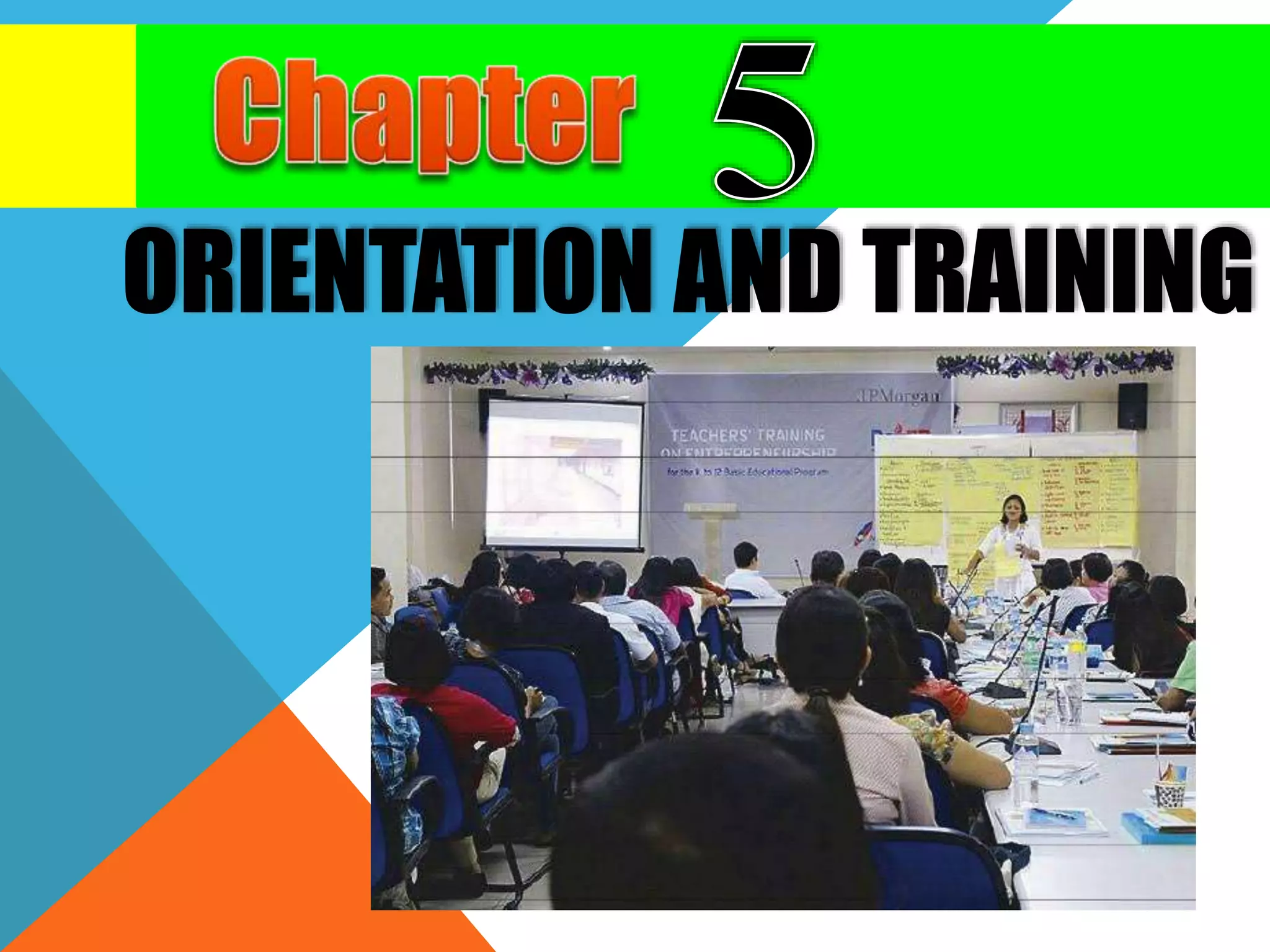
ORIENTATION AND TRAINING
 What is Orientation
 Purposes of Orientation
 Who is Responsible for Orientation
 Levels of Orientation
 How Orientation Programs are Presented
 What is Training
 Who is Responsible for Training
 Importance of Training
 Assessing Training Needs
 Methods of Identifying Training Needs
 Theories of Learning
 Training Methods
 Evaluating Training Programs
When the hiring process is
through, the new recruits will have
to undergo orientation and most
probably, training. Orientation is a
requirement before the recruit
starts working. Depending on the
circumstances, training may follow
immediately.
A set of activities such as
familiarizing new employees with
company rules, policies and
procedures, with the view of making
the employee well-adapted to the
work environment.
1. It creates an initial favorable
impression.
A new employee who has a good
impression of the company and the
work environment will find
adjustment easier.
2. It enhances interpersonal
acceptance.
Helps the new employee in
meeting the expectations of the
company and his work groups.
Work group adapts certain norms
of conduct that will soon the new
recruit will conform to these norms.
3. It helps the new recruit adjust
himself to the job.
Effective orientation creates a
sense of security, belongingness,
and confidence to the new recruit.
1. The Chief Executive Officer (CEO)
• Give them a warm welcome
• He can make the new employee
listen to and feel the company’s
vision.
Thus, the CEO rally the new
recruits to do their best
2. The Head of the HR Department
• Provide the necessary
administrative support so the
new recruits will spared of the
worries connected with those
concerns.
3. The Supervisor of the new
Employee
• Responsibility to make the new
employee feel that he is
welcome. (by introducing them
to his co-workers, seek support
to help the new employee adapt
to his new work environment)
1. Organizational Orientation
2. Departmental and Job
Orientation
Organizational Orientation
Topics that should be presented:
1. An overview of the company
2. A review of the key policies and
procedures
3. Compensation
4. Fringe benefits
5. Safety and accident prevention
6. Employee and union relations
7. Physical facilities
8. Economic factors
Departmental and Job Orientation
Topics that should be presented:
1. The function of the department
2. Job duties and responsibilities
3. Policies, procedures, rules and regulations
4. Tour of the department
5. Introduction to department employees
Providing relevant information to the new
employees are achieved through:
1. Classes
2. Meetings
3. Tour of the company offices and plants
4. Films
5. Employee handbook
6. Information leaflets
7. Slides
8. Charts
An attempt to improve the
employee’s ability to perform his
job so the goals of the
organization can be achieved.
The SUPERVISOR
 He knows what output his units needs
 He has the abilities, the skills and the
right attitude needed to be imparted to
the new employee.
 He possesses some specific knowledge
about operating various equipment in his
unit.
 However, he should have the ability to
teach.
The Personnel Manager or Training Director
Cover whatever assistance could be provided
to the supervisor who is conducting training.
1. Determining training activities needed.
2. Evaluating the training programs.
3. Informing the management on the status of
each programs.
4. Selling the training programs to all
supervisors and manager.
5. Integrating the training programs with other
personnel actions, such as promotions and
transfers.
• Employees be able to do their jobs with
maximum effects and minimum errors in order
to achieve highly competitive worlds of
business.
• Through proper training, skills and attitudes of
the employee currently possess may be
addressed.
• It helps minimize recruitment and hiring costs
as the employee concerned is already in place
and is familiar with the company and his job.
Training is not an end in itself but rather a
means to an end.
The objective of training is to facilitate the
accomplishment of some organizational
objectives.
Needs assessment is a process designed to
determine whether training is necessary or not.
(Does the organization meet its goals)
1. Performance Reviews or Appraisal
2. Development Centers
3. Human Resource Audit
4. Interviews
5. Questionnaires
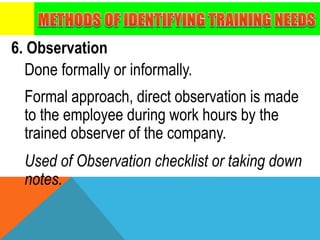
6. Observation
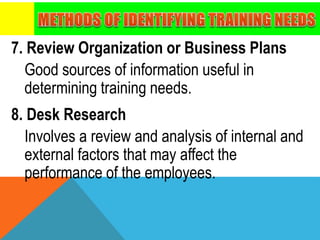
7. Review of Organization or Business
Plans
8. Desk Research
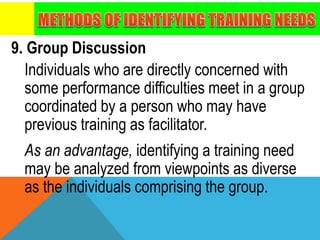
9. Group Discussion
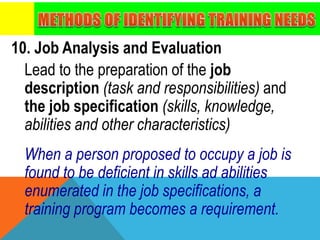
10. Job Analysis and Evaluation
1. Performance Review or Appraisal
The aim of the appraisal is to assess
employees performance while the review
aims to determine possible improvements in
performance.
2. Development Centers
Assessment techniques to ensure the
coverage of skills and attributes in the widest
possible manner.
3. Human Resource Audit
Comparing the current inventory of personnel
with the quantity and quality of employees
that will be needed in the future usually from
1 to 5 years.
Provide information on the number of
vacancies arising through retirement,
promotion, resignation and transfer.
4. Interviews
Training needs of individual employees may
also be ascertained through interviews. The
advantage of this method is that each
employee will have the opportunity to present
his own unique training need.
5. Questionnaire
Economical way of identifying training needs.
The ability to get many responses is an
advantage.
6. Observation
Done formally or informally.
Formal approach, direct observation is made
to the employee during work hours by the
trained observer of the company.
Used of Observation checklist or taking down
notes.
7. Review Organization or Business Plans
Good sources of information useful in
determining training needs.
8. Desk Research
Involves a review and analysis of internal and
external factors that may affect the
performance of the employees.
9. Group Discussion
Individuals who are directly concerned with
some performance difficulties meet in a group
coordinated by a person who may have
previous training as facilitator.
As an advantage, identifying a training need
may be analyzed from viewpoints as diverse
as the individuals comprising the group.
10. Job Analysis and Evaluation
Lead to the preparation of the job
description (task and responsibilities) and
the job specification (skills, knowledge,
abilities and other characteristics)
When a person proposed to occupy a job is
found to be deficient in skills ad abilities
enumerated in the job specifications, a
training program becomes a requirement.
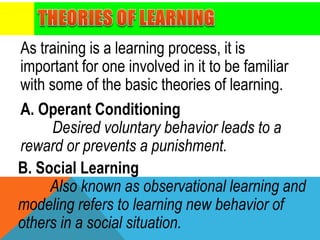
A. Operant Conditioning
Desired voluntary behavior leads to a
reward or prevents a punishment.
As training is a learning process, it is
important for one involved in it to be familiar
with some of the basic theories of learning.
B. Social Learning
Also known as observational learning and
modeling refers to learning new behavior of
others in a social situation.
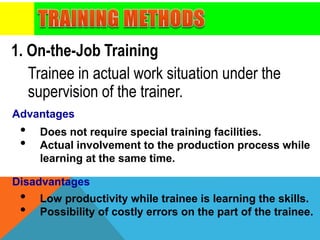
Trainee in actual work situation under the
supervision of the trainer.
1. On-the-Job Training
• Does not require special training facilities.
• Actual involvement to the production process while
learning at the same time.
• Low productivity while trainee is learning the skills.
• Possibility of costly errors on the part of the trainee.
Advantages
Disadvantages
A comprehensive exposure to the practical and
theoretical aspects of their chosen jobs.
2. Apprenticeship
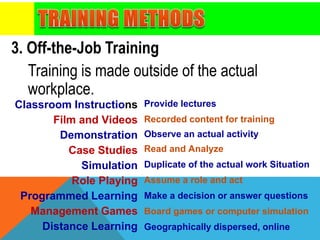
Training is made outside of the actual
workplace.
3. Off-the-Job Training
Classroom Instructions
Film and Videos
Demonstration
Case Studies
Simulation
Role Playing
Programmed Learning
Management Games
Distance Learning
Provide lectures
Recorded content for training
Observe an actual activity
Read and Analyze
Duplicate of the actual work Situation
Assume a role and act
Make a decision or answer questions
Board games or computer simulation
Geographically dispersed, online
Organizations will survive and grow if activities
they undertake are effective, they are able to
achieve their goals.
Training programs are designed to produce
various types of outcomes and several means
are used to determine them.
1. Cognitive Outcomes
2. Skill-based Outcomes
3. Affective Outcomes
4. Result Outcomes
Thank
You !!!
Reports ends here...

CEM Report

  • 1.
  • 2.
    ORIENTATION AND TRAINING What is Orientation  Purposes of Orientation  Who is Responsible for Orientation  Levels of Orientation  How Orientation Programs are Presented  What is Training  Who is Responsible for Training  Importance of Training  Assessing Training Needs  Methods of Identifying Training Needs  Theories of Learning  Training Methods  Evaluating Training Programs
  • 3.
    When the hiringprocess is through, the new recruits will have to undergo orientation and most probably, training. Orientation is a requirement before the recruit starts working. Depending on the circumstances, training may follow immediately.
  • 4.
    A set ofactivities such as familiarizing new employees with company rules, policies and procedures, with the view of making the employee well-adapted to the work environment.
  • 5.
    1. It createsan initial favorable impression. A new employee who has a good impression of the company and the work environment will find adjustment easier.
  • 6.
    2. It enhancesinterpersonal acceptance. Helps the new employee in meeting the expectations of the company and his work groups. Work group adapts certain norms of conduct that will soon the new recruit will conform to these norms.
  • 7.
    3. It helpsthe new recruit adjust himself to the job. Effective orientation creates a sense of security, belongingness, and confidence to the new recruit.
  • 8.
    1. The ChiefExecutive Officer (CEO) • Give them a warm welcome • He can make the new employee listen to and feel the company’s vision. Thus, the CEO rally the new recruits to do their best
  • 9.
    2. The Headof the HR Department • Provide the necessary administrative support so the new recruits will spared of the worries connected with those concerns.
  • 10.
    3. The Supervisorof the new Employee • Responsibility to make the new employee feel that he is welcome. (by introducing them to his co-workers, seek support to help the new employee adapt to his new work environment)
  • 11.
    1. Organizational Orientation 2.Departmental and Job Orientation
  • 12.
    Organizational Orientation Topics thatshould be presented: 1. An overview of the company 2. A review of the key policies and procedures 3. Compensation 4. Fringe benefits 5. Safety and accident prevention 6. Employee and union relations 7. Physical facilities 8. Economic factors
  • 13.
    Departmental and JobOrientation Topics that should be presented: 1. The function of the department 2. Job duties and responsibilities 3. Policies, procedures, rules and regulations 4. Tour of the department 5. Introduction to department employees
  • 14.
    Providing relevant informationto the new employees are achieved through: 1. Classes 2. Meetings 3. Tour of the company offices and plants 4. Films 5. Employee handbook 6. Information leaflets 7. Slides 8. Charts
  • 15.
    An attempt toimprove the employee’s ability to perform his job so the goals of the organization can be achieved.
  • 16.
    The SUPERVISOR  Heknows what output his units needs  He has the abilities, the skills and the right attitude needed to be imparted to the new employee.  He possesses some specific knowledge about operating various equipment in his unit.  However, he should have the ability to teach.
  • 17.
    The Personnel Manageror Training Director Cover whatever assistance could be provided to the supervisor who is conducting training. 1. Determining training activities needed. 2. Evaluating the training programs. 3. Informing the management on the status of each programs. 4. Selling the training programs to all supervisors and manager. 5. Integrating the training programs with other personnel actions, such as promotions and transfers.
  • 18.
    • Employees beable to do their jobs with maximum effects and minimum errors in order to achieve highly competitive worlds of business. • Through proper training, skills and attitudes of the employee currently possess may be addressed. • It helps minimize recruitment and hiring costs as the employee concerned is already in place and is familiar with the company and his job.
  • 19.
    Training is notan end in itself but rather a means to an end. The objective of training is to facilitate the accomplishment of some organizational objectives. Needs assessment is a process designed to determine whether training is necessary or not. (Does the organization meet its goals)
  • 20.
    1. Performance Reviewsor Appraisal 2. Development Centers 3. Human Resource Audit 4. Interviews 5. Questionnaires 6. Observation 7. Review of Organization or Business Plans 8. Desk Research 9. Group Discussion 10. Job Analysis and Evaluation
  • 21.
    1. Performance Reviewor Appraisal The aim of the appraisal is to assess employees performance while the review aims to determine possible improvements in performance. 2. Development Centers Assessment techniques to ensure the coverage of skills and attributes in the widest possible manner.
  • 22.
    3. Human ResourceAudit Comparing the current inventory of personnel with the quantity and quality of employees that will be needed in the future usually from 1 to 5 years. Provide information on the number of vacancies arising through retirement, promotion, resignation and transfer.
  • 23.
    4. Interviews Training needsof individual employees may also be ascertained through interviews. The advantage of this method is that each employee will have the opportunity to present his own unique training need. 5. Questionnaire Economical way of identifying training needs. The ability to get many responses is an advantage.
  • 24.
    6. Observation Done formallyor informally. Formal approach, direct observation is made to the employee during work hours by the trained observer of the company. Used of Observation checklist or taking down notes.
  • 25.
    7. Review Organizationor Business Plans Good sources of information useful in determining training needs. 8. Desk Research Involves a review and analysis of internal and external factors that may affect the performance of the employees.
  • 26.
    9. Group Discussion Individualswho are directly concerned with some performance difficulties meet in a group coordinated by a person who may have previous training as facilitator. As an advantage, identifying a training need may be analyzed from viewpoints as diverse as the individuals comprising the group.
  • 27.
    10. Job Analysisand Evaluation Lead to the preparation of the job description (task and responsibilities) and the job specification (skills, knowledge, abilities and other characteristics) When a person proposed to occupy a job is found to be deficient in skills ad abilities enumerated in the job specifications, a training program becomes a requirement.
  • 28.
    A. Operant Conditioning Desiredvoluntary behavior leads to a reward or prevents a punishment. As training is a learning process, it is important for one involved in it to be familiar with some of the basic theories of learning. B. Social Learning Also known as observational learning and modeling refers to learning new behavior of others in a social situation.
  • 29.
    Trainee in actualwork situation under the supervision of the trainer. 1. On-the-Job Training • Does not require special training facilities. • Actual involvement to the production process while learning at the same time. • Low productivity while trainee is learning the skills. • Possibility of costly errors on the part of the trainee. Advantages Disadvantages
  • 30.
    A comprehensive exposureto the practical and theoretical aspects of their chosen jobs. 2. Apprenticeship
  • 31.
    Training is madeoutside of the actual workplace. 3. Off-the-Job Training Classroom Instructions Film and Videos Demonstration Case Studies Simulation Role Playing Programmed Learning Management Games Distance Learning Provide lectures Recorded content for training Observe an actual activity Read and Analyze Duplicate of the actual work Situation Assume a role and act Make a decision or answer questions Board games or computer simulation Geographically dispersed, online
  • 32.
    Organizations will surviveand grow if activities they undertake are effective, they are able to achieve their goals. Training programs are designed to produce various types of outcomes and several means are used to determine them. 1. Cognitive Outcomes 2. Skill-based Outcomes 3. Affective Outcomes 4. Result Outcomes
  • 33.