Subject : Human Resource Management
Topic: Training, Development & career management
NATURE OF TRAINING AND
DEVELOPMENT
INPUTS IN TRAINING AND
DEVELOPMENT
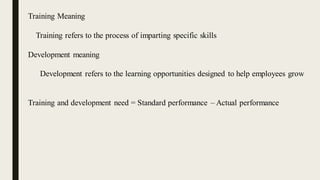
Training Meaning
Training refers to the process of imparting specific skills
Development meaning
Development refers to the learning opportunities designed to help employees grow
Training and development need = Standard performance – Actual performance
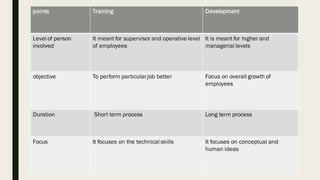
points Training Development
Level of person
involved
It meant for supervisor and operative level
of employees
It is meant for higher and
managerial levels
objective To perform particular job better Focus on overall growth of
employees
Duration Short term process Long term process
Focus It focuses on the technical skills It focuses on conceptual and
human ideas
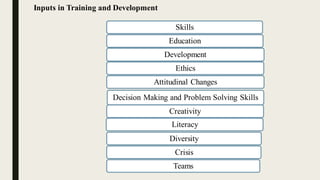
Inputs in Training and Development
Skills
Education
Development
Ethics
Attitudinal Changes
Decision Making and Problem Solving Skills
Creativity
Literacy
Diversity
Crisis
Teams
TRAINING & DEVELOPMENT AS
SOURCE OF COMPETITIVE
ADVANTAGES, AND BENEFITS OF
EMPLOYEE TRAINING
Training & Development As Source Of
Competitive Advantages
■ Training and development play a crucial role in providing
competitive advantages to organizations. By investing in
learning and development, companies can enhance
productivity, decision-making, problem-solving skills, and the
quality of work. This leads to increased efficiency, reduced
costs, and improved morale among employees
Benefits Of Employee Training
■ Increase Productivity
■ Increase Employee Performance
■ Boost Motivation & Engagement
■ Lead To Improve Profitability
■ Improve Job Knowledge
■ Help People To Identify Organizational Goal
■ Improve Relationship Between Boss And
Subordinate
Topic: Training Process
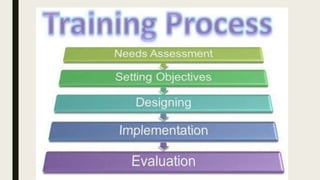
Steps in Training Process
■ 1) Needs Assessment
■ 2) Setting Objectives
■ 3) Designing
■ 4) Implementation
■ 5) Evaluation
1) Needs Assessment:
Assessing training needs and the resources available to meet those
needs forms the first step in developing and delivering effective
training.
2) Setting objectives:
The next phase in training Process is to identify instructional
objectives. Needs assessment helps prepare a blueprint that describes
the objectives to be archived by the trainee upon completion of the
training programme.
3) Designing:
Well-designed training is planned, appropriate to the target
audience and able to be delivered within the resources available.
Strategies and methods in this section address planning for training,
developing the materials used in the providing training and crafting a
4) Implementation:
Once the training programme has been designed, it needs to be implemented.
Implementation is beset with certain problems. Training and development requires a
higher degree of creativity than perhaps, any other problem.

5) Evaluation:
This is the last step of the Training Process. Evaluation considers the success of
training and is necessary for identifying elements of training processes and training
programmes that were beneficial and areas for improvement.
ON THE JOB
TRAINING METHOD
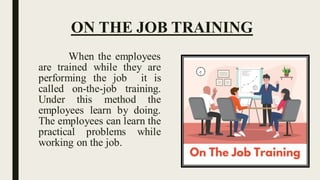
ON THE JOB TRAINING
When the employees
are trained while they are
performing the job it is
called on-the-job training.
Under this method the
employees learn by doing.
The employees can learn the
practical problems while
working on the job.
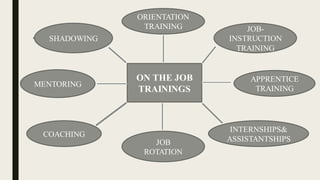
ON THE JOB
TRAININGS
SHADOWING
JOB
ROTATION
JOB-
INSTRUCTION
TRAINING
ORIENTATION
TRAINING
MENTORING
APPRENTICE
TRAINING
INTERNSHIPS&
ASSISTANTSHIPS
COACHING
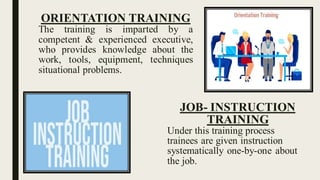
ORIENTATION TRAINING
The training is imparted by a
competent & experienced executive,
who provides knowledge about the
work, tools, equipment, techniques
situational problems.
JOB- INSTRUCTION
TRAINING
Under this training process
trainees are given instruction
systematically one-by-one about
the job.
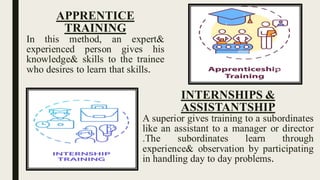
APPRENTICE
TRAINING
In this method, an expert&
experienced person gives his
knowledge& skills to the trainee
who desires to learn that skills.
INTERNSHIPS &
ASSISTANTSHIP
A superior gives training to a subordinates
like an assistant to a manager or director
.The subordinates learn through
experience& observation by participating
in handling day to day problems.
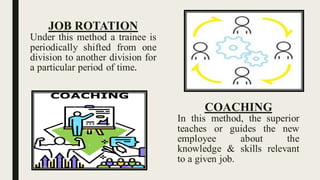
JOB ROTATION
Under this method a trainee is
periodically shifted from one
division to another division for
a particular period of time.
COACHING
In this method, the superior
teaches or guides the new
employee about the
knowledge & skills relevant
to a given job.
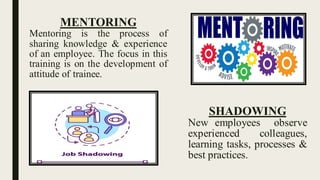
MENTORING
Mentoring is the process of
sharing knowledge & experience
of an employee. The focus in this
training is on the development of
attitude of trainee.
SHADOWING
New employees observe
experienced colleagues,
learning tasks, processes &
best practices.
ADVANTAGES OF ON THE JOB
TRAINING
PRACTICAL EXPERIENCE
COST EFFECTIVE
IMMEDIATE APPLICATION
CUSTOMIZATION
REAL WORLD CHALLENGES
DISADVANTAGES OF ON THE
JOB TRAINING
QUALITY VARIATION
DISRUPTION
LIMITED EXPOSURE
TIME CONSUMING
INCONSISTENT STANDARDS
METHOD OF TRAINING
(OFF THE JOB)
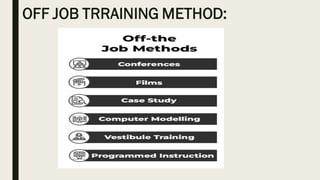
OFF JOB TRRAINING METHOD:
❑Class Room Lectures or
Conferences:
The lecture or conference
method is generally used for
conveying specific information,
rules, procedures, or methods.
❑ Films:
Films supply information
and show a definite display of
skills that are not easily
represented by other techniques.
❑ Case Study:
Case studies are the actual experiences faced
by the organization. They display the events that the
managers have faced in real life.
❑ Computer Modelling:
It encourages the work environment by
developing a computer program that copies a few of
the realities of the job and enables learning to take
place securely.
❑Vestibule Training:
In vestibule training, the employees are
given training on the equipment that they will be using
during their jobs.
❑Programmed Instruction:
In this method, the information is
divided into meaningful units, and these units are
arranged in a proper way to form a logical and
consecutive learning bundle or collection, i.e.,
from simple to complex.
Advantages of off- the- job training:
❑Productivity
❑Low risk
❑Economically beneficial
❑Save time
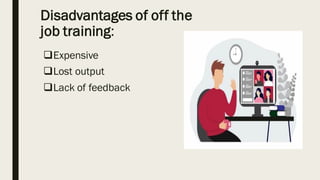
Disadvantages of off the
job training:
❑Expensive
❑Lost output
❑Lack of feedback
HOW TO MAKE TRAINING
EFFECTIVE, INTRO, NATURE AND
ROLLS OF CAREER DEVELOPMENT
How to make training effective?
■ Needs assessment
■ Allocate major resources
■ Practice and application
■ Experienced instructor
■ Supportive environment
Career development:-
■ Career development is the support an organization provides to
employees professional growth, especially to employees
movement to a new position or project within the organization.
Nature of career development:-
■ It is individualised and is an ongoing process.
■ It helps individuals develop skills required to fulfill different
career roles.
■ It defines life, career, abilities, and interests of the employees.
■ It can also give professional directions, as they relate to career
goals.
Rolls of career development:-
■ Organization
■ Manager
■ Employee
■ HR Manager
CAREER DEVELOPMENT
INITIATIVES &
CHALLENGES
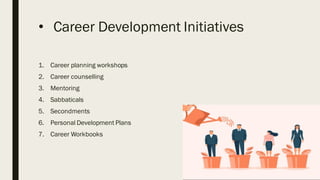
• Career Development Initiatives
1. Career planning workshops
2. Career counselling
3. Mentoring
4. Sabbaticals
5. Secondments
6. Personal Development Plans
7. Career Workbooks
• Career Development Challenges
1. Declining Career Opportunities
2. Diverce Workforce
3. Atypical Form of Employment
4. International Mobility
5. Low celling careers
6. Dual Career Couples
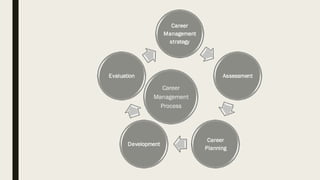
CAREER MANAGEMENT
PROCESS
Career
Management
Process
Career
Management
strategy
Assessment
Career
Planning
Development
Evaluation

Human Resource management -Training, Development and career Advancement

  • 1.
    Subject : HumanResource Management Topic: Training, Development & career management
  • 2.
    NATURE OF TRAININGAND DEVELOPMENT INPUTS IN TRAINING AND DEVELOPMENT
  • 3.
    Training Meaning Training refersto the process of imparting specific skills Development meaning Development refers to the learning opportunities designed to help employees grow Training and development need = Standard performance – Actual performance
  • 4.
    points Training Development Levelof person involved It meant for supervisor and operative level of employees It is meant for higher and managerial levels objective To perform particular job better Focus on overall growth of employees Duration Short term process Long term process Focus It focuses on the technical skills It focuses on conceptual and human ideas
  • 5.
    Inputs in Trainingand Development Skills Education Development Ethics Attitudinal Changes Decision Making and Problem Solving Skills Creativity Literacy Diversity Crisis Teams
  • 6.
    TRAINING & DEVELOPMENTAS SOURCE OF COMPETITIVE ADVANTAGES, AND BENEFITS OF EMPLOYEE TRAINING
  • 7.
    Training & DevelopmentAs Source Of Competitive Advantages ■ Training and development play a crucial role in providing competitive advantages to organizations. By investing in learning and development, companies can enhance productivity, decision-making, problem-solving skills, and the quality of work. This leads to increased efficiency, reduced costs, and improved morale among employees
  • 8.
    Benefits Of EmployeeTraining ■ Increase Productivity ■ Increase Employee Performance ■ Boost Motivation & Engagement ■ Lead To Improve Profitability ■ Improve Job Knowledge ■ Help People To Identify Organizational Goal ■ Improve Relationship Between Boss And Subordinate
  • 9.
  • 10.
    Steps in TrainingProcess ■ 1) Needs Assessment ■ 2) Setting Objectives ■ 3) Designing ■ 4) Implementation ■ 5) Evaluation
  • 12.
    1) Needs Assessment: Assessingtraining needs and the resources available to meet those needs forms the first step in developing and delivering effective training. 2) Setting objectives: The next phase in training Process is to identify instructional objectives. Needs assessment helps prepare a blueprint that describes the objectives to be archived by the trainee upon completion of the training programme. 3) Designing: Well-designed training is planned, appropriate to the target audience and able to be delivered within the resources available. Strategies and methods in this section address planning for training, developing the materials used in the providing training and crafting a
  • 13.
    4) Implementation: Once thetraining programme has been designed, it needs to be implemented. Implementation is beset with certain problems. Training and development requires a higher degree of creativity than perhaps, any other problem. 5) Evaluation: This is the last step of the Training Process. Evaluation considers the success of training and is necessary for identifying elements of training processes and training programmes that were beneficial and areas for improvement.
  • 14.
  • 15.
    ON THE JOBTRAINING When the employees are trained while they are performing the job it is called on-the-job training. Under this method the employees learn by doing. The employees can learn the practical problems while working on the job.
  • 16.
  • 17.
    ORIENTATION TRAINING The trainingis imparted by a competent & experienced executive, who provides knowledge about the work, tools, equipment, techniques situational problems. JOB- INSTRUCTION TRAINING Under this training process trainees are given instruction systematically one-by-one about the job.
  • 18.
    APPRENTICE TRAINING In this method,an expert& experienced person gives his knowledge& skills to the trainee who desires to learn that skills. INTERNSHIPS & ASSISTANTSHIP A superior gives training to a subordinates like an assistant to a manager or director .The subordinates learn through experience& observation by participating in handling day to day problems.
  • 19.
    JOB ROTATION Under thismethod a trainee is periodically shifted from one division to another division for a particular period of time. COACHING In this method, the superior teaches or guides the new employee about the knowledge & skills relevant to a given job.
  • 20.
    MENTORING Mentoring is theprocess of sharing knowledge & experience of an employee. The focus in this training is on the development of attitude of trainee. SHADOWING New employees observe experienced colleagues, learning tasks, processes & best practices.
  • 21.
    ADVANTAGES OF ONTHE JOB TRAINING PRACTICAL EXPERIENCE COST EFFECTIVE IMMEDIATE APPLICATION CUSTOMIZATION REAL WORLD CHALLENGES
  • 22.
    DISADVANTAGES OF ONTHE JOB TRAINING QUALITY VARIATION DISRUPTION LIMITED EXPOSURE TIME CONSUMING INCONSISTENT STANDARDS
  • 23.
  • 24.
  • 25.
    ❑Class Room Lecturesor Conferences: The lecture or conference method is generally used for conveying specific information, rules, procedures, or methods. ❑ Films: Films supply information and show a definite display of skills that are not easily represented by other techniques.
  • 26.
    ❑ Case Study: Casestudies are the actual experiences faced by the organization. They display the events that the managers have faced in real life. ❑ Computer Modelling: It encourages the work environment by developing a computer program that copies a few of the realities of the job and enables learning to take place securely.
  • 27.
    ❑Vestibule Training: In vestibuletraining, the employees are given training on the equipment that they will be using during their jobs. ❑Programmed Instruction: In this method, the information is divided into meaningful units, and these units are arranged in a proper way to form a logical and consecutive learning bundle or collection, i.e., from simple to complex.
  • 28.
    Advantages of off-the- job training: ❑Productivity ❑Low risk ❑Economically beneficial ❑Save time
  • 29.
    Disadvantages of offthe job training: ❑Expensive ❑Lost output ❑Lack of feedback
  • 30.
    HOW TO MAKETRAINING EFFECTIVE, INTRO, NATURE AND ROLLS OF CAREER DEVELOPMENT
  • 31.
    How to maketraining effective? ■ Needs assessment ■ Allocate major resources ■ Practice and application ■ Experienced instructor ■ Supportive environment
  • 32.
    Career development:- ■ Careerdevelopment is the support an organization provides to employees professional growth, especially to employees movement to a new position or project within the organization.
  • 33.
    Nature of careerdevelopment:- ■ It is individualised and is an ongoing process. ■ It helps individuals develop skills required to fulfill different career roles. ■ It defines life, career, abilities, and interests of the employees. ■ It can also give professional directions, as they relate to career goals.
  • 34.
    Rolls of careerdevelopment:- ■ Organization ■ Manager ■ Employee ■ HR Manager
  • 35.
  • 36.
    • Career DevelopmentInitiatives 1. Career planning workshops 2. Career counselling 3. Mentoring 4. Sabbaticals 5. Secondments 6. Personal Development Plans 7. Career Workbooks
  • 37.
    • Career DevelopmentChallenges 1. Declining Career Opportunities 2. Diverce Workforce 3. Atypical Form of Employment 4. International Mobility 5. Low celling careers 6. Dual Career Couples
  • 38.
  • 39.