Training and Development
1
2
Some Facts about Training & Development---
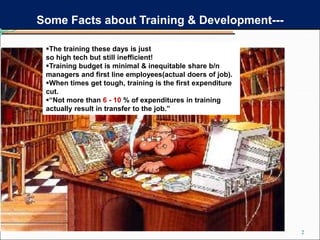
The training these days is just
so high tech but still inefficient!
Training budget is minimal & inequitable share b/n
managers and first line employees(actual doers of job).
When times get tough, training is the first expenditure
cut.
“Not more than 6 - 10 % of expenditures in training
actually result in transfer to the job.”
3
Training may be defined as a planned program designed to improve
performance and to bring about measurable changes in knowledge,
skills, attitude and social behavior of employees for doing a particular
job.
Training provides employees with specific, identifiable knowledge
and skills for use on their present jobs.
Training is a short-term process utilizing a systematic and organized
procedure by which workers acquire technical knowledge and skills
for a definite purpose
Distinction between Training and Development
4
Development on the other is the systematic process of education,
training and growing by which a person learns and applies
information, knowledge, skills, attitudes and perceptions.
Development being broader in scope and focusing on individuals
gaining new capabilities useful for both present and future jobs.
It is often the result of experience and the maturity that comes with
it.
Development is said to include training to increase skills and
knowledge to do a particular job and education concerned with
increasing general knowledge and understanding.
5
Example:-It is possible to train most people to run a postage meter,
drive a truck, operate a computer, or assemble a radio.
However, development in such areas as judgment, responsibility, and
decision making, is much more difficult, because such factors may or
may not develop over time, either through life experiences or as part
of a planned program.
6
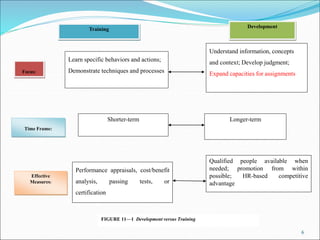
Learn specific behaviors and actions;
Demonstrate techniques and processes
Training
Understand information, concepts
and context; Develop judgment;
Expand capacities for assignments
Development
Focus:
Shorter-term Longer-term
Time Frame:
Performance appraisals, cost/benefit
analysis, passing tests, or
certification
Qualified people available when
needed; promotion from within
possible; HR-based competitive
advantage
Effective
Measures:
FIGURE 11—1 Development versus Training
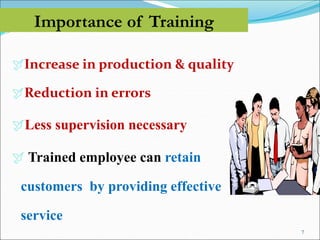
Importance of Training
Increase in production & quality
Reduction in errors
Less supervision necessary
 Trained employee can retain
customers by providing effective
service
7
8
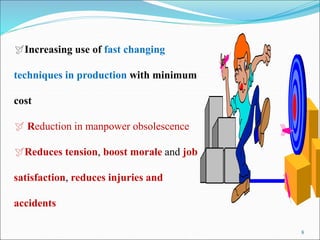
Increasing use of fast changing
techniques in production with minimum
cost
 Reduction in manpower obsolescence
Reduces tension, boost morale and job
satisfaction, reduces injuries and
accidents
9
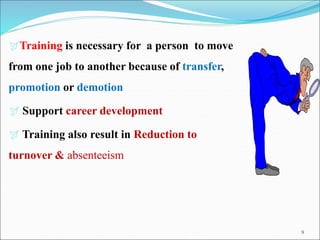
Training is necessary for a person to move
from one job to another because of transfer,
promotion or demotion
 Support career development
 Training also result in Reduction to
turnover & absenteeism
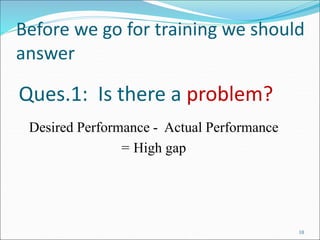
Before we go for training we should
answer
10
Ques.1: Is there a problem?
Desired Performance - Actual Performance
= High gap
11
If the answer is no…..
“Is the cost of the discrepancy (gap) high
enough that it seems worth pursuing a
solution?”
IGNORE
12
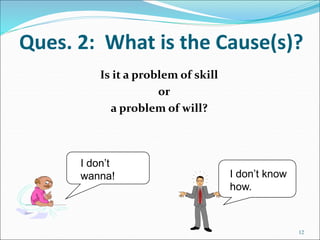
Is it a problem of skill
or
a problem of will?
Ques. 2: What is the Cause(s)?
I don’t
wanna! I don’t know
how.
13
Ques. 3
Is the problem can be solved by training?
14
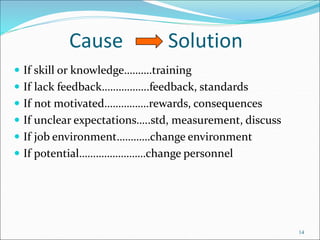
Cause Solution
 If skill or knowledge……….training
 If lack feedback……………..feedback, standards
 If not motivated…………….rewards, consequences
 If unclear expectations…..std, measurement, discuss
 If job environment…………change environment
 If potential……………………change personnel
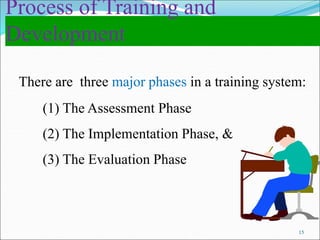
Process of Training and
Development
15
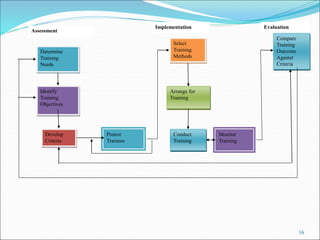
There are three major phases in a training system:
(1) The Assessment Phase
(2) The Implementation Phase, &
(3) The Evaluation Phase
16
Determine
Training
Needs
Identify
Training
Objectives
Develop
Criteria
Pretest
Trainees
Select
Training
Methods
Arrange for
Training
Conduct
Training
Monitor
Training
Compare
Training
Outcome
Against
Criteria
Assessment
Implementation Evaluation
17
A needs assessment is the process of
identifying performance requirements and
the "gap" between what performance is
required and what presently exists.
Training Needs Assessment
18
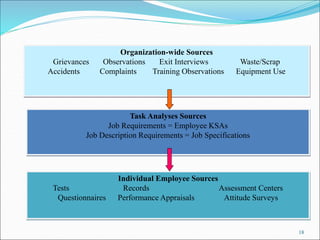
Organization-wide Sources
Grievances Observations Exit Interviews Waste/Scrap
Accidents Complaints Training Observations Equipment Use
Task Analyses Sources
Job Requirements = Employee KSAs
Job Description Requirements = Job Specifications
Individual Employee Sources
Tests Records Assessment Centers
Questionnaires Performance Appraisals Attitude Surveys
Identify Training Objectives
19
Once training needs have been identified
using the various analyses, then training
objectives and priorities must be
established.
Objectives for training can be set in any area by
using one of the following four dimensions:
20
•Quantity of work resulting from training (for example,
number of words per minute typed or number of
applications processed per day)
•Quality of work after training (for example, dollar cost of
rework, scrap, loss, or errors)
•Timeliness of work after training (for example, schedules
met or budget reports turned in on time)
•Cost savings as a result of training (for example, deviation
from budget, sales expense, or cost of downtime)
Select Training Methods
21
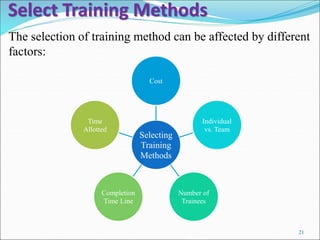
The selection of training method can be affected by different
factors:
Selecting
Training
Methods
Cost
Individual
vs. Team
Number of
Trainees
Completion
Time Line
Time
Allotted
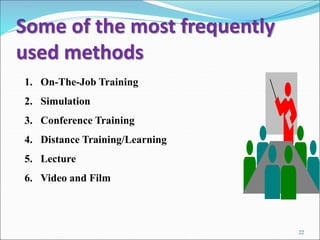
Some of the most frequently
used methods
22
1. On-The-Job Training
2. Simulation
3. Conference Training
4. Distance Training/Learning
5. Lecture
6. Video and Film
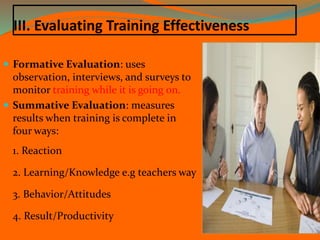
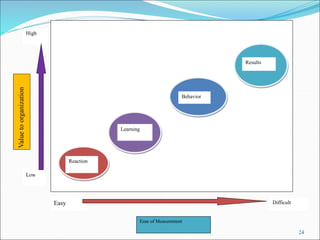
III. Evaluating Training Effectiveness
 Formative Evaluation: uses
observation, interviews, and surveys to
monitor training while it is going on.
 Summative Evaluation: measures
results when training is complete in
four ways:
1. Reaction
2. Learning/Knowledge e.g teachers way
3. Behavior/Attitudes
4. Result/Productivity
23
24
Reaction
Learning
Behavior
Results
High
Value
to
organization
Low
Easy Difficult
Ease of Measurement
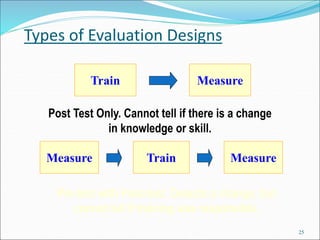
Types of Evaluation Designs
25
Train Measure
Post Test Only. Cannot tell if there is a change
in knowledge or skill.
Measure Train Measure
Pre-test with Post-test. Detects a change, but
cannot tell if training was responsible.
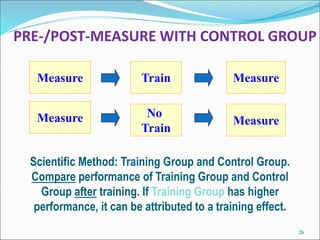
PRE-/POST-MEASURE WITH CONTROL GROUP
26
Measure
Scientific Method: Training Group and Control Group.
Compare performance of Training Group and Control
Group after training. If Training Group has higher
performance, it can be attributed to a training effect.
Train Measure
Measure
No
Train
Measure
27

Ch-3-Training & Development.ppt

  • 1.
  • 2.
    2 Some Facts aboutTraining & Development--- The training these days is just so high tech but still inefficient! Training budget is minimal & inequitable share b/n managers and first line employees(actual doers of job). When times get tough, training is the first expenditure cut. “Not more than 6 - 10 % of expenditures in training actually result in transfer to the job.”
  • 3.
    3 Training may bedefined as a planned program designed to improve performance and to bring about measurable changes in knowledge, skills, attitude and social behavior of employees for doing a particular job. Training provides employees with specific, identifiable knowledge and skills for use on their present jobs. Training is a short-term process utilizing a systematic and organized procedure by which workers acquire technical knowledge and skills for a definite purpose Distinction between Training and Development
  • 4.
    4 Development on theother is the systematic process of education, training and growing by which a person learns and applies information, knowledge, skills, attitudes and perceptions. Development being broader in scope and focusing on individuals gaining new capabilities useful for both present and future jobs. It is often the result of experience and the maturity that comes with it. Development is said to include training to increase skills and knowledge to do a particular job and education concerned with increasing general knowledge and understanding.
  • 5.
    5 Example:-It is possibleto train most people to run a postage meter, drive a truck, operate a computer, or assemble a radio. However, development in such areas as judgment, responsibility, and decision making, is much more difficult, because such factors may or may not develop over time, either through life experiences or as part of a planned program.
  • 6.
    6 Learn specific behaviorsand actions; Demonstrate techniques and processes Training Understand information, concepts and context; Develop judgment; Expand capacities for assignments Development Focus: Shorter-term Longer-term Time Frame: Performance appraisals, cost/benefit analysis, passing tests, or certification Qualified people available when needed; promotion from within possible; HR-based competitive advantage Effective Measures: FIGURE 11—1 Development versus Training
  • 7.
    Importance of Training Increasein production & quality Reduction in errors Less supervision necessary  Trained employee can retain customers by providing effective service 7
  • 8.
    8 Increasing use offast changing techniques in production with minimum cost  Reduction in manpower obsolescence Reduces tension, boost morale and job satisfaction, reduces injuries and accidents
  • 9.
    9 Training is necessaryfor a person to move from one job to another because of transfer, promotion or demotion  Support career development  Training also result in Reduction to turnover & absenteeism
  • 10.
    Before we gofor training we should answer 10 Ques.1: Is there a problem? Desired Performance - Actual Performance = High gap
  • 11.
    11 If the answeris no….. “Is the cost of the discrepancy (gap) high enough that it seems worth pursuing a solution?” IGNORE
  • 12.
    12 Is it aproblem of skill or a problem of will? Ques. 2: What is the Cause(s)? I don’t wanna! I don’t know how.
  • 13.
    13 Ques. 3 Is theproblem can be solved by training?
  • 14.
    14 Cause Solution  Ifskill or knowledge……….training  If lack feedback……………..feedback, standards  If not motivated…………….rewards, consequences  If unclear expectations…..std, measurement, discuss  If job environment…………change environment  If potential……………………change personnel
  • 15.
    Process of Trainingand Development 15 There are three major phases in a training system: (1) The Assessment Phase (2) The Implementation Phase, & (3) The Evaluation Phase
  • 16.
  • 17.
    17 A needs assessmentis the process of identifying performance requirements and the "gap" between what performance is required and what presently exists. Training Needs Assessment
  • 18.
    18 Organization-wide Sources Grievances ObservationsExit Interviews Waste/Scrap Accidents Complaints Training Observations Equipment Use Task Analyses Sources Job Requirements = Employee KSAs Job Description Requirements = Job Specifications Individual Employee Sources Tests Records Assessment Centers Questionnaires Performance Appraisals Attitude Surveys
  • 19.
    Identify Training Objectives 19 Oncetraining needs have been identified using the various analyses, then training objectives and priorities must be established.
  • 20.
    Objectives for trainingcan be set in any area by using one of the following four dimensions: 20 •Quantity of work resulting from training (for example, number of words per minute typed or number of applications processed per day) •Quality of work after training (for example, dollar cost of rework, scrap, loss, or errors) •Timeliness of work after training (for example, schedules met or budget reports turned in on time) •Cost savings as a result of training (for example, deviation from budget, sales expense, or cost of downtime)
  • 21.
    Select Training Methods 21 Theselection of training method can be affected by different factors: Selecting Training Methods Cost Individual vs. Team Number of Trainees Completion Time Line Time Allotted
  • 22.
    Some of themost frequently used methods 22 1. On-The-Job Training 2. Simulation 3. Conference Training 4. Distance Training/Learning 5. Lecture 6. Video and Film
  • 23.
    III. Evaluating TrainingEffectiveness  Formative Evaluation: uses observation, interviews, and surveys to monitor training while it is going on.  Summative Evaluation: measures results when training is complete in four ways: 1. Reaction 2. Learning/Knowledge e.g teachers way 3. Behavior/Attitudes 4. Result/Productivity 23
  • 24.
  • 25.
    Types of EvaluationDesigns 25 Train Measure Post Test Only. Cannot tell if there is a change in knowledge or skill. Measure Train Measure Pre-test with Post-test. Detects a change, but cannot tell if training was responsible.
  • 26.
    PRE-/POST-MEASURE WITH CONTROLGROUP 26 Measure Scientific Method: Training Group and Control Group. Compare performance of Training Group and Control Group after training. If Training Group has higher performance, it can be attributed to a training effect. Train Measure Measure No Train Measure
  • 27.