

INTRODUCTION TO
HUMAN RESOURCE
MANAGEMENT
•According to Adi Godrej,
“all corporate strengths are
dependent on people.”
Human Resource Management
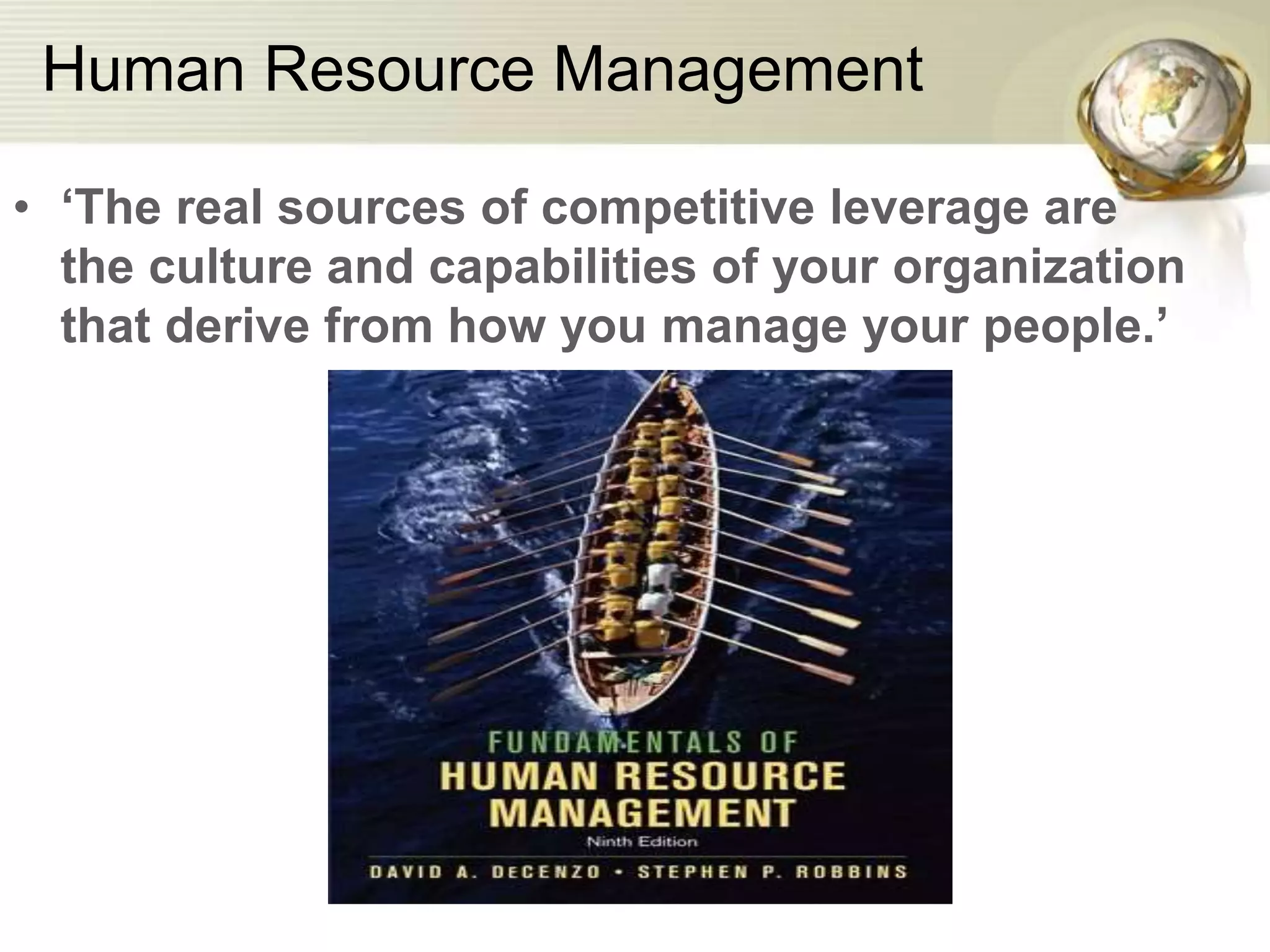
• ‘The real sources of competitive leverage are
the culture and capabilities of your organization
that derive from how you manage your people.’
Points to Ponder
• Definition and Concept of HRM
• History of HRM
• Functions of HRM
• HR Policies and Procedures
• Emerging Role of HRM
• Role of HR Executives
• Challenges to HR Professionals
• Strategic HRM
Human Resource Management
• “HRM is the function performed in
organizations that facilitates the most
effective use of people to achieve
organizational and individual goals.”
– Ivancevich and Glueck
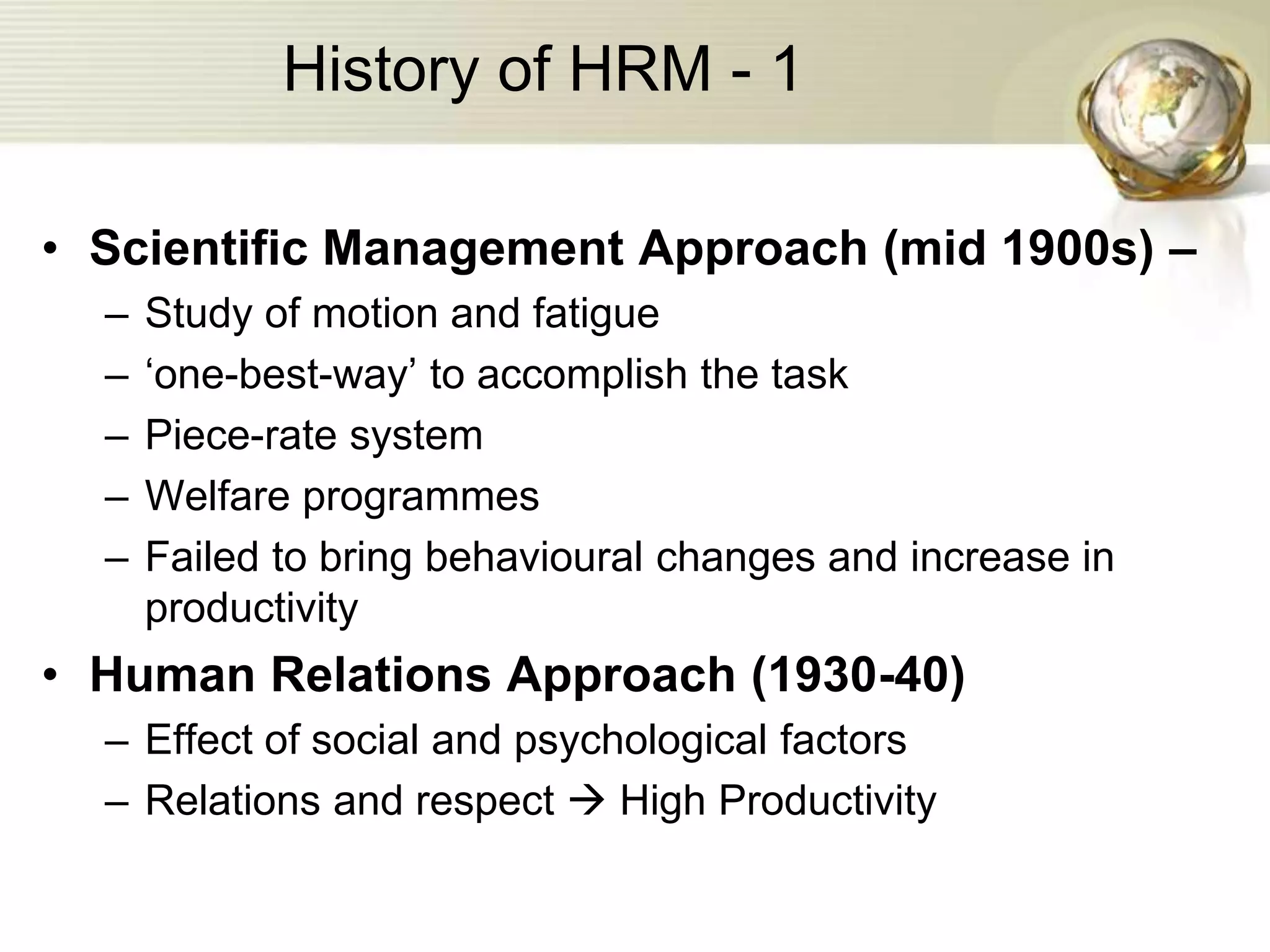
History of HRM - 1
• Scientific Management Approach (mid 1900s) –
– Study of motion and fatigue
– ‘one-best-way’ to accomplish the task
– Piece-rate system
– Welfare programmes
– Failed to bring behavioural changes and increase in
productivity
• Human Relations Approach (1930-40)
– Effect of social and psychological factors
– Relations and respect  High Productivity
History of HRM - 2
• Human Resources Approach (1970s)
– Principles
• Employees are assets
• Policies, programmes and practices - help in work and
personal development
• Conducive environment
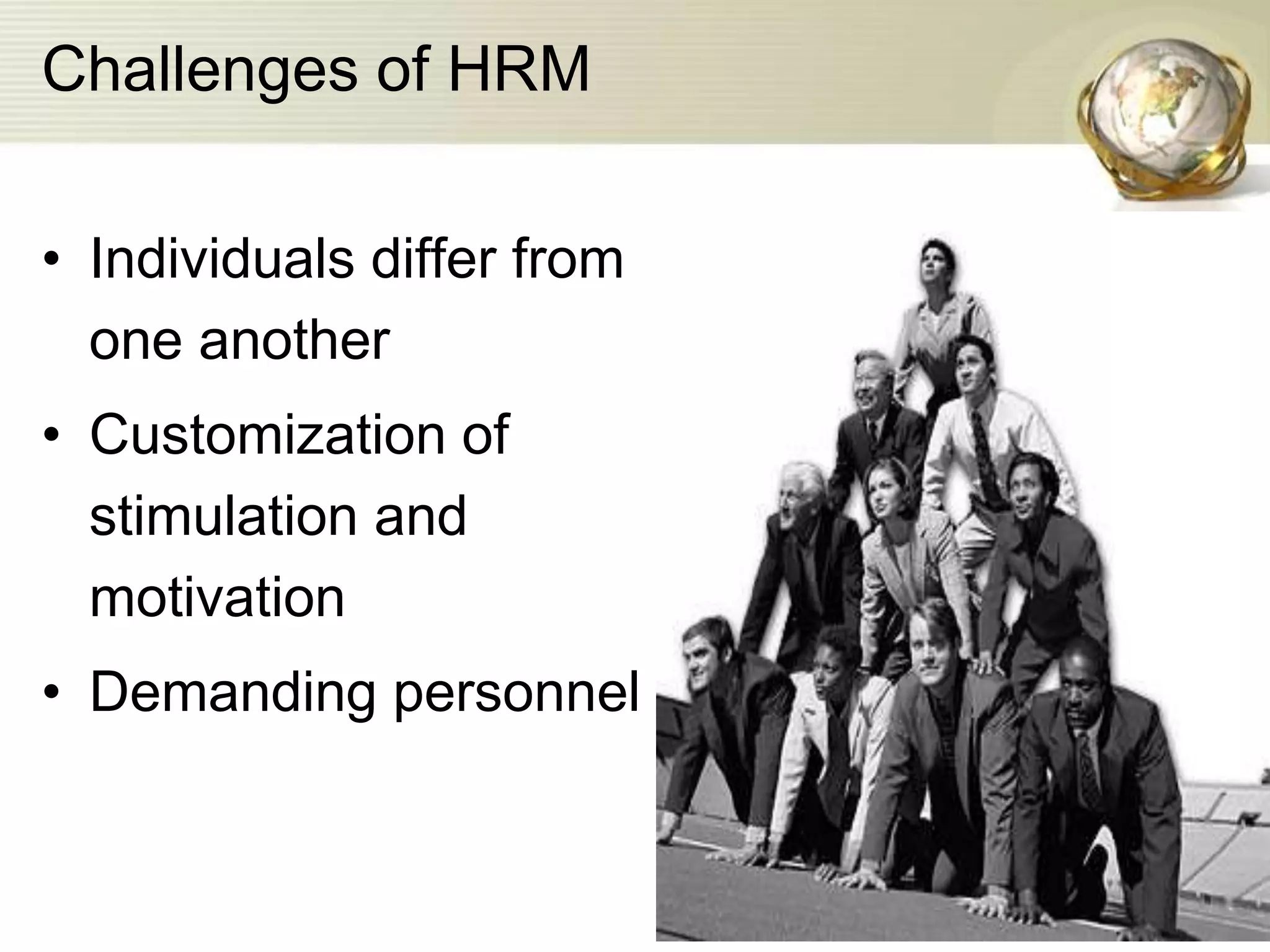
Challenges of HRM
• Individuals differ from
one another
• Customization of
stimulation and
motivation
• Demanding personnel
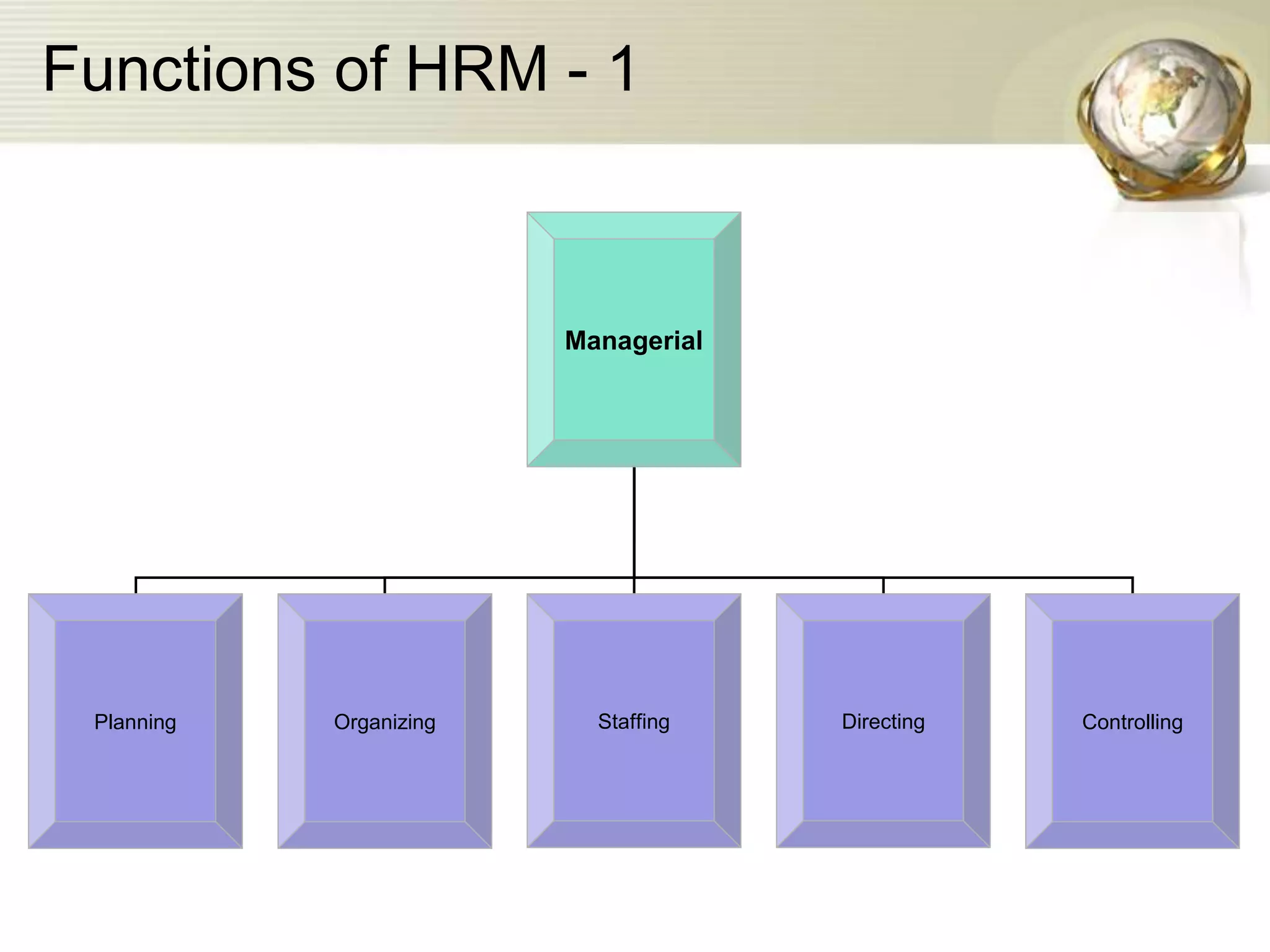
Functions of HRM - 1
Managerial
Planning Organizing Staffing Directing Controlling
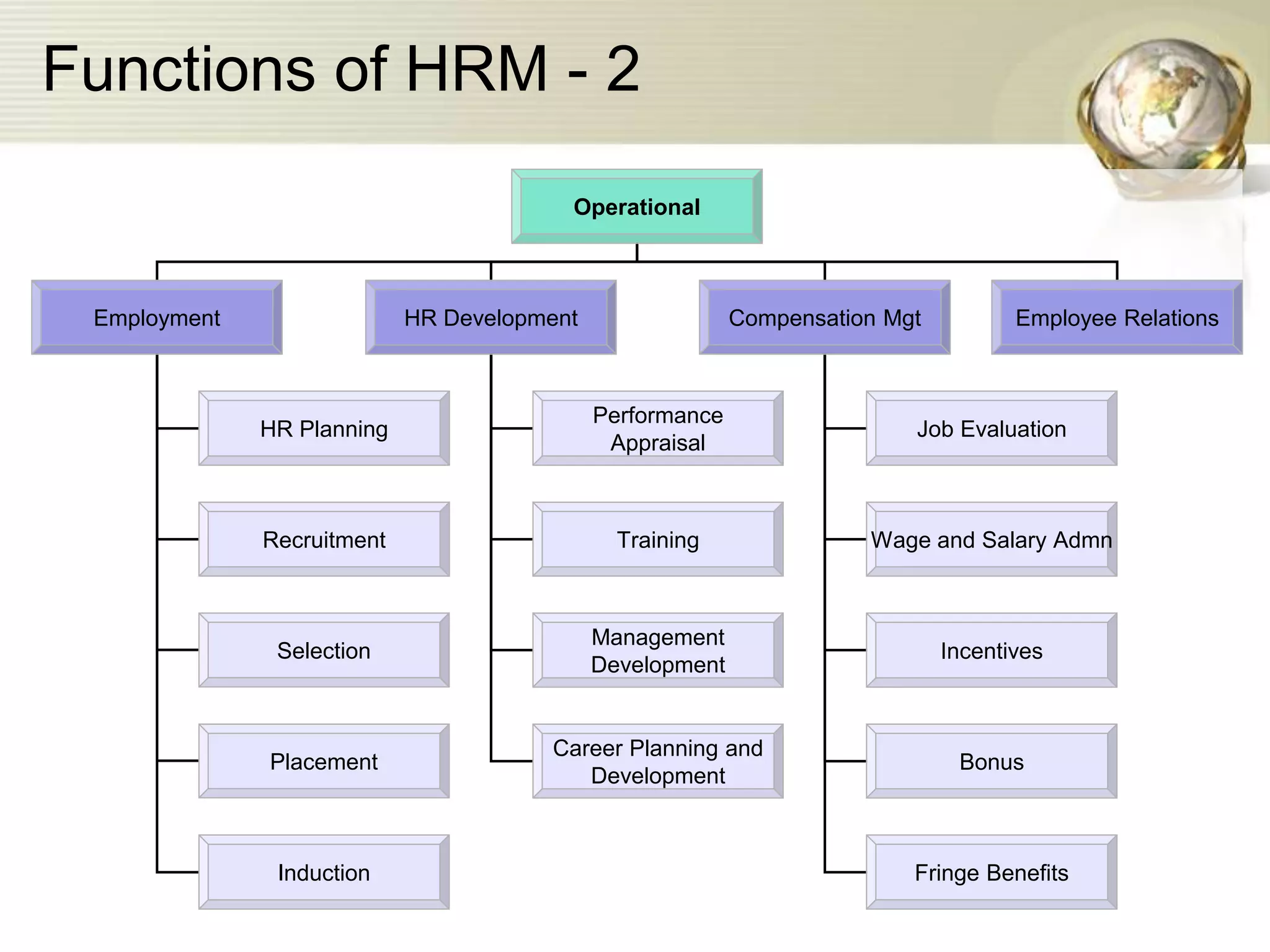
Functions of HRM - 2
Operational
Employment HR Development Compensation Mgt Employee Relations
HR Planning
Recruitment
Selection
Placement
Induction
Performance
Appraisal
Training
Management
Development
Career Planning and
Development
Job Evaluation
Wage and Salary Admn
Incentives
Bonus
Fringe Benefits
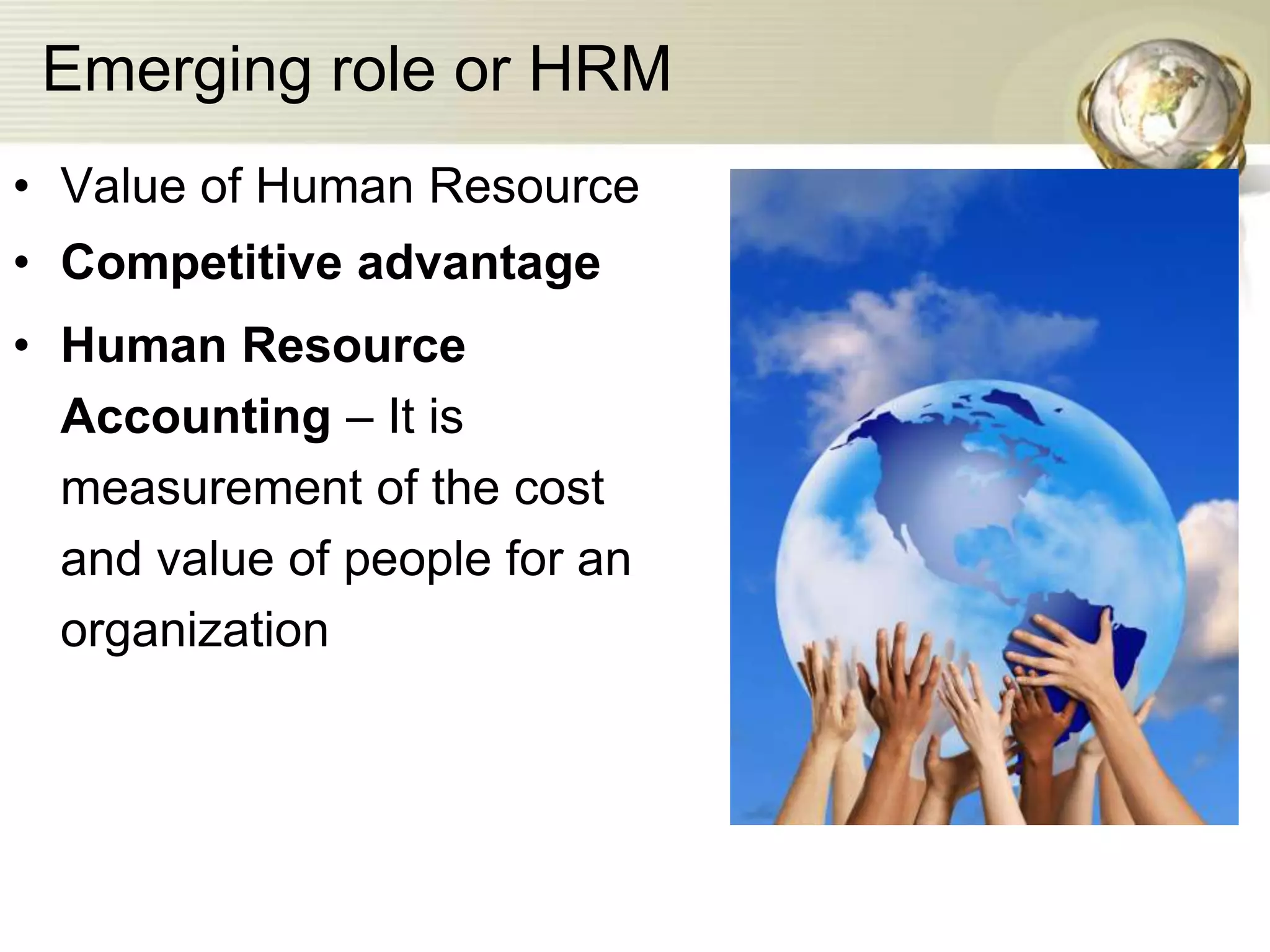
Emerging role or HRM
• Value of Human Resource
• Competitive advantage
• Human Resource
Accounting – It is
measurement of the cost
and value of people for an
organization
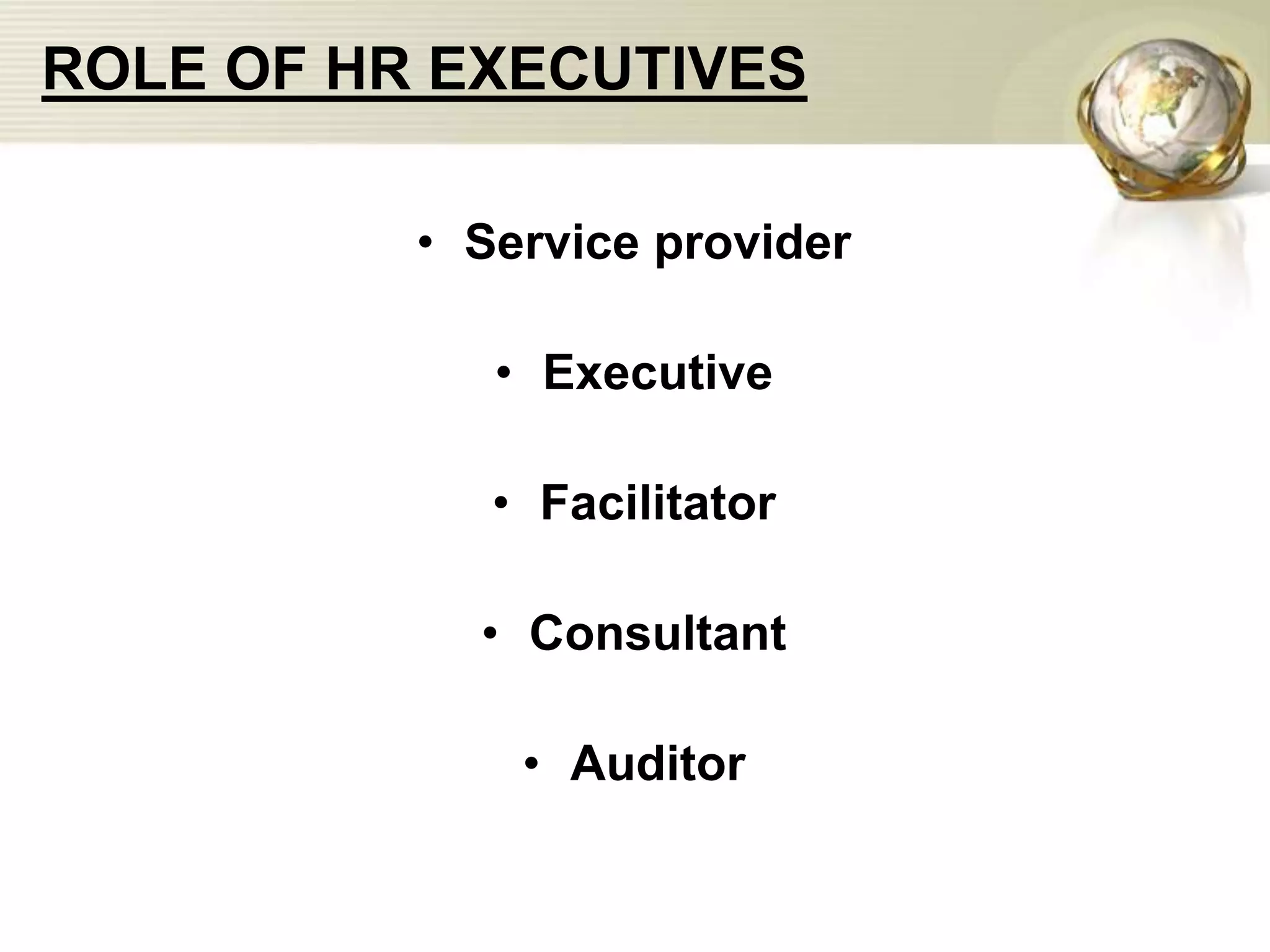
ROLE OF HR EXECUTIVES
• Service provider
• Executive
• Facilitator
• Consultant
• Auditor
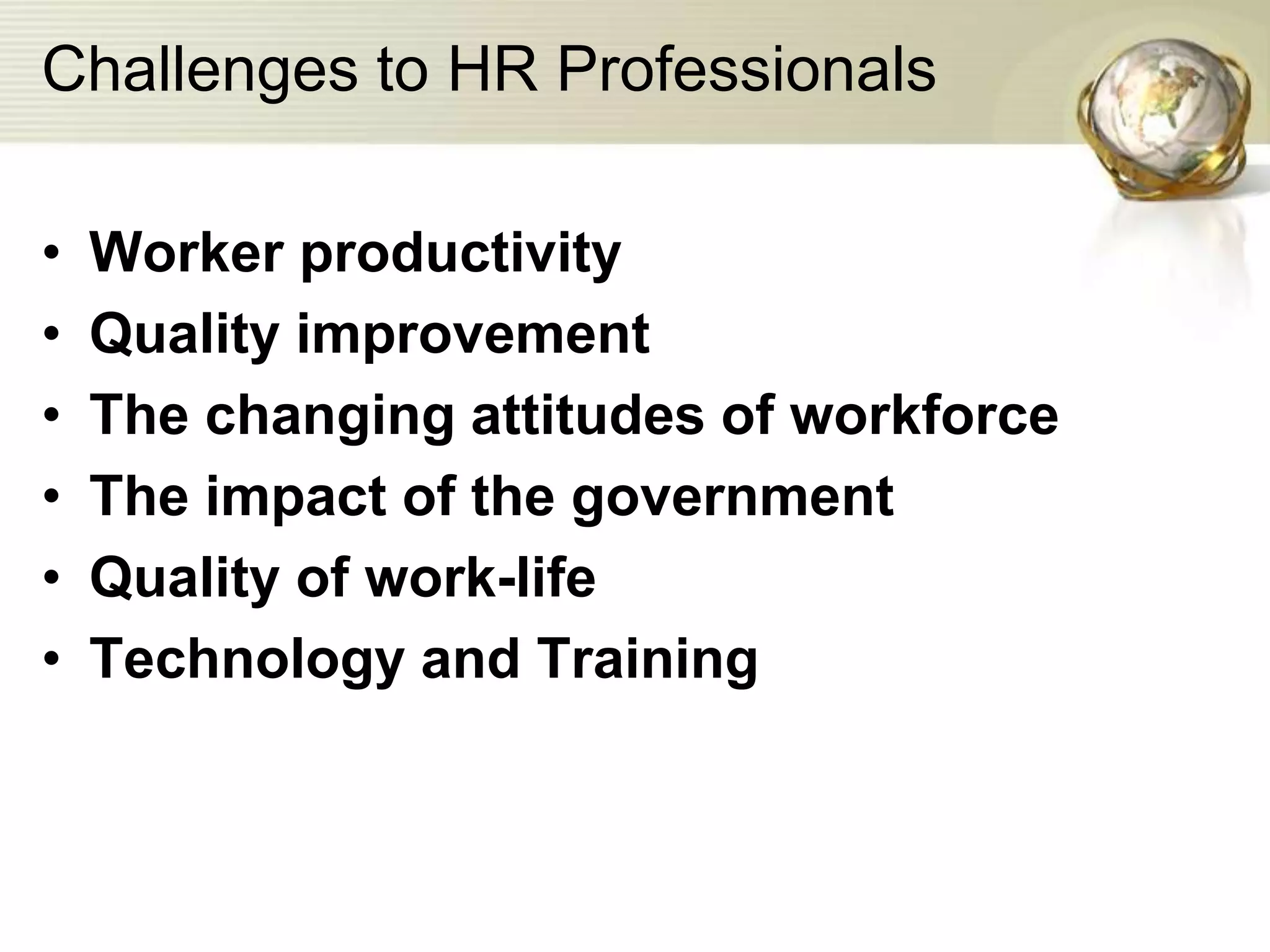
Challenges to HR Professionals
• Worker productivity
• Quality improvement
• The changing attitudes of workforce
• The impact of the government
• Quality of work-life
• Technology and Training
Organizational
Structure & HRM
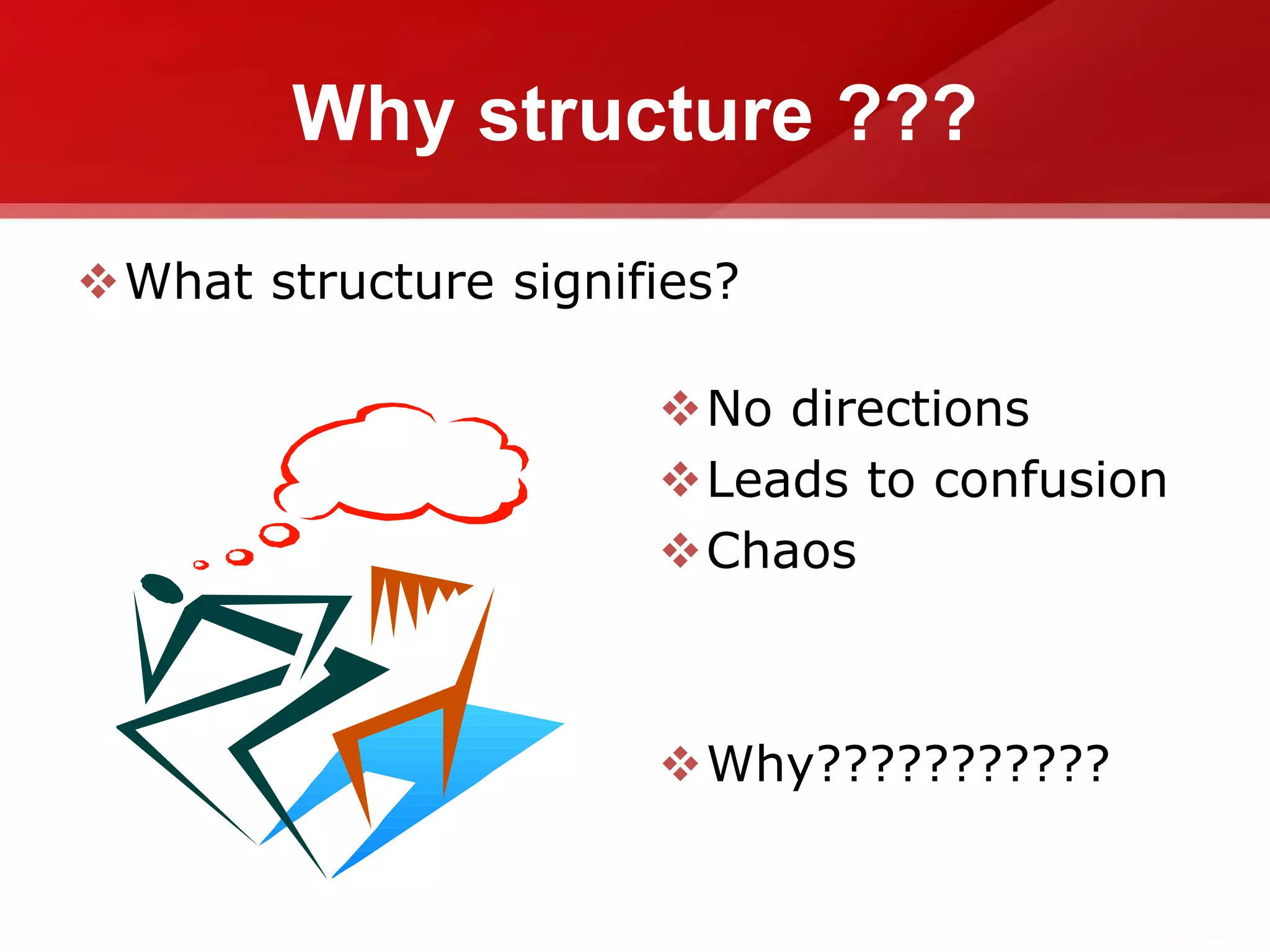
Why structure ???
What structure signifies?
No directions
Leads to confusion
Chaos
Why???????????
MAIN POINTS OF CHAPTER
Organizational Structure and Human
Resource Management
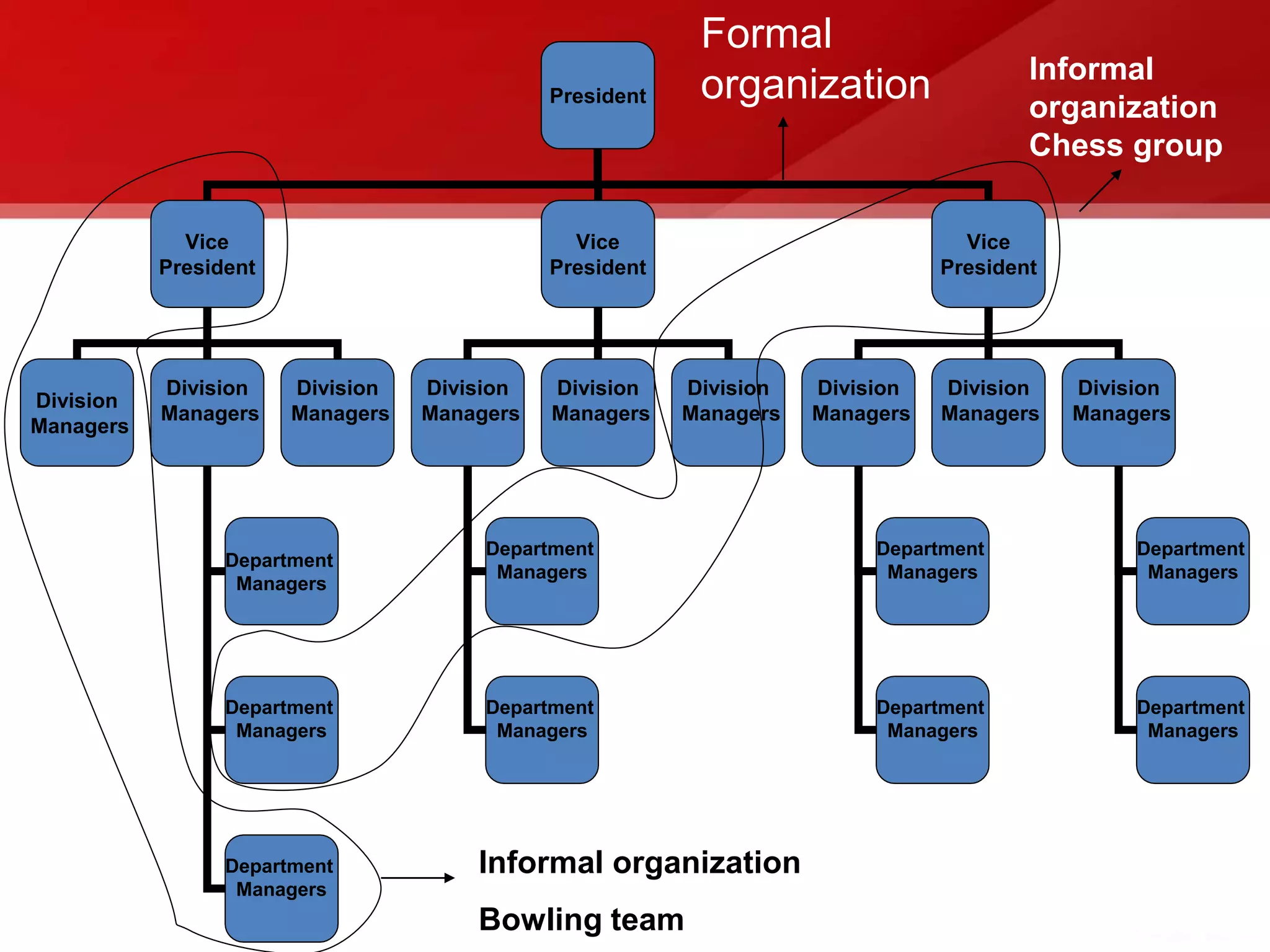
Formal and Informal Organizations
Tall and Flat Organizational Structures
Responsibility, Authority and
Accountability
Line and Staff Functions
Human Resource Management and other
Organizational Functions
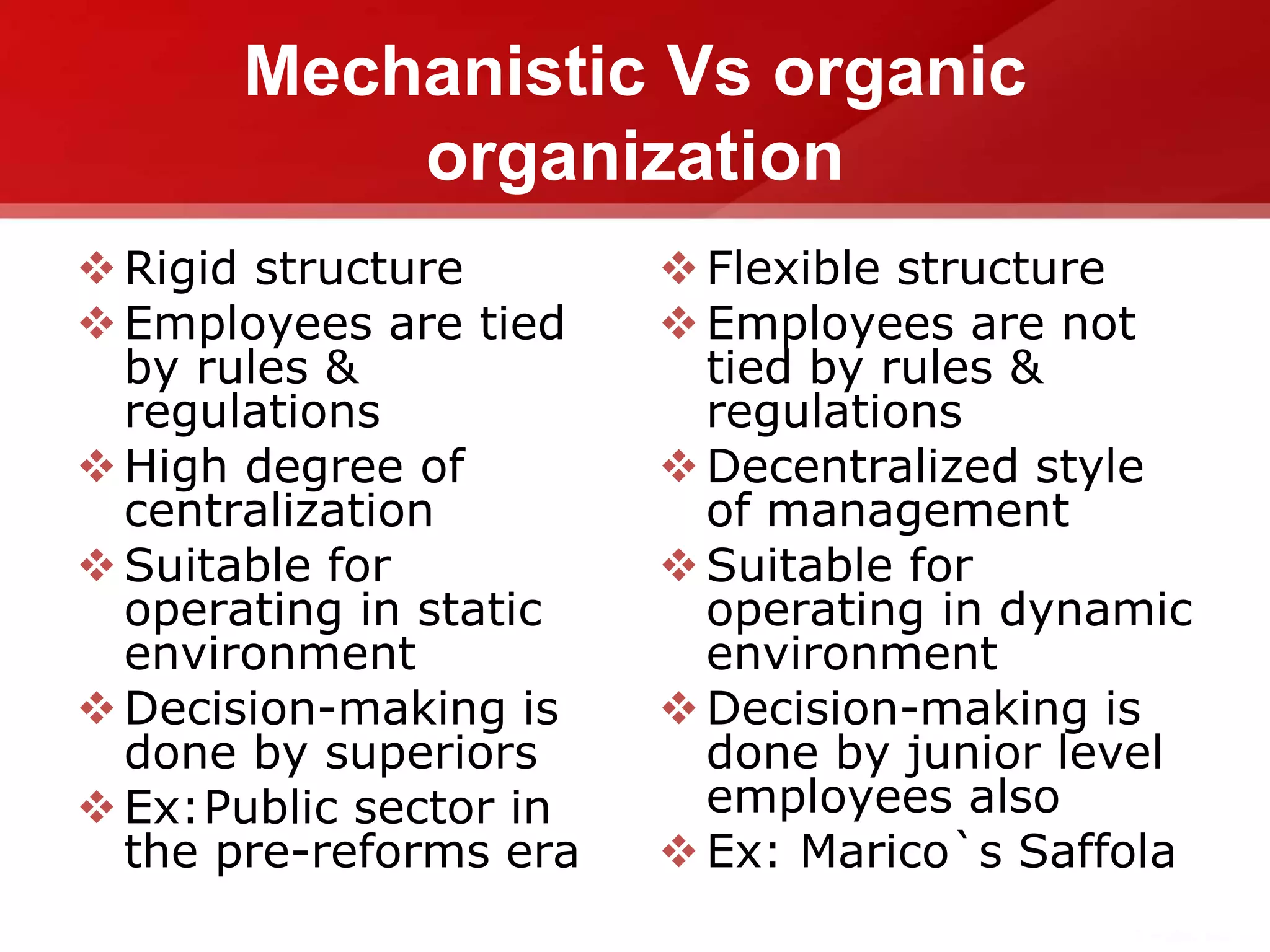
Mechanistic Vs organic
organization
Rigid structure
Employees are tied
by rules &
regulations
High degree of
centralization
Suitable for
operating in static
environment
Decision-making is
done by superiors
Ex:Public sector in
the pre-reforms era
Flexible structure
Employees are not
tied by rules &
regulations
Decentralized style
of management
Suitable for
operating in dynamic
environment
Decision-making is
done by junior level
employees also
Ex: Marico`s Saffola
President
Vice
President
Vice
President
Vice
President
Division
Managers
Division
Managers
Division
Managers
Division
Managers
Division
Managers
Division
Managers
Division
Managers
Division
Managers
Division
Managers
Department
Managers
Department
Managers
Department
Managers
Department
Managers
Department
Managers
Department
Managers
Department
Managers
Department
Managers
Department
Managers
Informal organization
Bowling team
Informal
organization
Chess group
Formal
organization
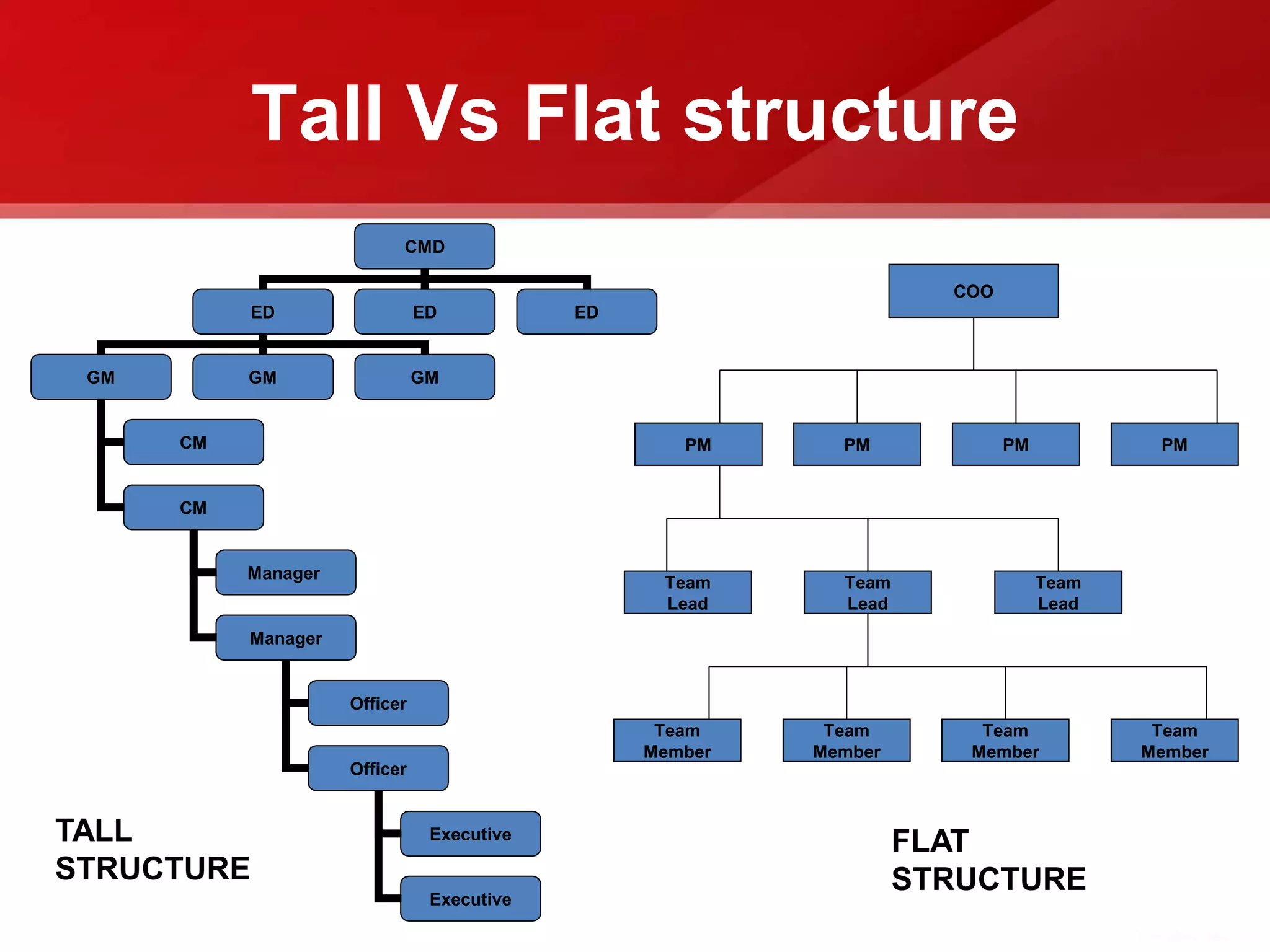
Tall Vs Flat structure
CMD
ED ED ED
GM GM GM
CM
CM
Manager
Manager
Officer
Officer
Executive
Executive
TALL
STRUCTURE
COO
PM PM PM PM
Team
Lead
Team
Lead
Team
Lead
Team
Member
Team
Member
Team
Member
Team
Member
FLAT
STRUCTURE
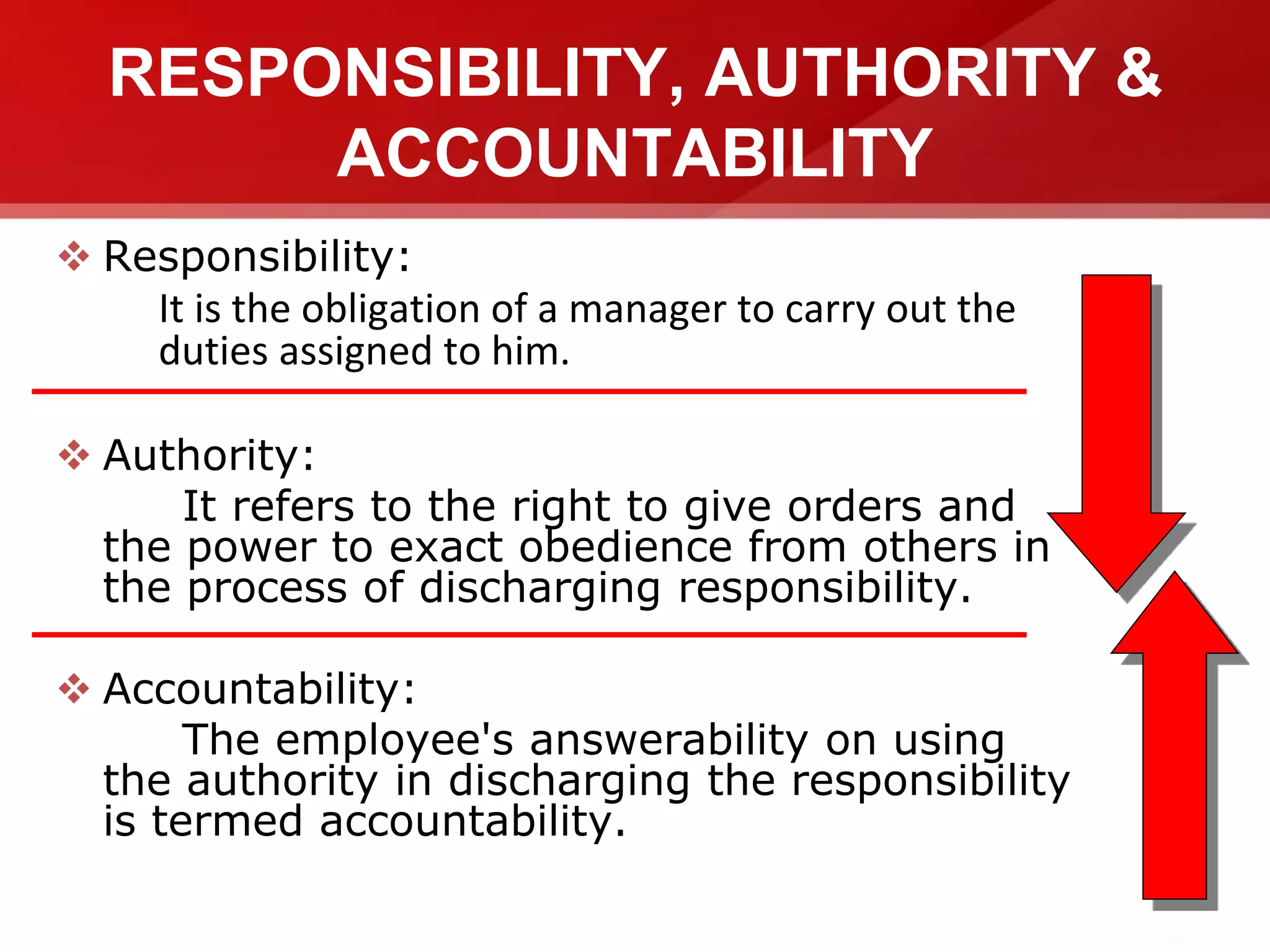
RESPONSIBILITY, AUTHORITY &
ACCOUNTABILITY
 Responsibility:
It is the obligation of a manager to carry out the
duties assigned to him.
 Authority:
It refers to the right to give orders and
the power to exact obedience from others in
the process of discharging responsibility.
 Accountability:
The employee's answerability on using
the authority in discharging the responsibility
is termed accountability.
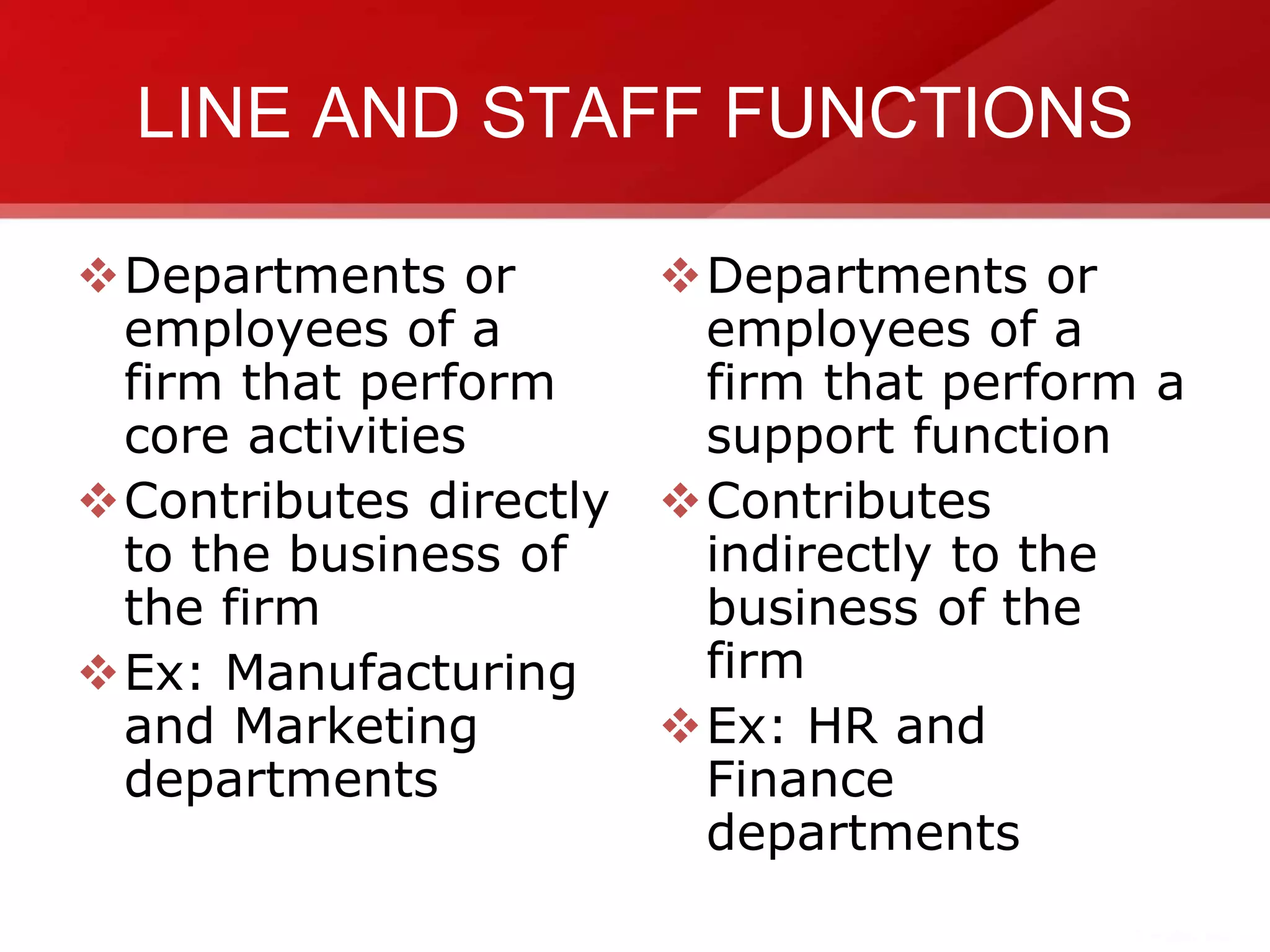
LINE AND STAFF FUNCTIONS
Departments or
employees of a
firm that perform
core activities
Contributes directly
to the business of
the firm
Ex: Manufacturing
and Marketing
departments
Departments or
employees of a
firm that perform a
support function
Contributes
indirectly to the
business of the
firm
Ex: HR and
Finance
departments
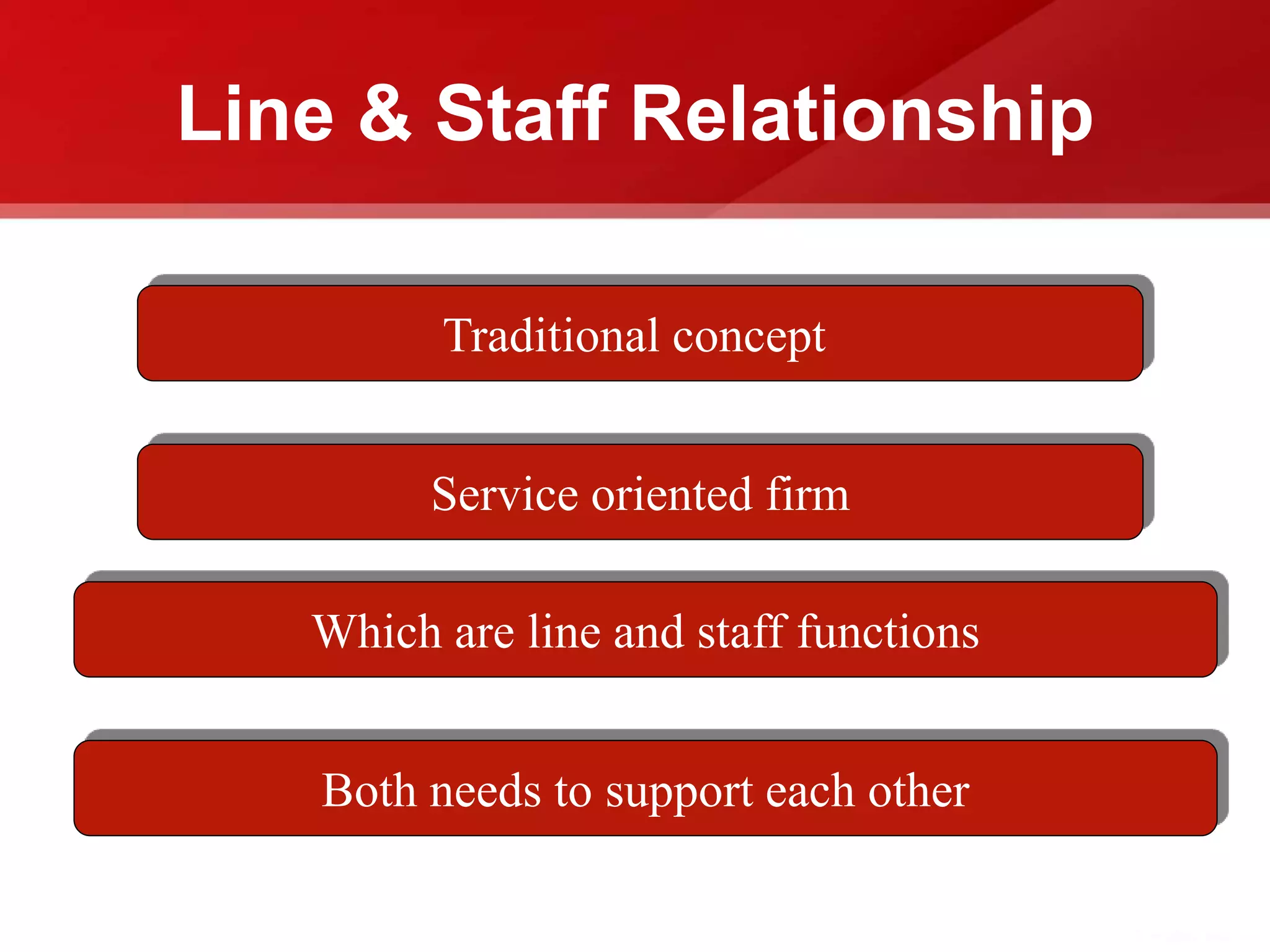
Line & Staff Relationship
Traditional concept
Service oriented firm
Which are line and staff functions
Both needs to support each other
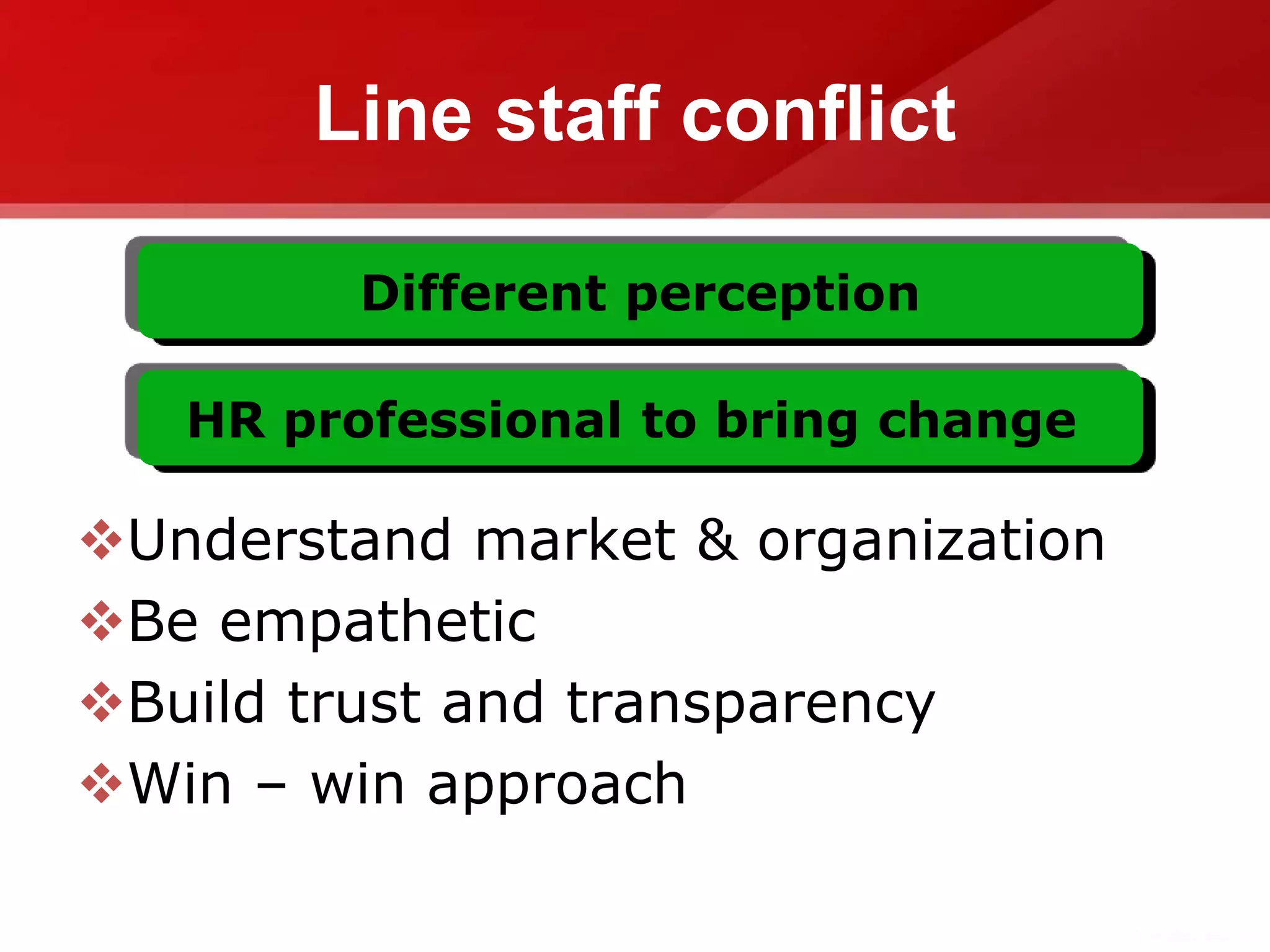
Line staff conflict
Different perception
HR professional to bring change
Understand market & organization
Be empathetic
Build trust and transparency
Win – win approach
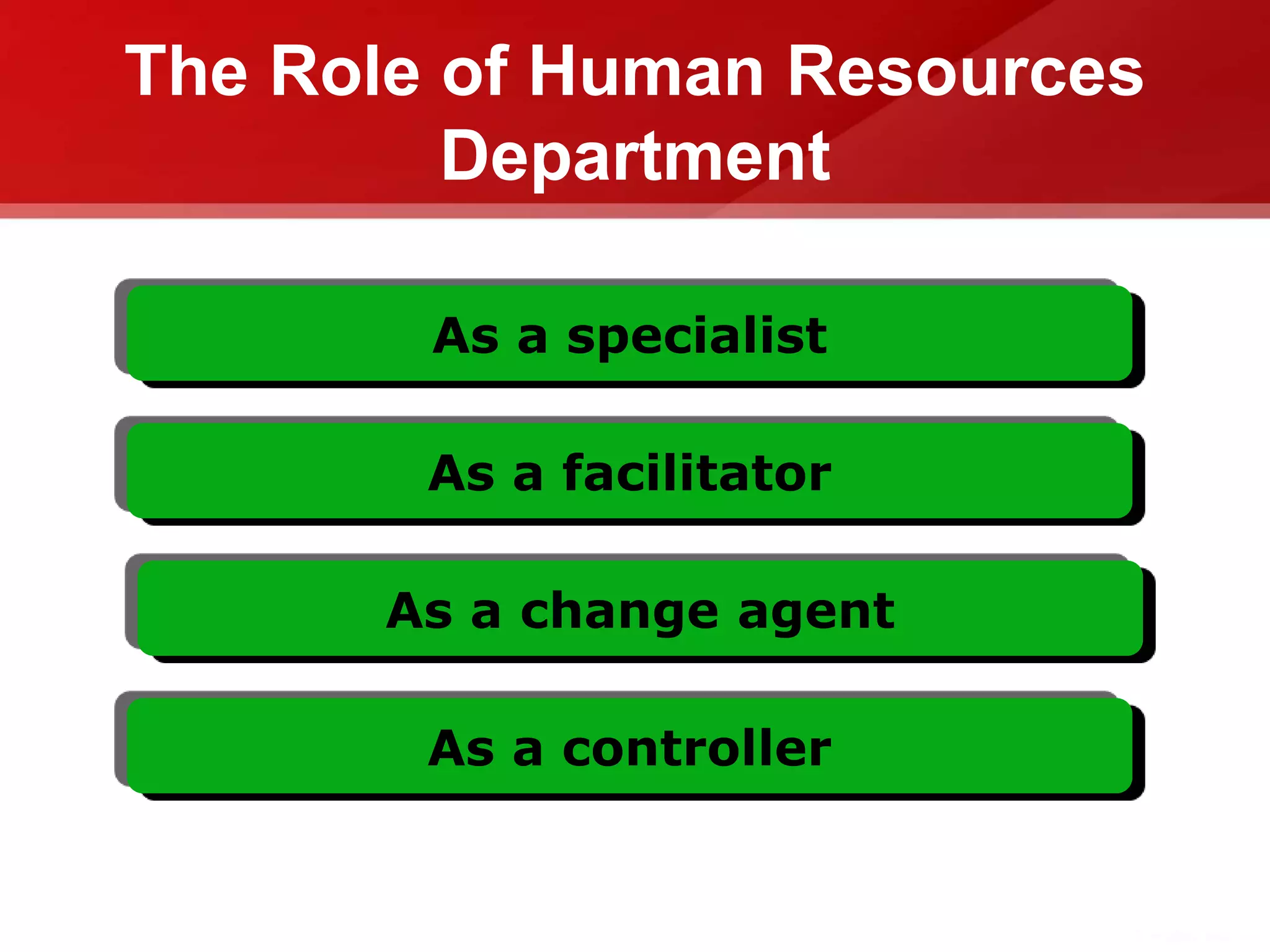
The Role of Human Resources
Department
As a specialist
As a facilitator
As a change agent
As a controller
HUMAN RESOURCE MANAGEMENT
AND OTHER ORGANIZATIONAL
FUNCTIONS
Product & HR
Production & HR
Marketing & HR
Management Techniques & HR
Organization structure & HR
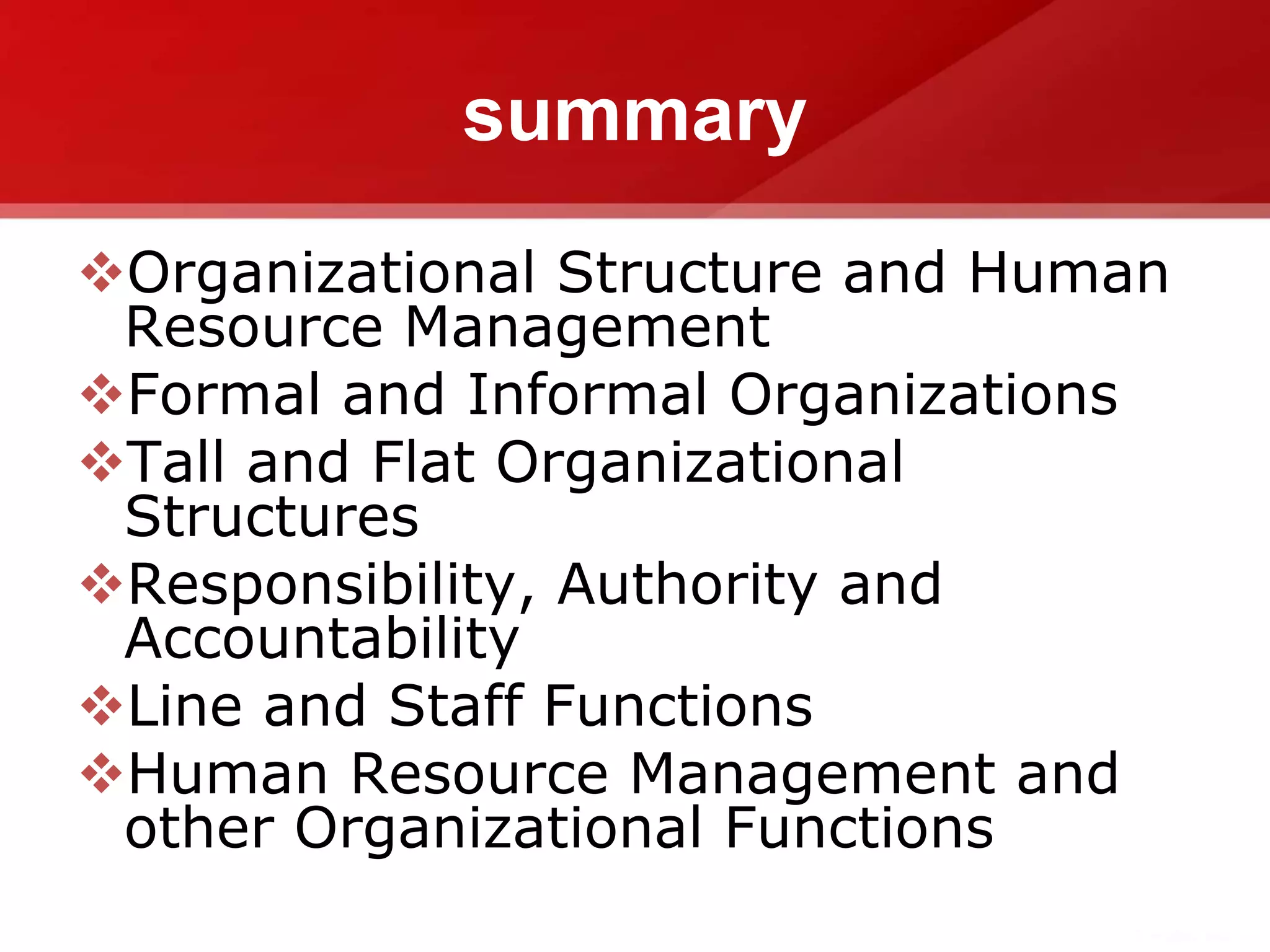
summary
Organizational Structure and Human
Resource Management
Formal and Informal Organizations
Tall and Flat Organizational
Structures
Responsibility, Authority and
Accountability
Line and Staff Functions
Human Resource Management and
other Organizational Functions
Think before others think
Human Resource
Planning
Point to ponder
 Definition of Human Resource
Planning
 Objectives of Human Resource
Planning
 The Process of Human Resource
Planning
 Managing the Forecasted
Demand/Surplus
 Growing Importance of Human
Resource Planning
Opening case
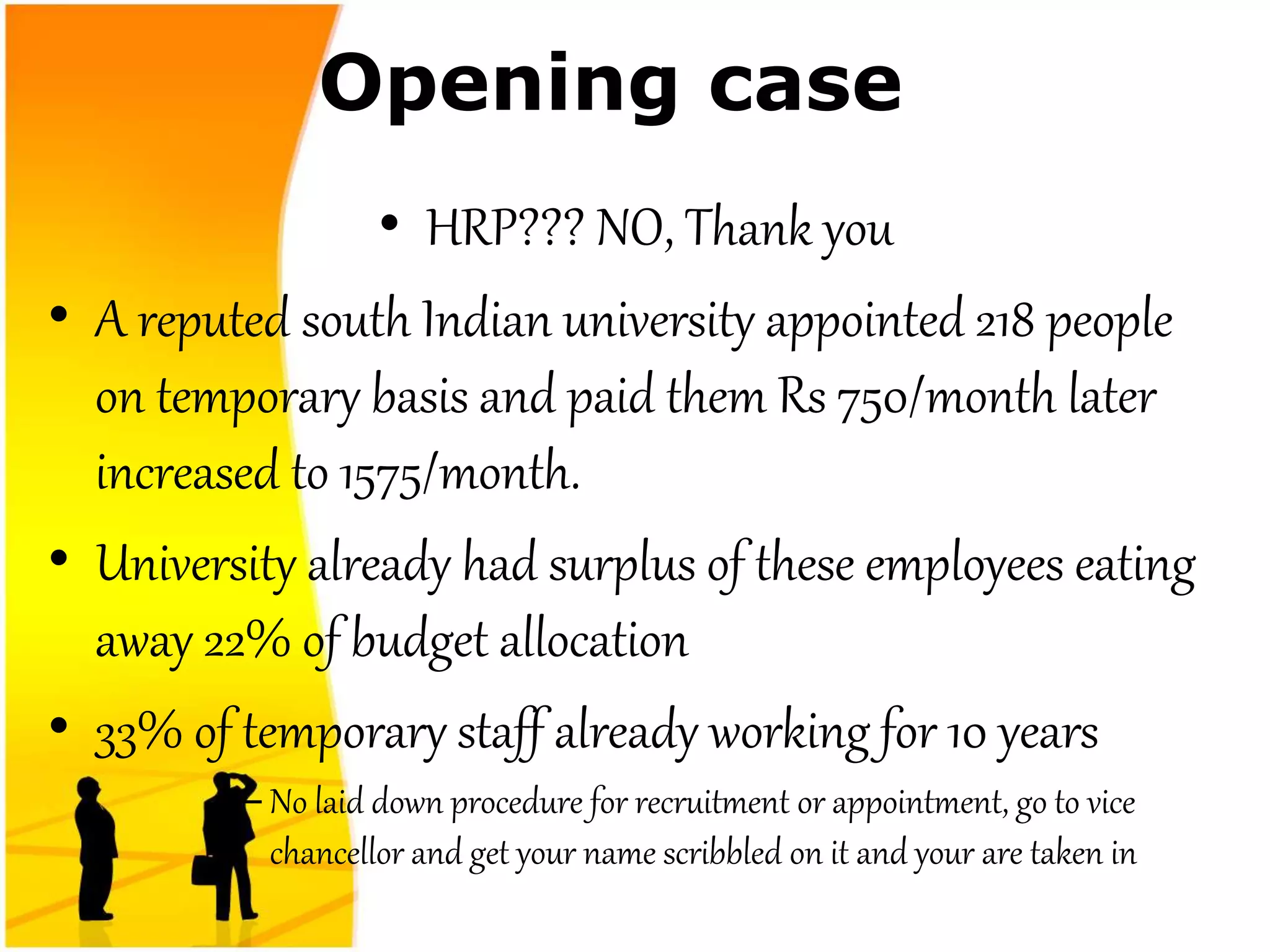
• HRP??? NO, Thank you
• A reputed south Indian university appointed 218 people
on temporary basis and paid them Rs 750/month later
increased to 1575/month.
• University already had surplus of these employees eating
away 22% of budget allocation
• 33% of temporary staff already working for 10 years
– No laid down procedure for recruitment or appointment, go to vice
chancellor and get your name scribbled on it and your are taken in
• They then realised the guilt of violating Equal Remuneration
Act and supressing human rights
• What to do with this 218 temoparay staff...??
• University can dismiss services of 33% as there have been
breaks in their services. Will they take it?????
• While 67% of temporary staff, university can not terminate
them, as there were no breaks
• University decides to regularize their services, with 50
available vacancies
• This would cost the university an exra expenditure of Rs 30
lakh/year. And 1.2 crore for rest remaining...
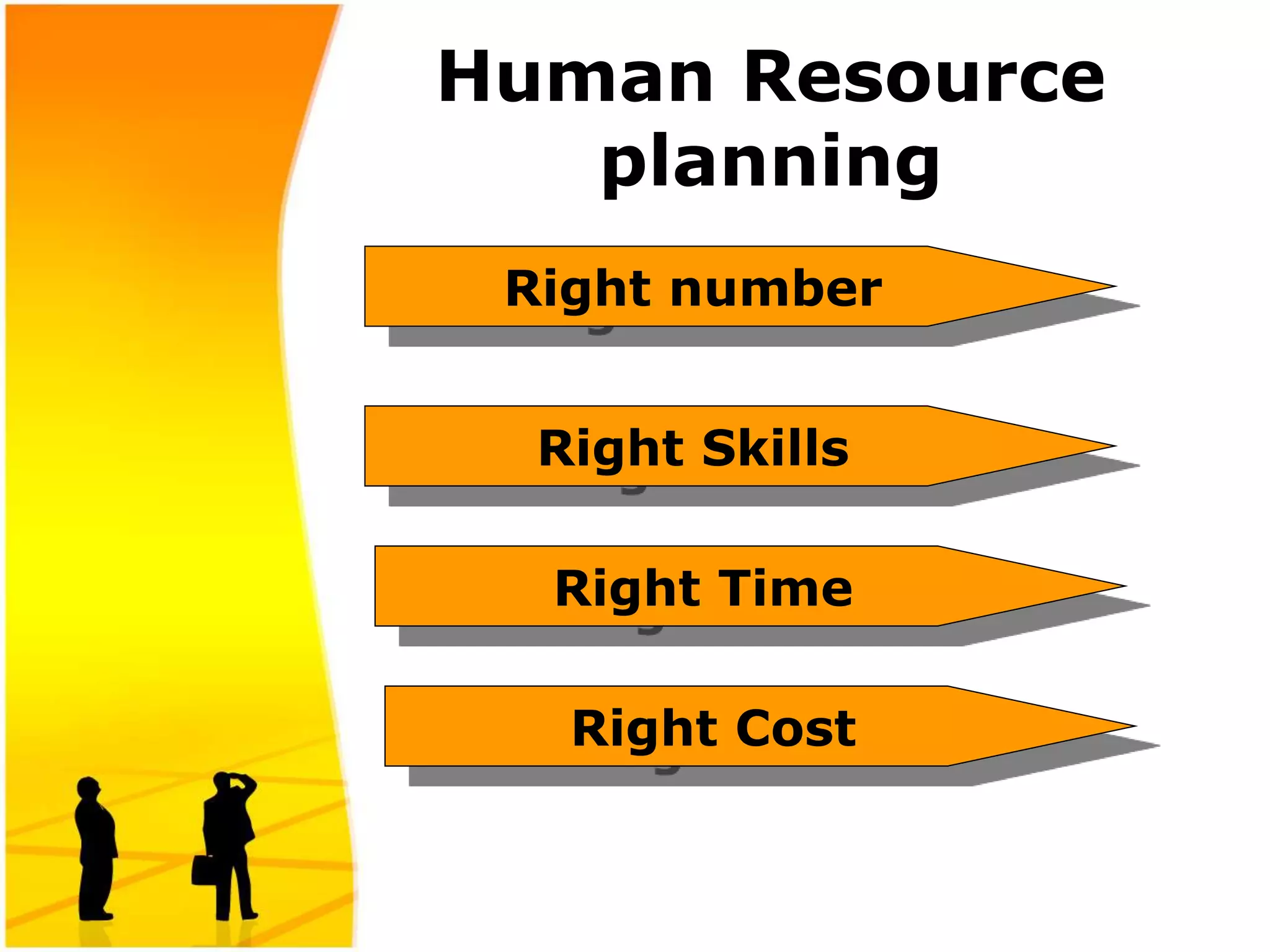
Human Resource
planning
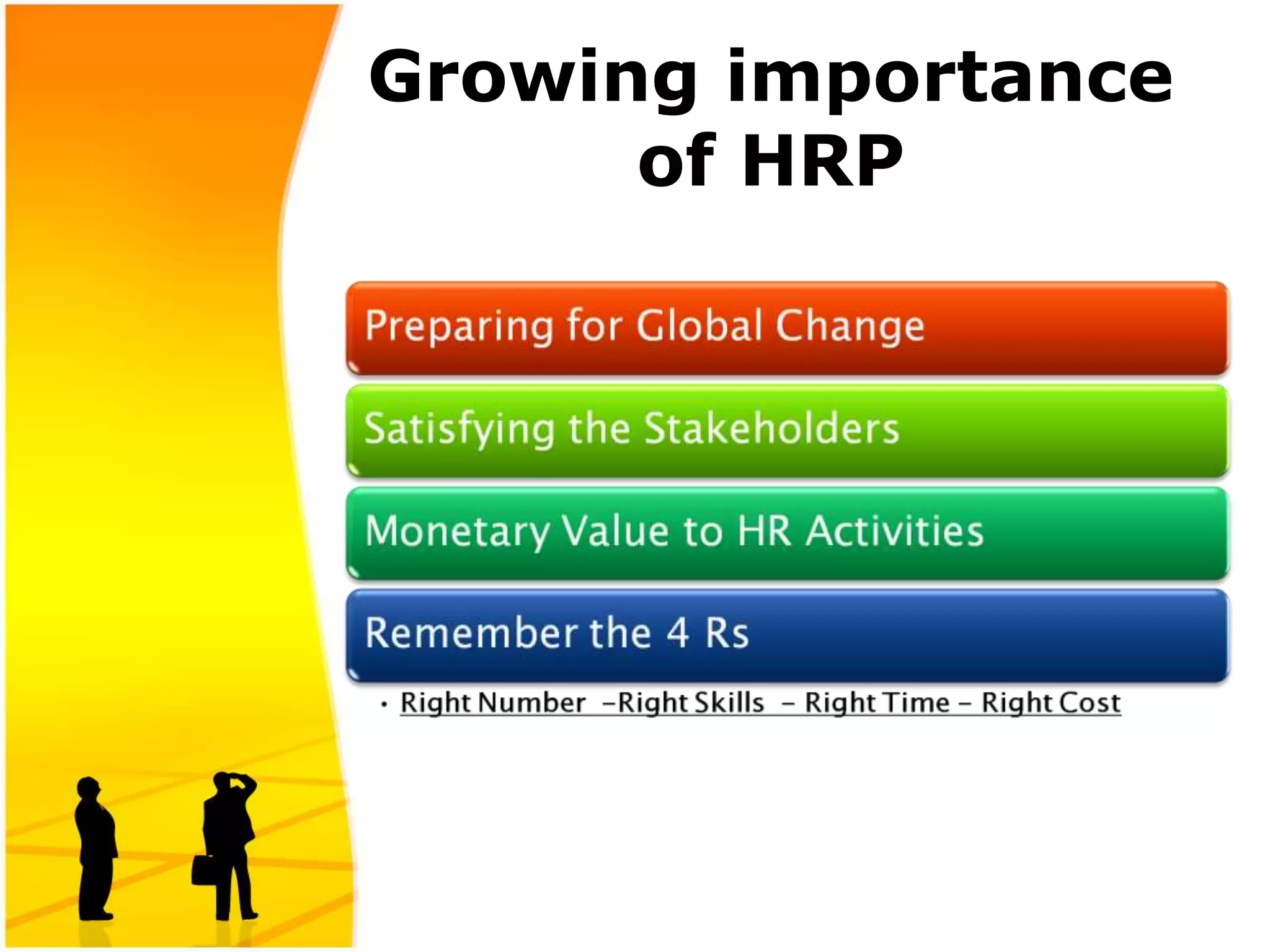
Right number
Right Skills
Right Time
Right Cost
HRP defined
•Process of anticipating and
making provision for the
movement of people into,
within, and out of an
organization
Objectives of HRP
• To maintain
• To forecast
• To optimize
• To utilize
Right Cost
Right Skills
Right number
Right Time
HRP at different
planning levels
Corporate – level planning
Intermediate – level
planning
Operations planning
Planning short-term activities
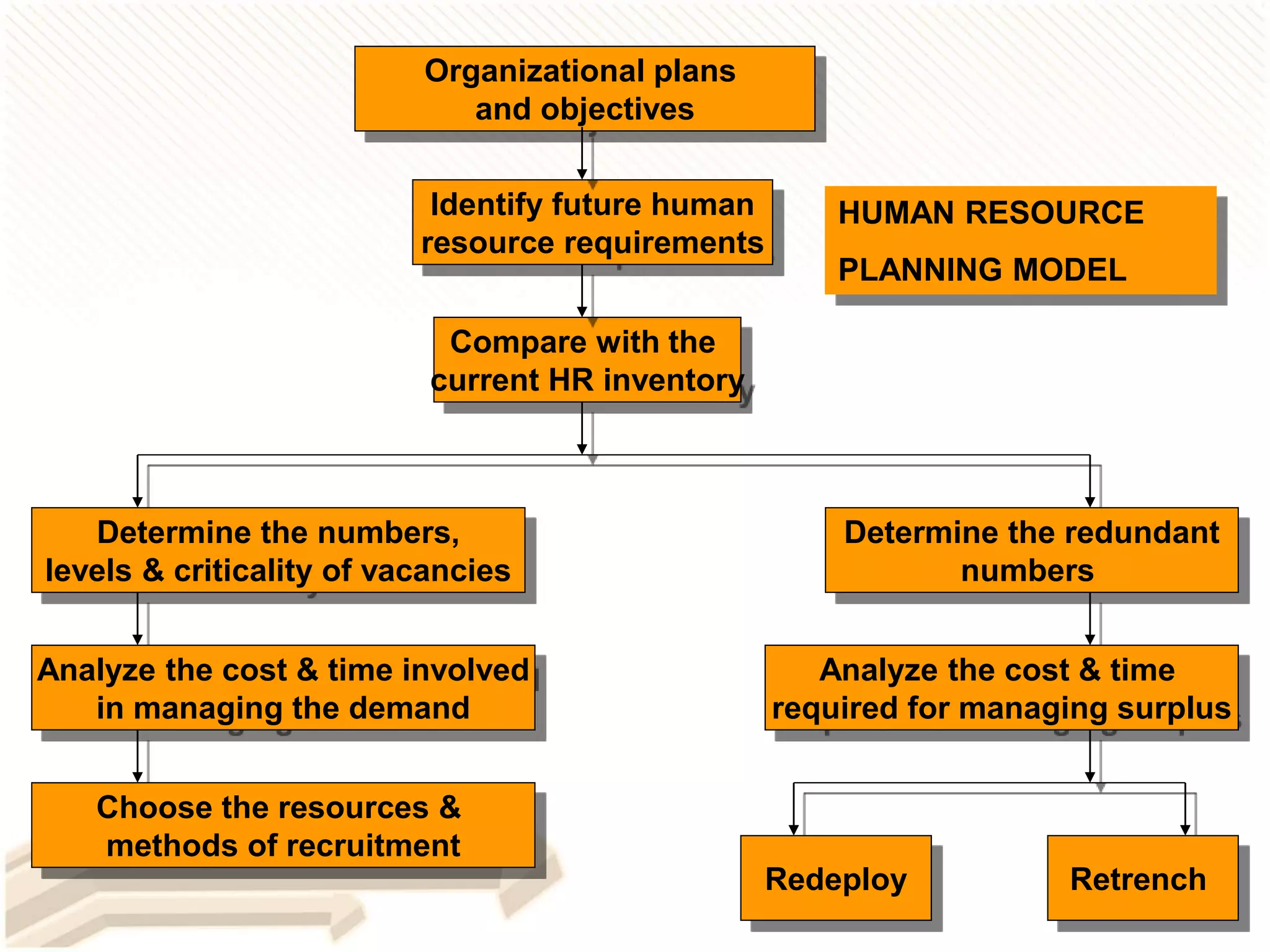
Organizational plans
and objectives
Identify future human
resource requirements
Compare with the
current HR inventory
Determine the redundant
numbers
Determine the numbers,
levels & criticality of vacancies
Analyze the cost & time involved
in managing the demand
Analyze the cost & time
required for managing surplus
Retrench
Choose the resources &
methods of recruitment
Redeploy
HUMAN RESOURCE
PLANNING MODEL
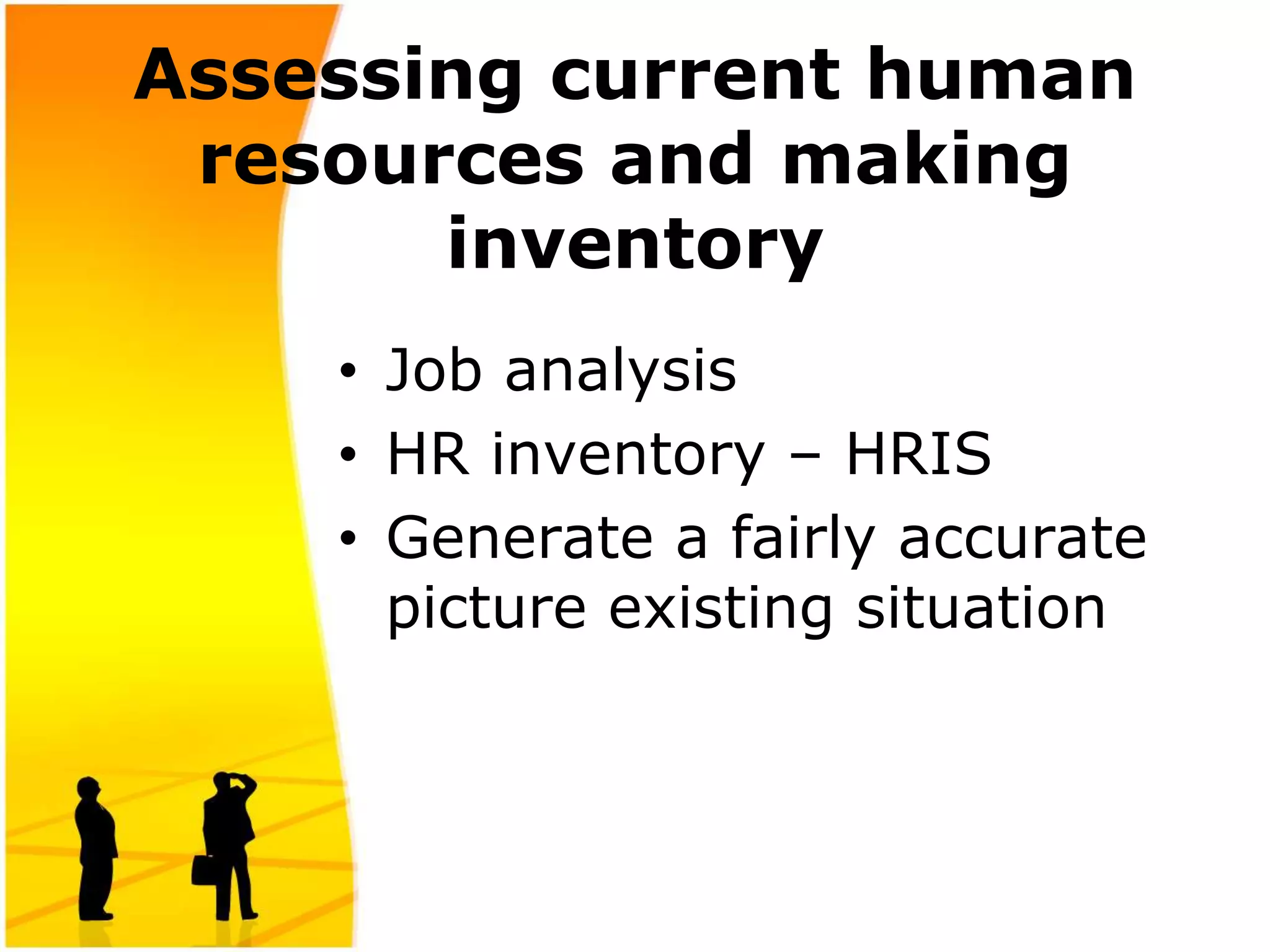
Assessing current human
resources and making
inventory
• Job analysis
• HR inventory – HRIS
• Generate a fairly accurate
picture existing situation
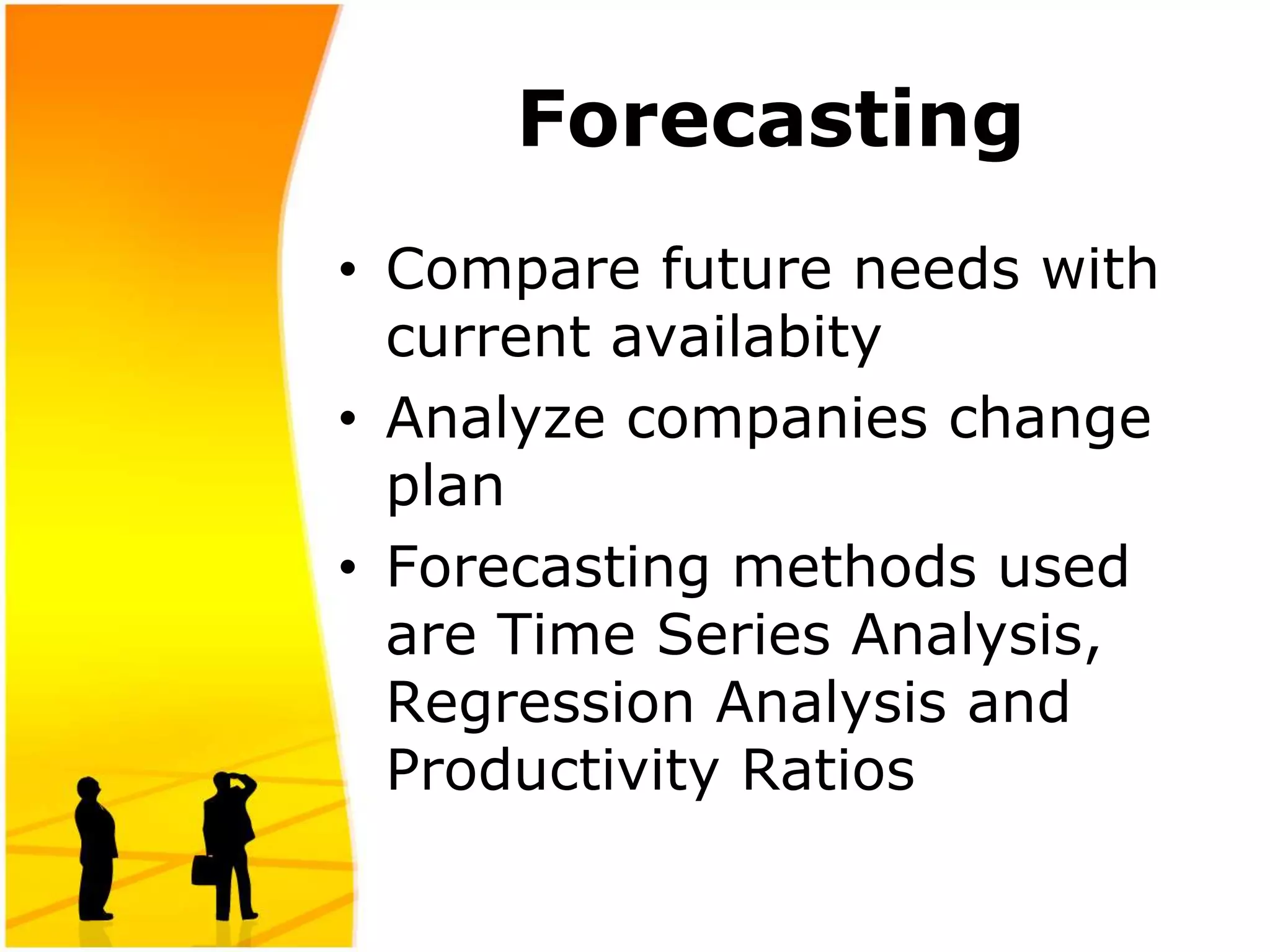
Forecasting
• Compare future needs with
current availabity
• Analyze companies change
plan
• Forecasting methods used
are Time Series Analysis,
Regression Analysis and
Productivity Ratios
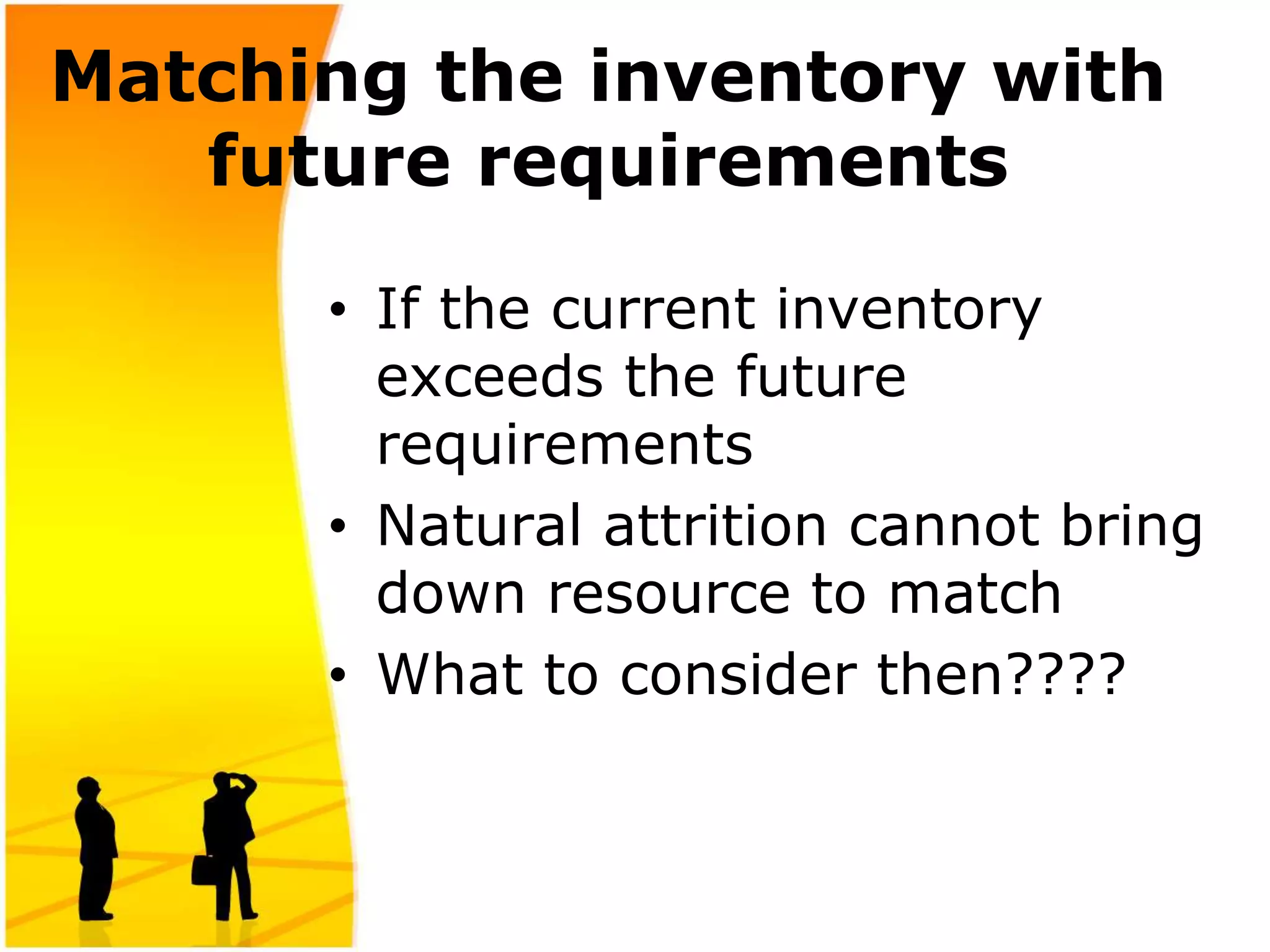
Matching the inventory with
future requirements
• If the current inventory
exceeds the future
requirements
• Natural attrition cannot bring
down resource to match
• What to consider then????
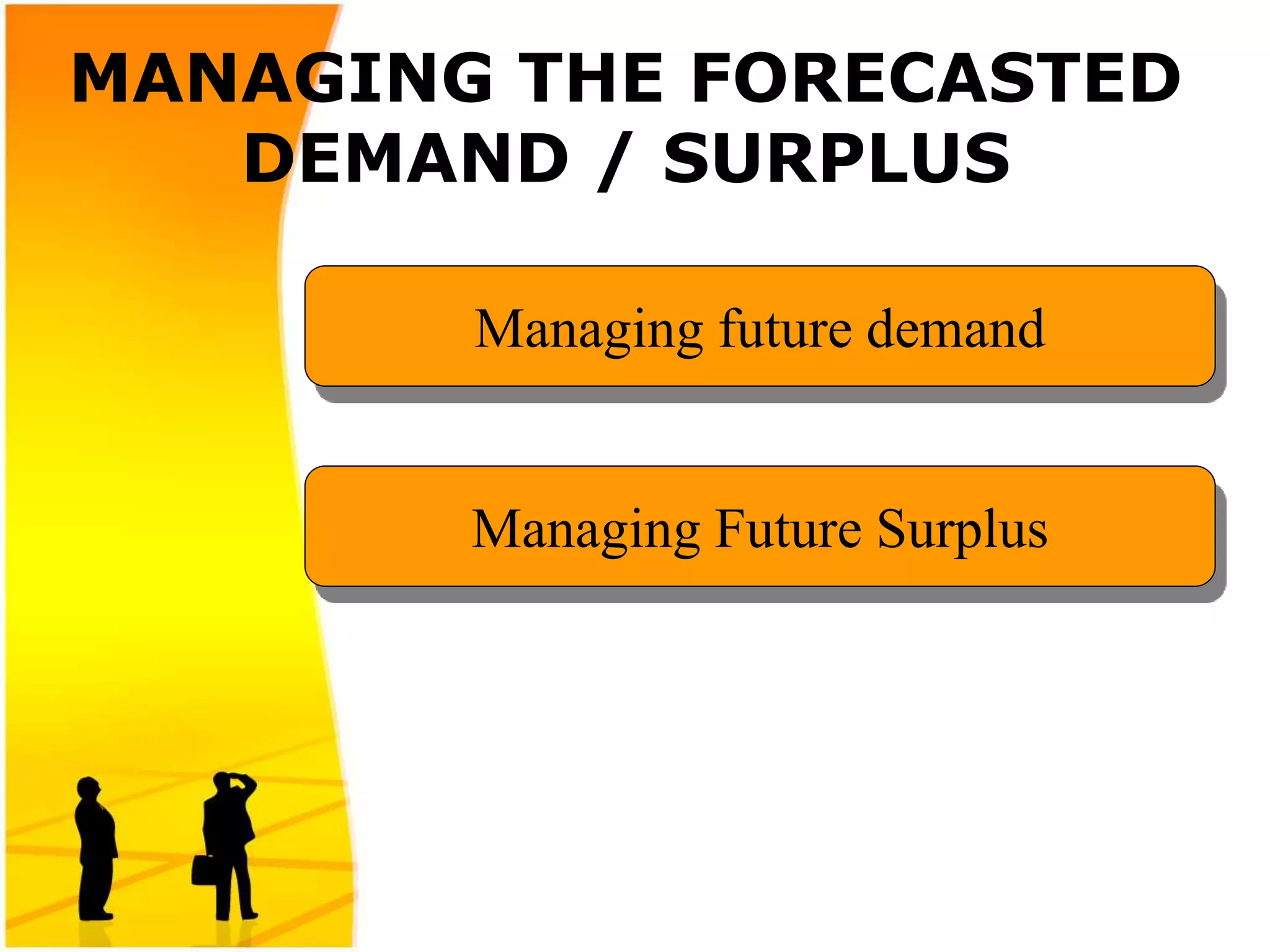
MANAGING THE FORECASTED
DEMAND / SURPLUS
Managing future demand
Managing Future Surplus
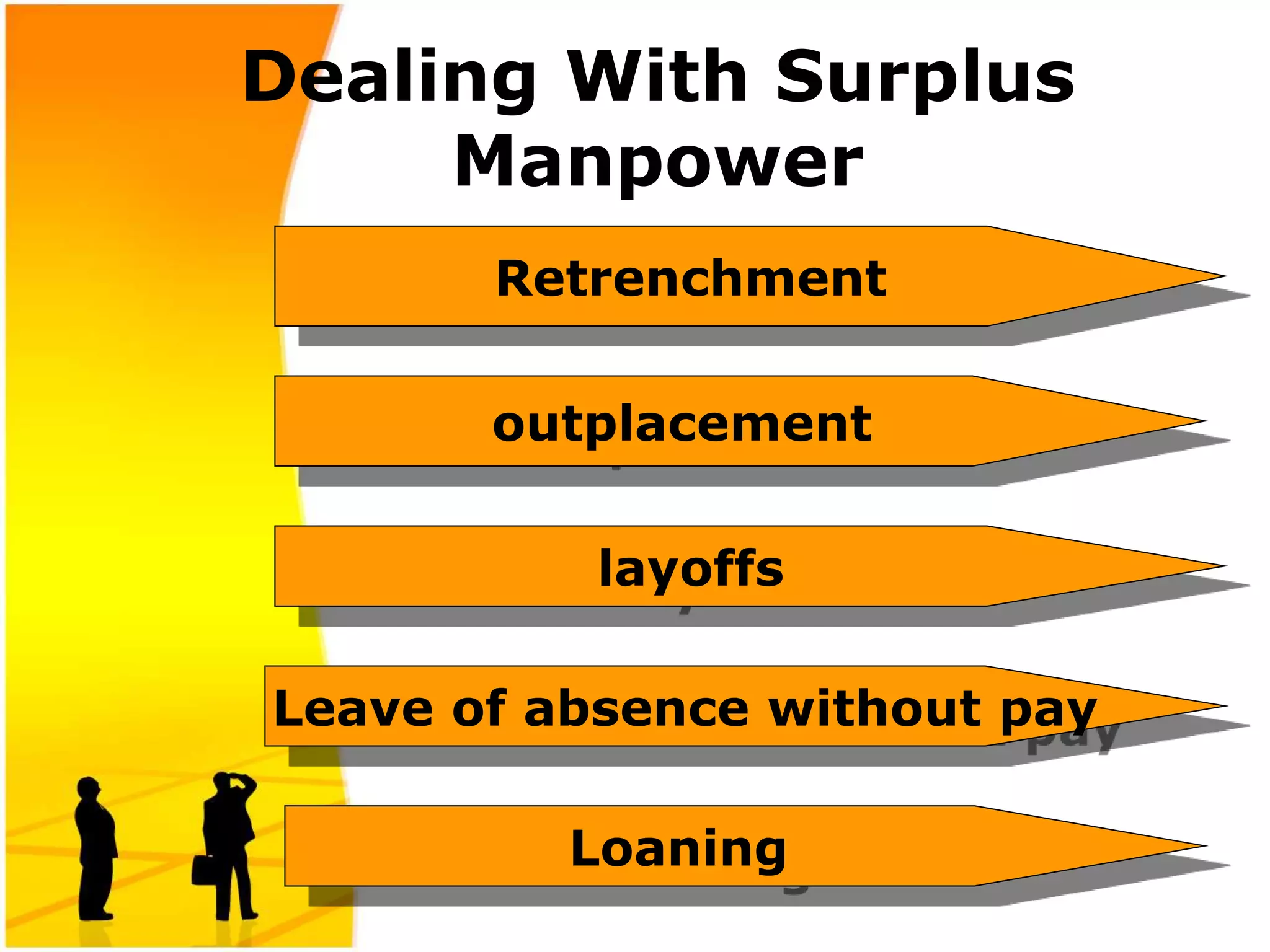
Dealing With Surplus
Manpower
Retrenchment
outplacement
layoffs
Leave of absence without pay
Loaning
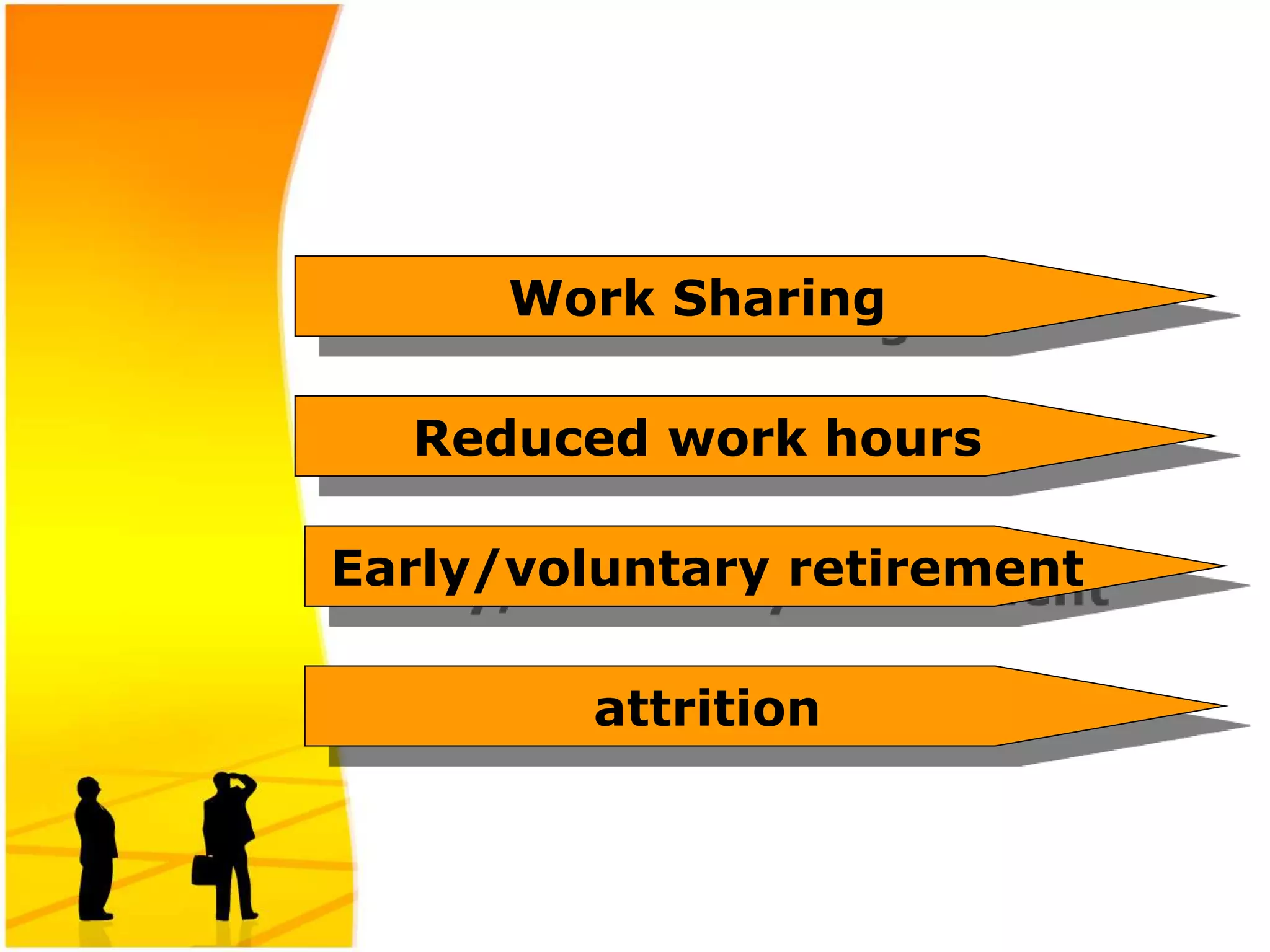
Work Sharing
Reduced work hours
attrition
Early/voluntary retirement
Growing importance
of HRP
Thank you

Introduction to human resource management

  • 1.
  • 2.
    •According to AdiGodrej, “all corporate strengths are dependent on people.”
  • 3.
    Human Resource Management •‘The real sources of competitive leverage are the culture and capabilities of your organization that derive from how you manage your people.’
  • 4.
    Points to Ponder •Definition and Concept of HRM • History of HRM • Functions of HRM • HR Policies and Procedures • Emerging Role of HRM • Role of HR Executives • Challenges to HR Professionals • Strategic HRM
  • 5.
    Human Resource Management •“HRM is the function performed in organizations that facilitates the most effective use of people to achieve organizational and individual goals.” – Ivancevich and Glueck
  • 6.
    History of HRM- 1 • Scientific Management Approach (mid 1900s) – – Study of motion and fatigue – ‘one-best-way’ to accomplish the task – Piece-rate system – Welfare programmes – Failed to bring behavioural changes and increase in productivity • Human Relations Approach (1930-40) – Effect of social and psychological factors – Relations and respect  High Productivity
  • 7.
    History of HRM- 2 • Human Resources Approach (1970s) – Principles • Employees are assets • Policies, programmes and practices - help in work and personal development • Conducive environment
  • 8.
    Challenges of HRM •Individuals differ from one another • Customization of stimulation and motivation • Demanding personnel
  • 9.
    Functions of HRM- 1 Managerial Planning Organizing Staffing Directing Controlling
  • 10.
    Functions of HRM- 2 Operational Employment HR Development Compensation Mgt Employee Relations HR Planning Recruitment Selection Placement Induction Performance Appraisal Training Management Development Career Planning and Development Job Evaluation Wage and Salary Admn Incentives Bonus Fringe Benefits
  • 11.
    Emerging role orHRM • Value of Human Resource • Competitive advantage • Human Resource Accounting – It is measurement of the cost and value of people for an organization
  • 12.
    ROLE OF HREXECUTIVES • Service provider • Executive • Facilitator • Consultant • Auditor
  • 13.
    Challenges to HRProfessionals • Worker productivity • Quality improvement • The changing attitudes of workforce • The impact of the government • Quality of work-life • Technology and Training
  • 14.
  • 15.
    Why structure ??? Whatstructure signifies? No directions Leads to confusion Chaos Why???????????
  • 16.
    MAIN POINTS OFCHAPTER Organizational Structure and Human Resource Management Formal and Informal Organizations Tall and Flat Organizational Structures Responsibility, Authority and Accountability Line and Staff Functions Human Resource Management and other Organizational Functions
  • 17.
    Mechanistic Vs organic organization Rigidstructure Employees are tied by rules & regulations High degree of centralization Suitable for operating in static environment Decision-making is done by superiors Ex:Public sector in the pre-reforms era Flexible structure Employees are not tied by rules & regulations Decentralized style of management Suitable for operating in dynamic environment Decision-making is done by junior level employees also Ex: Marico`s Saffola
  • 18.
  • 19.
    Tall Vs Flatstructure CMD ED ED ED GM GM GM CM CM Manager Manager Officer Officer Executive Executive TALL STRUCTURE COO PM PM PM PM Team Lead Team Lead Team Lead Team Member Team Member Team Member Team Member FLAT STRUCTURE
  • 20.
    RESPONSIBILITY, AUTHORITY & ACCOUNTABILITY Responsibility: It is the obligation of a manager to carry out the duties assigned to him.  Authority: It refers to the right to give orders and the power to exact obedience from others in the process of discharging responsibility.  Accountability: The employee's answerability on using the authority in discharging the responsibility is termed accountability.
  • 21.
    LINE AND STAFFFUNCTIONS Departments or employees of a firm that perform core activities Contributes directly to the business of the firm Ex: Manufacturing and Marketing departments Departments or employees of a firm that perform a support function Contributes indirectly to the business of the firm Ex: HR and Finance departments
  • 22.
    Line & StaffRelationship Traditional concept Service oriented firm Which are line and staff functions Both needs to support each other
  • 23.
    Line staff conflict Differentperception HR professional to bring change Understand market & organization Be empathetic Build trust and transparency Win – win approach
  • 24.
    The Role ofHuman Resources Department As a specialist As a facilitator As a change agent As a controller
  • 25.
    HUMAN RESOURCE MANAGEMENT ANDOTHER ORGANIZATIONAL FUNCTIONS Product & HR Production & HR Marketing & HR Management Techniques & HR Organization structure & HR
  • 26.
    summary Organizational Structure andHuman Resource Management Formal and Informal Organizations Tall and Flat Organizational Structures Responsibility, Authority and Accountability Line and Staff Functions Human Resource Management and other Organizational Functions
  • 27.
  • 28.
  • 29.
    Point to ponder Definition of Human Resource Planning  Objectives of Human Resource Planning  The Process of Human Resource Planning  Managing the Forecasted Demand/Surplus  Growing Importance of Human Resource Planning
  • 30.
    Opening case • HRP???NO, Thank you • A reputed south Indian university appointed 218 people on temporary basis and paid them Rs 750/month later increased to 1575/month. • University already had surplus of these employees eating away 22% of budget allocation • 33% of temporary staff already working for 10 years – No laid down procedure for recruitment or appointment, go to vice chancellor and get your name scribbled on it and your are taken in
  • 31.
    • They thenrealised the guilt of violating Equal Remuneration Act and supressing human rights • What to do with this 218 temoparay staff...?? • University can dismiss services of 33% as there have been breaks in their services. Will they take it????? • While 67% of temporary staff, university can not terminate them, as there were no breaks • University decides to regularize their services, with 50 available vacancies • This would cost the university an exra expenditure of Rs 30 lakh/year. And 1.2 crore for rest remaining...
  • 32.
    Human Resource planning Right number RightSkills Right Time Right Cost
  • 33.
    HRP defined •Process ofanticipating and making provision for the movement of people into, within, and out of an organization
  • 34.
    Objectives of HRP •To maintain • To forecast • To optimize • To utilize Right Cost Right Skills Right number Right Time
  • 35.
    HRP at different planninglevels Corporate – level planning Intermediate – level planning Operations planning Planning short-term activities
  • 36.
    Organizational plans and objectives Identifyfuture human resource requirements Compare with the current HR inventory Determine the redundant numbers Determine the numbers, levels & criticality of vacancies Analyze the cost & time involved in managing the demand Analyze the cost & time required for managing surplus Retrench Choose the resources & methods of recruitment Redeploy HUMAN RESOURCE PLANNING MODEL
  • 37.
    Assessing current human resourcesand making inventory • Job analysis • HR inventory – HRIS • Generate a fairly accurate picture existing situation
  • 38.
    Forecasting • Compare futureneeds with current availabity • Analyze companies change plan • Forecasting methods used are Time Series Analysis, Regression Analysis and Productivity Ratios
  • 39.
    Matching the inventorywith future requirements • If the current inventory exceeds the future requirements • Natural attrition cannot bring down resource to match • What to consider then????
  • 40.
    MANAGING THE FORECASTED DEMAND/ SURPLUS Managing future demand Managing Future Surplus
  • 41.
  • 42.
    Work Sharing Reduced workhours attrition Early/voluntary retirement
  • 43.
  • 44.