CONTENT
Introduction
Training vs Development
Need for training and development
Benefits of Training
Training Process
Types of Training
4 Levels of Training Evaluation
Balancing Costs and Benefits of Training
Points which make learning & training effective
10 Adult Learning Principles to Guide Effective
Training Design and Delivery
References
INTRODUCTION
 Training can be introduced simply as a process of assisting
a person for enhancing his efficiency and effectiveness to a
particular work area by getting more knowledge and
practices. Also training is important to establish specific
skills, abilities and knowledge to an employee
 Training and Development is the framework for helping
employees to develop their personal and organizational
skills, knowledge, and abilities.
Training vs Development
 Content- technical skills








and
knowledge,
application oriented
Purpose- specific job
related,
narrow
perspective
Duration-short term
For
Whommostly
technical
&
nonmanagerial personnel
By whom- trainer

 Managerial & behavioral

skills & knowledge &
attitudes
 Conceptual

&
GK.
Learning opportunities
designed
to
help
employees grow, broad
perspective.
 Long term
 Mostly

for managerial
personnel

 Self motivated
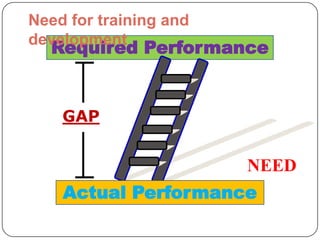
Need for training and
development

Required Performance

GAP

NEED
Actual Performance
Benefits of Training
 To the organization
 To the individual
 To Human Relations

 T & D offer competitive advantage to

a firm
 T & D should not always be the 1st
resort.
 If the above is achieved it negates the
expenses on T & D.
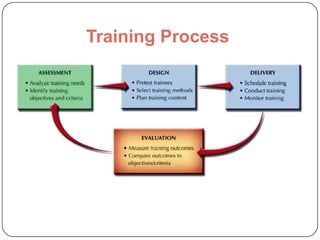
Training Process
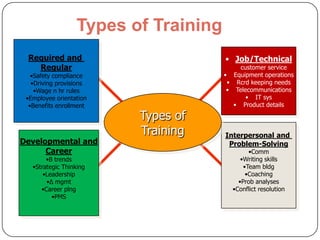
Types of Training
Required and
Regular

•Safety compliance
•Driving provisions
•Wage n hr rules
•Employee orientation
•Benefits enrollment

Developmental and
Career
•B trends
•Strategic Thinking
•Leadership
•∆ mgmt
•Career plng
•PMS

• Job/Technical

Types of
Training

customer service
• Equipment operations
• Rcrd keeping needs
• Telecommunications
• IT sys
• Product details

Interpersonal and
Problem-Solving
•Comm
•Writing skills
•Team bldg
•Coaching
•Prob analyses
•Conflict resolution
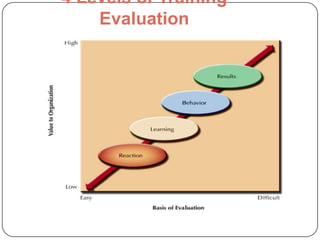
4 Levels of Training
Evaluation
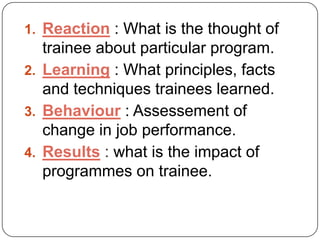
1. Reaction : What is the thought of

trainee about particular program.
2. Learning : What principles, facts
and techniques trainees learned.
3. Behaviour : Assessement of
change in job performance.
4. Results : what is the impact of
programmes on trainee.
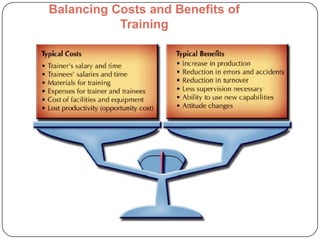
Balancing Costs and Benefits of
Training
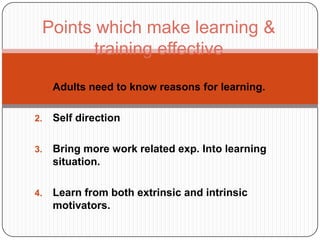
Points which make learning &
training effective
1.

Adults need to know reasons for learning.

2.

Self direction

3.

Bring more work related exp. Into learning
situation.

4.

Learn from both extrinsic and intrinsic
motivators.
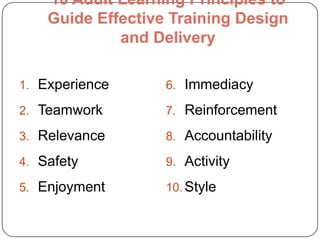
10 Adult Learning Principles to
Guide Effective Training Design
and Delivery
1. Experience

6. Immediacy

2. Teamwork

7. Reinforcement

3. Relevance

8. Accountability

4. Safety

9. Activity

5. Enjoyment

10. Style
References
 http://en.wikipedia.org/w/index.php?title=Spe

cial:Search&search=training+and+employee+
development&redirs=1&profile=default
 Noe’S BOOK
 ARTICLES :
http://articles.economictimes.indiatimes.com/
2012-05-24/news/31838944_1_trainingtjinsite-survey-employee-morale
 http://articles.economictimes.indiatimes.com/
2010-12-28/news/27584223_1_personalitydevelopment-programmers-project-managers
Presented byZarna Pansuriya
Tekinder Kumar
Rohit Jha
Nitin Bansal
Alay Nallulwar

training and employee development

  • 2.
    CONTENT Introduction Training vs Development Needfor training and development Benefits of Training Training Process Types of Training 4 Levels of Training Evaluation Balancing Costs and Benefits of Training Points which make learning & training effective 10 Adult Learning Principles to Guide Effective Training Design and Delivery References
  • 3.
    INTRODUCTION  Training canbe introduced simply as a process of assisting a person for enhancing his efficiency and effectiveness to a particular work area by getting more knowledge and practices. Also training is important to establish specific skills, abilities and knowledge to an employee  Training and Development is the framework for helping employees to develop their personal and organizational skills, knowledge, and abilities.
  • 4.
    Training vs Development Content- technical skills     and knowledge, application oriented Purpose- specific job related, narrow perspective Duration-short term For Whommostly technical & nonmanagerial personnel By whom- trainer  Managerial & behavioral skills & knowledge & attitudes  Conceptual & GK. Learning opportunities designed to help employees grow, broad perspective.  Long term  Mostly for managerial personnel  Self motivated
  • 5.
    Need for trainingand development Required Performance GAP NEED Actual Performance
  • 6.
    Benefits of Training To the organization  To the individual  To Human Relations  T & D offer competitive advantage to a firm  T & D should not always be the 1st resort.  If the above is achieved it negates the expenses on T & D.
  • 7.
  • 8.
    Types of Training Requiredand Regular •Safety compliance •Driving provisions •Wage n hr rules •Employee orientation •Benefits enrollment Developmental and Career •B trends •Strategic Thinking •Leadership •∆ mgmt •Career plng •PMS • Job/Technical Types of Training customer service • Equipment operations • Rcrd keeping needs • Telecommunications • IT sys • Product details Interpersonal and Problem-Solving •Comm •Writing skills •Team bldg •Coaching •Prob analyses •Conflict resolution
  • 9.
    4 Levels ofTraining Evaluation
  • 10.
    1. Reaction :What is the thought of trainee about particular program. 2. Learning : What principles, facts and techniques trainees learned. 3. Behaviour : Assessement of change in job performance. 4. Results : what is the impact of programmes on trainee.
  • 11.
    Balancing Costs andBenefits of Training
  • 12.
    Points which makelearning & training effective 1. Adults need to know reasons for learning. 2. Self direction 3. Bring more work related exp. Into learning situation. 4. Learn from both extrinsic and intrinsic motivators.
  • 13.
    10 Adult LearningPrinciples to Guide Effective Training Design and Delivery 1. Experience 6. Immediacy 2. Teamwork 7. Reinforcement 3. Relevance 8. Accountability 4. Safety 9. Activity 5. Enjoyment 10. Style
  • 14.
    References  http://en.wikipedia.org/w/index.php?title=Spe cial:Search&search=training+and+employee+ development&redirs=1&profile=default  Noe’SBOOK  ARTICLES : http://articles.economictimes.indiatimes.com/ 2012-05-24/news/31838944_1_trainingtjinsite-survey-employee-morale  http://articles.economictimes.indiatimes.com/ 2010-12-28/news/27584223_1_personalitydevelopment-programmers-project-managers
  • 15.
    Presented byZarna Pansuriya TekinderKumar Rohit Jha Nitin Bansal Alay Nallulwar