TRAINING AND
DEVELOPMENT
OF HUMAN
RESOURCE
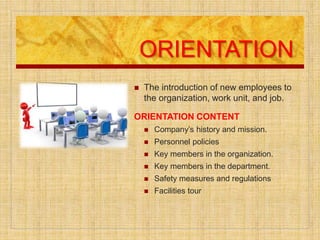
ORIENTATION
 The introduction of new employees to
the organization, work unit, and job.
ORIENTATION CONTENT
 Company’s history and mission.
 Personnel policies
 Key members in the organization.
 Key members in the department.
 Safety measures and regulations
 Facilities tour
ORIENTATION KIT
 Company organization chart.
 Map of the company’s facilities.
 Copy of policy and procedures handbook.
 List of holidays and fringe benefits.
 Copies of performance appraisal forms, dates, and procedures.
 Copies of other required forms.
 Emergency and accident prevention procedures.
 Telephone numbers and locations of key company personnel.
 Copies of insurance plans.
A successful orientation should accomplish four
things for new employees:
 Make them feel welcome and at ease.
 Help them understand the organization in a broad
sense.
 Make clear to them what is expected in terms of
work and behavior.
 Help them begin the process of becoming socialized
into the firm’s ways of acting and doing things.
TRAINING AND
DEVELOPMENT
 Is the field which is concerned with organizational activity aimed at bettering
the performance of individuals and group in organizational settings.
TRAINING DEFINED
A learning process that involves the acquisition of skills, concepts, rules or
attitudes to enhance the performance of employees.
PHASES:
“It’s not what you want in life, but it is knowing how to reach it”.
“it’s not where you want to go, but it’s knowing how to get there”.
“It’s not what you dream of doing, but it’s having the knowledge to do it”.
“It’s not a set of goals, but it’s more like a vision”.
“It’s not the goal you set, but it’s what you need to achieve it”
DIFFERENCE BETWEEN
TRAINING AND DEVELOPMENT
TRAINING
 It gives people an awareness of the rules and
procedures to guide their behavior.
 It intends to improve their performance on the
current job and prepares them for an intended
job.
DEVELOPMENT
 It helps individual in the progress towards
maturity and actualization of potential
capabilities so that they can become not only
good employees but better human beings.
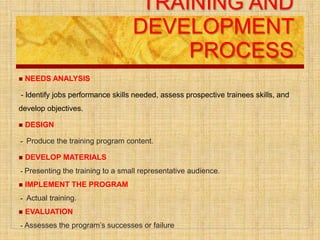
TRAINING AND
DEVELOPMENT
PROCESS
 NEEDS ANALYSIS
- Identify jobs performance skills needed, assess prospective trainees skills, and
develop objectives.
 DESIGN
- Produce the training program content.
 DEVELOP MATERIALS
- Presenting the training to a small representative audience.
 IMPLEMENT THE PROGRAM
- Actual training.
 EVALUATION
- Assesses the program’s successes or failure
TRAINING METHODS:
1. ON-THE-JOB TRAINING
The employee is shown how to perform the job and allowed to do it under the
trainer’s supervision.
 Job Rotation – a practice of moving employees between different tasks to
promote experience and variety.
 Coaching & Counseling – refers to actually teaching the job.
- refers to advising the employee as and when he
faces problems.
 Understudy – an employee is deputed to work under a senior.
 Apprenticeship – train people for careers that demand a wide range of skills,
knowledge and independent judgment.
2. OFF-THE-JOB TRAINING
Provide enjoyable way of learning skills such as management and
bonding for employees that enhances their productivity.
 Classroom Method
 Simulation Training
 Business Games
ADVANTAGES OF
TRAINING AND
DEVELOPMENT FOR
THE EMPLOYEES:
• BETTER CAREER
OPPORTUNITIES
• HIGH REWARDS
• INCREASED
MOTIVATION
• GROUP EFFORTS
ADVANTAGES OF
TRAINING AND
DEVELOPMENT FOR
THE COMPANY:
• Increase in efficiency of
worker
• Reduced Supervision
• Less Turnover of Labour
Make the Learning
Meaningful
 At the start of training, provide a bird’s-eye view of
the material to be presented to facilitates learning.
 Use a variety of familiar examples.
 Organize the information so you can present it
logically, and in meaningful units.
 Use terms and concepts that are already familiar
to trainees.
 Use as many visual aids as possible.
Motivate the Learner
 People learn best by doing so provide as much
realistic practice as possible.
 Trainees learn best when the trainers immediately
reinforce correct responses
 Trainees learn best at their own way.
 Create a perceived training need in the trainees’
minds.
 The schedule is important too: The learning curve
goes down late in the day, less than full day
training is most effective.

Training and Development of Human Resource

  • 1.
  • 2.
    ORIENTATION  The introductionof new employees to the organization, work unit, and job. ORIENTATION CONTENT  Company’s history and mission.  Personnel policies  Key members in the organization.  Key members in the department.  Safety measures and regulations  Facilities tour
  • 3.
    ORIENTATION KIT  Companyorganization chart.  Map of the company’s facilities.  Copy of policy and procedures handbook.  List of holidays and fringe benefits.  Copies of performance appraisal forms, dates, and procedures.  Copies of other required forms.  Emergency and accident prevention procedures.  Telephone numbers and locations of key company personnel.  Copies of insurance plans.
  • 4.
    A successful orientationshould accomplish four things for new employees:  Make them feel welcome and at ease.  Help them understand the organization in a broad sense.  Make clear to them what is expected in terms of work and behavior.  Help them begin the process of becoming socialized into the firm’s ways of acting and doing things.
  • 5.
    TRAINING AND DEVELOPMENT  Isthe field which is concerned with organizational activity aimed at bettering the performance of individuals and group in organizational settings. TRAINING DEFINED A learning process that involves the acquisition of skills, concepts, rules or attitudes to enhance the performance of employees. PHASES: “It’s not what you want in life, but it is knowing how to reach it”. “it’s not where you want to go, but it’s knowing how to get there”. “It’s not what you dream of doing, but it’s having the knowledge to do it”. “It’s not a set of goals, but it’s more like a vision”. “It’s not the goal you set, but it’s what you need to achieve it”
  • 6.
    DIFFERENCE BETWEEN TRAINING ANDDEVELOPMENT TRAINING  It gives people an awareness of the rules and procedures to guide their behavior.  It intends to improve their performance on the current job and prepares them for an intended job. DEVELOPMENT  It helps individual in the progress towards maturity and actualization of potential capabilities so that they can become not only good employees but better human beings.
  • 7.
    TRAINING AND DEVELOPMENT PROCESS  NEEDSANALYSIS - Identify jobs performance skills needed, assess prospective trainees skills, and develop objectives.  DESIGN - Produce the training program content.  DEVELOP MATERIALS - Presenting the training to a small representative audience.  IMPLEMENT THE PROGRAM - Actual training.  EVALUATION - Assesses the program’s successes or failure
  • 8.
    TRAINING METHODS: 1. ON-THE-JOBTRAINING The employee is shown how to perform the job and allowed to do it under the trainer’s supervision.  Job Rotation – a practice of moving employees between different tasks to promote experience and variety.  Coaching & Counseling – refers to actually teaching the job. - refers to advising the employee as and when he faces problems.  Understudy – an employee is deputed to work under a senior.  Apprenticeship – train people for careers that demand a wide range of skills, knowledge and independent judgment.
  • 9.
    2. OFF-THE-JOB TRAINING Provideenjoyable way of learning skills such as management and bonding for employees that enhances their productivity.  Classroom Method  Simulation Training  Business Games
  • 10.
    ADVANTAGES OF TRAINING AND DEVELOPMENTFOR THE EMPLOYEES: • BETTER CAREER OPPORTUNITIES • HIGH REWARDS • INCREASED MOTIVATION • GROUP EFFORTS ADVANTAGES OF TRAINING AND DEVELOPMENT FOR THE COMPANY: • Increase in efficiency of worker • Reduced Supervision • Less Turnover of Labour
  • 11.
    Make the Learning Meaningful At the start of training, provide a bird’s-eye view of the material to be presented to facilitates learning.  Use a variety of familiar examples.  Organize the information so you can present it logically, and in meaningful units.  Use terms and concepts that are already familiar to trainees.  Use as many visual aids as possible.
  • 12.
    Motivate the Learner People learn best by doing so provide as much realistic practice as possible.  Trainees learn best when the trainers immediately reinforce correct responses  Trainees learn best at their own way.  Create a perceived training need in the trainees’ minds.  The schedule is important too: The learning curve goes down late in the day, less than full day training is most effective.