TRAINING AND DEVELOPMENT
Orienting Employees
 Employee orientation
– A procedure for providing new employees with
basic background information about the firm.
 Orientation content
– Information on employee benefits
– Personnel (HR) policies
– The daily routine
– Company organization and operations
– Safety measures and regulations
– Facilities tour
Orienting Employees (cont’d)
 A successful orientation should accomplish four
things for new employees:
– Make them feel welcome and at ease (homelike).
– Help them understand the organization in a
broad sense.
– Make clear to them what is expected in terms of
work and behavior.
– Help them begin the process of becoming
socialized into the firm’s ways of acting and doing
things (including prevailing culture).
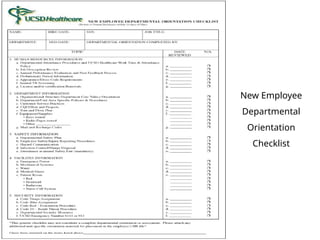
New Employee
Departmental
Orientation
Checklist
The Training Process
 Training
– The process of teaching new employees the basic
skills they need to perform their jobs.
 The strategic context of training
– Performance management: the process
employers use to make sure employees are
working toward organizational goals.
• Web-based training
• Distance learning-based training
• Cross-cultural diversity training
The Training and Development Process
 Needs analysis
– Identify job performance skills needed, assess
prospective trainees skills, and develop objectives.
 Instructional design
– Produce the training program content, including
workbooks, exercises, and activities.
 Validation
– Presenting (trying out) the training to a small
representative audience (also called pilot testing)
 Implement the program
– Actually training the targeted employee group.
 Evaluation
– Assesses the program’s successes or failures.
Make the Learning Meaningful
 At the start of training, provide a bird’s-eye view of the
material to be presented to facilitates learning.
 Use a variety of familiar examples.
 Organize the information so you can present it logically,
and in meaningful units.
 Use terms and concepts that are already familiar to
trainees.
 Use as many visual aids as possible.
Make Skills Transfer Easy
 Maximize the similarity between the training situation and
the work situation.
 Provide adequate practice.
 Label or identify each feature of the machine and/ or step
in the process.
 Direct trainees’ attention to important aspects of the job.
 Provide “heads-up” preparatory information that lets
trainees know they might happen back on the job.
Motivate the Learner
 People learn best by doing so provide as much realistic
practice as possible.
 Trainees learn best when the trainers immediately
reinforce correct responses
 Trainees learn best at their own pace.
 Create a perceived training need in the trainees’ minds.
 The schedule is important too: The learning curve goes
down late in the day, less than full day training is most
effective.
Analyzing Training Needs
 Task analysis
– A detailed study of a job to identify the specific
skills required, especially for new employees.
 Performance analysis
– Verifying that there is a performance deficiency
and determining whether that deficiency
should be corrected through training or
through some other means (such as
transferring the employee).
Training Methods
 On-the-job training (OJT)
– Having a person learn a job by actually doing the job.
 Apprenticeship training
– A structured process by which people become skilled
workers through a combination of classroom instruction
and on-the-job training.
 Informal learning
– The majority of what employees learn on the job they learn
through informal means of performing their jobs on a daily
basis.
 Job instruction training (JIT)
– Listing each job’s basic tasks, along with key points, in
order to provide step-by-step training for employees.
Training Methods (cont’d)
 Effective lectures
– Use signals to help listeners follow your ideas.
– Don’t start out on the wrong foot.
– Keep your conclusions short.
– Be alert to your audience.
– Maintain eye contact with the trainees.
– Make sure everyone in the room can hear.
– Control your hands.
– Talk from notes rather than from a script.
– Break a long talk into a series of five-minute
talks.
Training Methods (cont’d)
 Literacy training techniques
– Responses to functional illiteracy
• Testing job candidates’ basic skills.
• Setting up basic skills and literacy programs.
 Audiovisual-based training
– To illustrate following a sequence over time.
– To expose trainees to events not easily
demonstrable in live lectures.
– To meet the need for organization-wide training
and it is too costly to move the trainers from
place to place.
Training Methods (cont’d)
 Simulated training (occasionally called vestibule
training)
– Training employees on special off-the-job
equipment so training costs and hazards can be
reduced.
– Computer-based training (CBT)
– Electronic performance support systems (EPSS) –
use of computerized tools & displays to automate
training, documentation & phone support.
– Learning portals – using online vendors who make
training material/lectures available via employer’s
intranet portal.
Distance and Internet-Based Training
 Teletraining
– A trainer in a central location teaches groups of
employees at remote locations via TV hookups.
 Videoconferencing
– Interactively training employees who are
geographically separated from each other—or
from the trainer—via a combination of audio
and visual equipment.
 Training via the Internet
– Using the Internet or proprietary internal
intranets to facilitate computer-based training.
What Is Management Development?
 Management development
– Any attempt to improve current or future
management performance by imparting
knowledge, changing attitudes, or increasing skills.
 Succession planning
– A process through which senior-level openings are
planned for and eventually filled.
• Anticipate management needs
• Review firm’s management skills inventory
• Create replacement charts
• Begin management development
Managerial on-the-Job Training
 Job rotation
– Moving a trainee from department to
department to broaden his or her experience
and identify strong and weak points.
 Coaching/Understudy approach
– The trainee works directly with a senior manager
or with the person he or she is to replace; the
latter is responsible for the trainee’s coaching.
 Action learning
– Management trainees are allowed to work full-
time analyzing and solving problems in
different/ other departments.
Off-the-Job Management Training and
Development Techniques
 Case study method
– Managers are presented with a description of an
organizational problem to diagnose and solve.
 Management game
– Teams of managers compete by making
computerized decisions regarding realistic but
simulated situations.
 Outside seminars
– Many companies and universities offer Web-
based and traditional management development
seminars and conferences.
Off-the-Job Management Training and
Development Techniques (cont’d)
 Role playing
– Creating a realistic situation in which trainees
assume the roles of persons in that situation.
 Behavior modeling
– Modeling: showing trainees the right (or
“model”) way of doing something.
– Role playing: having trainees practice that way
– Social reinforcement: giving feedback on the
trainees’ performance.
– Transfer of learning: Encouraging trainees apply
their skills on the job.
Off-the-Job Management Training and
Development Techniques (cont’d)
 Corporate universities
– A corporate university is any educational entity that is a
strategic tool designed to assist its parent organization
in achieving its goals by conducting activities that foster
individual and organizational learning and knowledge.
– Provides a means for conveniently coordinating all the
company’s training efforts and delivering Web-based
modules that cover topics from strategic management to
mentoring.
 In-house development centers
– A company-based method for exposing prospective
managers to realistic exercises to develop improved
management skills.
Off-the-Job Management Training and
Development Techniques (cont’d)
 Executive coaches
– An outside consultant who questions the
executive’s boss, peers, subordinates, and
(sometimes) family in order to identify the
executive’s strengths and weaknesses.
– Counsels the executive so he or she can
capitalize on those strengths and overcome the
weaknesses.
Evaluating the Training Effort
 Designing the study
– Time series design
– Controlled experimentation
 Training effects to measure
– Reaction of trainees to the program
– Learning that actually took place
– Behavior that changed on the job
– Results that were achieved as a result of the
training
Thank You

(5) Project Target & Deviations part.ppt

  • 2.
  • 3.
    Orienting Employees  Employeeorientation – A procedure for providing new employees with basic background information about the firm.  Orientation content – Information on employee benefits – Personnel (HR) policies – The daily routine – Company organization and operations – Safety measures and regulations – Facilities tour
  • 4.
    Orienting Employees (cont’d) A successful orientation should accomplish four things for new employees: – Make them feel welcome and at ease (homelike). – Help them understand the organization in a broad sense. – Make clear to them what is expected in terms of work and behavior. – Help them begin the process of becoming socialized into the firm’s ways of acting and doing things (including prevailing culture).
  • 5.
  • 6.
    The Training Process Training – The process of teaching new employees the basic skills they need to perform their jobs.  The strategic context of training – Performance management: the process employers use to make sure employees are working toward organizational goals. • Web-based training • Distance learning-based training • Cross-cultural diversity training
  • 7.
    The Training andDevelopment Process  Needs analysis – Identify job performance skills needed, assess prospective trainees skills, and develop objectives.  Instructional design – Produce the training program content, including workbooks, exercises, and activities.  Validation – Presenting (trying out) the training to a small representative audience (also called pilot testing)  Implement the program – Actually training the targeted employee group.  Evaluation – Assesses the program’s successes or failures.
  • 8.
    Make the LearningMeaningful  At the start of training, provide a bird’s-eye view of the material to be presented to facilitates learning.  Use a variety of familiar examples.  Organize the information so you can present it logically, and in meaningful units.  Use terms and concepts that are already familiar to trainees.  Use as many visual aids as possible.
  • 9.
    Make Skills TransferEasy  Maximize the similarity between the training situation and the work situation.  Provide adequate practice.  Label or identify each feature of the machine and/ or step in the process.  Direct trainees’ attention to important aspects of the job.  Provide “heads-up” preparatory information that lets trainees know they might happen back on the job.
  • 10.
    Motivate the Learner People learn best by doing so provide as much realistic practice as possible.  Trainees learn best when the trainers immediately reinforce correct responses  Trainees learn best at their own pace.  Create a perceived training need in the trainees’ minds.  The schedule is important too: The learning curve goes down late in the day, less than full day training is most effective.
  • 11.
    Analyzing Training Needs Task analysis – A detailed study of a job to identify the specific skills required, especially for new employees.  Performance analysis – Verifying that there is a performance deficiency and determining whether that deficiency should be corrected through training or through some other means (such as transferring the employee).
  • 12.
    Training Methods  On-the-jobtraining (OJT) – Having a person learn a job by actually doing the job.  Apprenticeship training – A structured process by which people become skilled workers through a combination of classroom instruction and on-the-job training.  Informal learning – The majority of what employees learn on the job they learn through informal means of performing their jobs on a daily basis.  Job instruction training (JIT) – Listing each job’s basic tasks, along with key points, in order to provide step-by-step training for employees.
  • 13.
    Training Methods (cont’d) Effective lectures – Use signals to help listeners follow your ideas. – Don’t start out on the wrong foot. – Keep your conclusions short. – Be alert to your audience. – Maintain eye contact with the trainees. – Make sure everyone in the room can hear. – Control your hands. – Talk from notes rather than from a script. – Break a long talk into a series of five-minute talks.
  • 14.
    Training Methods (cont’d) Literacy training techniques – Responses to functional illiteracy • Testing job candidates’ basic skills. • Setting up basic skills and literacy programs.  Audiovisual-based training – To illustrate following a sequence over time. – To expose trainees to events not easily demonstrable in live lectures. – To meet the need for organization-wide training and it is too costly to move the trainers from place to place.
  • 15.
    Training Methods (cont’d) Simulated training (occasionally called vestibule training) – Training employees on special off-the-job equipment so training costs and hazards can be reduced. – Computer-based training (CBT) – Electronic performance support systems (EPSS) – use of computerized tools & displays to automate training, documentation & phone support. – Learning portals – using online vendors who make training material/lectures available via employer’s intranet portal.
  • 16.
    Distance and Internet-BasedTraining  Teletraining – A trainer in a central location teaches groups of employees at remote locations via TV hookups.  Videoconferencing – Interactively training employees who are geographically separated from each other—or from the trainer—via a combination of audio and visual equipment.  Training via the Internet – Using the Internet or proprietary internal intranets to facilitate computer-based training.
  • 17.
    What Is ManagementDevelopment?  Management development – Any attempt to improve current or future management performance by imparting knowledge, changing attitudes, or increasing skills.  Succession planning – A process through which senior-level openings are planned for and eventually filled. • Anticipate management needs • Review firm’s management skills inventory • Create replacement charts • Begin management development
  • 18.
    Managerial on-the-Job Training Job rotation – Moving a trainee from department to department to broaden his or her experience and identify strong and weak points.  Coaching/Understudy approach – The trainee works directly with a senior manager or with the person he or she is to replace; the latter is responsible for the trainee’s coaching.  Action learning – Management trainees are allowed to work full- time analyzing and solving problems in different/ other departments.
  • 19.
    Off-the-Job Management Trainingand Development Techniques  Case study method – Managers are presented with a description of an organizational problem to diagnose and solve.  Management game – Teams of managers compete by making computerized decisions regarding realistic but simulated situations.  Outside seminars – Many companies and universities offer Web- based and traditional management development seminars and conferences.
  • 20.
    Off-the-Job Management Trainingand Development Techniques (cont’d)  Role playing – Creating a realistic situation in which trainees assume the roles of persons in that situation.  Behavior modeling – Modeling: showing trainees the right (or “model”) way of doing something. – Role playing: having trainees practice that way – Social reinforcement: giving feedback on the trainees’ performance. – Transfer of learning: Encouraging trainees apply their skills on the job.
  • 21.
    Off-the-Job Management Trainingand Development Techniques (cont’d)  Corporate universities – A corporate university is any educational entity that is a strategic tool designed to assist its parent organization in achieving its goals by conducting activities that foster individual and organizational learning and knowledge. – Provides a means for conveniently coordinating all the company’s training efforts and delivering Web-based modules that cover topics from strategic management to mentoring.  In-house development centers – A company-based method for exposing prospective managers to realistic exercises to develop improved management skills.
  • 22.
    Off-the-Job Management Trainingand Development Techniques (cont’d)  Executive coaches – An outside consultant who questions the executive’s boss, peers, subordinates, and (sometimes) family in order to identify the executive’s strengths and weaknesses. – Counsels the executive so he or she can capitalize on those strengths and overcome the weaknesses.
  • 23.
    Evaluating the TrainingEffort  Designing the study – Time series design – Controlled experimentation  Training effects to measure – Reaction of trainees to the program – Learning that actually took place – Behavior that changed on the job – Results that were achieved as a result of the training
  • 24.

Editor's Notes

  • #2 The incidence of both lower incomes due to economic crisis and persistent high food prices has proved to be a devastating combination for the world’s most vulnerable populations.