WELCOME
MODULE – 4
Part-B Development of Human Resources
Training & Development
1
Training & Development
 Training v/s development
 Training v/s Education
 Systematic Approach to Training
 Training Methods
 Executive Development
 Methods and Development of Management Development
 Career and Succession Planning
2
Synopsis – Module 4
Source: “Personnel & Human Resource Management” Book by P.Subba Rao-PgNo 50
 According to Dale S.Beach defines the training as “The organized procedure by
which people learn knowledge and/or skill for a definite purpose.”
 According to Edward B. Flippo, “Training is the act of increasing the knowledge
and skill of an employee for doing a particular job.”
 Training is the process of planned programs and procedures undertaken for the
improvement of employee’s performance in terms of his attitude, skills, knowledge
and behavior.
 Training is the act of increasing the knowledge and skill of an employee for doing a
particular job. Training is the short term educational process and utilizing a
systematic and organized procedure by which employees learn technical knowledge
and skills for a definite purpose.
3
Training
4
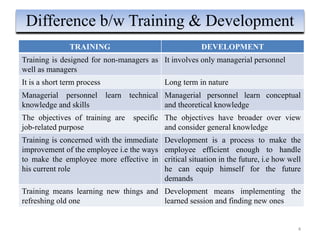
Difference b/w Training & Development
TRAINING DEVELOPMENT
Training is designed for non-managers as
well as managers
It involves only managerial personnel
It is a short term process Long term in nature
Managerial personnel learn technical
knowledge and skills
Managerial personnel learn conceptual
and theoretical knowledge
The objectives of training are specific
job-related purpose
The objectives have broader over view
and consider general knowledge
Training is concerned with the immediate
improvement of the employee i.e the ways
to make the employee more effective in
his current role
Development is a process to make the
employee efficient enough to handle
critical situation in the future, i.e how well
he can equip himself for the future
demands
Training means learning new things and
refreshing old one
Development means implementing the
learned session and finding new ones
5
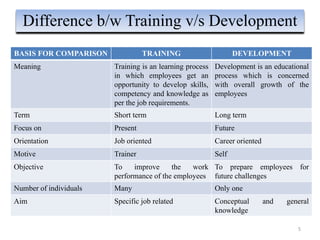
Difference b/w Training v/s Development
BASIS FOR COMPARISON TRAINING DEVELOPMENT
Meaning Training is an learning process
in which employees get an
opportunity to develop skills,
competency and knowledge as
per the job requirements.
Development is an educational
process which is concerned
with overall growth of the
employees
Term Short term Long term
Focus on Present Future
Orientation Job oriented Career oriented
Motive Trainer Self
Objective To improve the work
performance of the employees
To prepare employees for
future challenges
Number of individuals Many Only one
Aim Specific job related Conceptual and general
knowledge
6
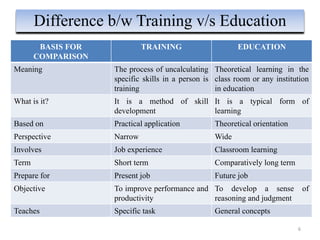
Difference b/w Training v/s Education
BASIS FOR
COMPARISON
TRAINING EDUCATION
Meaning The process of uncalculating
specific skills in a person is
training
Theoretical learning in the
class room or any institution
in education
What is it? It is a method of skill
development
It is a typical form of
learning
Based on Practical application Theoretical orientation
Perspective Narrow Wide
Involves Job experience Classroom learning
Term Short term Comparatively long term
Prepare for Present job Future job
Objective To improve performance and
productivity
To develop a sense of
reasoning and judgment
Teaches Specific task General concepts
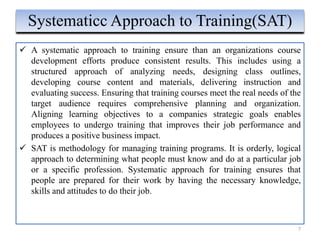
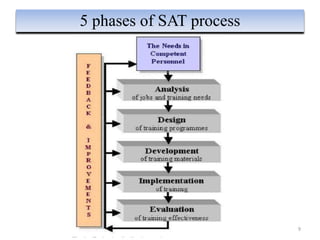
 A systematic approach to training ensure than an organizations course
development efforts produce consistent results. This includes using a
structured approach of analyzing needs, designing class outlines,
developing course content and materials, delivering instruction and
evaluating success. Ensuring that training courses meet the real needs of the
target audience requires comprehensive planning and organization.
Aligning learning objectives to a companies strategic goals enables
employees to undergo training that improves their job performance and
produces a positive business impact.
 SAT is methodology for managing training programs. It is orderly, logical
approach to determining what people must know and do at a particular job
or a specific profession. Systematic approach for training ensures that
people are prepared for their work by having the necessary knowledge,
skills and attitudes to do their job.
7
Systematicc Approach to Training(SAT)
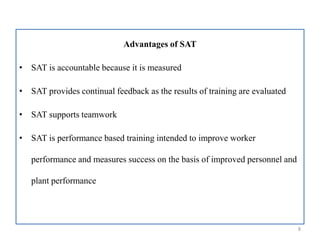
Advantages of SAT
• SAT is accountable because it is measured
• SAT provides continual feedback as the results of training are evaluated
• SAT supports teamwork
• SAT is performance based training intended to improve worker
performance and measures success on the basis of improved personnel and
plant performance
8
9
5 phases of SAT process
 According to Dale S.Beach defines the training as “The organized procedure by
which people learn knowledge and/or skill for a definite purpose.”
 According to Edward B. Flippo, “Training is the act of increasing the knowledge
and skill of an employee for doing a particular job.”
 Training is the process of planned programs and procedures undertaken for the
improvement of employee’s performance in terms of his attitude, skills, knowledge
and behavior.
 Training is the act of increasing the knowledge and skill of an employee for doing a
particular job. Training is the short term educational process and utilizing a
systematic and organized procedure by which employees learn technical knowledge
and skills for a definite purpose.
10
Training
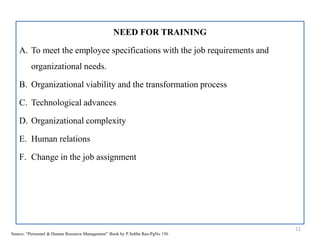
NEED FOR TRAINING
A. To meet the employee specifications with the job requirements and
organizational needs.
B. Organizational viability and the transformation process
C. Technological advances
D. Organizational complexity
E. Human relations
F. Change in the job assignment
11
Source: “Personnel & Human Resource Management” Book by P.Subba Rao-PgNo 156
12
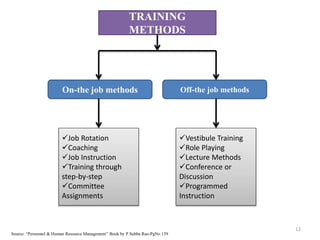
TRAINING
METHODS
On-the job methods Off-the job methods
Job Rotation
Coaching
Job Instruction
Training through
step-by-step
Committee
Assignments
Vestibule Training
Role Playing
Lecture Methods
Conference or
Discussion
Programmed
Instruction
Source: “Personnel & Human Resource Management” Book by P.Subba Rao-PgNo 159
13
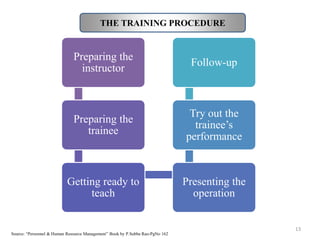
Source: “Personnel & Human Resource Management” Book by P.Subba Rao-PgNo 162
THE TRAINING PROCEDURE
Preparing the
instructor
Preparing the
trainee
Getting ready to
teach
Presenting the
operation
Try out the
trainee’s
performance
Follow-up
14
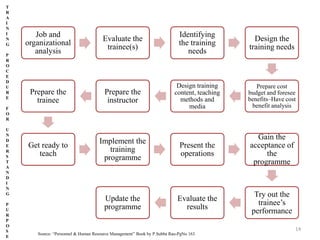
Job and
organizational
analysis
Evaluate the
trainee(s)
Identifying
the training
needs
Design the
training needs
Prepare cost
budget and foresee
benefits–Have cost
benefit analysis
Design training
content, teaching
methods and
media
Prepare the
instructor
Prepare the
trainee
Get ready to
teach
Implement the
training
programme
Present the
operations
Gain the
acceptance of
the
programme
Try out the
trainee’s
performance
Evaluate the
results
Update the
programme
Source: “Personnel & Human Resource Management” Book by P.Subba Rao-PgNo 163
T
R
A
I
N
I
N
G
P
R
O
C
E
D
U
R
E
F
O
R
U
N
D
E
R
S
T
A
N
D
I
N
G
P
U
R
P
O
S
E
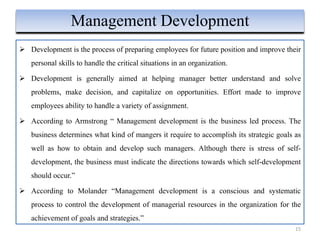
 Development is the process of preparing employees for future position and improve their
personal skills to handle the critical situations in an organization.
 Development is generally aimed at helping manager better understand and solve
problems, make decision, and capitalize on opportunities. Effort made to improve
employees ability to handle a variety of assignment.
 According to Armstrong “ Management development is the business led process. The
business determines what kind of mangers it require to accomplish its strategic goals as
well as how to obtain and develop such managers. Although there is stress of self-
development, the business must indicate the directions towards which self-development
should occur.”
 According to Molander “Management development is a conscious and systematic
process to control the development of managerial resources in the organization for the
achievement of goals and strategies.”
15
Management Development
16
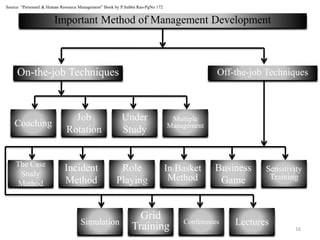
Important Method of Management Development
On-the-job Techniques Off-the-job Techniques
Coaching
Job
Rotation
Under
Study
Multiple
Management
The Case
Study
Method
Incident
Method
Role
Playing
In Basket
Method
Business
Game
Sensitivity
Training
Simulation
Grid
Training Conferences Lectures
Source: “Personnel & Human Resource Management” Book by P.Subba Rao-PgNo 172
 According to Schermerborn, Hunt, and Osborn, “Career Planning is a
process of systematically matching career goals and individual capabilities
with opportunities for their fulfillment.”
 Meaning: A career planning is a step wise process which enables an
individual to focus on where to want to be in life professionally. With the
short-term goal and the long-term goals in place.
 Career planning is one of the benefits of career development which aims at
the development system of the employee. This helps in the guidance and
assistance of aspirations, desires and the objectives of the growth. It has
more goals that are to be accomplished. It triggers communication between
employee and manager.
17
Career planning
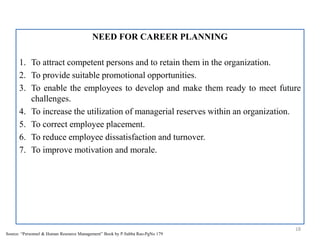
NEED FOR CAREER PLANNING
1. To attract competent persons and to retain them in the organization.
2. To provide suitable promotional opportunities.
3. To enable the employees to develop and make them ready to meet future
challenges.
4. To increase the utilization of managerial reserves within an organization.
5. To correct employee placement.
6. To reduce employee dissatisfaction and turnover.
7. To improve motivation and morale.
18
Source: “Personnel & Human Resource Management” Book by P.Subba Rao-PgNo 179
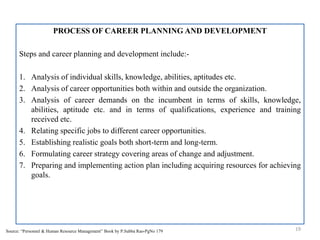
PROCESS OF CAREER PLANNING AND DEVELOPMENT
Steps and career planning and development include:-
1. Analysis of individual skills, knowledge, abilities, aptitudes etc.
2. Analysis of career opportunities both within and outside the organization.
3. Analysis of career demands on the incumbent in terms of skills, knowledge,
abilities, aptitude etc. and in terms of qualifications, experience and training
received etc.
4. Relating specific jobs to different career opportunities.
5. Establishing realistic goals both short-term and long-term.
6. Formulating career strategy covering areas of change and adjustment.
7. Preparing and implementing action plan including acquiring resources for achieving
goals.
19Source: “Personnel & Human Resource Management” Book by P.Subba Rao-PgNo 179
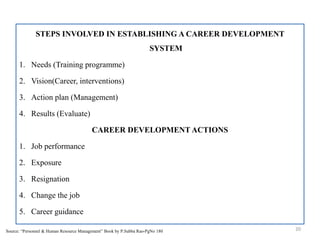
STEPS INVOLVED IN ESTABLISHING A CAREER DEVELOPMENT
SYSTEM
1. Needs (Training programme)
2. Vision(Career, interventions)
3. Action plan (Management)
4. Results (Evaluate)
CAREER DEVELOPMENT ACTIONS
1. Job performance
2. Exposure
3. Resignation
4. Change the job
5. Career guidance
20Source: “Personnel & Human Resource Management” Book by P.Subba Rao-PgNo 180
 According to William J.Rothwell, “Succession planning is a means of
identifying critical management positions starting at manager and
supervisor levels and extending up to the highest position in the
organization.”
 Succession planning can be defined as a purposeful and systematic effort
made by an organization to ensure leadership continuity, retain and develop
knowledge and intellectual capital for the future and encourage individual
employee growth and development.
 The process of identity and develop potential future leaders or senior
managers, as well as individuals to fill other positions critical to an
organization, either in the short or the long-term
 “A defined program that an organization systematized to ensure leadership
continuity for all key positions by developing activities that will build
personnel talent from within.”
21
Succession planning
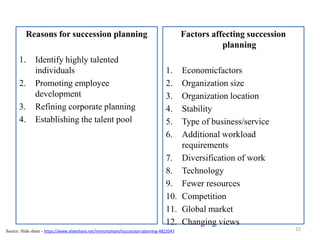
Reasons for succession planning
1. Identify highly talented
individuals
2. Promoting employee
development
3. Refining corporate planning
4. Establishing the talent pool
22
Factors affecting succession
planning
1. Economicfactors
2. Organization size
3. Organization location
4. Stability
5. Type of business/service
6. Additional workload
requirements
7. Diversification of work
8. Technology
9. Fewer resources
10. Competition
11. Global market
12. Changing views
Source: Slide share - https://www.slideshare.net/immortalsam/succession-planning-4822047
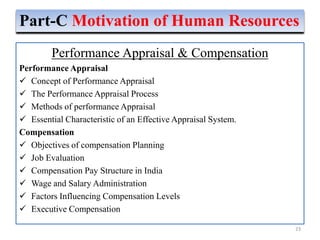
Performance Appraisal & Compensation
Performance Appraisal
 Concept of Performance Appraisal
 The Performance Appraisal Process
 Methods of performance Appraisal
 Essential Characteristic of an Effective Appraisal System.
Compensation
 Objectives of compensation Planning
 Job Evaluation
 Compensation Pay Structure in India
 Wage and Salary Administration
 Factors Influencing Compensation Levels
 Executive Compensation
23
Part-C Motivation of Human Resources
 According to Edwin B Flippo, “Performance appraisal is a systematic, periodic and
so far as humanly possible, an impartial rating of an employee’s excellence in
matters pertaining to his present job and to his potentialities for a better job.”
 According to Dale Beach, “Performance appraisal is the systematic evaluation of
the individual with regards to his or her performance on the job and his potential for
development.”
 Meaning: Performance appraisal means evaluating an employees current and/or
past performance in comparison with the set of standards.
 Performance appraisal is the systematic evaluation of the performance of the
employees and to understand the abilities of a person for future growth and
development.
24
Concept of performance appraisal
25
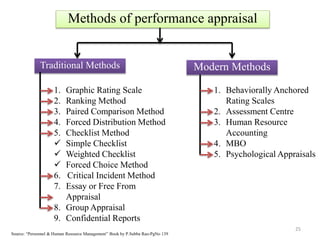
Methods of performance appraisal
Traditional Methods Modern Methods
1. Graphic Rating Scale
2. Ranking Method
3. Paired Comparison Method
4. Forced Distribution Method
5. Checklist Method
 Simple Checklist
 Weighted Checklist
 Forced Choice Method
6. Critical Incident Method
7. Essay or Free From
Appraisal
8. Group Appraisal
9. Confidential Reports
1. Behaviorally Anchored
Rating Scales
2. Assessment Centre
3. Human Resource
Accounting
4. MBO
5. Psychological Appraisals
Source: “Personnel & Human Resource Management” Book by P.Subba Rao-PgNo 139
26
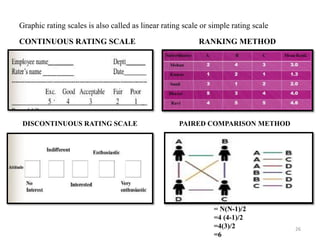
CONTINUOUS RATING SCALE
DISCONTINUOUS RATING SCALE
RANKING METHOD
PAIRED COMPARISON METHOD
= N(N-1)/2
=4 (4-1)/2
=4(3)/2
=6
Graphic rating scales is also called as linear rating scale or simple rating scale
27
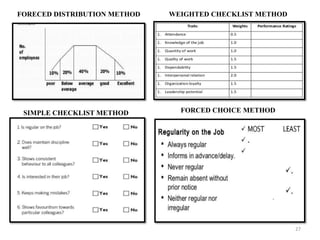
FORECED DISTRIBUTION METHOD WEIGHTED CHECKLIST METHOD
SIMPLE CHECKLIST METHOD FORCED CHOICE METHOD
28
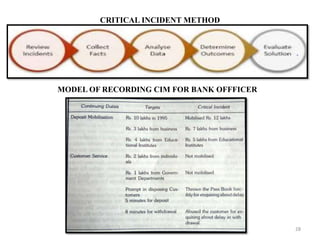
CRITICAL INCIDENT METHOD
MODEL OF RECORDING CIM FOR BANK OFFFICER
29
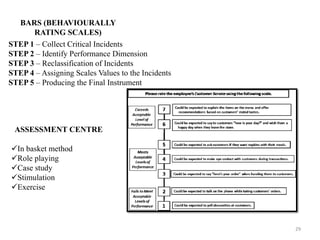
BARS (BEHAVIOURALLY
RATING SCALES)
STEP 1 – Collect Critical Incidents
STEP 2 – Identify Performance Dimension
STEP 3 – Reclassification of Incidents
STEP 4 – Assigning Scales Values to the Incidents
STEP 5 – Producing the Final Instrument
ASSESSMENT CENTRE
In basket method
Role playing
Case study
Stimulation
Exercise
30
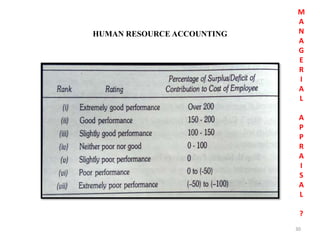
HUMAN RESOURCE ACCOUNTING
M
A
N
A
G
E
R
I
A
L
A
P
P
R
A
I
S
A
L
?
31
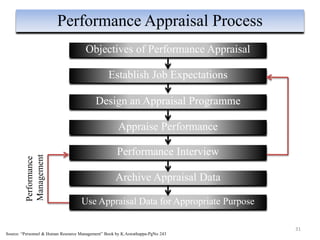
Performance Appraisal Process
Objectives of Performance Appraisal
Establish Job Expectations
Design an Appraisal Programme
Appraise Performance
Performance Interview
Archive Appraisal Data
Use Appraisal Data for Appropriate Purpose
Performance
Management
Source: “Personnel & Human Resource Management” Book by K.Aswathappa-PgNo 243
32
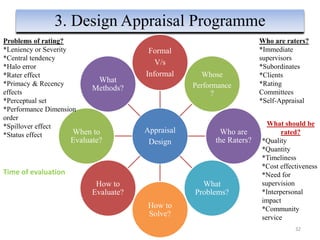
3. Design Appraisal Programme
Appraisal
Design
Formal
V/s
Informal Whose
Performance
?
Who are
the Raters?
What
Problems?
How to
Solve?
How to
Evaluate?
When to
Evaluate?
What
Methods?
Who are raters?
*Immediate
supervisors
*Subordinates
*Clients
*Rating
Committees
*Self-Appraisal
Problems of rating?
*Leniency or Severity
*Central tendency
*Halo error
*Rater effect
*Primacy & Recency
effects
*Perceptual set
*Performance Dimension
order
*Spillover effect
*Status effect
What should be
rated?
*Quality
*Quantity
*Timeliness
*Cost effectiveness
*Need for
supervision
*Interpersonal
impact
*Community
service
Time of evaluation
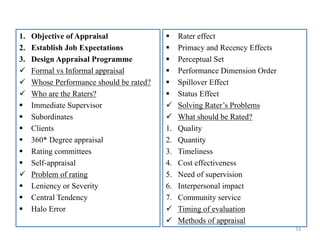
1. Objective of Appraisal
2. Establish Job Expectations
3. Design Appraisal Programme
 Formal vs Informal appraisal
 Whose Performance should be rated?
 Who are the Raters?
 Immediate Supervisor
 Subordinates
 Clients
 360* Degree appraisal
 Rating committees
 Self-appraisal
 Problem of rating
 Leniency or Severity
 Central Tendency
 Halo Error
33
 Rater effect
 Primacy and Recency Effects
 Perceptual Set
 Performance Dimension Order
 Spillover Effect
 Status Effect
 Solving Rater’s Problems
 What should be Rated?
1. Quality
2. Quantity
3. Timeliness
4. Cost effectiveness
5. Need of supervision
6. Interpersonal impact
7. Community service
 Timing of evaluation
 Methods of appraisal
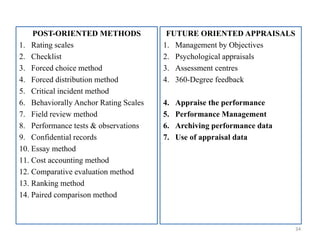
POST-ORIENTED METHODS
1. Rating scales
2. Checklist
3. Forced choice method
4. Forced distribution method
5. Critical incident method
6. Behaviorally Anchor Rating Scales
7. Field review method
8. Performance tests & observations
9. Confidential records
10. Essay method
11. Cost accounting method
12. Comparative evaluation method
13. Ranking method
14. Paired comparison method
34
FUTURE ORIENTED APPRAISALS
1. Management by Objectives
2. Psychological appraisals
3. Assessment centres
4. 360-Degree feedback
4. Appraise the performance
5. Performance Management
6. Archiving performance data
7. Use of appraisal data
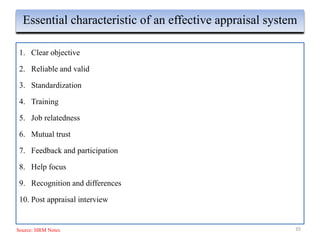
1. Clear objective
2. Reliable and valid
3. Standardization
4. Training
5. Job relatedness
6. Mutual trust
7. Feedback and participation
8. Help focus
9. Recognition and differences
10. Post appraisal interview
35
Essential characteristic of an effective appraisal system
Source: HRM Notes
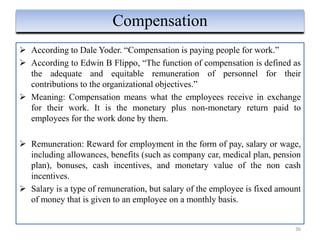
 According to Dale Yoder. “Compensation is paying people for work.”
 According to Edwin B Flippo, “The function of compensation is defined as
the adequate and equitable remuneration of personnel for their
contributions to the organizational objectives.”
 Meaning: Compensation means what the employees receive in exchange
for their work. It is the monetary plus non-monetary return paid to
employees for the work done by them.
 Remuneration: Reward for employment in the form of pay, salary or wage,
including allowances, benefits (such as company car, medical plan, pension
plan), bonuses, cash incentives, and monetary value of the non cash
incentives.
 Salary is a type of remuneration, but salary of the employee is fixed amount
of money that is given to an employee on a monthly basis.
36
Compensation
37
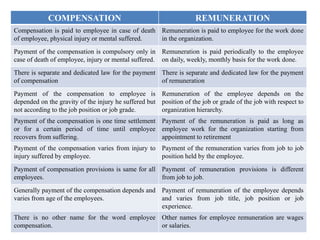
COMPENSATION REMUNERATION
Compensation is paid to employee in case of death
of employee, physical injury or mental suffered.
Remuneration is paid to employee for the work done
in the organization.
Payment of the compensation is compulsory only in
case of death of employee, injury or mental suffered.
Remuneration is paid periodically to the employee
on daily, weekly, monthly basis for the work done.
There is separate and dedicated law for the payment
of compensation
There is separate and dedicated law for the payment
of remuneration
Payment of the compensation to employee is
depended on the gravity of the injury he suffered but
not according to the job position or job grade.
Remuneration of the employee depends on the
position of the job or grade of the job with respect to
organization hierarchy.
Payment of the compensation is one time settlement
or for a certain period of time until employee
recovers from suffering.
Payment of the remuneration is paid as long as
employee work for the organization starting from
appointment to retirement
Payment of the compensation varies from injury to
injury suffered by employee.
Payment of the remuneration varies from job to job
position held by the employee.
Payment of compensation provisions is same for all
employees.
Payment of remuneration provisions is different
from job to job.
Generally payment of the compensation depends and
varies from age of the employees.
Payment of remuneration of the employee depends
and varies from job title, job position or job
experience.
There is no other name for the word employee
compensation.
Other names for employee remuneration are wages
or salaries.
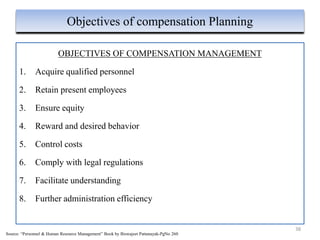
OBJECTIVES OF COMPENSATION MANAGEMENT
1. Acquire qualified personnel
2. Retain present employees
3. Ensure equity
4. Reward and desired behavior
5. Control costs
6. Comply with legal regulations
7. Facilitate understanding
8. Further administration efficiency
38
Objectives of compensation Planning
Source: “Personnel & Human Resource Management” Book by Biswajeet Pattanayak-PgNo 260
39
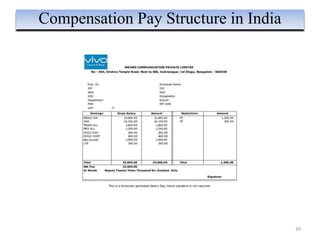
Compensation Pay Structure in India
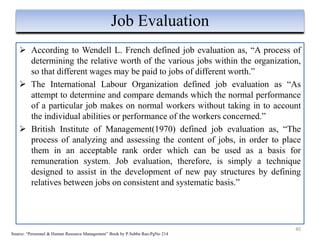
 According to Wendell L. French defined job evaluation as, “A process of
determining the relative worth of the various jobs within the organization,
so that different wages may be paid to jobs of different worth.”
 The International Labour Organization defined job evaluation as “As
attempt to determine and compare demands which the normal performance
of a particular job makes on normal workers without taking in to account
the individual abilities or performance of the workers concerned.”
 British Institute of Management(1970) defined job evaluation as, “The
process of analyzing and assessing the content of jobs, in order to place
them in an acceptable rank order which can be used as a basis for
remuneration system. Job evaluation, therefore, is simply a technique
designed to assist in the development of new pay structures by defining
relatives between jobs on consistent and systematic basis.”
40
Job Evaluation
Source: “Personnel & Human Resource Management” Book by P.Subba Rao-PgNo 214
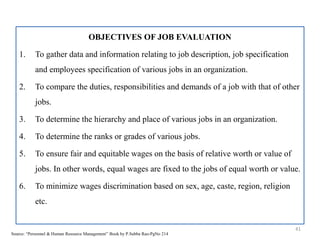
OBJECTIVES OF JOB EVALUATION
1. To gather data and information relating to job description, job specification
and employees specification of various jobs in an organization.
2. To compare the duties, responsibilities and demands of a job with that of other
jobs.
3. To determine the hierarchy and place of various jobs in an organization.
4. To determine the ranks or grades of various jobs.
5. To ensure fair and equitable wages on the basis of relative worth or value of
jobs. In other words, equal wages are fixed to the jobs of equal worth or value.
6. To minimize wages discrimination based on sex, age, caste, region, religion
etc.
41
Source: “Personnel & Human Resource Management” Book by P.Subba Rao-PgNo 214
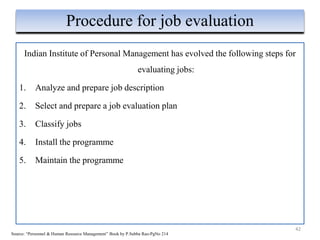
Indian Institute of Personal Management has evolved the following steps for
evaluating jobs:
1. Analyze and prepare job description
2. Select and prepare a job evaluation plan
3. Classify jobs
4. Install the programme
5. Maintain the programme
42
Procedure for job evaluation
Source: “Personnel & Human Resource Management” Book by P.Subba Rao-PgNo 214
43
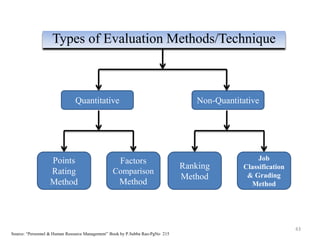
Types of Evaluation Methods/Technique
Quantitative Non-Quantitative
Points
Rating
Method
Factors
Comparison
Method
Ranking
Method
Job
Classification
& Grading
Method
Source: “Personnel & Human Resource Management” Book by P.Subba Rao-PgNo 215
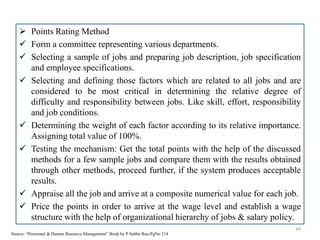
 Points Rating Method
 Form a committee representing various departments.
 Selecting a sample of jobs and preparing job description, job specification
and employee specifications.
 Selecting and defining those factors which are related to all jobs and are
considered to be most critical in determining the relative degree of
difficulty and responsibility between jobs. Like skill, effort, responsibility
and job conditions.
 Determining the weight of each factor according to its relative importance.
Assigning total value of 100%.
 Testing the mechanism: Get the total points with the help of the discussed
methods for a few sample jobs and compare them with the results obtained
through other methods, proceed further, if the system produces acceptable
results.
 Appraise all the job and arrive at a composite numerical value for each job.
 Price the points in order to arrive at the wage level and establish a wage
structure with the help of organizational hierarchy of jobs & salary policy.
44
Source: “Personnel & Human Resource Management” Book by P.Subba Rao-PgNo 214
45
Source: “Personnel & Human Resource Management” Book by P.Subba Rao-PgNo 214
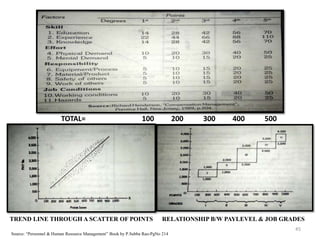
100 200 300 400 500TOTAL=
TREND LINE THROUGH A SCATTER OF POINTS RELATIONSHIP B/W PAYLEVEL & JOB GRADES
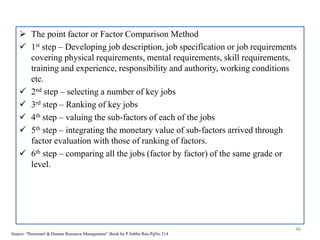
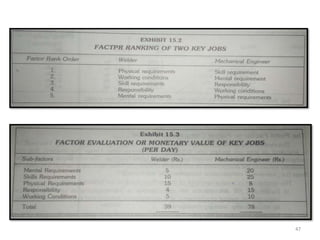
 The point factor or Factor Comparison Method
 1st step – Developing job description, job specification or job requirements
covering physical requirements, mental requirements, skill requirements,
training and experience, responsibility and authority, working conditions
etc.
 2nd step – selecting a number of key jobs
 3rd step – Ranking of key jobs
 4th step – valuing the sub-factors of each of the jobs
 5th step – integrating the monetary value of sub-factors arrived through
factor evaluation with those of ranking of factors.
 6th step – comparing all the jobs (factor by factor) of the same grade or
level.
46
Source: “Personnel & Human Resource Management” Book by P.Subba Rao-PgNo 214
47
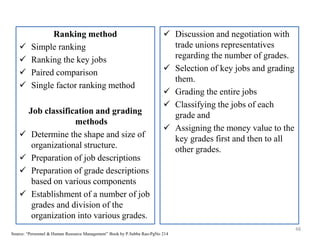
Ranking method
 Simple ranking
 Ranking the key jobs
 Paired comparison
 Single factor ranking method
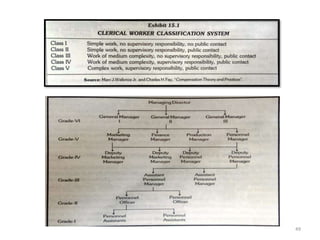
Job classification and grading
methods
 Determine the shape and size of
organizational structure.
 Preparation of job descriptions
 Preparation of grade descriptions
based on various components
 Establishment of a number of job
grades and division of the
organization into various grades.
48
Source: “Personnel & Human Resource Management” Book by P.Subba Rao-PgNo 214
 Discussion and negotiation with
trade unions representatives
regarding the number of grades.
 Selection of key jobs and grading
them.
 Grading the entire jobs
 Classifying the jobs of each
grade and
 Assigning the money value to the
key grades first and then to all
other grades.
49
50

HRM module 4

  • 1.
    WELCOME MODULE – 4 Part-BDevelopment of Human Resources Training & Development 1
  • 2.
    Training & Development Training v/s development  Training v/s Education  Systematic Approach to Training  Training Methods  Executive Development  Methods and Development of Management Development  Career and Succession Planning 2 Synopsis – Module 4 Source: “Personnel & Human Resource Management” Book by P.Subba Rao-PgNo 50
  • 3.
     According toDale S.Beach defines the training as “The organized procedure by which people learn knowledge and/or skill for a definite purpose.”  According to Edward B. Flippo, “Training is the act of increasing the knowledge and skill of an employee for doing a particular job.”  Training is the process of planned programs and procedures undertaken for the improvement of employee’s performance in terms of his attitude, skills, knowledge and behavior.  Training is the act of increasing the knowledge and skill of an employee for doing a particular job. Training is the short term educational process and utilizing a systematic and organized procedure by which employees learn technical knowledge and skills for a definite purpose. 3 Training
  • 4.
    4 Difference b/w Training& Development TRAINING DEVELOPMENT Training is designed for non-managers as well as managers It involves only managerial personnel It is a short term process Long term in nature Managerial personnel learn technical knowledge and skills Managerial personnel learn conceptual and theoretical knowledge The objectives of training are specific job-related purpose The objectives have broader over view and consider general knowledge Training is concerned with the immediate improvement of the employee i.e the ways to make the employee more effective in his current role Development is a process to make the employee efficient enough to handle critical situation in the future, i.e how well he can equip himself for the future demands Training means learning new things and refreshing old one Development means implementing the learned session and finding new ones
  • 5.
    5 Difference b/w Trainingv/s Development BASIS FOR COMPARISON TRAINING DEVELOPMENT Meaning Training is an learning process in which employees get an opportunity to develop skills, competency and knowledge as per the job requirements. Development is an educational process which is concerned with overall growth of the employees Term Short term Long term Focus on Present Future Orientation Job oriented Career oriented Motive Trainer Self Objective To improve the work performance of the employees To prepare employees for future challenges Number of individuals Many Only one Aim Specific job related Conceptual and general knowledge
  • 6.
    6 Difference b/w Trainingv/s Education BASIS FOR COMPARISON TRAINING EDUCATION Meaning The process of uncalculating specific skills in a person is training Theoretical learning in the class room or any institution in education What is it? It is a method of skill development It is a typical form of learning Based on Practical application Theoretical orientation Perspective Narrow Wide Involves Job experience Classroom learning Term Short term Comparatively long term Prepare for Present job Future job Objective To improve performance and productivity To develop a sense of reasoning and judgment Teaches Specific task General concepts
  • 7.
     A systematicapproach to training ensure than an organizations course development efforts produce consistent results. This includes using a structured approach of analyzing needs, designing class outlines, developing course content and materials, delivering instruction and evaluating success. Ensuring that training courses meet the real needs of the target audience requires comprehensive planning and organization. Aligning learning objectives to a companies strategic goals enables employees to undergo training that improves their job performance and produces a positive business impact.  SAT is methodology for managing training programs. It is orderly, logical approach to determining what people must know and do at a particular job or a specific profession. Systematic approach for training ensures that people are prepared for their work by having the necessary knowledge, skills and attitudes to do their job. 7 Systematicc Approach to Training(SAT)
  • 8.
    Advantages of SAT •SAT is accountable because it is measured • SAT provides continual feedback as the results of training are evaluated • SAT supports teamwork • SAT is performance based training intended to improve worker performance and measures success on the basis of improved personnel and plant performance 8
  • 9.
    9 5 phases ofSAT process
  • 10.
     According toDale S.Beach defines the training as “The organized procedure by which people learn knowledge and/or skill for a definite purpose.”  According to Edward B. Flippo, “Training is the act of increasing the knowledge and skill of an employee for doing a particular job.”  Training is the process of planned programs and procedures undertaken for the improvement of employee’s performance in terms of his attitude, skills, knowledge and behavior.  Training is the act of increasing the knowledge and skill of an employee for doing a particular job. Training is the short term educational process and utilizing a systematic and organized procedure by which employees learn technical knowledge and skills for a definite purpose. 10 Training
  • 11.
    NEED FOR TRAINING A.To meet the employee specifications with the job requirements and organizational needs. B. Organizational viability and the transformation process C. Technological advances D. Organizational complexity E. Human relations F. Change in the job assignment 11 Source: “Personnel & Human Resource Management” Book by P.Subba Rao-PgNo 156
  • 12.
    12 TRAINING METHODS On-the job methodsOff-the job methods Job Rotation Coaching Job Instruction Training through step-by-step Committee Assignments Vestibule Training Role Playing Lecture Methods Conference or Discussion Programmed Instruction Source: “Personnel & Human Resource Management” Book by P.Subba Rao-PgNo 159
  • 13.
    13 Source: “Personnel &Human Resource Management” Book by P.Subba Rao-PgNo 162 THE TRAINING PROCEDURE Preparing the instructor Preparing the trainee Getting ready to teach Presenting the operation Try out the trainee’s performance Follow-up
  • 14.
    14 Job and organizational analysis Evaluate the trainee(s) Identifying thetraining needs Design the training needs Prepare cost budget and foresee benefits–Have cost benefit analysis Design training content, teaching methods and media Prepare the instructor Prepare the trainee Get ready to teach Implement the training programme Present the operations Gain the acceptance of the programme Try out the trainee’s performance Evaluate the results Update the programme Source: “Personnel & Human Resource Management” Book by P.Subba Rao-PgNo 163 T R A I N I N G P R O C E D U R E F O R U N D E R S T A N D I N G P U R P O S E
  • 15.
     Development isthe process of preparing employees for future position and improve their personal skills to handle the critical situations in an organization.  Development is generally aimed at helping manager better understand and solve problems, make decision, and capitalize on opportunities. Effort made to improve employees ability to handle a variety of assignment.  According to Armstrong “ Management development is the business led process. The business determines what kind of mangers it require to accomplish its strategic goals as well as how to obtain and develop such managers. Although there is stress of self- development, the business must indicate the directions towards which self-development should occur.”  According to Molander “Management development is a conscious and systematic process to control the development of managerial resources in the organization for the achievement of goals and strategies.” 15 Management Development
  • 16.
    16 Important Method ofManagement Development On-the-job Techniques Off-the-job Techniques Coaching Job Rotation Under Study Multiple Management The Case Study Method Incident Method Role Playing In Basket Method Business Game Sensitivity Training Simulation Grid Training Conferences Lectures Source: “Personnel & Human Resource Management” Book by P.Subba Rao-PgNo 172
  • 17.
     According toSchermerborn, Hunt, and Osborn, “Career Planning is a process of systematically matching career goals and individual capabilities with opportunities for their fulfillment.”  Meaning: A career planning is a step wise process which enables an individual to focus on where to want to be in life professionally. With the short-term goal and the long-term goals in place.  Career planning is one of the benefits of career development which aims at the development system of the employee. This helps in the guidance and assistance of aspirations, desires and the objectives of the growth. It has more goals that are to be accomplished. It triggers communication between employee and manager. 17 Career planning
  • 18.
    NEED FOR CAREERPLANNING 1. To attract competent persons and to retain them in the organization. 2. To provide suitable promotional opportunities. 3. To enable the employees to develop and make them ready to meet future challenges. 4. To increase the utilization of managerial reserves within an organization. 5. To correct employee placement. 6. To reduce employee dissatisfaction and turnover. 7. To improve motivation and morale. 18 Source: “Personnel & Human Resource Management” Book by P.Subba Rao-PgNo 179
  • 19.
    PROCESS OF CAREERPLANNING AND DEVELOPMENT Steps and career planning and development include:- 1. Analysis of individual skills, knowledge, abilities, aptitudes etc. 2. Analysis of career opportunities both within and outside the organization. 3. Analysis of career demands on the incumbent in terms of skills, knowledge, abilities, aptitude etc. and in terms of qualifications, experience and training received etc. 4. Relating specific jobs to different career opportunities. 5. Establishing realistic goals both short-term and long-term. 6. Formulating career strategy covering areas of change and adjustment. 7. Preparing and implementing action plan including acquiring resources for achieving goals. 19Source: “Personnel & Human Resource Management” Book by P.Subba Rao-PgNo 179
  • 20.
    STEPS INVOLVED INESTABLISHING A CAREER DEVELOPMENT SYSTEM 1. Needs (Training programme) 2. Vision(Career, interventions) 3. Action plan (Management) 4. Results (Evaluate) CAREER DEVELOPMENT ACTIONS 1. Job performance 2. Exposure 3. Resignation 4. Change the job 5. Career guidance 20Source: “Personnel & Human Resource Management” Book by P.Subba Rao-PgNo 180
  • 21.
     According toWilliam J.Rothwell, “Succession planning is a means of identifying critical management positions starting at manager and supervisor levels and extending up to the highest position in the organization.”  Succession planning can be defined as a purposeful and systematic effort made by an organization to ensure leadership continuity, retain and develop knowledge and intellectual capital for the future and encourage individual employee growth and development.  The process of identity and develop potential future leaders or senior managers, as well as individuals to fill other positions critical to an organization, either in the short or the long-term  “A defined program that an organization systematized to ensure leadership continuity for all key positions by developing activities that will build personnel talent from within.” 21 Succession planning
  • 22.
    Reasons for successionplanning 1. Identify highly talented individuals 2. Promoting employee development 3. Refining corporate planning 4. Establishing the talent pool 22 Factors affecting succession planning 1. Economicfactors 2. Organization size 3. Organization location 4. Stability 5. Type of business/service 6. Additional workload requirements 7. Diversification of work 8. Technology 9. Fewer resources 10. Competition 11. Global market 12. Changing views Source: Slide share - https://www.slideshare.net/immortalsam/succession-planning-4822047
  • 23.
    Performance Appraisal &Compensation Performance Appraisal  Concept of Performance Appraisal  The Performance Appraisal Process  Methods of performance Appraisal  Essential Characteristic of an Effective Appraisal System. Compensation  Objectives of compensation Planning  Job Evaluation  Compensation Pay Structure in India  Wage and Salary Administration  Factors Influencing Compensation Levels  Executive Compensation 23 Part-C Motivation of Human Resources
  • 24.
     According toEdwin B Flippo, “Performance appraisal is a systematic, periodic and so far as humanly possible, an impartial rating of an employee’s excellence in matters pertaining to his present job and to his potentialities for a better job.”  According to Dale Beach, “Performance appraisal is the systematic evaluation of the individual with regards to his or her performance on the job and his potential for development.”  Meaning: Performance appraisal means evaluating an employees current and/or past performance in comparison with the set of standards.  Performance appraisal is the systematic evaluation of the performance of the employees and to understand the abilities of a person for future growth and development. 24 Concept of performance appraisal
  • 25.
    25 Methods of performanceappraisal Traditional Methods Modern Methods 1. Graphic Rating Scale 2. Ranking Method 3. Paired Comparison Method 4. Forced Distribution Method 5. Checklist Method  Simple Checklist  Weighted Checklist  Forced Choice Method 6. Critical Incident Method 7. Essay or Free From Appraisal 8. Group Appraisal 9. Confidential Reports 1. Behaviorally Anchored Rating Scales 2. Assessment Centre 3. Human Resource Accounting 4. MBO 5. Psychological Appraisals Source: “Personnel & Human Resource Management” Book by P.Subba Rao-PgNo 139
  • 26.
    26 CONTINUOUS RATING SCALE DISCONTINUOUSRATING SCALE RANKING METHOD PAIRED COMPARISON METHOD = N(N-1)/2 =4 (4-1)/2 =4(3)/2 =6 Graphic rating scales is also called as linear rating scale or simple rating scale
  • 27.
    27 FORECED DISTRIBUTION METHODWEIGHTED CHECKLIST METHOD SIMPLE CHECKLIST METHOD FORCED CHOICE METHOD
  • 28.
    28 CRITICAL INCIDENT METHOD MODELOF RECORDING CIM FOR BANK OFFFICER
  • 29.
    29 BARS (BEHAVIOURALLY RATING SCALES) STEP1 – Collect Critical Incidents STEP 2 – Identify Performance Dimension STEP 3 – Reclassification of Incidents STEP 4 – Assigning Scales Values to the Incidents STEP 5 – Producing the Final Instrument ASSESSMENT CENTRE In basket method Role playing Case study Stimulation Exercise
  • 30.
  • 31.
    31 Performance Appraisal Process Objectivesof Performance Appraisal Establish Job Expectations Design an Appraisal Programme Appraise Performance Performance Interview Archive Appraisal Data Use Appraisal Data for Appropriate Purpose Performance Management Source: “Personnel & Human Resource Management” Book by K.Aswathappa-PgNo 243
  • 32.
    32 3. Design AppraisalProgramme Appraisal Design Formal V/s Informal Whose Performance ? Who are the Raters? What Problems? How to Solve? How to Evaluate? When to Evaluate? What Methods? Who are raters? *Immediate supervisors *Subordinates *Clients *Rating Committees *Self-Appraisal Problems of rating? *Leniency or Severity *Central tendency *Halo error *Rater effect *Primacy & Recency effects *Perceptual set *Performance Dimension order *Spillover effect *Status effect What should be rated? *Quality *Quantity *Timeliness *Cost effectiveness *Need for supervision *Interpersonal impact *Community service Time of evaluation
  • 33.
    1. Objective ofAppraisal 2. Establish Job Expectations 3. Design Appraisal Programme  Formal vs Informal appraisal  Whose Performance should be rated?  Who are the Raters?  Immediate Supervisor  Subordinates  Clients  360* Degree appraisal  Rating committees  Self-appraisal  Problem of rating  Leniency or Severity  Central Tendency  Halo Error 33  Rater effect  Primacy and Recency Effects  Perceptual Set  Performance Dimension Order  Spillover Effect  Status Effect  Solving Rater’s Problems  What should be Rated? 1. Quality 2. Quantity 3. Timeliness 4. Cost effectiveness 5. Need of supervision 6. Interpersonal impact 7. Community service  Timing of evaluation  Methods of appraisal
  • 34.
    POST-ORIENTED METHODS 1. Ratingscales 2. Checklist 3. Forced choice method 4. Forced distribution method 5. Critical incident method 6. Behaviorally Anchor Rating Scales 7. Field review method 8. Performance tests & observations 9. Confidential records 10. Essay method 11. Cost accounting method 12. Comparative evaluation method 13. Ranking method 14. Paired comparison method 34 FUTURE ORIENTED APPRAISALS 1. Management by Objectives 2. Psychological appraisals 3. Assessment centres 4. 360-Degree feedback 4. Appraise the performance 5. Performance Management 6. Archiving performance data 7. Use of appraisal data
  • 35.
    1. Clear objective 2.Reliable and valid 3. Standardization 4. Training 5. Job relatedness 6. Mutual trust 7. Feedback and participation 8. Help focus 9. Recognition and differences 10. Post appraisal interview 35 Essential characteristic of an effective appraisal system Source: HRM Notes
  • 36.
     According toDale Yoder. “Compensation is paying people for work.”  According to Edwin B Flippo, “The function of compensation is defined as the adequate and equitable remuneration of personnel for their contributions to the organizational objectives.”  Meaning: Compensation means what the employees receive in exchange for their work. It is the monetary plus non-monetary return paid to employees for the work done by them.  Remuneration: Reward for employment in the form of pay, salary or wage, including allowances, benefits (such as company car, medical plan, pension plan), bonuses, cash incentives, and monetary value of the non cash incentives.  Salary is a type of remuneration, but salary of the employee is fixed amount of money that is given to an employee on a monthly basis. 36 Compensation
  • 37.
    37 COMPENSATION REMUNERATION Compensation ispaid to employee in case of death of employee, physical injury or mental suffered. Remuneration is paid to employee for the work done in the organization. Payment of the compensation is compulsory only in case of death of employee, injury or mental suffered. Remuneration is paid periodically to the employee on daily, weekly, monthly basis for the work done. There is separate and dedicated law for the payment of compensation There is separate and dedicated law for the payment of remuneration Payment of the compensation to employee is depended on the gravity of the injury he suffered but not according to the job position or job grade. Remuneration of the employee depends on the position of the job or grade of the job with respect to organization hierarchy. Payment of the compensation is one time settlement or for a certain period of time until employee recovers from suffering. Payment of the remuneration is paid as long as employee work for the organization starting from appointment to retirement Payment of the compensation varies from injury to injury suffered by employee. Payment of the remuneration varies from job to job position held by the employee. Payment of compensation provisions is same for all employees. Payment of remuneration provisions is different from job to job. Generally payment of the compensation depends and varies from age of the employees. Payment of remuneration of the employee depends and varies from job title, job position or job experience. There is no other name for the word employee compensation. Other names for employee remuneration are wages or salaries.
  • 38.
    OBJECTIVES OF COMPENSATIONMANAGEMENT 1. Acquire qualified personnel 2. Retain present employees 3. Ensure equity 4. Reward and desired behavior 5. Control costs 6. Comply with legal regulations 7. Facilitate understanding 8. Further administration efficiency 38 Objectives of compensation Planning Source: “Personnel & Human Resource Management” Book by Biswajeet Pattanayak-PgNo 260
  • 39.
  • 40.
     According toWendell L. French defined job evaluation as, “A process of determining the relative worth of the various jobs within the organization, so that different wages may be paid to jobs of different worth.”  The International Labour Organization defined job evaluation as “As attempt to determine and compare demands which the normal performance of a particular job makes on normal workers without taking in to account the individual abilities or performance of the workers concerned.”  British Institute of Management(1970) defined job evaluation as, “The process of analyzing and assessing the content of jobs, in order to place them in an acceptable rank order which can be used as a basis for remuneration system. Job evaluation, therefore, is simply a technique designed to assist in the development of new pay structures by defining relatives between jobs on consistent and systematic basis.” 40 Job Evaluation Source: “Personnel & Human Resource Management” Book by P.Subba Rao-PgNo 214
  • 41.
    OBJECTIVES OF JOBEVALUATION 1. To gather data and information relating to job description, job specification and employees specification of various jobs in an organization. 2. To compare the duties, responsibilities and demands of a job with that of other jobs. 3. To determine the hierarchy and place of various jobs in an organization. 4. To determine the ranks or grades of various jobs. 5. To ensure fair and equitable wages on the basis of relative worth or value of jobs. In other words, equal wages are fixed to the jobs of equal worth or value. 6. To minimize wages discrimination based on sex, age, caste, region, religion etc. 41 Source: “Personnel & Human Resource Management” Book by P.Subba Rao-PgNo 214
  • 42.
    Indian Institute ofPersonal Management has evolved the following steps for evaluating jobs: 1. Analyze and prepare job description 2. Select and prepare a job evaluation plan 3. Classify jobs 4. Install the programme 5. Maintain the programme 42 Procedure for job evaluation Source: “Personnel & Human Resource Management” Book by P.Subba Rao-PgNo 214
  • 43.
    43 Types of EvaluationMethods/Technique Quantitative Non-Quantitative Points Rating Method Factors Comparison Method Ranking Method Job Classification & Grading Method Source: “Personnel & Human Resource Management” Book by P.Subba Rao-PgNo 215
  • 44.
     Points RatingMethod  Form a committee representing various departments.  Selecting a sample of jobs and preparing job description, job specification and employee specifications.  Selecting and defining those factors which are related to all jobs and are considered to be most critical in determining the relative degree of difficulty and responsibility between jobs. Like skill, effort, responsibility and job conditions.  Determining the weight of each factor according to its relative importance. Assigning total value of 100%.  Testing the mechanism: Get the total points with the help of the discussed methods for a few sample jobs and compare them with the results obtained through other methods, proceed further, if the system produces acceptable results.  Appraise all the job and arrive at a composite numerical value for each job.  Price the points in order to arrive at the wage level and establish a wage structure with the help of organizational hierarchy of jobs & salary policy. 44 Source: “Personnel & Human Resource Management” Book by P.Subba Rao-PgNo 214
  • 45.
    45 Source: “Personnel &Human Resource Management” Book by P.Subba Rao-PgNo 214 100 200 300 400 500TOTAL= TREND LINE THROUGH A SCATTER OF POINTS RELATIONSHIP B/W PAYLEVEL & JOB GRADES
  • 46.
     The pointfactor or Factor Comparison Method  1st step – Developing job description, job specification or job requirements covering physical requirements, mental requirements, skill requirements, training and experience, responsibility and authority, working conditions etc.  2nd step – selecting a number of key jobs  3rd step – Ranking of key jobs  4th step – valuing the sub-factors of each of the jobs  5th step – integrating the monetary value of sub-factors arrived through factor evaluation with those of ranking of factors.  6th step – comparing all the jobs (factor by factor) of the same grade or level. 46 Source: “Personnel & Human Resource Management” Book by P.Subba Rao-PgNo 214
  • 47.
  • 48.
    Ranking method  Simpleranking  Ranking the key jobs  Paired comparison  Single factor ranking method Job classification and grading methods  Determine the shape and size of organizational structure.  Preparation of job descriptions  Preparation of grade descriptions based on various components  Establishment of a number of job grades and division of the organization into various grades. 48 Source: “Personnel & Human Resource Management” Book by P.Subba Rao-PgNo 214  Discussion and negotiation with trade unions representatives regarding the number of grades.  Selection of key jobs and grading them.  Grading the entire jobs  Classifying the jobs of each grade and  Assigning the money value to the key grades first and then to all other grades.
  • 49.
  • 50.