Training and Development
Unit 3
Training is Expensive , without
Training it is More expensive-
Nehru
• Training and development involves improving the effectiveness
of organizations and the individuals and teams within them.
• Training may be viewed as related to immediate changes
in organizational effectiveness via organized instruction, while
development is related to the progress of longer-term
organizational and employee goals.
Definition
Training: It is a formal and Systematic modification of Behavior through learning which
occurs as a result of education , Instruction, Development and Planned experience.
 It is short Term process
 refers to Technical and mechanical Problems.
 Specific Job Related Purpose.
Development is a learning activity, which is directed towards future rather than present needs,
which is concerned more with career goals rather than immediate performance.
 It is a long term education process.
 Refers to philosophical and theoretical educational concepts
 Managerial personnel
 General knowledge purpose
Why T and D????
Training
Helps Employees to do their current jobs.
Development
Helps the individual handle future responsibilities
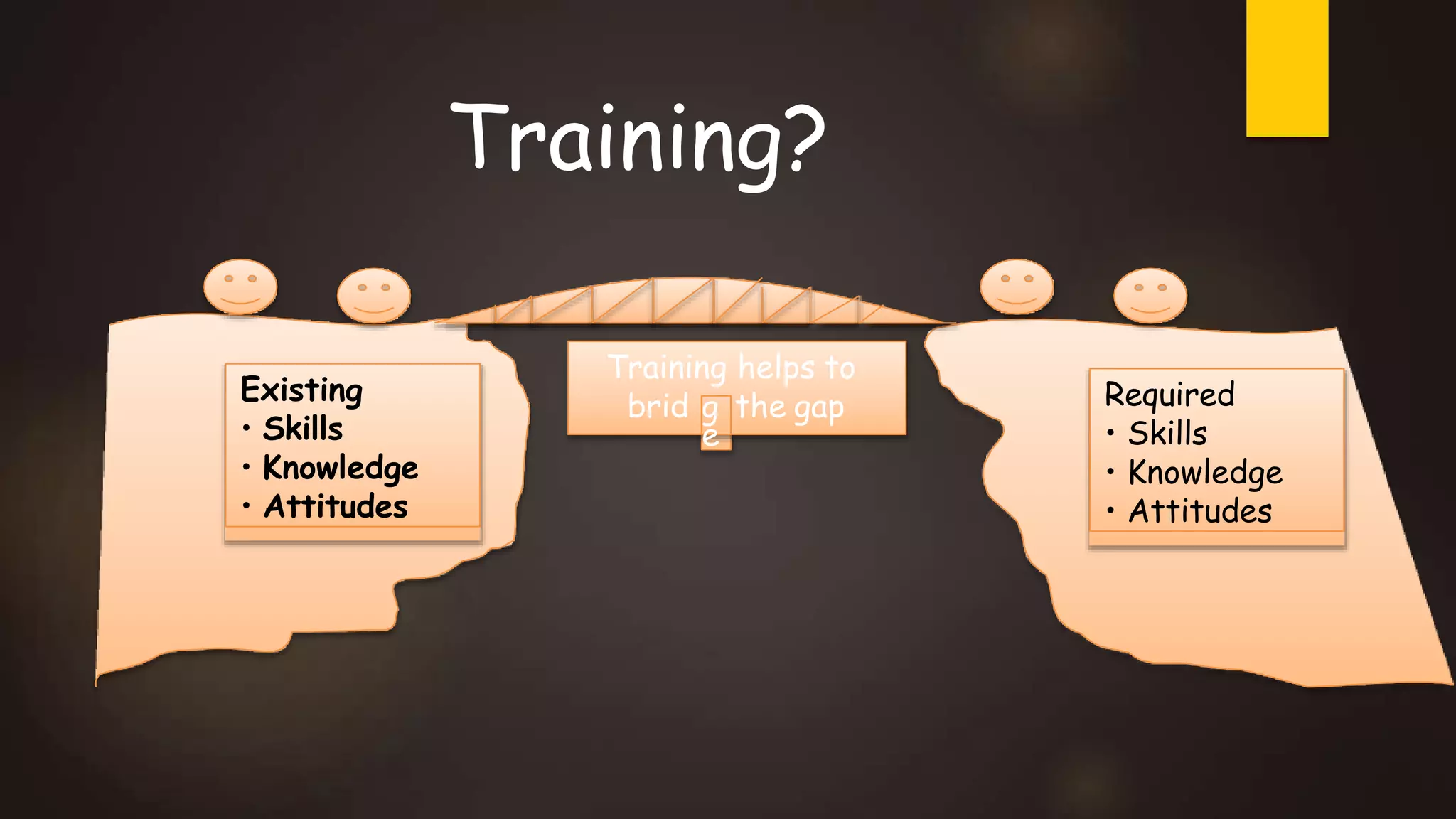
Training?
Training helps to
g
e
brid the gap
Existing
• Skills
• Knowledge
• Attitudes
Required
• Skills
• Knowledge
• Attitudes
• Training - a planned effort by a company to facilitate employees’
learning of job-related competencies.
• Competencies include knowledge, skills or behavior, abilities
(KSA) critical for successful job performance.
6
New
candidates who
join an
organization
Refresh and
enhance their
knowledge.
Implementation
of updates and
amendments
Promotion and
career growth
Training is given on four basic grounds:
Improving
Employee
Performance
Updating
Employee
Skills
Avoiding
Managerial
Obsolescenc
e
Preparing for
Promotion
and
Managerial
Succession
Retaining
and
Motivating
Employee
Creating an
Efficient
and
Effective
Organization
Improves
morale of
employees
Benefits
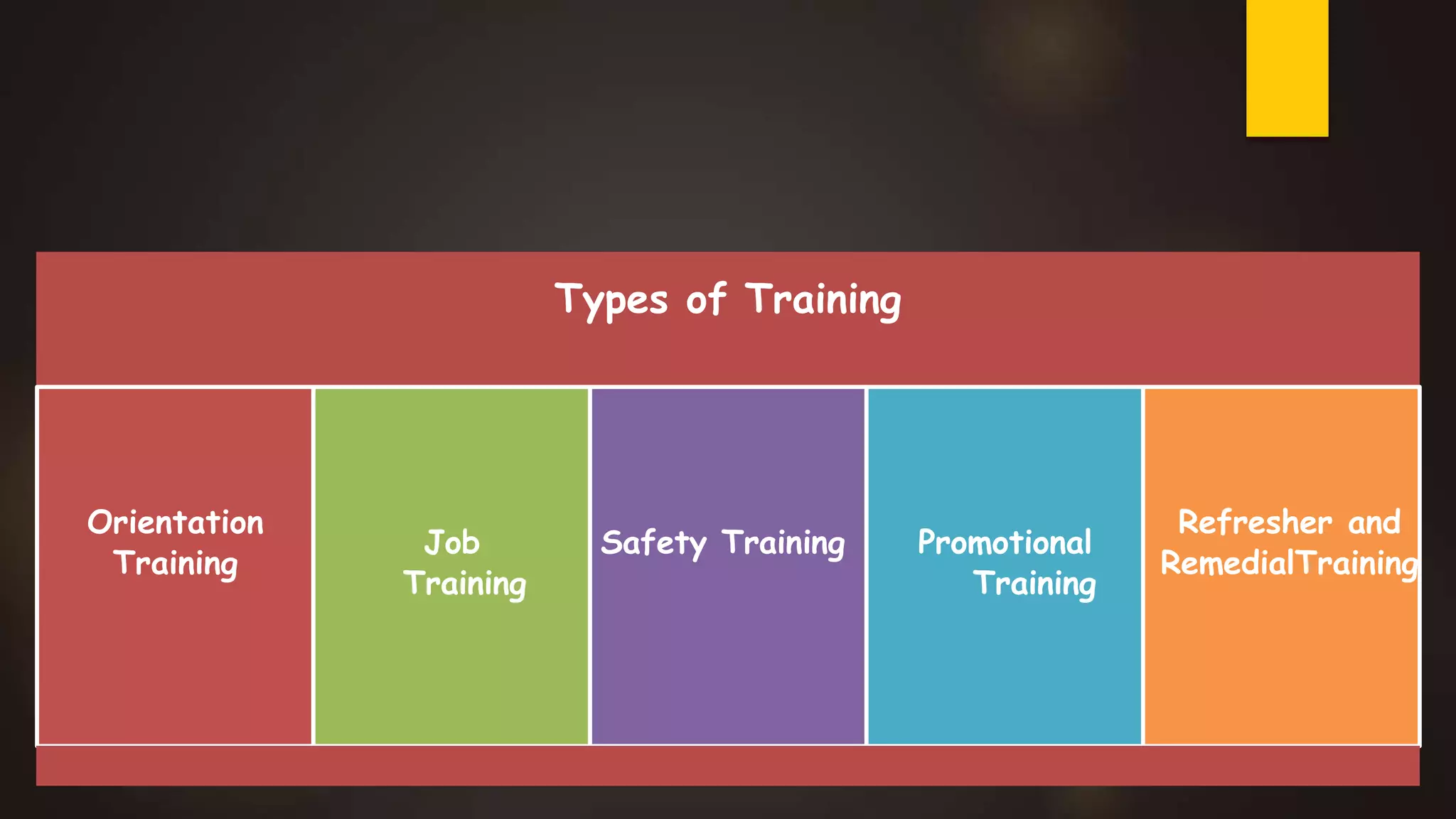
Types of Training
Orientation
Training
Job
Training
Safety Training Promotional
Training
Refresher and
RemedialTraining
DEVELOPMENT
• Employee development is a joint initiative of the employee as
well as the employer to upgrade the existing skills and knowledge
of an individual.
• Employee development goes a long way in training, sharpening the
skills of an employee and upgrading his/her existing knowledge
and abilities.
PersonalGrowth
Professional Growth
Employee Development
Professional Growth
Employee development activities must be defined keeping in mind an employee’s current stage and desired
stage. Knowing an employee’s current and desired stage helps you find the gaps and in which all genres
he/she needs to be trained on. Human resource professionals must encourage employees to participate in
internal or external trainings, get enrolled in online courses to increase their professional knowledge and
contribute effectively.
Personal Growth
• Employees start taking their work as a burden only when an organization does not provide any added
benefits or advantages which would help in their personal growth.
• Soft skills classes, fitness sessions, loans with lower interest rates are certain initiatives which not only
motivate an employee to do quality work but also help in employee development.
• Employee development not only helps in enhancing knowledge of employees but also increases the
productivity of organizations. Employees, as a result of employee development activities are better
trained and equipped and work harder to yield higher profits.
Systematic Approach
IdentifyingTraining Needs
Training Objectives
Select/Design/Review
Training Materials
• Organisational Analysis
– Organisational Objectives,
– Its Resources
– Resource allocation
– Organisational climate
– Environmentl Scanning
Task and Role Analysis
• Detailed analysis of job
Systematic Approach to Training
Conduct/Administer Training
Evaluate
• ManpowerAnalysis
– Training is needed
– Employee is capable
– Area
– Employee Performance
will be enhanced
– Any Modification Required
in Job setting
Training Objectives
Select/Design/Review
Training Materials
Conduct/Administer Training
Evaluate
• It expresses the gap between
existing skills and desired pool of
knowledge.
• It should be set in both
Quantitative and Qualitative terms
• Involvment of Top Management is
necessary
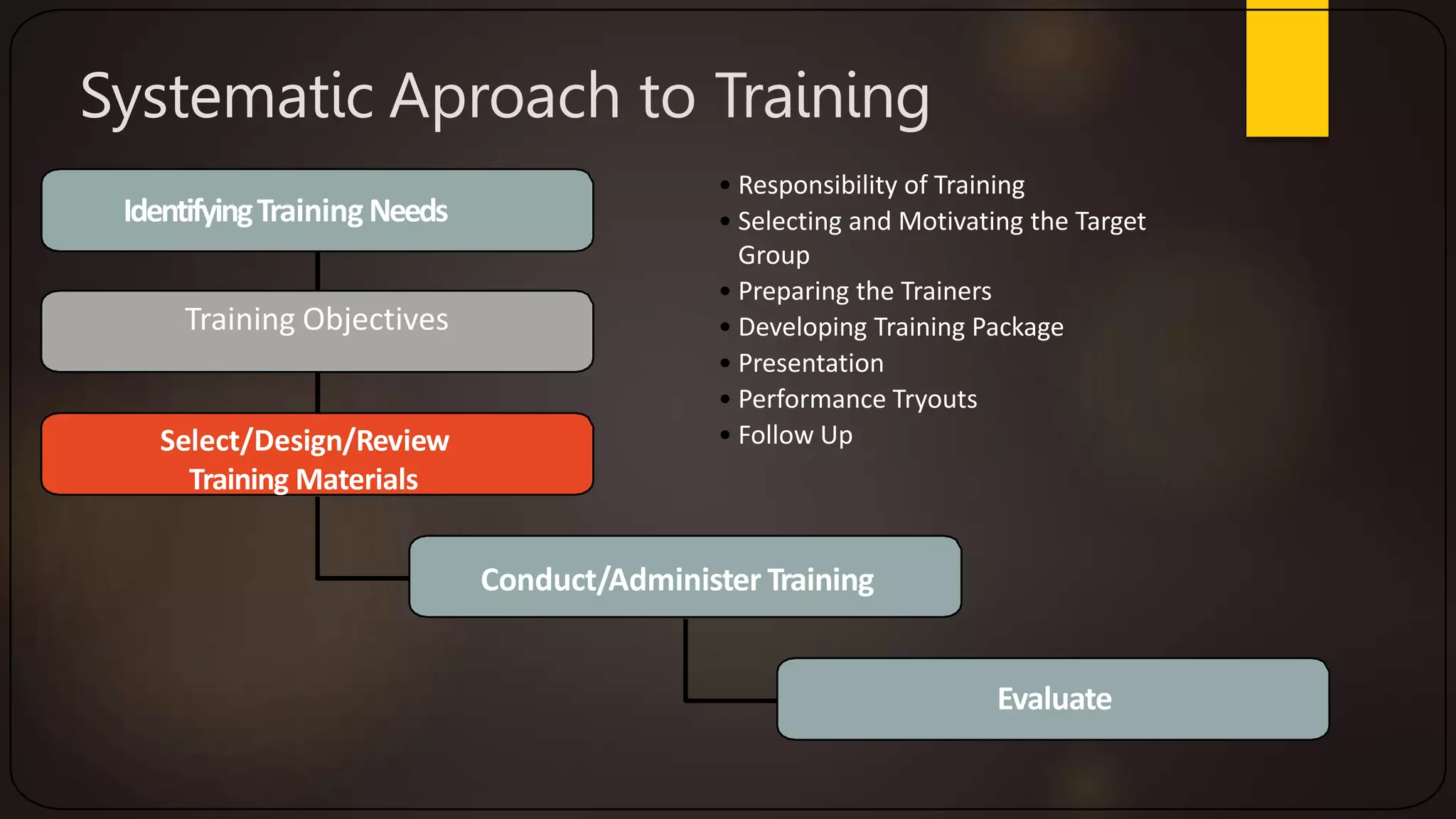
Systematic Aproach to Training
IdentifyingTraining Needs
Training Objectives
Select/Design/Review
Training Materials
Conduct/Administer Training
Evaluate
• Responsibility of Training
• Selecting and Motivating the Target
Group
• Preparing the Trainers
• Developing Training Package
• Presentation
• Performance Tryouts
• Follow Up
Systematic Aproach to Training
IdentifyingTraining Needs
Establish Training Requirements
Determine Training Needs
(have v.need)
Select/Design/Review
Training Materials
• Schedule programs
– consider: location of attendees, non-attendance rates,
turnover, employee availability, rosters for trainers/assessors,
venue availability etc
• Coordinate/administertraining
– enrolment
– notification/follow-up
– record results
– file records
– interaction with registered training organisations managed
Conduct/Administer Training
Evaluate
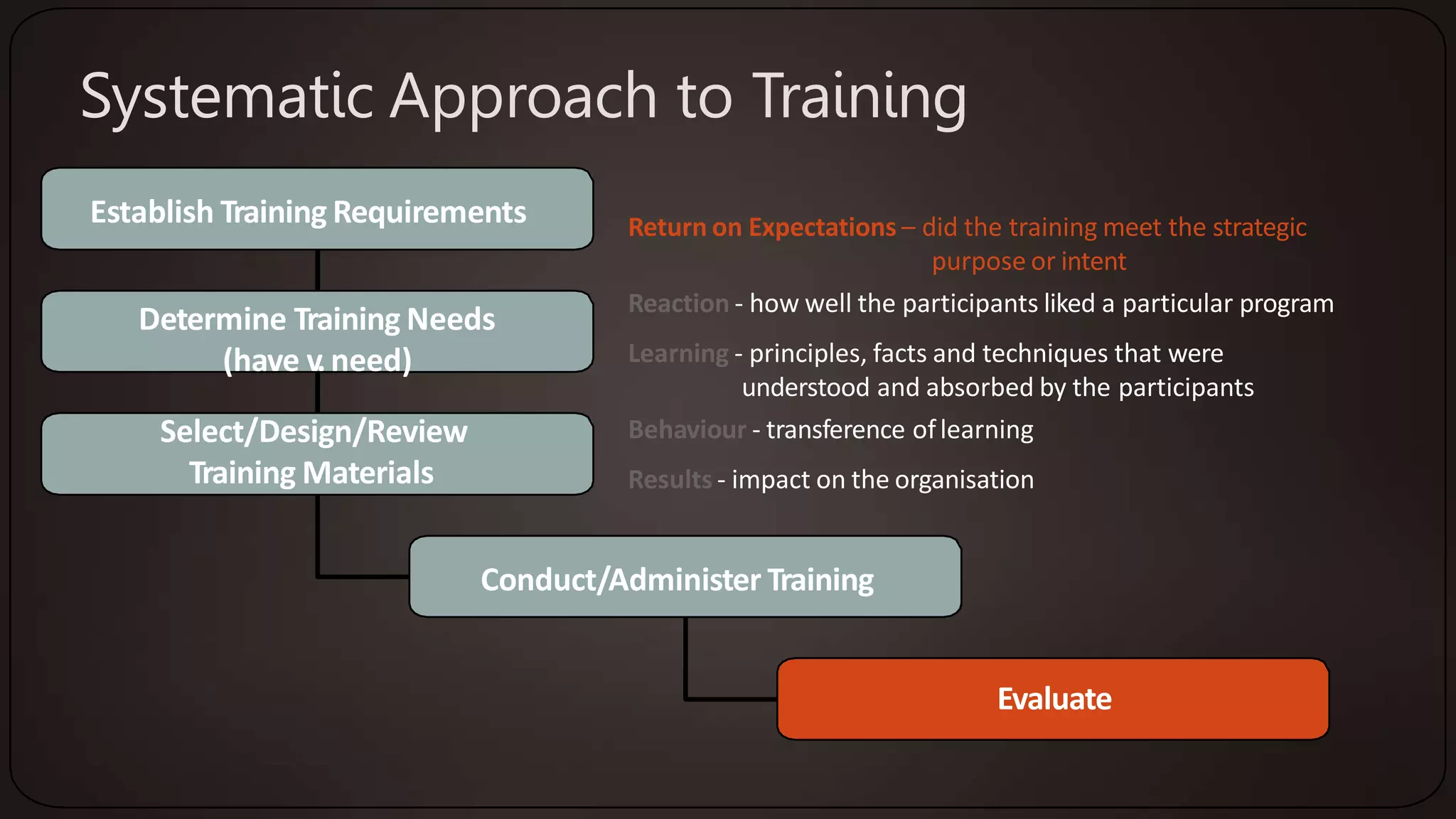
Systematic Approach to Training
Establish Training Requirements
Determine Training Needs
(have v.need)
Select/Design/Review
Training Materials
Conduct/Administer Training
Evaluate
Return on Expectations – did the training meet the strategic
purpose or intent
Reaction - how well the participants liked a particular program
Learning - principles, facts and techniques that were
understood and absorbed by the participants
Behaviour - transference oflearning
Results - impact on the organisation
Systematic Approach to Training
On-the Job Training
Internship
Job Rotation
Apprenticeship
Coaching
Off-the Job Training
Organizing Special
Curriculum and Classes
Organizing Conference
and seminars
Simulation
Vestibule training
Management Games
Programmed Instructions
Case Study Method
Role Playing Method
Lecture Method
IncidentAnalysis Method
Methods of Training
Mentoring
DIFFERENCE
ON THE JOB METHOD OFF THE JOB METHOD
Training is provided by superiors
to subordinates.
Training is provided by experts
from within or outside the
organization.
It is less costly. It is more costly.
It is less time consuming. It is more time consuming.
It is used where jobs are simple. It is used where jobs are complex.
ON THE JOB METHODS
• It means “Learning while doing”.
• It is less costly and less time consuming method.
• It includes:
I. Apprenticeship Training
II. Induction Training
III. Internship Training
IV. Job Rotation
APPRENTICESHIP TRAINING
• The trainer is appointed to guide the worker.
• The trainer performs the job and the learner observes.
• When the learner learns all the skills then he slowly
starts taking up the job step by step and the trainer
now becomes the observer.
• This method is suitable for people seeking to enter skill
traits for example plumbers and electrician.
INTERNSHIP TRAINING
• Under this method technical institutions and business
organizations jointly impart training to their members.
• The objective of the training is to strike a balance
between theoretical and practical knowledge.
• Educational institutions impart only theoretical
knowledge to their students and for the practical
knowledge they are sent to business organizations.
JOB ROTATION
• This method involves shifting the trainee from one
department or job to another.
• Suppose a person is appointed in production
department when he comes to know everything of that
department, he is shifted to another department.
• The motive is that during any circumstances the person
is capable of taking charge of various departments.
COACHING
Under this method, the trainee is placed under a
particular supervisor who functions as a coach in
training and provides feedback to the trainee.
Sometimes the trainee may not get an opportunity
to express his ideas.
Coaching is unlocking a person’s potential to
maximize their own performance . It is helping
them to learn rather than teaching them.
Mentoring
It is the influence , guidance or direction given by a
mentor. A mentor is someone who teaches or gives
help and advice to less experienced.
It focuses on Individual development.
It is a long term process.
OFF THE JOB METHODS
• It means “Learning before doing”.
• These methods are used away from work place.
• It includes:
I. Vestibule Training
II. Films
III.Case Study
IV.Class room lectures
VESTIBULE TRAINING
• In this method the employee learns their job on the
equipment, which is placed far away from the work
place.
• It is usually done when employees are required to
handle sophistication machinery and equipments.
FILMS
• They can provide information and the demonstrate the
skills required for performing the jobs.
CASE STUDY
• Trainees study the cases to determine the problem,
analyze the cause, develop alternate solutions, select
the best solution and implement.
CLASS ROOM LECTURES
• Under this method, theoretical knowledge of the managers
is brushed up. They are informed of the latest techniques
for tracking different problems.
• In large organizations, permanent experts are appointed to
pass on such information.
• Small organizations which cannot afford to appoint
permanent experts, invite experts from educational
institutions to deliver lectures.
Role play
 In this case also a problem situation is simulated asking the
employee to assume the role of a particular person in the
situation. The participant interacts with other participants
assuming different roles. The whole play will be recorded and
trainee gets an opportunity to examine their own
performance.
Methods of Development
Competency Development Area Methods
Decision-making skill Business games, Case study
Interpersonal skill Role playing, Sensitivity Training
Job Knowledge On-the-Job experiences, Coaching,
Organizational Knowledge Job Rotation, Multiple Management
General Knowledge Special course, Special Meeting, Specific Reading
Specific Individual Needs Special Projects, Committee Assignments
Training Needs Assessment
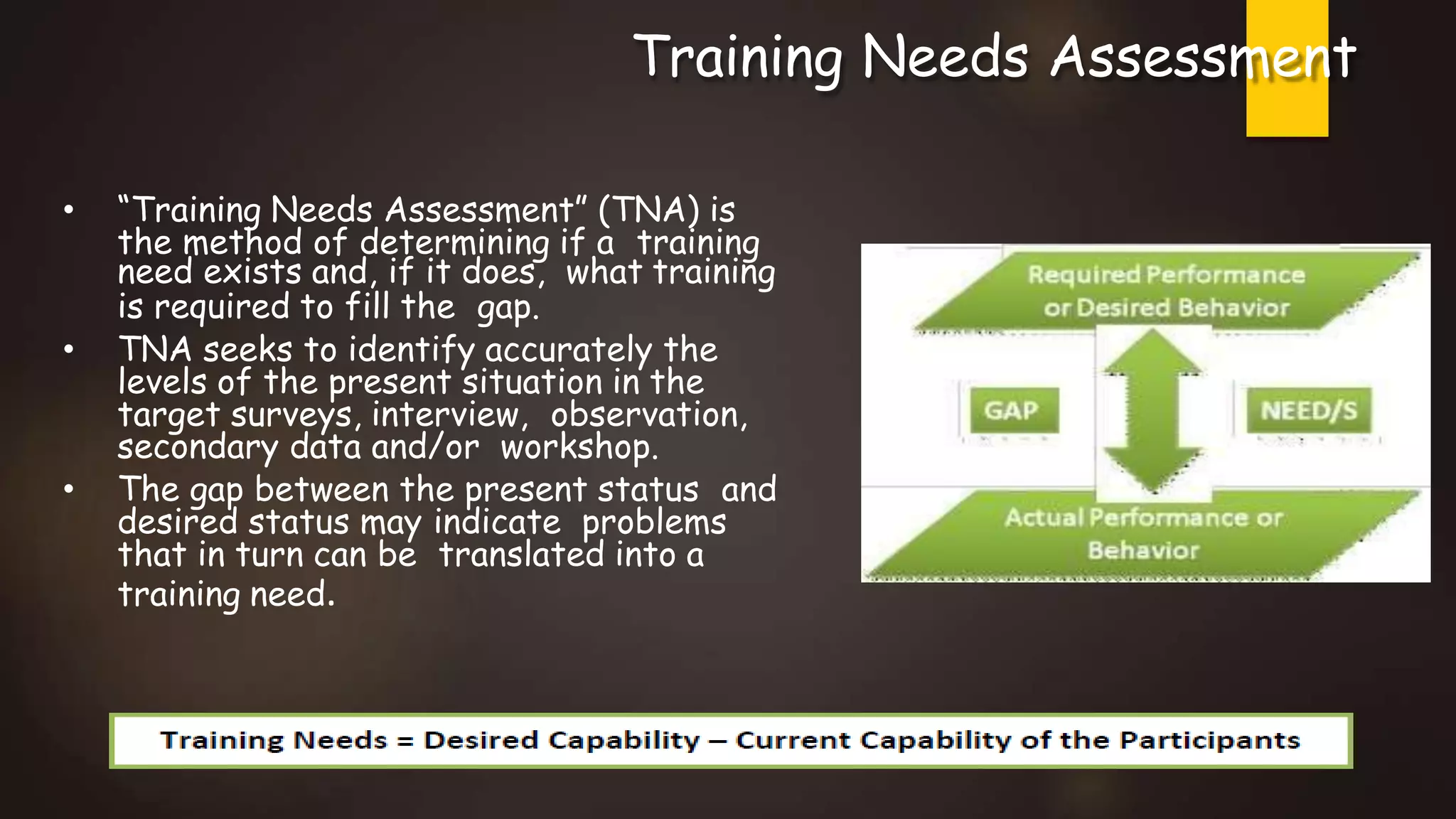
• “Training Needs Assessment” (TNA) is
the method of determining if a training
need exists and, if it does, what training
is required to fill the gap.
• TNA seeks to identify accurately the
levels of the present situation in the
target surveys, interview, observation,
secondary data and/or workshop.
• The gap between the present status and
desired status may indicate problems
that in turn can be translated into a
training need.
TNA process
24
Reasons for pressure points
• Lack of basic skills
• Poor performance
• Customer requests
• New Product
• New Jobs
• High performance standards
Task
Analysis
Person
Analysis
Organizationall
Analysis
Outcomes
• What Trainees need to learn
• Who receives training
• Type of Training
• Frequency of Training
• How training should be
evaluated
Organizational analysis
Organisational analysis involves considering the context in which training will occur.
Three factors need to be considered before choosing training as the solution to any pressure
point:
– Support of managers and peers for training activities
– Company strategy
– Training resources available.
27
Person analysis
Person analysis involves:
– Determining whether performance deficiencies result from a lack of knowledge, skill or
ability (a training issue) or from a motivational or work-design problem
– Identifying who needs training
– Determining employee’s readiness for training.
28
Task analysis
• Identifying the important tasks and knowledge, skills and behaviours that need to be
emphasised in training, in order for employees to complete their tasks.
Readiness for training
• Employees have the personal characteristics (ability, attitudes, beliefs, and motivation)
necessary to learn program content and apply it on the job.
• The work environment will facilitate learning and will not interfere with performance.
How can managers ensure employee readiness for training?
• Ensure employees’ self-efficacy.
• Understand the benefits of training.
• Be aware of training needs, career
interests and goals.
• Understand work environment characteristics.
• Ensure employees’ basic skills levels.
• Also consider input, output, consequences and feedback.
30
Training process outsourcing
 Training process outsourcing is when a business hires an external provider to manage a
complete set of L&D activities or processes. Organizations usually hire a training company
that provides end-to-end L&D services, such as a managed learning services provider.
Reasons
 Leveraging the cost of technology
 Realizing Generating revenue
 training is not core to your business
 Mitigating risk
 Improving scalability of resources
 Boosting speed to market –
 Improving access to talent
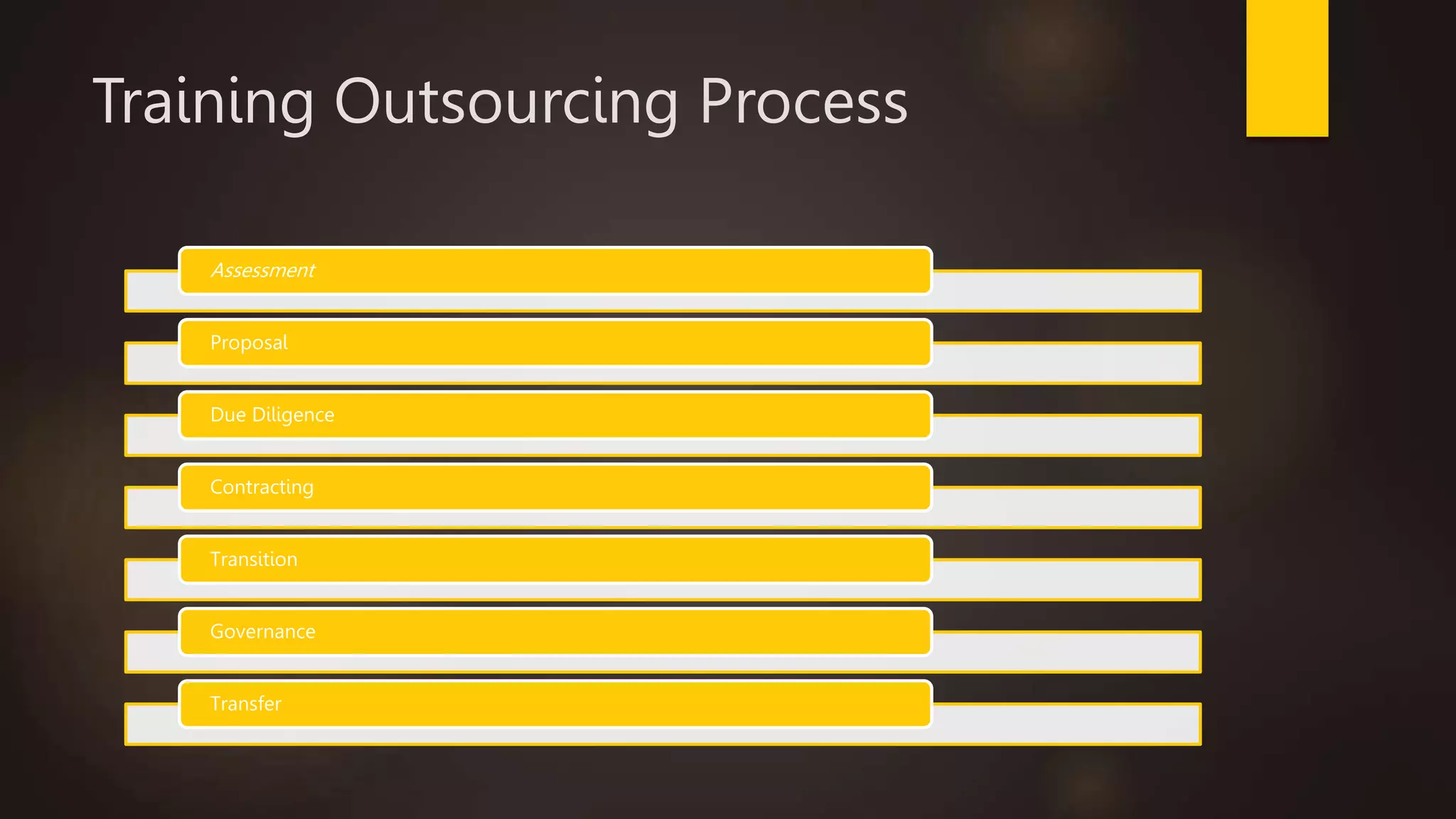
Training Outsourcing Process
Assessment
Proposal
Due Diligence
Contracting
Transition
Governance
Transfer
Competency-based training
 competency-based training is a type of training that is focused on specific competencies or
skills.
 competency-based training is broken down into much smaller units that are focused on
one single key skill. The learner must demonstrate his or her mastery of that single skill or
competency before continuing to the next segment of training.
 The skills are put together into modules and typically at the end the learner receives some
form of qualification or certification.
 This type of training may also be called outcome-based learning/training or skills-based
learning/training.
Benefits
Time management.
User-directed.
Reduced cost.
Allows personalization.
Flexible use.
Better retention.
Role-based training
 Role-based training is the term used to describe most learning activities
centred around the practical application of learned skills. For example, in
a retail setting, a role-based training exercise could be having new
cashiers-in-training operate a real cash register.
 They can check out items a manager or trainer brings to them, sign that
trainer or manager up for a company card if possible, and then void the
purchase at the end of the exercise. In this way, the cashier-in-training
learns what checking out a real customer with a functional cash register
will entail. Role-based training exercises can (and should) be developed
for almost every role within a company, particularly entry-level roles.
How to Use Role-based Training
Use actual locations and actors
Record your training exercises
Be creative
Why Role-based Training
Works
 It's inexpensive
 It's effective
 It identifies rising stars
 It lets you identify and address employee weaknesses
before they even begin working.
3.1 trainingdevelopment.pptx

3.1 trainingdevelopment.pptx

  • 1.
  • 2.
    Training is Expensive, without Training it is More expensive- Nehru
  • 3.
    • Training anddevelopment involves improving the effectiveness of organizations and the individuals and teams within them. • Training may be viewed as related to immediate changes in organizational effectiveness via organized instruction, while development is related to the progress of longer-term organizational and employee goals.
  • 4.
    Definition Training: It isa formal and Systematic modification of Behavior through learning which occurs as a result of education , Instruction, Development and Planned experience.  It is short Term process  refers to Technical and mechanical Problems.  Specific Job Related Purpose. Development is a learning activity, which is directed towards future rather than present needs, which is concerned more with career goals rather than immediate performance.  It is a long term education process.  Refers to philosophical and theoretical educational concepts  Managerial personnel  General knowledge purpose
  • 5.
    Why T andD???? Training Helps Employees to do their current jobs. Development Helps the individual handle future responsibilities
  • 7.
    Training? Training helps to g e bridthe gap Existing • Skills • Knowledge • Attitudes Required • Skills • Knowledge • Attitudes
  • 8.
    • Training -a planned effort by a company to facilitate employees’ learning of job-related competencies. • Competencies include knowledge, skills or behavior, abilities (KSA) critical for successful job performance. 6
  • 9.
    New candidates who join an organization Refreshand enhance their knowledge. Implementation of updates and amendments Promotion and career growth Training is given on four basic grounds:
  • 10.
  • 11.
    Types of Training Orientation Training Job Training SafetyTraining Promotional Training Refresher and RemedialTraining
  • 12.
  • 13.
    • Employee developmentis a joint initiative of the employee as well as the employer to upgrade the existing skills and knowledge of an individual. • Employee development goes a long way in training, sharpening the skills of an employee and upgrading his/her existing knowledge and abilities. PersonalGrowth Professional Growth Employee Development
  • 14.
    Professional Growth Employee developmentactivities must be defined keeping in mind an employee’s current stage and desired stage. Knowing an employee’s current and desired stage helps you find the gaps and in which all genres he/she needs to be trained on. Human resource professionals must encourage employees to participate in internal or external trainings, get enrolled in online courses to increase their professional knowledge and contribute effectively. Personal Growth • Employees start taking their work as a burden only when an organization does not provide any added benefits or advantages which would help in their personal growth. • Soft skills classes, fitness sessions, loans with lower interest rates are certain initiatives which not only motivate an employee to do quality work but also help in employee development. • Employee development not only helps in enhancing knowledge of employees but also increases the productivity of organizations. Employees, as a result of employee development activities are better trained and equipped and work harder to yield higher profits.
  • 15.
  • 16.
    IdentifyingTraining Needs Training Objectives Select/Design/Review TrainingMaterials • Organisational Analysis – Organisational Objectives, – Its Resources – Resource allocation – Organisational climate – Environmentl Scanning Task and Role Analysis • Detailed analysis of job Systematic Approach to Training Conduct/Administer Training Evaluate • ManpowerAnalysis – Training is needed – Employee is capable – Area – Employee Performance will be enhanced – Any Modification Required in Job setting
  • 17.
    Training Objectives Select/Design/Review Training Materials Conduct/AdministerTraining Evaluate • It expresses the gap between existing skills and desired pool of knowledge. • It should be set in both Quantitative and Qualitative terms • Involvment of Top Management is necessary Systematic Aproach to Training IdentifyingTraining Needs
  • 18.
    Training Objectives Select/Design/Review Training Materials Conduct/AdministerTraining Evaluate • Responsibility of Training • Selecting and Motivating the Target Group • Preparing the Trainers • Developing Training Package • Presentation • Performance Tryouts • Follow Up Systematic Aproach to Training IdentifyingTraining Needs
  • 19.
    Establish Training Requirements DetermineTraining Needs (have v.need) Select/Design/Review Training Materials • Schedule programs – consider: location of attendees, non-attendance rates, turnover, employee availability, rosters for trainers/assessors, venue availability etc • Coordinate/administertraining – enrolment – notification/follow-up – record results – file records – interaction with registered training organisations managed Conduct/Administer Training Evaluate Systematic Approach to Training
  • 20.
    Establish Training Requirements DetermineTraining Needs (have v.need) Select/Design/Review Training Materials Conduct/Administer Training Evaluate Return on Expectations – did the training meet the strategic purpose or intent Reaction - how well the participants liked a particular program Learning - principles, facts and techniques that were understood and absorbed by the participants Behaviour - transference oflearning Results - impact on the organisation Systematic Approach to Training
  • 21.
    On-the Job Training Internship JobRotation Apprenticeship Coaching Off-the Job Training Organizing Special Curriculum and Classes Organizing Conference and seminars Simulation Vestibule training Management Games Programmed Instructions Case Study Method Role Playing Method Lecture Method IncidentAnalysis Method Methods of Training Mentoring
  • 22.
    DIFFERENCE ON THE JOBMETHOD OFF THE JOB METHOD Training is provided by superiors to subordinates. Training is provided by experts from within or outside the organization. It is less costly. It is more costly. It is less time consuming. It is more time consuming. It is used where jobs are simple. It is used where jobs are complex.
  • 23.
    ON THE JOBMETHODS • It means “Learning while doing”. • It is less costly and less time consuming method. • It includes: I. Apprenticeship Training II. Induction Training III. Internship Training IV. Job Rotation
  • 24.
    APPRENTICESHIP TRAINING • Thetrainer is appointed to guide the worker. • The trainer performs the job and the learner observes. • When the learner learns all the skills then he slowly starts taking up the job step by step and the trainer now becomes the observer. • This method is suitable for people seeking to enter skill traits for example plumbers and electrician.
  • 25.
    INTERNSHIP TRAINING • Underthis method technical institutions and business organizations jointly impart training to their members. • The objective of the training is to strike a balance between theoretical and practical knowledge. • Educational institutions impart only theoretical knowledge to their students and for the practical knowledge they are sent to business organizations.
  • 26.
    JOB ROTATION • Thismethod involves shifting the trainee from one department or job to another. • Suppose a person is appointed in production department when he comes to know everything of that department, he is shifted to another department. • The motive is that during any circumstances the person is capable of taking charge of various departments.
  • 27.
    COACHING Under this method,the trainee is placed under a particular supervisor who functions as a coach in training and provides feedback to the trainee. Sometimes the trainee may not get an opportunity to express his ideas. Coaching is unlocking a person’s potential to maximize their own performance . It is helping them to learn rather than teaching them.
  • 28.
    Mentoring It is theinfluence , guidance or direction given by a mentor. A mentor is someone who teaches or gives help and advice to less experienced. It focuses on Individual development. It is a long term process.
  • 29.
    OFF THE JOBMETHODS • It means “Learning before doing”. • These methods are used away from work place. • It includes: I. Vestibule Training II. Films III.Case Study IV.Class room lectures
  • 30.
    VESTIBULE TRAINING • Inthis method the employee learns their job on the equipment, which is placed far away from the work place. • It is usually done when employees are required to handle sophistication machinery and equipments.
  • 31.
    FILMS • They canprovide information and the demonstrate the skills required for performing the jobs. CASE STUDY • Trainees study the cases to determine the problem, analyze the cause, develop alternate solutions, select the best solution and implement.
  • 32.
    CLASS ROOM LECTURES •Under this method, theoretical knowledge of the managers is brushed up. They are informed of the latest techniques for tracking different problems. • In large organizations, permanent experts are appointed to pass on such information. • Small organizations which cannot afford to appoint permanent experts, invite experts from educational institutions to deliver lectures.
  • 33.
    Role play  Inthis case also a problem situation is simulated asking the employee to assume the role of a particular person in the situation. The participant interacts with other participants assuming different roles. The whole play will be recorded and trainee gets an opportunity to examine their own performance.
  • 34.
    Methods of Development CompetencyDevelopment Area Methods Decision-making skill Business games, Case study Interpersonal skill Role playing, Sensitivity Training Job Knowledge On-the-Job experiences, Coaching, Organizational Knowledge Job Rotation, Multiple Management General Knowledge Special course, Special Meeting, Specific Reading Specific Individual Needs Special Projects, Committee Assignments
  • 36.
    Training Needs Assessment •“Training Needs Assessment” (TNA) is the method of determining if a training need exists and, if it does, what training is required to fill the gap. • TNA seeks to identify accurately the levels of the present situation in the target surveys, interview, observation, secondary data and/or workshop. • The gap between the present status and desired status may indicate problems that in turn can be translated into a training need.
  • 37.
    TNA process 24 Reasons forpressure points • Lack of basic skills • Poor performance • Customer requests • New Product • New Jobs • High performance standards Task Analysis Person Analysis Organizationall Analysis Outcomes • What Trainees need to learn • Who receives training • Type of Training • Frequency of Training • How training should be evaluated
  • 39.
    Organizational analysis Organisational analysisinvolves considering the context in which training will occur. Three factors need to be considered before choosing training as the solution to any pressure point: – Support of managers and peers for training activities – Company strategy – Training resources available. 27
  • 40.
    Person analysis Person analysisinvolves: – Determining whether performance deficiencies result from a lack of knowledge, skill or ability (a training issue) or from a motivational or work-design problem – Identifying who needs training – Determining employee’s readiness for training. 28
  • 41.
    Task analysis • Identifyingthe important tasks and knowledge, skills and behaviours that need to be emphasised in training, in order for employees to complete their tasks.
  • 42.
    Readiness for training •Employees have the personal characteristics (ability, attitudes, beliefs, and motivation) necessary to learn program content and apply it on the job. • The work environment will facilitate learning and will not interfere with performance. How can managers ensure employee readiness for training? • Ensure employees’ self-efficacy. • Understand the benefits of training. • Be aware of training needs, career interests and goals. • Understand work environment characteristics. • Ensure employees’ basic skills levels. • Also consider input, output, consequences and feedback. 30
  • 43.
    Training process outsourcing Training process outsourcing is when a business hires an external provider to manage a complete set of L&D activities or processes. Organizations usually hire a training company that provides end-to-end L&D services, such as a managed learning services provider.
  • 44.
    Reasons  Leveraging thecost of technology  Realizing Generating revenue  training is not core to your business  Mitigating risk  Improving scalability of resources  Boosting speed to market –  Improving access to talent
  • 45.
    Training Outsourcing Process Assessment Proposal DueDiligence Contracting Transition Governance Transfer
  • 46.
    Competency-based training  competency-basedtraining is a type of training that is focused on specific competencies or skills.  competency-based training is broken down into much smaller units that are focused on one single key skill. The learner must demonstrate his or her mastery of that single skill or competency before continuing to the next segment of training.  The skills are put together into modules and typically at the end the learner receives some form of qualification or certification.  This type of training may also be called outcome-based learning/training or skills-based learning/training.
  • 47.
    Benefits Time management. User-directed. Reduced cost. Allowspersonalization. Flexible use. Better retention.
  • 48.
    Role-based training  Role-basedtraining is the term used to describe most learning activities centred around the practical application of learned skills. For example, in a retail setting, a role-based training exercise could be having new cashiers-in-training operate a real cash register.  They can check out items a manager or trainer brings to them, sign that trainer or manager up for a company card if possible, and then void the purchase at the end of the exercise. In this way, the cashier-in-training learns what checking out a real customer with a functional cash register will entail. Role-based training exercises can (and should) be developed for almost every role within a company, particularly entry-level roles.
  • 49.
    How to UseRole-based Training Use actual locations and actors Record your training exercises Be creative
  • 50.
    Why Role-based Training Works It's inexpensive  It's effective  It identifies rising stars  It lets you identify and address employee weaknesses before they even begin working.