Human Resource Training
and Development
Orientation
 Orientation is a systematic and planned introduction of
employees to their jobs, their co-workers and the
organization.
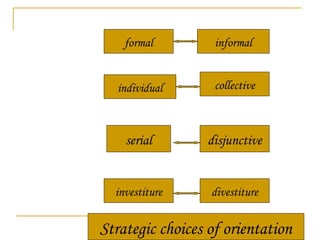
formal informal
individual collective
serial disjunctive
investiture divestiture
Strategic choices of orientation
Objective
 To help the new comer to overcome his shyness
 To build new employee’s confidence
 To develop the new entrants a sense of belonging and
loyalty
 To foster a close relationship…
 To prevent false impression and negative attitude of
the new employees
 To give the new comers necessary information like
canteen, locker room. Rest periods and leave rules
etc…
Steps
 Welcoming to the organization
 Explain about company
 Show the location/department where the new recruit will
work
 Give the company manual to the new recruit
 Provide details about various work groups and the extent
of unionism within the company
 Give details about pay,benefits,holidays,leave etc.
 Explain future training opportunities and career
prospectus
 Clarify doubts, by encouraging the employees to come
with the questions
 Take employee on a guided tour of building, facilities, etc.
 Hand him over to his supervisor.
Advantages
 It helps to build two way communication
 It facilitates informal relations and team work
 Induction is helpful in supplying information about the
organization, job, and welfare of employees
 Proper Induction will reduce employees grievances,
absenteeism and labor turnover
 Induction helps to develop good public relations and
improve the overall morale of employees
 An Induction program proves that the company is taking
a sincere interest in getting him off to a good start
PROBELMS
 Employee is overwhelmed with too much information
in a short time.
 Employee is overloaded with form to complete.
 Employees mistakes can damage the company.
.
 Employee is asked to perform tasks where there are high
chances of failure that could needlessly discourage the
employee.
 Employee is thrown into action too soon.
 Employee ‘s wrong perceptions because of short periods
spent on each job.
Training & Development
 Training enables an employee to do his present job more
efficiently and prepare himself for a higher level job.
 Training is a art of increasing knowledge, skills, &
capacity of a person.
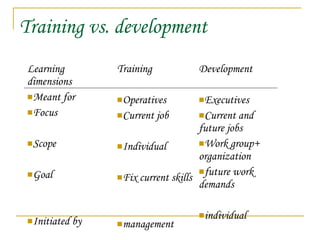
Training vs. development
Learning
dimensions
Meant for
Focus
Scope
Goal
Initiated by
Training
Operatives
Current job
Individual
Fix current skills
management
Development
Executives
Current and
future jobs
Work group+
organization
future work
demands
individual
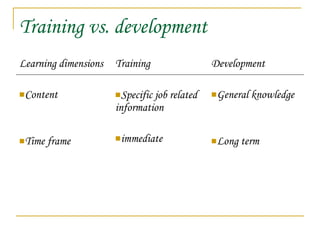
Training vs. development
Learning dimensions
Content
Time frame
Training
Specific job related
information
immediate
Development
General knowledge
Long term
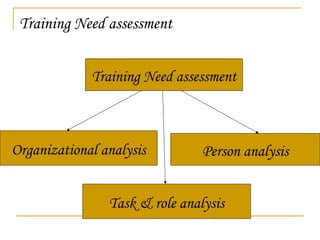
Training Need assessment
Organizational analysis
Task & role analysis
Person analysis
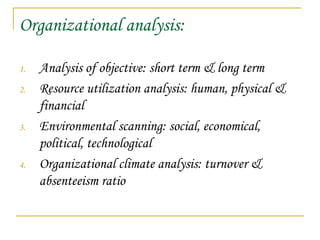
Organizational analysis:
1. Analysis of objective: short term & long term
2. Resource utilization analysis: human, physical &
financial
3. Environmental scanning: social, economical,
political, technological
4. Organizational climate analysis: turnover &
absenteeism ratio
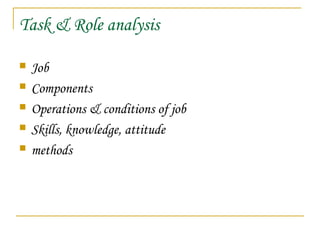
Task & Role analysis
 Job
 Components
 Operations & conditions of job
 Skills, knowledge, attitude
 methods
Person analysis
 Poor performers
 Person potential
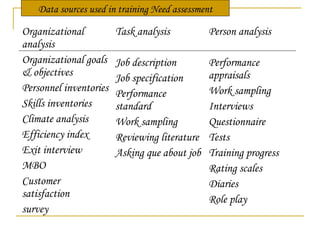
Organizational
analysis
Organizational goals
& objectives
Personnel inventories
Skills inventories
Climate analysis
Efficiency index
Exit interview
MBO
Customer
satisfaction
survey
Task analysis
Job description
Job specification
Performance
standard
Work sampling
Reviewing literature
Asking que about job
Person analysis
Performance
appraisals
Work sampling
Interviews
Questionnaire
Tests
Training progress
Rating scales
Diaries
Role play
Data sources used in training Need assessment
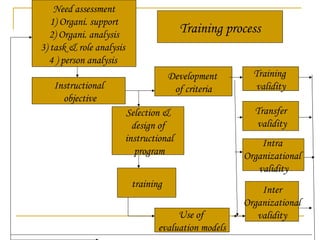
Need assessment
1) Organi. support
2) Organi. analysis
3) task & role analysis
4 ) person analysis
Instructional
objective
Development
of criteria
Training
validity
Transfer
validity
Intra
Organizational
validity
Inter
Organizational
validity
Selection &
design of
instructional
program
training
Use of
evaluation models
Training process
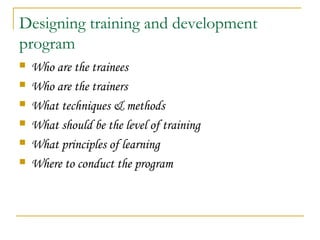
Designing training and development
program
 Who are the trainees
 Who are the trainers
 What techniques & methods
 What should be the level of training
 What principles of learning
 Where to conduct the program
Designing training and development
program
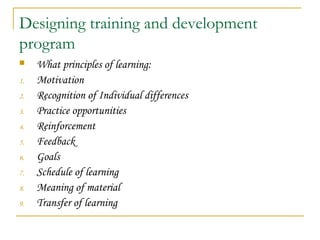
 What principles of learning:
1. Motivation
2. Recognition of Individual differences
3. Practice opportunities
4. Reinforcement
5. Feedback
6. Goals
7. Schedule of learning
8. Meaning of material
9. Transfer of learning
Designing training and development
program
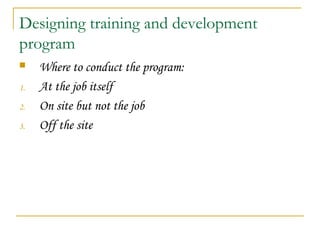
 Where to conduct the program:
1. At the job itself
2. On site but not the job
3. Off the site
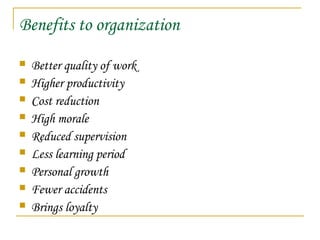
Benefits to organization
 Better quality of work
 Higher productivity
 Cost reduction
 High morale
 Reduced supervision
 Less learning period
 Personal growth
 Fewer accidents
 Brings loyalty
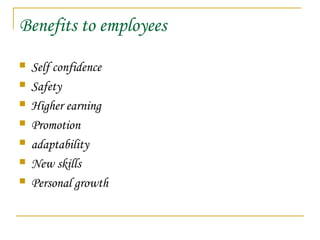
Benefits to employees
 Self confidence
 Safety
 Higher earning
 Promotion
 adaptability
 New skills
 Personal growth
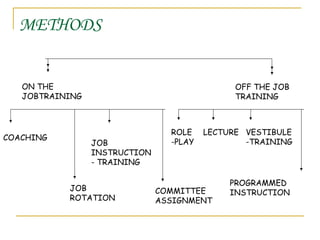
METHODS
ON THE
JOBTRAINING
OFF THE JOB
TRAINING
COACHING
JOB
INSTRUCTION
- TRAINING
ROLE
-PLAY
LECTURE VESTIBULE
-TRAINING
PROGRAMMED
INSTRUCTIONCOMMITTEE
ASSIGNMENT
JOB
ROTATION
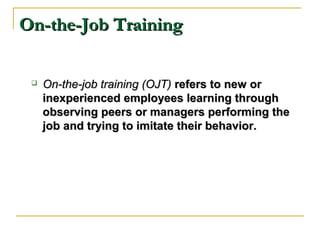
On-the-Job TrainingOn-the-Job Training
 On-the-job training (OJT)On-the-job training (OJT) refers to new orrefers to new or
inexperienced employees learning throughinexperienced employees learning through
observing peers or managers performing theobserving peers or managers performing the
job and trying to imitate their behavior.job and trying to imitate their behavior.
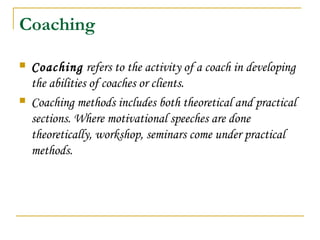
Coaching
 Coaching refers to the activity of a coach in developing
the abilities of coaches or clients.
 Coaching methods includes both theoretical and practical
sections. Where motivational speeches are done
theoretically, workshop, seminars come under practical
methods.
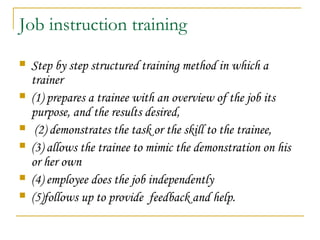
Job instruction training
 Step by step structured training method in which a
trainer
 (1) prepares a trainee with an overview of the job its
purpose, and the results desired,
 (2) demonstrates the task or the skill to the trainee,
 (3) allows the trainee to mimic the demonstration on his
or her own
 (4) employee does the job independently
 (5)follows up to provide feedback and help.
Job rotation
 Job rotation is an approach to management
development where an individual is moved through a
schedule of designed to give him or her a breadth of
exposure to the entire operation.
 Job rotation is also practiced to allow qualified employees
to gain more insights into the processes of a company,
and to reduce boredom and increase job satisfaction &
skill enhancement through job variation.
Off the job training
 Off the job training involves employees taking training
courses away from their place of work. This is often also
referred to as "formal training".
 Off the job training courses might be run by the business'
training department or by external providers.
 - Use of specialist trainers and accommodation
 - Employee can focus on the training - and not be
distracted by work 
Vestibule training
 Vestibule training is a type of instruction using a vestibule, a
small area away from the actual worksite, consisting of training
equipment exactly duplicating the materials and equipment used
on the job.
 The purpose of vestibule training is to reproduce an actual work
setting and place it under the trainer's control to allow for
immediate and constructive feedback.
 Training vestibules are useful because they allow trainees to
practice while avoiding personal injury and damage to expensive
equipment without affecting production.
lecture
 Training is basically incomplete without lecture. When the
trainer begins the training session by telling the aim, goal,
agenda, processes, or methods that will be used in training
that means the trainer is using the lecture method
Main Features of Lecture Method:
Inability to identify and correct misunderstandings
Less expensive
Can be reached large number of people at once
Knowledge building exercise
Less effective because lectures require long periods of
trainee inactivity
Role PlaysRole Plays
 Trainees act out characters assigned to them.Trainees act out characters assigned to them.
 Information regarding the situation is provided to theInformation regarding the situation is provided to the
trainees.trainees.
 Focus on interpersonal responses.Focus on interpersonal responses.
 Outcomes depend on the emotional (and subjective)Outcomes depend on the emotional (and subjective)
reactions of the other trainees.reactions of the other trainees.
 The more meaningful the exercise, the higher the level ofThe more meaningful the exercise, the higher the level of
participant focus and intensity.participant focus and intensity.
Evaluation
 Evaluation helps determining the results of training &
development program.
Training evaluationTraining evaluation provides the data needed to
demonstrate that training does provide benefits to the company.
Need for evaluation
 To determine the accomplishment of specific training
objective
 To determine the Cost effectiveness
 To determine the Program failure
 To determine the Correcting performance deficiencies
 Any Change in trainee capabilities are due to training &
not due to any other condition
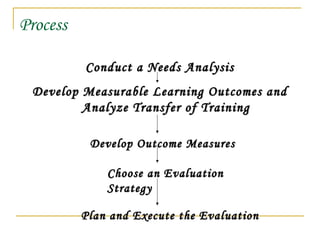
Process
Conduct a Needs AnalysisConduct a Needs Analysis
Develop Measurable Learning Outcomes andDevelop Measurable Learning Outcomes and
Analyze Transfer of TrainingAnalyze Transfer of Training
Develop Outcome MeasuresDevelop Outcome Measures
Choose an EvaluationChoose an Evaluation
StrategyStrategy
Plan and Execute the EvaluationPlan and Execute the Evaluation
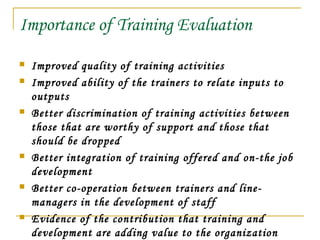
Importance of Training Evaluation
 Improved quality of training activities
 Improved ability of the trainers to relate inputs to
outputs
 Better discrimination of training activities between
those that are worthy of support and those that
should be dropped
 Better integration of training offered and on-the job
development
 Better co-operation between trainers and line-
managers in the development of staff
 Evidence of the contribution that training and
development are adding value to the organization
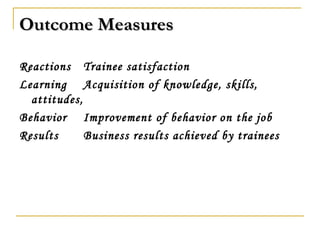
Outcome MeasuresOutcome Measures
Reactions Trainee satisfaction
Learning Acquisition of knowledge, skills,
attitudes,
Behavior Improvement of behavior on the job
Results Business results achieved by trainees
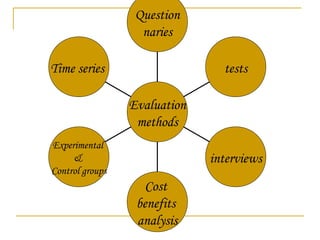
Time series
Experimental
&
Control groups
Cost
benefits
analysis
interviews
tests
Question
naries
Evaluation
methods
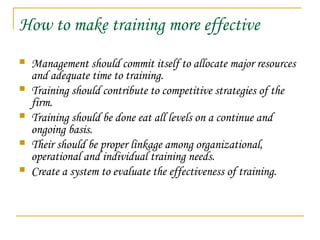
How to make training more effective
 Management should commit itself to allocate major resources
and adequate time to training.
 Training should contribute to competitive strategies of the
firm.
 Training should be done eat all levels on a continue and
ongoing basis.
 Their should be proper linkage among organizational,
operational and individual training needs.
 Create a system to evaluate the effectiveness of training.
HRD mechanisms
 Counseling
 Coaching
 Training & development
 Performance appraisal
 Potential appraisal
 Career planning and
development
 Organizational development
Counseling
 It is a two way process in which a counselor provides
help to the workers by way of advice and guidance.
 It is a two way process of helping subordinates to
achieve better adjustments with their work environment
to behave as psychologically mature individuals and help
in achieving a better understanding with others so his
dealing with them can be effective and purposeful.
Coaching
 “coaching” is the practice of giving sufficient direction,
instruction and training to a person or a group people, so
as to achieve some goals or even in developing specific
skills.
 Though coaching is a system of providing training, the
method of coaching differs from person to person, aim or
goals to be attained, and the areas needed.
Training & development
 Training enables an employee to do his present job more
efficiently and prepare himself for a higher level job.
 Training is a art of increasing knowledge, skills, &
capacity of a person.
Performance appraisal
 A performance appraisal, is a method by which the job
performance of an employee is evaluated generally in terms of
quality, quantity, cost, and time typically by the corresponding
manager or supervisor.
 It is the process of obtaining, analyzing, and recording
information about the relative worth of an employee to the
organization.
 Performance appraisal is an analysis of an employee's recent
successes and failures, personal strengths and weaknesses, and
suitability for promotion or further training.
Potential appraisal
 The potential appraisal refers to the appraisal i.e.
identification of the hidden talents and skills of a person.
The person might or might not be aware of them.
 Potential appraisal is a future – oriented appraisal whose
main objective is to identify and evaluate the potential of
the employees to assume higher positions and
responsibilities in the organizational hierarchy.
Career planning & development
. Career development helps you take stock of who you are and where
you want to go in life.
Career Development examines your present job situation and
features of the job that will enable you to use your aptitudes,
values, skills, competencies.
A career plan is meant to set goals to develop the required skills
that you need and will need in the future.
Organizational development
 O.D is a set of behavioral science based theories, values, strategies
& techniques aimed at the planned change of the organizational
work settings for the purpose of enhancing individual
development and improving organizational performance.
 Four types of interventions are used :
 Team intervention
 Inter-group intervention
 Structural Intervention
 Comprehensive intervention
HRD for Organizational Growth and
Effectiveness

434149 634141422631385000

  • 1.
  • 2.
    Orientation  Orientation isa systematic and planned introduction of employees to their jobs, their co-workers and the organization.
  • 3.
    formal informal individual collective serialdisjunctive investiture divestiture Strategic choices of orientation
  • 4.
    Objective  To helpthe new comer to overcome his shyness  To build new employee’s confidence  To develop the new entrants a sense of belonging and loyalty  To foster a close relationship…  To prevent false impression and negative attitude of the new employees  To give the new comers necessary information like canteen, locker room. Rest periods and leave rules etc…
  • 5.
    Steps  Welcoming tothe organization  Explain about company  Show the location/department where the new recruit will work  Give the company manual to the new recruit  Provide details about various work groups and the extent of unionism within the company
  • 6.
     Give detailsabout pay,benefits,holidays,leave etc.  Explain future training opportunities and career prospectus  Clarify doubts, by encouraging the employees to come with the questions  Take employee on a guided tour of building, facilities, etc.  Hand him over to his supervisor.
  • 7.
    Advantages  It helpsto build two way communication  It facilitates informal relations and team work  Induction is helpful in supplying information about the organization, job, and welfare of employees  Proper Induction will reduce employees grievances, absenteeism and labor turnover  Induction helps to develop good public relations and improve the overall morale of employees  An Induction program proves that the company is taking a sincere interest in getting him off to a good start
  • 8.
    PROBELMS  Employee isoverwhelmed with too much information in a short time.  Employee is overloaded with form to complete.  Employees mistakes can damage the company.
  • 9.
    .  Employee isasked to perform tasks where there are high chances of failure that could needlessly discourage the employee.  Employee is thrown into action too soon.  Employee ‘s wrong perceptions because of short periods spent on each job.
  • 10.
    Training & Development Training enables an employee to do his present job more efficiently and prepare himself for a higher level job.  Training is a art of increasing knowledge, skills, & capacity of a person.
  • 11.
    Training vs. development Learning dimensions Meantfor Focus Scope Goal Initiated by Training Operatives Current job Individual Fix current skills management Development Executives Current and future jobs Work group+ organization future work demands individual
  • 12.
    Training vs. development Learningdimensions Content Time frame Training Specific job related information immediate Development General knowledge Long term
  • 13.
    Training Need assessment TrainingNeed assessment Organizational analysis Task & role analysis Person analysis
  • 14.
    Organizational analysis: 1. Analysisof objective: short term & long term 2. Resource utilization analysis: human, physical & financial 3. Environmental scanning: social, economical, political, technological 4. Organizational climate analysis: turnover & absenteeism ratio
  • 15.
    Task & Roleanalysis  Job  Components  Operations & conditions of job  Skills, knowledge, attitude  methods
  • 16.
    Person analysis  Poorperformers  Person potential
  • 17.
    Organizational analysis Organizational goals & objectives Personnelinventories Skills inventories Climate analysis Efficiency index Exit interview MBO Customer satisfaction survey Task analysis Job description Job specification Performance standard Work sampling Reviewing literature Asking que about job Person analysis Performance appraisals Work sampling Interviews Questionnaire Tests Training progress Rating scales Diaries Role play Data sources used in training Need assessment
  • 18.
    Need assessment 1) Organi.support 2) Organi. analysis 3) task & role analysis 4 ) person analysis Instructional objective Development of criteria Training validity Transfer validity Intra Organizational validity Inter Organizational validity Selection & design of instructional program training Use of evaluation models Training process
  • 19.
    Designing training anddevelopment program  Who are the trainees  Who are the trainers  What techniques & methods  What should be the level of training  What principles of learning  Where to conduct the program
  • 20.
    Designing training anddevelopment program  What principles of learning: 1. Motivation 2. Recognition of Individual differences 3. Practice opportunities 4. Reinforcement 5. Feedback 6. Goals 7. Schedule of learning 8. Meaning of material 9. Transfer of learning
  • 21.
    Designing training anddevelopment program  Where to conduct the program: 1. At the job itself 2. On site but not the job 3. Off the site
  • 22.
    Benefits to organization Better quality of work  Higher productivity  Cost reduction  High morale  Reduced supervision  Less learning period  Personal growth  Fewer accidents  Brings loyalty
  • 23.
    Benefits to employees Self confidence  Safety  Higher earning  Promotion  adaptability  New skills  Personal growth
  • 24.
    METHODS ON THE JOBTRAINING OFF THEJOB TRAINING COACHING JOB INSTRUCTION - TRAINING ROLE -PLAY LECTURE VESTIBULE -TRAINING PROGRAMMED INSTRUCTIONCOMMITTEE ASSIGNMENT JOB ROTATION
  • 25.
    On-the-Job TrainingOn-the-Job Training On-the-job training (OJT)On-the-job training (OJT) refers to new orrefers to new or inexperienced employees learning throughinexperienced employees learning through observing peers or managers performing theobserving peers or managers performing the job and trying to imitate their behavior.job and trying to imitate their behavior.
  • 26.
    Coaching  Coaching refersto the activity of a coach in developing the abilities of coaches or clients.  Coaching methods includes both theoretical and practical sections. Where motivational speeches are done theoretically, workshop, seminars come under practical methods.
  • 27.
    Job instruction training Step by step structured training method in which a trainer  (1) prepares a trainee with an overview of the job its purpose, and the results desired,  (2) demonstrates the task or the skill to the trainee,  (3) allows the trainee to mimic the demonstration on his or her own  (4) employee does the job independently  (5)follows up to provide feedback and help.
  • 28.
    Job rotation  Jobrotation is an approach to management development where an individual is moved through a schedule of designed to give him or her a breadth of exposure to the entire operation.  Job rotation is also practiced to allow qualified employees to gain more insights into the processes of a company, and to reduce boredom and increase job satisfaction & skill enhancement through job variation.
  • 29.
    Off the jobtraining  Off the job training involves employees taking training courses away from their place of work. This is often also referred to as "formal training".  Off the job training courses might be run by the business' training department or by external providers.  - Use of specialist trainers and accommodation  - Employee can focus on the training - and not be distracted by work 
  • 30.
    Vestibule training  Vestibuletraining is a type of instruction using a vestibule, a small area away from the actual worksite, consisting of training equipment exactly duplicating the materials and equipment used on the job.  The purpose of vestibule training is to reproduce an actual work setting and place it under the trainer's control to allow for immediate and constructive feedback.  Training vestibules are useful because they allow trainees to practice while avoiding personal injury and damage to expensive equipment without affecting production.
  • 31.
    lecture  Training isbasically incomplete without lecture. When the trainer begins the training session by telling the aim, goal, agenda, processes, or methods that will be used in training that means the trainer is using the lecture method Main Features of Lecture Method: Inability to identify and correct misunderstandings Less expensive Can be reached large number of people at once Knowledge building exercise Less effective because lectures require long periods of trainee inactivity
  • 32.
    Role PlaysRole Plays Trainees act out characters assigned to them.Trainees act out characters assigned to them.  Information regarding the situation is provided to theInformation regarding the situation is provided to the trainees.trainees.  Focus on interpersonal responses.Focus on interpersonal responses.  Outcomes depend on the emotional (and subjective)Outcomes depend on the emotional (and subjective) reactions of the other trainees.reactions of the other trainees.  The more meaningful the exercise, the higher the level ofThe more meaningful the exercise, the higher the level of participant focus and intensity.participant focus and intensity.
  • 33.
    Evaluation  Evaluation helpsdetermining the results of training & development program. Training evaluationTraining evaluation provides the data needed to demonstrate that training does provide benefits to the company.
  • 34.
    Need for evaluation To determine the accomplishment of specific training objective  To determine the Cost effectiveness  To determine the Program failure  To determine the Correcting performance deficiencies  Any Change in trainee capabilities are due to training & not due to any other condition
  • 35.
    Process Conduct a NeedsAnalysisConduct a Needs Analysis Develop Measurable Learning Outcomes andDevelop Measurable Learning Outcomes and Analyze Transfer of TrainingAnalyze Transfer of Training Develop Outcome MeasuresDevelop Outcome Measures Choose an EvaluationChoose an Evaluation StrategyStrategy Plan and Execute the EvaluationPlan and Execute the Evaluation
  • 36.
    Importance of TrainingEvaluation  Improved quality of training activities  Improved ability of the trainers to relate inputs to outputs  Better discrimination of training activities between those that are worthy of support and those that should be dropped  Better integration of training offered and on-the job development  Better co-operation between trainers and line- managers in the development of staff  Evidence of the contribution that training and development are adding value to the organization
  • 37.
    Outcome MeasuresOutcome Measures ReactionsTrainee satisfaction Learning Acquisition of knowledge, skills, attitudes, Behavior Improvement of behavior on the job Results Business results achieved by trainees
  • 38.
  • 39.
    How to maketraining more effective  Management should commit itself to allocate major resources and adequate time to training.  Training should contribute to competitive strategies of the firm.  Training should be done eat all levels on a continue and ongoing basis.  Their should be proper linkage among organizational, operational and individual training needs.  Create a system to evaluate the effectiveness of training.
  • 40.
    HRD mechanisms  Counseling Coaching  Training & development  Performance appraisal  Potential appraisal  Career planning and development  Organizational development
  • 41.
    Counseling  It isa two way process in which a counselor provides help to the workers by way of advice and guidance.  It is a two way process of helping subordinates to achieve better adjustments with their work environment to behave as psychologically mature individuals and help in achieving a better understanding with others so his dealing with them can be effective and purposeful.
  • 42.
    Coaching  “coaching” isthe practice of giving sufficient direction, instruction and training to a person or a group people, so as to achieve some goals or even in developing specific skills.  Though coaching is a system of providing training, the method of coaching differs from person to person, aim or goals to be attained, and the areas needed.
  • 43.
    Training & development Training enables an employee to do his present job more efficiently and prepare himself for a higher level job.  Training is a art of increasing knowledge, skills, & capacity of a person.
  • 44.
    Performance appraisal  Aperformance appraisal, is a method by which the job performance of an employee is evaluated generally in terms of quality, quantity, cost, and time typically by the corresponding manager or supervisor.  It is the process of obtaining, analyzing, and recording information about the relative worth of an employee to the organization.  Performance appraisal is an analysis of an employee's recent successes and failures, personal strengths and weaknesses, and suitability for promotion or further training.
  • 45.
    Potential appraisal  Thepotential appraisal refers to the appraisal i.e. identification of the hidden talents and skills of a person. The person might or might not be aware of them.  Potential appraisal is a future – oriented appraisal whose main objective is to identify and evaluate the potential of the employees to assume higher positions and responsibilities in the organizational hierarchy.
  • 46.
    Career planning &development . Career development helps you take stock of who you are and where you want to go in life. Career Development examines your present job situation and features of the job that will enable you to use your aptitudes, values, skills, competencies. A career plan is meant to set goals to develop the required skills that you need and will need in the future.
  • 47.
    Organizational development  O.Dis a set of behavioral science based theories, values, strategies & techniques aimed at the planned change of the organizational work settings for the purpose of enhancing individual development and improving organizational performance.  Four types of interventions are used :  Team intervention  Inter-group intervention  Structural Intervention  Comprehensive intervention
  • 48.
    HRD for OrganizationalGrowth and Effectiveness