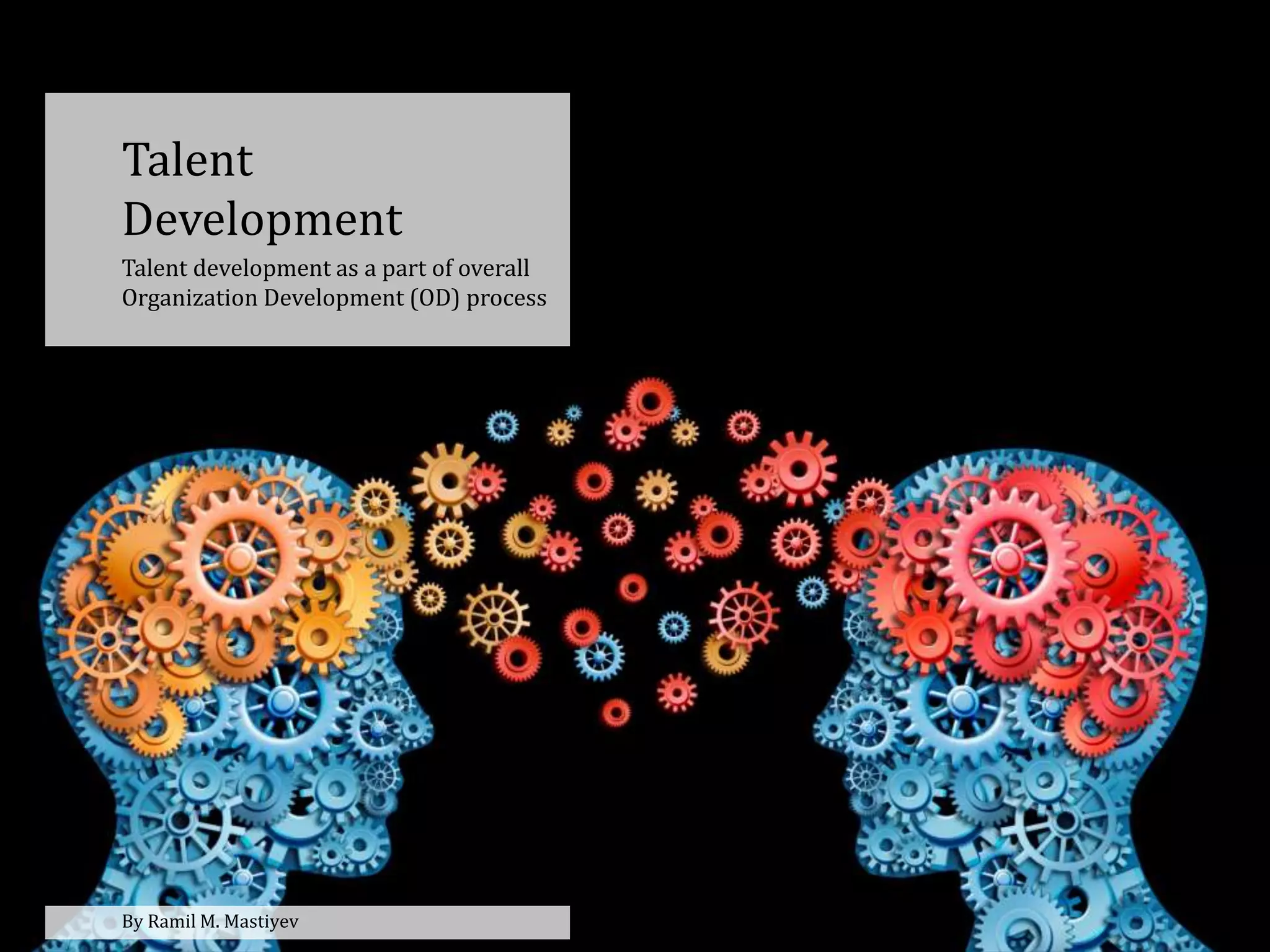


Talent
Development
Talent development as a part of overall
Organization Development (OD) process
By Ramil M. Mastiyev
Table of contents
Introduction to Talent Development 03
Importance of Talent Development 09
Why do we even need this? 13
Where do we start? 15
Talent Development | 2
About (COMPANY) Talent Development 19
Introduction to Talent Development
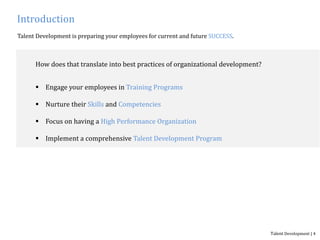
Introduction
Talent Development is preparing your employees for current and future SUCCESS.
How does that translate into best practices of organizational development?
 Engage your employees in Training Programs
 Nurture their Skills and Competencies
 Focus on having a High Performance Organization
 Implement a comprehensive Talent Development Program
Talent Development | 4
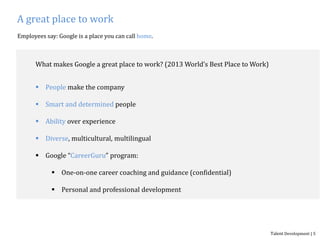
A great place to work
Employees say: Google is a place you can call home.
What makes Google a great place to work? (2013 World’s Best Place to Work)
 People make the company
 Smart and determined people
 Ability over experience
 Diverse, multicultural, multilingual
 Google “CareerGuru” program:
 One-on-one career coaching and guidance (confidential)
 Personal and professional development
Talent Development | 5
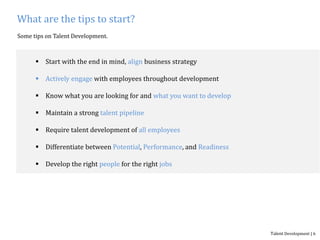
What are the tips to start?
Some tips on Talent Development.
 Start with the end in mind, align business strategy
 Actively engage with employees throughout development
 Know what you are looking for and what you want to develop
 Maintain a strong talent pipeline
 Require talent development of all employees
 Differentiate between Potential, Performance, and Readiness
 Develop the right people for the right jobs
Talent Development | 6
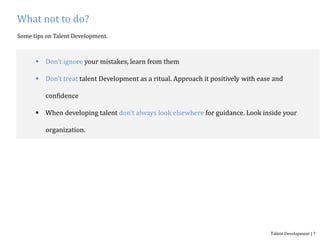
What not to do?
Some tips on Talent Development.
 Don’t ignore your mistakes, learn from them
 Don’t treat talent Development as a ritual. Approach it positively with ease and
confidence
 When developing talent don’t always look elsewhere for guidance. Look inside your
organization.
Talent Development | 7
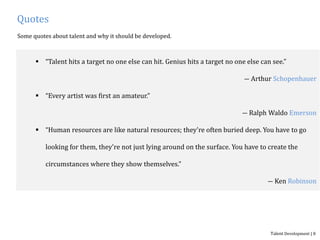
Quotes
Some quotes about talent and why it should be developed.
 “Talent hits a target no one else can hit. Genius hits a target no one else can see.”
― Arthur Schopenhauer
 “Every artist was first an amateur.”
― Ralph Waldo Emerson
 “Human resources are like natural resources; they're often buried deep. You have to go
looking for them, they're not just lying around on the surface. You have to create the
circumstances where they show themselves.”
― Ken Robinson
Talent Development | 8
Importance of TalentDevelopment
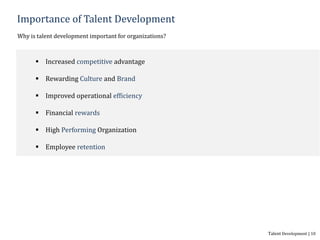
Importance of Talent Development
Why is talent development important for organizations?
 Increased competitive advantage
 Rewarding Culture and Brand
 Improved operational efficiency
 Financial rewards
 High Performing Organization
 Employee retention
Talent Development | 10
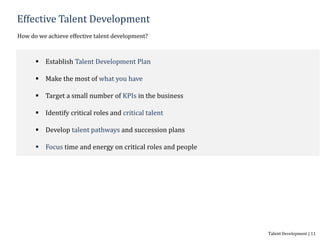
Effective Talent Development
How do we achieve effective talent development?
 Establish Talent Development Plan
 Make the most of what you have
 Target a small number of KPIs in the business
 Identify critical roles and critical talent
 Develop talent pathways and succession plans
 Focus time and energy on critical roles and people
Talent Development | 11
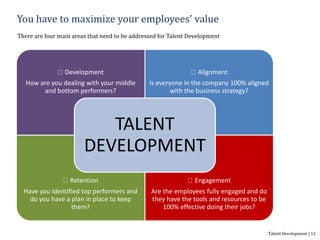
You have to maximize your employees’ value
There are four main areas that need to be addressed for Talent Development
Talent Development | 12
Development
How are you dealing with your middle
and bottom performers?
Alignment
Is everyone in the company 100% aligned
with the business strategy?
Retention
Have you identified top performers and
do you have a plan in place to keep
them?
Engagement
Are the employees fully engaged and do
they have the tools and resources to be
100% effective doing their jobs?
TALENT
DEVELOPMENT
Why do we even need this?
 Not enough geniuses out there – develop the talent you have!
 Competition getting stronger and richer, but people still value DEVELOPMENT higher
than SALARY
 Increase performance by assigning people to positions that match their talent
 Major step towards becoming a truly global company
Talent Development | 14
Wheredo we start?
Where do we start?
 Assign dedicated and motivated people as Talent Development Executives
 Sponsor necessary trainings, professional memberships, and in-house library
 Run as pilot training program with trainers from within the company
 Measure success, conduct surveys – if you are not measuring, you are not performing
 Create a comprehensive Talent Development Plan
Talent Development | 16
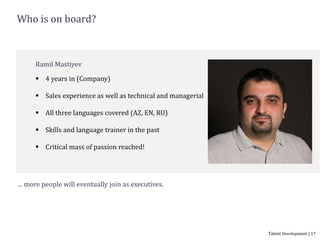
Who is on board?
Ramil Mastiyev
 4 years in (Company)
 Sales experience as well as technical and managerial
 All three languages covered (AZ, EN, RU)
 Skills and language trainer in the past
 Critical mass of passion reached!
Talent Development | 17
… more people will eventually join as executives.
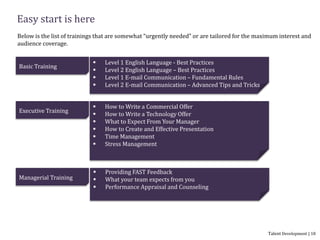
Easy start is here
Talent Development | 18
Below is the list of trainings that are somewhat “urgently needed” or are tailored for the maximum interest and
audience coverage.
Basic Training
 Level 1 English Language - Best Practices
 Level 2 English Language – Best Practices
 Level 1 E-mail Communication – Fundamental Rules
 Level 2 E-mail Communication – Advanced Tips and Tricks
 How to Write a Commercial Offer
 How to Write a Technology Offer
 What to Expect From Your Manager
 How to Create and Effective Presentation
 Time Management
 Stress Management
Executive Training
 Providing FAST Feedback
 What your team expects from you
 Performance Appraisal and Counseling
Managerial Training
Talent Development
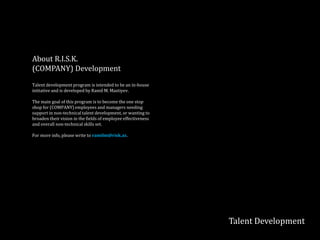
About
(COMPANY) Development
Talent development program is intended to be an in-house
initiative and is developed by Ramil M. Mastiyev.
The main goal of this program is to become the one stop
shop for (COMPANY) employees and managers needing
support in non-technical talent development, or wanting to
broaden their vision in the fields of employee effectiveness
and overall non-technical skills set.
For more info, please write to ramilm@risk.az.

Company talent development presentation (public)

  • 1.
    Talent Development Talent development asa part of overall Organization Development (OD) process By Ramil M. Mastiyev
  • 2.
    Table of contents Introductionto Talent Development 03 Importance of Talent Development 09 Why do we even need this? 13 Where do we start? 15 Talent Development | 2 About (COMPANY) Talent Development 19
  • 3.
  • 4.
    Introduction Talent Development ispreparing your employees for current and future SUCCESS. How does that translate into best practices of organizational development?  Engage your employees in Training Programs  Nurture their Skills and Competencies  Focus on having a High Performance Organization  Implement a comprehensive Talent Development Program Talent Development | 4
  • 5.
    A great placeto work Employees say: Google is a place you can call home. What makes Google a great place to work? (2013 World’s Best Place to Work)  People make the company  Smart and determined people  Ability over experience  Diverse, multicultural, multilingual  Google “CareerGuru” program:  One-on-one career coaching and guidance (confidential)  Personal and professional development Talent Development | 5
  • 6.
    What are thetips to start? Some tips on Talent Development.  Start with the end in mind, align business strategy  Actively engage with employees throughout development  Know what you are looking for and what you want to develop  Maintain a strong talent pipeline  Require talent development of all employees  Differentiate between Potential, Performance, and Readiness  Develop the right people for the right jobs Talent Development | 6
  • 7.
    What not todo? Some tips on Talent Development.  Don’t ignore your mistakes, learn from them  Don’t treat talent Development as a ritual. Approach it positively with ease and confidence  When developing talent don’t always look elsewhere for guidance. Look inside your organization. Talent Development | 7
  • 8.
    Quotes Some quotes abouttalent and why it should be developed.  “Talent hits a target no one else can hit. Genius hits a target no one else can see.” ― Arthur Schopenhauer  “Every artist was first an amateur.” ― Ralph Waldo Emerson  “Human resources are like natural resources; they're often buried deep. You have to go looking for them, they're not just lying around on the surface. You have to create the circumstances where they show themselves.” ― Ken Robinson Talent Development | 8
  • 9.
  • 10.
    Importance of TalentDevelopment Why is talent development important for organizations?  Increased competitive advantage  Rewarding Culture and Brand  Improved operational efficiency  Financial rewards  High Performing Organization  Employee retention Talent Development | 10
  • 11.
    Effective Talent Development Howdo we achieve effective talent development?  Establish Talent Development Plan  Make the most of what you have  Target a small number of KPIs in the business  Identify critical roles and critical talent  Develop talent pathways and succession plans  Focus time and energy on critical roles and people Talent Development | 11
  • 12.
    You have tomaximize your employees’ value There are four main areas that need to be addressed for Talent Development Talent Development | 12 Development How are you dealing with your middle and bottom performers? Alignment Is everyone in the company 100% aligned with the business strategy? Retention Have you identified top performers and do you have a plan in place to keep them? Engagement Are the employees fully engaged and do they have the tools and resources to be 100% effective doing their jobs? TALENT DEVELOPMENT
  • 13.
    Why do weeven need this?
  • 14.
    Why do weeven need this?  Not enough geniuses out there – develop the talent you have!  Competition getting stronger and richer, but people still value DEVELOPMENT higher than SALARY  Increase performance by assigning people to positions that match their talent  Major step towards becoming a truly global company Talent Development | 14
  • 15.
  • 16.
    Where do westart?  Assign dedicated and motivated people as Talent Development Executives  Sponsor necessary trainings, professional memberships, and in-house library  Run as pilot training program with trainers from within the company  Measure success, conduct surveys – if you are not measuring, you are not performing  Create a comprehensive Talent Development Plan Talent Development | 16
  • 17.
    Who is onboard? Ramil Mastiyev  4 years in (Company)  Sales experience as well as technical and managerial  All three languages covered (AZ, EN, RU)  Skills and language trainer in the past  Critical mass of passion reached! Talent Development | 17 … more people will eventually join as executives.
  • 18.
    Easy start ishere Talent Development | 18 Below is the list of trainings that are somewhat “urgently needed” or are tailored for the maximum interest and audience coverage. Basic Training  Level 1 English Language - Best Practices  Level 2 English Language – Best Practices  Level 1 E-mail Communication – Fundamental Rules  Level 2 E-mail Communication – Advanced Tips and Tricks  How to Write a Commercial Offer  How to Write a Technology Offer  What to Expect From Your Manager  How to Create and Effective Presentation  Time Management  Stress Management Executive Training  Providing FAST Feedback  What your team expects from you  Performance Appraisal and Counseling Managerial Training
  • 19.
    Talent Development About (COMPANY) Development Talentdevelopment program is intended to be an in-house initiative and is developed by Ramil M. Mastiyev. The main goal of this program is to become the one stop shop for (COMPANY) employees and managers needing support in non-technical talent development, or wanting to broaden their vision in the fields of employee effectiveness and overall non-technical skills set. For more info, please write to ramilm@risk.az.