


Training and Development
Anuj Bhandari
Bikash Karna
Laxmeshwor Mishra
Ravi Chandra Amatya
Shrawan Shrestha
Copyright © 2005 by South-Western, a division of Thomson Learning. All rights reserved.
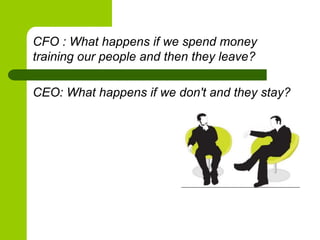
CFO : What happens if we spend money
training our people and then they leave?
CEO: What happens if we don't and they stay?
Copyright © 2005 by South-Western, a division of Thomson Learning. All rights reserved.
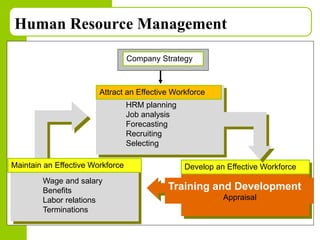
Human Resource Management
Develop an Effective Workforce
Training and Development
Appraisal
Maintain an Effective Workforce
Wage and salary
Benefits
Labor relations
Terminations
HRM planning
Job analysis
Forecasting
Recruiting
Selecting
Attract an Effective Workforce
Company Strategy
Copyright © 2005 by South-Western, a division of Thomson Learning. All rights reserved.
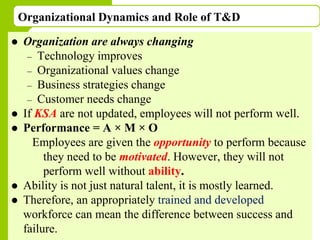
Organizational Dynamics and Role of T&D
 Organization are always changing
– Technology improves
– Organizational values change
– Business strategies change
– Customer needs change
 If KSA are not updated, employees will not perform well.
 Performance = A × M × O
Employees are given the opportunity to perform because
they need to be motivated. However, they will not
perform well without ability.
 Ability is not just natural talent, it is mostly learned.
 Therefore, an appropriately trained and developed
workforce can mean the difference between success and
failure.4
Copyright © 2005 by South-Western, a division of Thomson Learning. All rights reserved.
5
The benefit to the organization
• increased efficiency and productivity;
• reduction in costs;
• reduction in supervisory problems and grievances;
• reduction in accidents;
• improved quality;
• improved motivation and morale among employees;
• encouraging a culture of flexibility;
• developing a culture of learning;
• easing skills shortages;
• planning for succession.
Copyright © 2005 by South-Western, a division of Thomson Learning. All rights reserved.
66
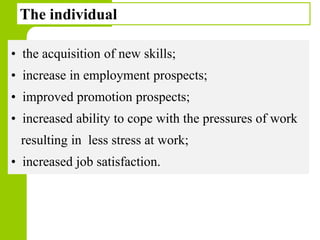
The individual
• the acquisition of new skills;
• increase in employment prospects;
• improved promotion prospects;
• increased ability to cope with the pressures of work
resulting in less stress at work;
• increased job satisfaction.
Copyright © 2005 by South-Western, a division of Thomson Learning. All rights reserved.
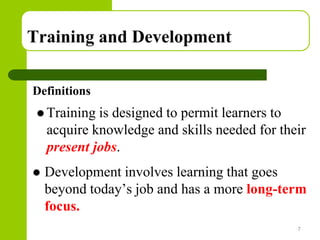
Training and Development
Definitions
 Training is designed to permit learners to
acquire knowledge and skills needed for their
present jobs.
 Development involves learning that goes
beyond today’s job and has a more long-term
focus.
7
Copyright © 2005 by South-Western, a division of Thomson Learning. All rights reserved.
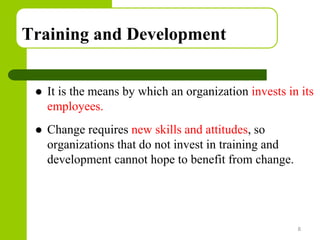
Training and Development
 It is the means by which an organization invests in its
employees.
 Change requires new skills and attitudes, so
organizations that do not invest in training and
development cannot hope to benefit from change.
8
Copyright © 2005 by South-Western, a division of Thomson Learning. All rights reserved.
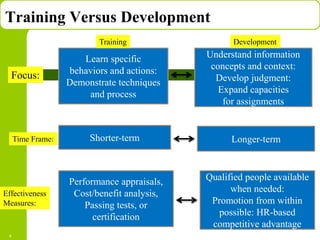
Training Versus Development
9
Learn specific
behaviors and actions:
Demonstrate techniques
and process
Understand information
concepts and context:
Develop judgment:
Expand capacities
for assignments
Shorter-term Longer-term
Performance appraisals,
Cost/benefit analysis,
Passing tests, or
certification
Qualified people available
when needed:
Promotion from within
possible: HR-based
competitive advantage
Focus:
Time Frame:
Effectiveness
Measures:
Training Development
Copyright © 2005 by South-Western, a division of Thomson Learning. All rights reserved.
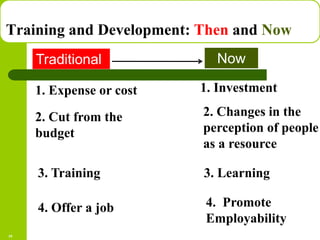
Training and Development: Then and Now
10
Traditional Now
1. Expense or cost 1. Investment
2. Cut from the
budget
2. Changes in the
perception of people
as a resource
3. Training 3. Learning
4. Offer a job 4. Promote
Employability
Copyright © 2005 by South-Western, a division of Thomson Learning. All rights reserved.
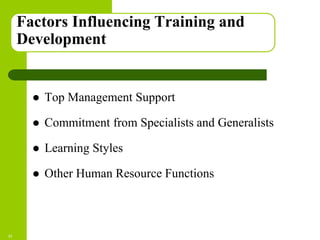
Factors Influencing Training and
Development
 Top Management Support
 Commitment from Specialists and Generalists
 Learning Styles
 Other Human Resource Functions
11
Copyright © 2005 by South-Western, a division of Thomson Learning. All rights reserved.
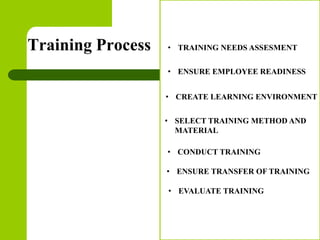
Training Process
12
• TRAINING NEEDS ASSESMENT
• ENSURE EMPLOYEE READINESS
• CREATE LEARNING ENVIRONMENT
• SELECT TRAINING METHOD AND
MATERIAL
• CONDUCT TRAINING
• ENSURE TRANSFER OF TRAINING
• EVALUATE TRAINING
Copyright © 2005 by South-Western, a division of Thomson Learning. All rights reserved.
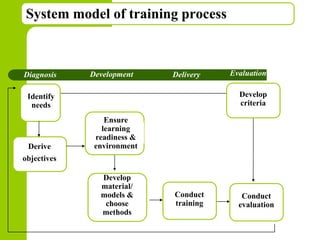
System model of training process
Diagnosis Development Delivery Evaluation
Identify
needs
Ensure
learning
readiness &
environment
Develop
material/
models &
choose
methods
Conduct
evaluation
Conduct
training
Develop
criteria
Derive
objectives
Copyright © 2005 by South-Western, a division of Thomson Learning. All rights reserved.
Training Needs Assessment
 Organizational analysis involves determining the
appropriateness of training, giving the company’s business
strategy, its resources available for training, and support by
managers and peers for training activities.
 Task analysis identifies the important tasks and knowledge,
skill, and behaviors that need to be emphasized in training for
employees to complete their jobs.
 Person analysis involves determining whether performance
deficiencies result from a lack of knowledge, skill or ability,
identifying who needs training and determining employees'
readiness for training.
Copyright © 2005 by South-Western, a division of Thomson Learning. All rights reserved.
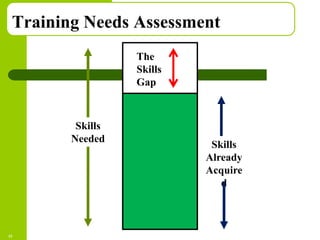
Training Needs Assessment
15
The
Skills
Gap
Skills
Already
Acquire
d
Skills
Needed
Copyright © 2005 by South-Western, a division of Thomson Learning. All rights reserved.
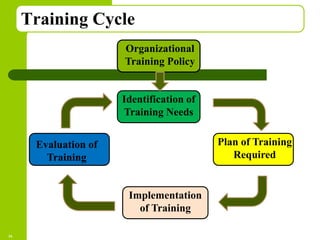
Training Cycle
16
Organizational
Training Policy
Identification of
Training Needs
Plan of Training
Required
Implementation
of Training
Evaluation of
Training
Copyright © 2005 by South-Western, a division of Thomson Learning. All rights reserved.
1717
Training needs analysis
This seeks to identify the gap between:
• the knowledge and skills possessed and the knowledge and
skills required;
• actual performance and target/standard performance
 The analysis is not confined to individuals, but to teams,
departments and the corporation as a whole.
 The training need is any shortcoming, gap or problem that
prevents the individual or organization achieving its objective
and can be overcome or reduced by training.
Copyright © 2005 by South-Western, a division of Thomson Learning. All rights reserved.
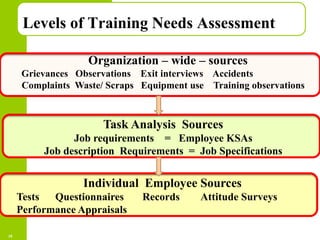
Levels of Training Needs Assessment
18
Organization – wide – sources
Grievances Observations Exit interviews Accidents
Complaints Waste/ Scraps Equipment use Training observations
Task Analysis Sources
Job requirements = Employee KSAs
Job description Requirements = Job Specifications
Individual Employee Sources
Tests Questionnaires Records Attitude Surveys
Performance Appraisals
Copyright © 2005 by South-Western, a division of Thomson Learning. All rights reserved.
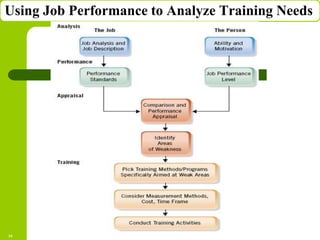
Using Job Performance to Analyze Training Needs
19
Copyright © 2005 by South-Western, a division of Thomson Learning. All rights reserved.
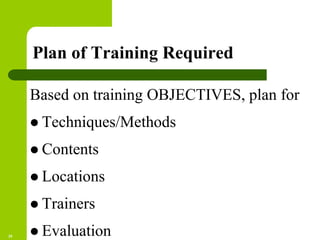
Plan of Training Required
Based on training OBJECTIVES, plan for
 Techniques/Methods
 Contents
 Locations
 Trainers
 Evaluation20
Copyright © 2005 by South-Western, a division of Thomson Learning. All rights reserved.
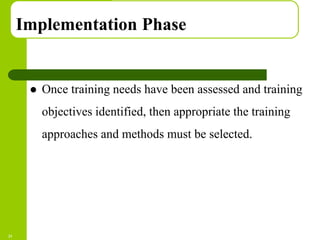
Implementation Phase
 Once training needs have been assessed and training
objectives identified, then appropriate the training
approaches and methods must be selected.
21
Copyright © 2005 by South-Western, a division of Thomson Learning. All rights reserved.
Which Training Method?
Films, videos, slides, audiotapes
and chalkboards
Video conferencing
Facilitate Self directed Learning
methods
Helps learn motivational
technique, leadership skills,
team work
22
Informational
Copyright © 2005 by South-Western, a division of Thomson Learning. All rights reserved.
Training Method -
 On the job training places the employees in actual work
situations and makes them appear to be immediately
productive.
 Orientation
 Coaching
 Mentoring
 Job Rotation
 Job Instruction Techniques
 Apprenticeship
23
Experimental
Copyright © 2005 by South-Western, a division of Thomson Learning. All rights reserved.
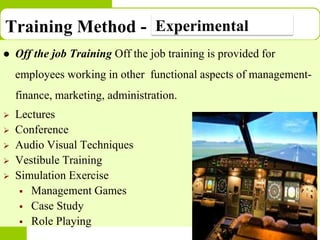
Training Method -
 Off the job Training Off the job training is provided for
employees working in other functional aspects of management-
finance, marketing, administration.
 Lectures
 Conference
 Audio Visual Techniques
 Vestibule Training
 Simulation Exercise
 Management Games
 Case Study
 Role Playing
24
Experimental
Copyright © 2005 by South-Western, a division of Thomson Learning. All rights reserved.
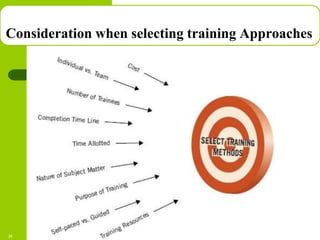
Consideration when selecting training Approaches
25
Copyright © 2005 by South-Western, a division of Thomson Learning. All rights reserved.
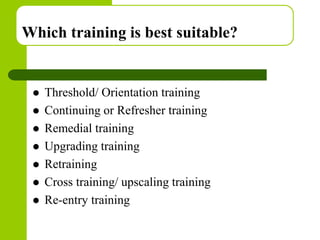
Which training is best suitable?
 Threshold/ Orientation training
 Continuing or Refresher training
 Remedial training
 Upgrading training
 Retraining
 Cross training/ upscaling training
 Re-entry training
Copyright © 2005 by South-Western, a division of Thomson Learning. All rights reserved.
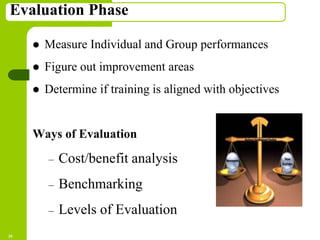
Evaluation Phase
 Measure Individual and Group performances
 Figure out improvement areas
 Determine if training is aligned with objectives
Ways of Evaluation
– Cost/benefit analysis
– Benchmarking
– Levels of Evaluation
28
Copyright © 2005 by South-Western, a division of Thomson Learning. All rights reserved.
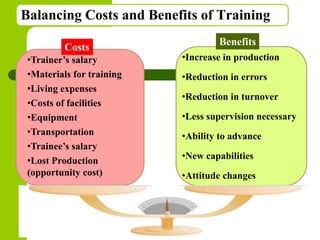
Balancing Costs and Benefits of Training
29
Costs
•Trainer’s salary
•Materials for training
•Living expenses
•Costs of facilities
•Equipment
•Transportation
•Trainee’s salary
•Lost Production
(opportunity cost)
Benefits
•Increase in production
•Reduction in errors
•Reduction in turnover
•Less supervision necessary
•Ability to advance
•New capabilities
•Attitude changes
Copyright © 2005 by South-Western, a division of Thomson Learning. All rights reserved.
Benchmarking
 Benchmark measures of training that are compared
from one organization to others.
 HR professionals in an organization gather data on
training and compare it to data on training at other
organizations in the same industry and same size.
30
Copyright © 2005 by South-Western, a division of Thomson Learning. All rights reserved.
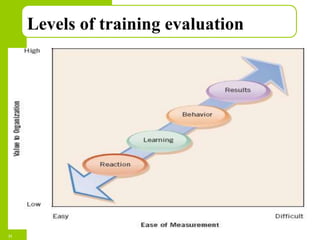
Levels of training evaluation
31
Copyright © 2005 by South-Western, a division of Thomson Learning. All rights reserved.
Levels of training evaluation
 Reaction: Organization evaluate the reaction
level of trainees by conducting interviews or by
administering questionnaires to the trainees.
 Learning: Learning level can be evaluated by
measuring how well trainees have learned facts,
ideas, concepts, theories, and attitudes.
Copyright © 2005 by South-Western, a division of Thomson Learning. All rights reserved.
Levels of training evaluation (Cont.)
 Behavior: Behavioral level involves measuring
the effect of training on job performance through
interviews of trainees and their coworkers and
observing job performance.
 Results: Results, such as productivity, turnover,
quality, time, sales, and costs, by measuring the
effect of training on the achievement of
organizational objective.
Copyright © 2005 by South-Western, a division of Thomson Learning. All rights reserved.
Steps to Effective Training and Development
 View training and development as an investment.
 Match training and development to organizational
objectives.
 Assess training needs in consultation with the potential
trainee and the line manager.
 Don’t treat training as a punishment.
 Put a monitoring and evaluation procedure in place.
 Remember that leaning never stops.
 Structure the training.
34
Copyright © 2005 by South-Western, a division of Thomson Learning. All rights reserved.
Thank You Very Much
For Your Attention
1-35

Employee training and development seminar

  • 1.
    Training and Development AnujBhandari Bikash Karna Laxmeshwor Mishra Ravi Chandra Amatya Shrawan Shrestha
  • 2.
    Copyright © 2005by South-Western, a division of Thomson Learning. All rights reserved. CFO : What happens if we spend money training our people and then they leave? CEO: What happens if we don't and they stay?
  • 3.
    Copyright © 2005by South-Western, a division of Thomson Learning. All rights reserved. Human Resource Management Develop an Effective Workforce Training and Development Appraisal Maintain an Effective Workforce Wage and salary Benefits Labor relations Terminations HRM planning Job analysis Forecasting Recruiting Selecting Attract an Effective Workforce Company Strategy
  • 4.
    Copyright © 2005by South-Western, a division of Thomson Learning. All rights reserved. Organizational Dynamics and Role of T&D  Organization are always changing – Technology improves – Organizational values change – Business strategies change – Customer needs change  If KSA are not updated, employees will not perform well.  Performance = A × M × O Employees are given the opportunity to perform because they need to be motivated. However, they will not perform well without ability.  Ability is not just natural talent, it is mostly learned.  Therefore, an appropriately trained and developed workforce can mean the difference between success and failure.4
  • 5.
    Copyright © 2005by South-Western, a division of Thomson Learning. All rights reserved. 5 The benefit to the organization • increased efficiency and productivity; • reduction in costs; • reduction in supervisory problems and grievances; • reduction in accidents; • improved quality; • improved motivation and morale among employees; • encouraging a culture of flexibility; • developing a culture of learning; • easing skills shortages; • planning for succession.
  • 6.
    Copyright © 2005by South-Western, a division of Thomson Learning. All rights reserved. 66 The individual • the acquisition of new skills; • increase in employment prospects; • improved promotion prospects; • increased ability to cope with the pressures of work resulting in less stress at work; • increased job satisfaction.
  • 7.
    Copyright © 2005by South-Western, a division of Thomson Learning. All rights reserved. Training and Development Definitions  Training is designed to permit learners to acquire knowledge and skills needed for their present jobs.  Development involves learning that goes beyond today’s job and has a more long-term focus. 7
  • 8.
    Copyright © 2005by South-Western, a division of Thomson Learning. All rights reserved. Training and Development  It is the means by which an organization invests in its employees.  Change requires new skills and attitudes, so organizations that do not invest in training and development cannot hope to benefit from change. 8
  • 9.
    Copyright © 2005by South-Western, a division of Thomson Learning. All rights reserved. Training Versus Development 9 Learn specific behaviors and actions: Demonstrate techniques and process Understand information concepts and context: Develop judgment: Expand capacities for assignments Shorter-term Longer-term Performance appraisals, Cost/benefit analysis, Passing tests, or certification Qualified people available when needed: Promotion from within possible: HR-based competitive advantage Focus: Time Frame: Effectiveness Measures: Training Development
  • 10.
    Copyright © 2005by South-Western, a division of Thomson Learning. All rights reserved. Training and Development: Then and Now 10 Traditional Now 1. Expense or cost 1. Investment 2. Cut from the budget 2. Changes in the perception of people as a resource 3. Training 3. Learning 4. Offer a job 4. Promote Employability
  • 11.
    Copyright © 2005by South-Western, a division of Thomson Learning. All rights reserved. Factors Influencing Training and Development  Top Management Support  Commitment from Specialists and Generalists  Learning Styles  Other Human Resource Functions 11
  • 12.
    Copyright © 2005by South-Western, a division of Thomson Learning. All rights reserved. Training Process 12 • TRAINING NEEDS ASSESMENT • ENSURE EMPLOYEE READINESS • CREATE LEARNING ENVIRONMENT • SELECT TRAINING METHOD AND MATERIAL • CONDUCT TRAINING • ENSURE TRANSFER OF TRAINING • EVALUATE TRAINING
  • 13.
    Copyright © 2005by South-Western, a division of Thomson Learning. All rights reserved. System model of training process Diagnosis Development Delivery Evaluation Identify needs Ensure learning readiness & environment Develop material/ models & choose methods Conduct evaluation Conduct training Develop criteria Derive objectives
  • 14.
    Copyright © 2005by South-Western, a division of Thomson Learning. All rights reserved. Training Needs Assessment  Organizational analysis involves determining the appropriateness of training, giving the company’s business strategy, its resources available for training, and support by managers and peers for training activities.  Task analysis identifies the important tasks and knowledge, skill, and behaviors that need to be emphasized in training for employees to complete their jobs.  Person analysis involves determining whether performance deficiencies result from a lack of knowledge, skill or ability, identifying who needs training and determining employees' readiness for training.
  • 15.
    Copyright © 2005by South-Western, a division of Thomson Learning. All rights reserved. Training Needs Assessment 15 The Skills Gap Skills Already Acquire d Skills Needed
  • 16.
    Copyright © 2005by South-Western, a division of Thomson Learning. All rights reserved. Training Cycle 16 Organizational Training Policy Identification of Training Needs Plan of Training Required Implementation of Training Evaluation of Training
  • 17.
    Copyright © 2005by South-Western, a division of Thomson Learning. All rights reserved. 1717 Training needs analysis This seeks to identify the gap between: • the knowledge and skills possessed and the knowledge and skills required; • actual performance and target/standard performance  The analysis is not confined to individuals, but to teams, departments and the corporation as a whole.  The training need is any shortcoming, gap or problem that prevents the individual or organization achieving its objective and can be overcome or reduced by training.
  • 18.
    Copyright © 2005by South-Western, a division of Thomson Learning. All rights reserved. Levels of Training Needs Assessment 18 Organization – wide – sources Grievances Observations Exit interviews Accidents Complaints Waste/ Scraps Equipment use Training observations Task Analysis Sources Job requirements = Employee KSAs Job description Requirements = Job Specifications Individual Employee Sources Tests Questionnaires Records Attitude Surveys Performance Appraisals
  • 19.
    Copyright © 2005by South-Western, a division of Thomson Learning. All rights reserved. Using Job Performance to Analyze Training Needs 19
  • 20.
    Copyright © 2005by South-Western, a division of Thomson Learning. All rights reserved. Plan of Training Required Based on training OBJECTIVES, plan for  Techniques/Methods  Contents  Locations  Trainers  Evaluation20
  • 21.
    Copyright © 2005by South-Western, a division of Thomson Learning. All rights reserved. Implementation Phase  Once training needs have been assessed and training objectives identified, then appropriate the training approaches and methods must be selected. 21
  • 22.
    Copyright © 2005by South-Western, a division of Thomson Learning. All rights reserved. Which Training Method? Films, videos, slides, audiotapes and chalkboards Video conferencing Facilitate Self directed Learning methods Helps learn motivational technique, leadership skills, team work 22 Informational
  • 23.
    Copyright © 2005by South-Western, a division of Thomson Learning. All rights reserved. Training Method -  On the job training places the employees in actual work situations and makes them appear to be immediately productive.  Orientation  Coaching  Mentoring  Job Rotation  Job Instruction Techniques  Apprenticeship 23 Experimental
  • 24.
    Copyright © 2005by South-Western, a division of Thomson Learning. All rights reserved. Training Method -  Off the job Training Off the job training is provided for employees working in other functional aspects of management- finance, marketing, administration.  Lectures  Conference  Audio Visual Techniques  Vestibule Training  Simulation Exercise  Management Games  Case Study  Role Playing 24 Experimental
  • 25.
    Copyright © 2005by South-Western, a division of Thomson Learning. All rights reserved. Consideration when selecting training Approaches 25
  • 26.
    Copyright © 2005by South-Western, a division of Thomson Learning. All rights reserved.
  • 27.
    Copyright © 2005by South-Western, a division of Thomson Learning. All rights reserved. Which training is best suitable?  Threshold/ Orientation training  Continuing or Refresher training  Remedial training  Upgrading training  Retraining  Cross training/ upscaling training  Re-entry training
  • 28.
    Copyright © 2005by South-Western, a division of Thomson Learning. All rights reserved. Evaluation Phase  Measure Individual and Group performances  Figure out improvement areas  Determine if training is aligned with objectives Ways of Evaluation – Cost/benefit analysis – Benchmarking – Levels of Evaluation 28
  • 29.
    Copyright © 2005by South-Western, a division of Thomson Learning. All rights reserved. Balancing Costs and Benefits of Training 29 Costs •Trainer’s salary •Materials for training •Living expenses •Costs of facilities •Equipment •Transportation •Trainee’s salary •Lost Production (opportunity cost) Benefits •Increase in production •Reduction in errors •Reduction in turnover •Less supervision necessary •Ability to advance •New capabilities •Attitude changes
  • 30.
    Copyright © 2005by South-Western, a division of Thomson Learning. All rights reserved. Benchmarking  Benchmark measures of training that are compared from one organization to others.  HR professionals in an organization gather data on training and compare it to data on training at other organizations in the same industry and same size. 30
  • 31.
    Copyright © 2005by South-Western, a division of Thomson Learning. All rights reserved. Levels of training evaluation 31
  • 32.
    Copyright © 2005by South-Western, a division of Thomson Learning. All rights reserved. Levels of training evaluation  Reaction: Organization evaluate the reaction level of trainees by conducting interviews or by administering questionnaires to the trainees.  Learning: Learning level can be evaluated by measuring how well trainees have learned facts, ideas, concepts, theories, and attitudes.
  • 33.
    Copyright © 2005by South-Western, a division of Thomson Learning. All rights reserved. Levels of training evaluation (Cont.)  Behavior: Behavioral level involves measuring the effect of training on job performance through interviews of trainees and their coworkers and observing job performance.  Results: Results, such as productivity, turnover, quality, time, sales, and costs, by measuring the effect of training on the achievement of organizational objective.
  • 34.
    Copyright © 2005by South-Western, a division of Thomson Learning. All rights reserved. Steps to Effective Training and Development  View training and development as an investment.  Match training and development to organizational objectives.  Assess training needs in consultation with the potential trainee and the line manager.  Don’t treat training as a punishment.  Put a monitoring and evaluation procedure in place.  Remember that leaning never stops.  Structure the training. 34
  • 35.
    Copyright © 2005by South-Western, a division of Thomson Learning. All rights reserved. Thank You Very Much For Your Attention 1-35