HUMAN RESOURCE DEVELOPMENT
TERM-PAPER
PRESENTED
BY
AREO KUNLE OYEYINKA
ROLL N0: 21
COUNTRY: - NIGERIA
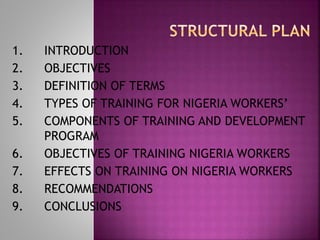
1. INTRODUCTION
2. OBJECTIVES
3. DEFINITION OF TERMS
4. TYPES OF TRAINING FOR NIGERIA WORKERS’
5. COMPONENTS OF TRAINING AND DEVELOPMENT
PROGRAM
6. OBJECTIVES OF TRAINING NIGERIA WORKERS
7. EFFECTS ON TRAINING ON NIGERIA WORKERS
8. RECOMMENDATIONS
9. CONCLUSIONS
 Human beings are the pivot of work in the
productive venture. This explains why organization
and nations take good steps to ensure the
effectiveness of individual. Human beings provide
ideas, innovations, invention and thereby wealth for
the benefit of both employers and employees.
 This cannot be achieved if workers are not
properly trained. Hence, training and development
has always been recognized as an important factor
that contributes to improved performance of an
employee
The main objective of this study
is to critically look at the
importance of employees
training and development in an
organization, and how it affects
the Nigerian economy as a whole
An Employee is any individual who is engaged in a
particular service in anticipation of agreed wages
to be paid in return for the services he renders to
his employer.
Training refers to improving competencies needed
today or very soon (Jackson & Schuler, 2003).
Training is the act of increasing the knowledge and
skills of an employee for performing the job
assigned to him. The term training refers to the
acquisition of knowledge, skills and competencies
as a result of vocational or practical skills and
knowledge that relates to specific useful
competencies (Wikipedia, 2011).
Development of workers involves the renewal or
updating of worker’s skills, knowledge, attitude,
work habits and competencies to enable them
perform their assigned responsibilities creditably.
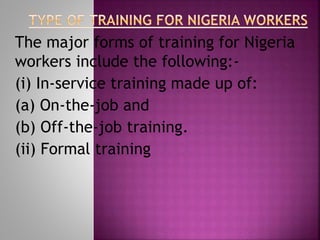
The major forms of training for Nigeria
workers include the following:-
(i) In-service training made up of:
(a) On-the-job and
(b) Off-the-job training.
(ii) Formal training
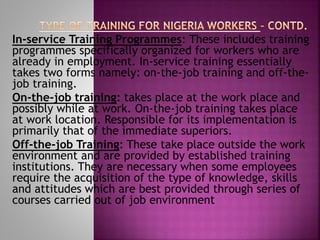
In-service Training Programmes: These includes training
programmes specifically organized for workers who are
already in employment. In-service training essentially
takes two forms namely: on-the-job training and off-the-
job training.
On-the-job training: takes place at the work place and
possibly while at work. On-the-job training takes place
at work location. Responsible for its implementation is
primarily that of the immediate superiors.
Off-the-job Training: These take place outside the work
environment and are provided by established training
institutions. They are necessary when some employees
require the acquisition of the type of knowledge, skills
and attitudes which are best provided through series of
courses carried out of job environment
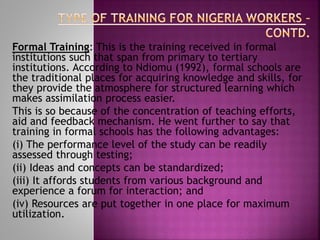
Formal Training: This is the training received in formal
institutions such that span from primary to tertiary
institutions. According to Ndiomu (1992), formal schools are
the traditional places for acquiring knowledge and skills, for
they provide the atmosphere for structured learning which
makes assimilation process easier.
This is so because of the concentration of teaching efforts,
aid and feedback mechanism. He went further to say that
training in formal schools has the following advantages:
(i) The performance level of the study can be readily
assessed through testing;
(ii) Ideas and concepts can be standardized;
(iii) It affords students from various background and
experience a forum for interaction; and
(iv) Resources are put together in one place for maximum
utilization.
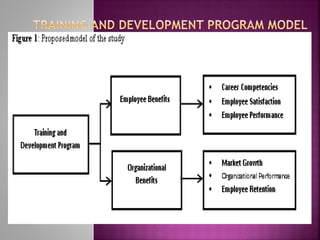
A perfect employee training and development
program must be the mixture of knowledge, career
development and goal setting.
Extensively use of the Information Technology
systems for the training and learning programs.
It should be created in a way that its not only
accomplish its goals but have optimistic
consequences on employees and organization.
It should be provided to them on the right time
without any delay.
Employees should improve understanding to work,
better accountability for career and strategy for
action to attain upcoming goals.
The objectives of training workers
according to Akinwale (2000) can be
examined along the following
dimensions namely:
(i) Organizational level;
(ii) Individual level; and
(iii) Employee level.
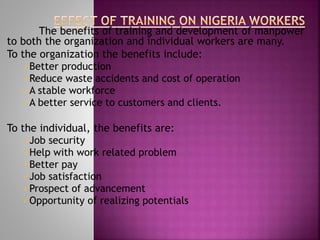
The benefits of training and development of manpower
to both the organization and individual workers are many.
To the organization the benefits include:
Better production
Reduce waste accidents and cost of operation
A stable workforce
A better service to customers and clients.
To the individual, the benefits are:
Job security
Help with work related problem
Better pay
Job satisfaction
Prospect of advancement
Opportunity of realizing potentials
The benefits of training might have a positive effect like as
individual employee benefits, which later affect organizational
results.
However, research is required to recognize the features that
enable a smooth transfer of employee development benefits on
different level.
There is a gap existing between the applied and academic
literature concerning the usage of cycle time as a factor to
measure usefulness of training and development program
The paper has attempted to discuss the meaning of worker,
training and development, types of training to workers, objectives
of training and equally the effect of training on workers’ task
performance in the organization.
For any organization to maintain higher productivity, the
organization must engage in training and re-training of its
workforce to meet technological changes taking place in the world
of work. This is to ensure improved performance on the job and
boost the morale of workers in Nigeria.
THE IMPORTANCE EMPLOYEES TRAINING AND DEVELOPMENT IN AN ORGANIZATION

THE IMPORTANCE EMPLOYEES TRAINING AND DEVELOPMENT IN AN ORGANIZATION

  • 1.
    HUMAN RESOURCE DEVELOPMENT TERM-PAPER PRESENTED BY AREOKUNLE OYEYINKA ROLL N0: 21 COUNTRY: - NIGERIA
  • 2.
    1. INTRODUCTION 2. OBJECTIVES 3.DEFINITION OF TERMS 4. TYPES OF TRAINING FOR NIGERIA WORKERS’ 5. COMPONENTS OF TRAINING AND DEVELOPMENT PROGRAM 6. OBJECTIVES OF TRAINING NIGERIA WORKERS 7. EFFECTS ON TRAINING ON NIGERIA WORKERS 8. RECOMMENDATIONS 9. CONCLUSIONS
  • 3.
     Human beingsare the pivot of work in the productive venture. This explains why organization and nations take good steps to ensure the effectiveness of individual. Human beings provide ideas, innovations, invention and thereby wealth for the benefit of both employers and employees.  This cannot be achieved if workers are not properly trained. Hence, training and development has always been recognized as an important factor that contributes to improved performance of an employee
  • 4.
    The main objectiveof this study is to critically look at the importance of employees training and development in an organization, and how it affects the Nigerian economy as a whole
  • 5.
    An Employee isany individual who is engaged in a particular service in anticipation of agreed wages to be paid in return for the services he renders to his employer. Training refers to improving competencies needed today or very soon (Jackson & Schuler, 2003). Training is the act of increasing the knowledge and skills of an employee for performing the job assigned to him. The term training refers to the acquisition of knowledge, skills and competencies as a result of vocational or practical skills and knowledge that relates to specific useful competencies (Wikipedia, 2011). Development of workers involves the renewal or updating of worker’s skills, knowledge, attitude, work habits and competencies to enable them perform their assigned responsibilities creditably.
  • 6.
    The major formsof training for Nigeria workers include the following:- (i) In-service training made up of: (a) On-the-job and (b) Off-the-job training. (ii) Formal training
  • 7.
    In-service Training Programmes:These includes training programmes specifically organized for workers who are already in employment. In-service training essentially takes two forms namely: on-the-job training and off-the- job training. On-the-job training: takes place at the work place and possibly while at work. On-the-job training takes place at work location. Responsible for its implementation is primarily that of the immediate superiors. Off-the-job Training: These take place outside the work environment and are provided by established training institutions. They are necessary when some employees require the acquisition of the type of knowledge, skills and attitudes which are best provided through series of courses carried out of job environment
  • 8.
    Formal Training: Thisis the training received in formal institutions such that span from primary to tertiary institutions. According to Ndiomu (1992), formal schools are the traditional places for acquiring knowledge and skills, for they provide the atmosphere for structured learning which makes assimilation process easier. This is so because of the concentration of teaching efforts, aid and feedback mechanism. He went further to say that training in formal schools has the following advantages: (i) The performance level of the study can be readily assessed through testing; (ii) Ideas and concepts can be standardized; (iii) It affords students from various background and experience a forum for interaction; and (iv) Resources are put together in one place for maximum utilization.
  • 9.
    A perfect employeetraining and development program must be the mixture of knowledge, career development and goal setting. Extensively use of the Information Technology systems for the training and learning programs. It should be created in a way that its not only accomplish its goals but have optimistic consequences on employees and organization. It should be provided to them on the right time without any delay. Employees should improve understanding to work, better accountability for career and strategy for action to attain upcoming goals.
  • 11.
    The objectives oftraining workers according to Akinwale (2000) can be examined along the following dimensions namely: (i) Organizational level; (ii) Individual level; and (iii) Employee level.
  • 12.
    The benefits oftraining and development of manpower to both the organization and individual workers are many. To the organization the benefits include: Better production Reduce waste accidents and cost of operation A stable workforce A better service to customers and clients. To the individual, the benefits are: Job security Help with work related problem Better pay Job satisfaction Prospect of advancement Opportunity of realizing potentials
  • 13.
    The benefits oftraining might have a positive effect like as individual employee benefits, which later affect organizational results. However, research is required to recognize the features that enable a smooth transfer of employee development benefits on different level. There is a gap existing between the applied and academic literature concerning the usage of cycle time as a factor to measure usefulness of training and development program
  • 14.
    The paper hasattempted to discuss the meaning of worker, training and development, types of training to workers, objectives of training and equally the effect of training on workers’ task performance in the organization. For any organization to maintain higher productivity, the organization must engage in training and re-training of its workforce to meet technological changes taking place in the world of work. This is to ensure improved performance on the job and boost the morale of workers in Nigeria.