Trial lens box
By - Raju Rathore
B.optometry 3nd sem
ITM university Raipur
.
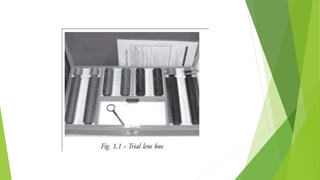
• Trial lens set is the primary and most
essential device in a refraction chamber
• A standard trial lens set contains a pair of
plus and minus lenses on each power in
sphere and cylinder form
• The spherical lenses are available in the
ranges from 0.12 D to 20.0 D and the
cylindrical lenses from 0.12 D to 6.0 D
• All trial lenses are mounted either by a metal or
plastic rim with hand grip for easy handling
• The accessory lenses are occluder, pinhole disc
,stenopic slit, Maddox rod, Red and Green
goggles and prisms from 0.5 to 12.0 D are also
available in the trial set
.
• In cylindrical lens, axis meridian is indicated by
special marks and comes without handle for easy
rotation
• Prism has its apex and base marked on the lens
• Occluder is an opaque disc used to close or
cover one eye during refraction examination
• It blocks one eye vision while performing the
test on the fellow eye, so that we can check
each eye separately
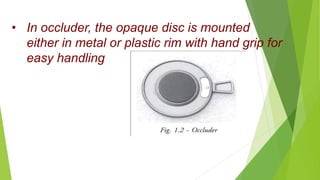
• In occluder, the opaque disc is mounted
either in metal or plastic rim with hand grip for
easy handling
• .
• Pinhole is an opaque disc used for determining
whether the decreased vision is due to refractive
error or due to pathological diseases of the eye
• It actually reduces the retinal blur and allows the
central light rays to reach the macula (retina)
which enhances Vision
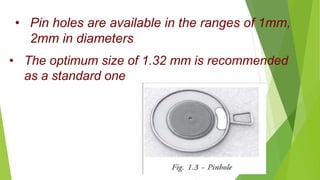
• Pin holes are available in the ranges of 1mm,
2mm in diameters
• The optimum size of 1.32 mm is recommended
as a standard one
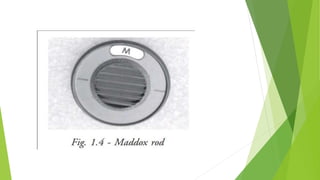
• Maddox rod is constructed of a series of
red cylindrical rods
• Each rod acts as a strong ‘+’ cylindrical lens
that forms a red streak band before the eye
• It is used to detect the presence of
heterophoria and to measure the amount of
heterotropia
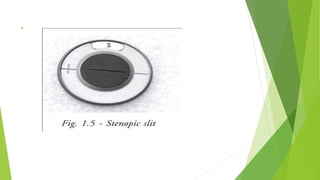
Stenopic slit
• consists of a rectangular aperture with a linear
slit 1mm in width and up to 15 mm in length
• It is useful for refining the axis of high
irregular astigmatism
.
.
• Red and green goggles are mainly used in
checking the binocular single vision by worth’s four
dot test and stereopsis test using TNO Charts
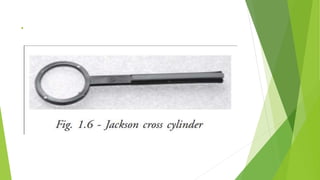
• JCC is a combination of minus and plus cylinder
power, the same power located perpendicular to
each other and supported with hand grip
• The axis of two Cylinders is marked in white
and red colors
.
• The white mark indicates the axis of ‘+’ cyl and
the red indicates the axis ‘-’ cyl
• It is used for determining the power and for
refining the correct axis
• Cross cylinders are available in 0.12D, 0.25D,
0.50D and 1.0D powers
.
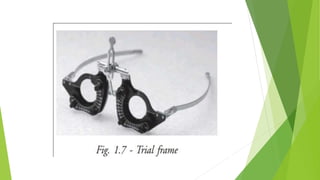
• The trial frame is a metallic / plastic frame for
holding the trial lenses before the eye during
refraction
• Each eye frame is constructed of three cells
on front side and one on back side
• The front three surfaces of the trial frame are used
for keeping the spherical, cylinder and other
accessories i.e. occluder, pinhole etc
.• The second front cell is arranged for placing the
cylindrical lens and the axis is marked Counter
clockwise
• The extreme forward cell is molded with three
knobs with support to place the lens accessories
• Like spectacles, two eye frames are being
mounted by an adjustable bridge and sides
• It is necessary to adjust the trial frame
depending on the patient’s pupillary distance
before starting the refraction test
• Special trial frames are available for children
and for doing low vision refraction.
.
ARAVIND EYE CARE SYSTEM : A TEXT BOOK OF
OPTICS AND REFRACTION
Dr. G. Venkataswamy
Chapter 1 (page no 2-4)
By - Raju RATHORE

Trail box

  • 1.
    Trial lens box By- Raju Rathore B.optometry 3nd sem ITM university Raipur
  • 2.
    . • Trial lensset is the primary and most essential device in a refraction chamber • A standard trial lens set contains a pair of plus and minus lenses on each power in sphere and cylinder form • The spherical lenses are available in the ranges from 0.12 D to 20.0 D and the cylindrical lenses from 0.12 D to 6.0 D
  • 3.
    • All triallenses are mounted either by a metal or plastic rim with hand grip for easy handling • The accessory lenses are occluder, pinhole disc ,stenopic slit, Maddox rod, Red and Green goggles and prisms from 0.5 to 12.0 D are also available in the trial set
  • 4.
    . • In cylindricallens, axis meridian is indicated by special marks and comes without handle for easy rotation • Prism has its apex and base marked on the lens
  • 6.
    • Occluder isan opaque disc used to close or cover one eye during refraction examination • It blocks one eye vision while performing the test on the fellow eye, so that we can check each eye separately
  • 7.
    • In occluder,the opaque disc is mounted either in metal or plastic rim with hand grip for easy handling
  • 8.
    • . • Pinholeis an opaque disc used for determining whether the decreased vision is due to refractive error or due to pathological diseases of the eye • It actually reduces the retinal blur and allows the central light rays to reach the macula (retina) which enhances Vision
  • 9.
    • Pin holesare available in the ranges of 1mm, 2mm in diameters • The optimum size of 1.32 mm is recommended as a standard one
  • 10.
    • Maddox rodis constructed of a series of red cylindrical rods • Each rod acts as a strong ‘+’ cylindrical lens that forms a red streak band before the eye • It is used to detect the presence of heterophoria and to measure the amount of heterotropia
  • 12.
    Stenopic slit • consistsof a rectangular aperture with a linear slit 1mm in width and up to 15 mm in length • It is useful for refining the axis of high irregular astigmatism
  • 13.
  • 14.
    . • Red andgreen goggles are mainly used in checking the binocular single vision by worth’s four dot test and stereopsis test using TNO Charts
  • 15.
    • JCC isa combination of minus and plus cylinder power, the same power located perpendicular to each other and supported with hand grip • The axis of two Cylinders is marked in white and red colors
  • 16.
    . • The whitemark indicates the axis of ‘+’ cyl and the red indicates the axis ‘-’ cyl • It is used for determining the power and for refining the correct axis • Cross cylinders are available in 0.12D, 0.25D, 0.50D and 1.0D powers
  • 17.
  • 18.
    • The trialframe is a metallic / plastic frame for holding the trial lenses before the eye during refraction • Each eye frame is constructed of three cells on front side and one on back side • The front three surfaces of the trial frame are used for keeping the spherical, cylinder and other accessories i.e. occluder, pinhole etc
  • 19.
    .• The secondfront cell is arranged for placing the cylindrical lens and the axis is marked Counter clockwise • The extreme forward cell is molded with three knobs with support to place the lens accessories • Like spectacles, two eye frames are being mounted by an adjustable bridge and sides
  • 20.
    • It isnecessary to adjust the trial frame depending on the patient’s pupillary distance before starting the refraction test • Special trial frames are available for children and for doing low vision refraction.
  • 22.
    . ARAVIND EYE CARESYSTEM : A TEXT BOOK OF OPTICS AND REFRACTION Dr. G. Venkataswamy Chapter 1 (page no 2-4)
  • 23.
    By - RajuRATHORE