INTRODUCTION
Astigmatism is a type of refractive error wherein the refraction varies
in different meridia
Type of astigmatism – There are two type of astigmatism
1) Regular
2) irregular
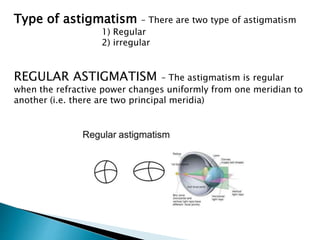
REGULAR ASTIGMATISM – The astigmatism is regular
when the refractive power changes uniformly from one meridian to
another (i.e. there are two principal meridia)
Aetiology – 1) Corneal astigmatism
2) Lenticular astigmatism
3) Retinal astigmatism
Type of regular astigmatism – Depending upon the axis and angle
between the two principal meridia
Classified into following type –
1) With-the-rule astigmatism
2) Against-the-rule astigmatism
3) Oblique astigmatism
4) Bi-oblique astigmatism
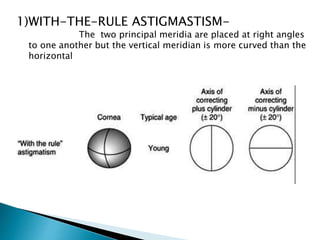
1)WITH-THE-RULE ASTIGMASTISM-
The two principal meridia are placed at right angles
to one another but the vertical meridian is more curved than the
horizontal
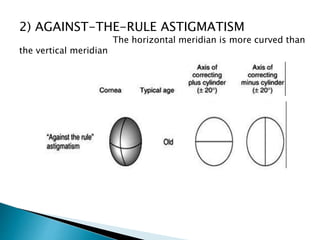
2) AGAINST-THE-RULE ASTIGMATISM
The horizontal meridian is more curved than
the vertical meridian
3) OBLIQUE ASTIGMATISM – the two principal meridia
are not the horizontal and vertical , though these are at right
angle to another
4) Bioblique astigmatism –The two principal
meridians are not at right angle to each other but are crossed
obliquely
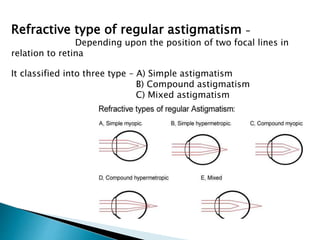
Refractive type of regular astigmatism –
Depending upon the position of two focal lines in
relation to retina
It classified into three type – A) Simple astigmatism
B) Compound astigmatism
C) Mixed astigmatism
Symptoms –
 Blurring of vision
 Asthenopic symptoms
 Tilting of head
 Squinting
 Burnning and itching
Investigation –
 Retinoscopy
Keratometry
Corneal topography
Astigmatic fan test
Jackson cross cylinder test
TREATMENTS –
1) OPTICAL TREATMENTS
• Cylindrical lenses
• Hard contact lens may be correct up to 2-3 D
• For higher degrees of astigmatism ,toric contact lens are needed
2) SURGICAL CORRECTION –LASIK SURGERY
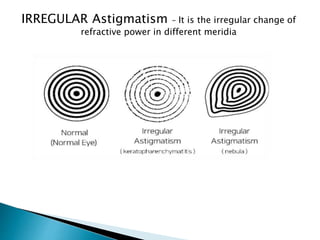
IRREGULAR Astigmatism – It is the irregular change of
refractive power in different meridia
Aetiological type –
Corneal irregular astigmatism
Lenticular irregular astigmatism
Retinal irregular astigmatism
Symptoms –
Defective vision
Distortion of objects
Polypia(seeing multipal image)
Sing and investigation –
Retinoscope- irregular pupillary reflex
Slit lamp – corneal irregularity of keratoconus
Placido’s disc test – reveals distorted circles
Corneal topography – irregular corneal curvature
TREATMENTS –
- OPTICAL TREATMENT
PRESCRIBING CONTACT LENS
PHOTOTHERAPEUTIC KERATECTOMY (PTK)
- LASAR TREATMENT OF CORNEA
SURGICAL TREATMENT
Astigmatism

Astigmatism

  • 2.
    INTRODUCTION Astigmatism is atype of refractive error wherein the refraction varies in different meridia
  • 3.
    Type of astigmatism– There are two type of astigmatism 1) Regular 2) irregular REGULAR ASTIGMATISM – The astigmatism is regular when the refractive power changes uniformly from one meridian to another (i.e. there are two principal meridia)
  • 4.
    Aetiology – 1)Corneal astigmatism 2) Lenticular astigmatism 3) Retinal astigmatism Type of regular astigmatism – Depending upon the axis and angle between the two principal meridia Classified into following type – 1) With-the-rule astigmatism 2) Against-the-rule astigmatism 3) Oblique astigmatism 4) Bi-oblique astigmatism
  • 5.
    1)WITH-THE-RULE ASTIGMASTISM- The twoprincipal meridia are placed at right angles to one another but the vertical meridian is more curved than the horizontal
  • 6.
    2) AGAINST-THE-RULE ASTIGMATISM Thehorizontal meridian is more curved than the vertical meridian
  • 7.
    3) OBLIQUE ASTIGMATISM– the two principal meridia are not the horizontal and vertical , though these are at right angle to another
  • 8.
    4) Bioblique astigmatism–The two principal meridians are not at right angle to each other but are crossed obliquely
  • 9.
    Refractive type ofregular astigmatism – Depending upon the position of two focal lines in relation to retina It classified into three type – A) Simple astigmatism B) Compound astigmatism C) Mixed astigmatism
  • 10.
    Symptoms –  Blurringof vision  Asthenopic symptoms  Tilting of head  Squinting  Burnning and itching Investigation –  Retinoscopy Keratometry Corneal topography Astigmatic fan test Jackson cross cylinder test
  • 11.
    TREATMENTS – 1) OPTICALTREATMENTS • Cylindrical lenses • Hard contact lens may be correct up to 2-3 D • For higher degrees of astigmatism ,toric contact lens are needed 2) SURGICAL CORRECTION –LASIK SURGERY
  • 12.
    IRREGULAR Astigmatism –It is the irregular change of refractive power in different meridia
  • 13.
    Aetiological type – Cornealirregular astigmatism Lenticular irregular astigmatism Retinal irregular astigmatism Symptoms – Defective vision Distortion of objects Polypia(seeing multipal image)
  • 14.
    Sing and investigation– Retinoscope- irregular pupillary reflex Slit lamp – corneal irregularity of keratoconus Placido’s disc test – reveals distorted circles Corneal topography – irregular corneal curvature
  • 15.
    TREATMENTS – - OPTICALTREATMENT PRESCRIBING CONTACT LENS PHOTOTHERAPEUTIC KERATECTOMY (PTK) - LASAR TREATMENT OF CORNEA SURGICAL TREATMENT