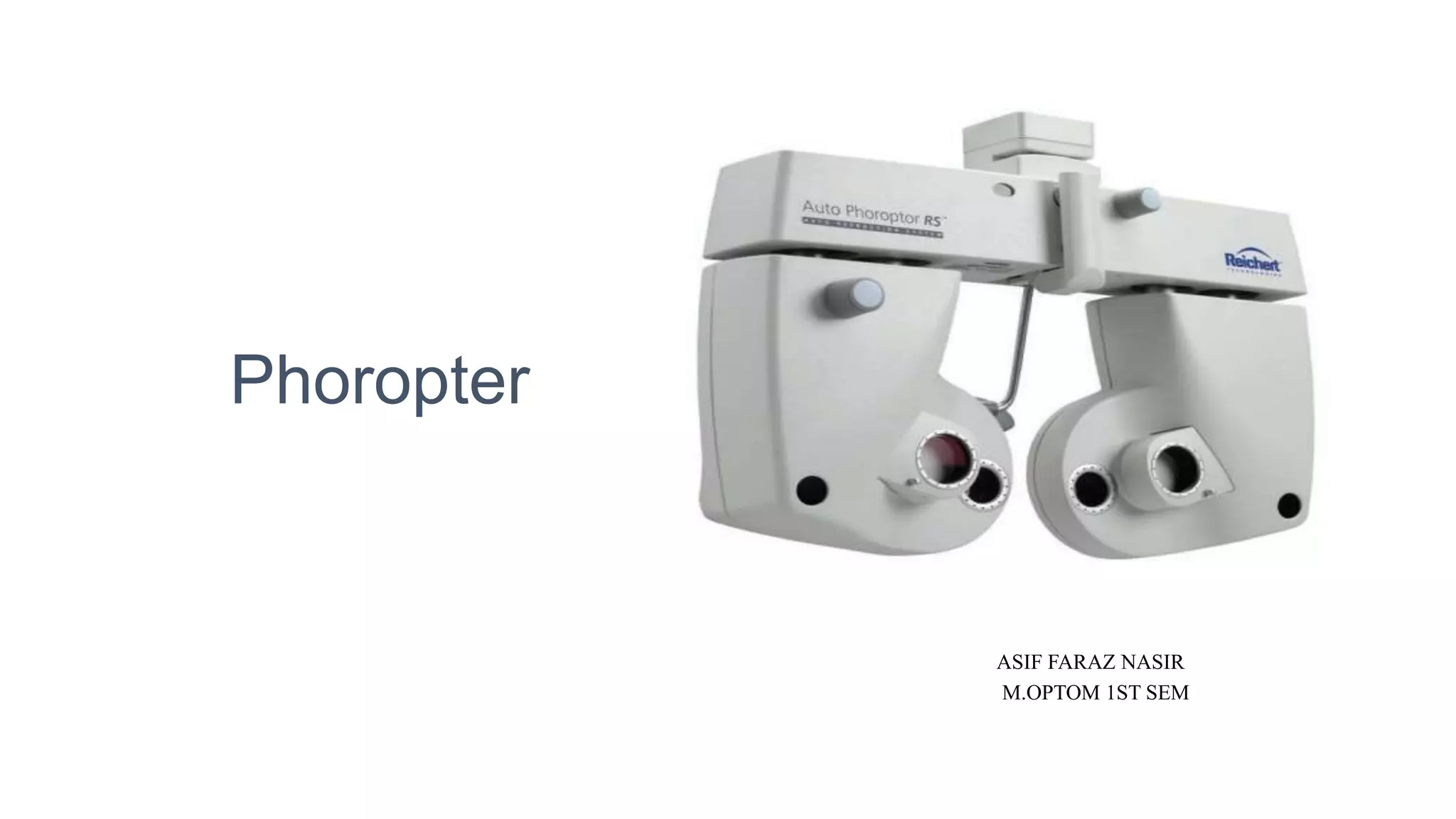
Phoropter
ASIF FARAZ NASIR
M.OPTOM 1ST SEM
Introduction
Phoropter/refractor is an instrument that is used for
measuring the refractive errors and to determine his/her
glass prescriptions during eye examination.
Commonly used by eye care professionals
HISTORY OF PHOROPTER
The first phoropter was
introduced in 1917 by
Nathan shigon also called
as ski-optometer and by
Henry DeZeng also called
phoro-optometer.
Types of phoropter
MANUAL PHOROPTER
AUTOMATED
PHOROPTER
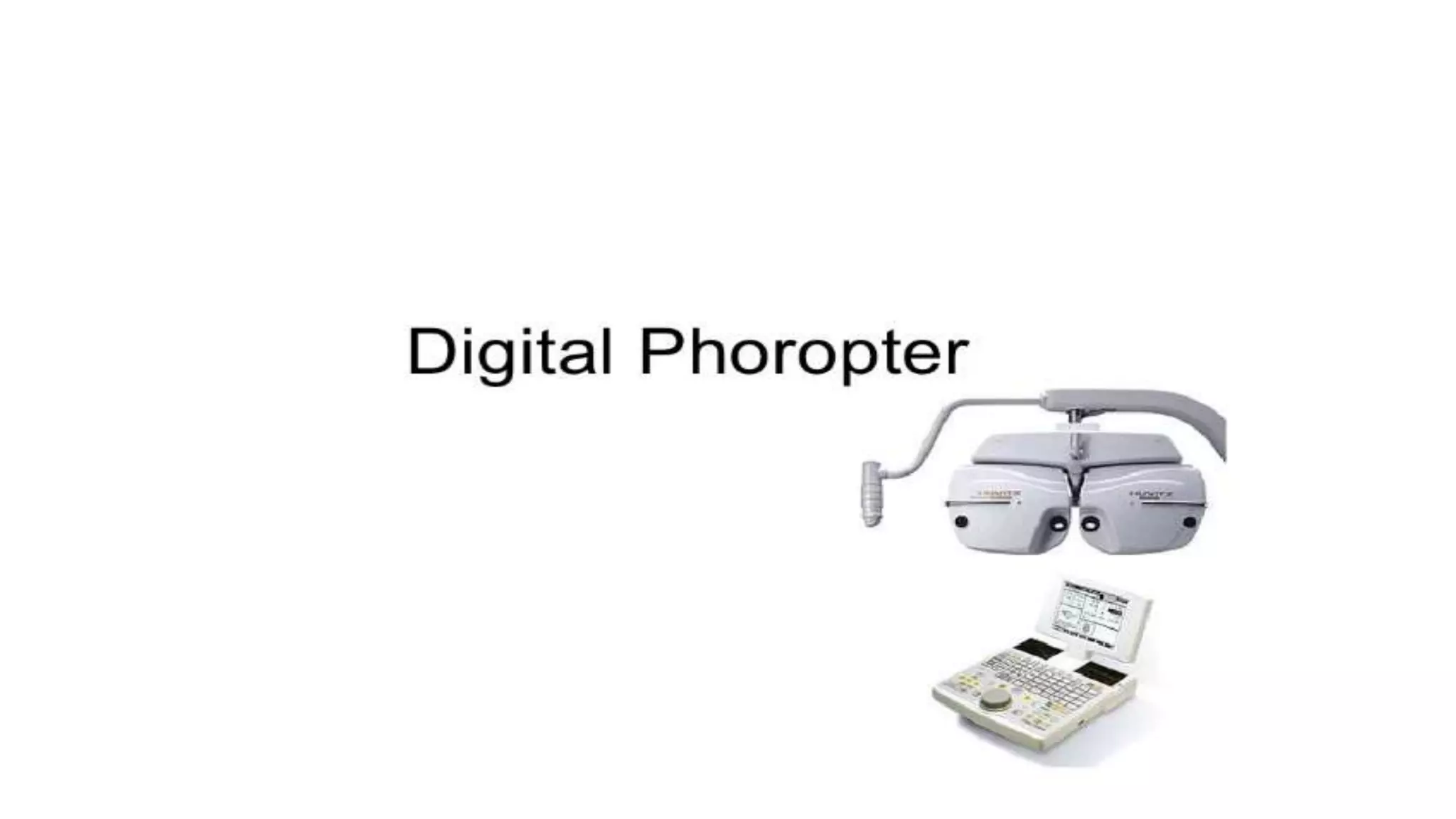
Automated phoropter
• This machine is divided into main body and keyboard
• has same principal of operation like manual phoropter
• easier to operate,one button to start the test
• contains memory system i.e. it stores all the testing
process
• simple and convenient
• also used to measure patients phorias and ductions which
are features of BSV
• can measure IPD
• can measure
convergence,stereopsis,myopia,hyperopia,astigmatism
parts.....
Procedures
• Instrumental and patient adjustment
• turn the phoropter head ON
• phoropter head needs to be aligned with patient before any measurements
• backside of phoropter-head needs to be placed in front of patient and centered in front of
patients eyes
• illuminated bubble present in phoropter should be used to make sure forehead level is alright
• after the phoropter alignment,phoropter head should be adjusted physically by examiner to
line up with patients eye.
• IPD should be adjusted by pressing PD and using multifunction knob
• then the corneal vertex distance should be adjusted so that refractor lenses are at a proper
distance from patients eyes(default vertex distance is 16mm)
• the operating monitor screen can be either placed on left or right sides of patient.
• then data can be inputed on the box placed in keyboard as according to spherical,cylindrical
powers and their axis can be adjusted by rotating knob cw or acw direction
• near add can also be obtained by data input a/c toresponse of patient
• finally data can be saved and printed out easily
Advantages Disadvantages
 More comfortable for patients
 Lenses do not become dirty or
scratched
 Axis of any cylindrical correction can
be read off from the refractor
 Additive errors can be reduced
 Examiner depends upon subjective
response
 Refracting unit hides the patient face
 Corrects only lower aberrations
 If head is tilted during refraction,the
cylindrical axis will be prescribed off
axis.
 expensive
 not portable
 restricted field of vision
manual vs automated phoropter
data processing of LM and AR
link of the chart and auxillary lens
near vision tests
near chart illumination
data comparison
data transfer to PC
Automated phoropter

Automated phoropter

  • 1.
  • 2.
    Introduction Phoropter/refractor is aninstrument that is used for measuring the refractive errors and to determine his/her glass prescriptions during eye examination. Commonly used by eye care professionals
  • 3.
    HISTORY OF PHOROPTER Thefirst phoropter was introduced in 1917 by Nathan shigon also called as ski-optometer and by Henry DeZeng also called phoro-optometer.
  • 4.
    Types of phoropter MANUALPHOROPTER AUTOMATED PHOROPTER
  • 5.
    Automated phoropter • Thismachine is divided into main body and keyboard • has same principal of operation like manual phoropter • easier to operate,one button to start the test • contains memory system i.e. it stores all the testing process • simple and convenient • also used to measure patients phorias and ductions which are features of BSV • can measure IPD • can measure convergence,stereopsis,myopia,hyperopia,astigmatism
  • 7.
  • 12.
    Procedures • Instrumental andpatient adjustment • turn the phoropter head ON • phoropter head needs to be aligned with patient before any measurements • backside of phoropter-head needs to be placed in front of patient and centered in front of patients eyes • illuminated bubble present in phoropter should be used to make sure forehead level is alright • after the phoropter alignment,phoropter head should be adjusted physically by examiner to line up with patients eye. • IPD should be adjusted by pressing PD and using multifunction knob • then the corneal vertex distance should be adjusted so that refractor lenses are at a proper distance from patients eyes(default vertex distance is 16mm) • the operating monitor screen can be either placed on left or right sides of patient. • then data can be inputed on the box placed in keyboard as according to spherical,cylindrical powers and their axis can be adjusted by rotating knob cw or acw direction • near add can also be obtained by data input a/c toresponse of patient • finally data can be saved and printed out easily
  • 13.
    Advantages Disadvantages  Morecomfortable for patients  Lenses do not become dirty or scratched  Axis of any cylindrical correction can be read off from the refractor  Additive errors can be reduced  Examiner depends upon subjective response  Refracting unit hides the patient face  Corrects only lower aberrations  If head is tilted during refraction,the cylindrical axis will be prescribed off axis.  expensive  not portable  restricted field of vision
  • 14.
    manual vs automatedphoropter data processing of LM and AR link of the chart and auxillary lens near vision tests near chart illumination data comparison data transfer to PC