CLEFT LIP / PALATE
Management
DR. GHLAM SAQULAIN
M.B.B.S,D.L.O,F.C.P.S
Head of Department of Otorhinolaryngology
CAPITAL HOSPITAL
Islamabad.
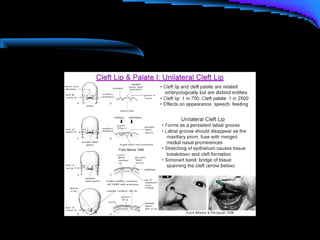
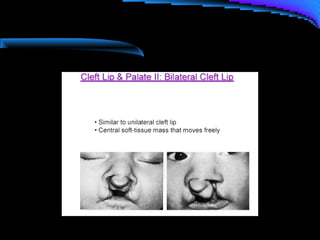
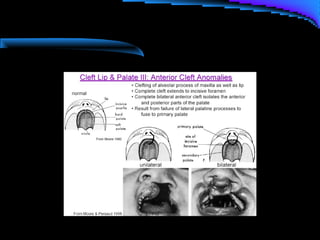
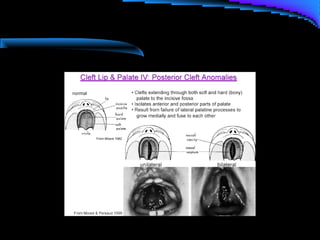
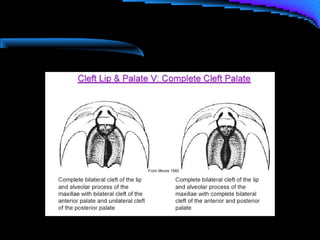
Cleft Lip and Palate are common
congenital deformities that often affect
speech, hearing, and cosmesis; and
may at times lead to airway
compromise.
MANAGEMENT
Team Approach
 Otolaryngologist has a pivotal role
 Initial Head and Neck Examination
 Speech Disorders
 Ear Disease
 Airway Problems
 Surgical Repair
A) Primary Management
 Antenatal Diagnosis:
 It is possible to diagnose by ultrasound scan after 18 weeks
of gestation. Isolated cleft palate cannot be diagnosed by
USS.
 When diagnosis is confirmed referral to cleft surgeon is
appropriate for genetic counseling.
 Feeding Difficulties:
 Most affected babies feed well and thrive provided
appropriate advise and support to mother is given.
 Some mothers are successful in breast feeding particularly
in incomplete clefts.
 Soft bottles and modified teats can help
Airway Problems:
 Major respiratory obstruction is uncommon but
can occur in some cases.
 Intermittent airway obstruction is more frequent
and managed by nursing the baby prone.
 More severe and persistent airway compromise
can be managed by retained nasopharyngeal
intubations.
 Surgical adhesion of tongue to lip c/a
Labioglossopexy can be an alternate in first few
days but it is less commonly practiced.
B) Surgical Techniques
Principles of Surgery:
 Surgical techniques are aimed to restore
the normal anatomy of lip, nose, and face
 Normal or near normal anatomy promotes
normal function, thereby encouraging
normal growth and development of lip,
nose, palate and facial skeleton
Timing of Surgery:
 Rule of tens
• At least 10 weeks old
• Weighs at least 10 pounds
• Has Hb. Of 10 gm.
 Better results are obtained when the child
is at least 3 months.
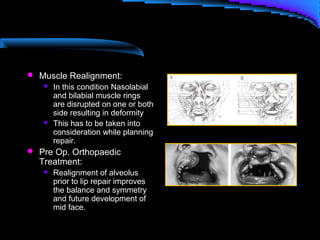
 Muscle Realignment:
 In this condition Nasolabial
and bilabial muscle rings
are disrupted on one or both
side resulting in deformity
 This has to be taken into
consideration while planning
repair.
 Pre Op. Orthopaedic
Treatment:
 Realignment of alveolus
prior to lip repair improves
the balance and symmetry
and future development of
mid face.
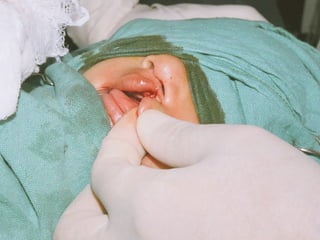
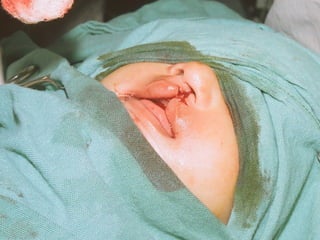
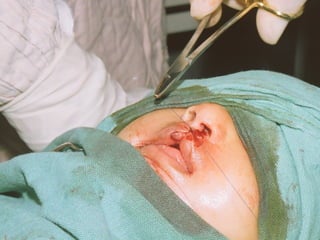
Operative Procedures (Cleft Lip)
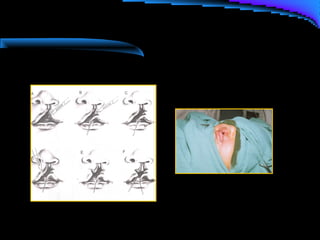
Two surgical techniques are used most
widely in cleft lip surgery:
 Rotation-advancement technique
 Triangular flap technique
Lip adhesions – Difference of opinion.
 It is first stage of two stage lip
reconstruction.
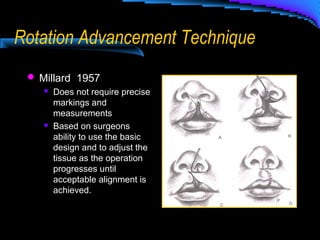
Rotation Advancement Technique
 Millard 1957
 Does not require precise
markings and
measurements
 Based on surgeons
ability to use the basic
design and to adjust the
tissue as the operation
progresses until
acceptable alignment is
achieved.
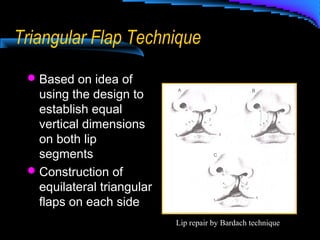
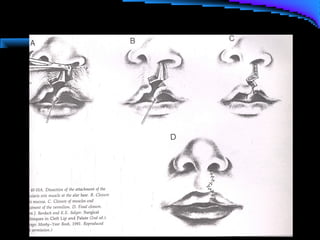
Triangular Flap Technique
Based on idea of
using the design to
establish equal
vertical dimensions
on both lip
segments
Construction of
equilateral triangular
flaps on each side
Lip repair by Bardach technique
Operative Procedure (Cleft Palate)
Several Techniques- Trend is towards less
scarring and less tension on palate
Scarring of palate may cause impaired mid-
facial growth (alveolar arch collapse, mid
face retrusion, malocclusion)
Facial growth may be less affected if surgery
is delayed until 18-24 months, but feeding,
speech, socialization may suffer.
Hearing Management:
 It has been recently recognized that a child with
craniofacial anomaly including cleft lip and palate
is at increased risk of sensori-neural hearing
deficit.
 All children born with cleft lip and palate should be
assessed for SNHL and Conductive hearing loss
before 12 months of age, by ABR and
tympanometry.
• SNHL is managed by Hearing aid
• Conductive Hearing loss is managed by Surgical and
medical management of OME.
C) REHABILITATION
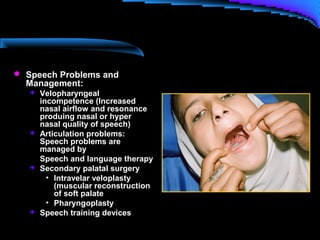
 Speech Problems and
Management:
 Velopharyngeal
incompetence (Increased
nasal airflow and resonance
produing nasal or hyper
nasal quality of speech)
 Articulation problems:
Speech problems are
managed by
Speech and language therapy
 Secondary palatal surgery
• Intravelar veloplasty
(muscular reconstruction
of soft palate
• Pharyngoplasty
 Speech training devices
 Dental Problems and Management
 Delayed tooth development
 Delayed eruption of teeth
 Morphological abnormalities
 Decreased number of teeth (hypodontia) or increased
number of teeth (Hyperdontia0
Regular examination should be done. Many patients
require orthodontic treatment
 Secondary Surgery for Cleft Lip and Palate
Despite adequate primary surgery, residual
problems do occur and are managed by
appropriate secondary surgical procedures.
Non Surgical Treatment
Lip Adhesions
Dental Obturator
 For high-risk patients or those that refuse
surgery.
 Advantage- High rate of closure
 Disadvantage- Need to wear a prosthesis,
and need to modify prosthesis as child
grows.
Questions?
Answers
Thank You
CLEFT LIP
A CASE REPORT
Dr. Aasma
House Surgeon, ENT Department
Patient Profile
Name: xyz
Address: G 7/1,
Islamabad
Age: 8 Months
Sex: Female
DOA: 25-07-06
DOD: 04-08-06
HISTORY
 Main Complaint:
 Lip deformity since birth
 Natal History:
 no H/O birth trauma.
 Normal vaginal delivery
 child cried well after birth.
 No H/O Feeding Problems or breathing difficulty.
 Weight of baby at birth was 2.7 Kg.
 Family History:
 No Family history of similar or congenital anomaly
 Milestones:
 Milestones achieved normally within time limits.
 Past History:
 No past H/o any significant medical disease
 No Past H/o any surgery
 No Past H/o Allergy
 Personal History:
 Seep and Appetite normal
 No C/o feeding problem, vomiting, diarrhoea, constipation
 No C/o Fever.
General Physical Examination
 Baby was active, conscious,
stable well oriented, cooperative
and smiling all the time.
 She was healthy according to
age.
 No other anomaly noted.
 Pulse: 115/min
 Temp: Afebrile
 Pallor: -ve
 Jaundice: -ve
 Dehydration: -ve
 Cyanosis: -ve
 Clubbing: -ve
 Edema: -ve
 Lymph Nodes: Not
palpable
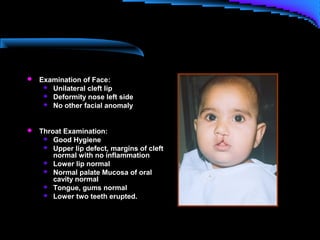
 Examination of Face:
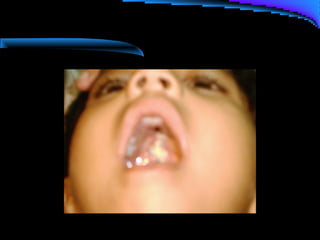
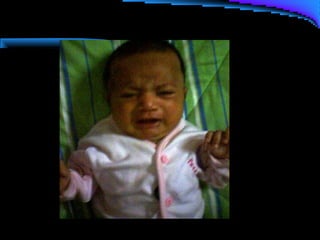
 Unilateral cleft lip
 Deformity nose left side
 No other facial anomaly
 Throat Examination:
 Good Hygiene
 Upper lip defect, margins of cleft
normal with no inflammation
 Lower lip normal
 Normal palate Mucosa of oral
cavity normal
 Tongue, gums normal
 Lower two teeth erupted.
Examination of Nose
 Depressed nasal ala on left side
 Nasal septum and lateral walls normal
 Floor normal posteriorly, anteriorly oro
nasal fistula opening in front of gum
margin.
Examination of Ear
Tympanic membranes in both ears normal
with no signs of secretry otitis media ( i.e,
retraction, buldging of TM, air bubbles, fluid
level behind TM.
Systemic Examination
 Cardio-Respiratory System:
 S1 +S2 audible in all four areas.
 Chest Clear with NVB
 GIT:
 NAD
 No Scar
 No Swelling
 No Tenderness
 CNS:
 NAD
 Loco motor System:
 No other congenital anomaly seen.
Investigations
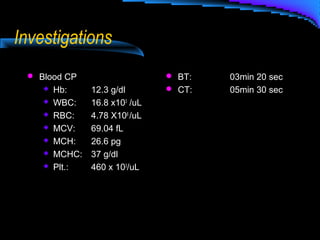
 Blood CP
 Hb: 12.3 g/dl
 WBC: 16.8 x10³
/uL
 RBC: 4.78 X10⁶
/uL
 MCV: 69.04 fL
 MCH: 26.6 pg
 MCHC: 37 g/dl
 Plt.: 460 x 103
/uL
 BT: 03min 20 sec
 CT: 05min 30 sec
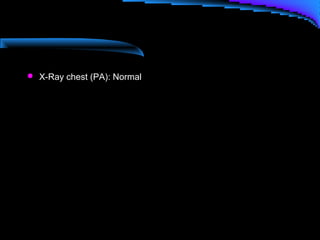
 X-Ray chest (PA): Normal
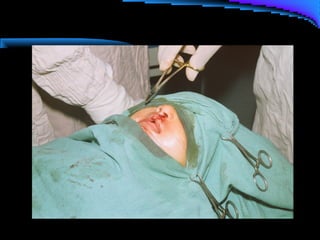
Surgical Repair:
After through preoperative preparation
&
Anesthetic fitness
Labioplasty performed under General
Anesthesia
 Date: 1.8.2008
Post Operative
Post Operative Treatment:
 Inj. Ceftim 125 mg i/v BD for two days
 Then Syp. Dynacef 125 mg tds.
 Syp. Brufen ½ tsf SOS.
Post Operative recovery was uneventful
Patient discharged on third post
operative day
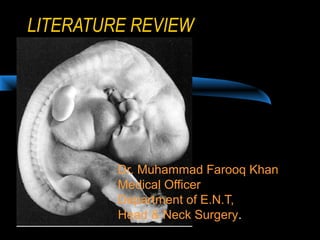
LITERATURE REVIEW
Dr. Muhammad Farooq Khan
Medical Officer
Department of E.N.T,
Head & Neck Surgery.
INTRODUCTION
Facial clef ting is the second most
common
congenital deformity (after clubfoot).
Affects 1 in 750 births
Problems are cosmetic, dental, speech,
swallowing, hearing, facial growth,
emotional
Otolaryngologist holds key role on CP
team
Incidence
Cleft Lip and Palate 1:600 Live
births
Isolated cleft palate 1:1000Live
births
In black population 1:2000
Live Births
In Native American Tribes of Montana
(USA) Highest Incidence 1:276 Live
Births
Gender Predominance
Cleft Lip More common in
males 80%
Cleft Palate More common in females
67%
Cleft Lip/ cleft palate … both
Predominate -
in males.
Types
Cleft Lip alone 15%
Cleft Lip & Cleft Palate both 45%
Isolated Cleft Palate 40%
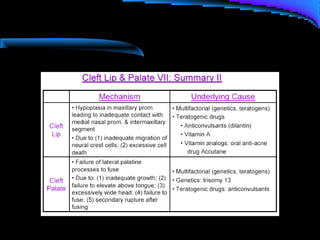
Etiology (Multifactorial)
Genetic predisposition
Contributory environment components
Maternal Age: Cleft lip is associated with
increasing maternal age but cleft palate has
no relation with it.
Maternal Epilepsy
Drugs During Pregnancy like:
 Anticonvulsants
 Steroids
 Sedatives
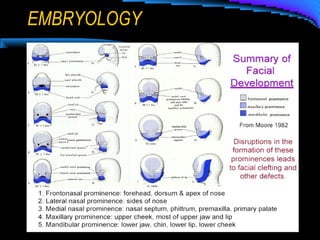
EMBRYOLOGY
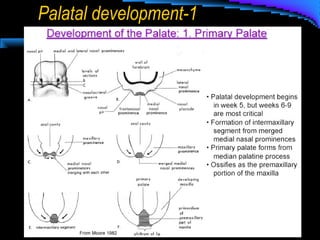
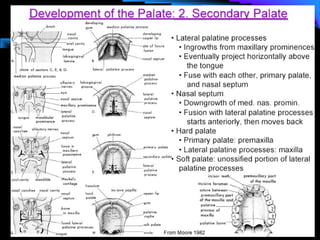
Palatal development-1
Cleft lip and palate management

Cleft lip and palate management

  • 2.
    CLEFT LIP /PALATE Management DR. GHLAM SAQULAIN M.B.B.S,D.L.O,F.C.P.S Head of Department of Otorhinolaryngology CAPITAL HOSPITAL Islamabad.
  • 3.
    Cleft Lip andPalate are common congenital deformities that often affect speech, hearing, and cosmesis; and may at times lead to airway compromise.
  • 4.
    MANAGEMENT Team Approach  Otolaryngologisthas a pivotal role  Initial Head and Neck Examination  Speech Disorders  Ear Disease  Airway Problems  Surgical Repair
  • 5.
    A) Primary Management Antenatal Diagnosis:  It is possible to diagnose by ultrasound scan after 18 weeks of gestation. Isolated cleft palate cannot be diagnosed by USS.  When diagnosis is confirmed referral to cleft surgeon is appropriate for genetic counseling.  Feeding Difficulties:  Most affected babies feed well and thrive provided appropriate advise and support to mother is given.  Some mothers are successful in breast feeding particularly in incomplete clefts.  Soft bottles and modified teats can help
  • 6.
    Airway Problems:  Majorrespiratory obstruction is uncommon but can occur in some cases.  Intermittent airway obstruction is more frequent and managed by nursing the baby prone.  More severe and persistent airway compromise can be managed by retained nasopharyngeal intubations.  Surgical adhesion of tongue to lip c/a Labioglossopexy can be an alternate in first few days but it is less commonly practiced.
  • 7.
    B) Surgical Techniques Principlesof Surgery:  Surgical techniques are aimed to restore the normal anatomy of lip, nose, and face  Normal or near normal anatomy promotes normal function, thereby encouraging normal growth and development of lip, nose, palate and facial skeleton
  • 8.
    Timing of Surgery: Rule of tens • At least 10 weeks old • Weighs at least 10 pounds • Has Hb. Of 10 gm.  Better results are obtained when the child is at least 3 months.
  • 9.
     Muscle Realignment: In this condition Nasolabial and bilabial muscle rings are disrupted on one or both side resulting in deformity  This has to be taken into consideration while planning repair.  Pre Op. Orthopaedic Treatment:  Realignment of alveolus prior to lip repair improves the balance and symmetry and future development of mid face.
  • 10.
    Operative Procedures (CleftLip) Two surgical techniques are used most widely in cleft lip surgery:  Rotation-advancement technique  Triangular flap technique Lip adhesions – Difference of opinion.  It is first stage of two stage lip reconstruction.
  • 11.
    Rotation Advancement Technique Millard 1957  Does not require precise markings and measurements  Based on surgeons ability to use the basic design and to adjust the tissue as the operation progresses until acceptable alignment is achieved.
  • 12.
    Triangular Flap Technique Basedon idea of using the design to establish equal vertical dimensions on both lip segments Construction of equilateral triangular flaps on each side Lip repair by Bardach technique
  • 18.
    Operative Procedure (CleftPalate) Several Techniques- Trend is towards less scarring and less tension on palate Scarring of palate may cause impaired mid- facial growth (alveolar arch collapse, mid face retrusion, malocclusion) Facial growth may be less affected if surgery is delayed until 18-24 months, but feeding, speech, socialization may suffer.
  • 19.
    Hearing Management:  Ithas been recently recognized that a child with craniofacial anomaly including cleft lip and palate is at increased risk of sensori-neural hearing deficit.  All children born with cleft lip and palate should be assessed for SNHL and Conductive hearing loss before 12 months of age, by ABR and tympanometry. • SNHL is managed by Hearing aid • Conductive Hearing loss is managed by Surgical and medical management of OME. C) REHABILITATION
  • 20.
     Speech Problemsand Management:  Velopharyngeal incompetence (Increased nasal airflow and resonance produing nasal or hyper nasal quality of speech)  Articulation problems: Speech problems are managed by Speech and language therapy  Secondary palatal surgery • Intravelar veloplasty (muscular reconstruction of soft palate • Pharyngoplasty  Speech training devices
  • 21.
     Dental Problemsand Management  Delayed tooth development  Delayed eruption of teeth  Morphological abnormalities  Decreased number of teeth (hypodontia) or increased number of teeth (Hyperdontia0 Regular examination should be done. Many patients require orthodontic treatment  Secondary Surgery for Cleft Lip and Palate Despite adequate primary surgery, residual problems do occur and are managed by appropriate secondary surgical procedures.
  • 23.
    Non Surgical Treatment LipAdhesions Dental Obturator  For high-risk patients or those that refuse surgery.  Advantage- High rate of closure  Disadvantage- Need to wear a prosthesis, and need to modify prosthesis as child grows.
  • 24.
  • 25.
    CLEFT LIP A CASEREPORT Dr. Aasma House Surgeon, ENT Department
  • 26.
    Patient Profile Name: xyz Address:G 7/1, Islamabad Age: 8 Months Sex: Female DOA: 25-07-06 DOD: 04-08-06
  • 27.
    HISTORY  Main Complaint: Lip deformity since birth  Natal History:  no H/O birth trauma.  Normal vaginal delivery  child cried well after birth.  No H/O Feeding Problems or breathing difficulty.  Weight of baby at birth was 2.7 Kg.  Family History:  No Family history of similar or congenital anomaly
  • 28.
     Milestones:  Milestonesachieved normally within time limits.  Past History:  No past H/o any significant medical disease  No Past H/o any surgery  No Past H/o Allergy  Personal History:  Seep and Appetite normal  No C/o feeding problem, vomiting, diarrhoea, constipation  No C/o Fever.
  • 29.
    General Physical Examination Baby was active, conscious, stable well oriented, cooperative and smiling all the time.  She was healthy according to age.  No other anomaly noted.  Pulse: 115/min  Temp: Afebrile  Pallor: -ve  Jaundice: -ve  Dehydration: -ve  Cyanosis: -ve  Clubbing: -ve  Edema: -ve  Lymph Nodes: Not palpable
  • 30.
     Examination ofFace:  Unilateral cleft lip  Deformity nose left side  No other facial anomaly  Throat Examination:  Good Hygiene  Upper lip defect, margins of cleft normal with no inflammation  Lower lip normal  Normal palate Mucosa of oral cavity normal  Tongue, gums normal  Lower two teeth erupted.
  • 31.
    Examination of Nose Depressed nasal ala on left side  Nasal septum and lateral walls normal  Floor normal posteriorly, anteriorly oro nasal fistula opening in front of gum margin. Examination of Ear Tympanic membranes in both ears normal with no signs of secretry otitis media ( i.e, retraction, buldging of TM, air bubbles, fluid level behind TM.
  • 32.
    Systemic Examination  Cardio-RespiratorySystem:  S1 +S2 audible in all four areas.  Chest Clear with NVB  GIT:  NAD  No Scar  No Swelling  No Tenderness  CNS:  NAD  Loco motor System:  No other congenital anomaly seen.
  • 33.
    Investigations  Blood CP Hb: 12.3 g/dl  WBC: 16.8 x10³ /uL  RBC: 4.78 X10⁶ /uL  MCV: 69.04 fL  MCH: 26.6 pg  MCHC: 37 g/dl  Plt.: 460 x 103 /uL  BT: 03min 20 sec  CT: 05min 30 sec
  • 34.
     X-Ray chest(PA): Normal
  • 35.
    Surgical Repair: After throughpreoperative preparation & Anesthetic fitness Labioplasty performed under General Anesthesia  Date: 1.8.2008
  • 37.
    Post Operative Post OperativeTreatment:  Inj. Ceftim 125 mg i/v BD for two days  Then Syp. Dynacef 125 mg tds.  Syp. Brufen ½ tsf SOS. Post Operative recovery was uneventful Patient discharged on third post operative day
  • 39.
    LITERATURE REVIEW Dr. MuhammadFarooq Khan Medical Officer Department of E.N.T, Head & Neck Surgery.
  • 40.
    INTRODUCTION Facial clef tingis the second most common congenital deformity (after clubfoot). Affects 1 in 750 births Problems are cosmetic, dental, speech, swallowing, hearing, facial growth, emotional Otolaryngologist holds key role on CP team
  • 41.
    Incidence Cleft Lip andPalate 1:600 Live births Isolated cleft palate 1:1000Live births In black population 1:2000 Live Births In Native American Tribes of Montana (USA) Highest Incidence 1:276 Live Births
  • 42.
    Gender Predominance Cleft LipMore common in males 80% Cleft Palate More common in females 67% Cleft Lip/ cleft palate … both Predominate - in males.
  • 43.
    Types Cleft Lip alone15% Cleft Lip & Cleft Palate both 45% Isolated Cleft Palate 40%
  • 44.
    Etiology (Multifactorial) Genetic predisposition Contributoryenvironment components Maternal Age: Cleft lip is associated with increasing maternal age but cleft palate has no relation with it. Maternal Epilepsy Drugs During Pregnancy like:  Anticonvulsants  Steroids  Sedatives
  • 45.
  • 46.