Presented BY
Dr Devraj K.C.
PG 1st year
Guided By:-
Dr Poornima B S
Assistant Professor
Dravyaguna Department
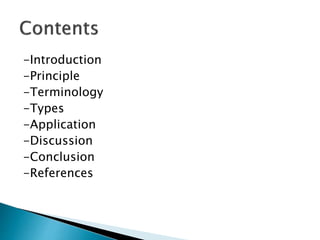
-Introduction
-Principle
-Terminology
-Types
-Application
-Discussion
-Conclusion
-References
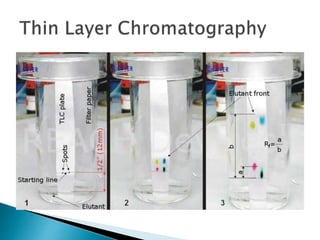
Chromatography Is a technique used to separate and
identify the components of a mixture The separation of
a mixture by distribution of its components between
a mobile and stationary phase over time
◦ mobile phase = solvent
◦ stationary phase = column packing material
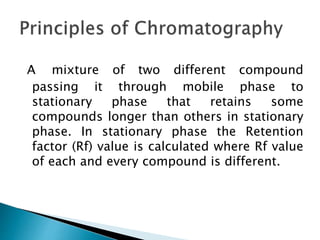
A mixture of two different compound
passing it through mobile phase to
stationary phase that retains some
compounds longer than others in stationary
phase. In stationary phase the Retention
factor (Rf) value is calculated where Rf value
of each and every compound is different.
Rf = distance moved by substance
distance moved by solvent front
Some terminology in chromatograph
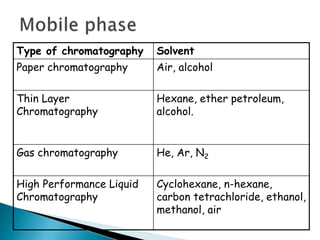
Type of chromatography Solvent
Paper chromatography Air, alcohol
Thin Layer
Chromatography
Hexane, ether petroleum,
alcohol.
Gas chromatography He, Ar, N2
High Performance Liquid
Chromatography
Cyclohexane, n-hexane,
carbon tetrachloride, ethanol,
methanol, air
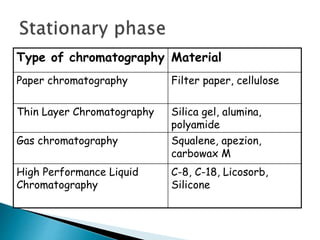
Type of chromatography Material
Paper chromatography Filter paper, cellulose
Thin Layer Chromatography Silica gel, alumina,
polyamide
Gas chromatography Squalene, apezion,
carbowax M
High Performance Liquid
Chromatography
C-8, C-18, Licosorb,
Silicone
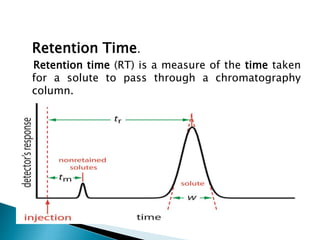
Retention Time.
Retention time (RT) is a measure of the time taken
for a solute to pass through a chromatography
column.
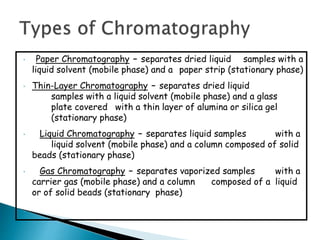
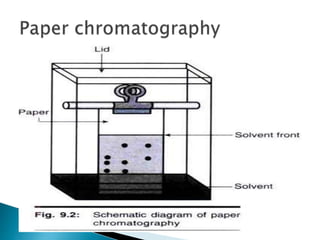
• Paper Chromatography – separates dried liquid samples with a
liquid solvent (mobile phase) and a paper strip (stationary phase)
• Thin-Layer Chromatography – separates dried liquid
samples with a liquid solvent (mobile phase) and a glass
plate covered with a thin layer of alumina or silica gel
(stationary phase)
• Liquid Chromatography – separates liquid samples with a
liquid solvent (mobile phase) and a column composed of solid
beads (stationary phase)
• Gas Chromatography – separates vaporized samples with a
carrier gas (mobile phase) and a column composed of a liquid
or of solid beads (stationary phase)
•
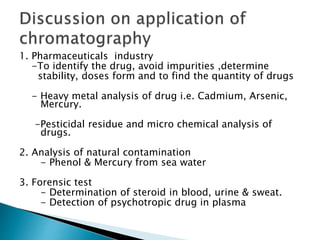
1. Pharmaceuticals industry
-To identify the drug, avoid impurities ,determine
stability, doses form and to find the quantity of drugs
- Heavy metal analysis of drug i.e. Cadmium, Arsenic,
Mercury.
-Pesticidal residue and micro chemical analysis of
drugs.
2. Analysis of natural contamination
- Phenol & Mercury from sea water
3. Forensic test
- Determination of steroid in blood, urine & sweat.
- Detection of psychotropic drug in plasma
4. Clinical test
- Monitoring of hepatic cirrhosis patient
through aquaporin 2 in the urine.
5. Food and essence manufacture
- sweetener analysis in the fruit juice
- preservative analysis.
i) paper chromatograph can be used for
isolating known and unknown
substances.
ii) Identifying pure substances from
mixtures.
iii) Determination of decomposed
products.
TLC vido
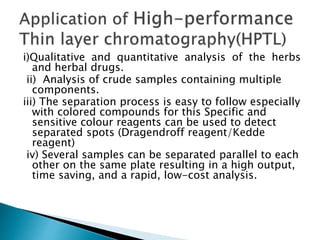
i)Qualitative and quantitative analysis of the herbs
and herbal drugs.
ii) Analysis of crude samples containing multiple
components.
iii) The separation process is easy to follow especially
with colored compounds for this Specific and
sensitive colour reagents can be used to detect
separated spots (Dragendroff reagent/Kedde
reagent)
iv) Several samples can be separated parallel to each
other on the same plate resulting in a high output,
time saving, and a rapid, low-cost analysis.
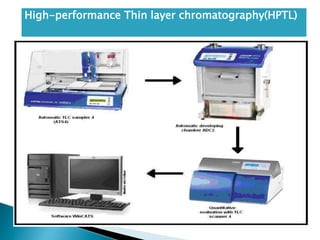
High-performance Thin layer chromatography(HPTL)
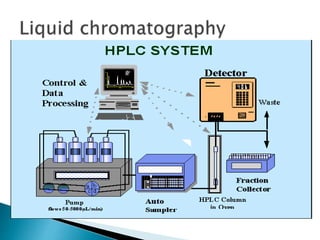
Preparative and analytical HPLC are widely
used in pharmaceutical industry for
isolating and purification of herbal
compounds. There are basically two types:-
i) Low pressure HPLC (typically under 5 bar)
ii) High pressure HPLC (pressure>20 bar)
i) LC-MS has become method of choice in
many stages of drug development. I.e.
Chemical standardization of an aqueous
extract of the mixture of the compound
herbal formulation.
ii) LC-MS is useful in analysis of amino
glycosides their solubility in water, plasma
protein binding capacity, and their excretion.
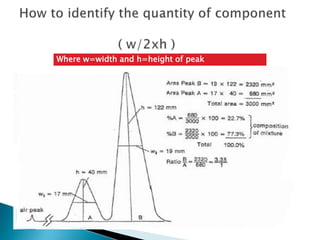
Where w=width and h=height of peak
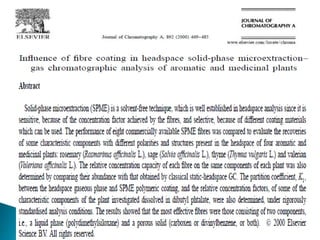
.Identification and quantifying of aromatics and
volatile substances of medicinal plants.
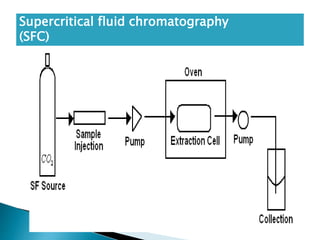
SFC permits the separation and determination
of a group of compounds that are not
conveniently handled by either gas or liquid
chromatography. It is useful for the
separation of much less
polar compounds such as
many natural products, including fat soluble
vitamins, carotenoids, and lipids along with
separation of each individual components of
herbal drugs.
Supercritical fluid chromatography
(SFC)
i) Complex mixture of herbal drug can be
separated by chromatography passing
through mobile to stationary phase.
ii) Mobile phase is either gas or liquid but
stationary phase is ever solid.
iii) Component in mobile and stationary
phase depends upon the test drug.
Iv) Chromatographic technique is compulsory
in the field of herbal drug standardization,
authentication and manufacturing.
v) For identification, authentication, quantifying,
preparation and standardization of ayurvedic
herbal drugs many physical, chemical, biological,
and instrumental technique are used among them
chromatography is physicochemical method.
vi) Paper chromatography is used to identify and
separate simple compound of herbal drugs.
vii)High-performance liquid chromatography (HPLC)
and High-performance thin layer chromatography
(HPTLC) are backbone of ayurveda for drug
standardization and Authentication.
vii) Gas Chromatography technique is widely
use to detect and quantify volatiles and
aromatics of herbal drugs.
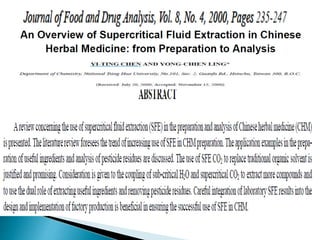
viii) Supercritical fluid chromatography is the
hybrid production of gas and liquid
chromatography for extraction from crude
herbs.
 Sharma A., Shanker C., Tyagi L.K., Singh M., Rao V. Herbal Medicine
for Market Potential in India:
 An Overview. Academic J. Plant Sci. 2008; 1 (2): 26-36. 2 Kadam
P.V., Yadav K.N., Shivatare R.S., Pande A.S., Patel A.N., Patil M.J.
 Standardization of Gomutra Haritaki Vati: An Ayurvedic Formulation.
Int. J. Pharm. Bio. Sci. 2012; 3(3): 181 – 187. 3. Mukharjee P.K.,
Wahile A.
 Integrated approaches towards drug development from Ayurveda
and other Indian system of medicines. J.
 Ethanopharmacol. 2006; 103 (1): 25-35. 4. Choudhary N., Sekhon
B.S.
 An overview of advances in the standardization of herbal drugs. J.
Pharm. Educ. Res. 2011; 2 (2): 55-70. 5. Amit J., Sunil C., Vimal K.,
Anupam P. Phytosomes:
 A revolution in herbal drugs. The Pharma Review 2007; 11- 13. 6.
Jena A., Saha D., Biswal B., Jana S.B., Koley A., Sur D., Battacharya A.
 Pharmacognostic Studies of leaves of Pterospermum Suberifolium.
Int. J.
Thank you

Application of chromatographic technique

  • 2.
    Presented BY Dr DevrajK.C. PG 1st year Guided By:- Dr Poornima B S Assistant Professor Dravyaguna Department
  • 3.
  • 4.
    Chromatography Is atechnique used to separate and identify the components of a mixture The separation of a mixture by distribution of its components between a mobile and stationary phase over time ◦ mobile phase = solvent ◦ stationary phase = column packing material
  • 5.
    A mixture oftwo different compound passing it through mobile phase to stationary phase that retains some compounds longer than others in stationary phase. In stationary phase the Retention factor (Rf) value is calculated where Rf value of each and every compound is different.
  • 6.
    Rf = distancemoved by substance distance moved by solvent front Some terminology in chromatograph
  • 7.
    Type of chromatographySolvent Paper chromatography Air, alcohol Thin Layer Chromatography Hexane, ether petroleum, alcohol. Gas chromatography He, Ar, N2 High Performance Liquid Chromatography Cyclohexane, n-hexane, carbon tetrachloride, ethanol, methanol, air
  • 10.
    Type of chromatographyMaterial Paper chromatography Filter paper, cellulose Thin Layer Chromatography Silica gel, alumina, polyamide Gas chromatography Squalene, apezion, carbowax M High Performance Liquid Chromatography C-8, C-18, Licosorb, Silicone
  • 11.
    Retention Time. Retention time(RT) is a measure of the time taken for a solute to pass through a chromatography column.
  • 13.
    • Paper Chromatography– separates dried liquid samples with a liquid solvent (mobile phase) and a paper strip (stationary phase) • Thin-Layer Chromatography – separates dried liquid samples with a liquid solvent (mobile phase) and a glass plate covered with a thin layer of alumina or silica gel (stationary phase) • Liquid Chromatography – separates liquid samples with a liquid solvent (mobile phase) and a column composed of solid beads (stationary phase) • Gas Chromatography – separates vaporized samples with a carrier gas (mobile phase) and a column composed of a liquid or of solid beads (stationary phase) •
  • 14.
    1. Pharmaceuticals industry -Toidentify the drug, avoid impurities ,determine stability, doses form and to find the quantity of drugs - Heavy metal analysis of drug i.e. Cadmium, Arsenic, Mercury. -Pesticidal residue and micro chemical analysis of drugs. 2. Analysis of natural contamination - Phenol & Mercury from sea water 3. Forensic test - Determination of steroid in blood, urine & sweat. - Detection of psychotropic drug in plasma
  • 15.
    4. Clinical test -Monitoring of hepatic cirrhosis patient through aquaporin 2 in the urine. 5. Food and essence manufacture - sweetener analysis in the fruit juice - preservative analysis.
  • 17.
    i) paper chromatographcan be used for isolating known and unknown substances. ii) Identifying pure substances from mixtures. iii) Determination of decomposed products.
  • 20.
  • 21.
    i)Qualitative and quantitativeanalysis of the herbs and herbal drugs. ii) Analysis of crude samples containing multiple components. iii) The separation process is easy to follow especially with colored compounds for this Specific and sensitive colour reagents can be used to detect separated spots (Dragendroff reagent/Kedde reagent) iv) Several samples can be separated parallel to each other on the same plate resulting in a high output, time saving, and a rapid, low-cost analysis.
  • 22.
    High-performance Thin layerchromatography(HPTL)
  • 24.
    Preparative and analyticalHPLC are widely used in pharmaceutical industry for isolating and purification of herbal compounds. There are basically two types:- i) Low pressure HPLC (typically under 5 bar) ii) High pressure HPLC (pressure>20 bar)
  • 25.
    i) LC-MS hasbecome method of choice in many stages of drug development. I.e. Chemical standardization of an aqueous extract of the mixture of the compound herbal formulation. ii) LC-MS is useful in analysis of amino glycosides their solubility in water, plasma protein binding capacity, and their excretion.
  • 29.
    Where w=width andh=height of peak
  • 32.
    .Identification and quantifyingof aromatics and volatile substances of medicinal plants.
  • 35.
    SFC permits theseparation and determination of a group of compounds that are not conveniently handled by either gas or liquid chromatography. It is useful for the separation of much less polar compounds such as many natural products, including fat soluble vitamins, carotenoids, and lipids along with separation of each individual components of herbal drugs.
  • 37.
  • 40.
    i) Complex mixtureof herbal drug can be separated by chromatography passing through mobile to stationary phase. ii) Mobile phase is either gas or liquid but stationary phase is ever solid. iii) Component in mobile and stationary phase depends upon the test drug. Iv) Chromatographic technique is compulsory in the field of herbal drug standardization, authentication and manufacturing.
  • 41.
    v) For identification,authentication, quantifying, preparation and standardization of ayurvedic herbal drugs many physical, chemical, biological, and instrumental technique are used among them chromatography is physicochemical method. vi) Paper chromatography is used to identify and separate simple compound of herbal drugs. vii)High-performance liquid chromatography (HPLC) and High-performance thin layer chromatography (HPTLC) are backbone of ayurveda for drug standardization and Authentication.
  • 42.
    vii) Gas Chromatographytechnique is widely use to detect and quantify volatiles and aromatics of herbal drugs. viii) Supercritical fluid chromatography is the hybrid production of gas and liquid chromatography for extraction from crude herbs.
  • 43.
     Sharma A.,Shanker C., Tyagi L.K., Singh M., Rao V. Herbal Medicine for Market Potential in India:  An Overview. Academic J. Plant Sci. 2008; 1 (2): 26-36. 2 Kadam P.V., Yadav K.N., Shivatare R.S., Pande A.S., Patel A.N., Patil M.J.  Standardization of Gomutra Haritaki Vati: An Ayurvedic Formulation. Int. J. Pharm. Bio. Sci. 2012; 3(3): 181 – 187. 3. Mukharjee P.K., Wahile A.  Integrated approaches towards drug development from Ayurveda and other Indian system of medicines. J.  Ethanopharmacol. 2006; 103 (1): 25-35. 4. Choudhary N., Sekhon B.S.  An overview of advances in the standardization of herbal drugs. J. Pharm. Educ. Res. 2011; 2 (2): 55-70. 5. Amit J., Sunil C., Vimal K., Anupam P. Phytosomes:  A revolution in herbal drugs. The Pharma Review 2007; 11- 13. 6. Jena A., Saha D., Biswal B., Jana S.B., Koley A., Sur D., Battacharya A.  Pharmacognostic Studies of leaves of Pterospermum Suberifolium. Int. J.
  • 44.