TP05PUB214 
TECHNICAL PAPER 2005 Society of Manufacturing Engineers ■ One SME Drive ■ P.O. Box 930 
An Account of the Use of DFA/DFM 
Tools in Modern Manufacturing 
Enterprises 
author(s) 
TOM PAGE 
Loughborough University 
Loughborough, Leicestershire, England 
abstract 
This paper provides an account of the role of design for manufacture (DFM) and 
design for assembly (DFA) in modern manufacturing enterprises. Software tools for 
integrated design for manufacture are presented with trend data on the use of such 
tools. A decision model for design for manufacture and assembly is also discussed 
for the purpose of highlighting the key features of these methodologies. 
terms 
Design for Assembly 
Design for Manufacture 
Integrated Design Tools 
Concurrent Engineering 
Dearborn, MI 48121 ■ Phone (313) 271-1500 ■ www.sme.org
SME TECHNICAL PAPERS 
This Technical Paper may not be reproduced in whole or in 
part in any form without the express written permission of 
the Society of Manufacturing Engineers. By publishing this 
paper, SME neither endorses any product, service or 
information discussed herein, nor offers any technical 
advice. SME specifically disclaims any warranty of 
reliability or safety of any of the information contained 
herein.
An Account of the Use of DFA/DFM Tools 
in Modern Manufacturing Enterprises 
T. Page, Department of Design & Technology, 
Loughborough University, UK 
Abstract: This paper provides an account of the role of Design for Manufacture 
(DFM) and Design for Assembly (DFA) in modern manufacturing enterprises. 
Software tools for integrated design for manufacture re presented with trend data 
on the use of such tools. A decision model for design for manufacture and 
assembly is also discussed for the purpose of highlighting the key features of 
these methodologies. 
Keywords: DFA, DFM, Integrated software tools, Concurrent Engineering 
DFM / DFA 
ƒ Concurrent Engineering 
ƒ Design for Manufacture (DFM) 
o What is DFM? 
o Principles of DFM 
ƒ Design For Assembly (DFA) 
o What is DFA? 
o Principles of DFA 
ƒ Integrated Design Tools 
Concurrent Engineering 
ƒ Concept 
o Consumers demand products that meet design requirements at the 
lowest price 
o Manufacturability issues have the greatest effect on product cost 
o Designers can directly affect the cost of products by considering 
manufacturability issues during the product design phase 
ƒ Practice 
o First recognized by Japanese manufacturers in the late 1970’s 
o Concurrent engineering attempted to bridge the gap between 
design and manufacturing 
o Best design practices were documented and organized into rules 
and guidelines 
o Beginning of DFM 
Design for Manufacture 
ƒ What is DFM? 
o Fundamental tool of concurrent engineering 
o Essentially a system of design principles, guidelines and rules 
o System narrows the region for an optimal design solution 
o Increases the probability of a sound design solution
2 
Design for Manufacture 
ƒ Where did DFM come from? 
o Old System - “School of Hard Knocks” 
o Designers learned good design practices on the job by trial and 
error 
o Experience divided good designers from bad 
ƒ New System - DFM 
o Good design practices documented and organized 
o Inexperienced designers learned best design practices from 
beginning 
o Design learning curve flattened 
Principles of DFM 
ƒ Reduce the total number of parts 
o Most fundamental concept 
o Greatest opportunity for cost savings 
ƒ Develop modular designs 
o Builds in versatility of manufacture and redesign 
ƒ Use standard components 
o Reduced cost 
o Shorter lead time 
ƒ Design parts to be multi-functional 
o Reduces total number of parts in product 
ƒ Design parts to be multi-use 
o Reduces total number of parts in system 
ƒ Design for ease of fabrication 
o Select optimum materials and processing 
o Eliminate secondary operations 
ƒ Avoid use of separate fasteners 
o Reduces handling and feeding 
o Increases product quality 
ƒ Minimize assembly directions 
o Downward assembly direction is optimal 
ƒ Maximize compliance 
o Use design features to facilitate assembly 
o Use chamfers and solid base parts 
ƒ Minimize handling 
o Symmetrical parts reduce handling 
o Asymmetries should be exaggerated to reduce handling errors 
o Avoid flexible components 
o Reduce packaging materials 
Design for Assembly 
ƒ What is DFA? 
o Quantitative product simplification tool 
o Reduces scope of design problem 
o Relates design decisions directly to cost
o Increases effectiveness of subsequent application of DFM 
3 
techniques 
o Potential savings 
ƒ 20-40% Manufacturing cost reduction 
ƒ 100-200% Assembly productivity increase 
Principles of DFA 
ƒ Two step approach 
o Reduce the total number of parts 
ƒ Similar to DFM principle 
ƒ Quantitative method 
ƒ Uses theoretical minimum as baseline 
o Estimate handling and assembly costs 
ƒ Based on practical data 
ƒ Generates estimated costs before detail design begins 
ƒ Efficiency index relates disparate manufacturing processes 
o Reduce the number of parts 
ƒ Determine the theoretical minimum 
o Parts must meet three criteria to be indispensable: 
o There is relative motion between the part and all other 
parts already assembled 
o The part must be made of a different material or be 
isolated from all other parts already assembled 
o The part must be separated from all parts already 
assembled because necessary assembly or 
disassembly would otherwise be impossible 
ƒ Estimate handling and assembly costs 
o Select assembly processes 
ƒ Six alternatives 
o Manual Assembly (MA) 
o Manual with Mechanical Assistance (MM) 
o Automated assembly, Indexing-transfer (AI) 
o Automated assembly, Free transfer (AF) 
o Automated, Programmable assembly (AP) 
o Automated, programmable Robot assembly (AR) 
o Calculate assembly cost 
ƒ Additional input data 
o Projected market life 
o Number of parts 
o Projected production volume 
o Company investment policy 
o Calculate assembly design efficiency 
ƒ Em = 3 * Nm / Tm 
Em = Manual assembly design efficiency 
Nm = Theoretical minimum number of parts 
Tm = Total assembly time 
Assumptions: 
- Parts are easy to handle 
- One third of parts are 
secured completely after 
insertion
4 
ƒ Re-design product 
o Reduce number of parts to theoretical minimum 
o Reduce excessive handling and assembly costs 
ƒ Re-evaluate assembly design efficiency 
ƒ Repeat process within budgetary constraints 
ƒ Proceed to DFM analysis 
Integrated Design Tools 
ƒ DFA Software 
o BDI-DFM released in 1981 
ƒ Developed by Boothroyd-Dewhurst, Inc. 
ƒ Became industry standard for concurrent engineering 
processes 
ƒ Reduced part costs as well as assembly costs 
ƒ Allowed designers to estimate assembly times 
ƒ Highlighted areas of potential improvement 
ƒ Quickly indicated the effects of design changes on assembly 
time and cost 
ƒ Appeared in mid-1980’s 
ƒ Provided guidance in the selection of materials and 
processes 
ƒ Generated piece part and tooling cost estimates at all stages 
of product design 
ƒ Trade-off analysis of design alternatives 
ƒ Trade-off analysis of process alternatives 
ƒ Quickly spread to many industries 
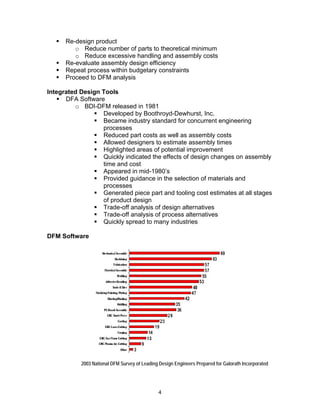
DFM Software 
2003 National DFM Survey of Leading Design Engineers Prepared for Galorath Incorporated
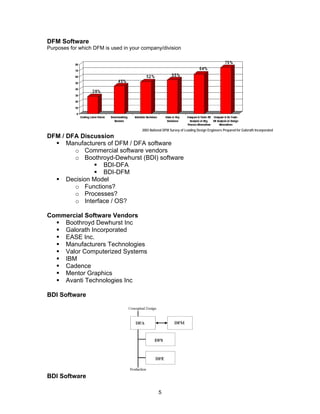
DFM Software 
Purposes for which DFM is used in your company/division 
2003 National DFM Survey of Leading Design Engineers Prepared for Galorath Incorporated 
5 
DFM / DFA Discussion 
ƒ Manufacturers of DFM / DFA software 
o Commercial software vendors 
o Boothroyd-Dewhurst (BDI) software 
ƒ BDI-DFA 
ƒ BDI-DFM 
ƒ Decision Model 
o Functions? 
o Processes? 
o Interface / OS? 
Commercial Software Vendors 
ƒ Boothroyd Dewhurst Inc 
ƒ Galorath Incorporated 
ƒ EASE Inc. 
ƒ Manufacturers Technologies 
ƒ Valor Computerized Systems 
ƒ IBM 
ƒ Cadence 
ƒ Mentor Graphics 
ƒ Avanti Technologies Inc 
BDI Software 
BDI Software
6 
ƒ Design for Assembly 
o Product simplification through DFA 
ƒ Design for Manufacture 
o Aids in the selection of materials and processes 
o Provides piece part and tooling cost estimate 
o Feedback to Design for Assembly 
ƒ Design for Service 
o Improve the serviceability and maintainability 
ƒ Design for Environment 
o Environmental impact of the final design 
BDI-DFA Software 
ƒ Structure Chart 
o Build complete list of items and operations directly on the Structure 
Chart 
o Entries appear as blocks in a tree form showing the structure of the 
product 
ƒ DFA Questions Window 
o Perform a basic DFA analysis by answering questions on 
ƒ part geometry 
ƒ handling and insertion difficulties 
ƒ minimum part criteria 
ƒ Suggestions and Graphs for Redesign 
BDI-DFM Software 
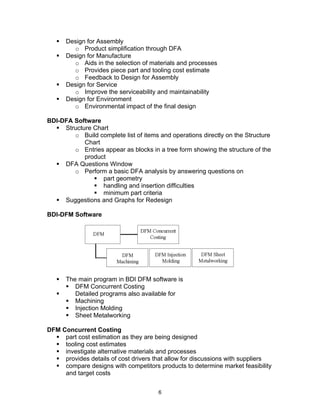
ƒ The main program in BDI DFM software is 
ƒ DFM Concurrent Costing 
ƒ Detailed programs also available for 
ƒ Machining 
ƒ Injection Molding 
ƒ Sheet Metalworking 
DFM Concurrent Costing 
ƒ part cost estimation as they are being designed 
ƒ tooling cost estimates 
ƒ investigate alternative materials and processes 
ƒ provides details of cost drivers that allow for discussions with suppliers 
ƒ compare designs with competitors products to determine market feasibility 
and target costs
7 
DFM Machining Module 
ƒ user develops a process chart where machining processes are graphically 
displayed 
ƒ The software calculates the optimum speed, feed and cost for the given 
process and materials 
ƒ This information is added to the process chart and the user can continue 
to add machining sequences 
Output 
ƒ the designer has a process chart for the component, total component cost 
and a list of optimum speeds and feeds 
DFM Injection Molding Module 
ƒ Provide the component cost of an injection molded part 
ƒ Estimates the mold cost, processing cost and materials cost for the part 
ƒ Process parameters, such as optimum number of cavities, set up time, set 
up cost, and mold time are estimated by the software 
ƒ Allows designers to see the cost impact of tolerance and finish 
specifications which can then be optimized by "what if" analysis 
ƒ This software also useful in evaluating vendor quotes 
DFM Sheet Metalworking Module 
ƒ The software estimates 
o the per part cost of sheet metal dies 
o primary shaping and forming costs (blanking, bending, etc.) 
o secondary operations costs (deburring, painting, etc.) 
o material costs (cost impact of using a different material or gage 
thickness) 
o compare processes such as stamping verses turret press work 
Output 
ƒ The costs are presented to the user in report or graphical format defining 
the primary operations, number of dies, typical press force, cycle time per 
part, machine rate, operation cost per part, set-up time, and die cost 
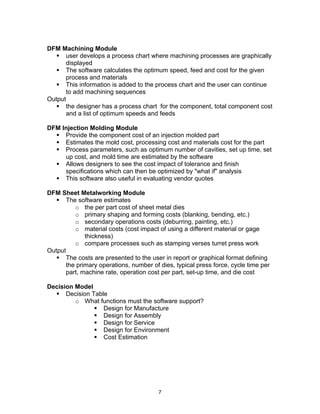
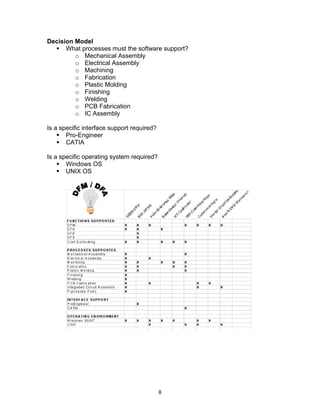
Decision Model 
ƒ Decision Table 
o What functions must the software support? 
ƒ Design for Manufacture 
ƒ Design for Assembly 
ƒ Design for Service 
ƒ Design for Environment 
ƒ Cost Estimation
8 
Decision Model 
ƒ What processes must the software support? 
o Mechanical Assembly 
o Electrical Assembly 
o Machining 
o Fabrication 
o Plastic Molding 
o Finishing 
o Welding 
o PCB Fabrication 
o IC Assembly 
Is a specific interface support required? 
ƒ Pro-Engineer 
ƒ CATIA 
Is a specific operating system required? 
ƒ Windows OS 
ƒ UNIX OS

Tp05 pub214

  • 1.
    TP05PUB214 TECHNICAL PAPER2005 Society of Manufacturing Engineers ■ One SME Drive ■ P.O. Box 930 An Account of the Use of DFA/DFM Tools in Modern Manufacturing Enterprises author(s) TOM PAGE Loughborough University Loughborough, Leicestershire, England abstract This paper provides an account of the role of design for manufacture (DFM) and design for assembly (DFA) in modern manufacturing enterprises. Software tools for integrated design for manufacture are presented with trend data on the use of such tools. A decision model for design for manufacture and assembly is also discussed for the purpose of highlighting the key features of these methodologies. terms Design for Assembly Design for Manufacture Integrated Design Tools Concurrent Engineering Dearborn, MI 48121 ■ Phone (313) 271-1500 ■ www.sme.org
  • 2.
    SME TECHNICAL PAPERS This Technical Paper may not be reproduced in whole or in part in any form without the express written permission of the Society of Manufacturing Engineers. By publishing this paper, SME neither endorses any product, service or information discussed herein, nor offers any technical advice. SME specifically disclaims any warranty of reliability or safety of any of the information contained herein.
  • 3.
    An Account ofthe Use of DFA/DFM Tools in Modern Manufacturing Enterprises T. Page, Department of Design & Technology, Loughborough University, UK Abstract: This paper provides an account of the role of Design for Manufacture (DFM) and Design for Assembly (DFA) in modern manufacturing enterprises. Software tools for integrated design for manufacture re presented with trend data on the use of such tools. A decision model for design for manufacture and assembly is also discussed for the purpose of highlighting the key features of these methodologies. Keywords: DFA, DFM, Integrated software tools, Concurrent Engineering DFM / DFA ƒ Concurrent Engineering ƒ Design for Manufacture (DFM) o What is DFM? o Principles of DFM ƒ Design For Assembly (DFA) o What is DFA? o Principles of DFA ƒ Integrated Design Tools Concurrent Engineering ƒ Concept o Consumers demand products that meet design requirements at the lowest price o Manufacturability issues have the greatest effect on product cost o Designers can directly affect the cost of products by considering manufacturability issues during the product design phase ƒ Practice o First recognized by Japanese manufacturers in the late 1970’s o Concurrent engineering attempted to bridge the gap between design and manufacturing o Best design practices were documented and organized into rules and guidelines o Beginning of DFM Design for Manufacture ƒ What is DFM? o Fundamental tool of concurrent engineering o Essentially a system of design principles, guidelines and rules o System narrows the region for an optimal design solution o Increases the probability of a sound design solution
  • 4.
    2 Design forManufacture ƒ Where did DFM come from? o Old System - “School of Hard Knocks” o Designers learned good design practices on the job by trial and error o Experience divided good designers from bad ƒ New System - DFM o Good design practices documented and organized o Inexperienced designers learned best design practices from beginning o Design learning curve flattened Principles of DFM ƒ Reduce the total number of parts o Most fundamental concept o Greatest opportunity for cost savings ƒ Develop modular designs o Builds in versatility of manufacture and redesign ƒ Use standard components o Reduced cost o Shorter lead time ƒ Design parts to be multi-functional o Reduces total number of parts in product ƒ Design parts to be multi-use o Reduces total number of parts in system ƒ Design for ease of fabrication o Select optimum materials and processing o Eliminate secondary operations ƒ Avoid use of separate fasteners o Reduces handling and feeding o Increases product quality ƒ Minimize assembly directions o Downward assembly direction is optimal ƒ Maximize compliance o Use design features to facilitate assembly o Use chamfers and solid base parts ƒ Minimize handling o Symmetrical parts reduce handling o Asymmetries should be exaggerated to reduce handling errors o Avoid flexible components o Reduce packaging materials Design for Assembly ƒ What is DFA? o Quantitative product simplification tool o Reduces scope of design problem o Relates design decisions directly to cost
  • 5.
    o Increases effectivenessof subsequent application of DFM 3 techniques o Potential savings ƒ 20-40% Manufacturing cost reduction ƒ 100-200% Assembly productivity increase Principles of DFA ƒ Two step approach o Reduce the total number of parts ƒ Similar to DFM principle ƒ Quantitative method ƒ Uses theoretical minimum as baseline o Estimate handling and assembly costs ƒ Based on practical data ƒ Generates estimated costs before detail design begins ƒ Efficiency index relates disparate manufacturing processes o Reduce the number of parts ƒ Determine the theoretical minimum o Parts must meet three criteria to be indispensable: o There is relative motion between the part and all other parts already assembled o The part must be made of a different material or be isolated from all other parts already assembled o The part must be separated from all parts already assembled because necessary assembly or disassembly would otherwise be impossible ƒ Estimate handling and assembly costs o Select assembly processes ƒ Six alternatives o Manual Assembly (MA) o Manual with Mechanical Assistance (MM) o Automated assembly, Indexing-transfer (AI) o Automated assembly, Free transfer (AF) o Automated, Programmable assembly (AP) o Automated, programmable Robot assembly (AR) o Calculate assembly cost ƒ Additional input data o Projected market life o Number of parts o Projected production volume o Company investment policy o Calculate assembly design efficiency ƒ Em = 3 * Nm / Tm Em = Manual assembly design efficiency Nm = Theoretical minimum number of parts Tm = Total assembly time Assumptions: - Parts are easy to handle - One third of parts are secured completely after insertion
  • 6.
    4 ƒ Re-designproduct o Reduce number of parts to theoretical minimum o Reduce excessive handling and assembly costs ƒ Re-evaluate assembly design efficiency ƒ Repeat process within budgetary constraints ƒ Proceed to DFM analysis Integrated Design Tools ƒ DFA Software o BDI-DFM released in 1981 ƒ Developed by Boothroyd-Dewhurst, Inc. ƒ Became industry standard for concurrent engineering processes ƒ Reduced part costs as well as assembly costs ƒ Allowed designers to estimate assembly times ƒ Highlighted areas of potential improvement ƒ Quickly indicated the effects of design changes on assembly time and cost ƒ Appeared in mid-1980’s ƒ Provided guidance in the selection of materials and processes ƒ Generated piece part and tooling cost estimates at all stages of product design ƒ Trade-off analysis of design alternatives ƒ Trade-off analysis of process alternatives ƒ Quickly spread to many industries DFM Software 2003 National DFM Survey of Leading Design Engineers Prepared for Galorath Incorporated
  • 7.
    DFM Software Purposesfor which DFM is used in your company/division 2003 National DFM Survey of Leading Design Engineers Prepared for Galorath Incorporated 5 DFM / DFA Discussion ƒ Manufacturers of DFM / DFA software o Commercial software vendors o Boothroyd-Dewhurst (BDI) software ƒ BDI-DFA ƒ BDI-DFM ƒ Decision Model o Functions? o Processes? o Interface / OS? Commercial Software Vendors ƒ Boothroyd Dewhurst Inc ƒ Galorath Incorporated ƒ EASE Inc. ƒ Manufacturers Technologies ƒ Valor Computerized Systems ƒ IBM ƒ Cadence ƒ Mentor Graphics ƒ Avanti Technologies Inc BDI Software BDI Software
  • 8.
    6 ƒ Designfor Assembly o Product simplification through DFA ƒ Design for Manufacture o Aids in the selection of materials and processes o Provides piece part and tooling cost estimate o Feedback to Design for Assembly ƒ Design for Service o Improve the serviceability and maintainability ƒ Design for Environment o Environmental impact of the final design BDI-DFA Software ƒ Structure Chart o Build complete list of items and operations directly on the Structure Chart o Entries appear as blocks in a tree form showing the structure of the product ƒ DFA Questions Window o Perform a basic DFA analysis by answering questions on ƒ part geometry ƒ handling and insertion difficulties ƒ minimum part criteria ƒ Suggestions and Graphs for Redesign BDI-DFM Software ƒ The main program in BDI DFM software is ƒ DFM Concurrent Costing ƒ Detailed programs also available for ƒ Machining ƒ Injection Molding ƒ Sheet Metalworking DFM Concurrent Costing ƒ part cost estimation as they are being designed ƒ tooling cost estimates ƒ investigate alternative materials and processes ƒ provides details of cost drivers that allow for discussions with suppliers ƒ compare designs with competitors products to determine market feasibility and target costs
  • 9.
    7 DFM MachiningModule ƒ user develops a process chart where machining processes are graphically displayed ƒ The software calculates the optimum speed, feed and cost for the given process and materials ƒ This information is added to the process chart and the user can continue to add machining sequences Output ƒ the designer has a process chart for the component, total component cost and a list of optimum speeds and feeds DFM Injection Molding Module ƒ Provide the component cost of an injection molded part ƒ Estimates the mold cost, processing cost and materials cost for the part ƒ Process parameters, such as optimum number of cavities, set up time, set up cost, and mold time are estimated by the software ƒ Allows designers to see the cost impact of tolerance and finish specifications which can then be optimized by "what if" analysis ƒ This software also useful in evaluating vendor quotes DFM Sheet Metalworking Module ƒ The software estimates o the per part cost of sheet metal dies o primary shaping and forming costs (blanking, bending, etc.) o secondary operations costs (deburring, painting, etc.) o material costs (cost impact of using a different material or gage thickness) o compare processes such as stamping verses turret press work Output ƒ The costs are presented to the user in report or graphical format defining the primary operations, number of dies, typical press force, cycle time per part, machine rate, operation cost per part, set-up time, and die cost Decision Model ƒ Decision Table o What functions must the software support? ƒ Design for Manufacture ƒ Design for Assembly ƒ Design for Service ƒ Design for Environment ƒ Cost Estimation
  • 10.
    8 Decision Model ƒ What processes must the software support? o Mechanical Assembly o Electrical Assembly o Machining o Fabrication o Plastic Molding o Finishing o Welding o PCB Fabrication o IC Assembly Is a specific interface support required? ƒ Pro-Engineer ƒ CATIA Is a specific operating system required? ƒ Windows OS ƒ UNIX OS