Design for Manufacturing
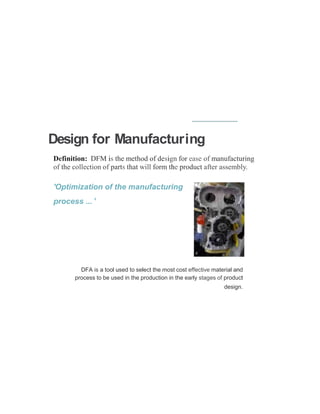
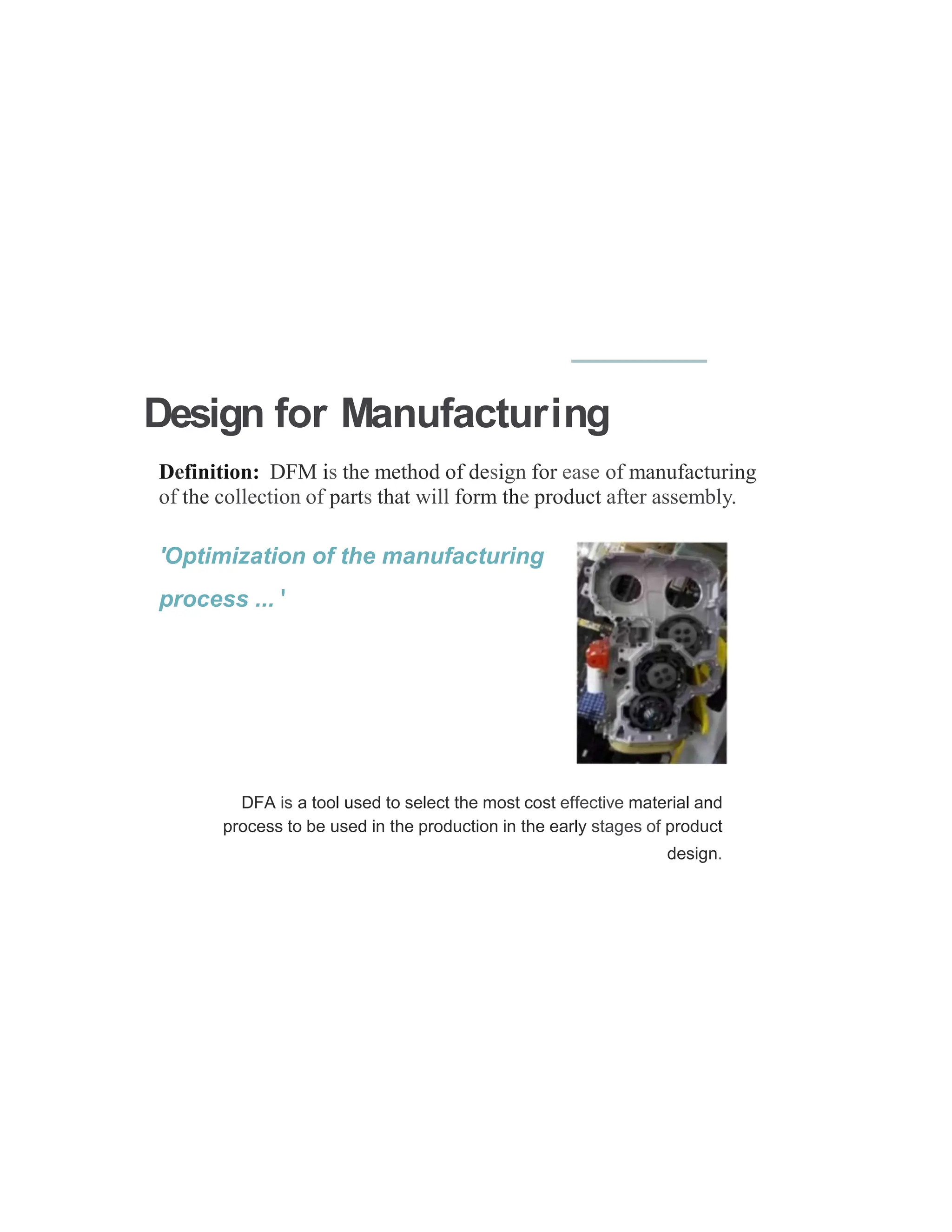
Definition: DFM is the method of design for ease of manufacturing
of the collection of parts that will form the product after assembly.
'Optimization of the manufacturing
process ... '
DFA is a tool used to select the most cost effective material and
process to be used in the production in the early stages of product
design.
Major DFM object ives
1)Estimate the mfg. costs
2)Reduce the costs of components
3)Reduce the costs of assembly
4)Reduce the costs of supporting production
5)Consider the impact of DFM decisions on other
factors.
Design for Assembly
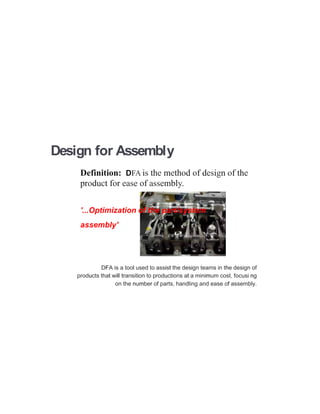
Definition: DFA is the method of design of the
product for ease of assembly.
'...Optimization of the part/system
assembly'
DFA is a tool used to assist the design teams in the design of
products that will transition to productions at a minimum cost, focusi ng
on the number of parts, handling and ease of assembly.
Differences
Design for Assembly (DFA)
•concerned only with reducing product assembly cost
0
minimizes number of assembly operations individual
parts tend to be more complex in design
0
Design for Manufacturing (DFM)
•concerned with reducing overall part production cost
0
minimizes complexity of manufacturing operations
uses common datum features and primary axes
0
Similarities
•Both DFM and DFA seek to reduce material, overhead,
and labor cost.
•They both shorten the product development cycle time.
•Both DFM and DFA seek to utilize standards to reduce cost
Design for Manufacturing
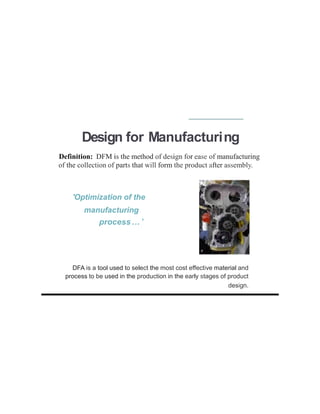
Definition: DFM is the method of design for ease of manufacturing
of the collection of parts that will form the product after assembly.
,
process ...
'Optimization of the
manufacturing
DFA is a tool used to select the most cost effective material and
process to be used in the production in the early stages of product
design.
Reduce the total number of parts
The reduction of the number of parts in a product is probably the best
opportunity for reducing manufacturing costs. Less parts implies less
purchases, inventory, handling, processing time, development time,
equipment, engineering time, assembly difficulty, service inspection,
testing
Develop a modular design
The use of modules in product design simplifies
manufacturing activities such as inspection, testing,
assembly, purchasing, redesign, maintenance, service
Use of standard components
Standard components are less expensive than custom made
items. The high availability of these components reduces
product lead times.
Design parts to be multi-functional
Multi-functional parts reduce the total number of parts in a
design, thus, obtaining the benefits given in rule 1.
Some examples are a part to act as both an electric conductor
and as a structural member, or as a heat dissipating element
and as a structural member.
Design parts for multi-use
In a manufacturing firm, different products can share parts that
have been designed for multi-use. These parts can have the
same or different functions when used in different products.
In order to do this, it is necessary to identify the parts that are
suitable for multi-use. For example, all the parts used in the
firm (purchased or made) can be sorted into two groups: the
first containing all the parts that are used commonly in all
products.
Design for ease of fabrication
Select the optimum combination between the material and
fabrication process to minimize the overall manufacturing
cost. In general, final operations such as painting, polishing,
finish machining, etc. should be avoided. Excessive tolerance,
surface-finish requirement, and so on are commonly found
problems that result in higher than necessary production cost.
Avoid separate fasteners
The use of fasteners increases the cost of manufacturing a
part due to the handling and feeding operations that have to
be performed. Besides the high cost of the equipment
required for them, these operations are not
100% successful, so they contribute to reducing the overall
manufacturing efficiency. In general, fasteners should be
avoided and replaced, for example, by using tabs or snap fits.
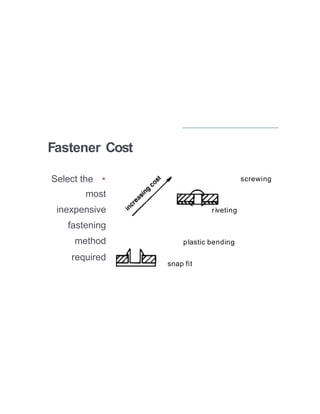
Fastener Cost
Select the •
most
inexpensive
fastening
method
required
screwing
riveting
plastic bending
snap fit
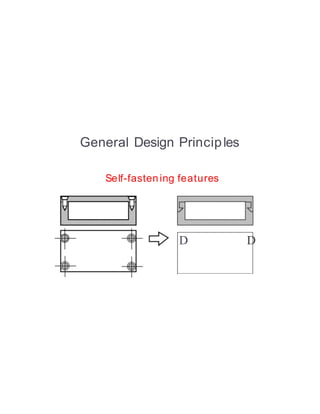
General Design Principles
Self-fastening features
D D

DFMA.ppt

  • 1.
    Design for Manufacturing Definition:DFM is the method of design for ease of manufacturing of the collection of parts that will form the product after assembly. 'Optimization of the manufacturing process ... ' DFA is a tool used to select the most cost effective material and process to be used in the production in the early stages of product design.
  • 2.
    Major DFM objectives 1)Estimate the mfg. costs 2)Reduce the costs of components 3)Reduce the costs of assembly 4)Reduce the costs of supporting production 5)Consider the impact of DFM decisions on other factors.
  • 3.
    Design for Assembly Definition:DFA is the method of design of the product for ease of assembly. '...Optimization of the part/system assembly' DFA is a tool used to assist the design teams in the design of products that will transition to productions at a minimum cost, focusi ng on the number of parts, handling and ease of assembly.
  • 4.
    Differences Design for Assembly(DFA) •concerned only with reducing product assembly cost 0 minimizes number of assembly operations individual parts tend to be more complex in design 0 Design for Manufacturing (DFM) •concerned with reducing overall part production cost 0 minimizes complexity of manufacturing operations uses common datum features and primary axes 0
  • 5.
    Similarities •Both DFM andDFA seek to reduce material, overhead, and labor cost. •They both shorten the product development cycle time. •Both DFM and DFA seek to utilize standards to reduce cost
  • 6.
    Design for Manufacturing Definition:DFM is the method of design for ease of manufacturing of the collection of parts that will form the product after assembly. , process ... 'Optimization of the manufacturing DFA is a tool used to select the most cost effective material and process to be used in the production in the early stages of product design.
  • 7.
    Reduce the totalnumber of parts The reduction of the number of parts in a product is probably the best opportunity for reducing manufacturing costs. Less parts implies less purchases, inventory, handling, processing time, development time, equipment, engineering time, assembly difficulty, service inspection, testing
  • 8.
    Develop a modulardesign The use of modules in product design simplifies manufacturing activities such as inspection, testing, assembly, purchasing, redesign, maintenance, service
  • 9.
    Use of standardcomponents Standard components are less expensive than custom made items. The high availability of these components reduces product lead times.
  • 10.
    Design parts tobe multi-functional Multi-functional parts reduce the total number of parts in a design, thus, obtaining the benefits given in rule 1. Some examples are a part to act as both an electric conductor and as a structural member, or as a heat dissipating element and as a structural member.
  • 11.
    Design parts formulti-use In a manufacturing firm, different products can share parts that have been designed for multi-use. These parts can have the same or different functions when used in different products. In order to do this, it is necessary to identify the parts that are suitable for multi-use. For example, all the parts used in the firm (purchased or made) can be sorted into two groups: the first containing all the parts that are used commonly in all products.
  • 12.
    Design for easeof fabrication Select the optimum combination between the material and fabrication process to minimize the overall manufacturing cost. In general, final operations such as painting, polishing, finish machining, etc. should be avoided. Excessive tolerance, surface-finish requirement, and so on are commonly found problems that result in higher than necessary production cost.
  • 13.
    Avoid separate fasteners Theuse of fasteners increases the cost of manufacturing a part due to the handling and feeding operations that have to be performed. Besides the high cost of the equipment required for them, these operations are not 100% successful, so they contribute to reducing the overall manufacturing efficiency. In general, fasteners should be avoided and replaced, for example, by using tabs or snap fits.
  • 14.
    Fastener Cost Select the• most inexpensive fastening method required screwing riveting plastic bending snap fit
  • 15.