Unit - V - DESIGN FOR MANUFACTURING AND
PRODUCT DEVELOPMENT
Topic 1: DESIGN FOR MANUFACTURING
OMF551 - Product Design and Development
Design f o r manufacturing
• The later development activities teams often
have difficulty linking needs and
specifications to the specific design issues
they face.
• For this reason, many teams practice “design
for X” (DFX) methodologies, where X may
correspond to one of dozens of quality criteria
such as reliability, robustness, serviceability,
environmentalimpact,or manufacturability.
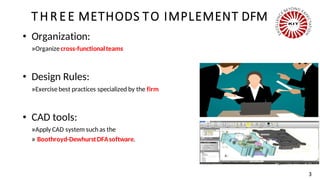
T H R E E METHODS TO IMPLEMENT DFM
• Organization:
»Organizecross-functionalteams
• Design Rules:
»Exercise best practices specialized by the firm
• CAD tools:
»Apply CAD system suchas the
» Boothroyd-DewhurstDFAsoftware.
3
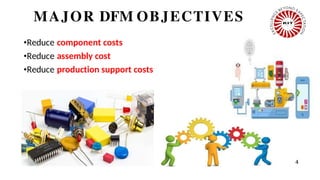
MAJOR DFM OBJECTIVES
•Reduce component costs
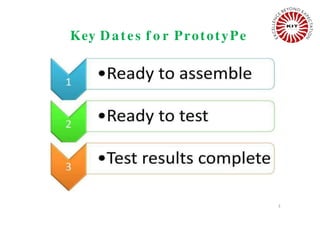
•Reduce assembly cost
•Reduce production support costs
4
MAJOR DFM OBJECTIVES
5
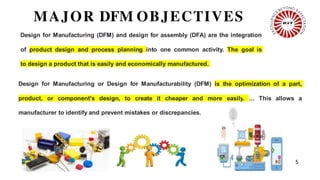
Design for Manufacturing (DFM) and design for assembly (DFA) are the integration
of product design and process planning into one common activity. The goal is
to design a product that is easily and economically manufactured.
Design for Manufacturing or Design for Manufacturability (DFM) is the optimization of a part,
product, or component's design, to create it cheaper and more easily. ... This allows a
manufacturer to identify and prevent mistakes or discrepancies.
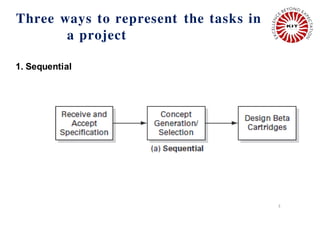
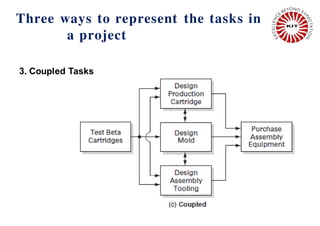
Unit - V - DESIGN FOR MANUFACTURING AND
PRODUCT DEVELOPMENT
Topic 2: Reducing the component costs
and assembly costs
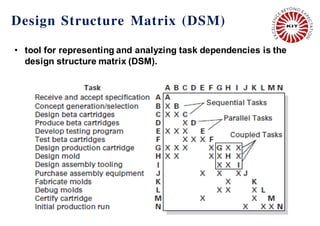
OMF551 - Product Design and Development
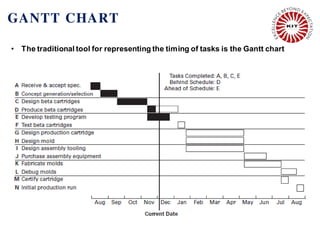
Reduce t h e c os t s of components
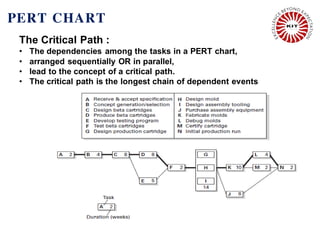
• Identify process constraintsand costdrivers-
automaticlaser cutting machine and a welding
process are the two best examplesto explain this.
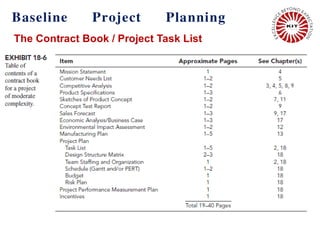
• Redesigncomponentsto eliminateprocessingsteps
Main fold housing-(Materials)
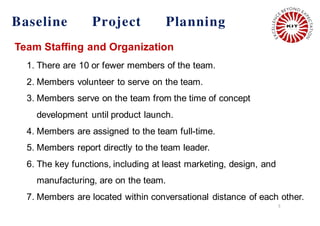
• Variable cost
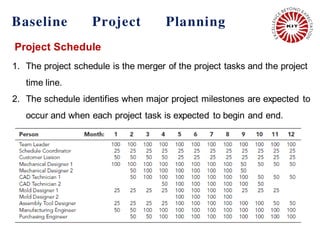
• Fixed cost (Mold tooling)
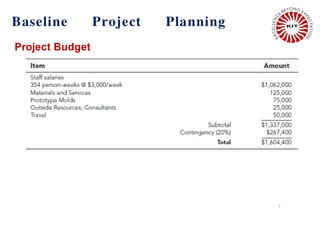
• Totaldirect cost (overhead charges)
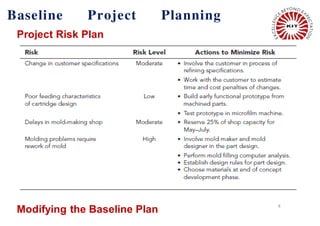
• Total unit cost
• Choose the appropriate economic scale for the part
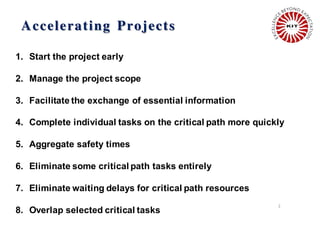
process
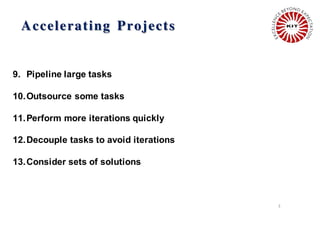
– Manufacturing costs drops as the volume of product increases called
ECONOMIES OF SCALE.
Example:Injection molded plasticpart.
• Standardizecomponentsand their processes-
• Internal standardization-Use of 3.8 liter V6 engine in several GM
cars.
• External standardization-Use of 10mm socket head cap screw
across several auto manufactures.
• Choose the appropriate economic scale for the part
process
Adhere the black-box component-A componentcost reduction
strategy used effectively in the Japanese auto industry is called black box
supplier design.
– Successful black box development requires “careful system- level design
and extremelyclear definitions”.
Reduce t h e c o s t s o f as s em b ly
• Design for assembly(DFA) is a fairly subset of DFM
that involvesminimizingcost of assembly.
• DFA index = (theoritical minimum number of parts)*(30 seconds)
/Estimatedtotal assembly time
• Integrateparts (using the Boothroyd method)
– Integration of several features into a single component.
– The EGR return and vacuum, source parts are
molded into the redesigned intake manifold.
Reduce t h e c o s t s o f as s em b ly
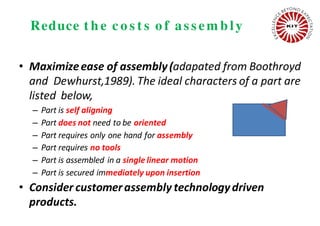
• Maximizeease of assembly(adapated from Boothroyd
and Dewhurst,1989). The ideal characters of a part are
listed below,
– Part is self aligning
– Part does not need to be oriented
– Part requires only one hand for assembly
– Part requires no tools
– Part is assembled in a single linear motion
– Part is secured immediately upon insertion
• Consider customerassembly technologydriven
products.
OMF551 - Product Design and Development
Unit - V - DESIGN FOR MANUFACTURING AND
PRODUCT DEVELOPMENT
Topic 3: Prototype basics
Reduce t h e c os t s of components
• Identify process constraintsand cost drivers-
automatic laser cutting machine and a welding
process are the two best examples to explain this.
• Redesign components toeliminate processing steps
Main fold housing-(Materials)
• Variablecost
• (Mold tooling)Fixedcost
• (overhead charges)Totaldirectcost
• Total unit cost
2
• Choose the appropriate economic scale for the part
process
– Manufacturingcosts drops as the volume of product increasescalled
ECONOMIES OF SCALE. Example: Injection molded plasticpart.
• Standardizecomponentsand their processes-
• Internal standardization-Useof 3.8 liter V6 engine in several GM cars.
• External standardization-Useof 10mm sockethead cap screw across
several automanufactures.
• Adhere the black-box component-A componentcost
reduction strategy used effectively in the Japanese auto
industry is called black box supplier design.
– Successful black box development requires “careful system- level
3
Reduce t h e c o s t s o f as s em b ly
• Design for assembly(DFA) is a fairly subset of DFM
that involves minimizing cost of assembly
• DFA index = (theoritical minimum number of parts)*(30 seconds)
/Estimatedtotalassemblytime
• Integrateparts (using the Boothroydmethod)
– Integration of several features into a single component.
– The EGR returnand vacuum, source parts are molded
intothe redesigned intakemanifold.
4
Reduce t h e c o s t s o f as s em b ly
• Maximize ease of assembly(adapated from Boothroyd and
Dewhurst,1989).Theideal characters of a part are listed below,
– Partis self aligning
– Partdoes not need to be oriented
– Partrequires only one hand for assembly
– Partrequires no tools
– Partis assembledin a single linear motion
– Partis secured immediately upon insertion
• Considercustomerassembly technologydriven products. 5
1
Unit - V - DESIGN FOR MANUFACTURING AND
PRODUCT DEVELOPMENT
Topic 4: Principles of Prototyping
OMF551 - Product Design and Development
PrinciPles o f PrototyPing
• Analytical Prototypes Are Generally More Flexible Than Physical
Prototypes
• Physical Prototypes Are Required to Detect Unanticipated
Phenomena
• A Prototype May Reduce the Risk of Costly Iterations
• A Prototype May Expedite Other Development Steps
• A Prototype May Restructure Task Dependencies
Prototyping technolog ies
3D CAD Modeling and Analysis:
The dominant mode of representing designs has shifted from drawings created by
computer to 3D CAD models.
• The advantage of 3D CAD include:
1. ability to easily visualize the three-dimensional
form of the design;
2. the ability to create photo-realistic images for assessment of
product appearance;
3. the ability to automatically compute physical properties
a) such as mass and volume
b) efficiency arising from the creation of one and only one canonical description of
the design, from which other, more focused descriptions, such as cross-sectional views
and fabrication drawings, can be created.
PrototyPing technolog ies
3D CAD Modeling and Analysis:
The dominant mode of representing designs has shifted from drawings created by
computer to 3D CAD models.
• Through the use of computer-aided engineering (CAE) tools, 3D CAD models
have begun to serve as analytical prototypes.
• Engineers also computed heat flows and thermal dissipation performance using finite-element
analysis based on 3D CAD models.
f r e e form fab rication
• In 1984, the first commercial free-form fabrication system was introduced by
3DSystems.
• This technology, called stereolithography, and dozens of competing
technologies that followed it, create physical objects directly from 3D CAD
models, and can be thought of as “three-dimensional printing.” This
collection of technologies is often called rapid prototyping.
• Free-form fabrication technologies enable realistic 3D prototypes to be
created earlier and less expensively than was possible before.
• For example, the PackBot prototype was made of components fabricated
using stereolithography in only four days.
1
Unit - V - DESIGN FOR MANUFACTURING AND
PRODUCT DEVELOPMENT
Topic 5: : Planning for Prototyping
OMF551 - Product Design and Development
Planning f o r PrototyPing
2
Key D ates f o r PrototyPe
3
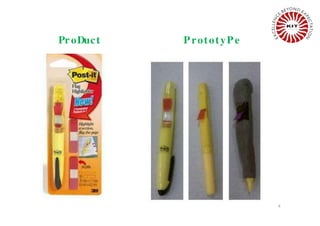
Pr oDuct PrototyPe
4
Planning Milestones PrototyP es
• The comprehensive prototypes a team uses as development
benefit from additional planning
• Planning the milestone dates is an integral part of establishing
an overall product development project plan
• As a base case, the team should consider using alpha, beta,
and preproduction prototypes as milestones.
• Additional early prototypes are common in situations where the
product embodies a new concept or technology. These early
prototypes are sometimes called experimental or engineering
prototypes.
5
a guide f o r students t o Plan their Prototypes
• It is important that the studentsconsiderhow to include
prototypes in the innovation process.
• Prototypes should be tested-preferably severaltimes-
during the innovationprocess and afterwards revised.
• Besides this,the studentsshould developand test
several differentprototypes that are able to “compete”
with eachother during the test period. 6
1
Unit - V - DESIGN FOR MANUFACTURING AND
PRODUCT DEVELOPMENT
Topic 6: : Economic Analysis
OMF551 - Product Design and Development
Economic Analysis Process
2
We recommend the following four-step method for the economic
analysis of a product-development project:
1. Build a base-case financial model.
2. Perform a sensitivity analysis to understand the relationships
between financial success and the key assumptions and variables
of the model.
3. Use the sensitivity analysis to understand project trade-offs.
4. Consider the influence of the qualitative factors on project
success.
Step 1: Build a Base-Case Financial
Model
3
The most basic categories of cash flow for a typical new
product development project are:
• Development cost (all remaining design, testing, and refinement
costs up to production ramp-up).
• Ramp-up cost.
• Marketing and support cost.
• Production cost.
• Sales revenues.
4
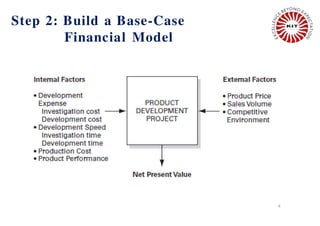
Step 2: Build a Base-Case
Financial Model
5
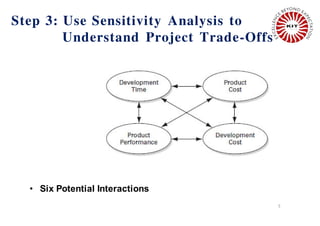
Step 3: Use Sensitivity Analysis to
Understand Project Trade-Offs
• Six Potential Interactions
6
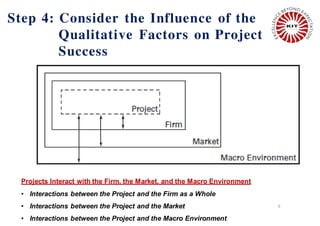
Step 4: Consider the Influence of the
Qualitative Factors on Project
Success
Projects Interact with the Firm, the Market, and the Macro Environment
• Interactions between the Project and the Firm as a Whole
• Interactions between the Project and the Market
• Interactions between the Project and the Macro Environment
1
Unit - V - DESIGN FOR MANUFACTURING AND
PRODUCT DEVELOPMENT
Topic 7: Understanding and Representing Tasks
OMF551 - Product Design and Development
2
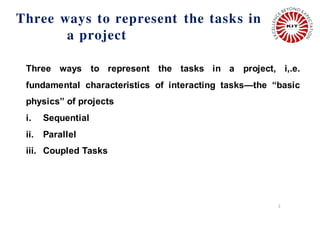
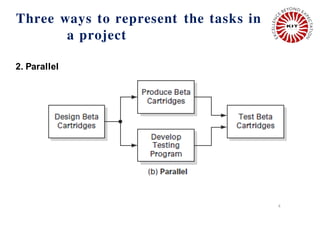
Three ways to represent the tasks in a project, i,.e.
fundamental characteristics of interacting tasks—the “basic
physics” of projects
i. Sequential
ii. Parallel
iii. Coupled Tasks
Three ways to represent the tasks in
a project
3
1. Sequential
Three ways to represent the tasks in
a project
4
2. Parallel
Three ways to represent the tasks in
a project
Three ways to represent the tasks in
a project
5
3. Coupled Tasks
6
Design Structure Matrix (DSM)
• tool for representing and analyzing task dependencies is the
design structure matrix (DSM).
7
GANTT CHART
• The traditional tool for representing the timing of tasks is the Gantt chart
8
PERT CHART
The Critical Path :
• The dependencies among the tasks in a PERT chart,
• arranged sequentially OR in parallel,
• lead to the concept of a critical path.
• The critical path is the longest chain of dependent events
1
Unit - V - DESIGN FOR MANUFACTURING AND
PRODUCT DEVELOPMENT
Topic 8: Baseline Project Planning
OMF551 - Product Design and Development
2
i. The project plan is the roadmap for the remaining
development effort.
ii. in coordinating the remaining tasks and
iii. in estimating the required development resources and
development time
iv. baseline project plan
v. The results of the concept development phase
plus the project plan make up the contract book.
Baseline Project Planning
3
i. The Contract Book
• document represents an agreement between the
development team and the senior management of the
company
• about project goals, direction, and resource requirements.
Baseline Project Planning
4
Baseline Project Planning
The Contract Book / Project Task List
5
Baseline Project Planning
Team Staffing and Organization
1. There are 10 or fewer members of the team.
2. Members volunteer to serve on the team.
3. Members serve on the team from the time of concept
development until product launch.
4. Members are assigned to the team full-time.
5. Members report directly to the team leader.
6. The key functions, including at least marketing, design, and
manufacturing, are on the team.
7. Members are located within conversational distance of each other.
6
Baseline Project Planning
Project Schedule
1. The project schedule is the merger of the project tasks and the project
time line.
2. The schedule identifies when major project milestones are expected to
occur and when each project task is expected to begin and end.
7
Baseline Project Planning
Project Budget
8
Baseline Project Planning
Project Risk Plan
Modifying the Baseline Plan
1
Unit - V - DESIGN FOR MANUFACTURING AND
PRODUCT DEVELOPMENT
Topic 9: : Accelerating the Project and
Project Execution
OMF551 - Product Design and Development
Accelerating Projects
2
1. Start the project early
2. Manage the project scope
3. Facilitate the exchange of essential information
4. Complete individual tasks on the critical path more quickly
5. Aggregate safety times
6. Eliminate some critical path tasks entirely
7. Eliminate waiting delays for critical path resources
8. Overlap selected critical tasks
Accelerating Projects
3
9. Pipeline large tasks
10.Outsource some tasks
11.Perform more iterations quickly
12.Decouple tasks to avoid iterations
13.Consider sets of solutions
Project Execution
4
Coordination Mechanisms:
i. Informal communication
ii. Meetings
iii. Schedule display
iv. Weekly updates
v. Incentives
vi. Process documents
Assessing Project Status
whether as per schedule or not
5
i. Changing the timing or frequency of meetings
ii. Changing the project staff
iii. Locating the team together physically
iv. Soliciting more time and effort from the team
v. Focusing more effort on the critical tasks
vi. Engaging outside resources
vii. Changing the project scope or schedule
Corrective Actions

Unit 5 design for manufacturing

  • 1.
    Unit - V- DESIGN FOR MANUFACTURING AND PRODUCT DEVELOPMENT Topic 1: DESIGN FOR MANUFACTURING OMF551 - Product Design and Development
  • 2.
    Design f or manufacturing • The later development activities teams often have difficulty linking needs and specifications to the specific design issues they face. • For this reason, many teams practice “design for X” (DFX) methodologies, where X may correspond to one of dozens of quality criteria such as reliability, robustness, serviceability, environmentalimpact,or manufacturability.
  • 3.
    T H RE E METHODS TO IMPLEMENT DFM • Organization: »Organizecross-functionalteams • Design Rules: »Exercise best practices specialized by the firm • CAD tools: »Apply CAD system suchas the » Boothroyd-DewhurstDFAsoftware. 3
  • 4.
    MAJOR DFM OBJECTIVES •Reducecomponent costs •Reduce assembly cost •Reduce production support costs 4
  • 5.
    MAJOR DFM OBJECTIVES 5 Designfor Manufacturing (DFM) and design for assembly (DFA) are the integration of product design and process planning into one common activity. The goal is to design a product that is easily and economically manufactured. Design for Manufacturing or Design for Manufacturability (DFM) is the optimization of a part, product, or component's design, to create it cheaper and more easily. ... This allows a manufacturer to identify and prevent mistakes or discrepancies.
  • 6.
    Unit - V- DESIGN FOR MANUFACTURING AND PRODUCT DEVELOPMENT Topic 2: Reducing the component costs and assembly costs OMF551 - Product Design and Development
  • 7.
    Reduce t he c os t s of components • Identify process constraintsand costdrivers- automaticlaser cutting machine and a welding process are the two best examplesto explain this. • Redesigncomponentsto eliminateprocessingsteps Main fold housing-(Materials) • Variable cost • Fixed cost (Mold tooling) • Totaldirect cost (overhead charges) • Total unit cost
  • 8.
    • Choose theappropriate economic scale for the part process – Manufacturing costs drops as the volume of product increases called ECONOMIES OF SCALE. Example:Injection molded plasticpart. • Standardizecomponentsand their processes- • Internal standardization-Use of 3.8 liter V6 engine in several GM cars. • External standardization-Use of 10mm socket head cap screw across several auto manufactures.
  • 9.
    • Choose theappropriate economic scale for the part process Adhere the black-box component-A componentcost reduction strategy used effectively in the Japanese auto industry is called black box supplier design. – Successful black box development requires “careful system- level design and extremelyclear definitions”.
  • 10.
    Reduce t he c o s t s o f as s em b ly • Design for assembly(DFA) is a fairly subset of DFM that involvesminimizingcost of assembly. • DFA index = (theoritical minimum number of parts)*(30 seconds) /Estimatedtotal assembly time • Integrateparts (using the Boothroyd method) – Integration of several features into a single component. – The EGR return and vacuum, source parts are molded into the redesigned intake manifold.
  • 11.
    Reduce t he c o s t s o f as s em b ly • Maximizeease of assembly(adapated from Boothroyd and Dewhurst,1989). The ideal characters of a part are listed below, – Part is self aligning – Part does not need to be oriented – Part requires only one hand for assembly – Part requires no tools – Part is assembled in a single linear motion – Part is secured immediately upon insertion • Consider customerassembly technologydriven products.
  • 12.
    OMF551 - ProductDesign and Development Unit - V - DESIGN FOR MANUFACTURING AND PRODUCT DEVELOPMENT Topic 3: Prototype basics
  • 13.
    Reduce t he c os t s of components • Identify process constraintsand cost drivers- automatic laser cutting machine and a welding process are the two best examples to explain this. • Redesign components toeliminate processing steps Main fold housing-(Materials) • Variablecost • (Mold tooling)Fixedcost • (overhead charges)Totaldirectcost • Total unit cost 2
  • 14.
    • Choose theappropriate economic scale for the part process – Manufacturingcosts drops as the volume of product increasescalled ECONOMIES OF SCALE. Example: Injection molded plasticpart. • Standardizecomponentsand their processes- • Internal standardization-Useof 3.8 liter V6 engine in several GM cars. • External standardization-Useof 10mm sockethead cap screw across several automanufactures. • Adhere the black-box component-A componentcost reduction strategy used effectively in the Japanese auto industry is called black box supplier design. – Successful black box development requires “careful system- level 3
  • 15.
    Reduce t he c o s t s o f as s em b ly • Design for assembly(DFA) is a fairly subset of DFM that involves minimizing cost of assembly • DFA index = (theoritical minimum number of parts)*(30 seconds) /Estimatedtotalassemblytime • Integrateparts (using the Boothroydmethod) – Integration of several features into a single component. – The EGR returnand vacuum, source parts are molded intothe redesigned intakemanifold. 4
  • 16.
    Reduce t he c o s t s o f as s em b ly • Maximize ease of assembly(adapated from Boothroyd and Dewhurst,1989).Theideal characters of a part are listed below, – Partis self aligning – Partdoes not need to be oriented – Partrequires only one hand for assembly – Partrequires no tools – Partis assembledin a single linear motion – Partis secured immediately upon insertion • Considercustomerassembly technologydriven products. 5
  • 17.
    1 Unit - V- DESIGN FOR MANUFACTURING AND PRODUCT DEVELOPMENT Topic 4: Principles of Prototyping OMF551 - Product Design and Development
  • 18.
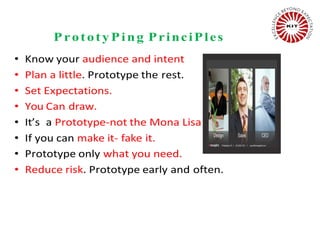
    PrinciPles o fPrototyPing • Analytical Prototypes Are Generally More Flexible Than Physical Prototypes • Physical Prototypes Are Required to Detect Unanticipated Phenomena • A Prototype May Reduce the Risk of Costly Iterations • A Prototype May Expedite Other Development Steps • A Prototype May Restructure Task Dependencies
  • 19.
    Prototyping technolog ies 3DCAD Modeling and Analysis: The dominant mode of representing designs has shifted from drawings created by computer to 3D CAD models. • The advantage of 3D CAD include: 1. ability to easily visualize the three-dimensional form of the design; 2. the ability to create photo-realistic images for assessment of product appearance; 3. the ability to automatically compute physical properties a) such as mass and volume b) efficiency arising from the creation of one and only one canonical description of the design, from which other, more focused descriptions, such as cross-sectional views and fabrication drawings, can be created.
  • 20.
    PrototyPing technolog ies 3DCAD Modeling and Analysis: The dominant mode of representing designs has shifted from drawings created by computer to 3D CAD models. • Through the use of computer-aided engineering (CAE) tools, 3D CAD models have begun to serve as analytical prototypes. • Engineers also computed heat flows and thermal dissipation performance using finite-element analysis based on 3D CAD models.
  • 22.
    f r ee form fab rication • In 1984, the first commercial free-form fabrication system was introduced by 3DSystems. • This technology, called stereolithography, and dozens of competing technologies that followed it, create physical objects directly from 3D CAD models, and can be thought of as “three-dimensional printing.” This collection of technologies is often called rapid prototyping. • Free-form fabrication technologies enable realistic 3D prototypes to be created earlier and less expensively than was possible before. • For example, the PackBot prototype was made of components fabricated using stereolithography in only four days.
  • 23.
    1 Unit - V- DESIGN FOR MANUFACTURING AND PRODUCT DEVELOPMENT Topic 5: : Planning for Prototyping OMF551 - Product Design and Development
  • 24.
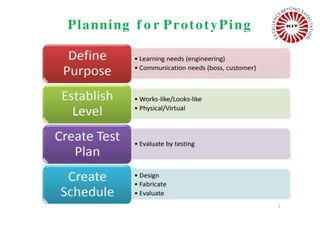
    Planning f or PrototyPing 2
  • 25.
    Key D atesf o r PrototyPe 3
  • 26.
  • 27.
    Planning Milestones PrototyPes • The comprehensive prototypes a team uses as development benefit from additional planning • Planning the milestone dates is an integral part of establishing an overall product development project plan • As a base case, the team should consider using alpha, beta, and preproduction prototypes as milestones. • Additional early prototypes are common in situations where the product embodies a new concept or technology. These early prototypes are sometimes called experimental or engineering prototypes. 5
  • 28.
    a guide fo r students t o Plan their Prototypes • It is important that the studentsconsiderhow to include prototypes in the innovation process. • Prototypes should be tested-preferably severaltimes- during the innovationprocess and afterwards revised. • Besides this,the studentsshould developand test several differentprototypes that are able to “compete” with eachother during the test period. 6
  • 29.
    1 Unit - V- DESIGN FOR MANUFACTURING AND PRODUCT DEVELOPMENT Topic 6: : Economic Analysis OMF551 - Product Design and Development
  • 30.
    Economic Analysis Process 2 Werecommend the following four-step method for the economic analysis of a product-development project: 1. Build a base-case financial model. 2. Perform a sensitivity analysis to understand the relationships between financial success and the key assumptions and variables of the model. 3. Use the sensitivity analysis to understand project trade-offs. 4. Consider the influence of the qualitative factors on project success.
  • 31.
    Step 1: Builda Base-Case Financial Model 3 The most basic categories of cash flow for a typical new product development project are: • Development cost (all remaining design, testing, and refinement costs up to production ramp-up). • Ramp-up cost. • Marketing and support cost. • Production cost. • Sales revenues.
  • 32.
    4 Step 2: Builda Base-Case Financial Model
  • 33.
    5 Step 3: UseSensitivity Analysis to Understand Project Trade-Offs • Six Potential Interactions
  • 34.
    6 Step 4: Considerthe Influence of the Qualitative Factors on Project Success Projects Interact with the Firm, the Market, and the Macro Environment • Interactions between the Project and the Firm as a Whole • Interactions between the Project and the Market • Interactions between the Project and the Macro Environment
  • 35.
    1 Unit - V- DESIGN FOR MANUFACTURING AND PRODUCT DEVELOPMENT Topic 7: Understanding and Representing Tasks OMF551 - Product Design and Development
  • 36.
    2 Three ways torepresent the tasks in a project, i,.e. fundamental characteristics of interacting tasks—the “basic physics” of projects i. Sequential ii. Parallel iii. Coupled Tasks Three ways to represent the tasks in a project
  • 37.
    3 1. Sequential Three waysto represent the tasks in a project
  • 38.
    4 2. Parallel Three waysto represent the tasks in a project
  • 39.
    Three ways torepresent the tasks in a project 5 3. Coupled Tasks
  • 40.
    6 Design Structure Matrix(DSM) • tool for representing and analyzing task dependencies is the design structure matrix (DSM).
  • 41.
    7 GANTT CHART • Thetraditional tool for representing the timing of tasks is the Gantt chart
  • 42.
    8 PERT CHART The CriticalPath : • The dependencies among the tasks in a PERT chart, • arranged sequentially OR in parallel, • lead to the concept of a critical path. • The critical path is the longest chain of dependent events
  • 43.
    1 Unit - V- DESIGN FOR MANUFACTURING AND PRODUCT DEVELOPMENT Topic 8: Baseline Project Planning OMF551 - Product Design and Development
  • 44.
    2 i. The projectplan is the roadmap for the remaining development effort. ii. in coordinating the remaining tasks and iii. in estimating the required development resources and development time iv. baseline project plan v. The results of the concept development phase plus the project plan make up the contract book. Baseline Project Planning
  • 45.
    3 i. The ContractBook • document represents an agreement between the development team and the senior management of the company • about project goals, direction, and resource requirements. Baseline Project Planning
  • 46.
    4 Baseline Project Planning TheContract Book / Project Task List
  • 47.
    5 Baseline Project Planning TeamStaffing and Organization 1. There are 10 or fewer members of the team. 2. Members volunteer to serve on the team. 3. Members serve on the team from the time of concept development until product launch. 4. Members are assigned to the team full-time. 5. Members report directly to the team leader. 6. The key functions, including at least marketing, design, and manufacturing, are on the team. 7. Members are located within conversational distance of each other.
  • 48.
    6 Baseline Project Planning ProjectSchedule 1. The project schedule is the merger of the project tasks and the project time line. 2. The schedule identifies when major project milestones are expected to occur and when each project task is expected to begin and end.
  • 49.
  • 50.
    8 Baseline Project Planning ProjectRisk Plan Modifying the Baseline Plan
  • 51.
    1 Unit - V- DESIGN FOR MANUFACTURING AND PRODUCT DEVELOPMENT Topic 9: : Accelerating the Project and Project Execution OMF551 - Product Design and Development
  • 52.
    Accelerating Projects 2 1. Startthe project early 2. Manage the project scope 3. Facilitate the exchange of essential information 4. Complete individual tasks on the critical path more quickly 5. Aggregate safety times 6. Eliminate some critical path tasks entirely 7. Eliminate waiting delays for critical path resources 8. Overlap selected critical tasks
  • 53.
    Accelerating Projects 3 9. Pipelinelarge tasks 10.Outsource some tasks 11.Perform more iterations quickly 12.Decouple tasks to avoid iterations 13.Consider sets of solutions
  • 54.
    Project Execution 4 Coordination Mechanisms: i.Informal communication ii. Meetings iii. Schedule display iv. Weekly updates v. Incentives vi. Process documents
  • 55.
    Assessing Project Status whetheras per schedule or not 5 i. Changing the timing or frequency of meetings ii. Changing the project staff iii. Locating the team together physically iv. Soliciting more time and effort from the team v. Focusing more effort on the critical tasks vi. Engaging outside resources vii. Changing the project scope or schedule Corrective Actions