Mike Shipulski, Ph.D. Director of Engineering Hypertherm, Inc. Systematic DFMA Deployment, it just Could Resurrect US Manufacturing
We have lost our way Working definitions The savings The problems The learning Systematic DFMA Deployment Comparison with other systematic methodologies Lean, Six Sigma, DFSS Quadrants of DFMA Deployment Five Milestones of DFMA Deployment Process (M1-M5) Big Finish Outline
We praised financial enterprises for driving economic growth knowing full well that moving and repackaging financial vehicles did not create sustainable growth All the while, manufacturing has taken it on the chin with: Astronomical job losses The thinnest capital investments And, most troubling, a general denigration of Manufacturing as an institution and profession We can resurrect Manufacturing with a back-to-basics approach to create sustainable economic growth. Manufacturing creates value when it combines raw materials and labor with thinking, which we call design, to create products that sell for more than the cost to make them, where Profit per part = Price – Cost  [1]   replacing Cost with Materials and Labor, eq. [1] becomes Profit per part = Price – (Materials + Labor).  [2] We have lost our way
Total profit is a function of the number of parts sold, so modifying eq. [2] for Volume Profit = [Price – (Materials + Labor)]  x  Volume. [3] The Market sets price and volume We are left only to with Materials and Labor to influence Profit. At the most basic level, we must reduce Materials and Labor to increase Profit. This is so important it must be written as a formula: Increased Profits in Manufacturing result from reduced  Materials and Labor costs .  [4] How do we use the simple fundamentals of eq. [4] to resurrect US Manufacturing? I propose we must change our designs to design out Material and Labor costs using Systematic DFMA Deployment. We have lost our way
Working Definitions Working Definition 1. Design for Manufacturing (DFM) A methodology to change a design to reduce the cost of making parts while retaining product function. Working Definition 2. Design for Assembly (DFA) A methodology to change a design by eliminating parts to reduce the cost of putting things together while retaining product function. Both definitions include: 1. Change the design 2. Retaining product function 3. Reduce the cost
Part-by-part and feature-by-feature reduction of costs Hard work is required Part count reduction of 20 – 50% Labor time reduction of 20 – 60% Cost savings of 20 – 50% Savings achieved in all types of industries High volumes, low volumes High tech, low tech Big ones, little ones Savings are possible with all types Downstream savings are significant The Savings
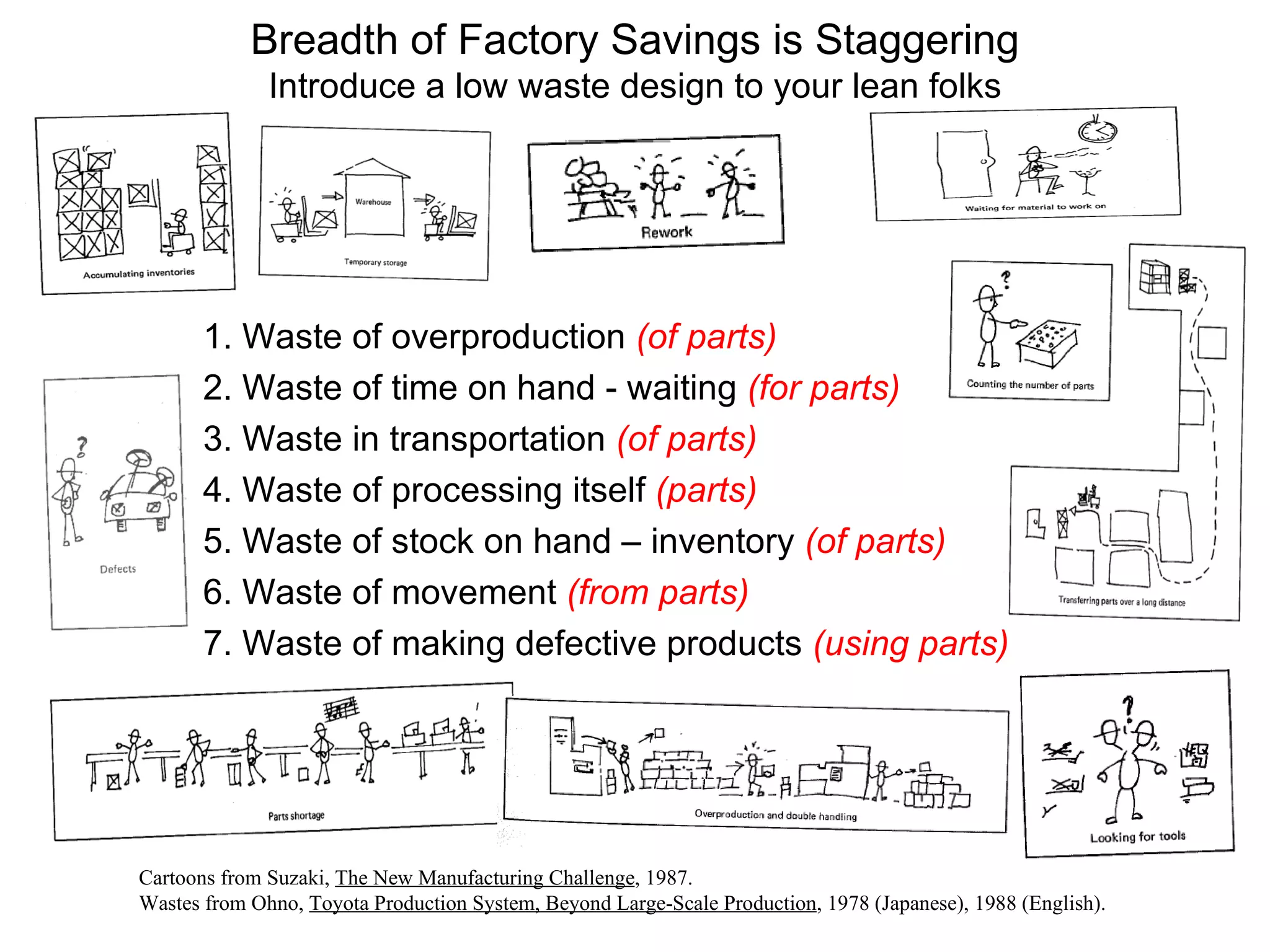
1. Waste of overproduction  (of parts) 2. Waste of time on hand - waiting  (for parts) 3. Waste in transportation  (of parts) 4. Waste of processing itself  (parts)   5. Waste of stock on hand – inventory  (of parts) 6. Waste of movement  (from parts) 7. Waste of making defective products  (using parts) Cartoons from Suzaki,  The New Manufacturing Challenge , 1987. Wastes from Ohno,  Toyota Production System, Beyond Large-Scale Production , 1978 (Japanese), 1988 (English). Breadth of Factory Savings is Staggering Introduce a low waste design to your lean folks
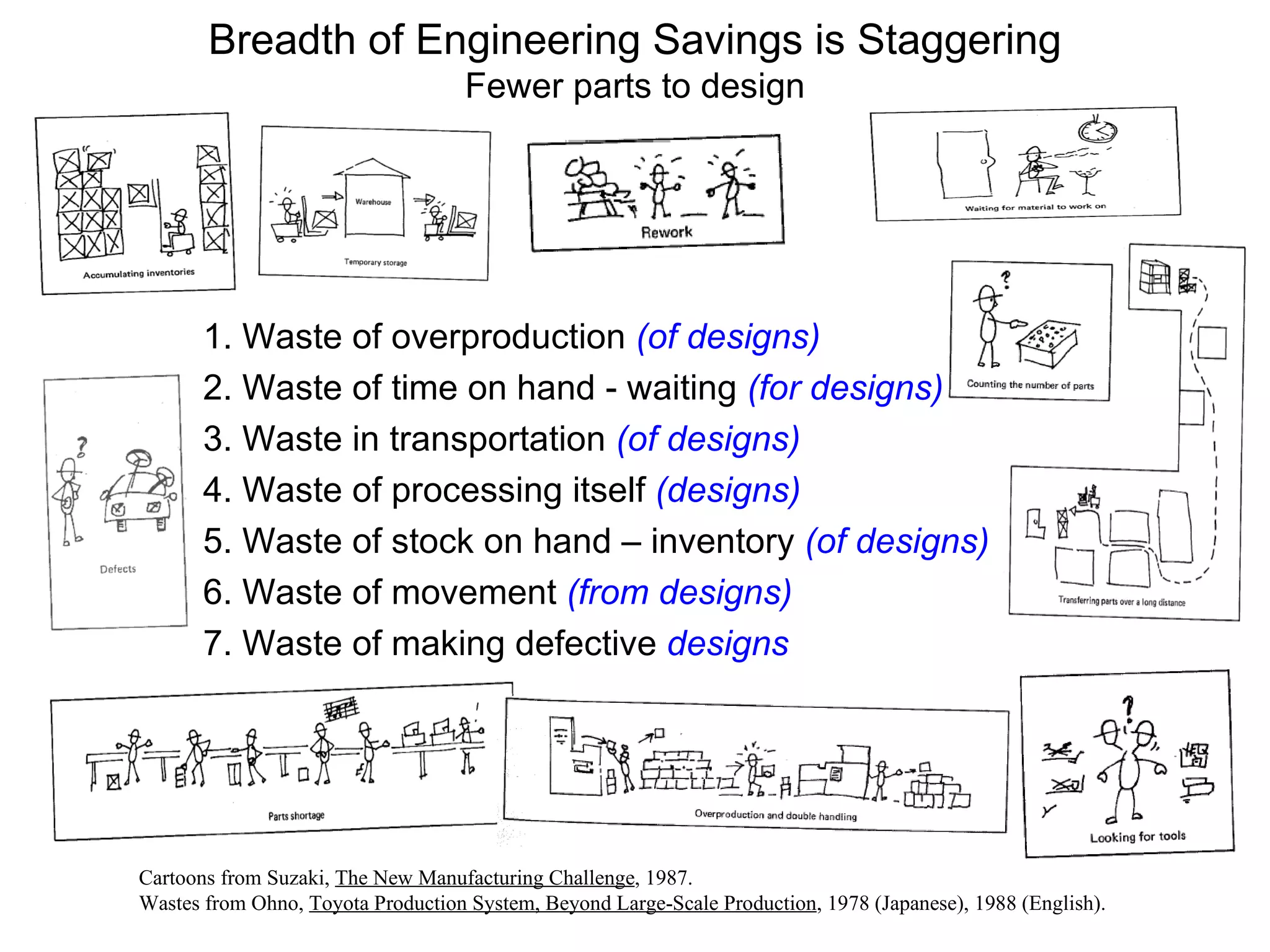
1. Waste of overproduction  (of designs) 2. Waste of time on hand - waiting  (for designs) 3. Waste in transportation  (of designs) 4. Waste of processing itself  (designs)   5. Waste of stock on hand – inventory  (of designs) 6. Waste of movement  (from designs) 7. Waste of making defective  designs Cartoons from Suzaki,  The New Manufacturing Challenge , 1987. Wastes from Ohno,  Toyota Production System, Beyond Large-Scale Production , 1978 (Japanese), 1988 (English). Breadth of Engineering Savings is Staggering Fewer parts to design
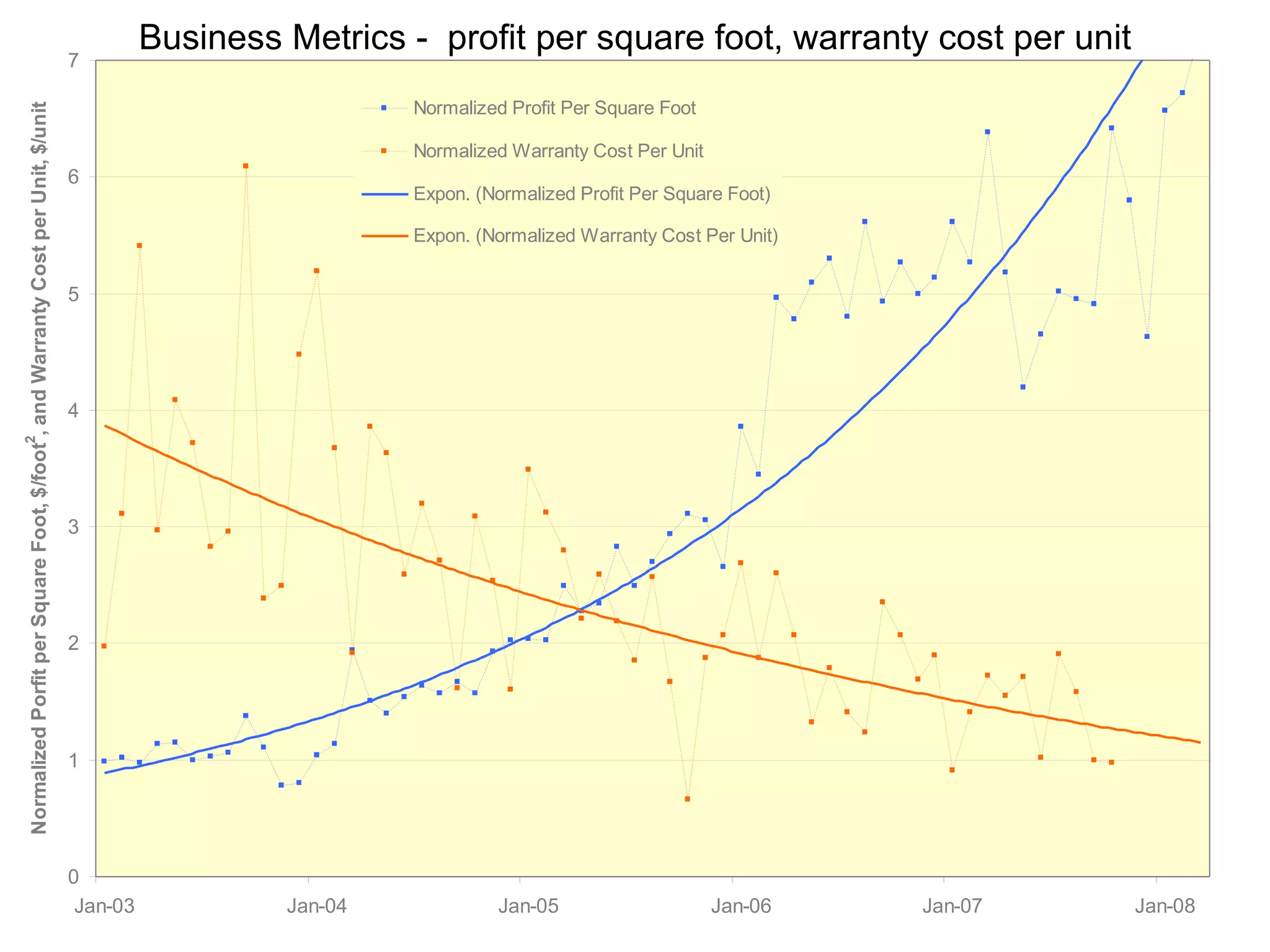
Business Metrics -  profit per square foot, warranty cost per unit
The significance of the savings are a problem – most don’t believe Companies don’t know how to start Companies don’t realize full savings Narrow implementation (e.g., one sub-assembly) Low DFMA deployment factor, D Poor implementation Projects run out of Manufacturing or Purchasing Poor project selection DFM at the expense of DFA Poor organizational roles and responsibilities Project resources unallocated Companies don’t know how to put all the pieces in place It’s more than just DFMA tools Infrastructure, organization, business processes, tools The Problems
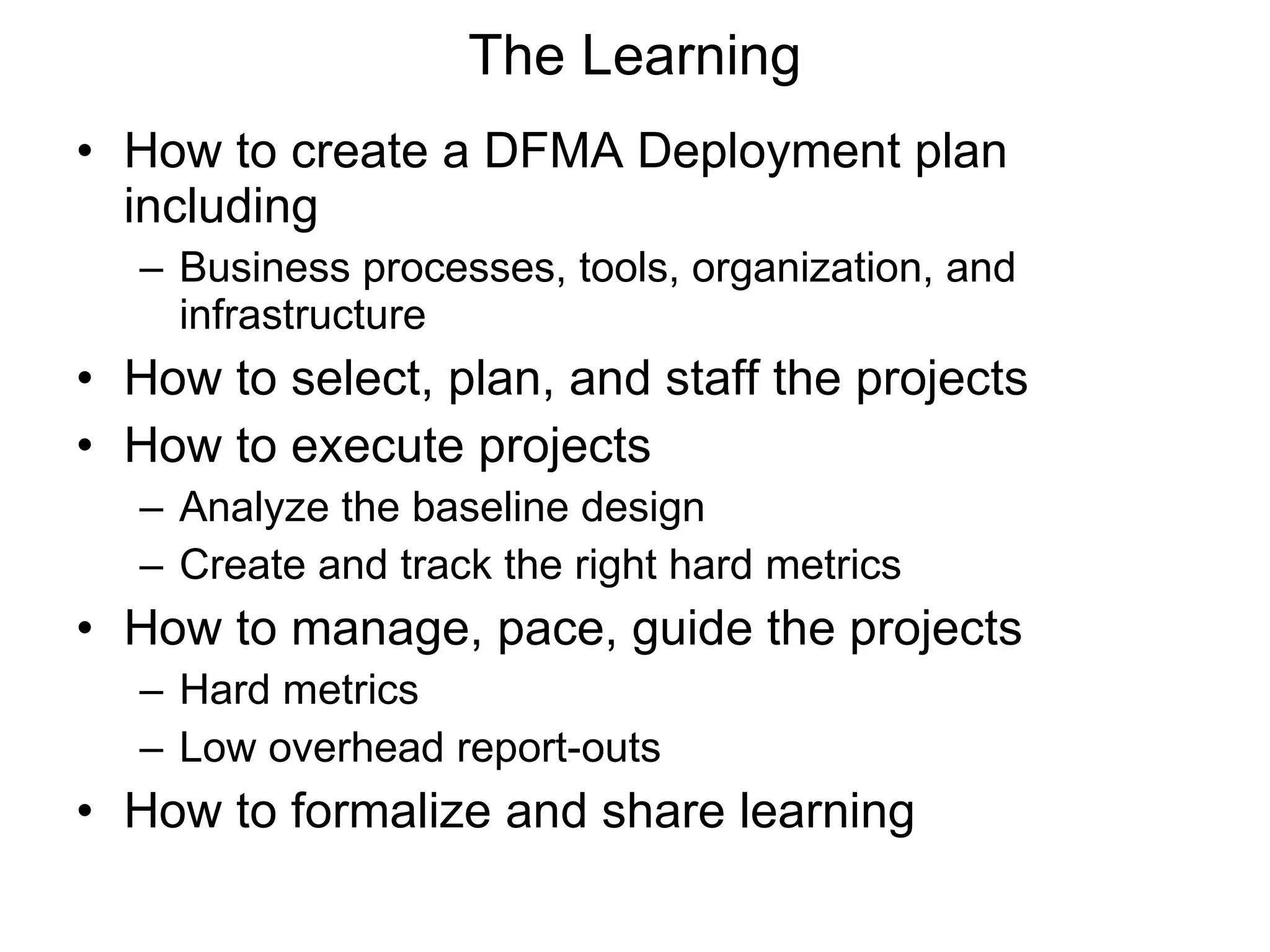
The Learning How to create a DFMA Deployment plan including Business processes, tools, organization, and infrastructure How to select, plan, and staff the projects How to execute projects Analyze the baseline design Create and track the right hard metrics How to manage, pace, guide the projects Hard metrics Low overhead report-outs How to formalize and share learning
Systematic DFMA Deployment What is it? How to do it?
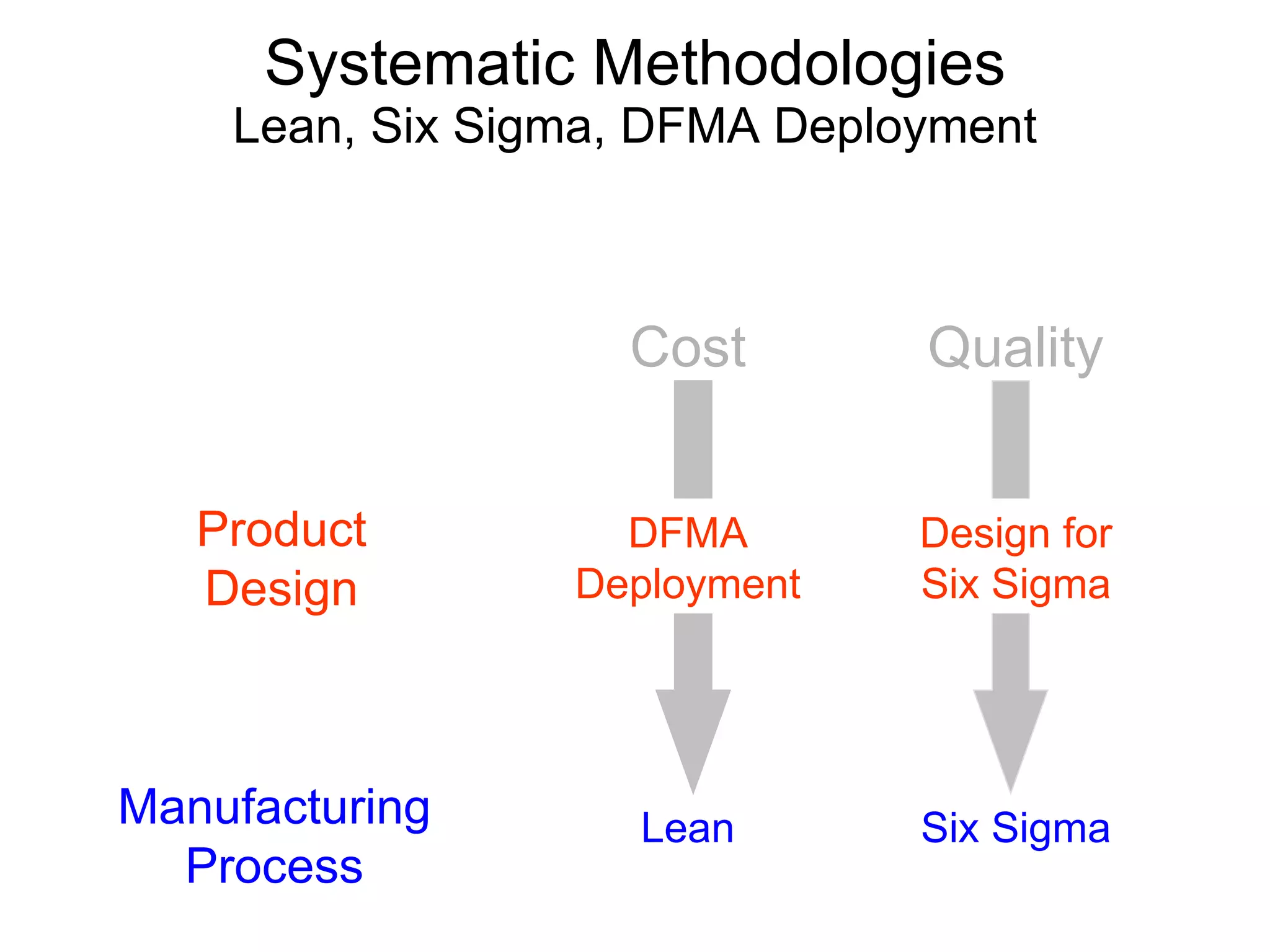
Systematic Methodologies Lean, Six Sigma, DFMA Deployment Lean Six Sigma Design for Six Sigma DFMA Deployment Cost Quality Manufacturing Process Product Design
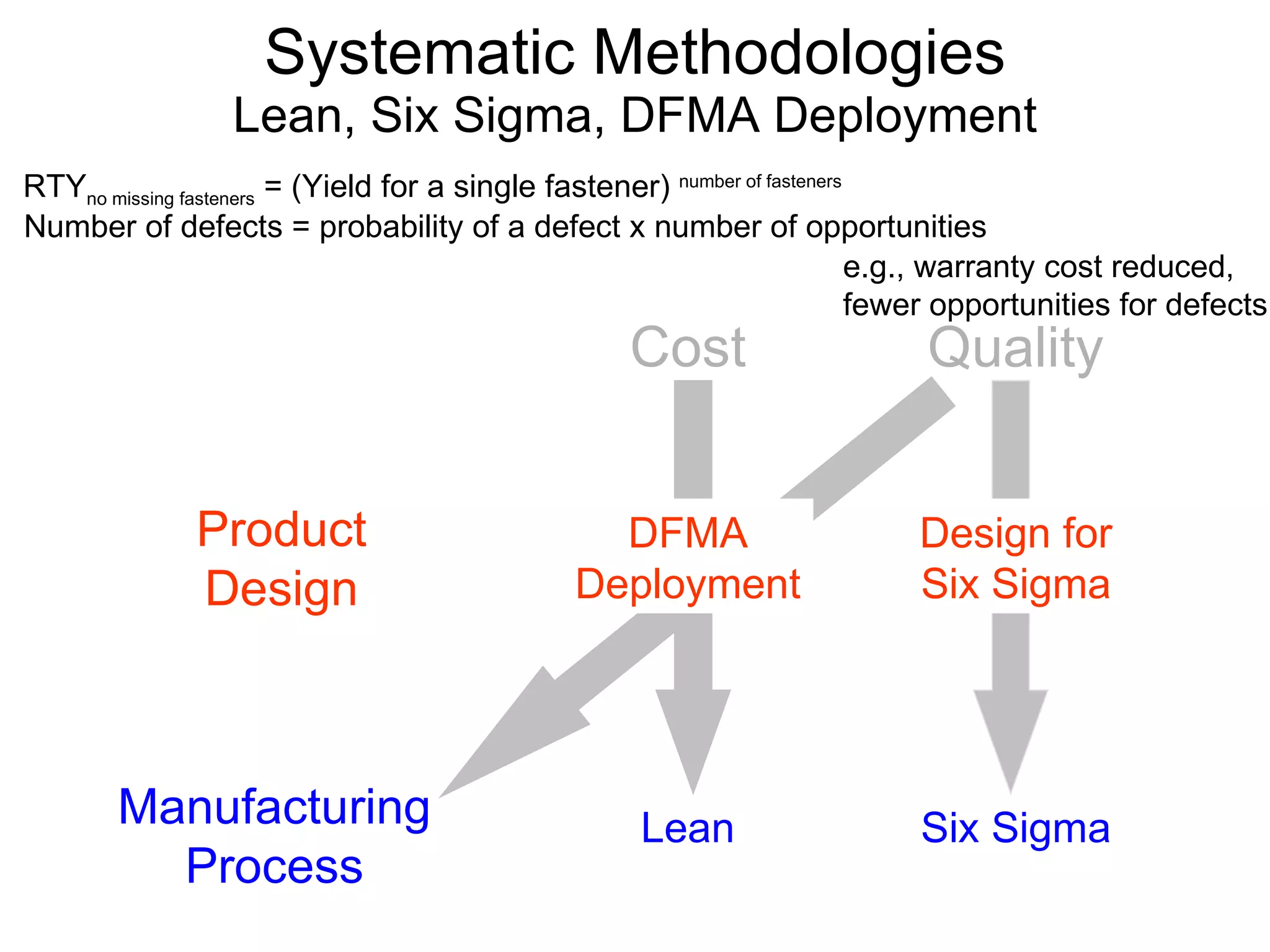
Systematic Methodologies Lean, Six Sigma, DFMA Deployment Lean Six Sigma Design for Six Sigma DFMA Deployment Cost Quality Manufacturing Process Product Design e.g., warranty cost reduced, fewer opportunities for defects RTY no missing fasteners  = (Yield for a single fastener)  number of fasteners Number of defects = probability of a defect x number of opportunities
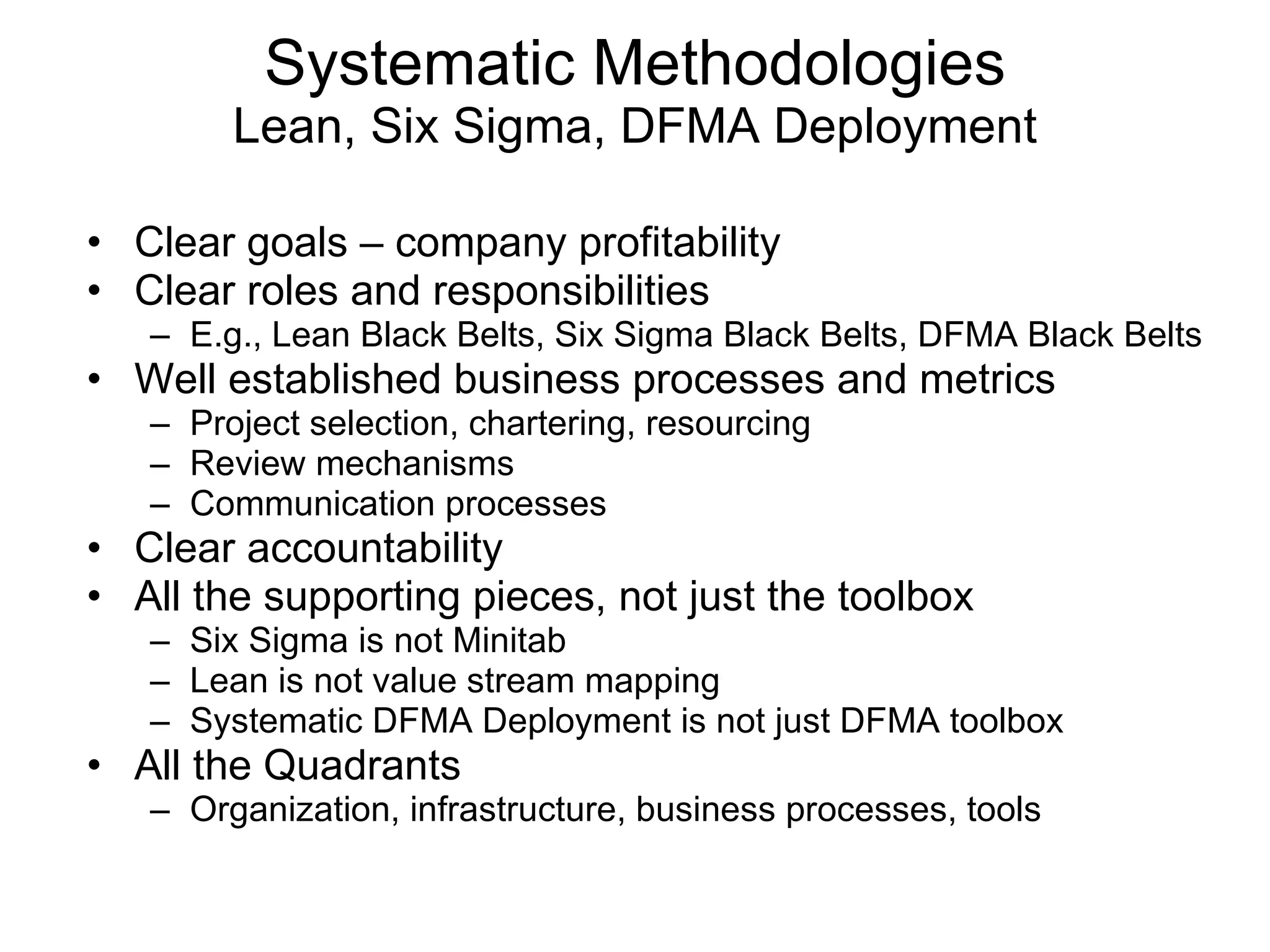
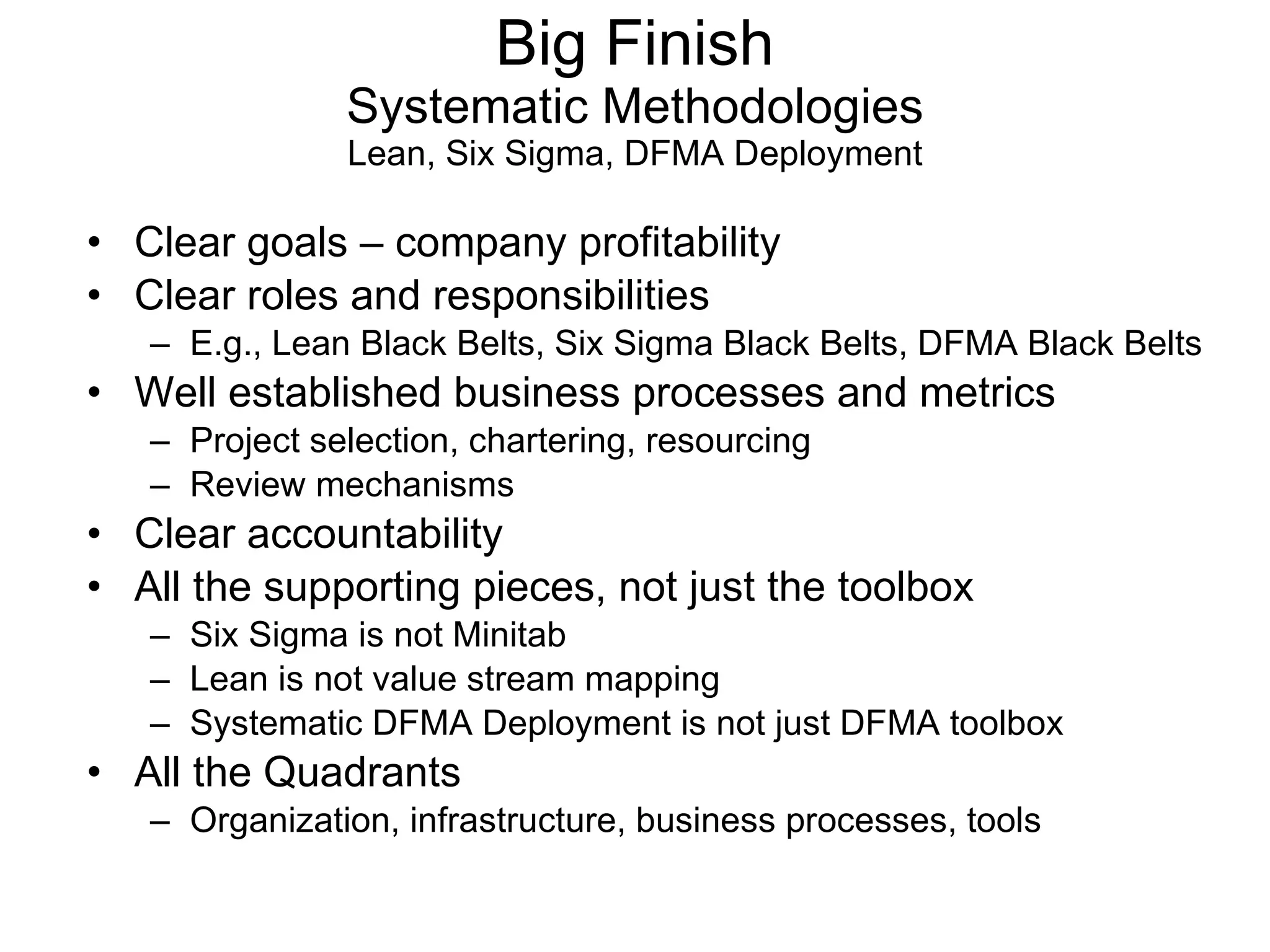
Clear goals – company profitability Clear roles and responsibilities E.g., Lean Black Belts, Six Sigma Black Belts, DFMA Black Belts Well established business processes and metrics Project selection, chartering, resourcing Review mechanisms Communication processes Clear accountability All the supporting pieces, not just the toolbox Six Sigma is not Minitab Lean is not value stream mapping Systematic DFMA Deployment is not just DFMA toolbox All the Quadrants Organization, infrastructure, business processes, tools Systematic Methodologies Lean, Six Sigma, DFMA Deployment
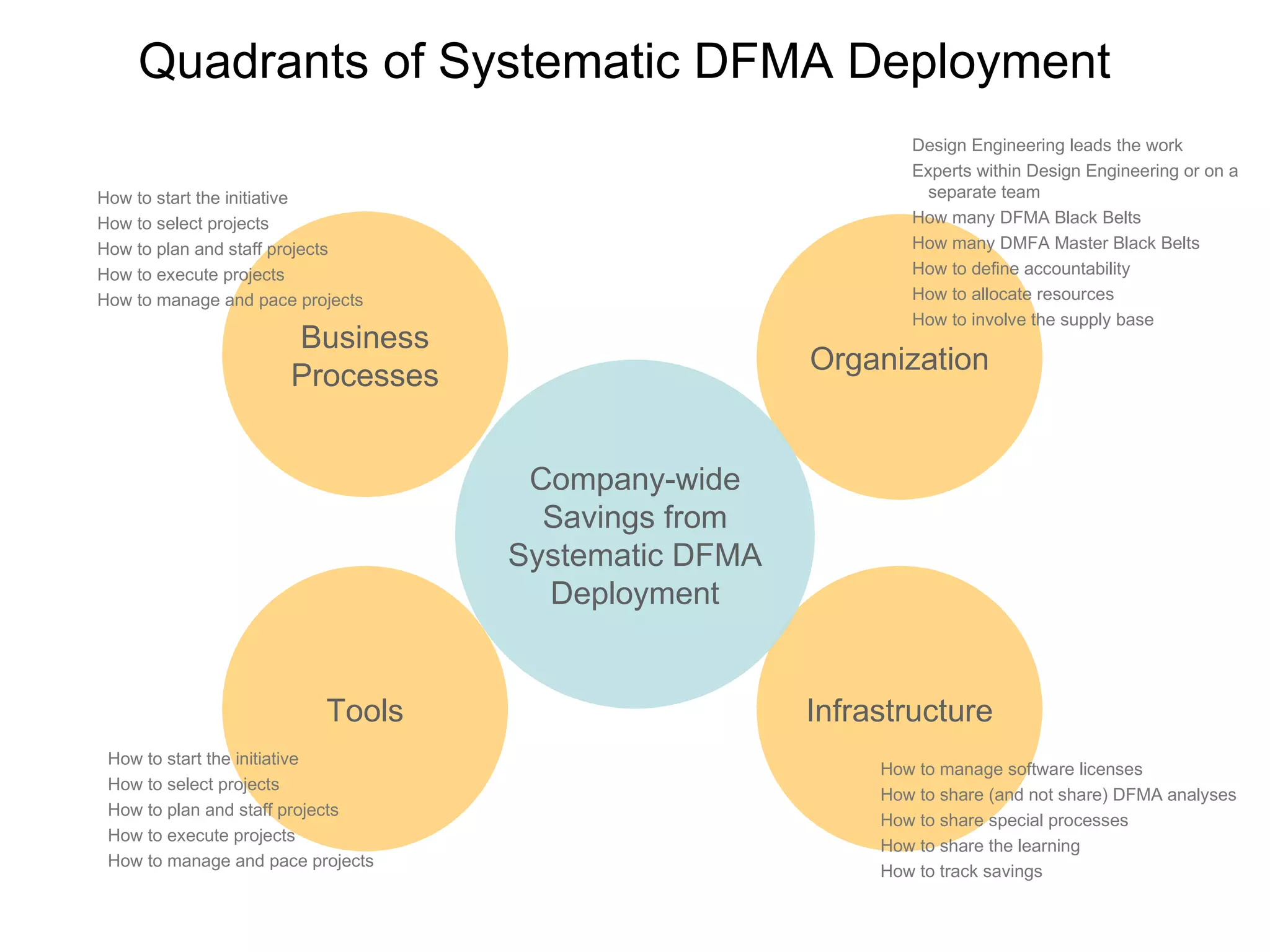
Organization Infrastructure Tools Company-wide Savings from Systematic DFMA Deployment Business Processes Quadrants of Systematic DFMA Deployment Design Engineering leads the work Experts within Design Engineering or on a separate team How many DFMA Black Belts How many DMFA Master Black Belts How to define accountability How to allocate resources How to involve the supply base How to start the initiative How to select projects How to plan and staff projects How to execute projects How to manage and pace projects How to manage software licenses How to share (and not share) DFMA analyses How to share special processes How to share the learning How to track savings How to start the initiative How to select projects How to plan and staff projects How to execute projects How to manage and pace projects
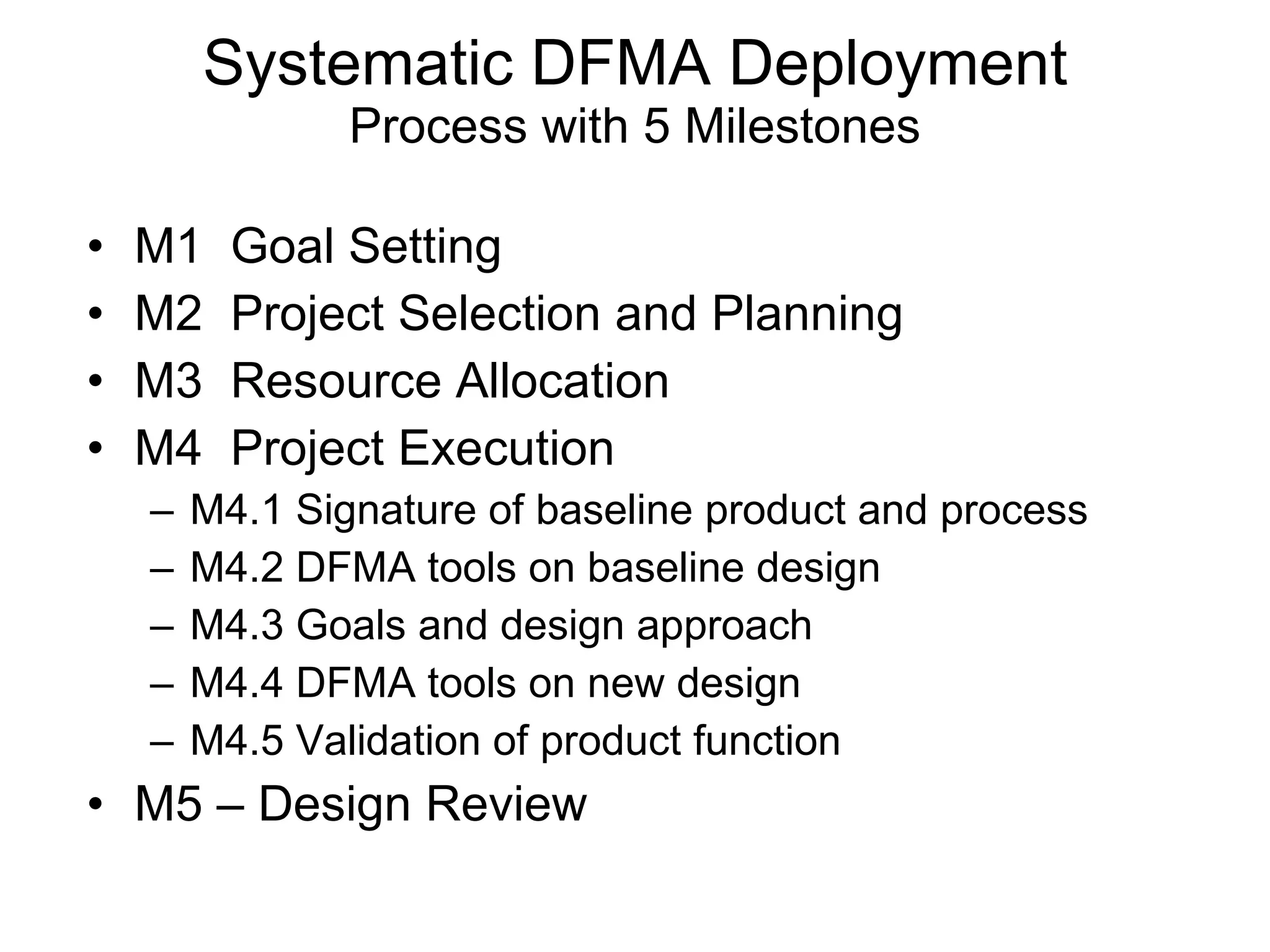
M1  Goal Setting M2  Project Selection and Planning M3  Resource Allocation M4  Project Execution M4.1 Signature of baseline product and process M4.2 DFMA tools on baseline design M4.3 Goals and design approach M4.4 DFMA tools on new design M4.5 Validation of product function M5 – Design Review Systematic DFMA Deployment Process with 5 Milestones
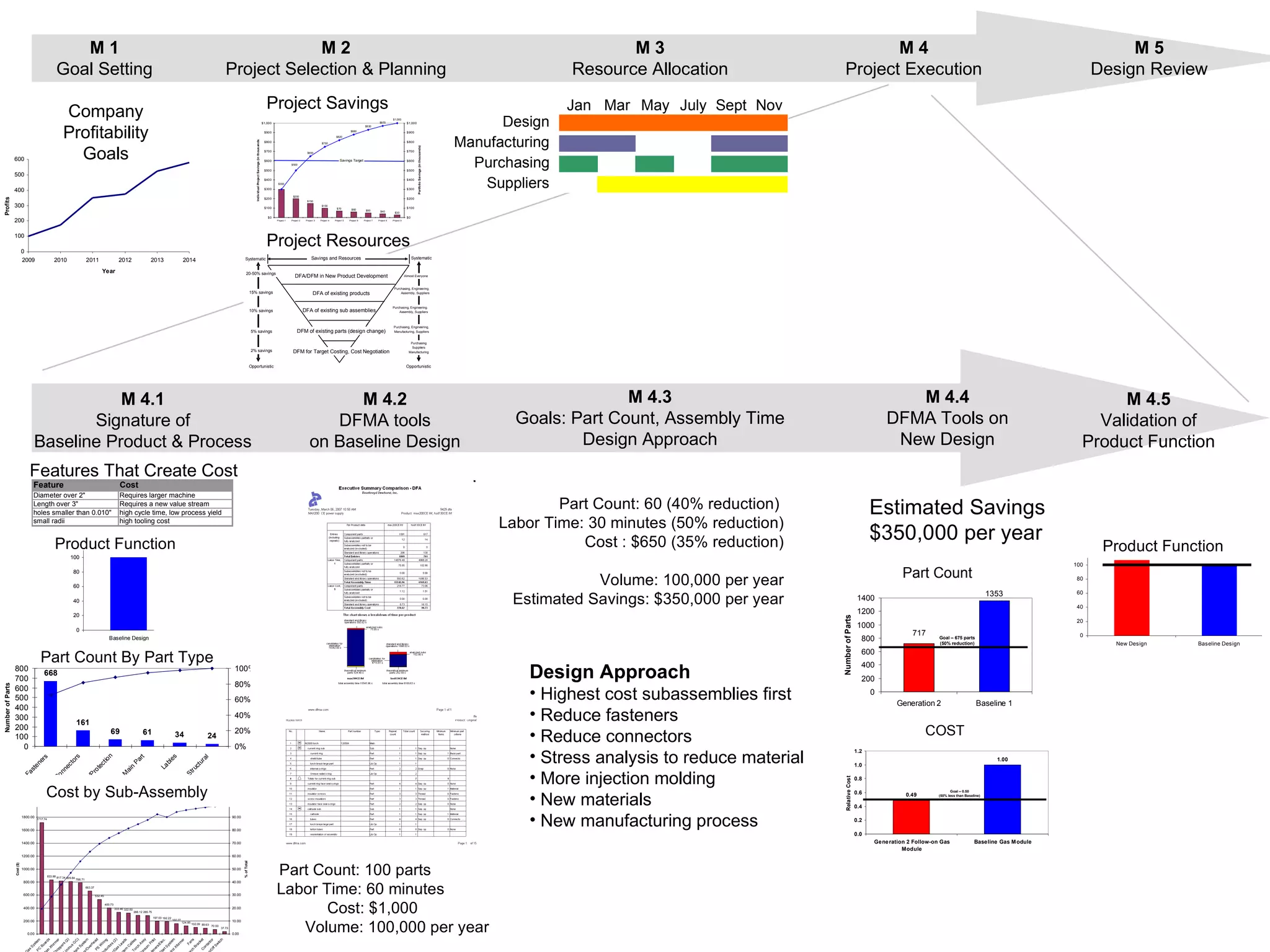
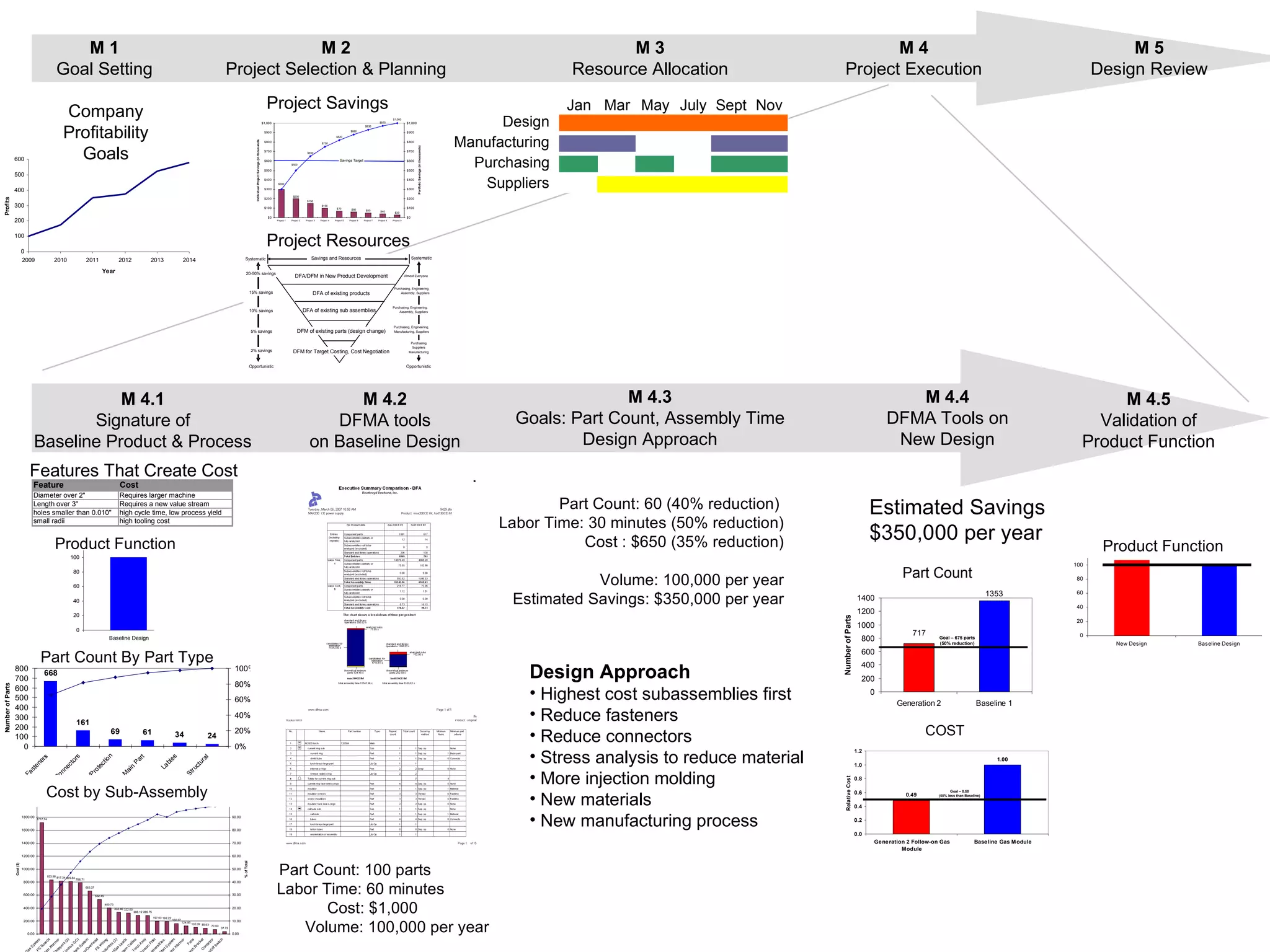
M 1 Goal Setting M 2 Project Selection & Planning M 3 Resource Allocation M 4 Project Execution M 5 Design Review M 4.1 Signature of Baseline Product & Process M 4.2 DFMA tools on Baseline Design M 4.3 Goals: Part Count, Assembly Time Design Approach Part Count: 60 (40% reduction)  Labor Time: 30 minutes (50% reduction) Cost : $650 (35% reduction) Volume: 100,000 per year Estimated Savings: $350,000 per year Part Count: 100 parts  Labor Time: 60 minutes  Cost: $1,000  Volume: 100,000 per year  Design Approach Highest cost subassemblies first Reduce fasteners Reduce connectors Stress analysis to reduce material More injection molding New materials New manufacturing process M 4.4 DFMA Tools on New Design M 4.5 Validation of Product Function Estimated Savings $350,000 per year Part Count By Part Type Cost by Sub-Assembly Product Function Non-Value Added Labor Parts, Labor Cost Project Savings Project Resources Company Profitability Goals Features That Create Cost Product Function
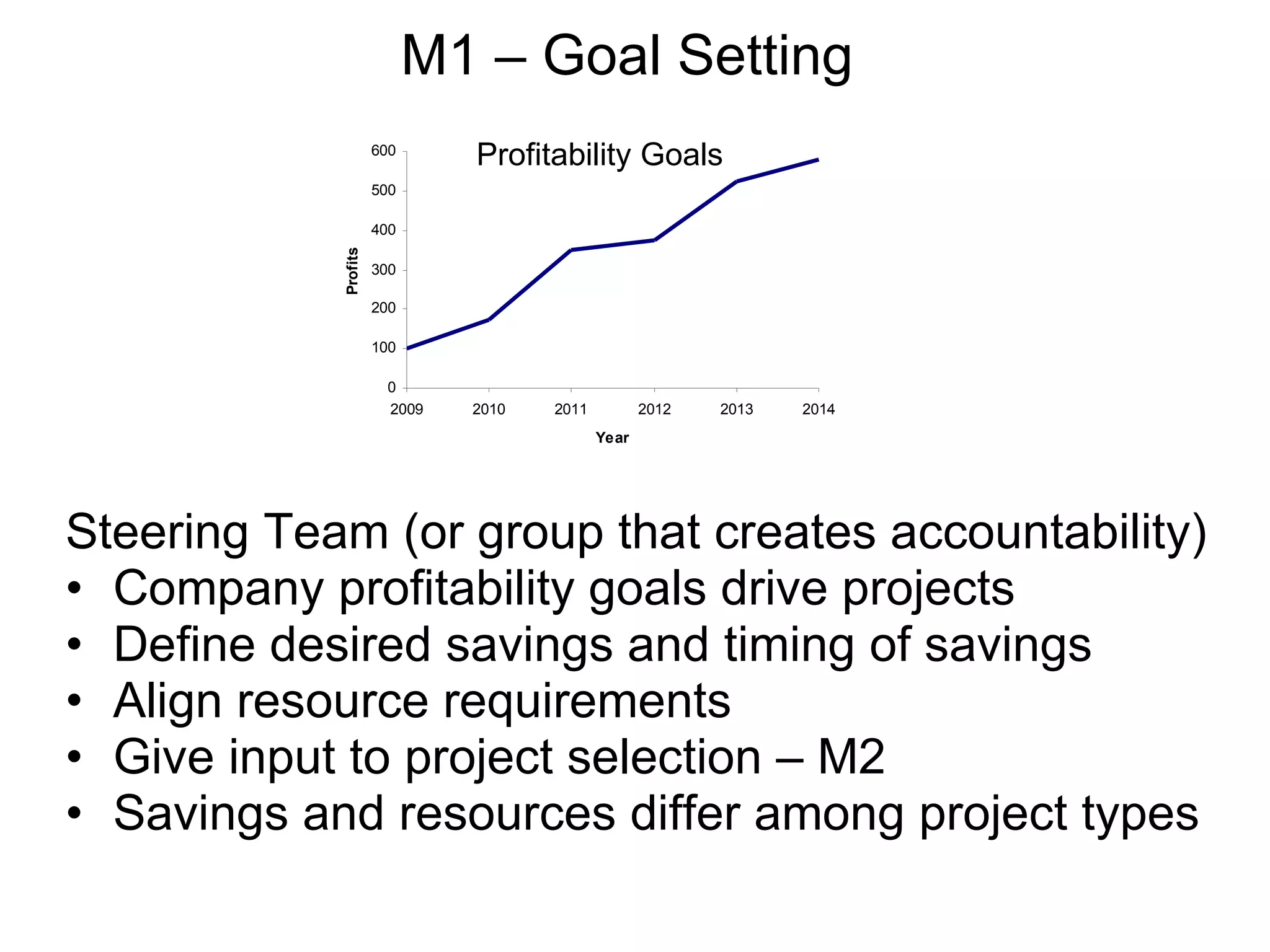
M1 – Goal Setting  Steering Team (or group that creates accountability) Company profitability goals drive projects Define desired savings and timing of savings Align resource requirements Give input to project selection – M2 Savings and resources differ among project types Profitability Goals
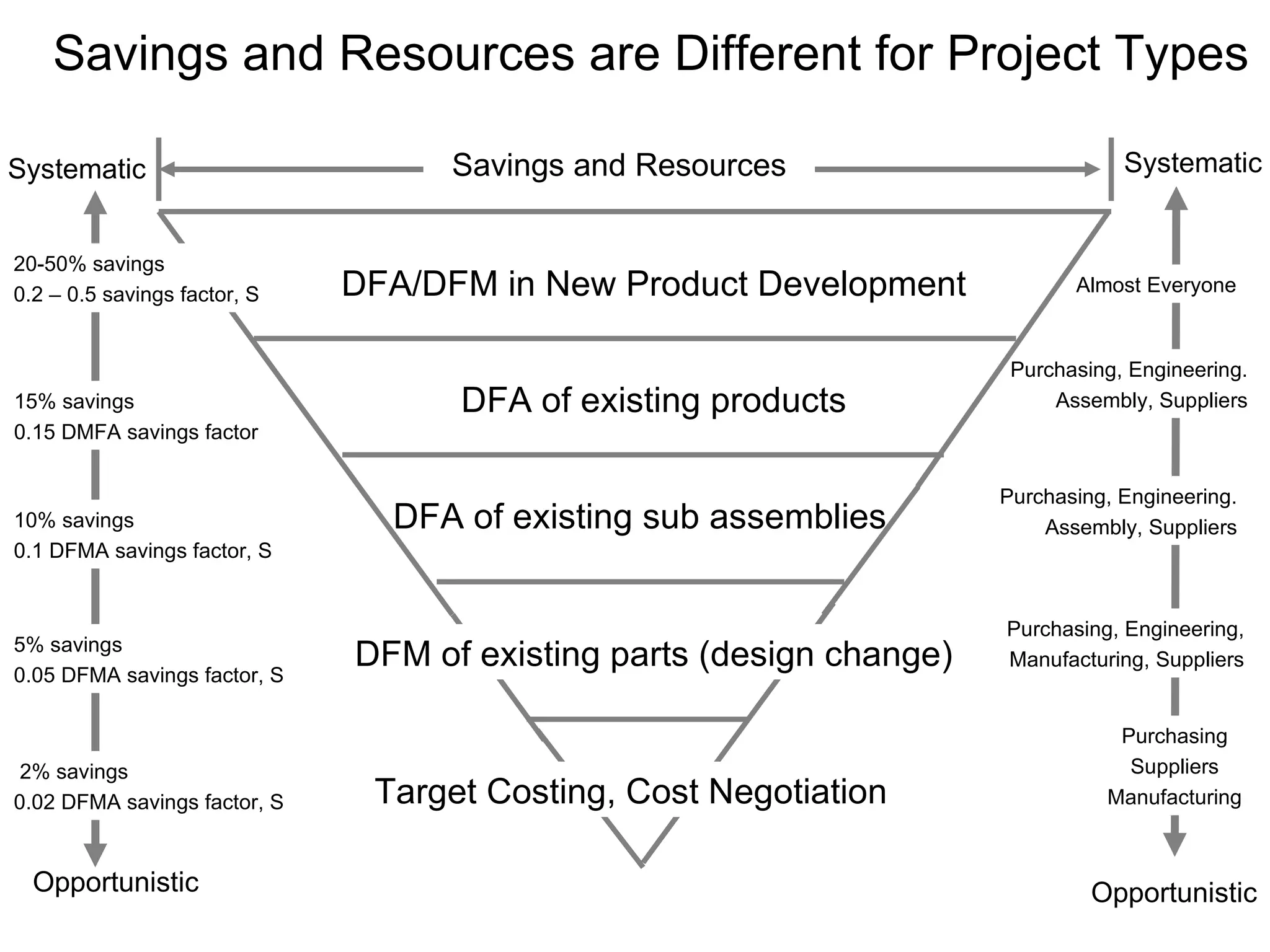
Savings and Resources are Different for Project Types DFA of existing sub assemblies DFA of existing products DFA/DFM in New Product Development 20-50% savings 0.2 – 0.5 savings factor, S Purchasing Suppliers Manufacturing 2% savings 0.02 DFMA savings factor, S 5% savings 0.05 DFMA savings factor, S 15% savings 0.15 DMFA savings factor 10% savings 0.1 DFMA savings factor, S Purchasing, Engineering, Manufacturing, Suppliers Purchasing, Engineering. Assembly, Suppliers Almost Everyone Purchasing, Engineering. Assembly, Suppliers Opportunistic Systematic Systematic Opportunistic Target Costing, Cost Negotiation DFM of existing parts (design change) Savings and Resources
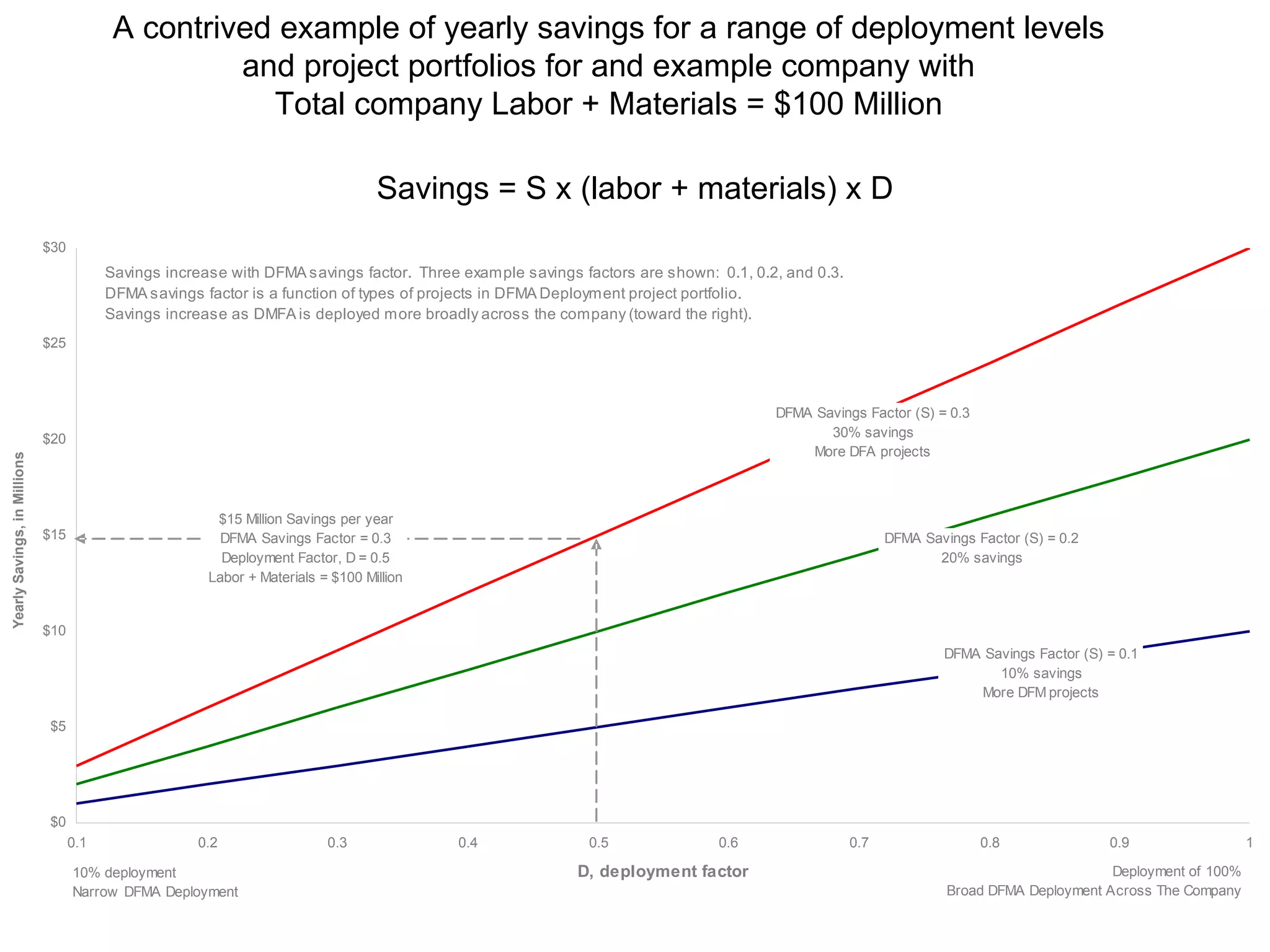
Savings = S x (labor + materials) x D A contrived example of yearly savings for a range of deployment levels and project portfolios for and example company with Total company Labor + Materials = $100 Million
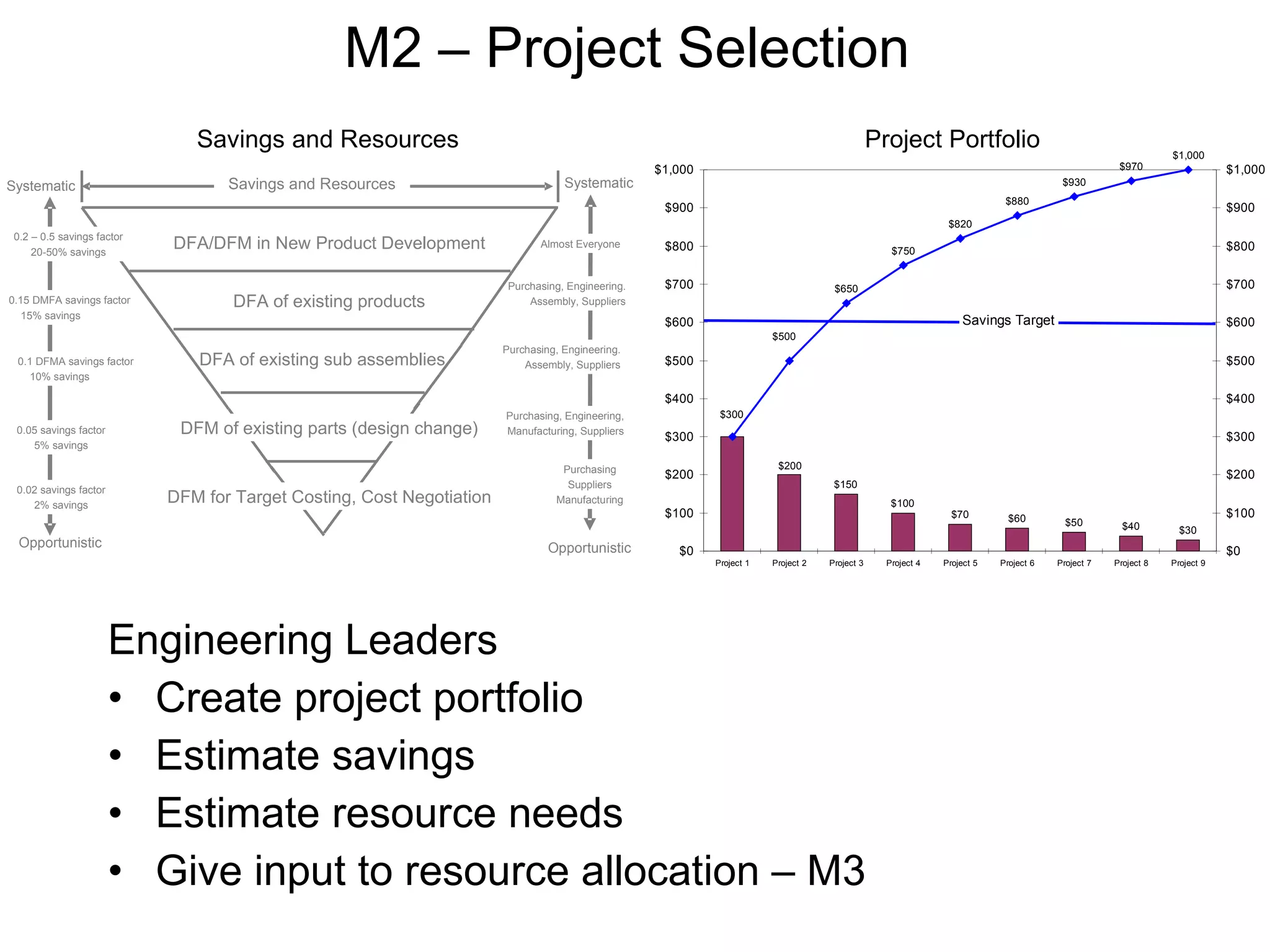
M2 – Project Selection  Engineering Leaders Create project portfolio Estimate savings Estimate resource needs Give input to resource allocation – M3 Savings and Resources Project Portfolio
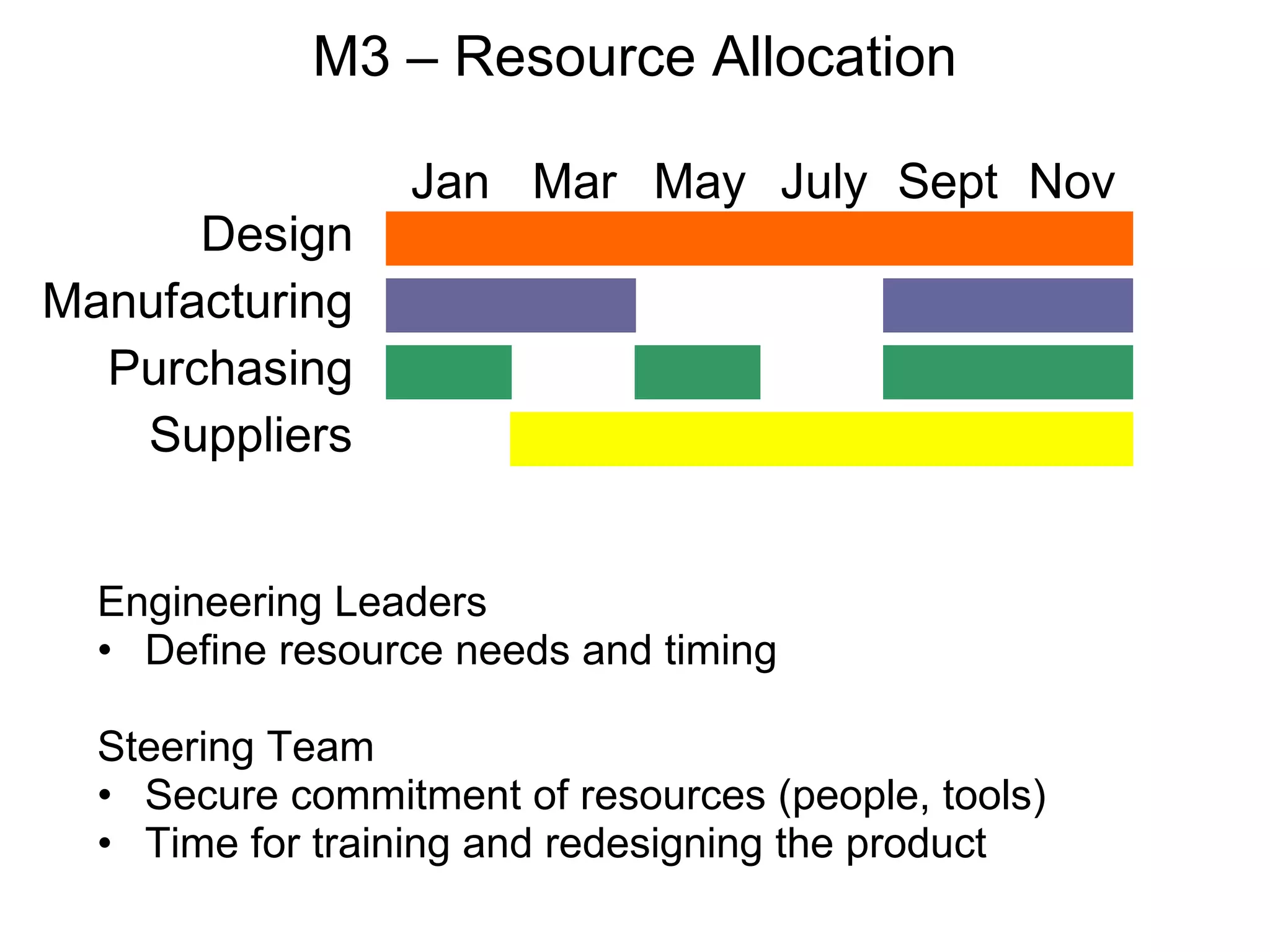
M3 – Resource Allocation Engineering Leaders Define resource needs and timing Steering Team Secure commitment of resources (people, tools) Time for training and redesigning the product
M4 - Project Execution The biggest phase M4.1 - Signature of baseline product  M4.2 - Evaluation of baseline product with DFMA tools M4.3 - Set formal goals: Part Count, Assembly Time, Cost M4.4 - Design new product, use DFMA tools new design M4.5 - Validation of product function
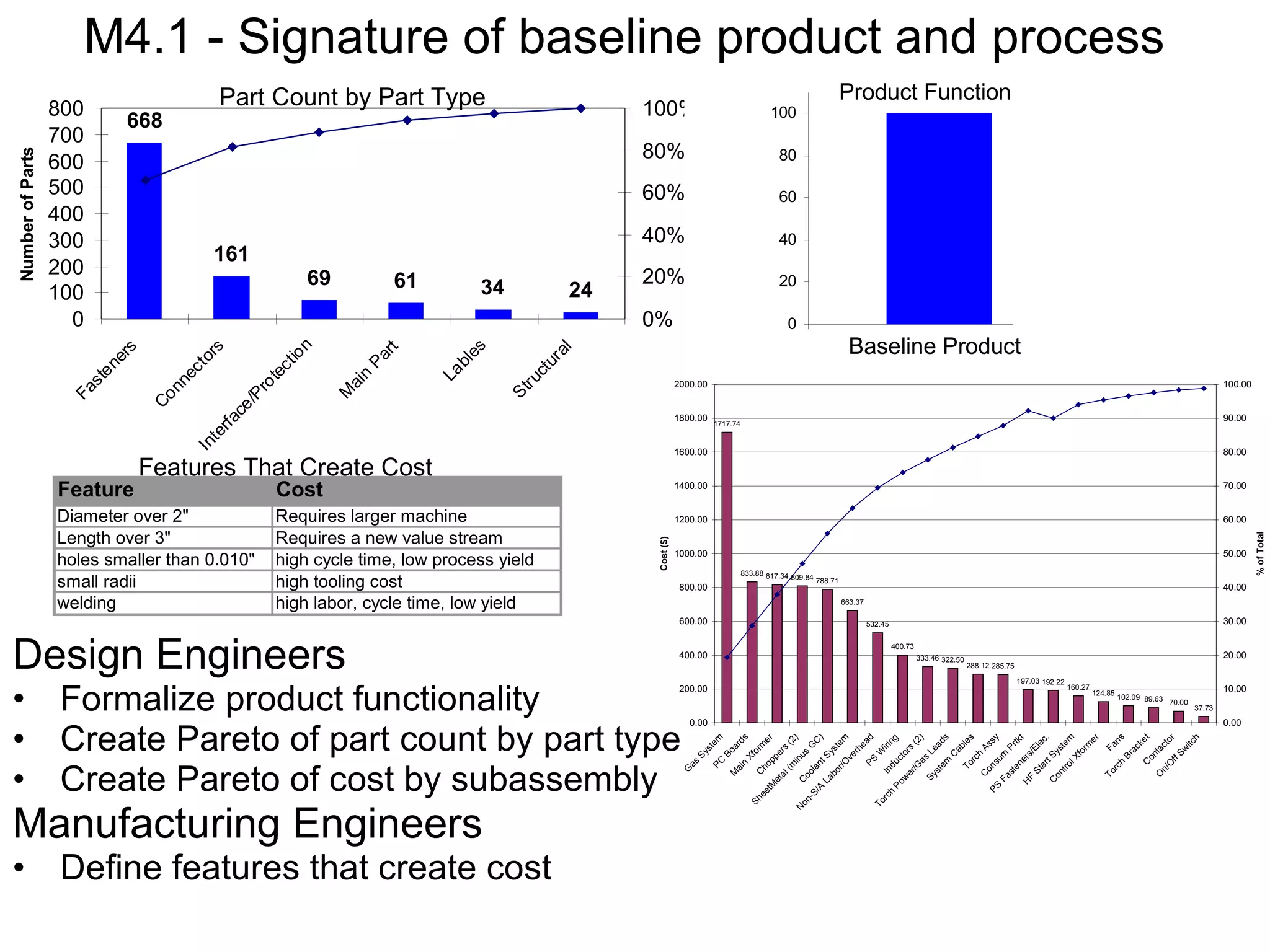
Design Engineers Formalize product functionality Create Pareto of part count by part type Create Pareto of cost by subassembly Manufacturing Engineers Define features that create cost M4.1 - Signature of baseline product and process   Part Count by Part Type Features That Create Cost
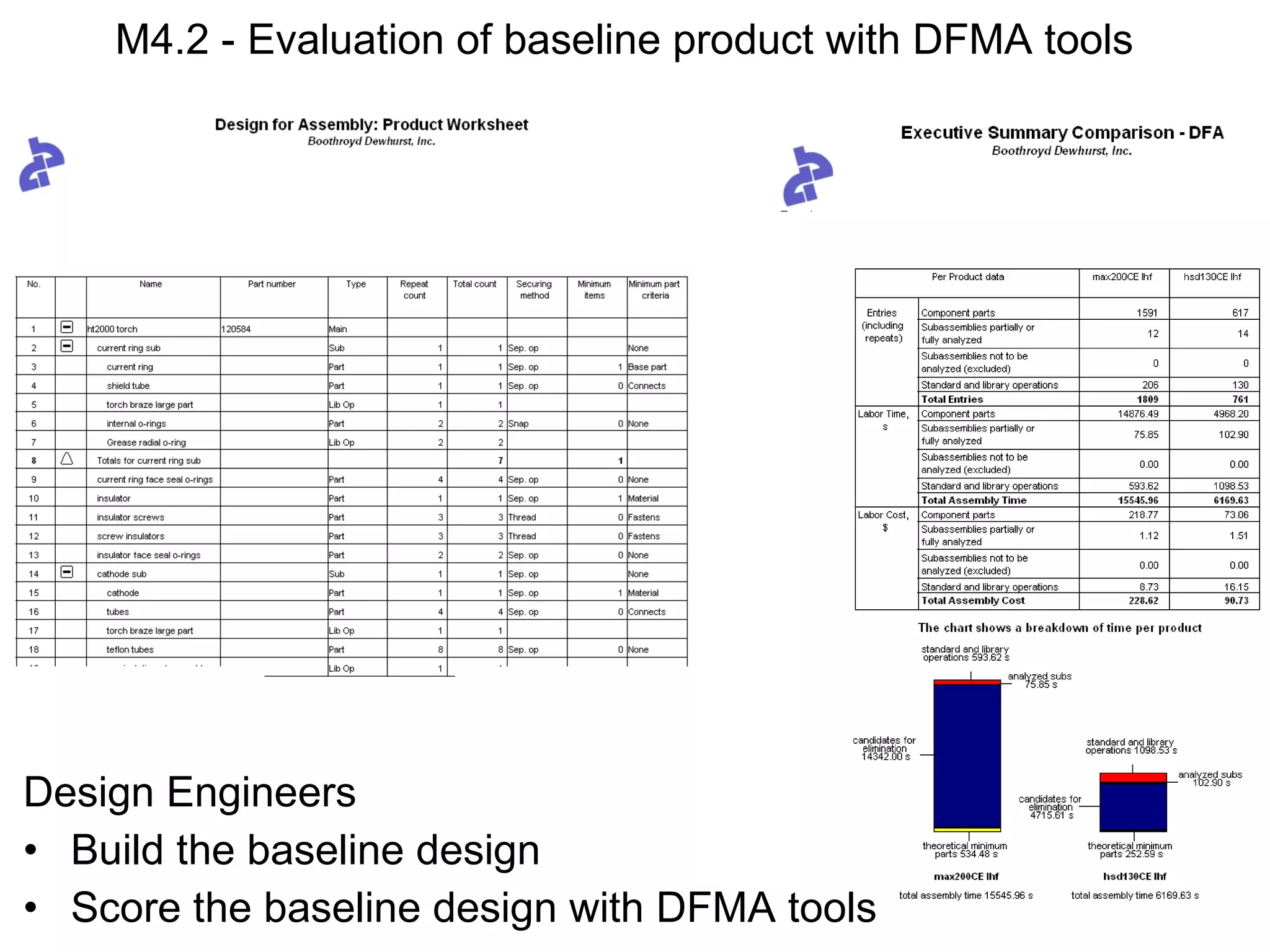
M4.2 - Evaluation of baseline product with DFMA tools Design Engineers Build the baseline design Score the baseline design with DFMA tools
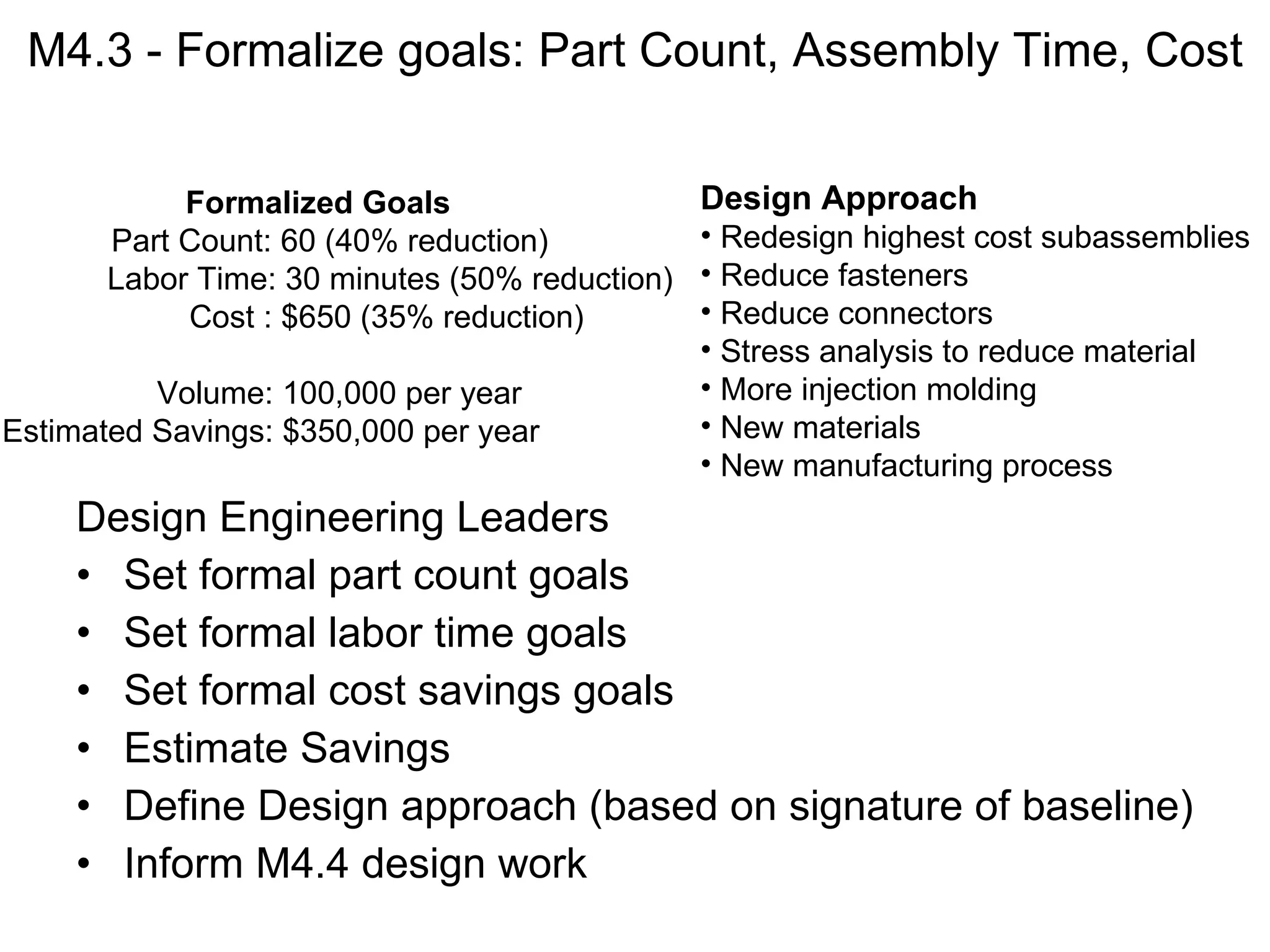
M4.3 - Formalize goals: Part Count, Assembly Time, Cost Design Engineering Leaders Set formal part count goals Set formal labor time goals Set formal cost savings goals Estimate Savings Define Design approach (based on signature of baseline) Inform M4.4 design work Formalized Goals  Part Count: 60 (40% reduction)  Labor Time: 30 minutes (50% reduction) Cost : $650 (35% reduction)  Volume: 100,000 per year  Estimated Savings: $350,000 per year   Design Approach Redesign highest cost subassemblies Reduce fasteners Reduce connectors Stress analysis to reduce material More injection molding New materials New manufacturing process
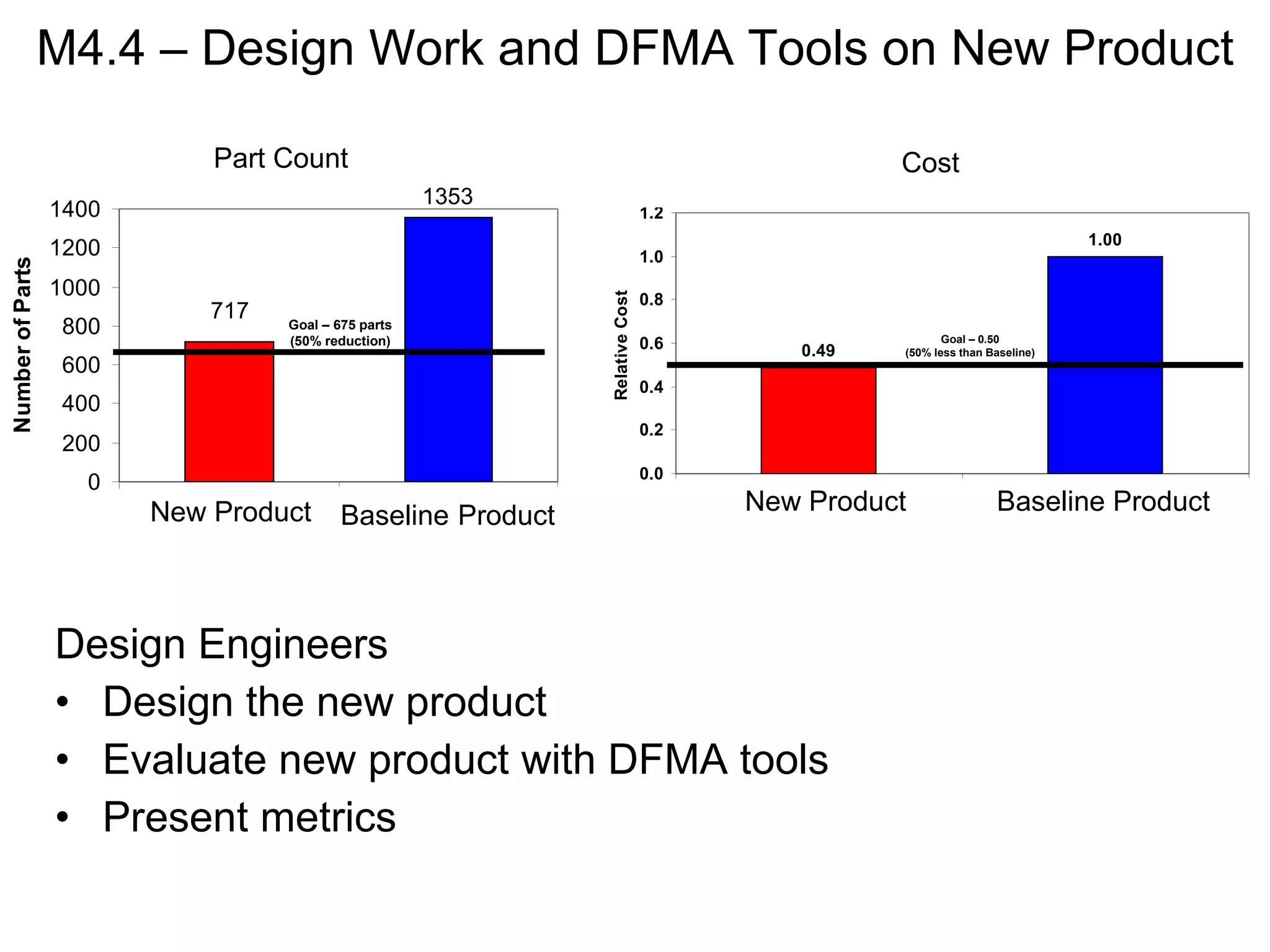
M4.4 – Design Work and DFMA Tools on New Product Design Engineers Design the new product Evaluate new product with DFMA tools Present metrics Baseline Product New Product New Product Baseline   Product Part Count Cost
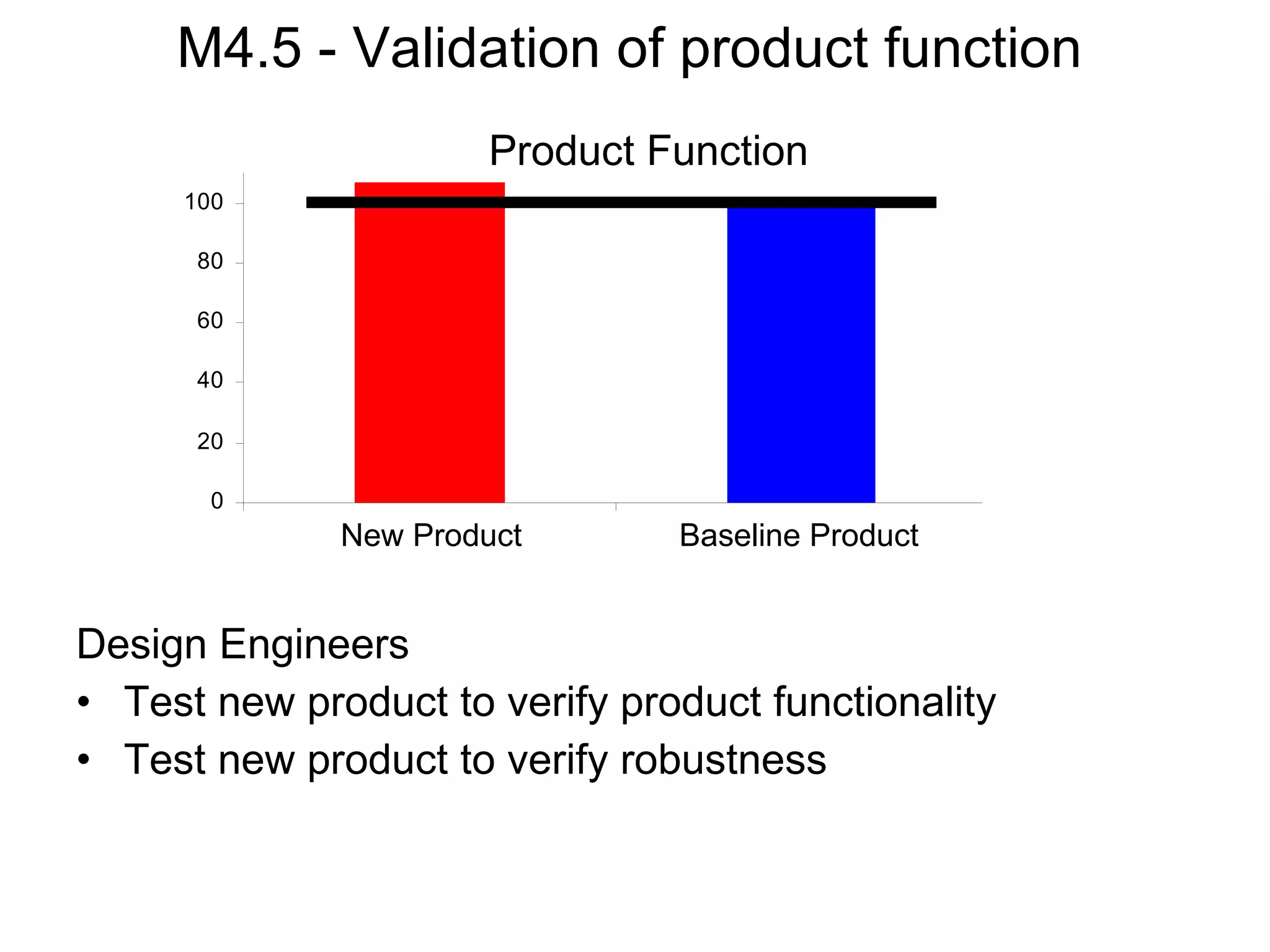
M4.5 - Validation of product function Design Engineers Test new product to verify product functionality Test new product to verify robustness Product Function Baseline Product New Product
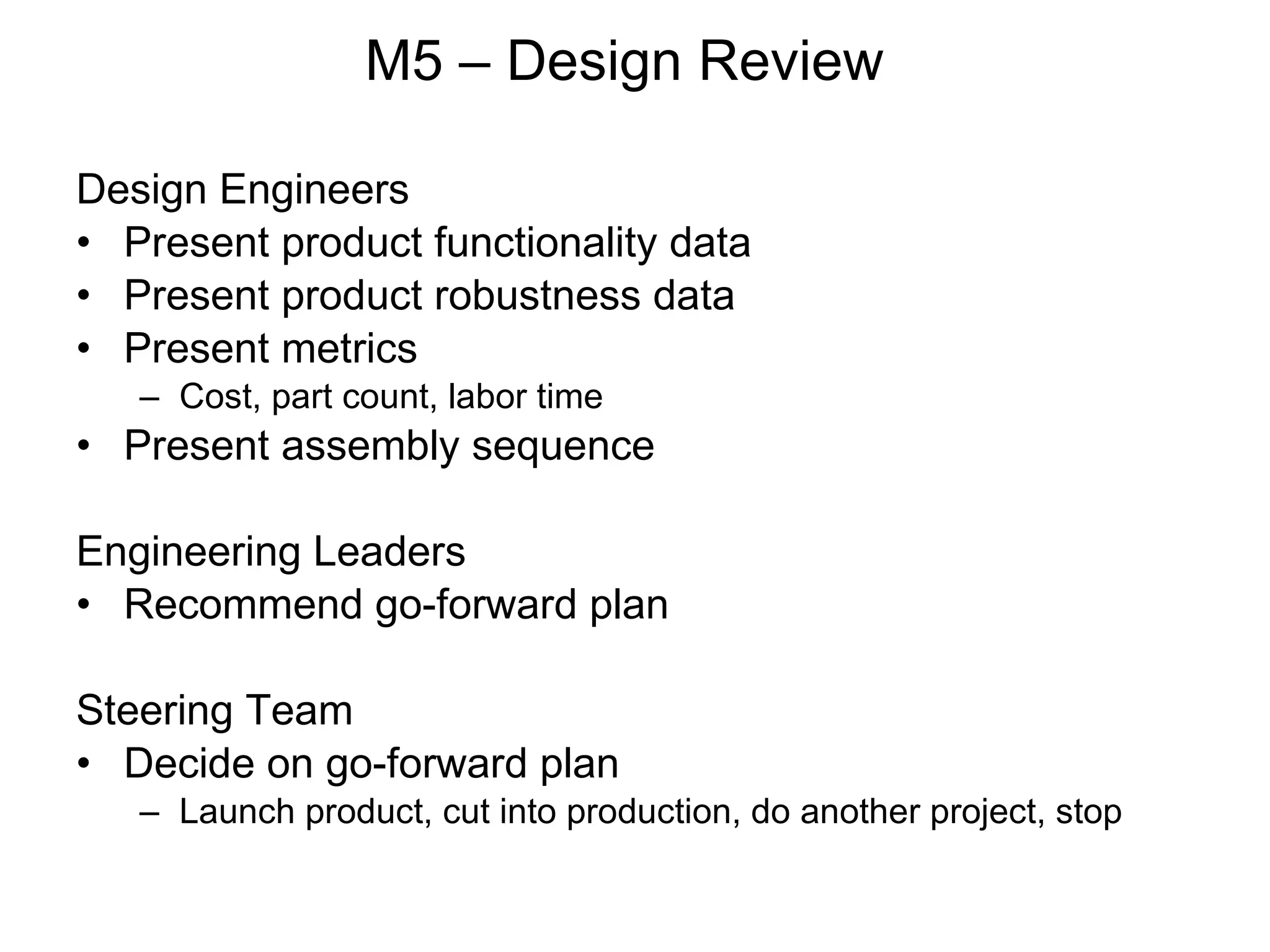
M5 – Design Review Design Engineers Present product functionality data Present product robustness data Present metrics Cost, part count, labor time Present assembly sequence Engineering Leaders Recommend go-forward plan Steering Team Decide on go-forward plan Launch product, cut into production, do another project, stop
M 1 Goal Setting M 2 Project Selection & Planning M 3 Resource Allocation M 4 Project Execution M 5 Design Review M 4.1 Signature of Baseline Product & Process M 4.2 DFMA tools on Baseline Design M 4.3 Goals: Part Count, Assembly Time Design Approach Part Count: 60 (40% reduction)  Labor Time: 30 minutes (50% reduction) Cost : $650 (35% reduction) Volume: 100,000 per year Estimated Savings: $350,000 per year Part Count: 100 parts  Labor Time: 60 minutes  Cost: $1,000  Volume: 100,000 per year  Design Approach Highest cost subassemblies first Reduce fasteners Reduce connectors Stress analysis to reduce material More injection molding New materials New manufacturing process M 4.4 DFMA Tools on New Design M 4.5 Validation of Product Function Estimated Savings $350,000 per year Part Count By Part Type Cost by Sub-Assembly Product Function Non-Value Added Labor Parts, Labor Cost Project Savings Project Resources Company Profitability Goals Features That Create Cost Product Function
Clear goals – company profitability Clear roles and responsibilities E.g., Lean Black Belts, Six Sigma Black Belts, DFMA Black Belts Well established business processes and metrics Project selection, chartering, resourcing Review mechanisms Clear accountability All the supporting pieces, not just the toolbox Six Sigma is not Minitab Lean is not value stream mapping Systematic DFMA Deployment is not just DFMA toolbox All the Quadrants Organization, infrastructure, business processes, tools Big Finish Systematic Methodologies Lean, Six Sigma, DFMA Deployment
Our children must learn how to do manufacturing if we are to have a secure economy Systematic DFMA Deployment is a credible approach to resurrecting a profitable US industrial base. I hope you take something from this work that helps you improve your part of the US industrial base. The Future

Resurrect Manufacturing 2009 DFMA Forum

  • 1.
    Mike Shipulski, Ph.D.Director of Engineering Hypertherm, Inc. Systematic DFMA Deployment, it just Could Resurrect US Manufacturing
  • 2.
    We have lostour way Working definitions The savings The problems The learning Systematic DFMA Deployment Comparison with other systematic methodologies Lean, Six Sigma, DFSS Quadrants of DFMA Deployment Five Milestones of DFMA Deployment Process (M1-M5) Big Finish Outline
  • 3.
    We praised financialenterprises for driving economic growth knowing full well that moving and repackaging financial vehicles did not create sustainable growth All the while, manufacturing has taken it on the chin with: Astronomical job losses The thinnest capital investments And, most troubling, a general denigration of Manufacturing as an institution and profession We can resurrect Manufacturing with a back-to-basics approach to create sustainable economic growth. Manufacturing creates value when it combines raw materials and labor with thinking, which we call design, to create products that sell for more than the cost to make them, where Profit per part = Price – Cost [1] replacing Cost with Materials and Labor, eq. [1] becomes Profit per part = Price – (Materials + Labor). [2] We have lost our way
  • 4.
    Total profit isa function of the number of parts sold, so modifying eq. [2] for Volume Profit = [Price – (Materials + Labor)] x Volume. [3] The Market sets price and volume We are left only to with Materials and Labor to influence Profit. At the most basic level, we must reduce Materials and Labor to increase Profit. This is so important it must be written as a formula: Increased Profits in Manufacturing result from reduced Materials and Labor costs . [4] How do we use the simple fundamentals of eq. [4] to resurrect US Manufacturing? I propose we must change our designs to design out Material and Labor costs using Systematic DFMA Deployment. We have lost our way
  • 5.
    Working Definitions WorkingDefinition 1. Design for Manufacturing (DFM) A methodology to change a design to reduce the cost of making parts while retaining product function. Working Definition 2. Design for Assembly (DFA) A methodology to change a design by eliminating parts to reduce the cost of putting things together while retaining product function. Both definitions include: 1. Change the design 2. Retaining product function 3. Reduce the cost
  • 6.
    Part-by-part and feature-by-featurereduction of costs Hard work is required Part count reduction of 20 – 50% Labor time reduction of 20 – 60% Cost savings of 20 – 50% Savings achieved in all types of industries High volumes, low volumes High tech, low tech Big ones, little ones Savings are possible with all types Downstream savings are significant The Savings
  • 7.
    1. Waste ofoverproduction (of parts) 2. Waste of time on hand - waiting (for parts) 3. Waste in transportation (of parts) 4. Waste of processing itself (parts) 5. Waste of stock on hand – inventory (of parts) 6. Waste of movement (from parts) 7. Waste of making defective products (using parts) Cartoons from Suzaki, The New Manufacturing Challenge , 1987. Wastes from Ohno, Toyota Production System, Beyond Large-Scale Production , 1978 (Japanese), 1988 (English). Breadth of Factory Savings is Staggering Introduce a low waste design to your lean folks
  • 8.
    1. Waste ofoverproduction (of designs) 2. Waste of time on hand - waiting (for designs) 3. Waste in transportation (of designs) 4. Waste of processing itself (designs) 5. Waste of stock on hand – inventory (of designs) 6. Waste of movement (from designs) 7. Waste of making defective designs Cartoons from Suzaki, The New Manufacturing Challenge , 1987. Wastes from Ohno, Toyota Production System, Beyond Large-Scale Production , 1978 (Japanese), 1988 (English). Breadth of Engineering Savings is Staggering Fewer parts to design
  • 9.
    Business Metrics - profit per square foot, warranty cost per unit
  • 10.
    The significance ofthe savings are a problem – most don’t believe Companies don’t know how to start Companies don’t realize full savings Narrow implementation (e.g., one sub-assembly) Low DFMA deployment factor, D Poor implementation Projects run out of Manufacturing or Purchasing Poor project selection DFM at the expense of DFA Poor organizational roles and responsibilities Project resources unallocated Companies don’t know how to put all the pieces in place It’s more than just DFMA tools Infrastructure, organization, business processes, tools The Problems
  • 11.
    The Learning Howto create a DFMA Deployment plan including Business processes, tools, organization, and infrastructure How to select, plan, and staff the projects How to execute projects Analyze the baseline design Create and track the right hard metrics How to manage, pace, guide the projects Hard metrics Low overhead report-outs How to formalize and share learning
  • 12.
    Systematic DFMA DeploymentWhat is it? How to do it?
  • 13.
    Systematic Methodologies Lean,Six Sigma, DFMA Deployment Lean Six Sigma Design for Six Sigma DFMA Deployment Cost Quality Manufacturing Process Product Design
  • 14.
    Systematic Methodologies Lean,Six Sigma, DFMA Deployment Lean Six Sigma Design for Six Sigma DFMA Deployment Cost Quality Manufacturing Process Product Design e.g., warranty cost reduced, fewer opportunities for defects RTY no missing fasteners = (Yield for a single fastener) number of fasteners Number of defects = probability of a defect x number of opportunities
  • 15.
    Clear goals –company profitability Clear roles and responsibilities E.g., Lean Black Belts, Six Sigma Black Belts, DFMA Black Belts Well established business processes and metrics Project selection, chartering, resourcing Review mechanisms Communication processes Clear accountability All the supporting pieces, not just the toolbox Six Sigma is not Minitab Lean is not value stream mapping Systematic DFMA Deployment is not just DFMA toolbox All the Quadrants Organization, infrastructure, business processes, tools Systematic Methodologies Lean, Six Sigma, DFMA Deployment
  • 16.
    Organization Infrastructure ToolsCompany-wide Savings from Systematic DFMA Deployment Business Processes Quadrants of Systematic DFMA Deployment Design Engineering leads the work Experts within Design Engineering or on a separate team How many DFMA Black Belts How many DMFA Master Black Belts How to define accountability How to allocate resources How to involve the supply base How to start the initiative How to select projects How to plan and staff projects How to execute projects How to manage and pace projects How to manage software licenses How to share (and not share) DFMA analyses How to share special processes How to share the learning How to track savings How to start the initiative How to select projects How to plan and staff projects How to execute projects How to manage and pace projects
  • 17.
    M1 GoalSetting M2 Project Selection and Planning M3 Resource Allocation M4 Project Execution M4.1 Signature of baseline product and process M4.2 DFMA tools on baseline design M4.3 Goals and design approach M4.4 DFMA tools on new design M4.5 Validation of product function M5 – Design Review Systematic DFMA Deployment Process with 5 Milestones
  • 18.
    M 1 GoalSetting M 2 Project Selection & Planning M 3 Resource Allocation M 4 Project Execution M 5 Design Review M 4.1 Signature of Baseline Product & Process M 4.2 DFMA tools on Baseline Design M 4.3 Goals: Part Count, Assembly Time Design Approach Part Count: 60 (40% reduction) Labor Time: 30 minutes (50% reduction) Cost : $650 (35% reduction) Volume: 100,000 per year Estimated Savings: $350,000 per year Part Count: 100 parts Labor Time: 60 minutes Cost: $1,000 Volume: 100,000 per year Design Approach Highest cost subassemblies first Reduce fasteners Reduce connectors Stress analysis to reduce material More injection molding New materials New manufacturing process M 4.4 DFMA Tools on New Design M 4.5 Validation of Product Function Estimated Savings $350,000 per year Part Count By Part Type Cost by Sub-Assembly Product Function Non-Value Added Labor Parts, Labor Cost Project Savings Project Resources Company Profitability Goals Features That Create Cost Product Function
  • 19.
    M1 – GoalSetting Steering Team (or group that creates accountability) Company profitability goals drive projects Define desired savings and timing of savings Align resource requirements Give input to project selection – M2 Savings and resources differ among project types Profitability Goals
  • 20.
    Savings and Resourcesare Different for Project Types DFA of existing sub assemblies DFA of existing products DFA/DFM in New Product Development 20-50% savings 0.2 – 0.5 savings factor, S Purchasing Suppliers Manufacturing 2% savings 0.02 DFMA savings factor, S 5% savings 0.05 DFMA savings factor, S 15% savings 0.15 DMFA savings factor 10% savings 0.1 DFMA savings factor, S Purchasing, Engineering, Manufacturing, Suppliers Purchasing, Engineering. Assembly, Suppliers Almost Everyone Purchasing, Engineering. Assembly, Suppliers Opportunistic Systematic Systematic Opportunistic Target Costing, Cost Negotiation DFM of existing parts (design change) Savings and Resources
  • 21.
    Savings = Sx (labor + materials) x D A contrived example of yearly savings for a range of deployment levels and project portfolios for and example company with Total company Labor + Materials = $100 Million
  • 22.
    M2 – ProjectSelection Engineering Leaders Create project portfolio Estimate savings Estimate resource needs Give input to resource allocation – M3 Savings and Resources Project Portfolio
  • 23.
    M3 – ResourceAllocation Engineering Leaders Define resource needs and timing Steering Team Secure commitment of resources (people, tools) Time for training and redesigning the product
  • 24.
    M4 - ProjectExecution The biggest phase M4.1 - Signature of baseline product M4.2 - Evaluation of baseline product with DFMA tools M4.3 - Set formal goals: Part Count, Assembly Time, Cost M4.4 - Design new product, use DFMA tools new design M4.5 - Validation of product function
  • 25.
    Design Engineers Formalizeproduct functionality Create Pareto of part count by part type Create Pareto of cost by subassembly Manufacturing Engineers Define features that create cost M4.1 - Signature of baseline product and process Part Count by Part Type Features That Create Cost
  • 26.
    M4.2 - Evaluationof baseline product with DFMA tools Design Engineers Build the baseline design Score the baseline design with DFMA tools
  • 27.
    M4.3 - Formalizegoals: Part Count, Assembly Time, Cost Design Engineering Leaders Set formal part count goals Set formal labor time goals Set formal cost savings goals Estimate Savings Define Design approach (based on signature of baseline) Inform M4.4 design work Formalized Goals Part Count: 60 (40% reduction) Labor Time: 30 minutes (50% reduction) Cost : $650 (35% reduction) Volume: 100,000 per year Estimated Savings: $350,000 per year Design Approach Redesign highest cost subassemblies Reduce fasteners Reduce connectors Stress analysis to reduce material More injection molding New materials New manufacturing process
  • 28.
    M4.4 – DesignWork and DFMA Tools on New Product Design Engineers Design the new product Evaluate new product with DFMA tools Present metrics Baseline Product New Product New Product Baseline Product Part Count Cost
  • 29.
    M4.5 - Validationof product function Design Engineers Test new product to verify product functionality Test new product to verify robustness Product Function Baseline Product New Product
  • 30.
    M5 – DesignReview Design Engineers Present product functionality data Present product robustness data Present metrics Cost, part count, labor time Present assembly sequence Engineering Leaders Recommend go-forward plan Steering Team Decide on go-forward plan Launch product, cut into production, do another project, stop
  • 31.
    M 1 GoalSetting M 2 Project Selection & Planning M 3 Resource Allocation M 4 Project Execution M 5 Design Review M 4.1 Signature of Baseline Product & Process M 4.2 DFMA tools on Baseline Design M 4.3 Goals: Part Count, Assembly Time Design Approach Part Count: 60 (40% reduction) Labor Time: 30 minutes (50% reduction) Cost : $650 (35% reduction) Volume: 100,000 per year Estimated Savings: $350,000 per year Part Count: 100 parts Labor Time: 60 minutes Cost: $1,000 Volume: 100,000 per year Design Approach Highest cost subassemblies first Reduce fasteners Reduce connectors Stress analysis to reduce material More injection molding New materials New manufacturing process M 4.4 DFMA Tools on New Design M 4.5 Validation of Product Function Estimated Savings $350,000 per year Part Count By Part Type Cost by Sub-Assembly Product Function Non-Value Added Labor Parts, Labor Cost Project Savings Project Resources Company Profitability Goals Features That Create Cost Product Function
  • 32.
    Clear goals –company profitability Clear roles and responsibilities E.g., Lean Black Belts, Six Sigma Black Belts, DFMA Black Belts Well established business processes and metrics Project selection, chartering, resourcing Review mechanisms Clear accountability All the supporting pieces, not just the toolbox Six Sigma is not Minitab Lean is not value stream mapping Systematic DFMA Deployment is not just DFMA toolbox All the Quadrants Organization, infrastructure, business processes, tools Big Finish Systematic Methodologies Lean, Six Sigma, DFMA Deployment
  • 33.
    Our children mustlearn how to do manufacturing if we are to have a secure economy Systematic DFMA Deployment is a credible approach to resurrecting a profitable US industrial base. I hope you take something from this work that helps you improve your part of the US industrial base. The Future