DFA:SOP
Design for Assembly
Prepared by: Udayraj M.
• Statement
• Objective
• DFA & DFM
• Difference
• Similarities
• Terminology
• Sequence of Analysis
• Design for Assembly Principles
• DFA Process
• DFA Analysis Worksheet
• DFA Guidelines
• Key DFMA Principles
CONTENT
To provide an overview of Design for Manufacturing and
Assembly (DFMA) techniques, which are used to minimize
product cost through design and process improvements
STATEMENT
o Differences and Similarities between Design for Manufacturing and
Design for Assembly
o Describe how product design has a primary influence
o Basic criteria for Part Minimization
o Quantitative analysis of a Design’s efficiency
o Critique product designs for ease of assembly
o The importance of involving production engineers in DFMA analysis
OBJECTIVE
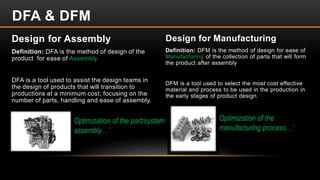
Design for Assembly
Definition: DFA is the method of design of the
product for ease of Assembly
DFA is a tool used to assist the design teams in
the design of products that will transition to
productions at a minimum cost, focusing on the
number of parts, handling and ease of assembly.
Design for Manufacturing
Definition: DFM is the method of design for ease of
Manufacturing of the collection of parts that will form
the product after assembly
DFM is a tool used to select the most cost effective
material and process to be used in the production in
the early stages of product design.
DFA & DFM
Optimization of the
manufacturing process…’
Optimization of the part/system
assembly…’
Design for Assembly (DFA)
concerned only with reducing product assembly cost
o minimizes number of assembly operations
o individual parts tend to be more complex in design
Design for Manufacturing (DFM)
concerned with reducing overall part production cost
o minimizes complexity of manufacturing operations
o uses common datum features and primary axes
DIFFERENCE
Both DFM and DFA seek to reduce material, overhead, and labor cost.
o They both shorten the product development cycle time.
o Both DFM and DFA seek to utilize standards to reduce cost
SIMILARITIES
Design for Manufacturing (DFM) and Design for Assembly (DFA) are
now commonly referred to as a single methodology, Design for
Manufacturing and Assembly (DFMA).
TERMINOLOGY
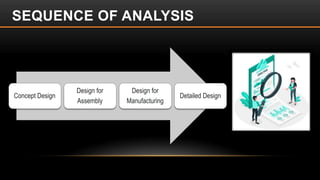
Concept Design
Design for
Assembly
Design for
Manufacturing
Detailed Design
SEQUENCE OF ANALYSIS
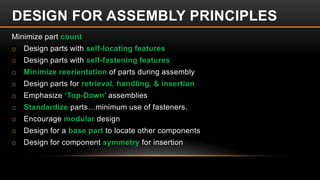
Minimize part count
o Design parts with self-locating features
o Design parts with self-fastening features
o Minimize reorientation of parts during assembly
o Design parts for retrieval, handling, & insertion
o Emphasize ‘Top-Down’ assemblies
o Standardize parts…minimum use of fasteners.
o Encourage modular design
o Design for a base part to locate other components
o Design for component symmetry for insertion
DESIGN FOR ASSEMBLY PRINCIPLES
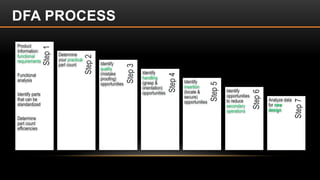
Step3
Step2
Step4
Step1
Step5
Product
Information:
functional
requirements
Functional
analysis
Identify parts
that can be
standardized
Determine
part count
efficiencies
Step6
Determine
your practical
part count
Step7
Identify
quality
(mistake
proofing)
opportunities
Identify
handling
(grasp &
orientation)
opportunities
Identify
insertion
(locate &
secure)
opportunities
Identify
opportunities
to reduce
secondary
operations
Analyze data
for new
design
DFA PROCESS
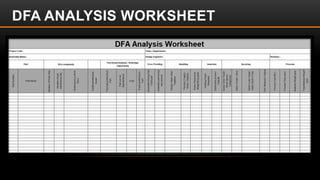
DFA ANALYSIS WORKSHEET
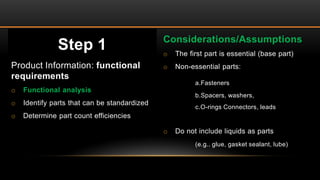
Step 1
Product Information: functional
requirements
o Functional analysis
o Identify parts that can be standardized
o Determine part count efficiencies
Considerations/Assumptions
o The first part is essential (base part)
o Non-essential parts:
a.Fasteners
b.Spacers, washers,
c.O-rings Connectors, leads
o Do not include liquids as parts
(e.g.. glue, gasket sealant, lube)
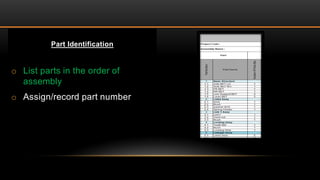
Part Identification
o List parts in the order of
assembly
o Assign/record part number
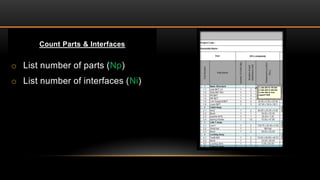
Count Parts & Interfaces
o List number of parts (Np)
o List number of interfaces (Ni)
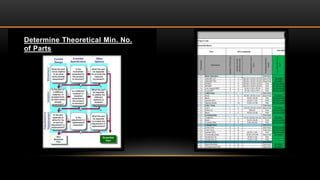
Determine Theoretical Min. No.
of Parts
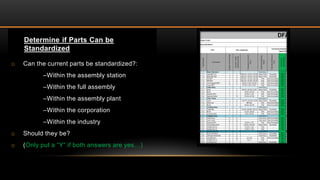
Determine if Parts Can be
Standardized
o Can the current parts be standardized?:
–Within the assembly station
–Within the full assembly
–Within the assembly plant
–Within the corporation
–Within the industry
o Should they be?
o (Only put a “Y” if both answers are yes…)
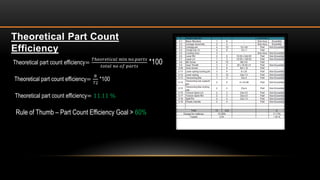
Theoretical Part Count
Efficiency
Theoretical part count efficiency=
𝑇ℎ𝑒𝑜𝑟𝑒𝑡𝑖𝑐𝑎𝑙 min 𝑛𝑜.𝑝𝑎𝑟𝑡𝑠
𝑡𝑜𝑡𝑎𝑙 𝑛𝑜 𝑜𝑓 𝑝𝑎𝑟𝑡𝑠
*100
Theoretical part count efficiency=
8
72
*100
Theoretical part count efficiency= 11.11 %
Rule of Thumb – Part Count Efficiency Goal > 60%
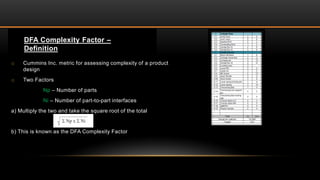
DFA Complexity Factor –
Definition
o Cummins Inc. metric for assessing complexity of a product
design
o Two Factors
Np – Number of parts
Ni – Number of part-to-part interfaces
a) Multiply the two and take the square root of the total
b) This is known as the DFA Complexity Factor
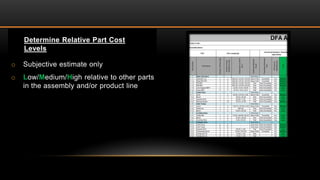
Determine Relative Part Cost
Levels
o Subjective estimate only
o Low/Medium/High relative to other parts
in the assembly and/or product line
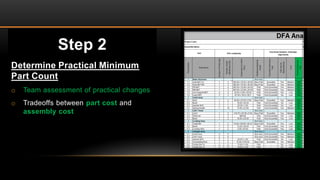
Step 2
Determine Practical Minimum
Part Count
o Team assessment of practical changes
o Tradeoffs between part cost and
assembly cost
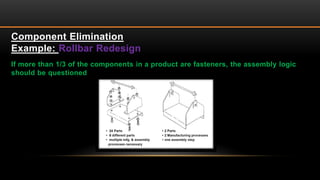
If more than 1/3 of the components in a product are fasteners, the assembly logic
should be questioned
Component Elimination
Example: Rollbar Redesign
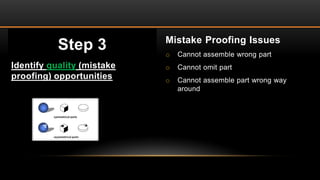
Step 3
Identify quality (mistake
proofing) opportunities
Mistake Proofing Issues
o Cannot assemble wrong part
o Cannot omit part
o Cannot assemble part wrong way
around
Step 4
Identify handling (grasp &
orientation) opportunities
Handling Difficulty
Quantitative criteria
o Handling Time: based on assembly
process and complexity of parts
a) How many hands are required?
b) Is any grasping assistance needed?
c) What is the effect of part symmetry
on assembly?
d) Is the part easy to align/position?
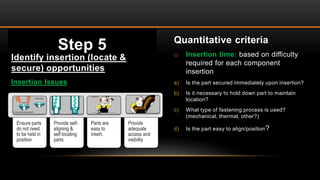
Step 5
Identify insertion (locate &
secure) opportunities
Insertion Issues
Quantitative criteria
o Insertion time: based on difficulty
required for each component
insertion
a) Is the part secured immediately upon insertion?
b) Is it necessary to hold down part to maintain
location?
c) What type of fastening process is used?
(mechanical, thermal, other?)
d) Is the part easy to align/position?
Ensure parts
do not need
to be held in
position
Provide self-
aligning &
self locating
parts
Parts are
easy to
insert.
Provide
adequate
access and
visibility
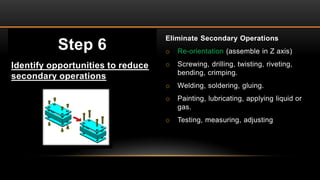
Step 6
Identify opportunities to reduce
secondary operations
Eliminate Secondary Operations
o Re-orientation (assemble in Z axis)
o Screwing, drilling, twisting, riveting,
bending, crimping.
o Welding, soldering, gluing.
o Painting, lubricating, applying liquid or
gas.
o Testing, measuring, adjusting
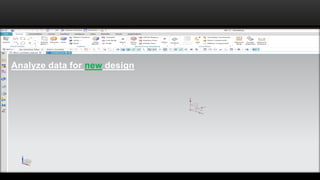
Analyze data for new design
In order of importance: DFA Guidelines
o Reduce part count & types
o Ensure parts cannot be installed incorrectly
o Strive to eliminate adjustments
o Ensure parts self-align & self-locate
o Ensure adequate access & unrestricted vision
o Ensure parts are easily handled from bulk
o Minimize reorientation (assemble in Z axis) & secondary operations during assembly
o Make parts symmetrical or obviously asymmetrical
DFA GUIDELINES
o Minimize Part Count
o Standardize Parts and Materials
o Create Modular Assemblies
o Design for Efficient Joining
o Minimize Reorientation of parts during Assembly and/or Machining
o Simplify and Reduce the number of Manufacturing Operations
o Specify ‘Acceptable’ surface Finishes for functionality
KEY DFMA PRINCIPLES
Thank you

Design for assembly

  • 1.
  • 2.
    • Statement • Objective •DFA & DFM • Difference • Similarities • Terminology • Sequence of Analysis • Design for Assembly Principles • DFA Process • DFA Analysis Worksheet • DFA Guidelines • Key DFMA Principles CONTENT
  • 3.
    To provide anoverview of Design for Manufacturing and Assembly (DFMA) techniques, which are used to minimize product cost through design and process improvements STATEMENT
  • 4.
    o Differences andSimilarities between Design for Manufacturing and Design for Assembly o Describe how product design has a primary influence o Basic criteria for Part Minimization o Quantitative analysis of a Design’s efficiency o Critique product designs for ease of assembly o The importance of involving production engineers in DFMA analysis OBJECTIVE
  • 5.
    Design for Assembly Definition:DFA is the method of design of the product for ease of Assembly DFA is a tool used to assist the design teams in the design of products that will transition to productions at a minimum cost, focusing on the number of parts, handling and ease of assembly. Design for Manufacturing Definition: DFM is the method of design for ease of Manufacturing of the collection of parts that will form the product after assembly DFM is a tool used to select the most cost effective material and process to be used in the production in the early stages of product design. DFA & DFM Optimization of the manufacturing process…’ Optimization of the part/system assembly…’
  • 6.
    Design for Assembly(DFA) concerned only with reducing product assembly cost o minimizes number of assembly operations o individual parts tend to be more complex in design Design for Manufacturing (DFM) concerned with reducing overall part production cost o minimizes complexity of manufacturing operations o uses common datum features and primary axes DIFFERENCE
  • 7.
    Both DFM andDFA seek to reduce material, overhead, and labor cost. o They both shorten the product development cycle time. o Both DFM and DFA seek to utilize standards to reduce cost SIMILARITIES
  • 8.
    Design for Manufacturing(DFM) and Design for Assembly (DFA) are now commonly referred to as a single methodology, Design for Manufacturing and Assembly (DFMA). TERMINOLOGY
  • 9.
    Concept Design Design for Assembly Designfor Manufacturing Detailed Design SEQUENCE OF ANALYSIS
  • 10.
    Minimize part count oDesign parts with self-locating features o Design parts with self-fastening features o Minimize reorientation of parts during assembly o Design parts for retrieval, handling, & insertion o Emphasize ‘Top-Down’ assemblies o Standardize parts…minimum use of fasteners. o Encourage modular design o Design for a base part to locate other components o Design for component symmetry for insertion DESIGN FOR ASSEMBLY PRINCIPLES
  • 11.
    Step3 Step2 Step4 Step1 Step5 Product Information: functional requirements Functional analysis Identify parts that canbe standardized Determine part count efficiencies Step6 Determine your practical part count Step7 Identify quality (mistake proofing) opportunities Identify handling (grasp & orientation) opportunities Identify insertion (locate & secure) opportunities Identify opportunities to reduce secondary operations Analyze data for new design DFA PROCESS
  • 12.
  • 13.
    Step 1 Product Information:functional requirements o Functional analysis o Identify parts that can be standardized o Determine part count efficiencies Considerations/Assumptions o The first part is essential (base part) o Non-essential parts: a.Fasteners b.Spacers, washers, c.O-rings Connectors, leads o Do not include liquids as parts (e.g.. glue, gasket sealant, lube)
  • 14.
    Part Identification o Listparts in the order of assembly o Assign/record part number
  • 15.
    Count Parts &Interfaces o List number of parts (Np) o List number of interfaces (Ni)
  • 16.
  • 17.
    Determine if PartsCan be Standardized o Can the current parts be standardized?: –Within the assembly station –Within the full assembly –Within the assembly plant –Within the corporation –Within the industry o Should they be? o (Only put a “Y” if both answers are yes…)
  • 18.
    Theoretical Part Count Efficiency Theoreticalpart count efficiency= 𝑇ℎ𝑒𝑜𝑟𝑒𝑡𝑖𝑐𝑎𝑙 min 𝑛𝑜.𝑝𝑎𝑟𝑡𝑠 𝑡𝑜𝑡𝑎𝑙 𝑛𝑜 𝑜𝑓 𝑝𝑎𝑟𝑡𝑠 *100 Theoretical part count efficiency= 8 72 *100 Theoretical part count efficiency= 11.11 % Rule of Thumb – Part Count Efficiency Goal > 60%
  • 19.
    DFA Complexity Factor– Definition o Cummins Inc. metric for assessing complexity of a product design o Two Factors Np – Number of parts Ni – Number of part-to-part interfaces a) Multiply the two and take the square root of the total b) This is known as the DFA Complexity Factor
  • 20.
    Determine Relative PartCost Levels o Subjective estimate only o Low/Medium/High relative to other parts in the assembly and/or product line
  • 21.
    Step 2 Determine PracticalMinimum Part Count o Team assessment of practical changes o Tradeoffs between part cost and assembly cost
  • 22.
    If more than1/3 of the components in a product are fasteners, the assembly logic should be questioned Component Elimination Example: Rollbar Redesign
  • 23.
    Step 3 Identify quality(mistake proofing) opportunities Mistake Proofing Issues o Cannot assemble wrong part o Cannot omit part o Cannot assemble part wrong way around
  • 24.
    Step 4 Identify handling(grasp & orientation) opportunities Handling Difficulty Quantitative criteria o Handling Time: based on assembly process and complexity of parts a) How many hands are required? b) Is any grasping assistance needed? c) What is the effect of part symmetry on assembly? d) Is the part easy to align/position?
  • 25.
    Step 5 Identify insertion(locate & secure) opportunities Insertion Issues Quantitative criteria o Insertion time: based on difficulty required for each component insertion a) Is the part secured immediately upon insertion? b) Is it necessary to hold down part to maintain location? c) What type of fastening process is used? (mechanical, thermal, other?) d) Is the part easy to align/position? Ensure parts do not need to be held in position Provide self- aligning & self locating parts Parts are easy to insert. Provide adequate access and visibility
  • 26.
    Step 6 Identify opportunitiesto reduce secondary operations Eliminate Secondary Operations o Re-orientation (assemble in Z axis) o Screwing, drilling, twisting, riveting, bending, crimping. o Welding, soldering, gluing. o Painting, lubricating, applying liquid or gas. o Testing, measuring, adjusting
  • 27.
    Analyze data fornew design
  • 28.
    In order ofimportance: DFA Guidelines o Reduce part count & types o Ensure parts cannot be installed incorrectly o Strive to eliminate adjustments o Ensure parts self-align & self-locate o Ensure adequate access & unrestricted vision o Ensure parts are easily handled from bulk o Minimize reorientation (assemble in Z axis) & secondary operations during assembly o Make parts symmetrical or obviously asymmetrical DFA GUIDELINES
  • 29.
    o Minimize PartCount o Standardize Parts and Materials o Create Modular Assemblies o Design for Efficient Joining o Minimize Reorientation of parts during Assembly and/or Machining o Simplify and Reduce the number of Manufacturing Operations o Specify ‘Acceptable’ surface Finishes for functionality KEY DFMA PRINCIPLES
  • 30.