TOYOTA
1-1
Wasim Khalil
Globalization Challenges
Vision & Mission
 Vision is to be the most respected and successful
enterprise, delighting customers with a wide range of
products and solutions in the automobile industry with the
best people and the best technology.
 Mission of Toyota is to provide safe & sound journey.
Toyota is developing various new technologies from the
perspective of energy saving and diversifying energy
sources. Environment has been first and most important
issue in priorities of Toyota and working toward creating a
prosperous society and clean world.
1-2
About Toyota
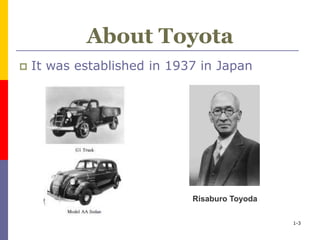
 It was established in 1937 in Japan
1-3
Risaburo Toyoda
It is leading auto manufacturer and the
eighth largest company in the world.
Toyota vehicles have found their way to
over 170 countries
 It production more than 200 million
vehicles in 2014
 Toyota Motor Corporation’s annual
revenue was $213 billion
 It employed 338,875 people. 1-4
TOYOTA’S BACKGROUND
1-5
Toyota has 53 manufacturing companies in
28 countries and regions outside Japan
1-6
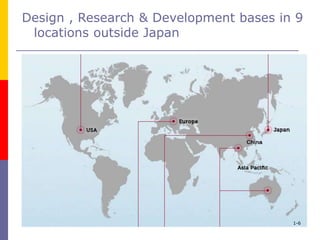
Design , Research & Development bases in 9
locations outside Japan
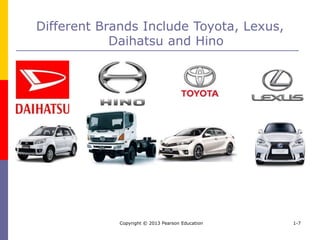
Different Brands Include Toyota, Lexus,
Daihatsu and Hino
Copyright © 2013 Pearson Education 1-7
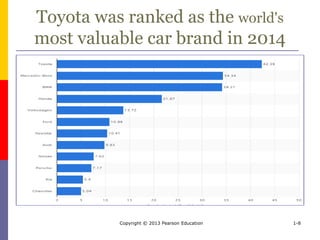
Toyota was ranked as the world's
most valuable car brand in 2014
Copyright © 2013 Pearson Education 1-8
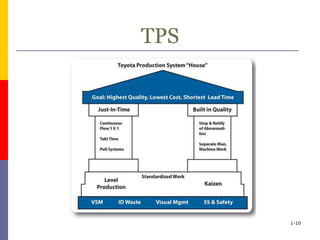
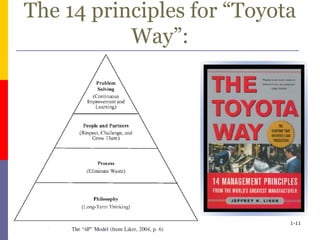
 Probably the most important message
Liker wishes to convey is that it is not
simply the Toyota Production System
(TPS) that accounts for Toyota’s success
but something bigger called the Toyota
Way.
1-9
WHY TOYOTA ARE
SUCCESSFUL ?
1-10
TPS
The 14 principles for “Toyota
Way”:
1-11
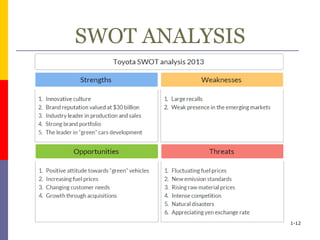
SWOT ANALYSIS
1-12
TOYOTA’S STRATEGY IN INTERNATIONAL
MARKETS
 Taking advantage of the opportunities of a global
market, Toyota has adopted a global strategy, but
considering the characteristics of markets in which it
acted. ‘think global, act local’
 TOYOTA Set up design labs in Europe and USA for a
better understanding of local influences and
preferences of current and potential clients, showing
care for their needs .(YARIS)
1-13
TOYOTA’S STRATEGY IN INTERNATIONAL
MARKETS
 KAIZEN strategy : It means „continuous
improvement” .
 TOYOTA products with high quality, and innovating
automotive technologies (develop hybrid systems)
 TOYOTA global strategies are considering entering the
international growing market, stable, slowly and
surely.(EU)
 Toyota took advantage of opportunities offered by
emerging countries with growing economies, lower
wage costs and more flexible markets (BRIC).
1-14
Aiming for Global Quality
Assurance
 Toyota established many manufactories in in
line with a policy of "producing vehicles where
the demand exists“.
 It is no important were Toyota cars are made
but all car must have same level of quality .by
spread Toyota’s manufacturing philosophy “the
Toyota Way” to all of Toyota manufactories and
locations.
 Also Toyota work on strategy to make all
location self-reliant by decreasing the support
comes from Japan to let each of the overseas
locations 1-15
Thank you
1-16

Toyota globalization challenges

  • 1.
  • 2.
    Vision & Mission Vision is to be the most respected and successful enterprise, delighting customers with a wide range of products and solutions in the automobile industry with the best people and the best technology.  Mission of Toyota is to provide safe & sound journey. Toyota is developing various new technologies from the perspective of energy saving and diversifying energy sources. Environment has been first and most important issue in priorities of Toyota and working toward creating a prosperous society and clean world. 1-2
  • 3.
    About Toyota  Itwas established in 1937 in Japan 1-3 Risaburo Toyoda
  • 4.
    It is leadingauto manufacturer and the eighth largest company in the world. Toyota vehicles have found their way to over 170 countries  It production more than 200 million vehicles in 2014  Toyota Motor Corporation’s annual revenue was $213 billion  It employed 338,875 people. 1-4 TOYOTA’S BACKGROUND
  • 5.
    1-5 Toyota has 53manufacturing companies in 28 countries and regions outside Japan
  • 6.
    1-6 Design , Research& Development bases in 9 locations outside Japan
  • 7.
    Different Brands IncludeToyota, Lexus, Daihatsu and Hino Copyright © 2013 Pearson Education 1-7
  • 8.
    Toyota was rankedas the world's most valuable car brand in 2014 Copyright © 2013 Pearson Education 1-8
  • 9.
     Probably themost important message Liker wishes to convey is that it is not simply the Toyota Production System (TPS) that accounts for Toyota’s success but something bigger called the Toyota Way. 1-9 WHY TOYOTA ARE SUCCESSFUL ?
  • 10.
  • 11.
    The 14 principlesfor “Toyota Way”: 1-11
  • 12.
  • 13.
    TOYOTA’S STRATEGY ININTERNATIONAL MARKETS  Taking advantage of the opportunities of a global market, Toyota has adopted a global strategy, but considering the characteristics of markets in which it acted. ‘think global, act local’  TOYOTA Set up design labs in Europe and USA for a better understanding of local influences and preferences of current and potential clients, showing care for their needs .(YARIS) 1-13
  • 14.
    TOYOTA’S STRATEGY ININTERNATIONAL MARKETS  KAIZEN strategy : It means „continuous improvement” .  TOYOTA products with high quality, and innovating automotive technologies (develop hybrid systems)  TOYOTA global strategies are considering entering the international growing market, stable, slowly and surely.(EU)  Toyota took advantage of opportunities offered by emerging countries with growing economies, lower wage costs and more flexible markets (BRIC). 1-14
  • 15.
    Aiming for GlobalQuality Assurance  Toyota established many manufactories in in line with a policy of "producing vehicles where the demand exists“.  It is no important were Toyota cars are made but all car must have same level of quality .by spread Toyota’s manufacturing philosophy “the Toyota Way” to all of Toyota manufactories and locations.  Also Toyota work on strategy to make all location self-reliant by decreasing the support comes from Japan to let each of the overseas locations 1-15
  • 16.