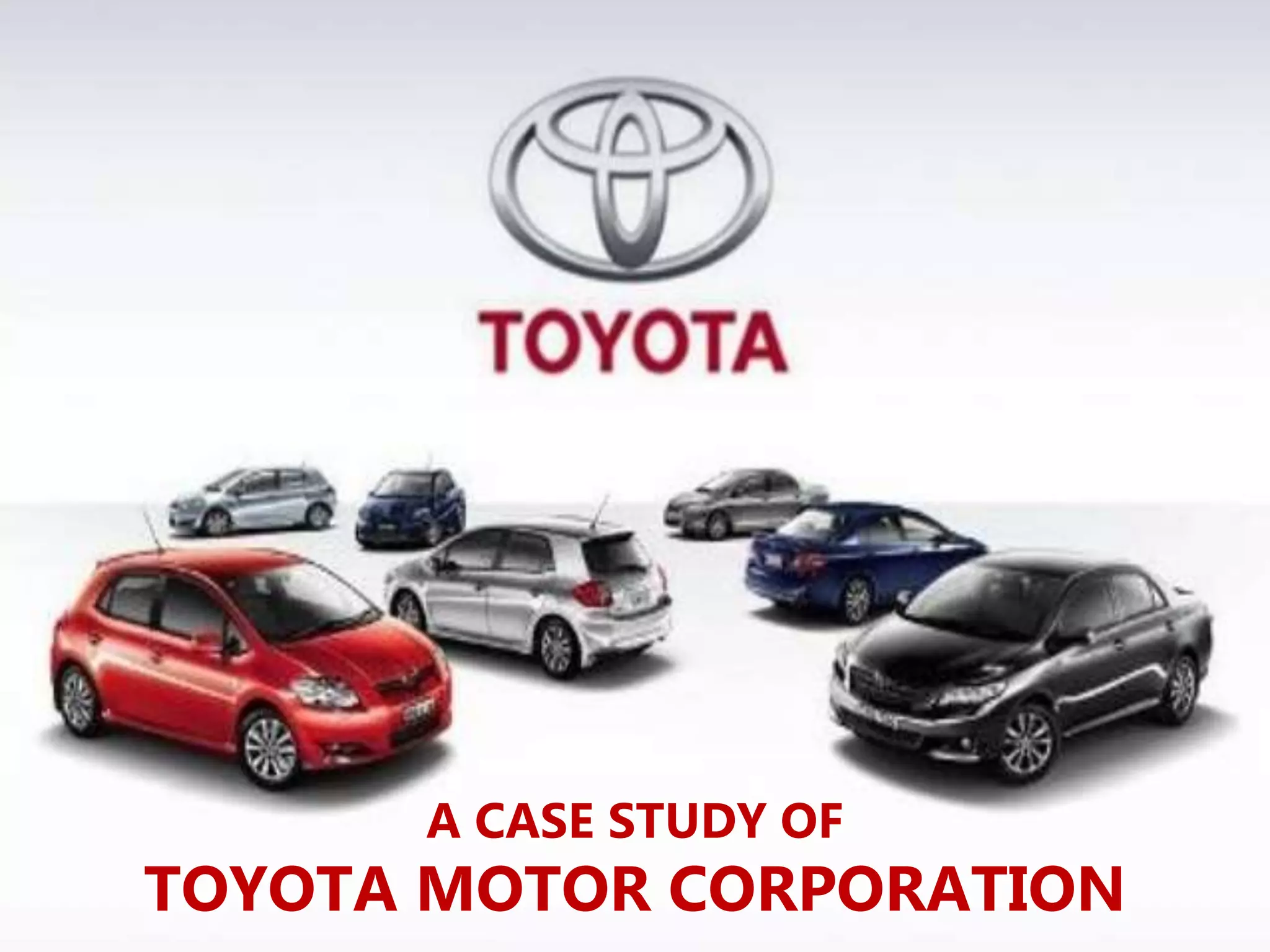
A CASE STUDY OF
TOYOTA MOTOR CORPORATION
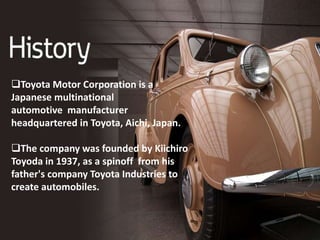
Toyota Motor Corporation is a
Japanese multinational
automotive manufacturer
headquartered in Toyota, Aichi, Japan.
The company was founded by Kiichiro
Toyoda in 1937, as a spinoff from his
father's company Toyota Industries to
create automobiles.
Founded: August 28, 1937; 79 years ago
Founder: Kiichiro Toyoda
Headquarters: Toyota, Aichi, Japan
Revenue: ¥28.40trillion (2016)
Operating income: ¥2.85trillion (2016)
Profit: ¥2.31 trillion (2016)
Total assets: ¥47.42 trillion (2016)
Total equity: ¥17.22 trillion (2016)
Number of employees: 348,877 (2016)
Toyota Motor Corporation (TMC) is a widely
recognized car manufacturer in Malaysia
and around the world. Currently, Toyota is
the top carmaker in the world, beating their
closest rivals, General Motors in both
production numbers and sales.
Segmentation followed by TOYOTA –
1) DEMOGRAPHIC SEGMENTATION – Based on
nationality, gender and age.
2) PSYCHOGRAPHIC SEGMENTATION – Based on
Lifestyle and social values.
 The company has a keen focus on developing a clean
energy car.
 In 1997, Toyota launched the Prius ,the first mass
produced hybrid car, for $19,995.
 Prius hit showrooms in 2002, dealers had already
received 10,000 orders.
 The Prius family totaled global cumulative sales of
6.1 million units in January 2017, representing 61% of
the 10 million hybrids sold worldwide by Toyota since
1997.
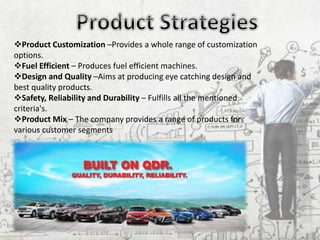
Product Customization –Provides a whole range of customization
options.
Fuel Efficient – Produces fuel efficient machines.
Design and Quality –Aims at producing eye catching design and
best quality products.
Safety, Reliability and Durability – Fulfills all the mentioned
criteria's.
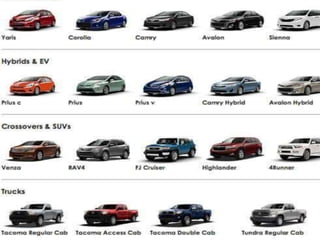
Product Mix – The company provides a range of products for
various customer segments
 The company aims at lean
manufacturing and continuous
improvement. It has well equipped
plants which can make large number
of vehicles simultaneously to
increase the pace of production.
 The company follows a Value based
pricing strategy which focuses on
market competitors and conditions.
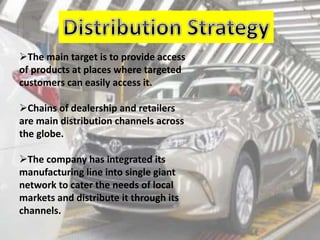
The main target is to provide access
of products at places where targeted
customers can easily access it.
Chains of dealership and retailers
are main distribution channels across
the globe.
The company has integrated its
manufacturing line into single giant
network to cater the needs of local
markets and distribute it through its
channels.
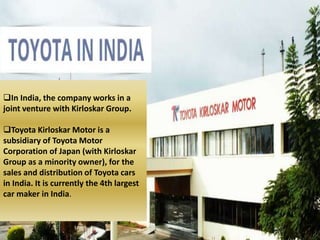
In India, the company works in a
joint venture with Kirloskar Group.
Toyota Kirloskar Motor is a
subsidiary of Toyota Motor
Corporation of Japan (with Kirloskar
Group as a minority owner), for the
sales and distribution of Toyota cars
in India. It is currently the 4th largest
car maker in India.
Customer satisfaction is main priority of the
company. There were many times when they
called back certain vehicles due to minor problems
in them.
To satisfy the needs of each segment of
customers, the company manufactures a whole lot
of different products ranging from luxury segment,
SUV’s, MPV’s, Vans and pickup trucks.
Following are main channels
of product promotions –
TV ads, newspapers, social
media, websites etc.
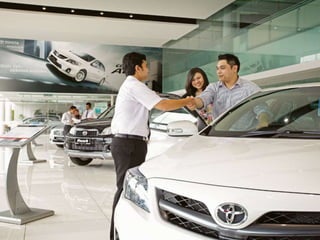
Personal sell through
dealerships.
Individual customer
interactions
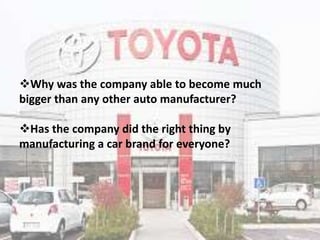
Why was the company able to become much
bigger than any other auto manufacturer?
Has the company did the right thing by
manufacturing a car brand for everyone?
The following are a few key points
of the company’s success –
 Lean manufacturing and continuous
improvement.
 Unique Marketing strategies.
 Proper Market Segmentation.
 Customer Satisfaction is top priority.
 Integrated manufacturing units
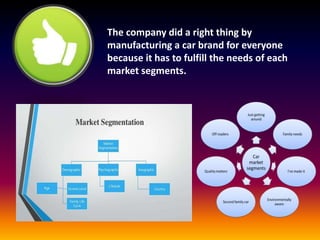
The company did a right thing by
manufacturing a car brand for everyone
because it has to fulfill the needs of each
market segments.
History
About the Company
Global Brand Equity &Identity
Market Segmentation
Development Strategies
Product Strategies
Pricing Strategies
Product Distribution
Toyota in India
Customer Satisfaction
Promotion of products
Question and Answer
Presented by Aayush Sharma,
during a marketing internship
under
Professor Sameer Mathur,
IIM-Lucknow

Case study of Toyota

  • 1.
    A CASE STUDYOF TOYOTA MOTOR CORPORATION
  • 2.
    Toyota Motor Corporationis a Japanese multinational automotive manufacturer headquartered in Toyota, Aichi, Japan. The company was founded by Kiichiro Toyoda in 1937, as a spinoff from his father's company Toyota Industries to create automobiles.
  • 3.
    Founded: August 28,1937; 79 years ago Founder: Kiichiro Toyoda Headquarters: Toyota, Aichi, Japan Revenue: ¥28.40trillion (2016) Operating income: ¥2.85trillion (2016) Profit: ¥2.31 trillion (2016) Total assets: ¥47.42 trillion (2016) Total equity: ¥17.22 trillion (2016) Number of employees: 348,877 (2016)
  • 5.
    Toyota Motor Corporation(TMC) is a widely recognized car manufacturer in Malaysia and around the world. Currently, Toyota is the top carmaker in the world, beating their closest rivals, General Motors in both production numbers and sales. Segmentation followed by TOYOTA – 1) DEMOGRAPHIC SEGMENTATION – Based on nationality, gender and age. 2) PSYCHOGRAPHIC SEGMENTATION – Based on Lifestyle and social values.
  • 6.
     The companyhas a keen focus on developing a clean energy car.  In 1997, Toyota launched the Prius ,the first mass produced hybrid car, for $19,995.  Prius hit showrooms in 2002, dealers had already received 10,000 orders.  The Prius family totaled global cumulative sales of 6.1 million units in January 2017, representing 61% of the 10 million hybrids sold worldwide by Toyota since 1997.
  • 7.
    Product Customization –Providesa whole range of customization options. Fuel Efficient – Produces fuel efficient machines. Design and Quality –Aims at producing eye catching design and best quality products. Safety, Reliability and Durability – Fulfills all the mentioned criteria's. Product Mix – The company provides a range of products for various customer segments
  • 9.
     The companyaims at lean manufacturing and continuous improvement. It has well equipped plants which can make large number of vehicles simultaneously to increase the pace of production.  The company follows a Value based pricing strategy which focuses on market competitors and conditions.
  • 10.
    The main targetis to provide access of products at places where targeted customers can easily access it. Chains of dealership and retailers are main distribution channels across the globe. The company has integrated its manufacturing line into single giant network to cater the needs of local markets and distribute it through its channels.
  • 12.
    In India, thecompany works in a joint venture with Kirloskar Group. Toyota Kirloskar Motor is a subsidiary of Toyota Motor Corporation of Japan (with Kirloskar Group as a minority owner), for the sales and distribution of Toyota cars in India. It is currently the 4th largest car maker in India.
  • 14.
    Customer satisfaction ismain priority of the company. There were many times when they called back certain vehicles due to minor problems in them. To satisfy the needs of each segment of customers, the company manufactures a whole lot of different products ranging from luxury segment, SUV’s, MPV’s, Vans and pickup trucks.
  • 15.
    Following are mainchannels of product promotions – TV ads, newspapers, social media, websites etc. Personal sell through dealerships. Individual customer interactions
  • 17.
    Why was thecompany able to become much bigger than any other auto manufacturer? Has the company did the right thing by manufacturing a car brand for everyone?
  • 18.
    The following area few key points of the company’s success –  Lean manufacturing and continuous improvement.  Unique Marketing strategies.  Proper Market Segmentation.  Customer Satisfaction is top priority.  Integrated manufacturing units
  • 19.
    The company dida right thing by manufacturing a car brand for everyone because it has to fulfill the needs of each market segments.
  • 20.
    History About the Company GlobalBrand Equity &Identity Market Segmentation Development Strategies Product Strategies Pricing Strategies Product Distribution Toyota in India Customer Satisfaction Promotion of products Question and Answer
  • 21.
    Presented by AayushSharma, during a marketing internship under Professor Sameer Mathur, IIM-Lucknow