Global Strategy
Presented By-
Group 6
Manvi Bajpai (26)
Tanmoy Bhattacharyya (49)
Varun Goel (50)
Yamini Yadav (53)
Toyota Motor Corporation
o Headquartered in Japan
o Founded by Kiichiro Toyoda in 1937
o Revenues 18.9 trillion Yen in 2010
o 71,116 employees
o Operations in North America, Latin America, Europe,
Africa, Asia, Oceania and Middle East
Globalization Efforts
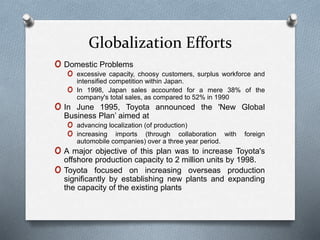
o Domestic Problems
o excessive capacity, choosy customers, surplus workforce and
intensified competition within Japan.
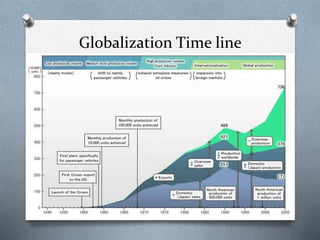
o In 1998, Japan sales accounted for a mere 38% of the
company's total sales, as compared to 52% in 1990
o In June 1995, Toyota announced the 'New Global
Business Plan’ aimed at
o advancing localization (of production)
o increasing imports (through collaboration with foreign
automobile companies) over a three year period.
o A major objective of this plan was to increase Toyota's
offshore production capacity to 2 million units by 1998.
o Toyota focused on increasing overseas production
significantly by establishing new plants and expanding
the capacity of the existing plants
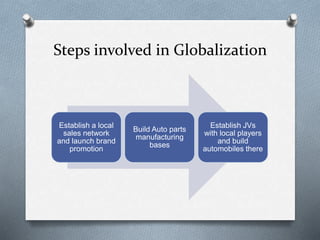
Steps involved in Globalization
Establish a local
sales network
and launch brand
promotion
Build Auto parts
manufacturing
bases
Establish JVs
with local players
and build
automobiles there
Globalization Time line
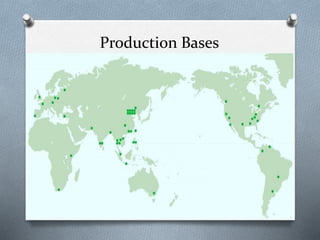
Production Bases
Hurdles in Globalization
o Quality Assurance
o “no matter where Toyota vehicles are made, they have the
same quality.”
o Made by Toyota
o “ The Toyota Way” needs to be spread across all locations
o Minimize the necessary support that comes from Japan
and let each of the overseas bases become self-reliant
o Respect for people in local community and Toyota’s local
employees
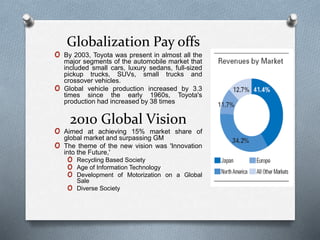
Globalization Pay offs
o By 2003, Toyota was present in almost all the
major segments of the automobile market that
included small cars, luxury sedans, full-sized
pickup trucks, SUVs, small trucks and
crossover vehicles.
o Global vehicle production increased by 3.3
times since the early 1960s, Toyota's
production had increased by 38 times
2010 Global Vision
o Aimed at achieving 15% market share of
global market and surpassing GM
o The theme of the new vision was 'Innovation
into the Future,'
o Recycling Based Society
o Age of Information Technology
o Development of Motorization on a Global
Sale
o Diverse Society
Global Production Center
o To ensure that all across the overseas bases the value
of Toyota remain the same
o Best Practices need to be determined and followed
o Initially established with Motomachi plant in 2003
o Activity Goals:
o “Human Resources Development”
o “Localization of Model Switchovers”
o Helping plant personnel learn how to prepare for the
production of redesigned and/or different vehicle models
o In 2006 GPC were opened in United States, United
Kingdom and Thailand to ensure skill training and HR
development in their respective regions
Globalization and Localization
Manufacturing
o During the almost 50 years since they first began
exports, Toyota vehicles have found their way to over
170 countries and regions throughout the world
o Currently there are 52 bases in 27 different countries
and regions.
o In addition, there are design and R&D bases in seven
locations overseas
“from development and design to production, sales and service,
Toyota has now achieved consistent globalization as well as
localization.” - Koichi INA, Senior Technical Executive, Toyota
Motors
The Global Toyota
• The reaches of Toyota extend throughout the world.
• Toyota has plants located in every continent except Antarctica, with many more
still under construction.
• Even in Europe, production by Toyota subsidiaries will increase from 500,000
units to 610,000 units made in the United Kingdom, France, and Turkey by 2006
• The first Chinese-built Toyota, the VIOS, was made in October 2002
• As a measure of attempting to tap into the Chinese market, Toyota hopes to
capture 10% of the market by 2010
• In North America alone, upwards of 175,000 people are employed by Toyota
subsidiaries.
• As of today, the majority of Toyotas purchased in North America are built in
North America.
• In North America, the Avalon, Camry, Corolla, Matrix, Sequoia, Sienna, Solara,
Tacoma and Tundra are produced.
• At TMMAL, more than 120,000 engines are produced annually for the Toyota
Tundra , which in turn is built by TMMI.
• More than 150,000 Tundras will be built at TMMT, a plant to be built in Texas by
2006.
• Even the Toyota Tacoma will be produced in Mexico starting in 2005
• A joint venture between General Motors and Toyota, known as NUMMI (New
United Motor Manufacturing, Incorporated) is currently based in Fremont,
California
• As a part of Toyota policy, much of the steel used in production is purchased
locally
Thank You

Toyota ppt

  • 1.
    Global Strategy Presented By- Group6 Manvi Bajpai (26) Tanmoy Bhattacharyya (49) Varun Goel (50) Yamini Yadav (53)
  • 2.
    Toyota Motor Corporation oHeadquartered in Japan o Founded by Kiichiro Toyoda in 1937 o Revenues 18.9 trillion Yen in 2010 o 71,116 employees o Operations in North America, Latin America, Europe, Africa, Asia, Oceania and Middle East
  • 3.
    Globalization Efforts o DomesticProblems o excessive capacity, choosy customers, surplus workforce and intensified competition within Japan. o In 1998, Japan sales accounted for a mere 38% of the company's total sales, as compared to 52% in 1990 o In June 1995, Toyota announced the 'New Global Business Plan’ aimed at o advancing localization (of production) o increasing imports (through collaboration with foreign automobile companies) over a three year period. o A major objective of this plan was to increase Toyota's offshore production capacity to 2 million units by 1998. o Toyota focused on increasing overseas production significantly by establishing new plants and expanding the capacity of the existing plants
  • 4.
    Steps involved inGlobalization Establish a local sales network and launch brand promotion Build Auto parts manufacturing bases Establish JVs with local players and build automobiles there
  • 5.
  • 6.
  • 7.
    Hurdles in Globalization oQuality Assurance o “no matter where Toyota vehicles are made, they have the same quality.” o Made by Toyota o “ The Toyota Way” needs to be spread across all locations o Minimize the necessary support that comes from Japan and let each of the overseas bases become self-reliant o Respect for people in local community and Toyota’s local employees
  • 8.
    Globalization Pay offs oBy 2003, Toyota was present in almost all the major segments of the automobile market that included small cars, luxury sedans, full-sized pickup trucks, SUVs, small trucks and crossover vehicles. o Global vehicle production increased by 3.3 times since the early 1960s, Toyota's production had increased by 38 times 2010 Global Vision o Aimed at achieving 15% market share of global market and surpassing GM o The theme of the new vision was 'Innovation into the Future,' o Recycling Based Society o Age of Information Technology o Development of Motorization on a Global Sale o Diverse Society
  • 9.
    Global Production Center oTo ensure that all across the overseas bases the value of Toyota remain the same o Best Practices need to be determined and followed o Initially established with Motomachi plant in 2003 o Activity Goals: o “Human Resources Development” o “Localization of Model Switchovers” o Helping plant personnel learn how to prepare for the production of redesigned and/or different vehicle models o In 2006 GPC were opened in United States, United Kingdom and Thailand to ensure skill training and HR development in their respective regions
  • 10.
    Globalization and Localization Manufacturing oDuring the almost 50 years since they first began exports, Toyota vehicles have found their way to over 170 countries and regions throughout the world o Currently there are 52 bases in 27 different countries and regions. o In addition, there are design and R&D bases in seven locations overseas “from development and design to production, sales and service, Toyota has now achieved consistent globalization as well as localization.” - Koichi INA, Senior Technical Executive, Toyota Motors
  • 11.
    The Global Toyota •The reaches of Toyota extend throughout the world. • Toyota has plants located in every continent except Antarctica, with many more still under construction. • Even in Europe, production by Toyota subsidiaries will increase from 500,000 units to 610,000 units made in the United Kingdom, France, and Turkey by 2006 • The first Chinese-built Toyota, the VIOS, was made in October 2002 • As a measure of attempting to tap into the Chinese market, Toyota hopes to capture 10% of the market by 2010 • In North America alone, upwards of 175,000 people are employed by Toyota subsidiaries. • As of today, the majority of Toyotas purchased in North America are built in North America. • In North America, the Avalon, Camry, Corolla, Matrix, Sequoia, Sienna, Solara, Tacoma and Tundra are produced. • At TMMAL, more than 120,000 engines are produced annually for the Toyota Tundra , which in turn is built by TMMI. • More than 150,000 Tundras will be built at TMMT, a plant to be built in Texas by 2006. • Even the Toyota Tacoma will be produced in Mexico starting in 2005 • A joint venture between General Motors and Toyota, known as NUMMI (New United Motor Manufacturing, Incorporated) is currently based in Fremont, California • As a part of Toyota policy, much of the steel used in production is purchased locally
  • 12.