TOYOTA
History
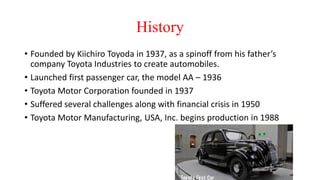
• Founded by Kiichiro Toyoda in 1937, as a spinoff from his father’s
company Toyota Industries to create automobiles.
• Launched first passenger car, the model AA – 1936
• Toyota Motor Corporation founded in 1937
• Suffered several challenges along with financial crisis in 1950
• Toyota Motor Manufacturing, USA, Inc. begins production in 1988
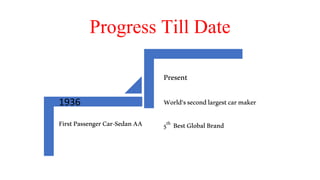
Progress Till Date
1936
FirstPassengerCar-SedanAA
Present
World’ssecondlargestcarmaker
5th BestGlobalBrand
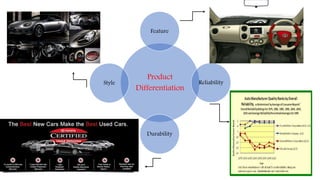
Product
Differentiation
Feature
Reliability
Durability
Style
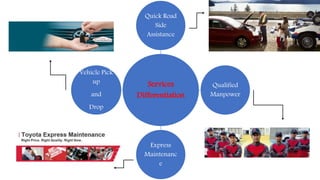
Services
Differentiation
Quick Road
Side
Assistance
Qualified
Manpower
Express
Maintenanc
e
Vehicle Pick
up
and
Drop
Design
• 1982, Launched Camry- four door car, mid- sized offered more
space
• Best selling car in North America
• World’s market leader in sales of Hybrid electric vehicles
• Scion targeted young adults.
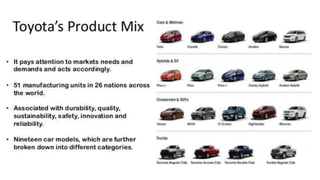
• Designs car from family sedans to SUVs to trucks and minivans.
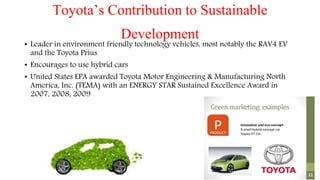
Toyota’s Contribution to Sustainable
Development• Leader in environment friendly technology vehicles, most notably the RAV4 EV
and the Toyota Prius
• Encourages to use hybrid cars
• United States EPA awarded Toyota Motor Engineering & Manufacturing North
America, Inc. (TEMA) with an ENERGY STAR Sustained Excellence Award in
2007, 2008, 2009
Marketing
Strategy
Price Place Promotion
Product 4Ps
Segmentation
Demographic Segmentation : Based on nationality, gender,
age, etc.
Psychographic Segmentation : Based on life style, social value,
personal values etc.
Expansion
• Country and it’s culture are taken in to account
• eg: In US, luxury meant comfort, size and dependability; in Europe,
luxury meant attention to detail and brand heritage.
• To remain the leader globally, company focuses on designing hybrid
cars as a clean energy car
• Most selling product of Toyota
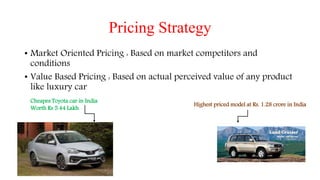
Pricing Strategy
• Market Oriented Pricing : Based on market competitors and
conditions
• Value Based Pricing : Based on actual perceived value of any product
like luxury car
Cheapes Toyota car in India
Worth Rs 5.44 Lakh
Highest priced model at Rs. 1.28 crore in India
Places
• Toyota’s vehicles are sold in more than 170 countries across the world
• Company marketed The Scion at music events
• Possess showrooms where “young people feel comfortable hanging
out and not a place where they just go stare at a car”, quoted Scion
Vice President Jim Letz
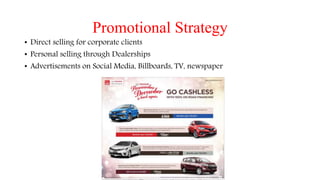
Promotional Strategy
• Direct selling for corporate clients
• Personal selling through Dealerships
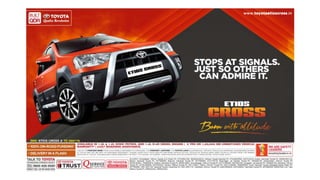
• Advertisements on Social Media, Billboards, TV, newspaper
Toyota Sponsors
• Sports authorities and competitions
• Competition for potential musicians
• Motor Sports
• Motor shows
• Design Competition
Bigger Question : Why was it able to become so
much bigger than any other auto manufacturer?
• Mastery of lean manufacturing and continuous
improvement
• Can make as many as eight models at the same time,
bringing huge increases in productivity and market
responsiveness
• Assembly line production
• Innovates to reduce operational cost
Has Toyota done the right thing by manufacturing
a car brand for everyone? Why or why not?
• The customer gets the choice to choose according to price,
comfort and other personal needs
• Hence, the target segment would be bigger. Customer loyalty
will increase and ultimately the revenue will increase.
• In a way Toyota is doing the right thing by manufacturing a
car brand for everyone.
Summary
• The company encourages problem solving, always looking to revise
techniques which can improve all other processes.
• Strongly focuses on hybrid vehicles which has proven to be
profitable and helped the company rebound.
• Toyota offers a full line of cars for the global market, from family
sedans and sport utility vehicles to trucks and minivans.
• In 2013, the company earned more than 22 trillion yen and sold
8.87 million automobiles, edging past General Motors to become the
world’s largest car-maker.
Toyota

Toyota

  • 1.
  • 2.
    History • Founded byKiichiro Toyoda in 1937, as a spinoff from his father’s company Toyota Industries to create automobiles. • Launched first passenger car, the model AA – 1936 • Toyota Motor Corporation founded in 1937 • Suffered several challenges along with financial crisis in 1950 • Toyota Motor Manufacturing, USA, Inc. begins production in 1988
  • 3.
  • 4.
  • 5.
  • 6.
    Design • 1982, LaunchedCamry- four door car, mid- sized offered more space • Best selling car in North America • World’s market leader in sales of Hybrid electric vehicles • Scion targeted young adults. • Designs car from family sedans to SUVs to trucks and minivans.
  • 7.
    Toyota’s Contribution toSustainable Development• Leader in environment friendly technology vehicles, most notably the RAV4 EV and the Toyota Prius • Encourages to use hybrid cars • United States EPA awarded Toyota Motor Engineering & Manufacturing North America, Inc. (TEMA) with an ENERGY STAR Sustained Excellence Award in 2007, 2008, 2009
  • 8.
  • 9.
    Segmentation Demographic Segmentation :Based on nationality, gender, age, etc. Psychographic Segmentation : Based on life style, social value, personal values etc.
  • 10.
    Expansion • Country andit’s culture are taken in to account • eg: In US, luxury meant comfort, size and dependability; in Europe, luxury meant attention to detail and brand heritage. • To remain the leader globally, company focuses on designing hybrid cars as a clean energy car • Most selling product of Toyota
  • 12.
    Pricing Strategy • MarketOriented Pricing : Based on market competitors and conditions • Value Based Pricing : Based on actual perceived value of any product like luxury car Cheapes Toyota car in India Worth Rs 5.44 Lakh Highest priced model at Rs. 1.28 crore in India
  • 13.
    Places • Toyota’s vehiclesare sold in more than 170 countries across the world • Company marketed The Scion at music events • Possess showrooms where “young people feel comfortable hanging out and not a place where they just go stare at a car”, quoted Scion Vice President Jim Letz
  • 14.
    Promotional Strategy • Directselling for corporate clients • Personal selling through Dealerships • Advertisements on Social Media, Billboards, TV, newspaper
  • 16.
    Toyota Sponsors • Sportsauthorities and competitions • Competition for potential musicians • Motor Sports • Motor shows • Design Competition
  • 18.
    Bigger Question :Why was it able to become so much bigger than any other auto manufacturer? • Mastery of lean manufacturing and continuous improvement • Can make as many as eight models at the same time, bringing huge increases in productivity and market responsiveness • Assembly line production • Innovates to reduce operational cost
  • 19.
    Has Toyota donethe right thing by manufacturing a car brand for everyone? Why or why not? • The customer gets the choice to choose according to price, comfort and other personal needs • Hence, the target segment would be bigger. Customer loyalty will increase and ultimately the revenue will increase. • In a way Toyota is doing the right thing by manufacturing a car brand for everyone.
  • 20.
    Summary • The companyencourages problem solving, always looking to revise techniques which can improve all other processes. • Strongly focuses on hybrid vehicles which has proven to be profitable and helped the company rebound. • Toyota offers a full line of cars for the global market, from family sedans and sport utility vehicles to trucks and minivans. • In 2013, the company earned more than 22 trillion yen and sold 8.87 million automobiles, edging past General Motors to become the world’s largest car-maker.