International Human Resource Management

Toyota Motor Corporation
Group 4
Nguyen Thu Hang
Vu Le Hoang
To Duc Anh
Table of Content
I.

Toyota Motor Corp
1. Introduction
2. Globalization

II.

National and Corporate Culture
1. Japanese Culture
2. Toyota Culture

III. Toyota Business
1. Business Strategies
2. Strategic IHRM

2
I. Toyota Motor Corp
1. Introduction
 Toyota was born in a rural area near Nagoya,
Japan in 1867 by Sakichi Toyoda
 The first product made by the effort of Sakichi
and his son was an automatic loom in 1924
 In 1929, with the notion that the auto industry
is growing  he sold his patent to Platt
Brothers company  take the fund to invest in
the manufacturing and automotive
manufacturing
 August 28,1937, Toyota Motor Corporation
3
officially launched
I. Toyota Motor Corp
2. Globalization
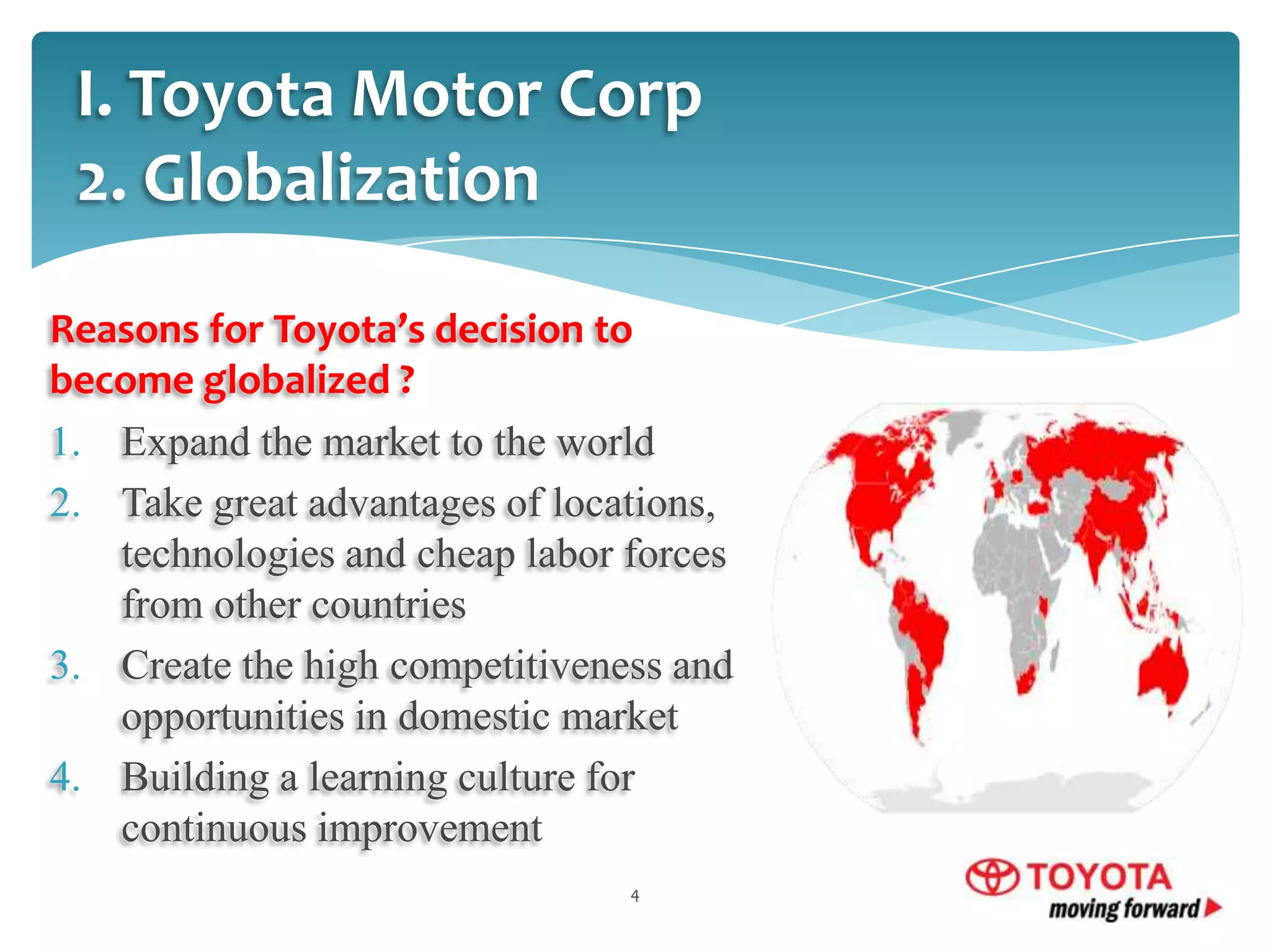
Reasons for Toyota’s decision to
become globalized ?
1. Expand the market to the world
2. Take great advantages of locations,
technologies and cheap labor forces
from other countries
3. Create the high competitiveness and
opportunities in domestic market
4. Building a learning culture for
continuous improvement
4
I. Toyota Motor Corp
2. Globalization
Impacts on IHRM of Toyota’s
employees ?
1.
2.
3.
4.
5.

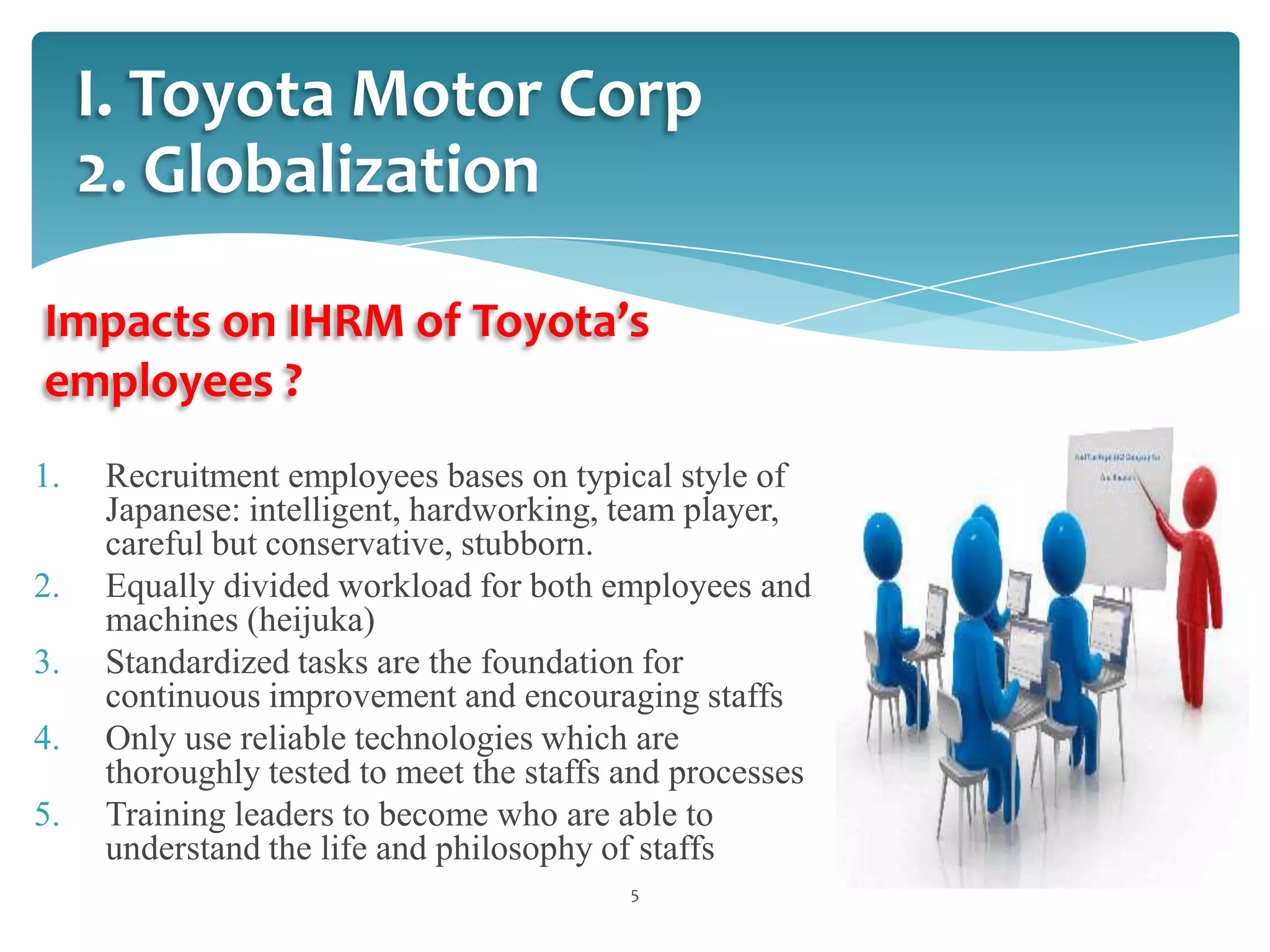
Recruitment employees bases on typical style of
Japanese: intelligent, hardworking, team player,
careful but conservative, stubborn.
Equally divided workload for both employees and
machines (heijuka)
Standardized tasks are the foundation for
continuous improvement and encouraging staffs
Only use reliable technologies which are
thoroughly tested to meet the staffs and processes
Training leaders to become who are able to
understand the life and philosophy of staffs
5
II. National & Corporate Culture

Japanese culture

Toyota culture
6
II. National & Corporate Culture
1. Japanese Culture
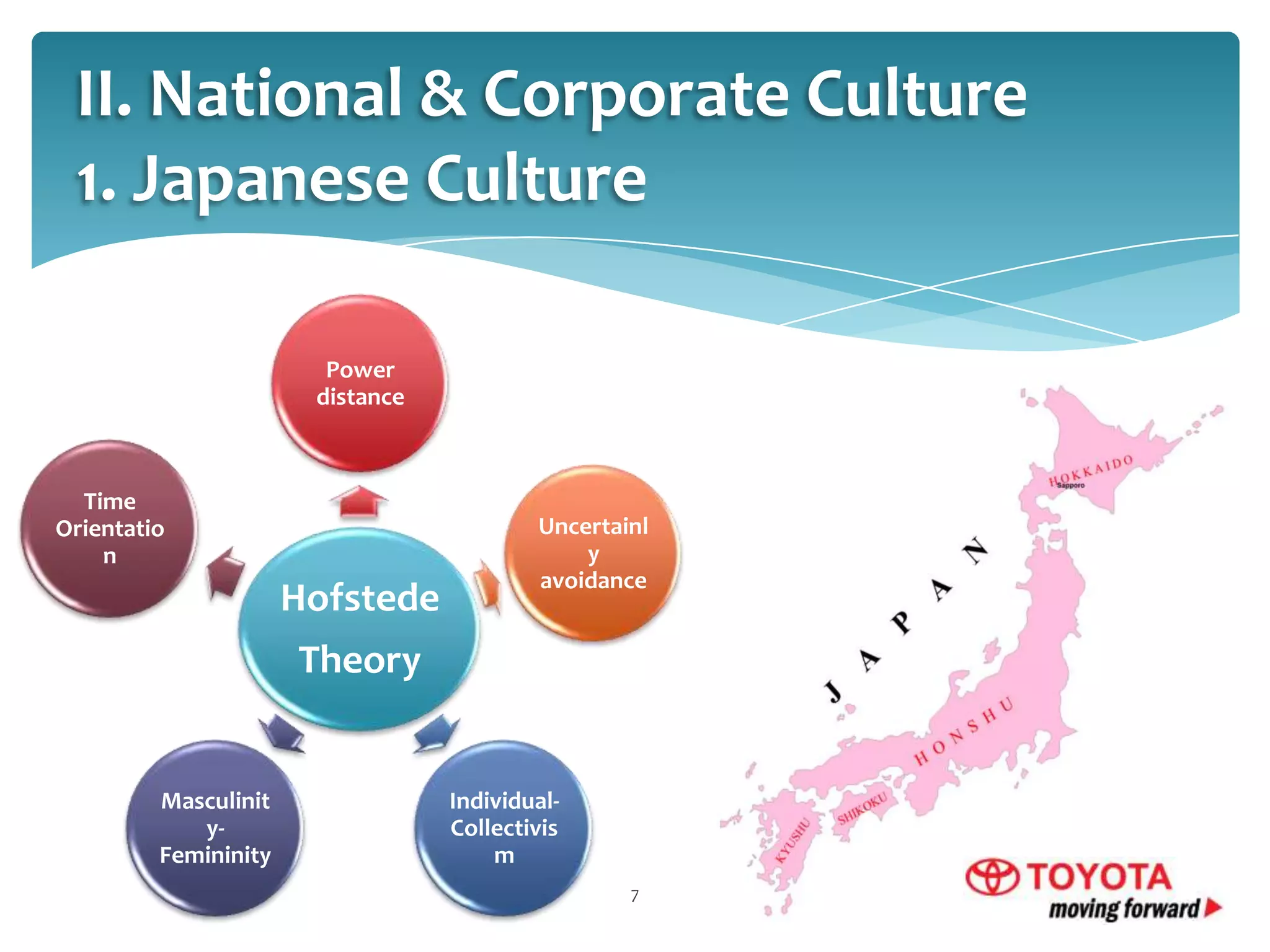
Power
distance

Time
Orientatio
n

Hofstede

Uncertainl
y
avoidance

Theory

Masculinit
yFemininity

IndividualCollectivis
m
7
II. National & Corporate Culture
1. Japanese Culture
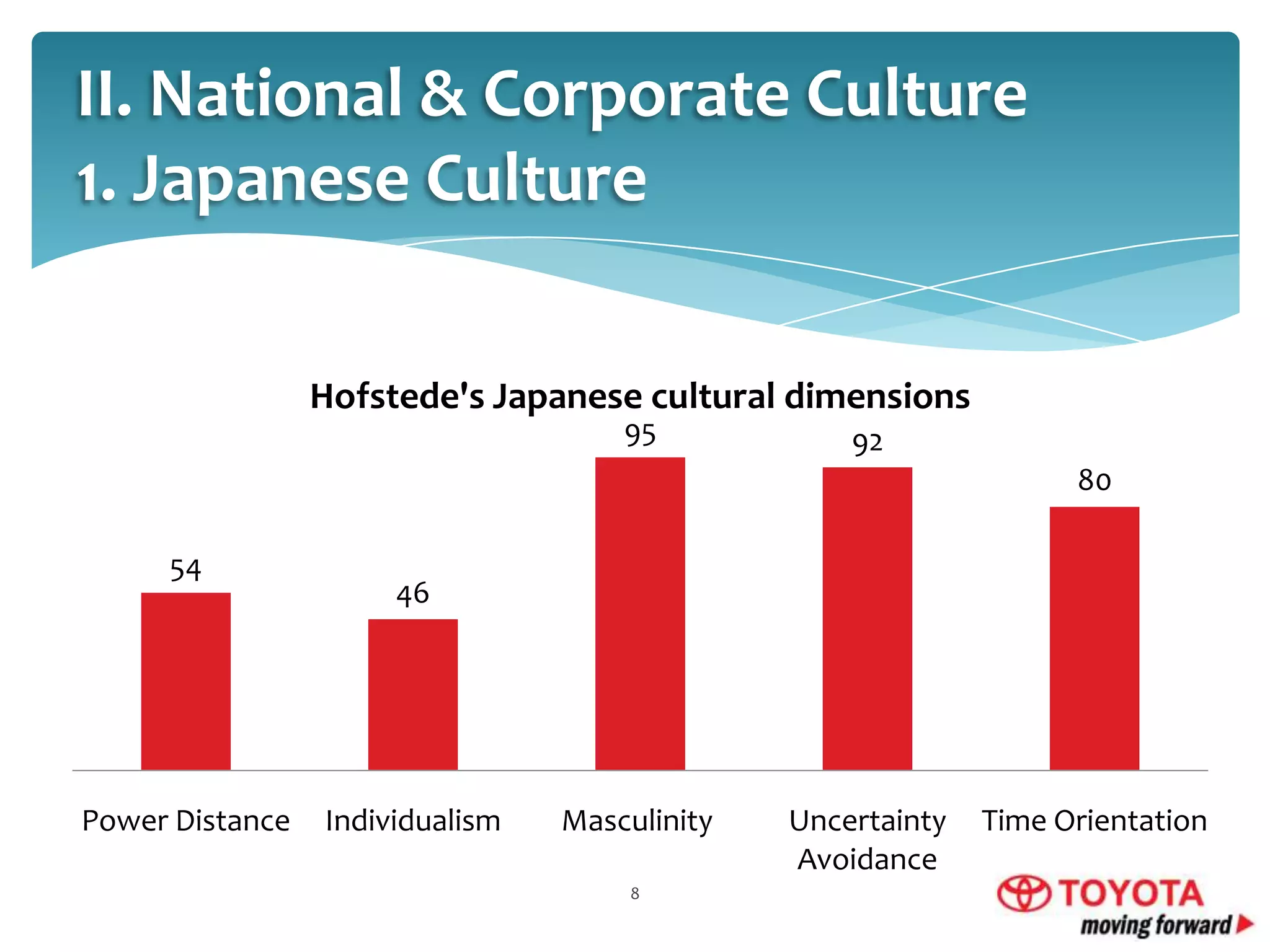
Hofstede's Japanese cultural dimensions
95

92
80

54

Power Distance

46

Individualism

Masculinity
8

Uncertainty
Avoidance

Time Orientation
II. National & Corporate Culture
1. Japanese Culture
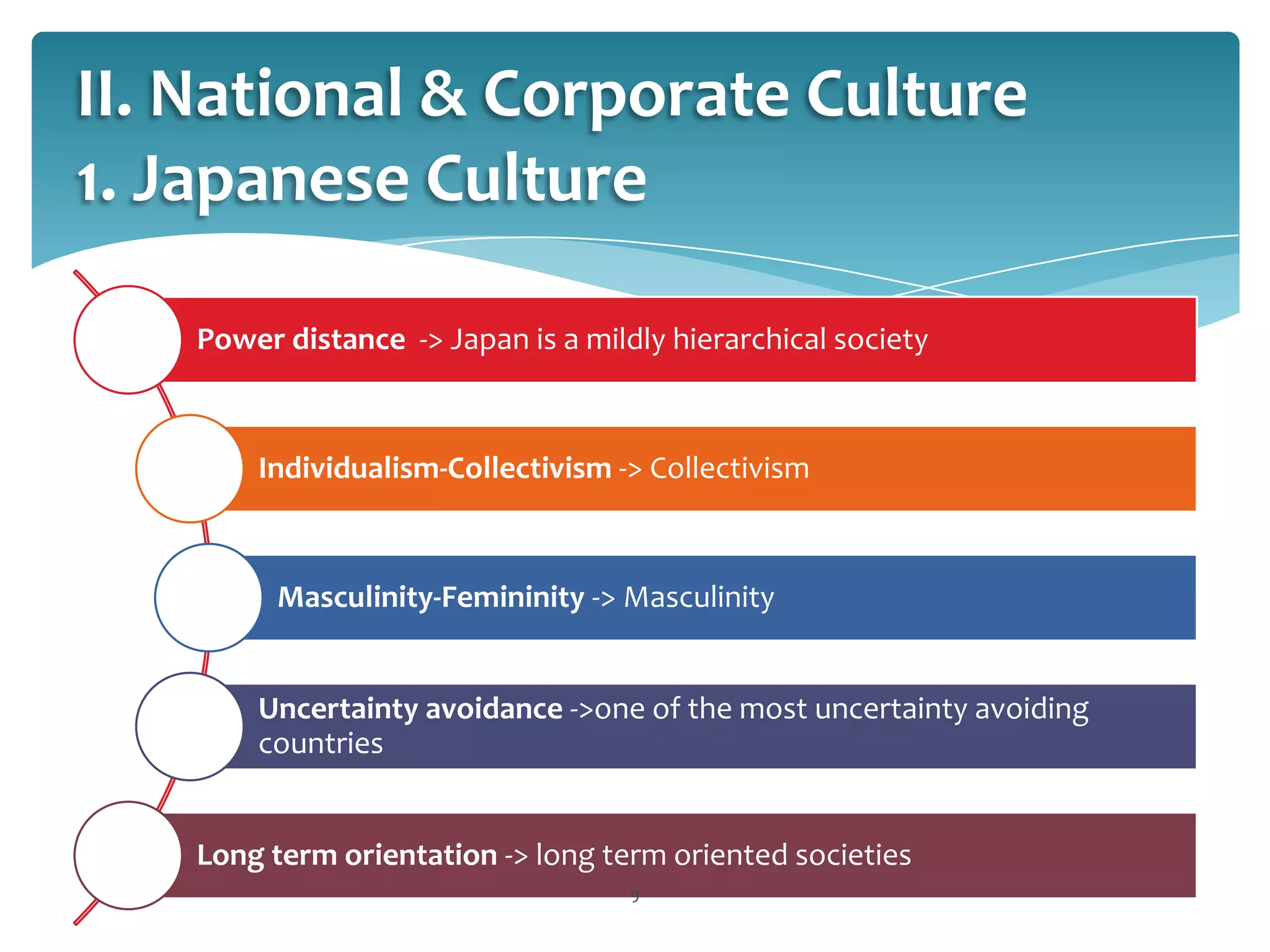
Power distance -> Japan is a mildly hierarchical society

Individualism-Collectivism -> Collectivism

Masculinity-Femininity -> Masculinity

Uncertainty avoidance ->one of the most uncertainty avoiding
countries

Long term orientation -> long term oriented societies
9
II. National & Corporate Culture
2. Toyota Culture
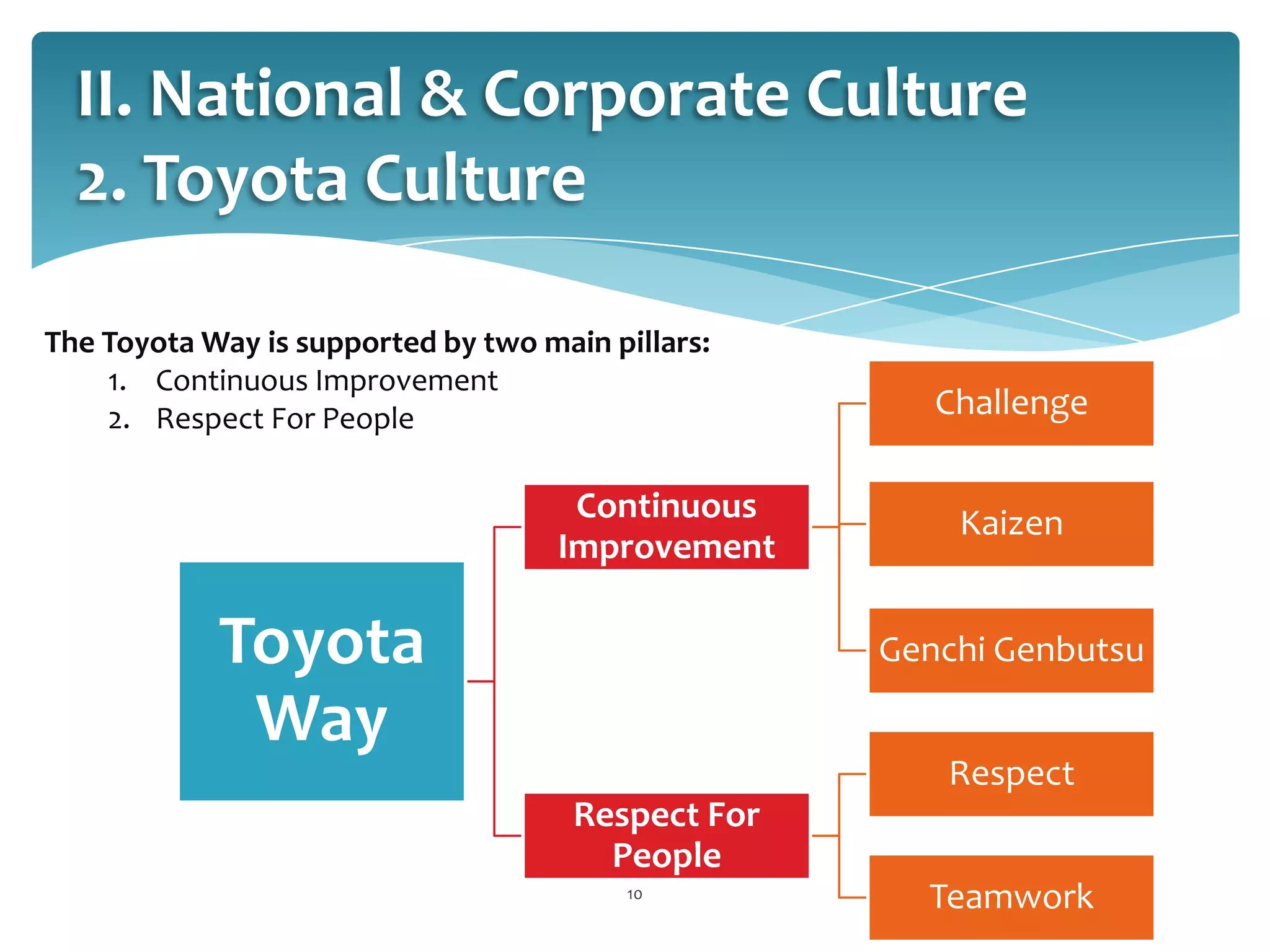
The Toyota Way is supported by two main pillars:
1. Continuous Improvement
2. Respect For People

Continuous
Improvement

Toyota
Way

Challenge
Kaizen
Genchi Genbutsu
Respect

Respect For
People
10

Teamwork
II. National & Corporate Culture
2. Toyota Culture
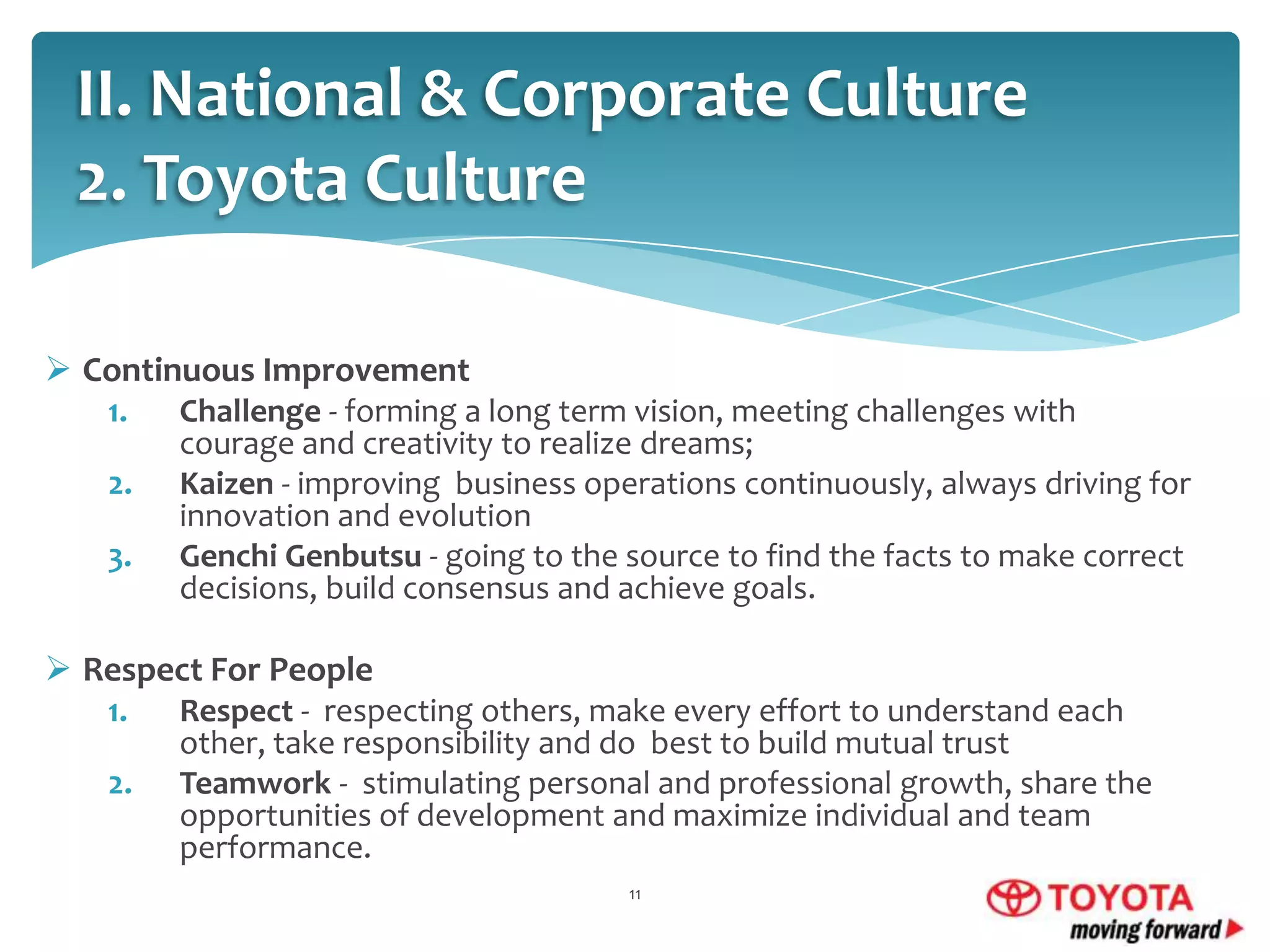
 Continuous Improvement
1.
2.
3.

Challenge - forming a long term vision, meeting challenges with
courage and creativity to realize dreams;
Kaizen - improving business operations continuously, always driving for
innovation and evolution
Genchi Genbutsu - going to the source to find the facts to make correct
decisions, build consensus and achieve goals.

 Respect For People
1.
2.

Respect - respecting others, make every effort to understand each
other, take responsibility and do best to build mutual trust
Teamwork - stimulating personal and professional growth, share the
opportunities of development and maximize individual and team
performance.
11
III. Toyota Business
1. Business Strategies
What type of business strategy has Toyota
pursued in its international business?

Geocentric approach
Regiocentric approach
Standardization
More adapted approach to be more
close to consumers expectation
“Think globally, act locally”

12
2. Strategic IHRM
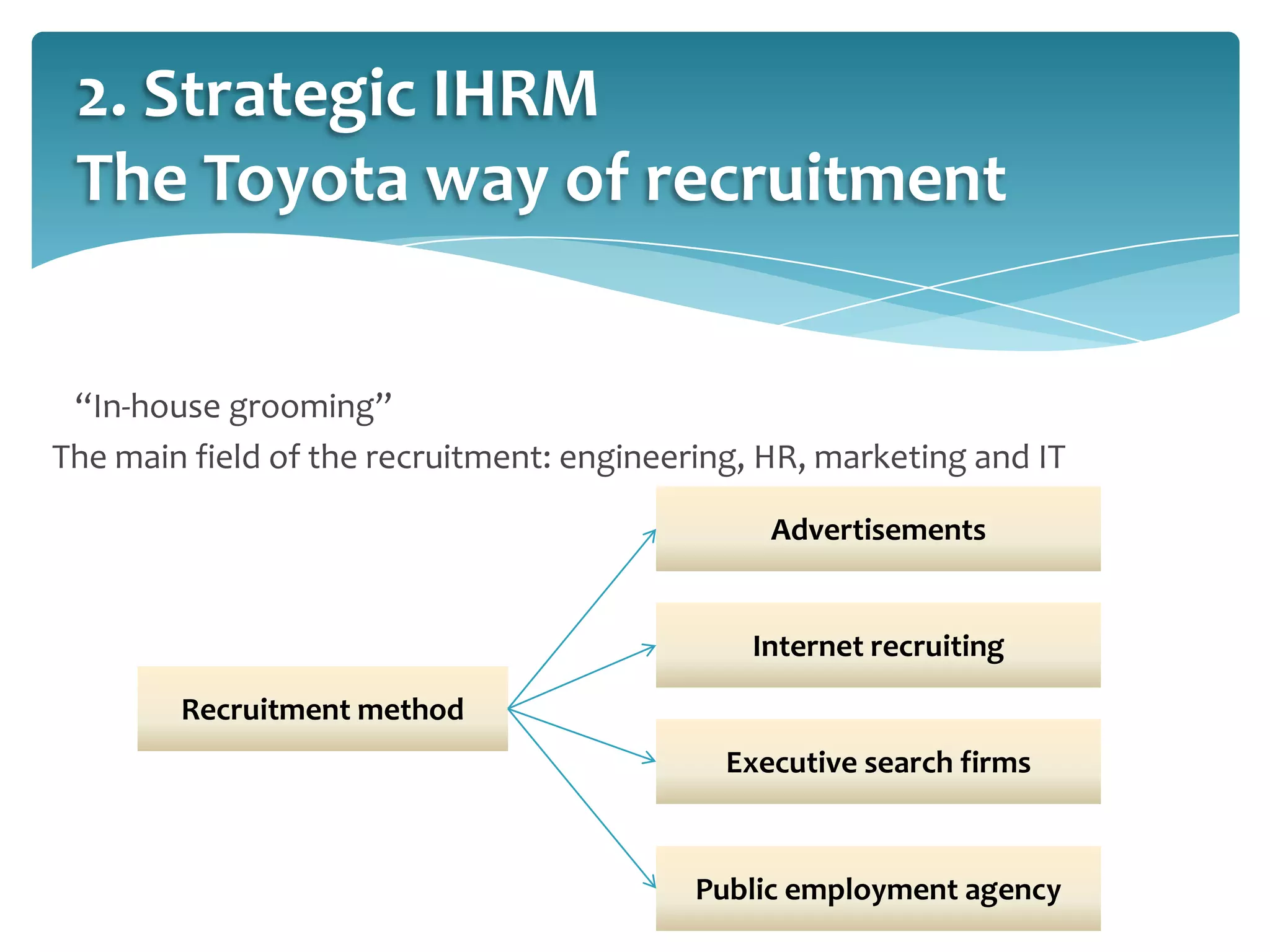
The Toyota way of recruitment
“In-house grooming”
The main field of the recruitment: engineering, HR, marketing and IT
Advertisements

Internet recruiting
Recruitment method

Executive search firms

Public employment agency
2. Strategic IHRM
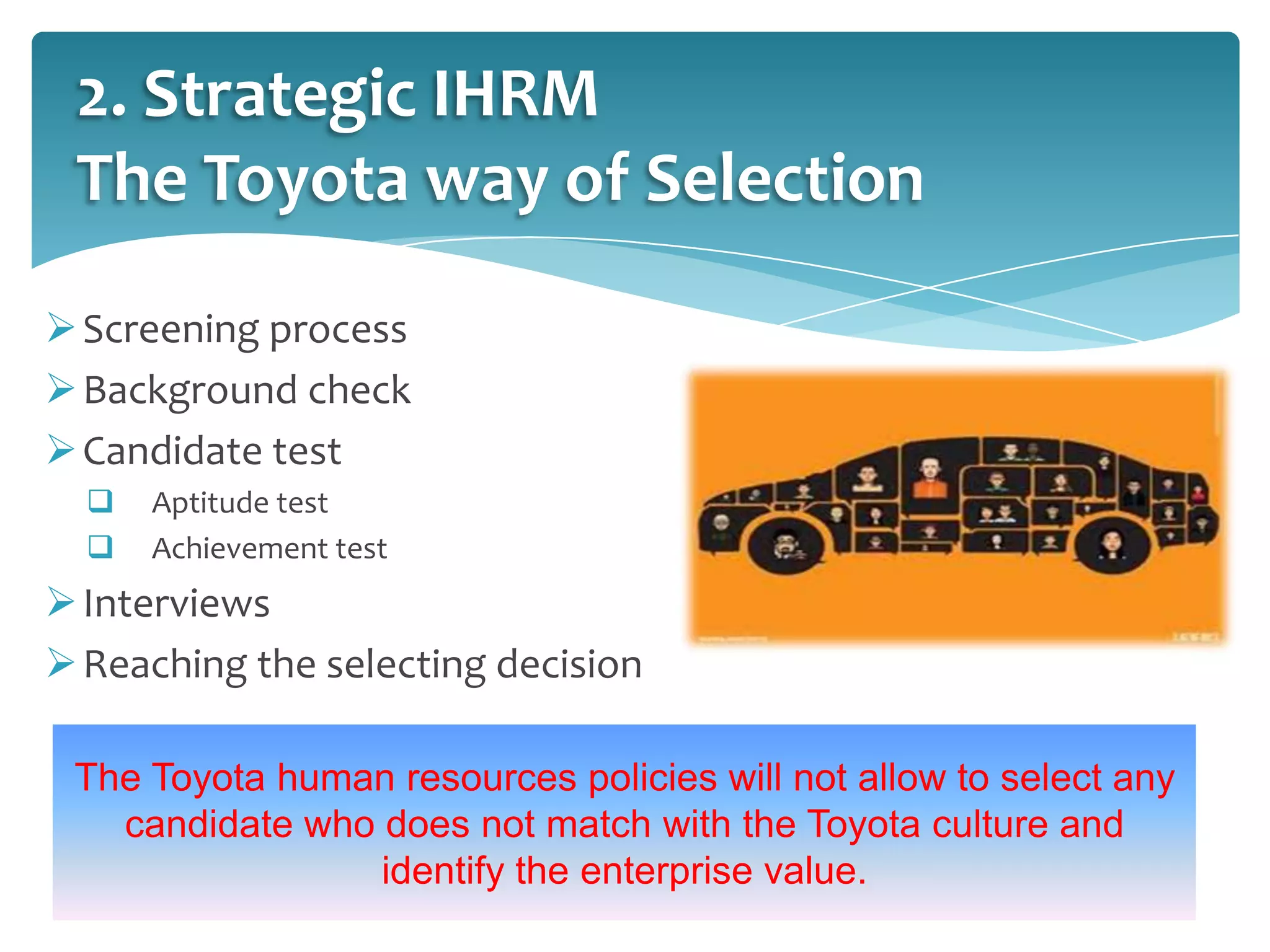
The Toyota way of Selection
 Screening process
 Background check
 Candidate test



Aptitude test
Achievement test

 Interviews
 Reaching the selecting decision
The Toyota human resources policies will not allow to select any
candidate who does not match with the Toyota culture and
identify the enterprise value.
14
2. Strategic IHRM
Using PCNs and HCNs
PCNs from Toyota

HCNs and TCNs

• Firstly, the internal selection can also
guarantee the deep understanding of
Toyota spirits.
• Secondly, the position promotion will
be a convention for the expatriate
when he comes back .
• Thirdly, Toyota encourages the
expatriate together with his family
members and supply the financial
support.

• Communicative: HCN and TCN shall
have the strong intention to express
and exchange own ideas with the
Japanese colleague, learning the
enterprise spirits of Toyota actively.

15
2. Strategic IHRM
Training and Development
TRAINING
• Employees are involved directly
in running the Toyota Production
System.
• Responsibility for the quality of
their own role in the production
process.
• Passing on only good work on
the line which they see as their
“customer”

DEVELOPMENT
• Structured development path
with clearly identified courses to
develop employees’ skills and
provide a path way to the next
level within the company.

16
2. Strategic IHRM
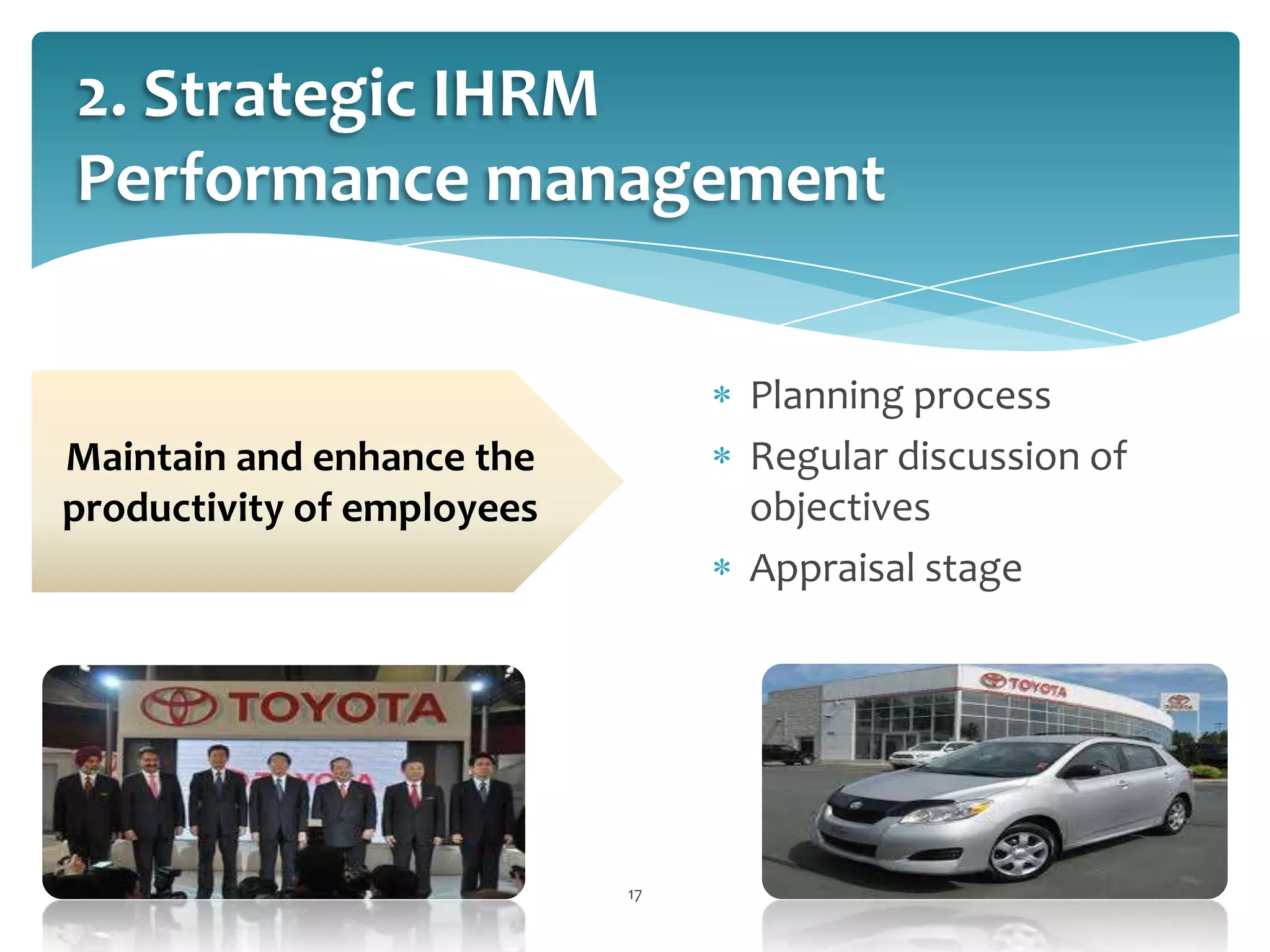
Performance management
Planning process
Regular discussion of
objectives
Appraisal stage

Maintain and enhance the
productivity of employees

17
Thank you
for watching
18

Toyota way Ihrm

  • 1.
    International Human ResourceManagement Toyota Motor Corporation Group 4 Nguyen Thu Hang Vu Le Hoang To Duc Anh
  • 2.
    Table of Content I. ToyotaMotor Corp 1. Introduction 2. Globalization II. National and Corporate Culture 1. Japanese Culture 2. Toyota Culture III. Toyota Business 1. Business Strategies 2. Strategic IHRM 2
  • 3.
    I. Toyota MotorCorp 1. Introduction  Toyota was born in a rural area near Nagoya, Japan in 1867 by Sakichi Toyoda  The first product made by the effort of Sakichi and his son was an automatic loom in 1924  In 1929, with the notion that the auto industry is growing  he sold his patent to Platt Brothers company  take the fund to invest in the manufacturing and automotive manufacturing  August 28,1937, Toyota Motor Corporation 3 officially launched
  • 4.
    I. Toyota MotorCorp 2. Globalization Reasons for Toyota’s decision to become globalized ? 1. Expand the market to the world 2. Take great advantages of locations, technologies and cheap labor forces from other countries 3. Create the high competitiveness and opportunities in domestic market 4. Building a learning culture for continuous improvement 4
  • 5.
    I. Toyota MotorCorp 2. Globalization Impacts on IHRM of Toyota’s employees ? 1. 2. 3. 4. 5. Recruitment employees bases on typical style of Japanese: intelligent, hardworking, team player, careful but conservative, stubborn. Equally divided workload for both employees and machines (heijuka) Standardized tasks are the foundation for continuous improvement and encouraging staffs Only use reliable technologies which are thoroughly tested to meet the staffs and processes Training leaders to become who are able to understand the life and philosophy of staffs 5
  • 6.
    II. National &Corporate Culture Japanese culture Toyota culture 6
  • 7.
    II. National &Corporate Culture 1. Japanese Culture Power distance Time Orientatio n Hofstede Uncertainl y avoidance Theory Masculinit yFemininity IndividualCollectivis m 7
  • 8.
    II. National &Corporate Culture 1. Japanese Culture Hofstede's Japanese cultural dimensions 95 92 80 54 Power Distance 46 Individualism Masculinity 8 Uncertainty Avoidance Time Orientation
  • 9.
    II. National &Corporate Culture 1. Japanese Culture Power distance -> Japan is a mildly hierarchical society Individualism-Collectivism -> Collectivism Masculinity-Femininity -> Masculinity Uncertainty avoidance ->one of the most uncertainty avoiding countries Long term orientation -> long term oriented societies 9
  • 10.
    II. National &Corporate Culture 2. Toyota Culture The Toyota Way is supported by two main pillars: 1. Continuous Improvement 2. Respect For People Continuous Improvement Toyota Way Challenge Kaizen Genchi Genbutsu Respect Respect For People 10 Teamwork
  • 11.
    II. National &Corporate Culture 2. Toyota Culture  Continuous Improvement 1. 2. 3. Challenge - forming a long term vision, meeting challenges with courage and creativity to realize dreams; Kaizen - improving business operations continuously, always driving for innovation and evolution Genchi Genbutsu - going to the source to find the facts to make correct decisions, build consensus and achieve goals.  Respect For People 1. 2. Respect - respecting others, make every effort to understand each other, take responsibility and do best to build mutual trust Teamwork - stimulating personal and professional growth, share the opportunities of development and maximize individual and team performance. 11
  • 12.
    III. Toyota Business 1.Business Strategies What type of business strategy has Toyota pursued in its international business? Geocentric approach Regiocentric approach Standardization More adapted approach to be more close to consumers expectation “Think globally, act locally” 12
  • 13.
    2. Strategic IHRM TheToyota way of recruitment “In-house grooming” The main field of the recruitment: engineering, HR, marketing and IT Advertisements Internet recruiting Recruitment method Executive search firms Public employment agency
  • 14.
    2. Strategic IHRM TheToyota way of Selection  Screening process  Background check  Candidate test   Aptitude test Achievement test  Interviews  Reaching the selecting decision The Toyota human resources policies will not allow to select any candidate who does not match with the Toyota culture and identify the enterprise value. 14
  • 15.
    2. Strategic IHRM UsingPCNs and HCNs PCNs from Toyota HCNs and TCNs • Firstly, the internal selection can also guarantee the deep understanding of Toyota spirits. • Secondly, the position promotion will be a convention for the expatriate when he comes back . • Thirdly, Toyota encourages the expatriate together with his family members and supply the financial support. • Communicative: HCN and TCN shall have the strong intention to express and exchange own ideas with the Japanese colleague, learning the enterprise spirits of Toyota actively. 15
  • 16.
    2. Strategic IHRM Trainingand Development TRAINING • Employees are involved directly in running the Toyota Production System. • Responsibility for the quality of their own role in the production process. • Passing on only good work on the line which they see as their “customer” DEVELOPMENT • Structured development path with clearly identified courses to develop employees’ skills and provide a path way to the next level within the company. 16
  • 17.
    2. Strategic IHRM Performancemanagement Planning process Regular discussion of objectives Appraisal stage Maintain and enhance the productivity of employees 17
  • 18.