
JAPAN Country Workshop Ozan Can Koseley
JAPAN Country Workshop Japan: the Country Economy of Japan The Japanese Management Style The Japanese Automotive Industry A Japanese leading company Business Case
Japan: the Country
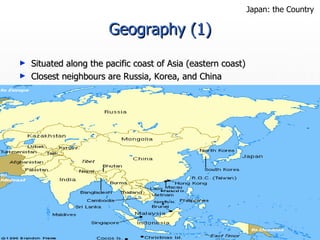
Geography (1) Situated along the pacific coast of Asia (eastern coast) Closest neighbours are Russia, Korea, and China Japan: the Country
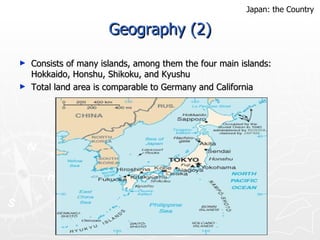
Geography (2) Consists of many islands, among them the four main islands: Hokkaido, Honshu, Shikoku, and Kyushu Total land area is comparable to Germany and California  Japan: the Country
Geography (3) Largest part of Japan is mountainous Highest mountain is the well known Mount Fuji (12,385 ft) Japan is also situated in a volcanic zone Japan: the Country
Climate The climate of Japan varies strongly in the different regions The climate in most of the major cities is sub tropic with four seasons Japan: the Country
Population (1) Population currently a little above 127 million people including 2 million of foreign people Japan has one of the world highest life expectancy (81,25 years in 2006) Growth rate is slowing down for the first time in 100 years, reason is the falling birth rate  Japan: the Country
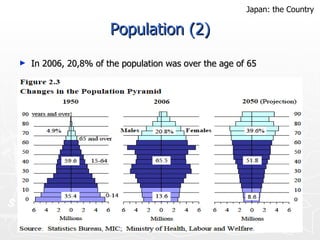
Population (2) In 2006, 20,8% of the population was over the age of 65  Japan: the Country
Population (3) Japanese society is mostly linguistically and culturally homogenous 99% of the population speak Japanese as their first language The most dominant native ethnic group is the Yamato people “ Nikkeijin” = Japanese people who either emigrated from Japan or are descendants of a person who emigrated from Japan Japan: the Country
Population (4) Top 4 of places where Japanese people immigrate to: Brazil (Sáo  Paula and Parana) Philippines Peru Hawaii Japan: the Country
Religion 84-96% believe in Shinto and Mahayana Buddhism Japanese beliefs and methodology are influenced by: Buddhism Taoism Confucianism Japanese tends to be syncretic in nature Resulting in variety of different practices  Japan: the Country
Economy of Japan
 One of the largest economy in the world Why  ? This strong economy is  partly due  to The close government-industry cooperation A strong work ethic  Mastery of high technology  A comparatively small defence allocation (1% of GDP) Economy Of Japan
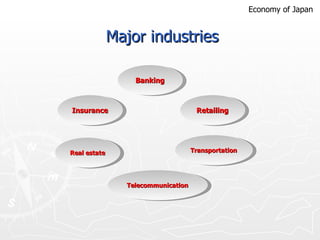
Major industries Banking Insurance Real estate Retailing Transportation Telecommunication Economy of Japan
Two notable characteristics  Keiretsu  The guarantee of lifetime employment in big corporations Economy of Japan
Tokyo stock exchange The second largest stock exchange market in the world by monetary volume.  It Currently lists: 2,271 domestic companies 31 foreign companies A total market capitalization of over $5 trillion  Economy of Japan
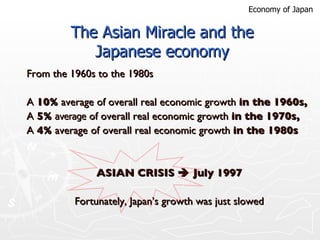
The Asian Miracle and the Japanese economy From the 1960s to the 1980s A  10%  average of overall real economic growth  in the 1960s,  A  5%  average  of overall real economic growth  in the 1970s,  A  4%  average   of   overall real economic growth  in the 1980s ASIAN CRISIS    July 1997 Fortunately, Japan’s growth was just slowed Economy of Japan
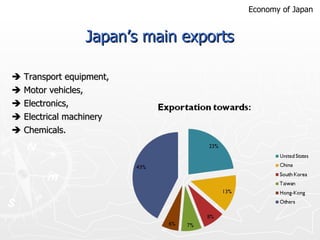
   Transport equipment,     Motor vehicles,     Electronics,    Electrical machinery    Chemicals. Japan’s main exports Economy of Japan
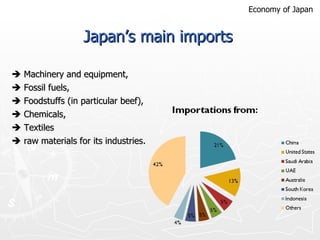
   Machinery and equipment,     Fossil fuels,     Foodstuffs (in particular beef),     Chemicals,    Textiles    raw materials for its industries.   Japan’s main imports Economy of Japan
THE JAPANESE MANAGEMENT STYLE
The characteristics of the Japanese management style A group consensus in decision making A Career job security A pay and promotion system heavily reliant upon senority In-house unions enlisting all company employees The Japanese Management Style
The Western admiration for the Japanese management style Resulting from the higher labour productivity growth rate of Japan     9.3% from 1960 to 1980 The perceived devotion of Japanese employees to their companies and work The competitiveness of the Japanese corporate system : a managerial autonomy The relationship with the shareholders The Japanese Management Style
Leadership and decision-making The Japanese corporations are rigidly organized and extremely hierarchical An independent power centre in each department of the organization Decision making : a real group process Careful attention being given to the preliminary stages of management by group consensus The ‘ringisho’ The Japanese Management Style
The advantages to the Japanese form of decision-making It has some elements of democracy A greater participation of decision-making  in the company The inclusion of many individuals in the decision-making process    An easier and more efficient implementation  The Japanese Management Style
The flaws of the Japanese process Too many people and sections get involved Too many meetings are held The meetings are very long The delay of business decision-making The influence of the relationships between the participants in the final decision The Japanese Management Style
The Lifetime Employment : ‘shushinkoyo’ Employees are recruited directly from school rather than from an open job market Employees are expected to stay with the company all their working life     they can expect lifelong job security The importance of the recruitment A real family-type social organization The Japanese Management Style
The seniority Promotion: ‘nenko joretsu’ ‘ nenko’: the merit in the number of years an employee has provided his services A major motivation for employees to stay long in one company A system under pression (from mid-1980s) The Japanese Management Style
The enterprise trade unions: ‘kigyo-betsu kumiai’ Basic organization in Japan’s labour movement A competitive advantage of the Japanese management system No differentiation as to occupation and job status A unique interdependent relationship between the enterprise union and the company The same office space and facilities    provided by the company The same future The Japanese Management Style
The Japanese Automotive Industry
The Japanese Industry Second largest industry in the world GDP output of $4.883 Trillion  The Japanese Automotive Industry
The Japanese Industry Largest and most technologically advanced producers  Motor Vehicles Electronic Equipment Machine Tools  Metals  Ships  Chemicals  Textiles  Processed Foods Major Industries Banking  Insurance Real estate Retailing Transportation Telecommunications  The Japanese Automotive Industry
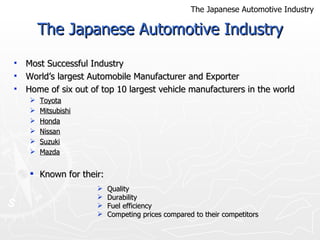
The Japanese Automotive Industry Most Successful Industry  World’s largest Automobile Manufacturer and Exporter Home of six out of top 10 largest vehicle manufacturers in the world Toyota Mitsubishi Honda Nissan Suzuki Mazda Known for their: Quality Durability Fuel efficiency  Competing prices compared to their competitors  The Japanese Automotive Industry
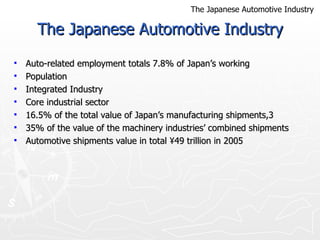
Auto-related employment totals 7.8% of Japan’s working Population Integrated Industry  Core industrial sector 16.5% of the total value of Japan’s manufacturing shipments,3 35% of the value of the machinery industries’ combined shipments  Automotive shipments value in total ¥49 trillion in 2005 The Japanese Automotive Industry The Japanese Automotive Industry
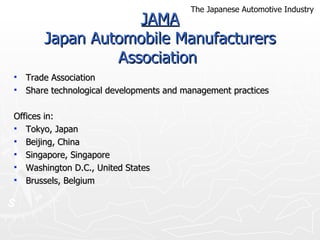
JAMA Japan Automobile Manufacturers Association  Trade Association  Share technological developments and management practices Offices in:  Tokyo, Japan Beijing, China  Singapore, Singapore Washington D.C., United States  Brussels, Belgium The Japanese Automotive Industry
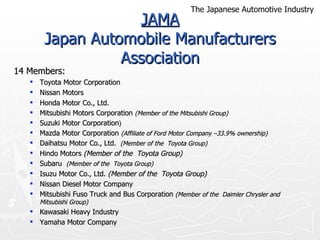
JAMA Japan Automobile Manufacturers Association 14 Members: Toyota Motor Corporation Nissan Motors Honda Motor Co., Ltd. Mitsubishi Motors Corporation  (Member of the Mitsubishi Group) Suzuki Motor Corporation ) Mazda Motor Corporation   (Affiliate of Ford Motor Company –33.9% ownership) Daihatsu Motor Co., Ltd.  (Member of the  Toyota Group)  Hindo Motors  (Member of the  Toyota Group) Subaru  (Member of the  Toyota Group) Isuzu Motor Co., Ltd.  (Member of the  Toyota Group) Nissan Diesel Motor Company Mitsubishi Fuso Truck and Bus Corporation  (Member of the  Daimler Chrysler and Mitsubishi Group)  Kawasaki Heavy Industry Yamaha Motor Company The Japanese Automotive Industry
Other Car manufacturers,  Coachbuilders and Tuning Companies Mitsuoka Spoon Sports HKS The Japanese Automotive Industry
A Japanese leading company
The Toyota Group It is the biggest single firm in Japan Its annual sales is approximately $72 billion  Overall 72 thousand employees  Toyota Industries Corporation and Toyota Motor Corporation In contrast to the horizontal keiretsu the Toyota Group is not oriented around a bank  Also operates in many other fields such as: telecommunications  computer development (with IBM Japan)  nonlife insurance (automobile insurance)  real estate  finance  leasing  aircraft development  automobile marketing  A Japanese leading Company
The Toyota Group The Toyota Group comprises of 16 companies: Toyota Industries Corporation (founded in 1926)  JTEKT Corporation (1935)  Toyota Motor Corporation (1937)  Toyota Motor Corporation (1937)  Toyota Auto Body, Co. Ltd. (1940) Aichi Steel Corporation (1940) Kanto Auto Works, Ltd. (1945) Toyota Tsusho Corporation (1946) Aisin Seiki Co., Ltd. (1949) Toyoda Gosei Co., Ltd. (1949) Denso Corporation (1949) Toyota Boshoku Corporation (1950) Towa Real Estate Co., Ltd. (1953) Toyota Central R&D Labs., Inc. (1960) Daihatsu Motor Co (1907; Toyota owns 51% of the company since 1999) Hino Motors (diesel trucks and buses. Toyota owns 50.5% of the company since 2001)   A Japanese leading Company
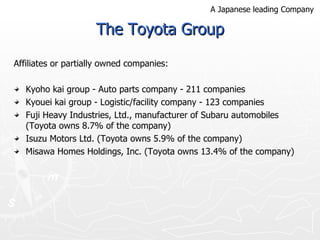
The Toyota Group Affiliates or partially owned companies: Kyoho kai group - Auto parts company - 211 companies Kyouei kai group - Logistic/facility company - 123 companies Fuji Heavy Industries, Ltd., manufacturer of Subaru automobiles (Toyota owns 8.7% of the company) Isuzu Motors Ltd. (Toyota owns 5.9% of the company) Misawa Homes Holdings, Inc. (Toyota owns 13.4% of the company) A Japanese leading Company
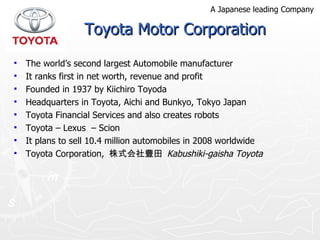
Toyota Motor Corporation The world’s second largest Automobile manufacturer It ranks first in net worth, revenue and profit  Founded in 1937 by Kiichiro Toyoda Headquarters in Toyota, Aichi and Bunkyo, Tokyo Japan Toyota Financial Services and also creates robots Toyota – Lexus  – Scion  It plans to sell 10.4 million automobiles in 2008 worldwide Toyota Corporation,  株式会社豊田  Kabushiki-gaisha Toyota A Japanese leading Company
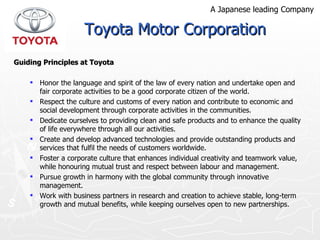
Guiding Principles at Toyota Honor the language and spirit of the law of every nation and undertake open and fair corporate activities to be a good corporate citizen of the world. Respect the culture and customs of every nation and contribute to economic and social development through corporate activities in the communities.  Dedicate ourselves to providing clean and safe products and to enhance the quality of life everywhere through  all our activities.  Create and develop advanced technologies and provide outstanding products and services that fulfil the needs  of customers worldwide.  Foster a corporate culture that enhances individual  creativity and teamwork value, while honouring mutual trust and respect between labour and management.  Pursue growth in harmony with the global community  through innovative management.  Work with business partners in research and creation to achieve stable, long-term growth and mutual benefits,  while keeping ourselves open to new partnerships. Toyota Motor Corporation A Japanese leading Company
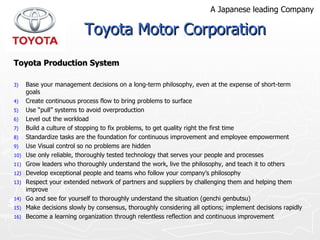
Toyota Production System Base your management decisions on a long-term philosophy, even at the expense of short-term  goals  Create continuous process flow to bring problems to surface Use “pull” systems to avoid overproduction Level out the workload Build a culture of stopping to fix problems, to get quality right the first time Standardize tasks are the foundation for continuous improvement and employee empowerment Use Visual control so no problems are hidden Use only reliable, thoroughly tested technology that serves your people and processes Grow leaders who thoroughly understand the work, live the philosophy, and teach it to others Develop exceptional people and teams who follow your company’s philosophy Respect your extended network of partners and suppliers by challenging them and helping them improve Go and see for yourself to thoroughly understand the situation (genchi genbutsu) Make decisions slowly by consensus, thoroughly considering all options; implement decisions rapidly Become a learning organization through relentless reflection and continuous improvement Toyota Motor Corporation A Japanese leading Company
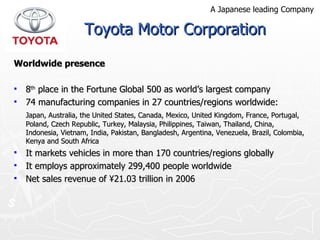
Worldwide presence 8 th  place in the Fortune Global 500 as world’s largest company 74 manufacturing companies in 27 countries/regions worldwide: Japan, Australia, the United States, Canada, Mexico, United Kingdom, France, Portugal, Poland, Czech Republic, Turkey, Malaysia, Philippines, Taiwan, Thailand, China, Indonesia, Vietnam, India, Pakistan, Bangladesh, Argentina, Venezuela, Brazil, Colombia, Kenya and South Africa It markets vehicles in more than 170 countries/regions globally It employs approximately 299,400 people worldwide Net sales revenue of ¥21.03 trillion in 2006 Toyota Motor Corporation A Japanese leading Company
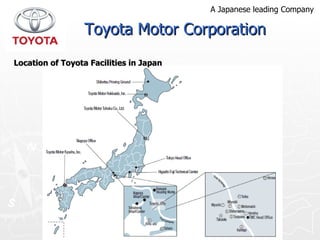
Location of Toyota Facilities in Japan Toyota Motor Corporation A Japanese leading Company
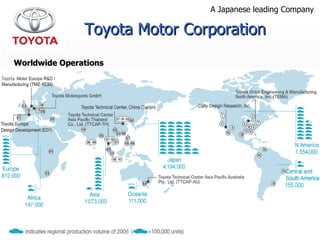
Worldwide Operations Toyota Motor Corporation A Japanese leading Company
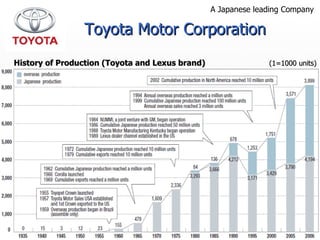
History of Production (Toyota and Lexus brand)   (1=1000 units) Toyota Motor Corporation A Japanese leading Company
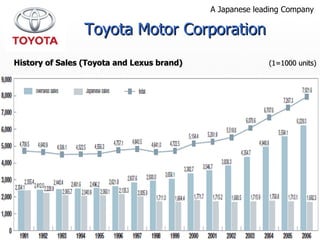
History of Sales (Toyota and Lexus brand)   (1=1000 units) Toyota Motor Corporation A Japanese leading Company
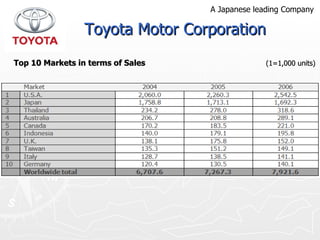
Top 10 Markets in terms of Sales   (1=1,000 units) Toyota Motor Corporation A Japanese leading Company
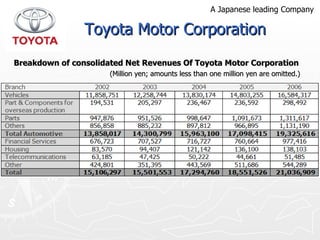
Breakdown of consolidated Net Revenues Of Toyota Motor Corporation (Million yen; amounts less than one million yen are omitted.) Toyota Motor Corporation A Japanese leading Company
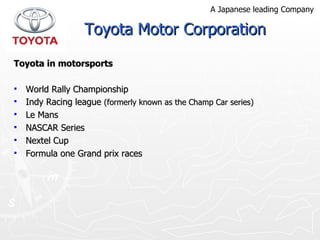
Toyota in motorsports   World Rally Championship Indy Racing league  (formerly known as the Champ Car series)  Le Mans NASCAR Series Nextel Cup Formula one Grand prix races Toyota Motor Corporation A Japanese leading Company
Toyota in the Future To improve overall quality through consistently adopting a ‘customer first’ mindset and through achieving ‘built-in quality with ownership’  To operate with full autonomy  Implementing sustainability within the frameworks of research and development, production, and social contribution Toyota Global Vision 2020 : Toyota wants to become  ‘the most admired in the world’ Through the combined efforts of all associates across the globe it will put Toyota well on its way to realizing its dreams of sustainability for the future. Toyota Motor Corporation A Japanese leading Company
Failed businesses in Japan
Question 1 Business in Japan. Why does it make sense?   Failed Businesses in Japan
Answer Business in Japan. Why does it make sense?   Japan is the  world's second largest market competitor 125 million people Advanced tec hnolog y 20 million internet users 50 million  mo bile phone  15% of the world's economy is in Japan Failed Businesses in Japan
Question 2  What are the common reasons that cause international companies to fail in  J apan? Failed Businesses in Japan
Answer What are the common reasons that cause international companies to fail in  J apan? They have to take longer views Lack of meeting local market needs They need to focus on human resources Insufficient investment Trying to adopt their business models directly to Japan  Failed Businesses in Japan
Japanese culture quiz In business meetings it is customary for the most senior person to enter the room last and sit closest to the door.  In Japanese the number 4 sounds like the word for 'death' and consequently is deemed unlucky.  As in many Western cultures, silence is seen as uncomfortable and avoided where possible.  In Japanese culture, laughter is often used to hide feelings such as nervousness, shock, embarrassment, confusion and disapproval.  It is not rude to slurp or make noise while eating noodles or drinking tea
Japanese culture quiz In business meetings it is customary for the most senior person to enter the room last and sit closest to the door.  False. The most senior member of the team generally enters the room first, followed by his subordinates in order of rank. The least senior member will sit closest to the door.  In Japanese the number 4 sounds like the word for 'death' and consequently is deemed unlucky.  True.  As in many Western cultures, silence is seen as uncomfortable and avoided where possible.  False. Silence is often used as part of the thought process and is never thought of as uncomfortable.  In Japanese culture, laughter is often used to hide feelings such as nervousness, shock, embarrassment, confusion and disapproval.  True. It is generally used when it is not known what feelings to express.  It is not rude to slurp or make noise while eating noodles or drinking tea  True. It is a positive sign that you are enjoying it!

Japan country workshop_pp

  • 1.
    JAPAN Country WorkshopOzan Can Koseley
  • 2.
    JAPAN Country WorkshopJapan: the Country Economy of Japan The Japanese Management Style The Japanese Automotive Industry A Japanese leading company Business Case
  • 3.
  • 4.
    Geography (1) Situatedalong the pacific coast of Asia (eastern coast) Closest neighbours are Russia, Korea, and China Japan: the Country
  • 5.
    Geography (2) Consistsof many islands, among them the four main islands: Hokkaido, Honshu, Shikoku, and Kyushu Total land area is comparable to Germany and California Japan: the Country
  • 6.
    Geography (3) Largestpart of Japan is mountainous Highest mountain is the well known Mount Fuji (12,385 ft) Japan is also situated in a volcanic zone Japan: the Country
  • 7.
    Climate The climateof Japan varies strongly in the different regions The climate in most of the major cities is sub tropic with four seasons Japan: the Country
  • 8.
    Population (1) Populationcurrently a little above 127 million people including 2 million of foreign people Japan has one of the world highest life expectancy (81,25 years in 2006) Growth rate is slowing down for the first time in 100 years, reason is the falling birth rate Japan: the Country
  • 9.
    Population (2) In2006, 20,8% of the population was over the age of 65 Japan: the Country
  • 10.
    Population (3) Japanesesociety is mostly linguistically and culturally homogenous 99% of the population speak Japanese as their first language The most dominant native ethnic group is the Yamato people “ Nikkeijin” = Japanese people who either emigrated from Japan or are descendants of a person who emigrated from Japan Japan: the Country
  • 11.
    Population (4) Top4 of places where Japanese people immigrate to: Brazil (Sáo Paula and Parana) Philippines Peru Hawaii Japan: the Country
  • 12.
    Religion 84-96% believein Shinto and Mahayana Buddhism Japanese beliefs and methodology are influenced by: Buddhism Taoism Confucianism Japanese tends to be syncretic in nature Resulting in variety of different practices Japan: the Country
  • 13.
  • 14.
     One ofthe largest economy in the world Why ? This strong economy is partly due to The close government-industry cooperation A strong work ethic Mastery of high technology A comparatively small defence allocation (1% of GDP) Economy Of Japan
  • 15.
    Major industries BankingInsurance Real estate Retailing Transportation Telecommunication Economy of Japan
  • 16.
    Two notable characteristics Keiretsu  The guarantee of lifetime employment in big corporations Economy of Japan
  • 17.
    Tokyo stock exchangeThe second largest stock exchange market in the world by monetary volume. It Currently lists: 2,271 domestic companies 31 foreign companies A total market capitalization of over $5 trillion Economy of Japan
  • 18.
    The Asian Miracleand the Japanese economy From the 1960s to the 1980s A 10% average of overall real economic growth in the 1960s, A 5% average of overall real economic growth in the 1970s, A 4% average of overall real economic growth in the 1980s ASIAN CRISIS  July 1997 Fortunately, Japan’s growth was just slowed Economy of Japan
  • 19.
    Transport equipment,  Motor vehicles,  Electronics,  Electrical machinery  Chemicals. Japan’s main exports Economy of Japan
  • 20.
    Machinery and equipment,  Fossil fuels,  Foodstuffs (in particular beef),  Chemicals,  Textiles  raw materials for its industries. Japan’s main imports Economy of Japan
  • 21.
  • 22.
    The characteristics ofthe Japanese management style A group consensus in decision making A Career job security A pay and promotion system heavily reliant upon senority In-house unions enlisting all company employees The Japanese Management Style
  • 23.
    The Western admirationfor the Japanese management style Resulting from the higher labour productivity growth rate of Japan  9.3% from 1960 to 1980 The perceived devotion of Japanese employees to their companies and work The competitiveness of the Japanese corporate system : a managerial autonomy The relationship with the shareholders The Japanese Management Style
  • 24.
    Leadership and decision-makingThe Japanese corporations are rigidly organized and extremely hierarchical An independent power centre in each department of the organization Decision making : a real group process Careful attention being given to the preliminary stages of management by group consensus The ‘ringisho’ The Japanese Management Style
  • 25.
    The advantages tothe Japanese form of decision-making It has some elements of democracy A greater participation of decision-making in the company The inclusion of many individuals in the decision-making process  An easier and more efficient implementation The Japanese Management Style
  • 26.
    The flaws ofthe Japanese process Too many people and sections get involved Too many meetings are held The meetings are very long The delay of business decision-making The influence of the relationships between the participants in the final decision The Japanese Management Style
  • 27.
    The Lifetime Employment: ‘shushinkoyo’ Employees are recruited directly from school rather than from an open job market Employees are expected to stay with the company all their working life  they can expect lifelong job security The importance of the recruitment A real family-type social organization The Japanese Management Style
  • 28.
    The seniority Promotion:‘nenko joretsu’ ‘ nenko’: the merit in the number of years an employee has provided his services A major motivation for employees to stay long in one company A system under pression (from mid-1980s) The Japanese Management Style
  • 29.
    The enterprise tradeunions: ‘kigyo-betsu kumiai’ Basic organization in Japan’s labour movement A competitive advantage of the Japanese management system No differentiation as to occupation and job status A unique interdependent relationship between the enterprise union and the company The same office space and facilities  provided by the company The same future The Japanese Management Style
  • 30.
  • 31.
    The Japanese IndustrySecond largest industry in the world GDP output of $4.883 Trillion The Japanese Automotive Industry
  • 32.
    The Japanese IndustryLargest and most technologically advanced producers Motor Vehicles Electronic Equipment Machine Tools Metals Ships Chemicals Textiles Processed Foods Major Industries Banking Insurance Real estate Retailing Transportation Telecommunications The Japanese Automotive Industry
  • 33.
    The Japanese AutomotiveIndustry Most Successful Industry World’s largest Automobile Manufacturer and Exporter Home of six out of top 10 largest vehicle manufacturers in the world Toyota Mitsubishi Honda Nissan Suzuki Mazda Known for their: Quality Durability Fuel efficiency Competing prices compared to their competitors The Japanese Automotive Industry
  • 34.
    Auto-related employment totals7.8% of Japan’s working Population Integrated Industry Core industrial sector 16.5% of the total value of Japan’s manufacturing shipments,3 35% of the value of the machinery industries’ combined shipments Automotive shipments value in total ¥49 trillion in 2005 The Japanese Automotive Industry The Japanese Automotive Industry
  • 35.
    JAMA Japan AutomobileManufacturers Association Trade Association Share technological developments and management practices Offices in: Tokyo, Japan Beijing, China Singapore, Singapore Washington D.C., United States Brussels, Belgium The Japanese Automotive Industry
  • 36.
    JAMA Japan AutomobileManufacturers Association 14 Members: Toyota Motor Corporation Nissan Motors Honda Motor Co., Ltd. Mitsubishi Motors Corporation (Member of the Mitsubishi Group) Suzuki Motor Corporation ) Mazda Motor Corporation (Affiliate of Ford Motor Company –33.9% ownership) Daihatsu Motor Co., Ltd. (Member of the Toyota Group) Hindo Motors (Member of the Toyota Group) Subaru (Member of the Toyota Group) Isuzu Motor Co., Ltd. (Member of the Toyota Group) Nissan Diesel Motor Company Mitsubishi Fuso Truck and Bus Corporation (Member of the Daimler Chrysler and Mitsubishi Group) Kawasaki Heavy Industry Yamaha Motor Company The Japanese Automotive Industry
  • 37.
    Other Car manufacturers, Coachbuilders and Tuning Companies Mitsuoka Spoon Sports HKS The Japanese Automotive Industry
  • 38.
  • 39.
    The Toyota GroupIt is the biggest single firm in Japan Its annual sales is approximately $72 billion Overall 72 thousand employees Toyota Industries Corporation and Toyota Motor Corporation In contrast to the horizontal keiretsu the Toyota Group is not oriented around a bank Also operates in many other fields such as: telecommunications computer development (with IBM Japan) nonlife insurance (automobile insurance) real estate finance leasing aircraft development automobile marketing A Japanese leading Company
  • 40.
    The Toyota GroupThe Toyota Group comprises of 16 companies: Toyota Industries Corporation (founded in 1926) JTEKT Corporation (1935) Toyota Motor Corporation (1937) Toyota Motor Corporation (1937) Toyota Auto Body, Co. Ltd. (1940) Aichi Steel Corporation (1940) Kanto Auto Works, Ltd. (1945) Toyota Tsusho Corporation (1946) Aisin Seiki Co., Ltd. (1949) Toyoda Gosei Co., Ltd. (1949) Denso Corporation (1949) Toyota Boshoku Corporation (1950) Towa Real Estate Co., Ltd. (1953) Toyota Central R&D Labs., Inc. (1960) Daihatsu Motor Co (1907; Toyota owns 51% of the company since 1999) Hino Motors (diesel trucks and buses. Toyota owns 50.5% of the company since 2001)   A Japanese leading Company
  • 41.
    The Toyota GroupAffiliates or partially owned companies: Kyoho kai group - Auto parts company - 211 companies Kyouei kai group - Logistic/facility company - 123 companies Fuji Heavy Industries, Ltd., manufacturer of Subaru automobiles (Toyota owns 8.7% of the company) Isuzu Motors Ltd. (Toyota owns 5.9% of the company) Misawa Homes Holdings, Inc. (Toyota owns 13.4% of the company) A Japanese leading Company
  • 42.
    Toyota Motor CorporationThe world’s second largest Automobile manufacturer It ranks first in net worth, revenue and profit Founded in 1937 by Kiichiro Toyoda Headquarters in Toyota, Aichi and Bunkyo, Tokyo Japan Toyota Financial Services and also creates robots Toyota – Lexus – Scion It plans to sell 10.4 million automobiles in 2008 worldwide Toyota Corporation, 株式会社豊田 Kabushiki-gaisha Toyota A Japanese leading Company
  • 43.
    Guiding Principles atToyota Honor the language and spirit of the law of every nation and undertake open and fair corporate activities to be a good corporate citizen of the world. Respect the culture and customs of every nation and contribute to economic and social development through corporate activities in the communities. Dedicate ourselves to providing clean and safe products and to enhance the quality of life everywhere through all our activities. Create and develop advanced technologies and provide outstanding products and services that fulfil the needs of customers worldwide. Foster a corporate culture that enhances individual creativity and teamwork value, while honouring mutual trust and respect between labour and management. Pursue growth in harmony with the global community through innovative management. Work with business partners in research and creation to achieve stable, long-term growth and mutual benefits, while keeping ourselves open to new partnerships. Toyota Motor Corporation A Japanese leading Company
  • 44.
    Toyota Production SystemBase your management decisions on a long-term philosophy, even at the expense of short-term goals  Create continuous process flow to bring problems to surface Use “pull” systems to avoid overproduction Level out the workload Build a culture of stopping to fix problems, to get quality right the first time Standardize tasks are the foundation for continuous improvement and employee empowerment Use Visual control so no problems are hidden Use only reliable, thoroughly tested technology that serves your people and processes Grow leaders who thoroughly understand the work, live the philosophy, and teach it to others Develop exceptional people and teams who follow your company’s philosophy Respect your extended network of partners and suppliers by challenging them and helping them improve Go and see for yourself to thoroughly understand the situation (genchi genbutsu) Make decisions slowly by consensus, thoroughly considering all options; implement decisions rapidly Become a learning organization through relentless reflection and continuous improvement Toyota Motor Corporation A Japanese leading Company
  • 45.
    Worldwide presence 8th place in the Fortune Global 500 as world’s largest company 74 manufacturing companies in 27 countries/regions worldwide: Japan, Australia, the United States, Canada, Mexico, United Kingdom, France, Portugal, Poland, Czech Republic, Turkey, Malaysia, Philippines, Taiwan, Thailand, China, Indonesia, Vietnam, India, Pakistan, Bangladesh, Argentina, Venezuela, Brazil, Colombia, Kenya and South Africa It markets vehicles in more than 170 countries/regions globally It employs approximately 299,400 people worldwide Net sales revenue of ¥21.03 trillion in 2006 Toyota Motor Corporation A Japanese leading Company
  • 46.
    Location of ToyotaFacilities in Japan Toyota Motor Corporation A Japanese leading Company
  • 47.
    Worldwide Operations ToyotaMotor Corporation A Japanese leading Company
  • 48.
    History of Production(Toyota and Lexus brand) (1=1000 units) Toyota Motor Corporation A Japanese leading Company
  • 49.
    History of Sales(Toyota and Lexus brand) (1=1000 units) Toyota Motor Corporation A Japanese leading Company
  • 50.
    Top 10 Marketsin terms of Sales (1=1,000 units) Toyota Motor Corporation A Japanese leading Company
  • 51.
    Breakdown of consolidatedNet Revenues Of Toyota Motor Corporation (Million yen; amounts less than one million yen are omitted.) Toyota Motor Corporation A Japanese leading Company
  • 52.
    Toyota in motorsports  World Rally Championship Indy Racing league (formerly known as the Champ Car series) Le Mans NASCAR Series Nextel Cup Formula one Grand prix races Toyota Motor Corporation A Japanese leading Company
  • 53.
    Toyota in theFuture To improve overall quality through consistently adopting a ‘customer first’ mindset and through achieving ‘built-in quality with ownership’ To operate with full autonomy Implementing sustainability within the frameworks of research and development, production, and social contribution Toyota Global Vision 2020 : Toyota wants to become ‘the most admired in the world’ Through the combined efforts of all associates across the globe it will put Toyota well on its way to realizing its dreams of sustainability for the future. Toyota Motor Corporation A Japanese leading Company
  • 54.
  • 55.
    Question 1 Businessin Japan. Why does it make sense? Failed Businesses in Japan
  • 56.
    Answer Business inJapan. Why does it make sense? Japan is the world's second largest market competitor 125 million people Advanced tec hnolog y 20 million internet users 50 million mo bile phone 15% of the world's economy is in Japan Failed Businesses in Japan
  • 57.
    Question 2 What are the common reasons that cause international companies to fail in J apan? Failed Businesses in Japan
  • 58.
    Answer What arethe common reasons that cause international companies to fail in J apan? They have to take longer views Lack of meeting local market needs They need to focus on human resources Insufficient investment Trying to adopt their business models directly to Japan Failed Businesses in Japan
  • 59.
    Japanese culture quizIn business meetings it is customary for the most senior person to enter the room last and sit closest to the door. In Japanese the number 4 sounds like the word for 'death' and consequently is deemed unlucky. As in many Western cultures, silence is seen as uncomfortable and avoided where possible. In Japanese culture, laughter is often used to hide feelings such as nervousness, shock, embarrassment, confusion and disapproval. It is not rude to slurp or make noise while eating noodles or drinking tea
  • 60.
    Japanese culture quizIn business meetings it is customary for the most senior person to enter the room last and sit closest to the door. False. The most senior member of the team generally enters the room first, followed by his subordinates in order of rank. The least senior member will sit closest to the door. In Japanese the number 4 sounds like the word for 'death' and consequently is deemed unlucky. True. As in many Western cultures, silence is seen as uncomfortable and avoided where possible. False. Silence is often used as part of the thought process and is never thought of as uncomfortable. In Japanese culture, laughter is often used to hide feelings such as nervousness, shock, embarrassment, confusion and disapproval. True. It is generally used when it is not known what feelings to express. It is not rude to slurp or make noise while eating noodles or drinking tea True. It is a positive sign that you are enjoying it!

Editor's Notes

  • #2 Japan Country Workshop
  • #3 Japan Country Workshop
  • #4 Japan Country Workshop
  • #5 Japan Country Workshop
  • #6 Japan Country Workshop
  • #7 Japan Country Workshop
  • #8 Japan Country Workshop
  • #9 Japan Country Workshop
  • #10 Japan Country Workshop
  • #11 Japan Country Workshop
  • #12 Japan Country Workshop
  • #13 Japan Country Workshop
  • #14 Japan Country Workshop
  • #15 Japan Country Workshop
  • #16 Japan Country Workshop
  • #17 Japan Country Workshop
  • #18 Japan Country Workshop
  • #19 Japan Country Workshop
  • #20 Japan Country Workshop
  • #21 Japan Country Workshop
  • #22 Japan Country Workshop
  • #23 Japan Country Workshop
  • #24 Japan Country Workshop
  • #25 Japan Country Workshop
  • #26 Japan Country Workshop
  • #27 Japan Country Workshop
  • #28 Japan Country Workshop
  • #29 Japan Country Workshop
  • #30 Japan Country Workshop
  • #31 Japan Country Workshop
  • #32 Japan Country Workshop
  • #33 Japan Country Workshop
  • #34 Japan Country Workshop
  • #36 Japan Country Workshop
  • #37 Japan Country Workshop
  • #38 Japan Country Workshop
  • #39 Japan Country Workshop
  • #40 Japan Country Workshop
  • #41 Japan Country Workshop
  • #42 Japan Country Workshop
  • #43 Japan Country Workshop
  • #44 Japan Country Workshop
  • #45 Japan Country Workshop
  • #46 Japan Country Workshop
  • #47 Japan Country Workshop
  • #48 Japan Country Workshop
  • #49 Japan Country Workshop
  • #50 Japan Country Workshop
  • #51 Japan Country Workshop
  • #52 Japan Country Workshop
  • #53 Japan Country Workshop
  • #54 Japan Country Workshop
  • #55 Japan Country Workshop
  • #56 Japan Country Workshop
  • #57 Japan Country Workshop
  • #58 Japan Country Workshop
  • #59 Japan Country Workshop
  • #60 Japan Country Workshop
  • #61 Japan Country Workshop