TOYOTA
PRESENTATION BY:
DEVVRAT SINGH SHEKHAWAT
Scheme of Presentation
Vision & Mission
History of Toyota
Organization Structure
Recent News
Financial Information
Strategy & Principles
Business Segments
Toyota Production System
Toyota in India
Recalls
SWOT
HA:MO
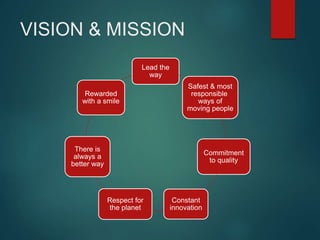
VISION & MISSION
Lead the
way
Safest & most
responsible
ways of
moving people
Commitment
to quality
Constant
innovation
Respect for
the planet
There is
always a
better way
Rewarded
with a smile
Established in 1937 (Kiichiro Toyoda)
First car 1935 (TYPE - A)
(SA MODEL passenger car) 1947
Toyota production system (TPS) 1950
First global expansion 1959 brazil
In 1982, the Toyota Motor Company and
Toyota Motor Sales merged into
one company, the Toyota Motor
Corporation
Toyota introduced a new worldwide logo in
October 1989
2002 Formula one
In 2004, Toyota showcased its trumpet-
playing robot
Sedan AA 1936
Logo until 1989, now still used as a corporate logo
Logo since 1989
History
Country of Origin: Japan
FOUNDER : KIICHIRO TOYODA
[August 28, 1937; 79 years ago]
PRESIDENT & CEO : Akio Toyoda
Chairman : Takeshi Uchiyamada
Number of Employees(2016): 346,219
Unit Sales (2014): 10.2 million
Toyota's headquarters in Toyota
City, Aichi Prefecture, Japan
Organization Structure
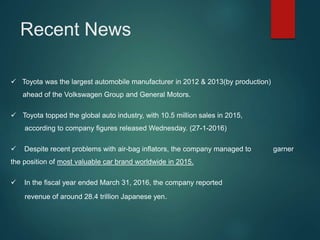
 Toyota was the largest automobile manufacturer in 2012 & 2013(by production)
ahead of the Volkswagen Group and General Motors.
 Toyota topped the global auto industry, with 10.5 million sales in 2015,
according to company figures released Wednesday. (27-1-2016)
 Despite recent problems with air-bag inflators, the company managed to garner
the position of most valuable car brand worldwide in 2015.
 In the fiscal year ended March 31, 2016, the company reported
revenue of around 28.4 trillion Japanese yen.
Recent News
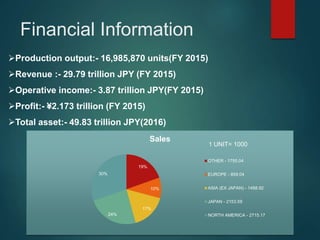
Production output:- 16,985,870 units(FY 2015)
Revenue :- 29.79 trillion JPY (FY 2015)
Operative income:- 3.87 trillion JPY(FY 2015)
Profit:- ¥2.173 trillion (FY 2015)
Total asset:- 49.83 trillion JPY(2016)
19%
10%
17%
24%
30%
Sales
OTHER - 1755.04
EUROPE - 859.04
ASIA (EX JAPAN) - 1488.92
JAPAN - 2153.59
NORTH AMERICA - 2715.17
1 UNIT= 1000
Financial Information
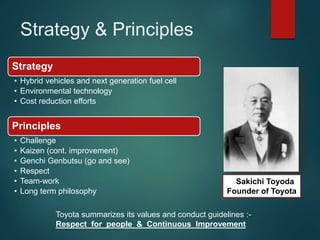
Sakichi Toyoda
Founder of Toyota
Toyota summarizes its values and conduct guidelines :-
Respect for people & Continuous Improvement
Strategy & Principles
Strategy
• Hybrid vehicles and next generation fuel cell
• Environmental technology
• Cost reduction efforts
Principles
• Challenge
• Kaizen (cont. improvement)
• Genchi Genbutsu (go and see)
• Respect
• Team-work
• Long term philosophy
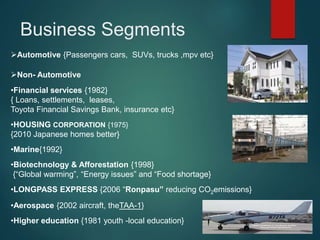
Automotive {Passengers cars, SUVs, trucks ,mpv etc}
Non- Automotive
•Financial services {1982}
{ Loans, settlements, leases,
Toyota Financial Savings Bank, insurance etc}
•HOUSING CORPORATION {1975}
{2010 Japanese homes better}
•Marine{1992}
•Biotechnology & Afforestation {1998}
{“Global warming”, “Energy issues” and “Food shortage}
•LONGPASS EXPRESS {2006 “Ronpasu” reducing CO2emissions}
•Aerospace {2002 aircraft, theTAA-1}
•Higher education {1981 youth -local education}
Business Segments
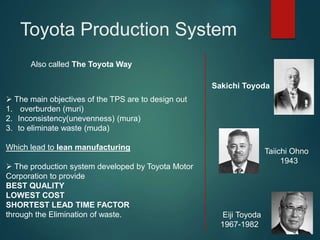
 The main objectives of the TPS are to design out
1. overburden (muri)
2. Inconsistency(unevenness) (mura)
3. to eliminate waste (muda)
Which lead to lean manufacturing
 The production system developed by Toyota Motor
Corporation to provide
BEST QUALITY
LOWEST COST
SHORTEST LEAD TIME FACTOR
through the Elimination of waste.
Also called The Toyota Way
Sakichi Toyoda
Taiichi Ohno
1943
Eiji Toyoda
1967-1982
Toyota Production System
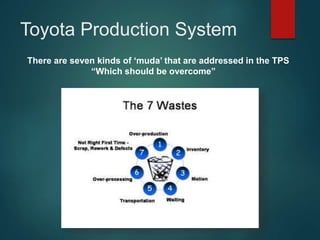
There are seven kinds of ‘muda’ that are addressed in the TPS
“Which should be overcome”
Toyota Production System
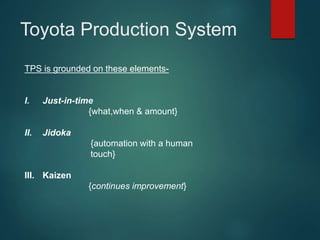
TPS is grounded on these elements-
I. Just-in-time
{what,when & amount}
II. Jidoka
{automation with a human
touch}
III. Kaizen
{continues improvement}
Toyota Production System
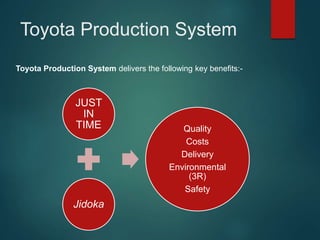
Toyota Production System delivers the following key benefits:-
JUST
IN
TIME
Jidoka
Quality
Costs
Delivery
Environmental
(3R)
Safety
Toyota Production System
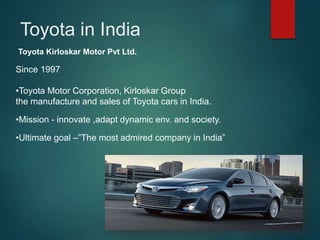
Since 1997
•Toyota Motor Corporation, Kirloskar Group
the manufacture and sales of Toyota cars in India.
•Mission - innovate ,adapt dynamic env. and society.
•Ultimate goal –”The most admired company in India”
Toyota Kirloskar Motor Pvt Ltd.
Toyota in India
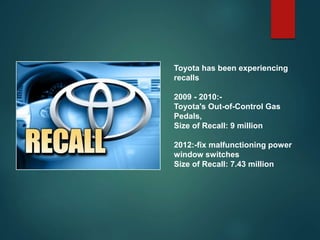
Toyota has been experiencing
recalls
2009 - 2010:-
Toyota's Out-of-Control Gas
Pedals,
Size of Recall: 9 million
2012:-fix malfunctioning power
window switches
Size of Recall: 7.43 million
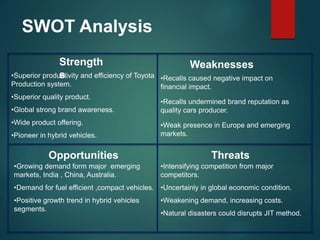
•Intensifying competition from major
competitors.
•Uncertainly in global economic condition.
•Weakening demand, increasing costs.
•Natural disasters could disrupts JIT method.
•Superior productivity and efficiency of Toyota
Production system.
•Superior quality product.
•Global strong brand awareness.
•Wide product offering.
•Pioneer in hybrid vehicles.
•Growing demand form major emerging
markets, India , China, Australia.
•Demand for fuel efficient ,compact vehicles.
•Positive growth trend in hybrid vehicles
segments.
•Recalls caused negative impact on
financial impact.
•Recalls undermined brand reputation as
quality cars producer.
•Weak presence in Europe and emerging
markets.
Strength
s
Weaknesses
Opportunities Threats
SWOT Analysis
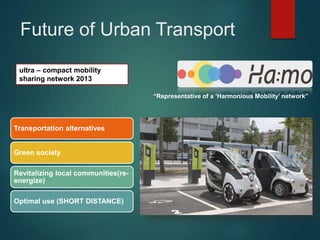
ultra – compact mobility
sharing network 2013
“Representative of a ‘Harmonious Mobility’ network”
Transportation alternatives
Green society
Revitalizing local communities(re-
energize)
Optimal use (SHORT DISTANCE)
Future of Urban Transport
• If we take example of cab (uber,ola,meru) most of car
manufacturer are Toyota like (etios, etios-cross, etios liva )
• So, why cab service is paying for Toyota brand :-
1.After sale service
2. Low maintenance
3.Safety features
4.High quality material
• Invested in Mitsubishi Aircraft Corporation, US$67.2 million
for Mitsubishi Regional Jet, slated for first deliveries in 2017.
Current Environment
Thank You!

Toyota

  • 1.
  • 2.
    Scheme of Presentation Vision& Mission History of Toyota Organization Structure Recent News Financial Information Strategy & Principles Business Segments Toyota Production System Toyota in India Recalls SWOT HA:MO
  • 3.
    VISION & MISSION Leadthe way Safest & most responsible ways of moving people Commitment to quality Constant innovation Respect for the planet There is always a better way Rewarded with a smile
  • 4.
    Established in 1937(Kiichiro Toyoda) First car 1935 (TYPE - A) (SA MODEL passenger car) 1947 Toyota production system (TPS) 1950 First global expansion 1959 brazil In 1982, the Toyota Motor Company and Toyota Motor Sales merged into one company, the Toyota Motor Corporation Toyota introduced a new worldwide logo in October 1989 2002 Formula one In 2004, Toyota showcased its trumpet- playing robot Sedan AA 1936 Logo until 1989, now still used as a corporate logo Logo since 1989 History
  • 5.
    Country of Origin:Japan FOUNDER : KIICHIRO TOYODA [August 28, 1937; 79 years ago] PRESIDENT & CEO : Akio Toyoda Chairman : Takeshi Uchiyamada Number of Employees(2016): 346,219 Unit Sales (2014): 10.2 million Toyota's headquarters in Toyota City, Aichi Prefecture, Japan Organization Structure
  • 6.
     Toyota wasthe largest automobile manufacturer in 2012 & 2013(by production) ahead of the Volkswagen Group and General Motors.  Toyota topped the global auto industry, with 10.5 million sales in 2015, according to company figures released Wednesday. (27-1-2016)  Despite recent problems with air-bag inflators, the company managed to garner the position of most valuable car brand worldwide in 2015.  In the fiscal year ended March 31, 2016, the company reported revenue of around 28.4 trillion Japanese yen. Recent News
  • 7.
    Production output:- 16,985,870units(FY 2015) Revenue :- 29.79 trillion JPY (FY 2015) Operative income:- 3.87 trillion JPY(FY 2015) Profit:- ¥2.173 trillion (FY 2015) Total asset:- 49.83 trillion JPY(2016) 19% 10% 17% 24% 30% Sales OTHER - 1755.04 EUROPE - 859.04 ASIA (EX JAPAN) - 1488.92 JAPAN - 2153.59 NORTH AMERICA - 2715.17 1 UNIT= 1000 Financial Information
  • 8.
    Sakichi Toyoda Founder ofToyota Toyota summarizes its values and conduct guidelines :- Respect for people & Continuous Improvement Strategy & Principles Strategy • Hybrid vehicles and next generation fuel cell • Environmental technology • Cost reduction efforts Principles • Challenge • Kaizen (cont. improvement) • Genchi Genbutsu (go and see) • Respect • Team-work • Long term philosophy
  • 9.
    Automotive {Passengers cars,SUVs, trucks ,mpv etc} Non- Automotive •Financial services {1982} { Loans, settlements, leases, Toyota Financial Savings Bank, insurance etc} •HOUSING CORPORATION {1975} {2010 Japanese homes better} •Marine{1992} •Biotechnology & Afforestation {1998} {“Global warming”, “Energy issues” and “Food shortage} •LONGPASS EXPRESS {2006 “Ronpasu” reducing CO2emissions} •Aerospace {2002 aircraft, theTAA-1} •Higher education {1981 youth -local education} Business Segments
  • 10.
     The mainobjectives of the TPS are to design out 1. overburden (muri) 2. Inconsistency(unevenness) (mura) 3. to eliminate waste (muda) Which lead to lean manufacturing  The production system developed by Toyota Motor Corporation to provide BEST QUALITY LOWEST COST SHORTEST LEAD TIME FACTOR through the Elimination of waste. Also called The Toyota Way Sakichi Toyoda Taiichi Ohno 1943 Eiji Toyoda 1967-1982 Toyota Production System
  • 11.
    There are sevenkinds of ‘muda’ that are addressed in the TPS “Which should be overcome” Toyota Production System
  • 12.
    TPS is groundedon these elements- I. Just-in-time {what,when & amount} II. Jidoka {automation with a human touch} III. Kaizen {continues improvement} Toyota Production System
  • 13.
    Toyota Production Systemdelivers the following key benefits:- JUST IN TIME Jidoka Quality Costs Delivery Environmental (3R) Safety Toyota Production System
  • 14.
    Since 1997 •Toyota MotorCorporation, Kirloskar Group the manufacture and sales of Toyota cars in India. •Mission - innovate ,adapt dynamic env. and society. •Ultimate goal –”The most admired company in India” Toyota Kirloskar Motor Pvt Ltd. Toyota in India
  • 15.
    Toyota has beenexperiencing recalls 2009 - 2010:- Toyota's Out-of-Control Gas Pedals, Size of Recall: 9 million 2012:-fix malfunctioning power window switches Size of Recall: 7.43 million
  • 16.
    •Intensifying competition frommajor competitors. •Uncertainly in global economic condition. •Weakening demand, increasing costs. •Natural disasters could disrupts JIT method. •Superior productivity and efficiency of Toyota Production system. •Superior quality product. •Global strong brand awareness. •Wide product offering. •Pioneer in hybrid vehicles. •Growing demand form major emerging markets, India , China, Australia. •Demand for fuel efficient ,compact vehicles. •Positive growth trend in hybrid vehicles segments. •Recalls caused negative impact on financial impact. •Recalls undermined brand reputation as quality cars producer. •Weak presence in Europe and emerging markets. Strength s Weaknesses Opportunities Threats SWOT Analysis
  • 17.
    ultra – compactmobility sharing network 2013 “Representative of a ‘Harmonious Mobility’ network” Transportation alternatives Green society Revitalizing local communities(re- energize) Optimal use (SHORT DISTANCE) Future of Urban Transport
  • 18.
    • If wetake example of cab (uber,ola,meru) most of car manufacturer are Toyota like (etios, etios-cross, etios liva ) • So, why cab service is paying for Toyota brand :- 1.After sale service 2. Low maintenance 3.Safety features 4.High quality material • Invested in Mitsubishi Aircraft Corporation, US$67.2 million for Mitsubishi Regional Jet, slated for first deliveries in 2017. Current Environment
  • 19.