BANASTHALI UNIVERSITY
RAJASTHAN
TOUCH SCREEN
TECHNOLOGY
Presented by: SHAMBHVI SINHA
B.TECH (3rd year, EI)
ID: BTBTN13695
Roll number: 9343
Department of Electronics
Banasthali University, 2015
1
CONTENTS
 Introduction
 History
 Components
 Touch technologies
 Applications
 Advantages
 Disadvantages
 Future scope
 References 2
INTRODUCTION
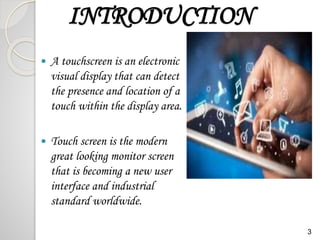
 A touchscreen is an electronic
visual display that can detect
the presence and location of a
touch within the display area.
 Touch screen is the modern
great looking monitor screen
that is becoming a new user
interface and industrial
standard worldwide.
3
HISTORY
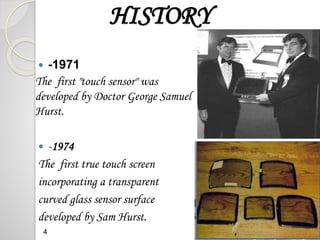
 -1971
The first "touch sensor" was
developed by Doctor George Samuel
Hurst.
 -1974
The first true touch screen
incorporating a transparent
curved glass sensor surface
developed by Sam Hurst.
4
 -1977
Elographics developed &
patented five-wire resistive
technology, called
“AccuTouch”.
 - 1983
HP-150 was one of the
world's earliest commercial
touchscreen computers, made
by Hewlett Packard.
5
Components Of A Touch Screen
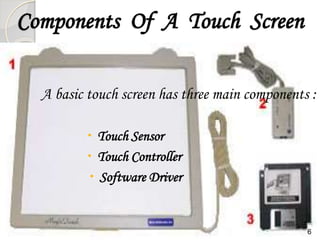
A basic touch screen has three main components :
 Touch Sensor
 Touch Controller
 Software Driver
6
Touch Sensor
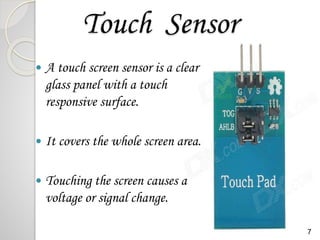
 A touch screen sensor is a clear
glass panel with a touch
responsive surface.
 It covers the whole screen area.
 Touching the screen causes a
voltage or signal change.
7
Touch Controller
 This is the Microcontroller based Integrated circuit
 It is meant for transferring the information from
the touch sensor to the embedded system.
8
Software Driver
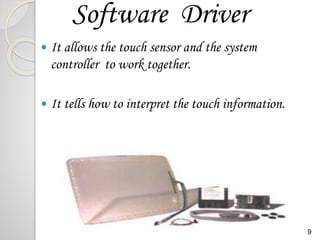
 It allows the touch sensor and the system
controller to work together.
 It tells how to interpret the touch information.
9
T
O
U
C
H
T
E
C
H
N
O
L
O
G
I
E
S
TOUCH
SCREEN
RESISTIVE
CAPACITIVE
SURFACE
ACOUSTIC
WAVE (SAW)
INFRARED
OPTICAL
IMAGING
DISPERSIVE
SIGNAL
TECHNOLOGY
ACOUSTIC
PULSE
RECOGNITION
10
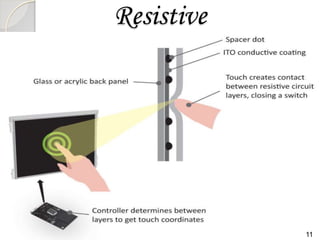
Resistive
11
Capacitive
 It is the most
popular and
durable
touchscreen
technology.
 This systems
transmit
almost 90%
of light from
the monitor.
12
Capacitive
touch
Surface Projected
13
Surface Acoustic Wave(SAW)
14
•This technology is based on two
transducers (transmitting and
receiving).
•The controller sends electrical
signal to the transmitting
transducer, and it converts the
signal into ultrasonic waves and
emits to reflectors that are lined
up along the edge of the panel.
Infrared
15
 It relies on the
interruption of an IR
light grid in front of
the display screen.
 It shows highest image
clarity and light
transmission.
Optical Imaging
 It uses an array of infrared (IR) light-emitting diodes.
 This touch technology is sometimes called “scanning IR.”.
16
Dispersive Signal Technology
 It sets new large-format
touch standards for fast,
accurate repeatable
touch response.
 It gives fast, accurate
and repeatable touch
response.
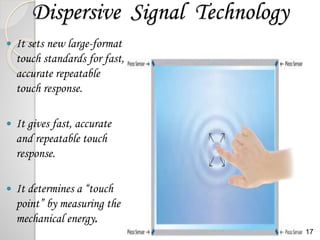
 It determines a “touch
point” by measuring the
mechanical energy.
17
Acoustic Pulse Recognition
 It combines the
ultimate in all other
technologies.
 It is resistant to
water and other
contaminants on the
screen.
 APR is designed to
reject ambient and
extraneous sounds.
18
APPLICATIONS
Public Information
Displays
Retail and
Restaurant
Systems
19
Computer access for
the physically
disabled
Control and
Automation
Systems
20
ADVANTAGES
 User friendly.
 Fast response.
 Error free input.
 Use finger , fingernail ,
gloved hands , stylus or any
soft tip pointer.
 Easy to clean.
 Does not interfere mouse
and keyboard
 Make computing easy ,
powerful and fun.
 It benefits children .
21
DISADVANTAGES
 Screen has to be really big.
 Big screen leads to low battery
life .
 Touchscreen means screen
can’t be read too well in direct
sunlight.
 Screens get very dirty
 Massive computing power
required.
 They cost more than
alternative devices.
22
FUTURE SCOPE
In Video
Projectors
In A
Restaurant
23
REFERENCES
 http://plc.cwru.edu/tutorial/enhanced/files/lcd/intro.htm
 http://www.touchscreensolutions.com.au/resources/technology/infra-
red-touch-screen-technology
 http://www2.advantech.com.tw/embcore/promotions/whitepaper/Elo
%20TouchSystems-
Acoustic_Pulse_Recognition_Touch_Technology.pdf
 http://walkermobile.com/December_2006_ID_Acoustic_Pulse_Reco
gnition_Enters_Touch_Screen_Market.pdf
 http://www.ijcsmc.com/docs/papers/September2013/V2I9201321.pdf
 http://www.renesas.eu/edge_ol/topics/20/index.jsp
 http://solutions.3mindia.co.in/3MContentRetrievalAPI/BlobServlet?lm
d=1332776667000&locale=en_US&assetType=MMM_Image&assetI
d=1319224170371&blobAttribute=ImageFile
 Frank BECK & Bent STUMPE (24 May 1973), “Two devices for
operator interaction in the central control of the new CERN
accelerator”, CERN.
 Holsinger,Erik.(1994) “How Multimedia Works”.Emeryville, CA: Ziff-
Davis Press.
24
25

Touch Screen technology