Dr. Rajendra Gode Institute of
Technology & Research ,
Amravati
Presented By:
Ms. Radha R. Mahalle
Final year, EXTC
GSM Based Automatic
Irrigation System
Guided By:
Prof. A.V. Kalaskar
EXTC Dept.
• OUTLINE
• INTRODUCTION
• WORKING
• COMPONETS
• ADVANTAGES
• APPLICATION
• CONCLUSION
• FUTURE SCOPE
 CONTENTS
 OUTLINE
• 60% Of India's land area is agricultural land.
• Irrigation is the artificial application of water to the land or soil.
• It is used to assist in the growing of agricultural crops,
maintenance of landscapes, and re-vegetation of disturbed soils in
dry areas and during periods of inadequate rainfall.
• Over Irrigation
• Under Irrigation
• Land is more, we need more
manpower and labor also.
 Problems In Current System
 INTRODUCTION
• Based on GSM i.e. system works by using a mobile call
• The system is totally automated
• Easy to operate
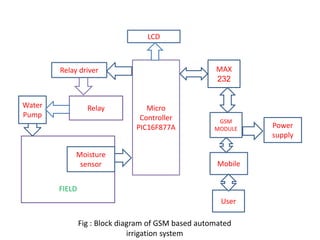
FIELD
Fig : Block diagram of GSM based automated
irrigation system
Micro
Controller
PIC16F877A
Relay driver
Water
Pump
Moisture
sensor
LCD
MAX
232
GSM
MODULE Power
supply
User
Mobile
Relay
 WORKING
• Moisture Sensor senses the low moisture content of the
soil.
• Gives a signal to the Microcontroller.
• Microcontroller then gives a signal to the called mobile,
by pressing call receiving button microcontroller get signal
to turn on the valve.
• When the moisture content becomes sufficient, the sensor
senses this and gives back the signal to the Microcontroller.
• Relay gets open and the water pump become turn off.
 COMPONETS
• Soil Moisture Sensor
• Microcontroller
• GSM Module
• MAX 232
• Relay
• LCD
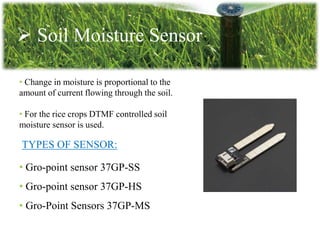
 Soil Moisture Sensor
• Change in moisture is proportional to the
amount of current flowing through the soil.
• For the rice crops DTMF controlled soil
moisture sensor is used.
• Gro-point sensor 37GP-SS
• Gro-point sensor 37GP-HS
• Gro-Point Sensors 37GP-MS
TYPES OF SENSOR:
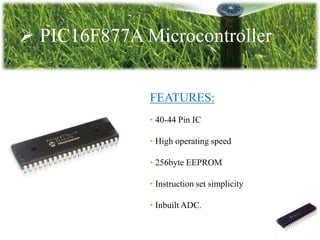
 PIC16F877A Microcontroller
FEATURES:
• 40-44 Pin IC
• High operating speed
• 256byte EEPROM
• Instruction set simplicity
• Inbuilt ADC.
 GSM Module
Benefits of GSM Module:
• Ultra small size (22×22×3mm), lightweight
(3.3g) and easy to integrate.
• Low power consumption
• High performance & low price
• Controlled using AT commands
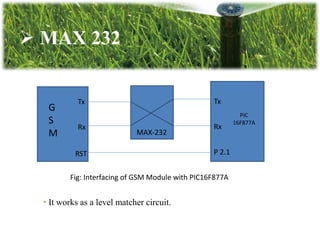
 MAX 232
Tx
Rx
G
S
M
RST
Tx
Rx
P 2.1
MAX-232
PIC
16F877A
Fig: Interfacing of GSM Module with PIC16F877A
• It works as a level matcher circuit.
 ADVANTAGES
• Saves water
• Improves growth
• Save time
• Adaptable
• Simplest method
• Reduces manpower
 APPLICATIONS
• Useful Irrigation in Fields.
• Useful Irrigation In Gardens, Parks.
• This Irrigation System is very efficient for
Paddy, Rice Fields.
• Household purpose.
 FUTURE SCOPE
• This system will helps the farmer to overcome the drawbacks of
traditional irrigation system.
• Provide the new technology for farmer to improve the quality of
their irrigation system.
• Also helps to those farmer which do not have sufficient water
for their farming.
 CONCLUSION
 The GSM Based Automated Irrigation System will be monitors and controls all the
activities of irrigation system efficiently.
 GSM Based Automated Irrigation System will be a valuable tool for accurate soil moisture
control and it is a simple, precise method of irrigation.
 It will also helps in time saving, removal of human error in adjusting available soil
moisture levels and to maximize their net profits.
 REFERENCES
RESEARCH PAPER
“Microcontroller Based Automated Irrigation System” The International Journal Of
Engineering And Science (IJES) Volume 3,
Issue 06-9- 2014 ISSN (e):2319 –1813 ISSN (p):2319 –1805
“GSM based Automatic Irrigation Control System” IOSR-JMCE-ISSN: 2278-1684,p-ISSN:
2320-334X, Volume 11, Issue 4 Ver. I (Jul-Aug. 2014), PP 49-55
H.T ingale and N.N. Kasat, “Automated Irrigation System”, Proceedings of the International
Journal of Engineering Research and Development, Volume 4, Issue 11 November 2012.
BOOKS:
Microcontrollers[ THEORY AND APPLICATIONS ]
By Ajay V Deshmukh
 PIC Microcontroller and Embedded System using Assembly and C for PIC18
By Muhammad Ali Mazidi
 REFERENCES
Websites:
 www.iosrjournals.org/iosr-jmce/papers/vol11-
issue4/Version-1/I011414955.pdf
 www.nowsms.com/faq/what-is-a-gsm-modem
 www.microcontrollerslab.com/alternating-current-
measurement-using-pic-microcontroller/
GSM Based Automatic Irrigation System

GSM Based Automatic Irrigation System

  • 1.
    Dr. Rajendra GodeInstitute of Technology & Research , Amravati Presented By: Ms. Radha R. Mahalle Final year, EXTC GSM Based Automatic Irrigation System Guided By: Prof. A.V. Kalaskar EXTC Dept.
  • 2.
    • OUTLINE • INTRODUCTION •WORKING • COMPONETS • ADVANTAGES • APPLICATION • CONCLUSION • FUTURE SCOPE  CONTENTS
  • 3.
     OUTLINE • 60%Of India's land area is agricultural land. • Irrigation is the artificial application of water to the land or soil. • It is used to assist in the growing of agricultural crops, maintenance of landscapes, and re-vegetation of disturbed soils in dry areas and during periods of inadequate rainfall.
  • 4.
    • Over Irrigation •Under Irrigation • Land is more, we need more manpower and labor also.  Problems In Current System
  • 5.
     INTRODUCTION • Basedon GSM i.e. system works by using a mobile call • The system is totally automated • Easy to operate
  • 6.
    FIELD Fig : Blockdiagram of GSM based automated irrigation system Micro Controller PIC16F877A Relay driver Water Pump Moisture sensor LCD MAX 232 GSM MODULE Power supply User Mobile Relay
  • 7.
     WORKING • MoistureSensor senses the low moisture content of the soil. • Gives a signal to the Microcontroller. • Microcontroller then gives a signal to the called mobile, by pressing call receiving button microcontroller get signal to turn on the valve. • When the moisture content becomes sufficient, the sensor senses this and gives back the signal to the Microcontroller. • Relay gets open and the water pump become turn off.
  • 8.
     COMPONETS • SoilMoisture Sensor • Microcontroller • GSM Module • MAX 232 • Relay • LCD
  • 9.
     Soil MoistureSensor • Change in moisture is proportional to the amount of current flowing through the soil. • For the rice crops DTMF controlled soil moisture sensor is used. • Gro-point sensor 37GP-SS • Gro-point sensor 37GP-HS • Gro-Point Sensors 37GP-MS TYPES OF SENSOR:
  • 10.
     PIC16F877A Microcontroller FEATURES: •40-44 Pin IC • High operating speed • 256byte EEPROM • Instruction set simplicity • Inbuilt ADC.
  • 11.
     GSM Module Benefitsof GSM Module: • Ultra small size (22×22×3mm), lightweight (3.3g) and easy to integrate. • Low power consumption • High performance & low price • Controlled using AT commands
  • 12.
     MAX 232 Tx Rx G S M RST Tx Rx P2.1 MAX-232 PIC 16F877A Fig: Interfacing of GSM Module with PIC16F877A • It works as a level matcher circuit.
  • 13.
     ADVANTAGES • Saveswater • Improves growth • Save time • Adaptable • Simplest method • Reduces manpower
  • 14.
     APPLICATIONS • UsefulIrrigation in Fields. • Useful Irrigation In Gardens, Parks. • This Irrigation System is very efficient for Paddy, Rice Fields. • Household purpose.
  • 15.
     FUTURE SCOPE •This system will helps the farmer to overcome the drawbacks of traditional irrigation system. • Provide the new technology for farmer to improve the quality of their irrigation system. • Also helps to those farmer which do not have sufficient water for their farming.
  • 16.
     CONCLUSION  TheGSM Based Automated Irrigation System will be monitors and controls all the activities of irrigation system efficiently.  GSM Based Automated Irrigation System will be a valuable tool for accurate soil moisture control and it is a simple, precise method of irrigation.  It will also helps in time saving, removal of human error in adjusting available soil moisture levels and to maximize their net profits.
  • 17.
     REFERENCES RESEARCH PAPER “MicrocontrollerBased Automated Irrigation System” The International Journal Of Engineering And Science (IJES) Volume 3, Issue 06-9- 2014 ISSN (e):2319 –1813 ISSN (p):2319 –1805 “GSM based Automatic Irrigation Control System” IOSR-JMCE-ISSN: 2278-1684,p-ISSN: 2320-334X, Volume 11, Issue 4 Ver. I (Jul-Aug. 2014), PP 49-55 H.T ingale and N.N. Kasat, “Automated Irrigation System”, Proceedings of the International Journal of Engineering Research and Development, Volume 4, Issue 11 November 2012. BOOKS: Microcontrollers[ THEORY AND APPLICATIONS ] By Ajay V Deshmukh  PIC Microcontroller and Embedded System using Assembly and C for PIC18 By Muhammad Ali Mazidi
  • 18.
     REFERENCES Websites:  www.iosrjournals.org/iosr-jmce/papers/vol11- issue4/Version-1/I011414955.pdf www.nowsms.com/faq/what-is-a-gsm-modem  www.microcontrollerslab.com/alternating-current- measurement-using-pic-microcontroller/

Editor's Notes

  • #11 Because of the inbuilt ADC, PIC reduces the complexity of the circuit as there is no need to design a separate ADC block