SPACE BASED SOLAR POWER
TRANSMISSION
History…
 Nikola Tesla in late 1890s, Pioneer of induction
techniques.
 His vision for “World Wireless System”.
 In 1940s ability to convert energy to
microwaves was developed.
 In 1964 William C. Brown demonstrated a
Rectenna.
WPT via Solar Power Satellite
2
Solar Power Satellite
WPT via Solar Power Satellite
3
 In 1968 idea for solar power satellites was proposed
by Peter Glaser.
 Between 1978 and 1981, the Congress authorized
the Department of Energy (DoE).
 In 1999, NASA's Space Solar Power Exploratory
Research and Technology program (SERT) was
initiated.
 On Nov 2, 2012, China proposed space collaboration
with India that mentioned SBSP.
WPT via Solar Power Satellite
4
Advantages over Earth based solar power
WPT via Solar Power Satellite
5
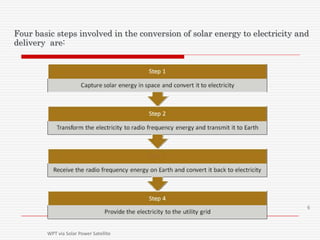
Four basic steps involved in the conversion of solar energy to electricity and
delivery are:
WPT via Solar Power Satellite
6
Solar Power Satellite
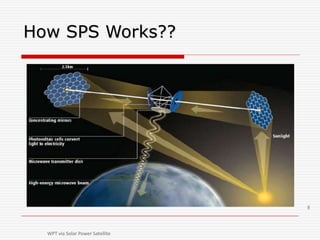
Solar Power Satellites (SPS) have proposed to collect solar
energy in space and beam it down to the Earth.
WPT via Solar Power Satellite
7
How SPS Works??
WPT via Solar Power Satellite
8
“An antenna is an electrical device which converts electric power into
radio waves.
The transmitting antenna on the horizontal under-surface faces the Earth, and
the other two sides of the prism carry solar arrays.
The Microwave thus produced Travels through Atmosphere & is collected by
RECTENNAS on Earth.
The Spacetenna has a square shape whose dimension is 132 meters by 132
meters and which is regularly filled with 1936 segments of sub array.
 There will be about 2.6 million antenna elements in the spacetenna.
SPACETENNA: (THE ANTENNA ON SATELLITE)
WPT via Solar Power Satellite
9
“An antenna comprising a mesh of dipoles and diodes
for absorbing microwave energy from a transmitter
and converting it into electric power.”
Diameter is around 5km .
Microwaves of 2.45 GHz frequency are used to transmit
power from the satellite to the rectenna.
 It is 85% efficient and 95% of the beam will fall on the
rectenna
.
RECTENNNA :(RECTIFYING ANTENNA)
WPT via Solar Power Satellite
10
5,000 MW Receiving Station
(Rectenna). This station is about a
mile and a half long.
WPT via Solar Power Satellite
11
5,000 MW Receiving Station (Rectenna).
This station is about a mile and a half long.
Disadvantages
 Geosynchronous satellites would take up large sections of space
 Interference with communication satellites
 Possible health hazards
 Effects of long term exposure
 Exposure is equal to the amount that people
receive from cell phones and microwaves
WPT via Solar Power Satellite
12
Conclusions
 The technology for the space based solar power
(SBSP) is still in development
 If the SBSP is developed then it will completely
remove the usage of fossil fuels.
BY –
CH. ADITYA SASANK

Sps1 ppt

  • 1.
    SPACE BASED SOLARPOWER TRANSMISSION
  • 2.
    History…  Nikola Teslain late 1890s, Pioneer of induction techniques.  His vision for “World Wireless System”.  In 1940s ability to convert energy to microwaves was developed.  In 1964 William C. Brown demonstrated a Rectenna. WPT via Solar Power Satellite 2
  • 3.
    Solar Power Satellite WPTvia Solar Power Satellite 3  In 1968 idea for solar power satellites was proposed by Peter Glaser.  Between 1978 and 1981, the Congress authorized the Department of Energy (DoE).  In 1999, NASA's Space Solar Power Exploratory Research and Technology program (SERT) was initiated.  On Nov 2, 2012, China proposed space collaboration with India that mentioned SBSP.
  • 4.
    WPT via SolarPower Satellite 4
  • 5.
    Advantages over Earthbased solar power WPT via Solar Power Satellite 5
  • 6.
    Four basic stepsinvolved in the conversion of solar energy to electricity and delivery are: WPT via Solar Power Satellite 6
  • 7.
    Solar Power Satellite SolarPower Satellites (SPS) have proposed to collect solar energy in space and beam it down to the Earth. WPT via Solar Power Satellite 7
  • 8.
    How SPS Works?? WPTvia Solar Power Satellite 8
  • 9.
    “An antenna isan electrical device which converts electric power into radio waves. The transmitting antenna on the horizontal under-surface faces the Earth, and the other two sides of the prism carry solar arrays. The Microwave thus produced Travels through Atmosphere & is collected by RECTENNAS on Earth. The Spacetenna has a square shape whose dimension is 132 meters by 132 meters and which is regularly filled with 1936 segments of sub array.  There will be about 2.6 million antenna elements in the spacetenna. SPACETENNA: (THE ANTENNA ON SATELLITE) WPT via Solar Power Satellite 9
  • 10.
    “An antenna comprisinga mesh of dipoles and diodes for absorbing microwave energy from a transmitter and converting it into electric power.” Diameter is around 5km . Microwaves of 2.45 GHz frequency are used to transmit power from the satellite to the rectenna.  It is 85% efficient and 95% of the beam will fall on the rectenna . RECTENNNA :(RECTIFYING ANTENNA) WPT via Solar Power Satellite 10
  • 11.
    5,000 MW ReceivingStation (Rectenna). This station is about a mile and a half long. WPT via Solar Power Satellite 11 5,000 MW Receiving Station (Rectenna). This station is about a mile and a half long.
  • 12.
    Disadvantages  Geosynchronous satelliteswould take up large sections of space  Interference with communication satellites  Possible health hazards  Effects of long term exposure  Exposure is equal to the amount that people receive from cell phones and microwaves WPT via Solar Power Satellite 12
  • 13.
    Conclusions  The technologyfor the space based solar power (SBSP) is still in development  If the SBSP is developed then it will completely remove the usage of fossil fuels. BY – CH. ADITYA SASANK