Uninterruptible Power Supply
           (UPS)
Introduction

   An Uninterruptible Power Supply,  also Uninterruptible

    Power Source, UPS or  battery/flywheel backup,  is  an 

    electrical  apparatus  that  provides  emergency  power  to  a  load 

    when the input power source, typically the utility mains, fails.
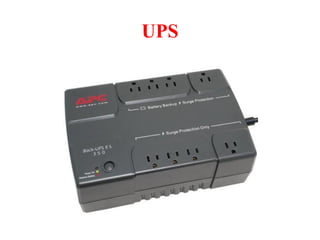
UPS
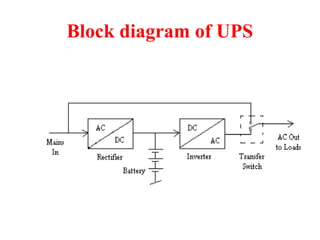
Block diagram of UPS
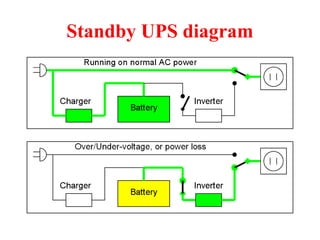
Standby UPS diagram
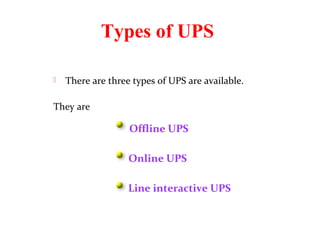
Types of UPS

   There are three types of UPS are available.

They are

                   Offline UPS

                   Online UPS

                   Line interactive UPS
Offline UPS

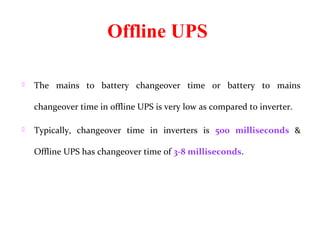
   The  mains  to  battery  changeover  time  or  battery  to  mains 

    changeover time in offline UPS is very low as compared to inverter. 

   Typically,  changeover  time  in  inverters  is  500 milliseconds & 

    Offline UPS has changeover time of 3-8 milliseconds. 
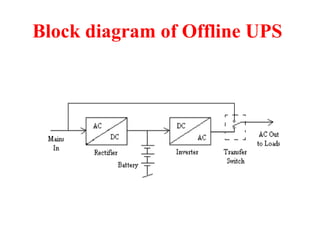
Block diagram of Offline UPS
Offline UPS
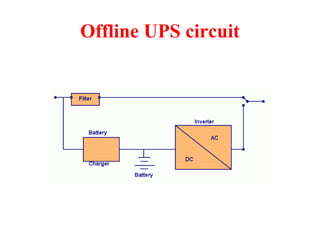
   In a time, when mains ac is present, Inverter provides the output as 

    is the input mains. 

   While,  Offline  UPS  has  built in Automatic Voltage Regulator

    (AVR) to regulate the output voltage close to 220V ac. 

   Offline  UPSs  are  normal  weight  UPSs  and  are  widely  used  for 

    domestic computers.
Offline UPS circuit
Line Interactive UPS

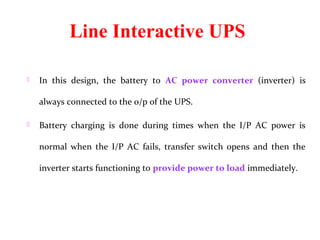
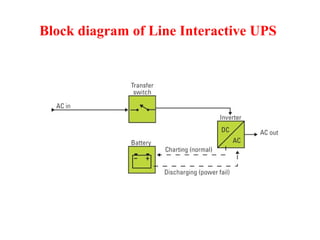
   In  this  design,  the  battery  to  AC power converter (inverter)  is 

    always connected to the o/p of the UPS. 

   Battery  charging  is  done  during  times  when  the  I/P  AC  power  is 

    normal  when  the  I/P  AC  fails,  transfer  switch  opens  and  then  the 

    inverter starts functioning to provide power to load immediately. 
Block diagram of Line Interactive UPS
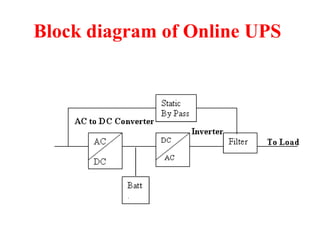
Online UPS
   In this type of UPS, the system always remains on battery, whether 

    mains ac is present or not. 

   When  mains  ac  is  present,  it  provides  power to DC supply of 

    inverter section as well as charges the battery simultaneously. 

   When mains ac is not present, it will run the connected load till the 

    battery has a recommended dischargeable level.
Block diagram of Online UPS
The End


…… Thank You ……

Ups

  • 1.
  • 2.
    Introduction  An Uninterruptible Power Supply,  also Uninterruptible Power Source, UPS or  battery/flywheel backup,  is  an  electrical  apparatus  that  provides  emergency  power  to  a  load  when the input power source, typically the utility mains, fails.
  • 3.
  • 4.
  • 5.
  • 6.
    Types of UPS  There are three types of UPS are available. They are Offline UPS Online UPS Line interactive UPS
  • 7.
    Offline UPS  The  mains  to  battery  changeover  time  or  battery  to  mains  changeover time in offline UPS is very low as compared to inverter.   Typically,  changeover  time  in  inverters  is  500 milliseconds &  Offline UPS has changeover time of 3-8 milliseconds. 
  • 8.
    Block diagram ofOffline UPS
  • 9.
    Offline UPS  In a time, when mains ac is present, Inverter provides the output as  is the input mains.   While,  Offline  UPS  has  built in Automatic Voltage Regulator (AVR) to regulate the output voltage close to 220V ac.   Offline  UPSs  are  normal  weight  UPSs  and  are  widely  used  for  domestic computers.
  • 10.
  • 11.
    Line Interactive UPS  In  this  design,  the  battery  to  AC power converter (inverter)  is  always connected to the o/p of the UPS.   Battery  charging  is  done  during  times  when  the  I/P  AC  power  is  normal  when  the  I/P  AC  fails,  transfer  switch  opens  and  then  the  inverter starts functioning to provide power to load immediately. 
  • 12.
    Block diagram ofLine Interactive UPS
  • 13.
    Online UPS  In this type of UPS, the system always remains on battery, whether  mains ac is present or not.   When  mains  ac  is  present,  it  provides  power to DC supply of  inverter section as well as charges the battery simultaneously.   When mains ac is not present, it will run the connected load till the  battery has a recommended dischargeable level.
  • 14.
    Block diagram ofOnline UPS
  • 15.