GUIDED BY ABHIRAM J
MR.SREEHARI V K REG NO:17201080
(Lecture of ECE) ROLL NO:01
1
CONTENTS
 INTRODUCTION
 HOW ITS WORKS
 ADVANTAGES
 LIMITATIONS
 FUTURE ENHANCEMENTS
 CONCLUTION
 REFERENCES
2
INTRODUCTION
 Even the companies that sell smart phones at
phenomenal rates have the issue of battery’s
performance.
 The performance is better as compared to others, but it is
still a mystery if discussed in terms of long life.
3
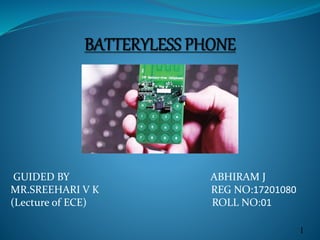
What is batteryless phone?
 Needed no battery.
 Phone used to only calling function.
 device uses a minute photo diode to harvest energy from the
ambient light or RF sources.
 It operate the RF wave to convert DC power.
4
Conversion of RF to DC power
5
WORKING
 Antenna receive RF wave.
 RF to DC converter convert radio frequency signal
to DC.
 Power condition check the required voltage and fed
to the output.
6
Conversion of Signals to Power
 A photo diode for converting ambient signals and
light into current.
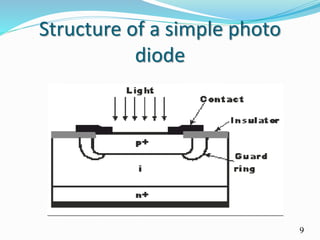
 It is a semiconductor, with p-n junction diode and an
intrinsic layer between two junctions.
 When photons of energy greater than 1.1 electron volt
(eV) strike the diode, electron-hole pairs are
originated.
7
 Holes proceed toward the anode and the electrons
move toward the cathode(generate photo current).
 The sum of photocurrents and dark currents, which
flow with or without light.
 It is the amount of current progressing through the
photodiode.
 Small amount of power is generated in the battery less
phone with the assistance of a tiny photo diode.
8
Structure of a simple photo
diode
9
PROTOTYPE
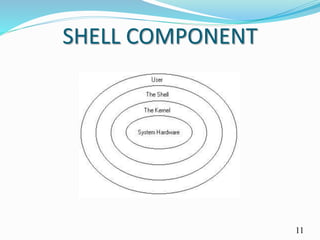
 The team of researchers utilized the shell components on a
printed circuit board.
 It perform basic functions like calling someone up and then
hanging up the call without any inadequate call drops.
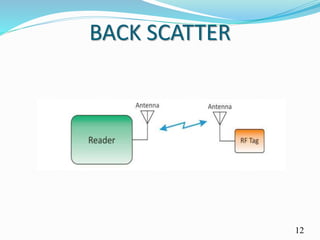
 A custom base station collects the data in form of digital
packages with the help of a “Backscatter.”
 The device inherits the signals with a technology referred as
“Zero Power Amplitude Modulation.”
10
SHELL COMPONENT
11
BACK SCATTER
12
How solar cell works?
 Solar cell constitutes of P-N junction diode, which is
assembled from Silicon and Germanium.
 This process constructs open space for light to fall on P layer
and hence underlying the P-N junction.
 The bottom of N layer comprises of current assembling
electrode.
 When a light photon arrives at the junction, they exhilarate
electrons from valence band to conduction band.
13
A solar cell used as in the
battery less phone
14
ADVANTAGES
 Conserves Electricity
 Saves Time
 Low Power Consumption
 No Charging Issues
15
LIMITATIONS
 Limited range
 Use of solar cell
 Lacking multiple operational features
16
FUTURE SCOPE
 Increase in the range
 Encryption
 Video streming
 Internet access
 Low power E-ink display
17
CONCLUSION
 It was extremely astonishing to witness that a group of
researchers have finally developed a phone that uses no
power.
 which means the phone has no battery and harnesses energy
from ambient signals and light sources.
 That convert light and signal strength into a current which is
furthermore converted into few microwatts of power.
 With the phone, we can just dial a number and call to another
person.
18
REFERENCE
 Paret, Dominique. RFID at ultra and super high frequencies:
Theory and application. John Wiley & Sons, 2009.
 Shin, Choonsung, Jin-Hyuk Hong, Anind K. Dey,
"Understanding and prediction of mobile application usage for
smart phones", In Proceedings of the 2012 ACM Conference
on Ubiquitous Computing, pp. 173-182. ACM, 2012.
 Goodenough, John B., Kyu-Sung Park,"The Li-ion
rechargeable battery: A perspective." Journal of the American
Chemical Society 135, No. 4, pp. 1167-1176, 2013
19
20
21

BATTERY LESS PHONE

  • 1.
    GUIDED BY ABHIRAMJ MR.SREEHARI V K REG NO:17201080 (Lecture of ECE) ROLL NO:01 1
  • 2.
    CONTENTS  INTRODUCTION  HOWITS WORKS  ADVANTAGES  LIMITATIONS  FUTURE ENHANCEMENTS  CONCLUTION  REFERENCES 2
  • 3.
    INTRODUCTION  Even thecompanies that sell smart phones at phenomenal rates have the issue of battery’s performance.  The performance is better as compared to others, but it is still a mystery if discussed in terms of long life. 3
  • 4.
    What is batterylessphone?  Needed no battery.  Phone used to only calling function.  device uses a minute photo diode to harvest energy from the ambient light or RF sources.  It operate the RF wave to convert DC power. 4
  • 5.
    Conversion of RFto DC power 5
  • 6.
    WORKING  Antenna receiveRF wave.  RF to DC converter convert radio frequency signal to DC.  Power condition check the required voltage and fed to the output. 6
  • 7.
    Conversion of Signalsto Power  A photo diode for converting ambient signals and light into current.  It is a semiconductor, with p-n junction diode and an intrinsic layer between two junctions.  When photons of energy greater than 1.1 electron volt (eV) strike the diode, electron-hole pairs are originated. 7
  • 8.
     Holes proceedtoward the anode and the electrons move toward the cathode(generate photo current).  The sum of photocurrents and dark currents, which flow with or without light.  It is the amount of current progressing through the photodiode.  Small amount of power is generated in the battery less phone with the assistance of a tiny photo diode. 8
  • 9.
    Structure of asimple photo diode 9
  • 10.
    PROTOTYPE  The teamof researchers utilized the shell components on a printed circuit board.  It perform basic functions like calling someone up and then hanging up the call without any inadequate call drops.  A custom base station collects the data in form of digital packages with the help of a “Backscatter.”  The device inherits the signals with a technology referred as “Zero Power Amplitude Modulation.” 10
  • 11.
  • 12.
  • 13.
    How solar cellworks?  Solar cell constitutes of P-N junction diode, which is assembled from Silicon and Germanium.  This process constructs open space for light to fall on P layer and hence underlying the P-N junction.  The bottom of N layer comprises of current assembling electrode.  When a light photon arrives at the junction, they exhilarate electrons from valence band to conduction band. 13
  • 14.
    A solar cellused as in the battery less phone 14
  • 15.
    ADVANTAGES  Conserves Electricity Saves Time  Low Power Consumption  No Charging Issues 15
  • 16.
    LIMITATIONS  Limited range Use of solar cell  Lacking multiple operational features 16
  • 17.
    FUTURE SCOPE  Increasein the range  Encryption  Video streming  Internet access  Low power E-ink display 17
  • 18.
    CONCLUSION  It wasextremely astonishing to witness that a group of researchers have finally developed a phone that uses no power.  which means the phone has no battery and harnesses energy from ambient signals and light sources.  That convert light and signal strength into a current which is furthermore converted into few microwatts of power.  With the phone, we can just dial a number and call to another person. 18
  • 19.
    REFERENCE  Paret, Dominique.RFID at ultra and super high frequencies: Theory and application. John Wiley & Sons, 2009.  Shin, Choonsung, Jin-Hyuk Hong, Anind K. Dey, "Understanding and prediction of mobile application usage for smart phones", In Proceedings of the 2012 ACM Conference on Ubiquitous Computing, pp. 173-182. ACM, 2012.  Goodenough, John B., Kyu-Sung Park,"The Li-ion rechargeable battery: A perspective." Journal of the American Chemical Society 135, No. 4, pp. 1167-1176, 2013 19
  • 20.
  • 21.