
Dr. Ashwani Dhingra
9996230055
ashwani1683@gnkgei.ac.in
Total Quality
Management
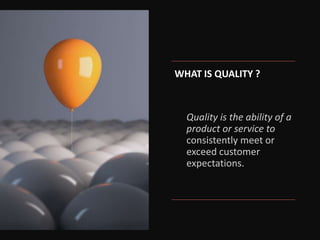
WHAT IS QUALITY ?
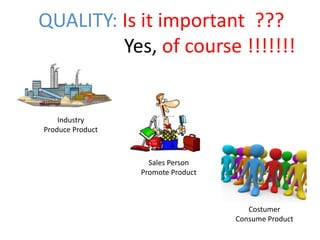
QUALITY: Is it important ???
Yes, of course !!!!!!!
Industry
Produce Product
Sales Person
Promote Product
Costumer
Consume Product
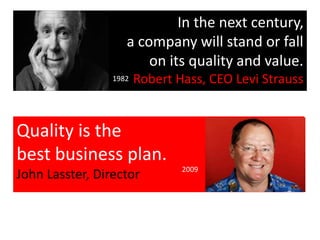
In the next century,
a company will stand or fall
on its quality and value.
Robert Hass, CEO Levi Strauss
1982
Quality is the
best business plan.
John Lasster, Director 2009
Today all of these & others state:
QUALITY is our MOTO
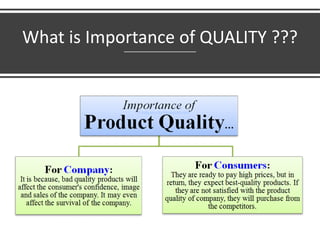
What is Importance of QUALITY ???
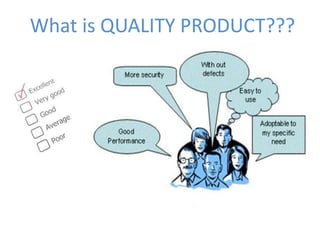
What is QUALITY PRODUCT???
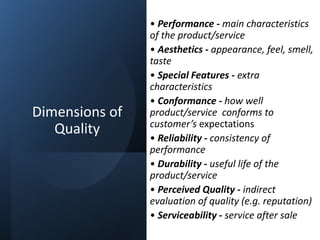
Dimensions of
Quality
• Performance - main characteristics
of the product/service
• Aesthetics - appearance, feel, smell,
taste
• Special Features - extra
characteristics
• Conformance - how well
product/service conforms to
customer’s expectations
• Reliability - consistency of
performance
• Durability - useful life of the
product/service
• Perceived Quality - indirect
evaluation of quality (e.g. reputation)
• Serviceability - service after sale
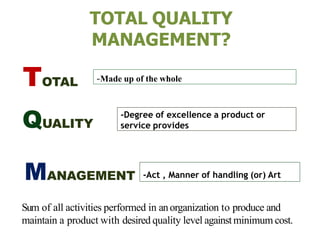
TOTAL
TOTAL QUALITY
MANAGEMENT?
QUALITY
MANAGEMENT
-Made up of the whole
-Act , Manner of handling (or) Art
-Degree of excellence a product or
service provides
Sum of all activities performed in anorganization to produce and
maintain a product with desired quality level againstminimum cost.
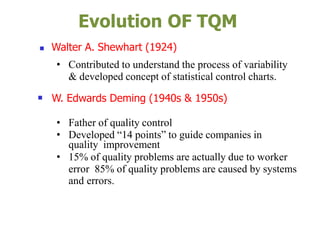
Evolution OF TQM
 Walter A. Shewhart (1924)
• Contributed to understand the process of variability
& developed concept of statistical control charts.
 W. Edwards Deming (1940s & 1950s)
• Father of quality control
• Developed “14 points” to guide companies in
quality improvement
• 15% of quality problems are actually due to worker
error 85% of quality problems are caused by systems
and errors.
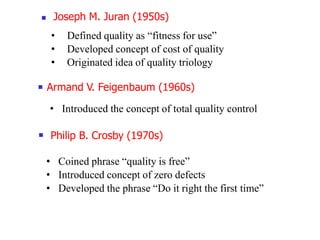
 Joseph M. Juran (1950s)
• Defined quality as “fitness for use”
• Developed concept of cost of quality
• Originated idea of quality triology
 Armand V. Feigenbaum (1960s)
• Introduced the concept of total quality control
 Philip B. Crosby (1970s)
• Coined phrase “quality is free”
• Introduced concept of zero defects
• Developed the phrase “Do it right the first time”
 Kaoru Ishikawa (1970s)
• Developed cause-and-effect diagrams
• Identified concept of “internal customer”
• Introduced the concept of “quality circles”
 Genichi Taguchi (1980s)
• Focused on product design
• Robust Design
• A design that results in a product that can perform
over a wide range of conditions
• Cost of Quality
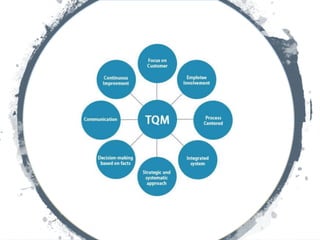
 Management Commitment
1. Plan (drive, direct)
2. Do (deploy, support, participate)
3. Check (review)
4. Act (recognize, communicate, revise)
 Employee Empowerment
1. Training
2. Suggestion scheme
3. Measurement and recognition
4. Excellence teams
 Continuous Improvement
1. Systematic measurement
2. Excellence teams
3. Cross-functional process management
4. Attain, maintain, improve standards
 Customer Focus
1. Supplier partnership
2. Service relationship with internal customers
3. Never compromise quality
4. Customer driven standards
Principles OF
TQM..
17
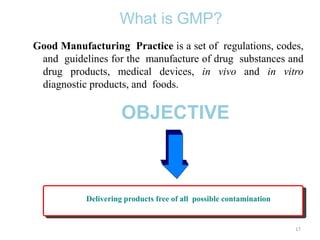
Good Manufacturing Practice is a set of regulations, codes,
and guidelines for the manufacture of drug substances and
drug products, medical devices, in vivo and in vitro
diagnostic products, and foods.
What is GMP?
Delivering products free of all possible contamination
OBJECTIVE
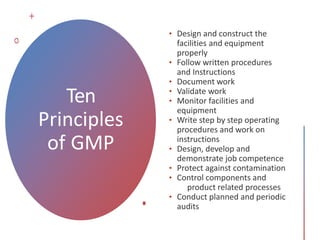
Ten
Principles
of GMP
•
•
•
•
•
•
•
•
•
•
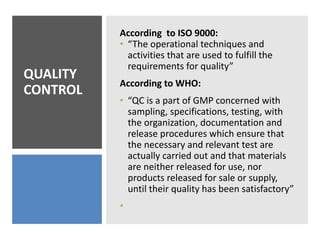
QUALITY
CONTROL
According to ISO 9000:
• “The operational techniques and
activities that are used to fulfill the
requirements for quality”
According to WHO:
• “QC is a part of GMP concerned with
sampling, specifications, testing, with
the organization, documentation and
release procedures which ensure that
the necessary and relevant test are
actually carried out and that materials
are neither released for use, nor
products released for sale or supply,
until their quality has been satisfactory”
•
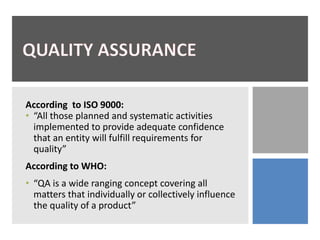
According to ISO 9000:
• “All those planned and systematic activities
implemented to provide adequate confidence
that an entity will fulfill requirements for
quality”
According to WHO:
• “QA is a wide ranging concept covering all
matters that individually or collectively influence
the quality of a product”
21
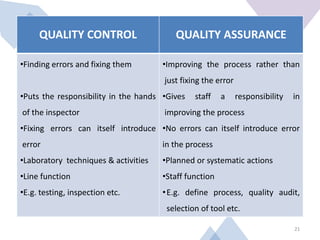
QUALITY CONTROL QUALITY ASSURANCE
•Finding errors and fixing them
•Puts the responsibility in the hands
of the inspector
•Fixing errors can itself introduce
error
•Laboratory techniques & activities
•Line function
•E.g. testing, inspection etc.
•Improving the process rather than
just fixing the error
•Gives staff a responsibility in
improving the process
•No errors can itself introduce error
in the process
•Planned or systematic actions
•Staff function
•E.g. define process, quality audit,
selection of tool etc.
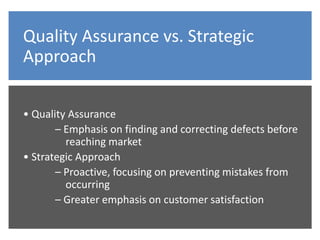
Quality Assurance vs. Strategic
Approach
• Quality Assurance
– Emphasis on finding and correcting defects before
reaching market
• Strategic Approach
– Proactive, focusing on preventing mistakes from
occurring
– Greater emphasis on customer satisfaction
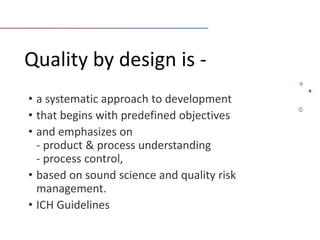
Quality by design is -
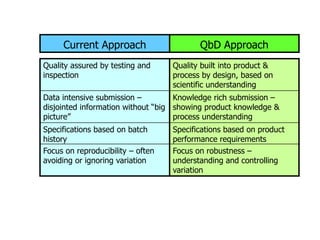
Current Approach QbD Approach
Quality assured by testing and
inspection
Quality built into product &
process by design, based on
scientific understanding
Data intensive submission –
disjointed information without “big
picture”
Knowledge rich submission –
showing product knowledge &
process understanding
Specifications based on batch
history
Specifications based on product
performance requirements
Focus on reproducibility – often
avoiding or ignoring variation
Focus on robustness –
understanding and controlling
variation
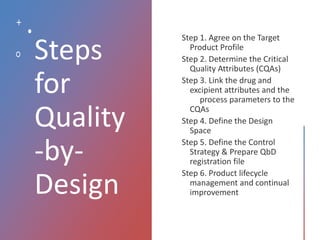
Steps
for
Quality
-by-
Design
Benefits OF
TQM..
• Attain higher profitability and
increased market share
• Improve customer satisfaction
• Improve organizational
productivity
• Improve employee morale and
job satisfaction
• Create a positive work culture
• Undertake systematic problem
solving and decision making
through project teams
• Improve teamwork
• Create a climate conducive to
continuous improvement
Revolution in
Quality Thinking
• Quality can not be tested
into products;
• it has to be
• built in by design.
Dr. Ashwani Dhingra
9996230055
ashwani1683@gnkgei.ac.in

Total Quality Management

  • 1.
  • 2.
  • 3.
    QUALITY: Is itimportant ??? Yes, of course !!!!!!! Industry Produce Product Sales Person Promote Product Costumer Consume Product
  • 4.
    In the nextcentury, a company will stand or fall on its quality and value. Robert Hass, CEO Levi Strauss 1982 Quality is the best business plan. John Lasster, Director 2009
  • 5.
    Today all ofthese & others state: QUALITY is our MOTO
  • 6.
    What is Importanceof QUALITY ???
  • 7.
    What is QUALITYPRODUCT???
  • 8.
    Dimensions of Quality • Performance- main characteristics of the product/service • Aesthetics - appearance, feel, smell, taste • Special Features - extra characteristics • Conformance - how well product/service conforms to customer’s expectations • Reliability - consistency of performance • Durability - useful life of the product/service • Perceived Quality - indirect evaluation of quality (e.g. reputation) • Serviceability - service after sale
  • 9.
    TOTAL TOTAL QUALITY MANAGEMENT? QUALITY MANAGEMENT -Made upof the whole -Act , Manner of handling (or) Art -Degree of excellence a product or service provides Sum of all activities performed in anorganization to produce and maintain a product with desired quality level againstminimum cost.
  • 11.
    Evolution OF TQM Walter A. Shewhart (1924) • Contributed to understand the process of variability & developed concept of statistical control charts.  W. Edwards Deming (1940s & 1950s) • Father of quality control • Developed “14 points” to guide companies in quality improvement • 15% of quality problems are actually due to worker error 85% of quality problems are caused by systems and errors.
  • 12.
     Joseph M.Juran (1950s) • Defined quality as “fitness for use” • Developed concept of cost of quality • Originated idea of quality triology  Armand V. Feigenbaum (1960s) • Introduced the concept of total quality control  Philip B. Crosby (1970s) • Coined phrase “quality is free” • Introduced concept of zero defects • Developed the phrase “Do it right the first time”
  • 13.
     Kaoru Ishikawa(1970s) • Developed cause-and-effect diagrams • Identified concept of “internal customer” • Introduced the concept of “quality circles”  Genichi Taguchi (1980s) • Focused on product design • Robust Design • A design that results in a product that can perform over a wide range of conditions • Cost of Quality
  • 16.
     Management Commitment 1.Plan (drive, direct) 2. Do (deploy, support, participate) 3. Check (review) 4. Act (recognize, communicate, revise)  Employee Empowerment 1. Training 2. Suggestion scheme 3. Measurement and recognition 4. Excellence teams  Continuous Improvement 1. Systematic measurement 2. Excellence teams 3. Cross-functional process management 4. Attain, maintain, improve standards  Customer Focus 1. Supplier partnership 2. Service relationship with internal customers 3. Never compromise quality 4. Customer driven standards Principles OF TQM..
  • 17.
    17 Good Manufacturing Practiceis a set of regulations, codes, and guidelines for the manufacture of drug substances and drug products, medical devices, in vivo and in vitro diagnostic products, and foods. What is GMP? Delivering products free of all possible contamination OBJECTIVE
  • 18.
  • 19.
    QUALITY CONTROL According to ISO9000: • “The operational techniques and activities that are used to fulfill the requirements for quality” According to WHO: • “QC is a part of GMP concerned with sampling, specifications, testing, with the organization, documentation and release procedures which ensure that the necessary and relevant test are actually carried out and that materials are neither released for use, nor products released for sale or supply, until their quality has been satisfactory” •
  • 20.
    According to ISO9000: • “All those planned and systematic activities implemented to provide adequate confidence that an entity will fulfill requirements for quality” According to WHO: • “QA is a wide ranging concept covering all matters that individually or collectively influence the quality of a product”
  • 21.
    21 QUALITY CONTROL QUALITYASSURANCE •Finding errors and fixing them •Puts the responsibility in the hands of the inspector •Fixing errors can itself introduce error •Laboratory techniques & activities •Line function •E.g. testing, inspection etc. •Improving the process rather than just fixing the error •Gives staff a responsibility in improving the process •No errors can itself introduce error in the process •Planned or systematic actions •Staff function •E.g. define process, quality audit, selection of tool etc.
  • 22.
    Quality Assurance vs.Strategic Approach • Quality Assurance – Emphasis on finding and correcting defects before reaching market • Strategic Approach – Proactive, focusing on preventing mistakes from occurring – Greater emphasis on customer satisfaction
  • 25.
  • 26.
    Current Approach QbDApproach Quality assured by testing and inspection Quality built into product & process by design, based on scientific understanding Data intensive submission – disjointed information without “big picture” Knowledge rich submission – showing product knowledge & process understanding Specifications based on batch history Specifications based on product performance requirements Focus on reproducibility – often avoiding or ignoring variation Focus on robustness – understanding and controlling variation
  • 27.
  • 29.
    Benefits OF TQM.. • Attainhigher profitability and increased market share • Improve customer satisfaction • Improve organizational productivity • Improve employee morale and job satisfaction • Create a positive work culture • Undertake systematic problem solving and decision making through project teams • Improve teamwork • Create a climate conducive to continuous improvement
  • 30.
    Revolution in Quality Thinking •Quality can not be tested into products; • it has to be • built in by design.
  • 31.