QUALITY MANAGEMENT SYSTEM
DEEKSHITHA H S
DEPARTMENT OF QUALITY
ASSURANCE
PHARMACEUTICAL QUALITY
MANAGEMENT
CONTENTS
 Basics of Quality management
Total Quality Management –
 Introduction to TQM –
 Principles of TQM
 Six basic concepts of TQM
 6 C’s of TQM
 References
BASICS OF QUALITY MANAGEMENT
Quality word oriented from Latin word ‘Qualitus’ it means General excellence or
distinctive feature.
QUALITY STANDS FOR :
Q : Quest for excellence
U : Understanding customer needs
A : Action to achieve customer needs
L : Leadership determination to be leader
I : Involving all people
T : Team spirit to work for common goal
Y : Yard stick measure progress .
DEFINITION OF QUALITY :
Quality is defined as the totality of features and characteristics of a product
or service that bear on its ability to satisfy stated or implied needs .
Dimensions of Quality
1. Performance :Performance refers to a product's primary operating characteristics.
2. Feature :Features are additional characteristics that enhance the appeal of the product or service to the
user.
3. Reliability :Reliability is the likelihood that a product will not fail within a specific time period.
4. Perceived quality :Perceived Quality is the quality attributed to a good or service
5.Aesthetics : It represents the individual’s personal preference.
6. Durability : Durability measures the length of a product’s life.
7.Conformance : Conformance is the precision with which the product or service meets the specified
standards.
8. Serviceability: Serviceability is the speed with which the product can be put into service when it breaks
down, as well as the competence and the behavior of the service person.
9.Response :human to human interface ,such as the courtesy of dealer .
Quality Management
Quality management ensures that an organization,
product or service is consistent.
It has four main components:
• Quality planning
• Quality assurance
• Quality control
• Quality improvement
Quality management is focused not only on product
and service quality, but also on the means to achieve it.
Principles of Quality management
The International Standard for Quality management (ISO 9001:2015)
adopts a number of management principles, that can be used by top
management to guide their organizations towards improved performance.
• Customer focus
• Leadership
• Engagement of people
• Process approach
• Improvement
• Evidence based decision making
• Relationship management
• Criticism
Total Quality Management
 Total – Made up of the whole or Complete.
 Quality – Degree of Excellence a product or service provides to the customer in
present and future.
 Management – Act , art, or manner of handling , controlling, directing, etc.
 TQM is the art of managing the whole to achieve excellence
TQM is the integration of all functions and processes with in an organization in
order to achieve continuous improvement of the quality of goods and services.
The goal is customer satisfaction.
TQM is the management approach of an organization, centered on quality, based on the
participation of all its members and aiming at long-term success through customer
satisfaction. and benefits to all members of the organization and to society.- ISO
•1920 - Some of the first seeds of quality management were planted as the principles
of scientific management swept through U.S. industry.
• Businesses clearly separated the processes of planning and carrying out the plan,
and union opposition arose as workers were deprived of a voice in the conditions and
functions of their work.
• The Hawthorne experiments in the late 1920s showed how worker productivity could
be impacted by participation.
•1930 -Walter Shewhart developed the methods for statistical analysis and control of quality.
1950s -W. Edwards Deming taught methods for statistical analysis and control of quality to
Japanese engineers and executives. This can be considered the origin of TQM.
Joseph M. Juran taught the concepts of controlling quality and managerial breakthrough.
Armand V. Feigenbaum’s book Total Quality Control, a forerunner for the present understanding of
TQM, was published.
Philip B. Crosby’s promotion of zero defects paved the way for quality improvement in many
companies.
Evolution of
TQM
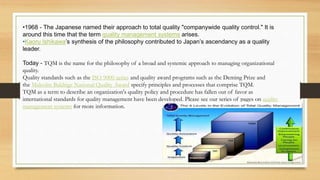
•1968 - The Japanese named their approach to total quality "companywide quality control." It is
around this time that the term quality management systems arises.
•Kaoru Ishikawa’s synthesis of the philosophy contributed to Japan’s ascendancy as a quality
leader.
Today - TQM is the name for the philosophy of a broad and systemic approach to managing organizational
quality.
Quality standards such as the ISO 9000 series and quality award programs such as the Deming Prize and
the Malcolm Baldrige National Quality Award specify principles and processes that comprise TQM.
TQM as a term to describe an organization's quality policy and procedure has fallen out of favor as
international standards for quality management have been developed. Please see our series of pages on quality
management systems for more information.
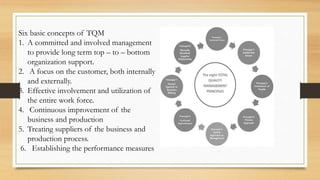
Six basic concepts of TQM
1. A committed and involved management
to provide long term top – to – bottom
organization support.
2. A focus on the customer, both internally
and externally.
3. Effective involvement and utilization of
the entire work force.
4. Continuous improvement of the
business and production
5. Treating suppliers of the business and
production process.
6. Establishing the performance measures
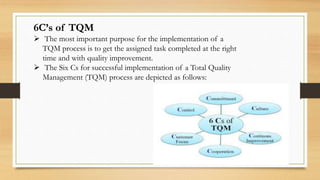
6C’s of TQM
 The most important purpose for the implementation of a
TQM process is to get the assigned task completed at the right
time and with quality improvement.
 The Six Cs for successful implementation of a Total Quality
Management (TQM) process are depicted as follows:
BARRIERS TO TQM
1. Lack of management commitment
2. Lack of faith in and support to TQM activities among management personnel
3. Failure to appreciate TQM as a cultural revolution. In other words, inability to change organizational culture
4. Misunderstanding about the concept of TQM
5. Improper planning
6. Lack of employees commitment
7. Lack of effective communication
8. Lack of continuous training and education
9. Lack of interest or incompetence of leaders
10.Ineffective measurement techniques and lack of access to data and results
11.Non-application of proper tools and techniques
12.Inadequate use of empowerment and team work
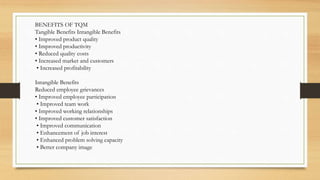
BENEFITS OF TQM
Tangible Benefits Intangible Benefits
• Improved product quality
• Improved productivity
• Reduced quality costs
• Increased market and customers
• Increased profitability
Intangible Benefits
Reduced employee grievances
• Improved employee participation
• Improved team work
• Improved working relationships
• Improved customer satisfaction
• Improved communication
• Enhancement of job interest
• Enhanced problem solving capacity
• Better company image
References :
• The Quality Management Sourcebook by Christine Avery and Diane zabel.
• Juran’s Quality Handbook fifth edition
• https://en.m.wikipedia.org/wiki/Six _sigma
• Quality management hand book

Total Quality Management

  • 1.
    QUALITY MANAGEMENT SYSTEM DEEKSHITHAH S DEPARTMENT OF QUALITY ASSURANCE PHARMACEUTICAL QUALITY MANAGEMENT
  • 2.
    CONTENTS  Basics ofQuality management Total Quality Management –  Introduction to TQM –  Principles of TQM  Six basic concepts of TQM  6 C’s of TQM  References
  • 3.
    BASICS OF QUALITYMANAGEMENT Quality word oriented from Latin word ‘Qualitus’ it means General excellence or distinctive feature. QUALITY STANDS FOR : Q : Quest for excellence U : Understanding customer needs A : Action to achieve customer needs L : Leadership determination to be leader I : Involving all people T : Team spirit to work for common goal Y : Yard stick measure progress . DEFINITION OF QUALITY : Quality is defined as the totality of features and characteristics of a product or service that bear on its ability to satisfy stated or implied needs .
  • 4.
    Dimensions of Quality 1.Performance :Performance refers to a product's primary operating characteristics. 2. Feature :Features are additional characteristics that enhance the appeal of the product or service to the user. 3. Reliability :Reliability is the likelihood that a product will not fail within a specific time period. 4. Perceived quality :Perceived Quality is the quality attributed to a good or service 5.Aesthetics : It represents the individual’s personal preference. 6. Durability : Durability measures the length of a product’s life. 7.Conformance : Conformance is the precision with which the product or service meets the specified standards. 8. Serviceability: Serviceability is the speed with which the product can be put into service when it breaks down, as well as the competence and the behavior of the service person. 9.Response :human to human interface ,such as the courtesy of dealer .
  • 5.
    Quality Management Quality managementensures that an organization, product or service is consistent. It has four main components: • Quality planning • Quality assurance • Quality control • Quality improvement Quality management is focused not only on product and service quality, but also on the means to achieve it.
  • 6.
    Principles of Qualitymanagement The International Standard for Quality management (ISO 9001:2015) adopts a number of management principles, that can be used by top management to guide their organizations towards improved performance. • Customer focus • Leadership • Engagement of people • Process approach • Improvement • Evidence based decision making • Relationship management • Criticism
  • 7.
    Total Quality Management Total – Made up of the whole or Complete.  Quality – Degree of Excellence a product or service provides to the customer in present and future.  Management – Act , art, or manner of handling , controlling, directing, etc.  TQM is the art of managing the whole to achieve excellence TQM is the integration of all functions and processes with in an organization in order to achieve continuous improvement of the quality of goods and services. The goal is customer satisfaction. TQM is the management approach of an organization, centered on quality, based on the participation of all its members and aiming at long-term success through customer satisfaction. and benefits to all members of the organization and to society.- ISO
  • 8.
    •1920 - Someof the first seeds of quality management were planted as the principles of scientific management swept through U.S. industry. • Businesses clearly separated the processes of planning and carrying out the plan, and union opposition arose as workers were deprived of a voice in the conditions and functions of their work. • The Hawthorne experiments in the late 1920s showed how worker productivity could be impacted by participation. •1930 -Walter Shewhart developed the methods for statistical analysis and control of quality. 1950s -W. Edwards Deming taught methods for statistical analysis and control of quality to Japanese engineers and executives. This can be considered the origin of TQM. Joseph M. Juran taught the concepts of controlling quality and managerial breakthrough. Armand V. Feigenbaum’s book Total Quality Control, a forerunner for the present understanding of TQM, was published. Philip B. Crosby’s promotion of zero defects paved the way for quality improvement in many companies. Evolution of TQM
  • 9.
    •1968 - TheJapanese named their approach to total quality "companywide quality control." It is around this time that the term quality management systems arises. •Kaoru Ishikawa’s synthesis of the philosophy contributed to Japan’s ascendancy as a quality leader. Today - TQM is the name for the philosophy of a broad and systemic approach to managing organizational quality. Quality standards such as the ISO 9000 series and quality award programs such as the Deming Prize and the Malcolm Baldrige National Quality Award specify principles and processes that comprise TQM. TQM as a term to describe an organization's quality policy and procedure has fallen out of favor as international standards for quality management have been developed. Please see our series of pages on quality management systems for more information.
  • 10.
    Six basic conceptsof TQM 1. A committed and involved management to provide long term top – to – bottom organization support. 2. A focus on the customer, both internally and externally. 3. Effective involvement and utilization of the entire work force. 4. Continuous improvement of the business and production 5. Treating suppliers of the business and production process. 6. Establishing the performance measures
  • 11.
    6C’s of TQM The most important purpose for the implementation of a TQM process is to get the assigned task completed at the right time and with quality improvement.  The Six Cs for successful implementation of a Total Quality Management (TQM) process are depicted as follows:
  • 12.
    BARRIERS TO TQM 1.Lack of management commitment 2. Lack of faith in and support to TQM activities among management personnel 3. Failure to appreciate TQM as a cultural revolution. In other words, inability to change organizational culture 4. Misunderstanding about the concept of TQM 5. Improper planning 6. Lack of employees commitment 7. Lack of effective communication 8. Lack of continuous training and education 9. Lack of interest or incompetence of leaders 10.Ineffective measurement techniques and lack of access to data and results 11.Non-application of proper tools and techniques 12.Inadequate use of empowerment and team work
  • 13.
    BENEFITS OF TQM TangibleBenefits Intangible Benefits • Improved product quality • Improved productivity • Reduced quality costs • Increased market and customers • Increased profitability Intangible Benefits Reduced employee grievances • Improved employee participation • Improved team work • Improved working relationships • Improved customer satisfaction • Improved communication • Enhancement of job interest • Enhanced problem solving capacity • Better company image
  • 14.
    References : • TheQuality Management Sourcebook by Christine Avery and Diane zabel. • Juran’s Quality Handbook fifth edition • https://en.m.wikipedia.org/wiki/Six _sigma • Quality management hand book