[ MBA - I ]
Presented By
Vishal Patel
Pooja Srivastawa
Definition of Quality
 Quality is the totality of features and characteristics of a
product or service that bear on its ability to satisfy stated
or implied needs.
 Some goals of quality programs include:
 Fitness for use. (Is the product or service capable of being
used?)
 Fitness for purpose. (Does the product or service meet its
intended purpose?)
 Customer satisfaction. (Does the product or service meet the
customer's expectations?)
 Conformance to the requirements. (Does the product or
service conform to the requirements?)
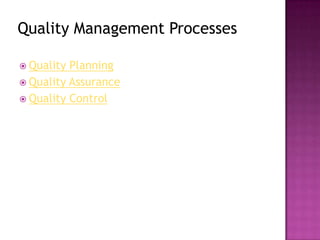
Quality Management Processes
 Quality Planning
 Quality Assurance
 Quality Control
Quality Planning
The process of identifying which quality standards are
relevant to the project and determining how to satisfy
them.
 Input includes: Quality policy, scope statement, product
description, standards and regulations, and other process
Output.
 Methods used: benefit / cost analysis, benchmarking,
flowcharting, and design of experiments
 Output includes: Quality Management Plan, operational
definitions, checklists, and Input to other processes.
Quality Assurance
The process of evaluating overall project performance on
a regular basis to provide confidence that the project will
satisfy the relevant quality standards.
 Input includes: Quality Management Plan, results of
quality control measurements, and operational
definitions.
 Methods used: quality planning tools and techniques and
quality audits.
 Output includes: quality improvement.
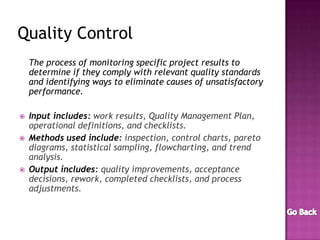
Quality Control
The process of monitoring specific project results to
determine if they comply with relevant quality standards
and identifying ways to eliminate causes of unsatisfactory
performance.
 Input includes: work results, Quality Management Plan,
operational definitions, and checklists.
 Methods used include: inspection, control charts, pareto
diagrams, statistical sampling, flowcharting, and trend
analysis.
 Output includes: quality improvements, acceptance
decisions, rework, completed checklists, and process
adjustments.
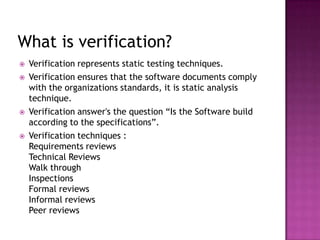
What is verification?
 Verification represents static testing techniques.
 Verification ensures that the software documents comply
with the organizations standards, it is static analysis
technique.
 Verification answer's the question “Is the Software build
according to the specifications”.
 Verification techniques :
Requirements reviews
Technical Reviews
Walk through
Inspections
Formal reviews
Informal reviews
Peer reviews
What is software validation?
 Validation represents dynamic testing techniques.
 Validation ensures that the software operates as planned in
the requirements phase by executing it, running predefined
test cases and measuring the output with expected results.
 Validation answers the question “Did we build the software fit
for purpose and does it provides the solution to the problem”.
 Validation is concerned with evaluating the software,
component or system to determine it meets end user
requirements.
 Validation techniques :
Unit testing
Integration testing
System testing
Integration testing
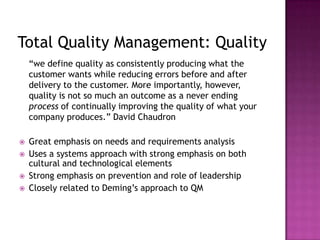
Total Quality Management: Quality
“we define quality as consistently producing what the
customer wants while reducing errors before and after
delivery to the customer. More importantly, however,
quality is not so much an outcome as a never ending
process of continually improving the quality of what your
company produces.” David Chaudron
 Great emphasis on needs and requirements analysis
 Uses a systems approach with strong emphasis on both
cultural and technological elements
 Strong emphasis on prevention and role of leadership
 Closely related to Deming’s approach to QM
ISO 8402 and 9000: Quality and QM
“The totality of characteristics of an entity that bear on its
ability to satisfy stated and implied needs” ISO 8402
Quality management: activities performed to formulate
and implement policies and programs intended to achieve
quality.
 Examples:
 quality planning,
 quality control,
 quality assurance, and
 quality improvement
ISO 9000: Eight Principles
 Customer Focus (on needs and requirements)
 Leadership (establish unity of purpose, direction,
environment for participation)
 Involvement of people (full)
 Process Approach (managing activities & resources)
 Systems Approach to Management (of inter-related
processes)
 Continual Improvement (of processes and performance)
 Factual Approach to Decision Making (analysis of data/info)
 Mutually Beneficial supplier relationships
Quality Concepts
 Zero Defects
 Implies that there is no tolerance for errors within the
system.
 The goal of all processes is to avoid defects in the product or
service.
 Similar to six sigma: almost zero defects
 The Customer is the Next Person in the Process
 The internal organization has a system that ensures the
product or service is transferred to the next person in the
process in a complete and correct manner.
 The product or service being built is transferred to another
internal party only after it meets all the specifications and all
actions at the current work station.
 Avoids incorrectly assembled components and poor
workmanship.
Quality Concepts
 Do the Right Thing Right the First Time (DTRTRTFT)
 Implies that it is easier and less costly to do the work right the
first time than it is to do it the second time.
 Entails the training of personnel to ensure sufficient skills and
tools to correctly complete the work.
 Continuous Improvement Process (CIP) (From Japanese
word, Kaizen)
 A sustained, gradual change to improve the situation.
 Differs from innovation -- does not make a sudden jump to a
plateau where it matures over time.
 Focuses on 11 principles: constancy of purpose, commitment
to quality, customer focus and involvement, process
orientation, continuous improvement, system-centered
management, investment in knowledge, teamwork,
conservation of human resources, total involvement, and
perpetual commitment.
Cost of Quality
 Cost of quality is the total price of all efforts to achieve product
or service quality. This includes all work to build a product or
service that conforms to the requirements as well as all work
resulting from nonconformance to the requirements.
 The typical project should have a goal of between 3-5% of the
total value as the cost of a quality program depending on the
type of project and its total dollar value.
 Cost to build right the first time
 Training programs
 Statistical Process Control (SPC) Costs
 Cost of a quality system is often viewed as a negative cost
because errors in work have been traditionally accepted as a cost
of doing business.
Major Cost Categories of Quality
 Prevention Cost - cost to plan and execute a project so that it
will be error-free
 Appraisal Cost - cost of evaluating the processes and the Output
of the processes to ensure the product is error-free
 Internal Failure Cost - cost incurred to correct an identified
defect before the customer receives the product
 External Failure Cost - cost incurred due to errors detected by
the customer. This includes warranty cost, field service
personnel training cost, complaint handling, and future business
losses.
 Measurement and Test Equipment - capital cost of equipment
used to perform prevention and appraisal activities.
Opportunities for Reducing Cost
Areas of Waste in Projects
 Waste in rejects of completed work
 Waste in design flaws
 Waste in work-in-process
 Waste in motion for manpower (under-trained employee)
 Waste in management (Improper direction of work)
 Waste in manpower (Misplaced or waiting workers)
 Waste in facilities (Ordering excess material)
 Waste in expenses (Unnecessary meetings, travel)
Thank
You

Quality management

  • 1.
    [ MBA -I ] Presented By Vishal Patel Pooja Srivastawa
  • 2.
    Definition of Quality Quality is the totality of features and characteristics of a product or service that bear on its ability to satisfy stated or implied needs.  Some goals of quality programs include:  Fitness for use. (Is the product or service capable of being used?)  Fitness for purpose. (Does the product or service meet its intended purpose?)  Customer satisfaction. (Does the product or service meet the customer's expectations?)  Conformance to the requirements. (Does the product or service conform to the requirements?)
  • 3.
    Quality Management Processes Quality Planning  Quality Assurance  Quality Control
  • 4.
    Quality Planning The processof identifying which quality standards are relevant to the project and determining how to satisfy them.  Input includes: Quality policy, scope statement, product description, standards and regulations, and other process Output.  Methods used: benefit / cost analysis, benchmarking, flowcharting, and design of experiments  Output includes: Quality Management Plan, operational definitions, checklists, and Input to other processes.
  • 5.
    Quality Assurance The processof evaluating overall project performance on a regular basis to provide confidence that the project will satisfy the relevant quality standards.  Input includes: Quality Management Plan, results of quality control measurements, and operational definitions.  Methods used: quality planning tools and techniques and quality audits.  Output includes: quality improvement.
  • 6.
    Quality Control The processof monitoring specific project results to determine if they comply with relevant quality standards and identifying ways to eliminate causes of unsatisfactory performance.  Input includes: work results, Quality Management Plan, operational definitions, and checklists.  Methods used include: inspection, control charts, pareto diagrams, statistical sampling, flowcharting, and trend analysis.  Output includes: quality improvements, acceptance decisions, rework, completed checklists, and process adjustments.
  • 7.
    What is verification? Verification represents static testing techniques.  Verification ensures that the software documents comply with the organizations standards, it is static analysis technique.  Verification answer's the question “Is the Software build according to the specifications”.  Verification techniques : Requirements reviews Technical Reviews Walk through Inspections Formal reviews Informal reviews Peer reviews
  • 8.
    What is softwarevalidation?  Validation represents dynamic testing techniques.  Validation ensures that the software operates as planned in the requirements phase by executing it, running predefined test cases and measuring the output with expected results.  Validation answers the question “Did we build the software fit for purpose and does it provides the solution to the problem”.  Validation is concerned with evaluating the software, component or system to determine it meets end user requirements.  Validation techniques : Unit testing Integration testing System testing Integration testing
  • 9.
    Total Quality Management:Quality “we define quality as consistently producing what the customer wants while reducing errors before and after delivery to the customer. More importantly, however, quality is not so much an outcome as a never ending process of continually improving the quality of what your company produces.” David Chaudron  Great emphasis on needs and requirements analysis  Uses a systems approach with strong emphasis on both cultural and technological elements  Strong emphasis on prevention and role of leadership  Closely related to Deming’s approach to QM
  • 10.
    ISO 8402 and9000: Quality and QM “The totality of characteristics of an entity that bear on its ability to satisfy stated and implied needs” ISO 8402 Quality management: activities performed to formulate and implement policies and programs intended to achieve quality.  Examples:  quality planning,  quality control,  quality assurance, and  quality improvement
  • 11.
    ISO 9000: EightPrinciples  Customer Focus (on needs and requirements)  Leadership (establish unity of purpose, direction, environment for participation)  Involvement of people (full)  Process Approach (managing activities & resources)  Systems Approach to Management (of inter-related processes)  Continual Improvement (of processes and performance)  Factual Approach to Decision Making (analysis of data/info)  Mutually Beneficial supplier relationships
  • 12.
    Quality Concepts  ZeroDefects  Implies that there is no tolerance for errors within the system.  The goal of all processes is to avoid defects in the product or service.  Similar to six sigma: almost zero defects  The Customer is the Next Person in the Process  The internal organization has a system that ensures the product or service is transferred to the next person in the process in a complete and correct manner.  The product or service being built is transferred to another internal party only after it meets all the specifications and all actions at the current work station.  Avoids incorrectly assembled components and poor workmanship.
  • 13.
    Quality Concepts  Dothe Right Thing Right the First Time (DTRTRTFT)  Implies that it is easier and less costly to do the work right the first time than it is to do it the second time.  Entails the training of personnel to ensure sufficient skills and tools to correctly complete the work.  Continuous Improvement Process (CIP) (From Japanese word, Kaizen)  A sustained, gradual change to improve the situation.  Differs from innovation -- does not make a sudden jump to a plateau where it matures over time.  Focuses on 11 principles: constancy of purpose, commitment to quality, customer focus and involvement, process orientation, continuous improvement, system-centered management, investment in knowledge, teamwork, conservation of human resources, total involvement, and perpetual commitment.
  • 14.
    Cost of Quality Cost of quality is the total price of all efforts to achieve product or service quality. This includes all work to build a product or service that conforms to the requirements as well as all work resulting from nonconformance to the requirements.  The typical project should have a goal of between 3-5% of the total value as the cost of a quality program depending on the type of project and its total dollar value.  Cost to build right the first time  Training programs  Statistical Process Control (SPC) Costs  Cost of a quality system is often viewed as a negative cost because errors in work have been traditionally accepted as a cost of doing business.
  • 15.
    Major Cost Categoriesof Quality  Prevention Cost - cost to plan and execute a project so that it will be error-free  Appraisal Cost - cost of evaluating the processes and the Output of the processes to ensure the product is error-free  Internal Failure Cost - cost incurred to correct an identified defect before the customer receives the product  External Failure Cost - cost incurred due to errors detected by the customer. This includes warranty cost, field service personnel training cost, complaint handling, and future business losses.  Measurement and Test Equipment - capital cost of equipment used to perform prevention and appraisal activities.
  • 16.
    Opportunities for ReducingCost Areas of Waste in Projects  Waste in rejects of completed work  Waste in design flaws  Waste in work-in-process  Waste in motion for manpower (under-trained employee)  Waste in management (Improper direction of work)  Waste in manpower (Misplaced or waiting workers)  Waste in facilities (Ordering excess material)  Waste in expenses (Unnecessary meetings, travel)
  • 17.