



QUALITY ASSURANCE
Navneeth krishna
Crescent college of
pharmaceutical sciences
The quality of something depends on the criteria being applied to it.
Something might be good because it is useful, because it is beautiful,
or simply because it exists
Quality can refer to:
•Technical interpretation - A specific characteristic of an object (the
qualities of ice - i.e. its properties)
•Philosophical interpretation - The essence of an object (the quality of ice
- i.e. "iceness")
•Practical interpretation - The achievement or excellence of an object
(good quality ice - i.e. not of inferior grade)
•Metaphysical interpretation - The meaning of excellence itself
•Scientific interpretation - In physics, the range of frequencies over which
something will characteristically respond.
Quality assurance (QA)

• QA is the activity of providing evidence needed to establish confidence among
all concerned, that quality-related activities are being performed effectively.
• All those planned or systematic actions necessary to provide adequate
confidence that a product or service will satisfy given requirements for quality.
• Quality Assurance is a part and consistent pair of quality management proving
fact-based external confidence to customers and other stakeholders that a
product meets needs, expectations, and other requirements.
• QA assures the existence and effectiveness of procedures that attempt to
make sure - in advance - that the expected levels of quality will be reached.
QUALITY ASSURANCE IN
PHARMA INDUSTRY




It is a measure of high degree of
managerial, scientific, technical functions
by sophisticated design and development.
Implement of quality assurance Is the
most vital function of total quality
management in pharmaceutical industry
and is considered as an internal part of
business and market.
QUALITY OBJECTIVES
For any industry or organization functional
objective should be well defined and quantified.


It help management to stimulate action and allow
companies to perform against defined objectives.


A large company has to establish on
interdepartmental mechanism to identify important
objective of the company / organization which need
to work assess their economic and other efforts and
fix priorities of action.



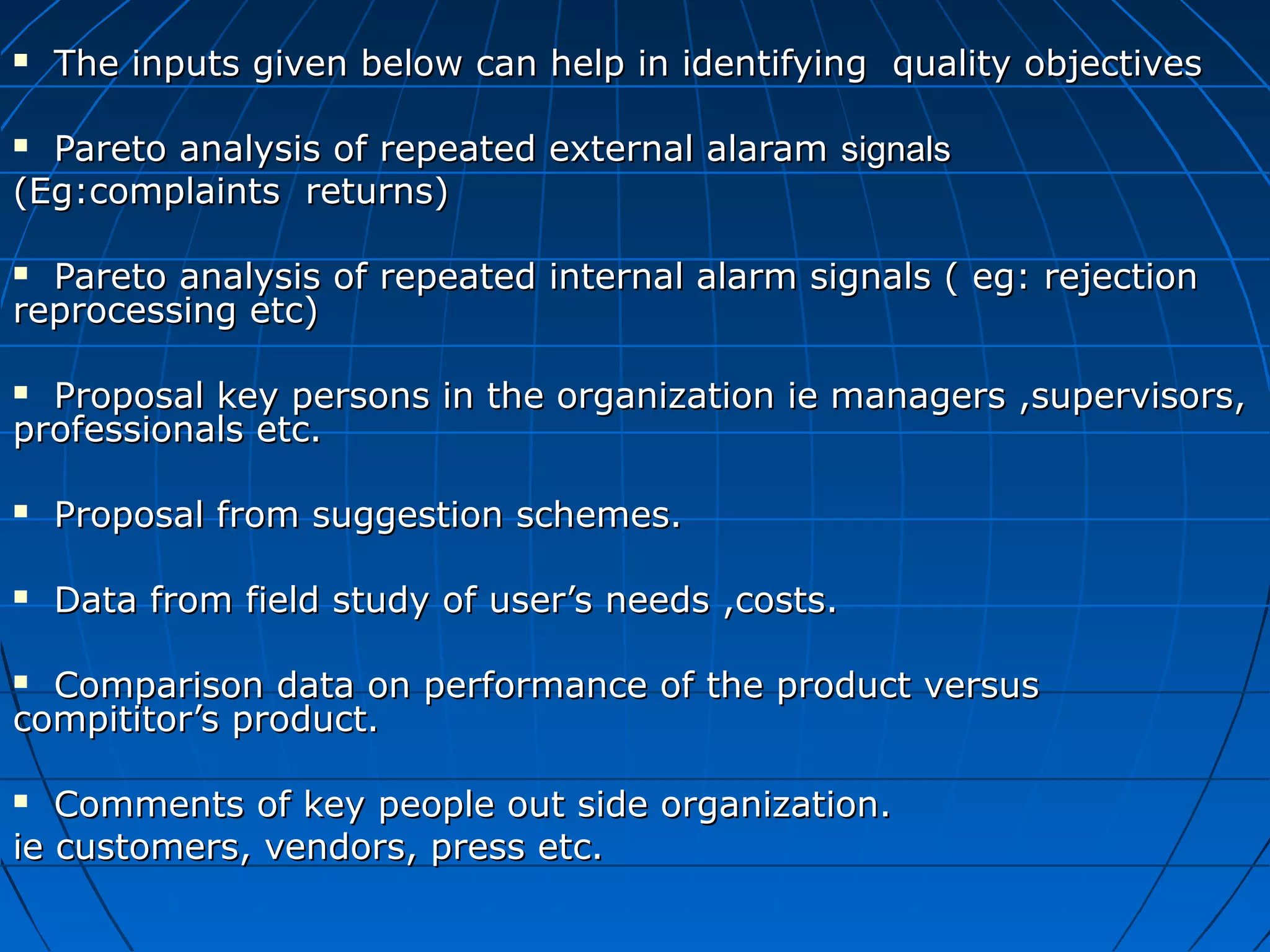
The inputs given below can help in identifying quality objectives

Pareto analysis of repeated external alaram signals
(Eg:complaints returns)


Pareto analysis of repeated internal alarm signals ( eg: rejection
reprocessing etc)


Proposal key persons in the organization ie managers ,supervisors,
professionals etc.




Proposal from suggestion schemes.



Data from field study of user’s needs ,costs.

Comparison data on performance of the product versus
compititor’s product.


Comments of key people out side organization.
ie customers, vendors, press etc.

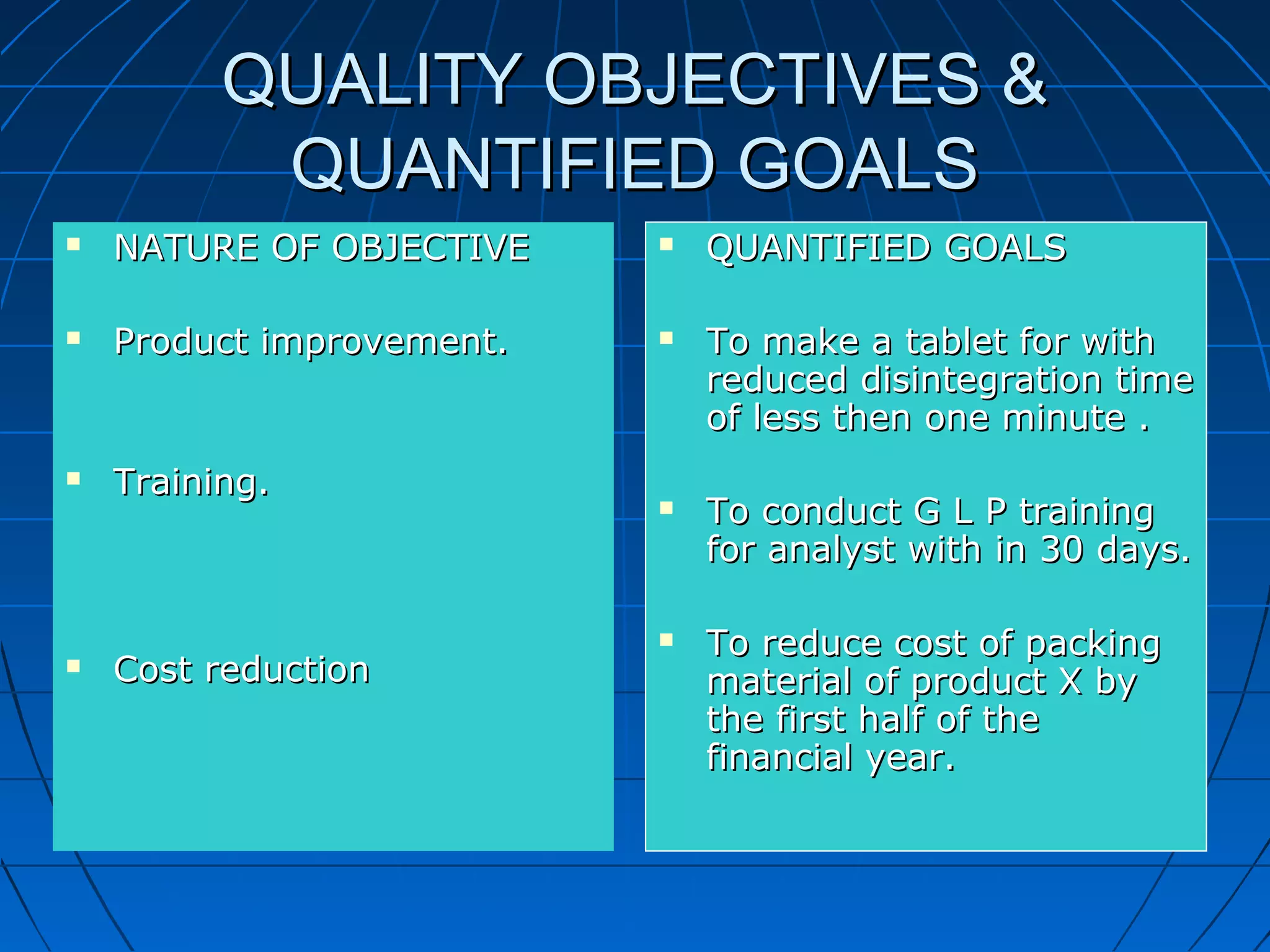
QUALITY OBJECTIVES &
QUANTIFIED GOALS


NATURE OF OBJECTIVE





Product improvement.





Training.



Cost reduction





QUANTIFIED GOALS
To make a tablet for with
reduced disintegration time
of less then one minute .
To conduct G L P training
for analyst with in 30 days.
To reduce cost of packing
material of product X by
the first half of the
financial year.
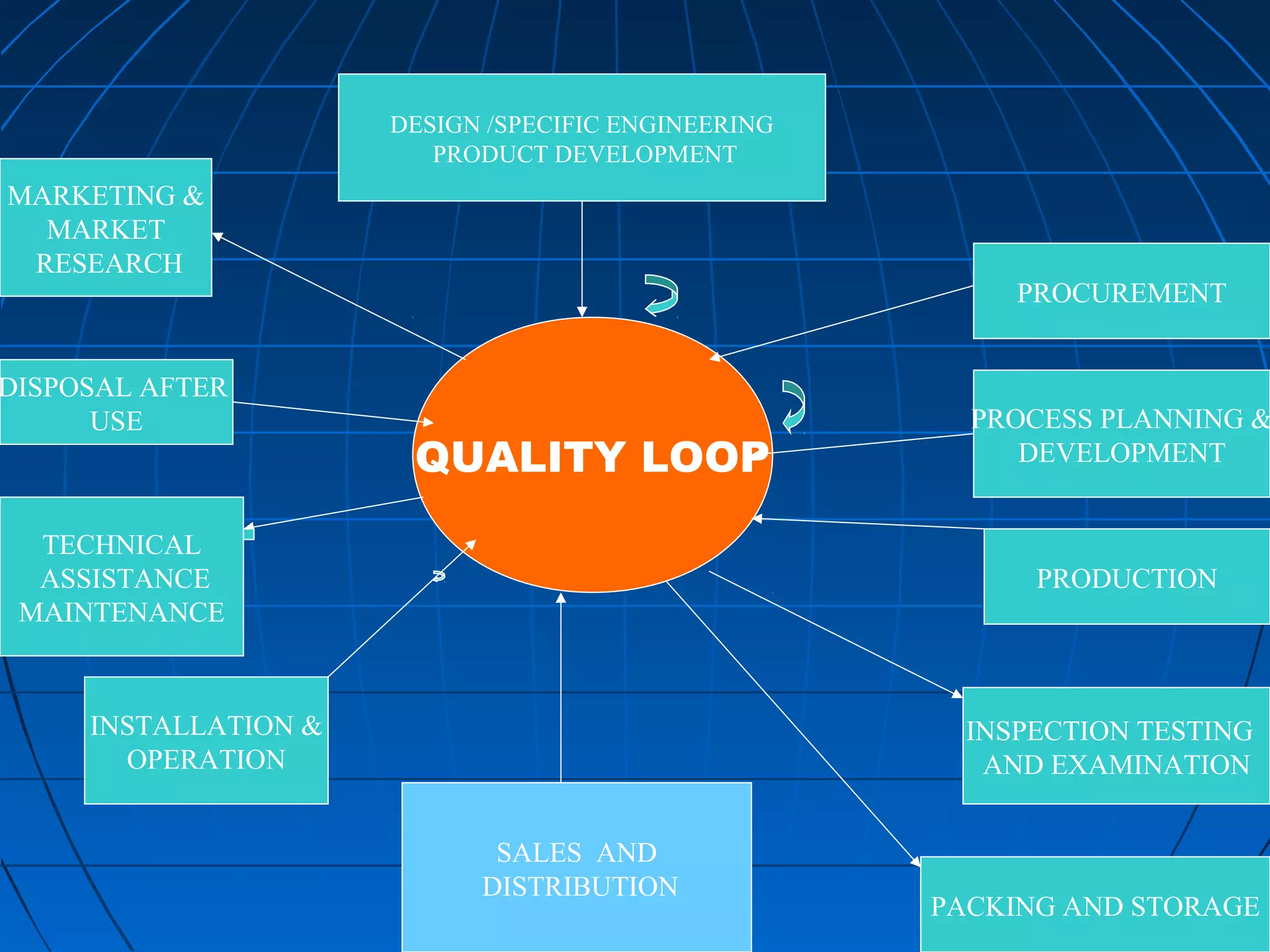
DESIGN /SPECIFIC ENGINEERING
PRODUCT DEVELOPMENT

MARKETING &
MARKET
RESEARCH

DISPOSAL AFTER
USE

PROCUREMENT

QUALITY LOOP

TECHNICAL
ASSISTANCE
MAINTENANCE

PROCESS PLANNING &
DEVELOPMENT

PRODUCTION

INSTALLATION &
OPERATION

INSPECTION TESTING
AND EXAMINATION
SALES AND
DISTRIBUTION

PACKING AND STORAGE
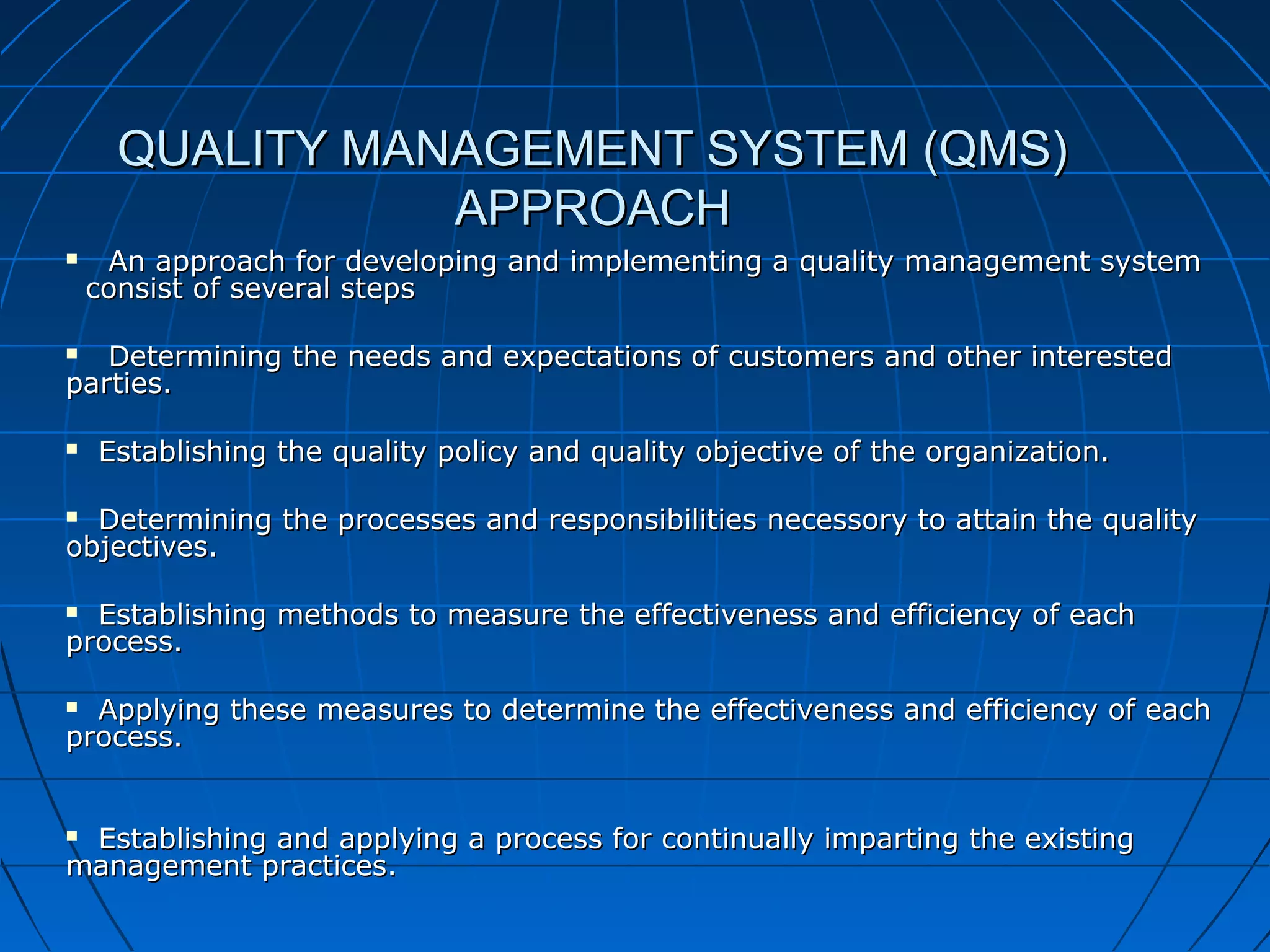
QUALITY MANAGEMENT SYSTEM (QMS)
APPROACH


An approach for developing and implementing a quality management system
consist of several steps

Determining the needs and expectations of customers and other interested
parties.




Establishing the quality policy and quality objective of the organization.

Determining the processes and responsibilities necessory to attain the quality
objectives.


Establishing methods to measure the effectiveness and efficiency of each
process.


Applying these measures to determine the effectiveness and efficiency of each
process.


Establishing and applying a process for continually imparting the existing
management practices.

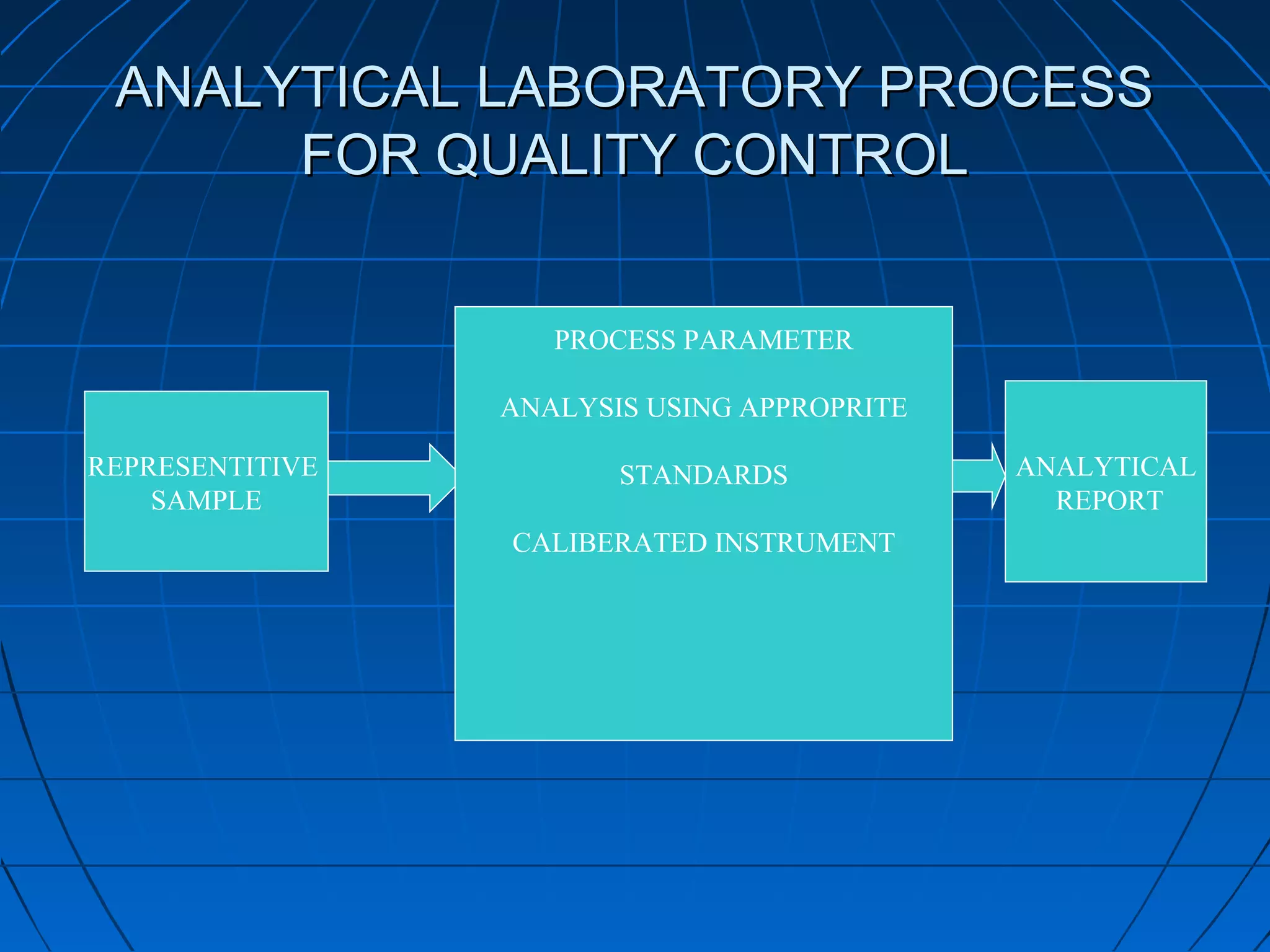
ANALYTICAL LABORATORY PROCESS
FOR QUALITY CONTROL
PROCESS PARAMETER
ANALYSIS USING APPROPRITE
REPRESENTITIVE
SAMPLE

STANDARDS
CALIBERATED INSTRUMENT

ANALYTICAL
REPORT
WHERE FROM THE
QUALITY COMES
The quality comes from a process.
A process is the transformation of set of
inputs ,which can include actions ,
materials an operations into desired out put
in the form of products, information
,services or results are to be analyzed by
examination of its inputs and outputs .this
will determine the actions which will be
necessory to improve quality.

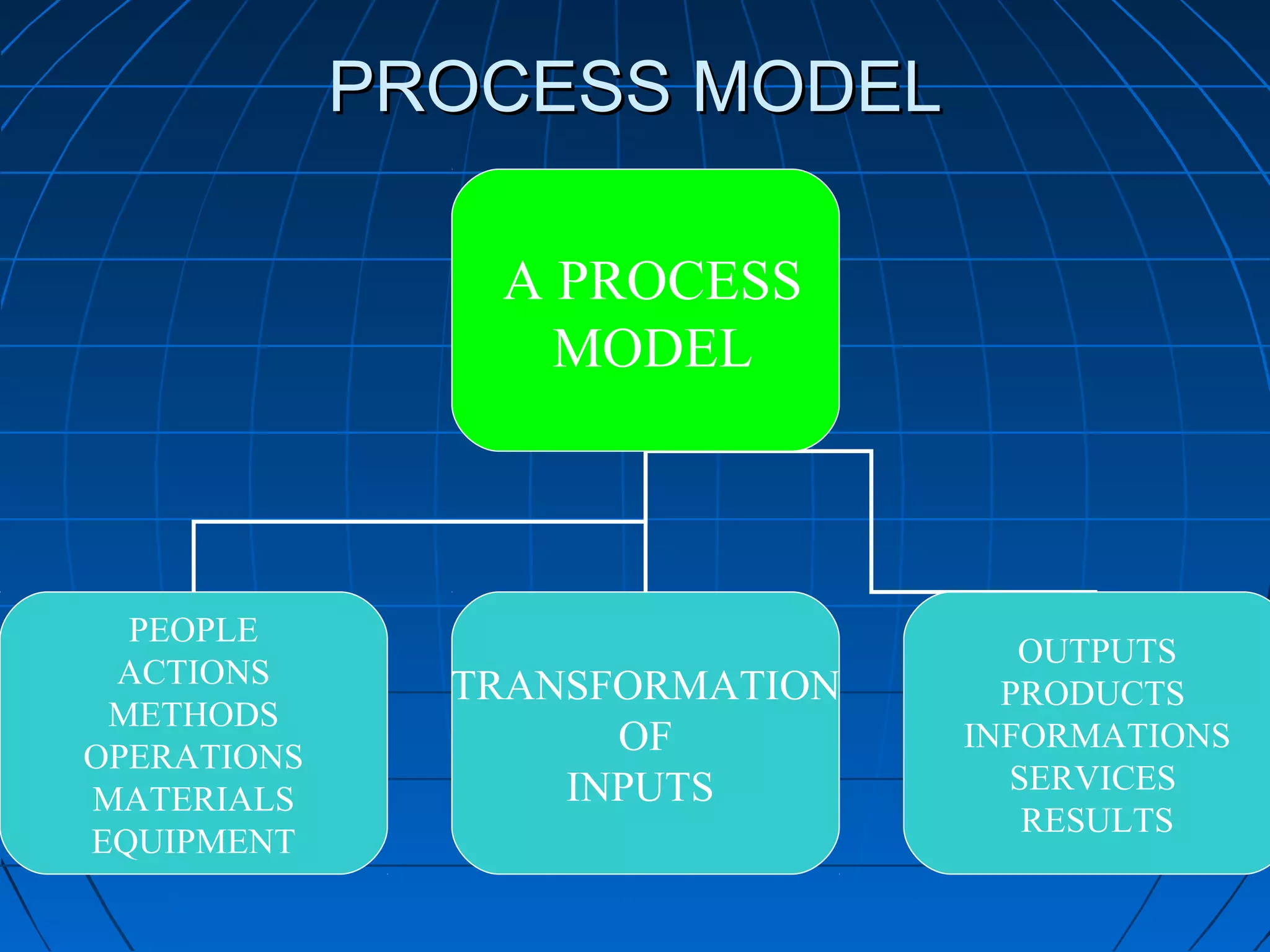
PROCESS MODEL
A PROCESS
MODEL

PEOPLE
ACTIONS
METHODS
OPERATIONS
MATERIALS
EQUIPMENT

TRANSFORMATION
OF
INPUTS

OUTPUTS
PRODUCTS
INFORMATIONS
SERVICES
RESULTS
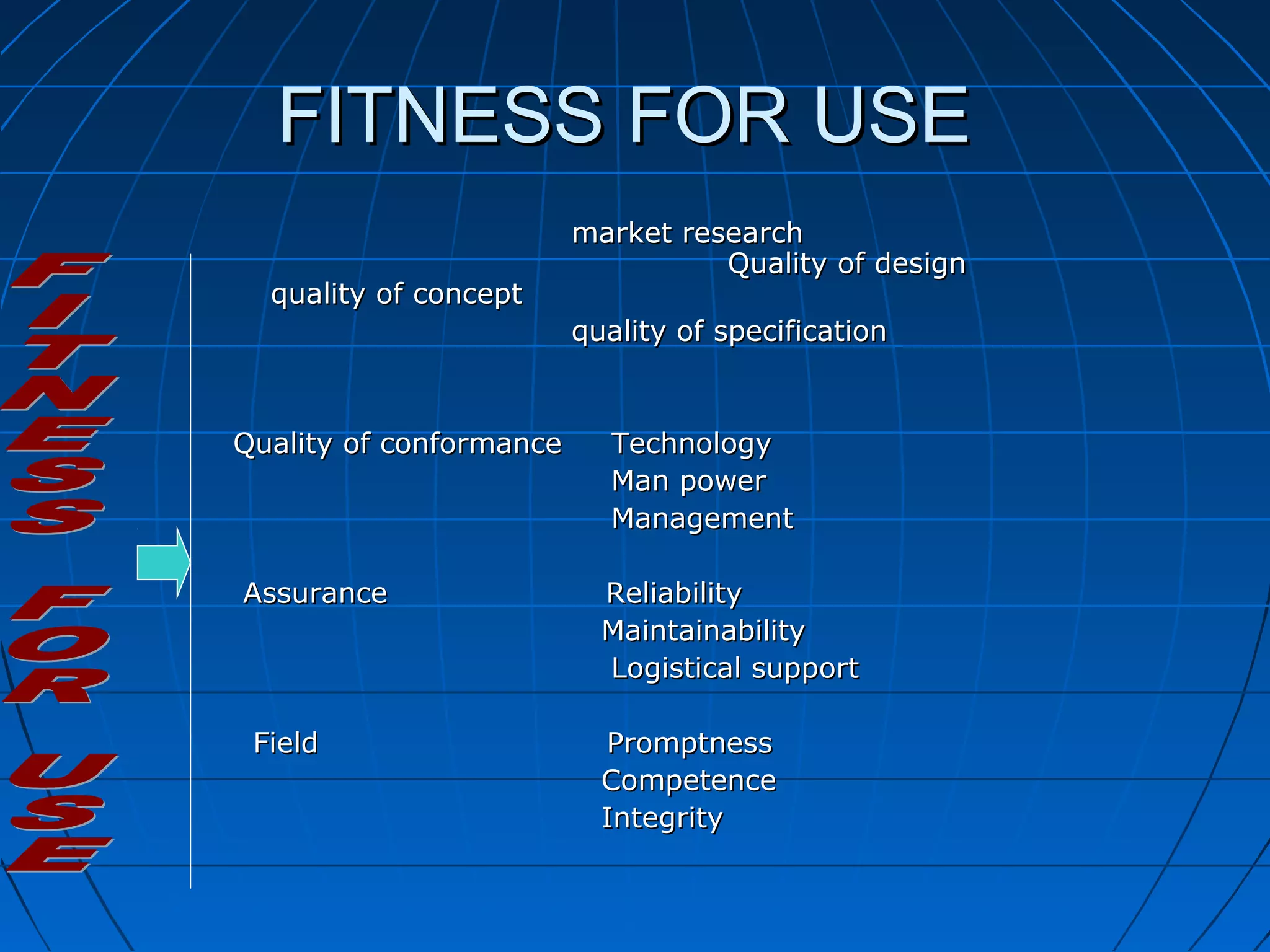
FITNESS FOR USE
quality of concept

market research
Quality of design
quality of specification

Quality of conformance

Assurance

Field

Technology
Man power
Management
Reliability
Maintainability
Logistical support
Promptness
Competence
Integrity
FITNESS FOR USE


A difference in the quality of grade
(which include level of fitness of the
product for use and level of
purchasing power of the customer)
will determine the quality & design of
the product.
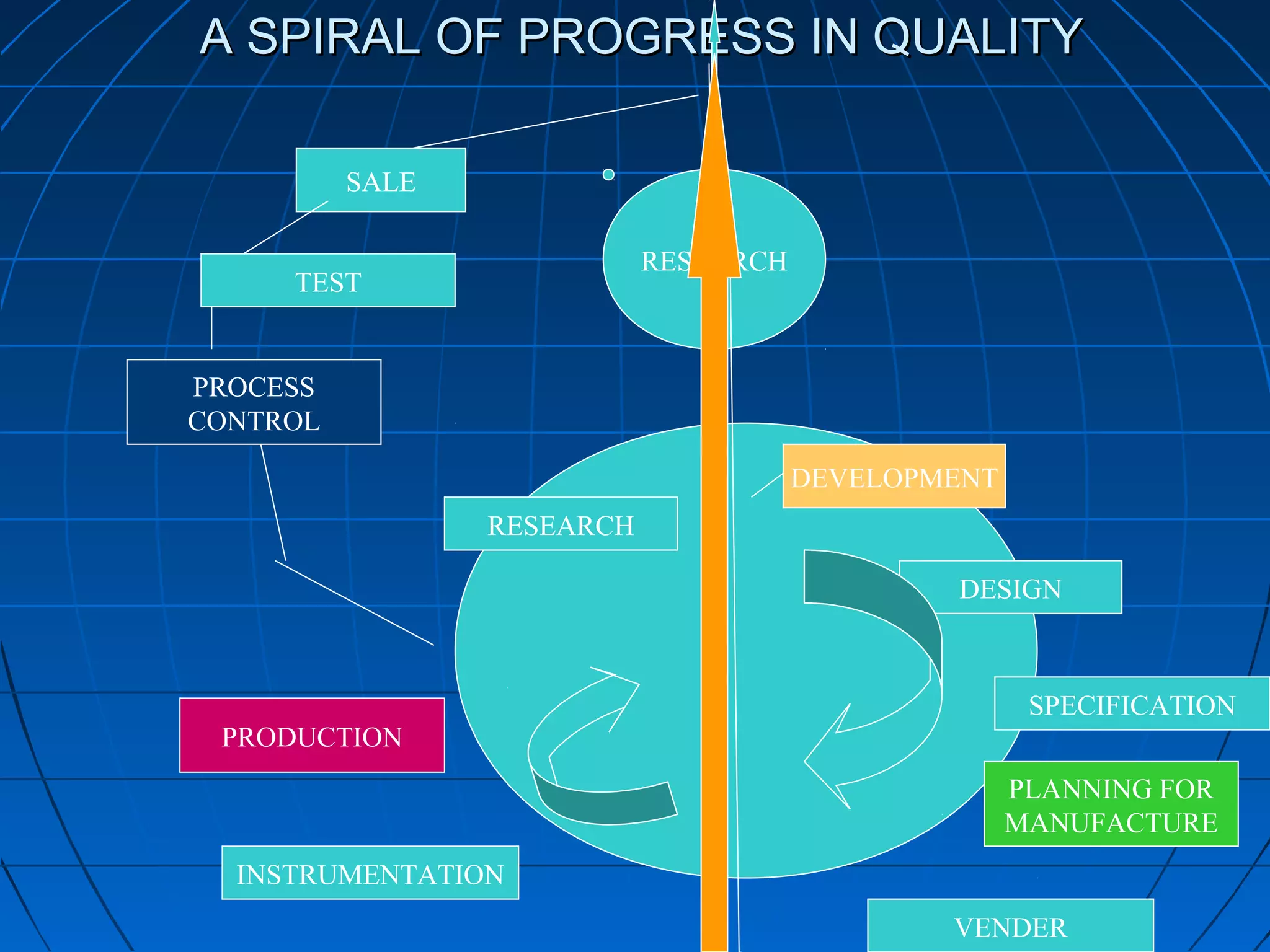
A SPIRAL OF PROGRESS IN QUALITY
SALE
RESEARCH

TEST

PROCESS
CONTROL
DEVELOPMENT
RESEARCH
DESIGN

SPECIFICATION
PRODUCTION
PLANNING FOR
MANUFACTURE
INSTRUMENTATION
VENDER
CUSTOMER
(AND OTHER
CUSTOMER
CUSTOMERS
INTERESTED
(AND OTHER
(AND
PARTIESOTHER
NTERESTED
INTERESTED
PARTIES)
PARTIES)

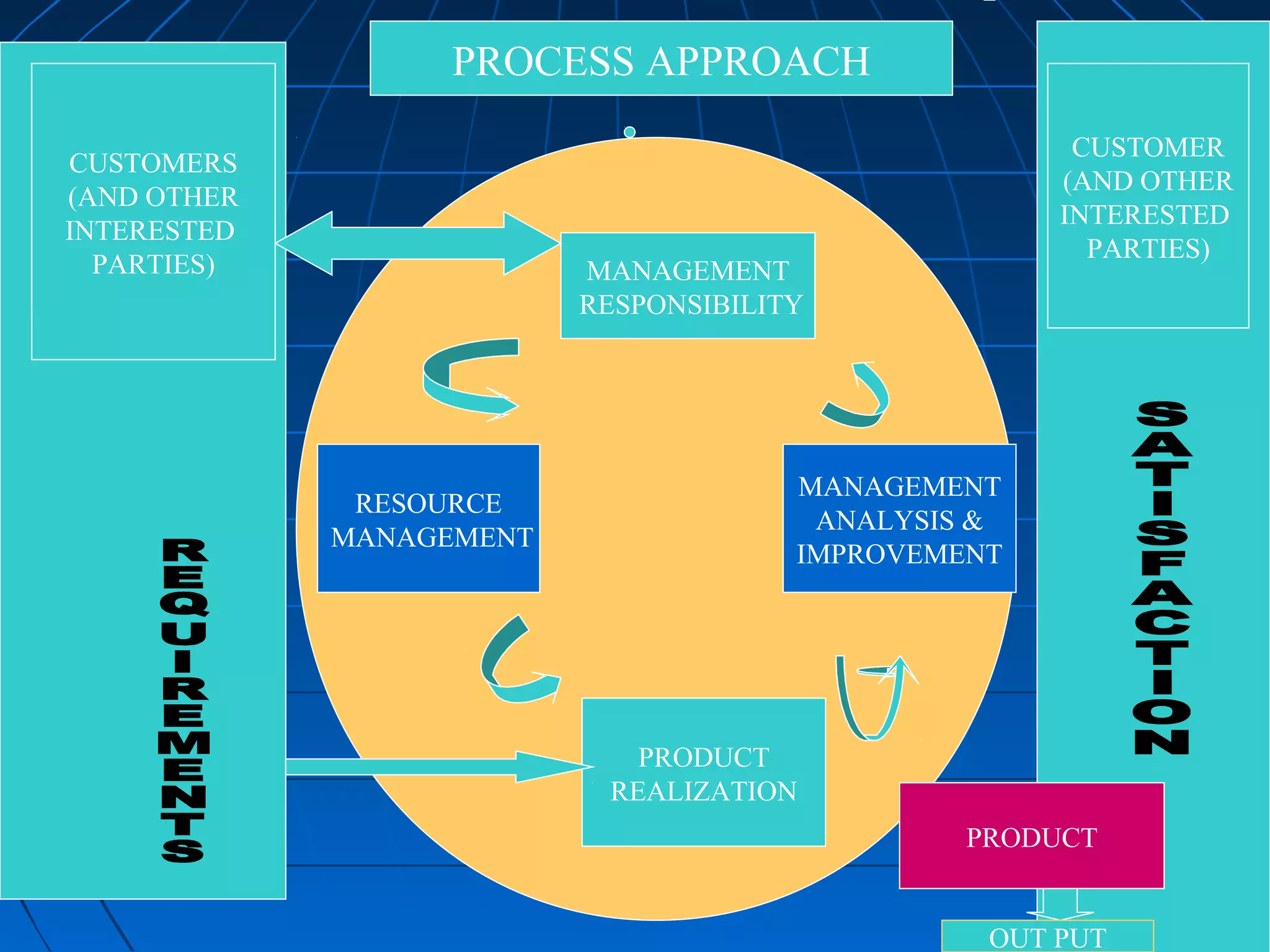
PROCESS APPROACH
CUSTOMER
(AND OTHER
INTERESTED
PARTIES)

MANAGEMENT
RESPONSIBILITY

RESOURCE
MANAGEMENT

MANAGEMENT
ANALYSIS &
IMPROVEMENT

PRODUCT
REALIZATION
PRODUCT
OUT PUT
REFERENCES




WEBSITE: wikipedia.com
www.pitu.edu
Philosophy.com/QA
Foss.dk
TEXTBOOKS: Quality assurance and
Quality managament
Quality Management
THANK YOU

Qa quality assurance

  • 1.
    QUALITY ASSURANCE Navneeth krishna Crescentcollege of pharmaceutical sciences
  • 2.
    The quality ofsomething depends on the criteria being applied to it. Something might be good because it is useful, because it is beautiful, or simply because it exists Quality can refer to: •Technical interpretation - A specific characteristic of an object (the qualities of ice - i.e. its properties) •Philosophical interpretation - The essence of an object (the quality of ice - i.e. "iceness") •Practical interpretation - The achievement or excellence of an object (good quality ice - i.e. not of inferior grade) •Metaphysical interpretation - The meaning of excellence itself •Scientific interpretation - In physics, the range of frequencies over which something will characteristically respond.
  • 3.
    Quality assurance (QA) •QA is the activity of providing evidence needed to establish confidence among all concerned, that quality-related activities are being performed effectively. • All those planned or systematic actions necessary to provide adequate confidence that a product or service will satisfy given requirements for quality. • Quality Assurance is a part and consistent pair of quality management proving fact-based external confidence to customers and other stakeholders that a product meets needs, expectations, and other requirements. • QA assures the existence and effectiveness of procedures that attempt to make sure - in advance - that the expected levels of quality will be reached.
  • 4.
    QUALITY ASSURANCE IN PHARMAINDUSTRY   It is a measure of high degree of managerial, scientific, technical functions by sophisticated design and development. Implement of quality assurance Is the most vital function of total quality management in pharmaceutical industry and is considered as an internal part of business and market.
  • 5.
    QUALITY OBJECTIVES For anyindustry or organization functional objective should be well defined and quantified.  It help management to stimulate action and allow companies to perform against defined objectives.  A large company has to establish on interdepartmental mechanism to identify important objective of the company / organization which need to work assess their economic and other efforts and fix priorities of action. 
  • 6.
     The inputs givenbelow can help in identifying quality objectives Pareto analysis of repeated external alaram signals (Eg:complaints returns)  Pareto analysis of repeated internal alarm signals ( eg: rejection reprocessing etc)  Proposal key persons in the organization ie managers ,supervisors, professionals etc.   Proposal from suggestion schemes.  Data from field study of user’s needs ,costs. Comparison data on performance of the product versus compititor’s product.  Comments of key people out side organization. ie customers, vendors, press etc. 
  • 7.
    QUALITY OBJECTIVES & QUANTIFIEDGOALS  NATURE OF OBJECTIVE   Product improvement.   Training.  Cost reduction   QUANTIFIED GOALS To make a tablet for with reduced disintegration time of less then one minute . To conduct G L P training for analyst with in 30 days. To reduce cost of packing material of product X by the first half of the financial year.
  • 8.
    DESIGN /SPECIFIC ENGINEERING PRODUCTDEVELOPMENT MARKETING & MARKET RESEARCH DISPOSAL AFTER USE PROCUREMENT QUALITY LOOP TECHNICAL ASSISTANCE MAINTENANCE PROCESS PLANNING & DEVELOPMENT PRODUCTION INSTALLATION & OPERATION INSPECTION TESTING AND EXAMINATION SALES AND DISTRIBUTION PACKING AND STORAGE
  • 9.
    QUALITY MANAGEMENT SYSTEM(QMS) APPROACH  An approach for developing and implementing a quality management system consist of several steps Determining the needs and expectations of customers and other interested parties.   Establishing the quality policy and quality objective of the organization. Determining the processes and responsibilities necessory to attain the quality objectives.  Establishing methods to measure the effectiveness and efficiency of each process.  Applying these measures to determine the effectiveness and efficiency of each process.  Establishing and applying a process for continually imparting the existing management practices. 
  • 10.
    ANALYTICAL LABORATORY PROCESS FORQUALITY CONTROL PROCESS PARAMETER ANALYSIS USING APPROPRITE REPRESENTITIVE SAMPLE STANDARDS CALIBERATED INSTRUMENT ANALYTICAL REPORT
  • 11.
    WHERE FROM THE QUALITYCOMES The quality comes from a process. A process is the transformation of set of inputs ,which can include actions , materials an operations into desired out put in the form of products, information ,services or results are to be analyzed by examination of its inputs and outputs .this will determine the actions which will be necessory to improve quality. 
  • 12.
  • 13.
    FITNESS FOR USE qualityof concept market research Quality of design quality of specification Quality of conformance Assurance Field Technology Man power Management Reliability Maintainability Logistical support Promptness Competence Integrity
  • 14.
    FITNESS FOR USE  Adifference in the quality of grade (which include level of fitness of the product for use and level of purchasing power of the customer) will determine the quality & design of the product.
  • 15.
    A SPIRAL OFPROGRESS IN QUALITY SALE RESEARCH TEST PROCESS CONTROL DEVELOPMENT RESEARCH DESIGN SPECIFICATION PRODUCTION PLANNING FOR MANUFACTURE INSTRUMENTATION VENDER
  • 16.
    CUSTOMER (AND OTHER CUSTOMER CUSTOMERS INTERESTED (AND OTHER (AND PARTIESOTHER NTERESTED INTERESTED PARTIES) PARTIES) PROCESSAPPROACH CUSTOMER (AND OTHER INTERESTED PARTIES) MANAGEMENT RESPONSIBILITY RESOURCE MANAGEMENT MANAGEMENT ANALYSIS & IMPROVEMENT PRODUCT REALIZATION PRODUCT OUT PUT
  • 40.
  • 41.