Total Quality Management
TQM
Advanced workshop
Anthony Spanos Accredited EFQM trainer
For Excellence certifications and CSR. Accredited trainer
European Business Ethics. GRI-G4 Sustainability reporting
competent
FOR MANAGERS OF ADVANCED
ORGANIZATIONS INCLUDING HEALTH
SECTOR
AUGUST 2015
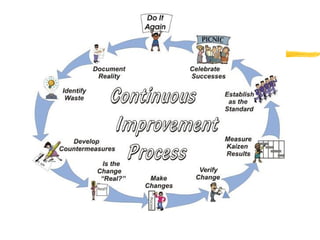
What is the Continuous Improvement
Process
A systematic research for the causes of
unwanted symptoms and the gradual
therapy of the causes using specific tools,
teamwork, innovation and communication
Continuous Improvement steps
1.Detect symptom (eg increased nosocomial infections)
2.Analyze potential causes (lack of systematic
disinfection, no hands washing etc)
3.Locate most important causes
4.Locate potential solutions Select optimal solution
(systematic disinfection)
5.Correct important causes (apply training of medical
personnel, enforce cleanliness)
1ST
principle. We are aiming continuously at the improvement of
the existing situation. CIP is a never ending process
2nd
Principle of CIP : The customer decides what is Quality for
him
3d principle . Everybody is responsible for the quality if his
(her ) work. We are all quality managers
4th
principle. Prevention is the key. Prevention comes before
correction
CIP Principles
5th
principle Everybody is committed and involved in idea
generation, identification and resolution of problems through
systematic teamwork.
6th
principle . Team work relies on cooperation and recognition
of performance as well as commitment and contribution.
7th
principle. Everybody supports improvement efforts.
Improvement is not a job for the few
CIP Principles
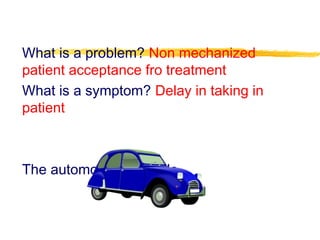
What is a problem? Non mechanized
patient acceptance fro treatment
What is a symptom? Delay in taking in
patient
The automobile example
A measurement system is
required
Measurement in Health Sector : Examples• Mortality
• Morbidity
• Percentage of Nosocomial Infections
• Percentage of complete cure of incoming patients
• Percentage of improvement of incoming patients
• Percentage of patients without cure
• Satisfaction of patients from knowledgeable doctors
• Satisfaction of patients from hospitality environment
• Satisfaction of patients from acceptance and release processes
• Number of medical personnel per patient
• Required days of cure (bed occupation) per case
• Effective capitalization of available beds
Zero defects = “I do it right the first
time”
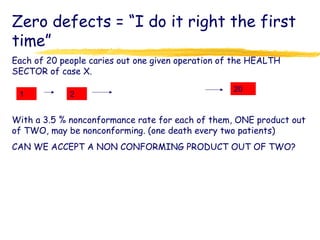
Each of 20 people caries out one given operation of the HEALTH
SECTOR of case X.
With a 3.5 % nonconformance rate for each of them, ONE product out
of TWO, may be nonconforming. (one death every two patients)
CAN WE ACCEPT A NON CONFORMING PRODUCT OUT OF TWO?
1 2
20
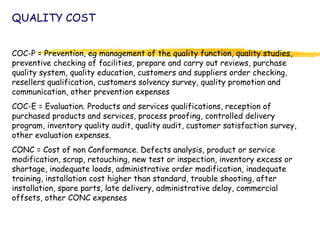
QUALITY COST
COC-P = Prevention, eg management of the quality function, quality studies,
preventive checking of facilities, prepare and carry out reviews, purchase
quality system, quality education, customers and suppliers order checking,
resellers qualification, customers solvency survey, quality promotion and
communication, other prevention expenses
COC-E = Evaluation. Products and services qualifications, reception of
purchased products and services, process proofing, controlled delivery
program, inventory quality audit, quality audit, customer satisfaction survey,
other evaluation expenses.
CONC = Cost of non Conformance. Defects analysis, product or service
modification, scrap, retouching, new test or inspection, inventory excess or
shortage, inadequate loads, administrative order modification, inadequate
training, installation cost higher than standard, trouble shooting, after
installation, spare parts, late delivery, administrative delay, commercial
offsets, other CONC expenses
My strategy is the
creative mind of my
people
BILL GATES :
Includes lots of
innovation !!
11
Our skilled, multicultural
employee base
Our success depends on our people and its
reputation for high service levels, expert
knowledge and partnership approach. We aim to
build on it by:
 Increasing our
understanding of our
customers and solutions
 Developing our skills and
competencies
 Making real our culture and
values
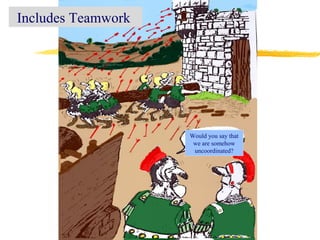
Would you say that
we are somehow
uncoordinated?
Includes Teamwork
Example of continuous improvement.
The building of an orchestra
A widely accepted Strategy and Strategic
objectives communicated to the people Via:
•Presentations
•Pamphlets
•Internet
•Team and personal objectives and targets
•KPI’s
•Training
•Participation in decision making
A measurement system
Measurement in Health Sector : Examples• Mortality
• Morbidity
• Percentage of Nosocomial Infections
• Percentage of complete cure of incoming patients
• Percentage of improvement of incoming patients
• Percentage of patients without cure
• Satisfaction of patients from knowledgeable doctors
• Satisfaction of patients from hospitality environment
• Satisfaction of patients from acceptance and release processes
• Number of medical personnel per patient
• Required days of cure (bed occupation) per case
• Effective capitalization of available beds
Performance measurement frameworkPerformance measurement framework
Locate
Describe
Measure
Monitor
Reporti
KeyKey
PerformancePerformance
IndicatorsIndicators
ImplementImplement
StrategyStrategy
Vision
Mission
Strategy
StrategicStrategic
ObjectivesObjectives
Three critical components for effective process of
performance management
Performance
Management
Infrastructure
Performance
Management
Culture
Performance
Management
Process
Performance management
cycle is continuous and
consistent
Culture that is based
on performance
accountability
Logistic support and
performance management
administration
Performance Management ComponentPerformance Management Component
STRATEGY
Plan and Execute
Monitor and Evaluate
Reward and Coach
Set Measures and Target
Performance Management CyclePerformance Management Cycle
Relevant to
Strategic Objectives
Does KPI have a linkage with the strategic
objectives?
Controlled
performance
Are the KPI achievements still under control?
Manageable Can any action be taken to improve the
performance?
Simple Is the KPI easy to explain?
Dependable Is the KPI not easy to manipulate?
Directions for KPIsDirections for KPIs
KPIKPI Family DimensionFamily Dimension
Productivity Measures employee output (units/
transactions/ dollars), the uptime levels and
how employees use their time (sales-to-
assets ratio, dollar revenue from new
customers, sales pipeline).
Measures the ability to meet and/or exceed
the requirements and expectations of the
customer (customer complaints, percent
returns, DPMO -- defects per million
opportunities).
Quality
KPIKPI Family DimensionFamily Dimension
Profitability Measures the overall effectiveness of the
management organization in generating
profits (profit contribution by
segment/customer, margin spreads).
Measures the point in time (day/week/
month) when management and employee
tasks are completed (on-time delivery,
percent of late orders).
Timeliness
KPIKPI Family DimensionFamily Dimension
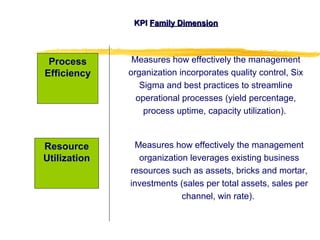
Process
Efficiency
Measures how effectively the management
organization incorporates quality control, Six
Sigma and best practices to streamline
operational processes (yield percentage,
process uptime, capacity utilization).
Measures how effectively the management
organization leverages existing business
resources such as assets, bricks and mortar,
investments (sales per total assets, sales per
channel, win rate).
Resource
Utilization
KPIKPI Family DimensionFamily Dimension
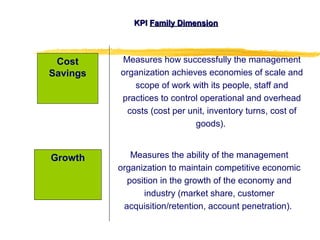
Cost
Savings
Measures how successfully the management
organization achieves economies of scale and
scope of work with its people, staff and
practices to control operational and overhead
costs (cost per unit, inventory turns, cost of
goods).
Measures the ability of the management
organization to maintain competitive economic
position in the growth of the economy and
industry (market share, customer
acquisition/retention, account penetration).
Growth
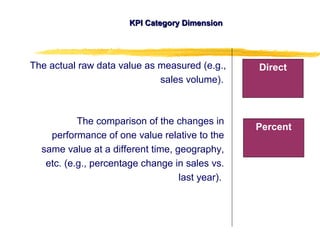
KPI Category DimensionKPI Category Dimension
DirectThe actual raw data value as measured (e.g.,
sales volume).
Percent
The comparison of the changes in
performance of one value relative to the
same value at a different time, geography,
etc. (e.g., percentage change in sales vs.
last year).
KPI Category DimensionKPI Category Dimension
Simple
Ratio
The comparison of one value relative to another to
provide a benchmark for comparison of
performance (e.g., average sales per day).
Index
A combination of several separate measures
added together that result in an overall indicator
of performance (e.g., (company sales growth)/
(industry sales growth) for a specific geography).
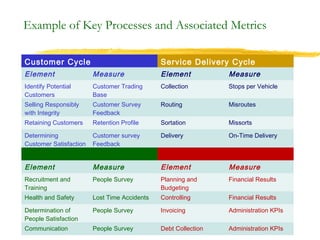
Example of Key Processes
and Associated MetricsCustomer Cycle Service Delivery Cycle
Element Measure Element Measure
Identify Potential
Customers
Customer Trading
Base
Collection Stops per Vehicle
Selling Responsibly
with Integrity
Customer Survey
Feedback
Routing Misroutes
Retaining Customers Retention Profile Sortation Missorts
Determining
Customer Satisfaction
Customer survey
Feedback
Delivery On-Time Delivery
Element Measure Element Measure
Recruitment and
Training
People Survey Planning and
Budgeting
Financial Results
Health and Safety Lost Time Accidents Controlling Financial Results
Determination of
People Satisfaction
People Survey Invoicing Administration KPIs
Communication People Survey Debt Collection Administration KPIs
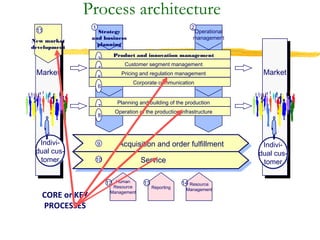
Process architecture
Strategy
and business
planning
Operational
management
MarketMarket MarketMarket
Resource
ManagementReporting
Indivi-
dual cus-
tomer
Indivi-
dual cus-
tomer
Indivi-
dual cus-
tomer
Indivi-
dual cus-
tomer
Acquisition and order fulfillment
Service
13 14
1 2
New market
development
11
Human
Resource
Management
12
9
10
Planning and building of the production
infrastructure
7
Product and innovation management
3
Customer segment management
4
Pricing and regulation management
5
Corporate communication
6
Operation of the production infrastructure
8
CORE or KEY
PROCESSES
Example of Key Processes and Associated Metrics
Customer Cycle Service Delivery Cycle
Element Measure Element Measure
Identify Potential
Customers
Customer Trading
Base
Collection Stops per Vehicle
Selling Responsibly
with Integrity
Customer Survey
Feedback
Routing Misroutes
Retaining Customers Retention Profile Sortation Missorts
Determining
Customer Satisfaction
Customer survey
Feedback
Delivery On-Time Delivery
Element Measure Element Measure
Recruitment and
Training
People Survey Planning and
Budgeting
Financial Results
Health and Safety Lost Time Accidents Controlling Financial Results
Determination of
People Satisfaction
People Survey Invoicing Administration KPIs
Communication People Survey Debt Collection Administration KPIs
Strategy and Balanced ScorecardStrategy and Balanced Scorecard
Mission –
Why We
Exist
Vision –
What We
Want to Be
Values –
What’s
Important
to Us
Strategy :
Our Game
Plan
Strategy
Map :
Translate the
Strategy
Balanced
Scorecard :
Measure and
Focus
Strategic
Outcomes
Satisfied
Shareholders
Delighted
Customers
Excellent
Processes
Motivated
Workforce
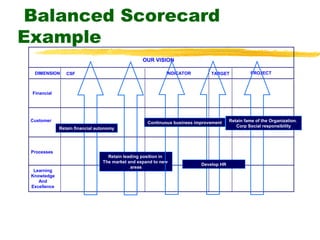
Balanced Scorecard
Example
OUR VISION
DIMENSION CSF INDICATOR TARGET PROJECT
Retain financial autonomy
Retain leading position in
The market and expand to new
areas
Develop HR
Continuous business improvement Retain fame of the Organization.
Corp Social responsibility
Financial
Customer
Processes
Learning
Knowledge
And
Εxcellence
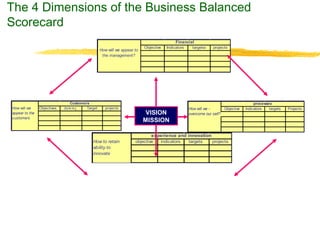
The 4 Dimensions of the Business Balanced
Scorecard
Objective Indicators targetsι projects
Financial
How will we appear to
the management?
How will we Objectives indicatorΔείκτες Target projects
appear to the
customers
Customers
How will we - Objective Indicators targets Projects
overcome our self?
processes
How to retain objective indicators targets projects
ability to
innovate
experience and innovation
VISION
MISSION
Optimize HR Efficiency
Drive Long term
Shareholder Value
Enhance People & Organizational
Effectiveness
Achieve HR
Process
Excellence
Develop Strategic &
Functional HR Competencies
Build Strategic
Employee
Competencies
Drive
Organizational
Performance
Enhance Technology
for HR
Create Climate for
HR Action
HR Strategy Map TemplateHR Strategy Map Template
Financial
Customer
HR Internal Process
Learning & Growth
Create Positive Work
Environment
Provide Quality
HR Service
Provide High
Performance People
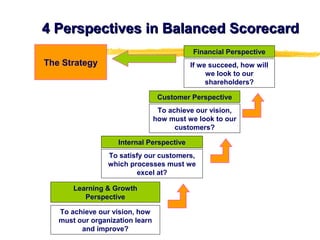
4 Perspectives in Balanced Scorecard4 Perspectives in Balanced Scorecard
If we succeed, how will
we look to our
shareholders?
Financial Perspective
To achieve our vision,
how must we look to our
customers?
Customer Perspective
To satisfy our customers,
which processes must we
excel at?
Internal Perspective
To achieve our vision, how
must our organization learn
and improve?
Learning & Growth
Perspective
The Strategy
METRICS AND TARGET SETTING
CRITICAL SUCCESS FACTORS CRITICAL PERFORMANCE
INDICATORS
4. HIGH MARKET SHARES 52%
2. HIGH EXPORTS 40%
3. COMPETITIVE COST UNDER 45%
1. HIGH QUALITY OF PRODUCTS LESS THAN 3% RETURNED WIHIN THE
YEAR
ECOLOGY OBTAIN ISO 14,000
INNOVATIONS 10 NEW PRODUCTS PER YEAR
180 VARIATIONS PER YEAR
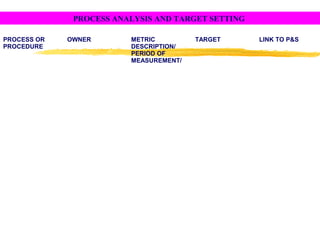
PROCESS OR
PROCEDURE
OWNER METRIC
DESCRIPTION/
PERIOD OF
MEASUREMENT/
TARGET LINK TO P&S
PROCESS ANALYSIS AND TARGET SETTING
PROCESS OR
PROCEDURE
OWNER INDICATOR TARGET FOR
TERM, ACTUAL
PERFORMANCE
LINK TO P&S
KEY-
SUPPORTIVE- SUB
ANALYSIS OF PROCESSES .............., UNIT ..............
HOW TO
DO
WHO HOW,
WHEN
MEASURED
THE BEEF ALIGNMEN
T (DO THE
RIGHT
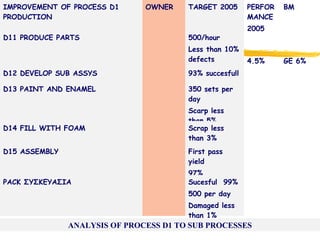
IMPROVEMENT OF PROCESS D1
PRODUCTION
OWNER TARGET 2005 PERFOR
MANCE
2005
ΒΜ
D11 PRODUCE PARTS 500/hour
Less than 10%
defects 4.5% GE 6%
D12 DEVELOP SUB ASSYS 93% succesfull
D13 PAINT AND ENAMEL 350 sets per
day
Scarp less
than 5%
D14 FILL WITH FOAM Scrap less
than 3%
D15 ASSEMBLY First pass
yield
97%
PACK ΣΥΣΚΕΥΑΣΙΑ Sucesful 99%
500 per day
Damaged less
than 1%
ANALYSIS OF PROCESS D1 TO SUB PROCESSES
A working environment supporting free
expression of thought and Innovation.
1
2
3
2
2
3
IN TEAMS OF FIVE SPECIFY THE
CHARACTERISTICS OF AN
INNOVATIVE IDEAS SYSTEM TO
IMPROVE THE PERFORMANCE
OF YOUR UNIT
There are always solutions
We have only to look for them
The prerequisites of the CIP
1. LEADERSHIP COMMITTMENT
2. TRAINING
3. RECOGNITION
4. PARTICIPATION
5. SYSTEMATIC IMPROVEMENT
6. COMMUNICATION
8. THE EFFORT LASTS for EVER
The essential areas to monitor in an
organization:
•KPI’s and reporting
•People management
•Customer management
•Quality system, certified or not, Process
management
•Sustainability plan
•Logistics
•Strategic Plan
The improvement Engine
Process
Input
Output
METHODS / INDICATORS TO MEASURE THE RESULTS & ALIGNEMENT
TO the CRITICAL BUSINESS OBJECTIVES, POLICY & STRATEGY. INCLUSION
OF SYSTEMATIC LEARNING ACTIVITY, DEPLOYMENT OF LEARNING
IMPROVEMENT ENGINE (3 STAGES)
INPUT: SYSTEMATIC AND
COORDINATED
INPUTS FROM:
METHODS TO PRIORITIZE FINDINGS & SELECT IMPROVEMENT ACTION.
Incl. CAUSE ANALYSIS, ACTION PLANS, USE of BENCHMARKING
LINKAGE TO BUSINESS OBJECTIVES, ALIGNMENT & REVIEW PERFORMANCE
TARGETS IAW POLICY & STRATEGY. METHODS OF DEPLOYMENT OF
IMPROVEMENT(S) INCLUDING MATERIALIZATION MECHANISMS (WORK
TEAMS, COMMITTEES etc). LINKAGE TO EXISTING PROCESSES AND TOOLS,
eg TO THE BBSC
PROCESS: PROCESSING OF
INPUTS, REACHING
DECISION & INITIATING
ACTION
OUTPUT: HOW OUTPUT IS
EVALUATED
& REVIEW IS
SYSTEMATICALLY
PERFORMED
Groups of STAKEHOLDERS VIA: SURVEYS, AUDITS,
COMPLAINTS, LEGAL ACTION, CONSUMER
ORGANIZATIONS, ASSESSMENTS, INNOVATIVE
IDEAS, MEETINGS, PERFORMANCE
MEASUREMENT, etc
Τhe team members contribute :
Specialization
Skills
Time compliance
Performance of specific duties
People generating ideas
Advocates of the devil
Decisive
Good speakers
Motivators
The KAI-ZEN process
Zero Defects
How to become Dantotsu ?
Best of the Best
5 stages to eliminate mistakes
1.Describe the situation –symptom
2. Correct temporarily.
3. Identify causes.
4. Apply corrective action .)
5. Review and improve..
The technique of 5 WHY’s
5 questions to reach the core cause
1.Why are citizens dissatisfied? Because we do not
provide good service
2.Why are they dissatisfied with service? Because we
delay to provide solutions.
3. Why do we delay? Because there is much
bureaucracy.
4. Why there is much bureaucracy? Because the
procedures are outdated
5. Why are the procedures outdated? Because there is
no systematic process to reform proceduresα
R esults
A pproach
D eployment
A ssessment
R eview
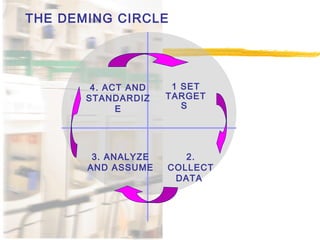
THE DEMING CIRCLE
1 SET
TARGET
S
2.
COLLECT
DATA
3. ANALYZE
AND ASSUME
4. ACT AND
STANDARDIZ
E
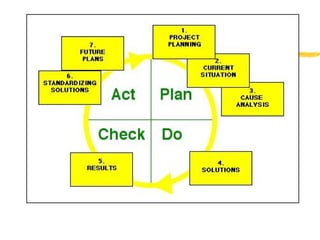
ISO 9001 and THE DEMING CIRCLE
Innovative ideas systems
A proven method for continuous
improvement with the
participation of people
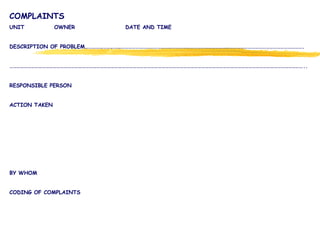
COMPLAINTS
UNIT OWNER DATE AND TIME
DESCRIPTION OF PROBLEM……………………………………………………………………………………………………………………………………………………………….
………………………………………………………………………………………………………………………………………………………………………………………………………………………..
RESPONSIBLE PERSON
ACTION TAKEN
BY WHOM
CODING OF COMPLAINTS
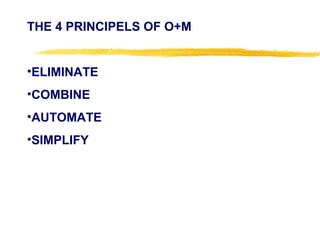
THE 4 PRINCIPELS OF O+M
•ELIMINATE
•COMBINE
•AUTOMATE
•SIMPLIFY
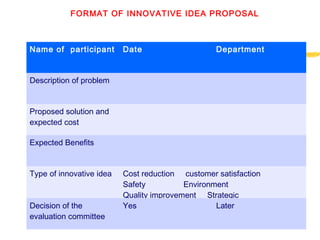
Name of participant Date Department
Description of problem
Proposed solution and
expected cost
Expected Benefits
Type of innovative idea Cost reduction customer satisfaction
Safety Environment
Quality improvement Strategic
Decision of the
evaluation committee
Yes Later
FORMAT OF INNOVATIVE IDEA PROPOSAL
The Six Sigma and DMAIC concept
The DMAIC CIRCLE
GB_B_01_V02_EN_Over
view_6Sigma.ppt 7373
MG_021103 MG_040224
6 SIGMA´s systematic
approach is called DMAIC
D efine M easure A nalyze I mprove C ontrol
If it cannot be
measured, it cannot be
systematically
improved!
sustainability
1) Supplier/Input/Process/Output/Customer 2) Failure Mode and Effect Analysis
• project
charter
• SIPOC1)
• ...
• measurement
system analysis
• data collection
plan
• ...
• process
mapping
• data analysis
• ...
• creativity
tools
• FMEA2)
• ...
• control chart
• standardization
• ...
process view
AND
data view
The Kaoru Ishikawa Tools and
Techniques
CIP TOOLS
WORK FLOW DIAGRAM BAR CHART
CONTROL SHEET
SCATTER DIAGRAM
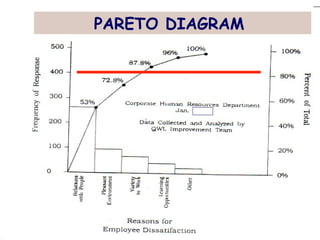
PARETO DIAGRAM LINE DIAGRAM
FISHBONE CONTROL CHART
CIP TECHNIQUES AT A GLANCE
BRAINSTORMING
PRIORITIZATIO
N
CONSENSUS USE OF CRITERIA
FORCE FIELD ANALYSIS SURVEYING
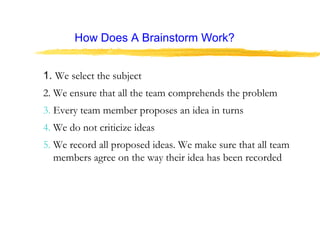
How Does A Brainstorm Work?
1. We select the subject
2. We ensure that all the team comprehends the problem
3. Every team member proposes an idea in turns
4. We do not criticize ideas
5. We record all proposed ideas. We make sure that all team
members agree on the way their idea has been recorded
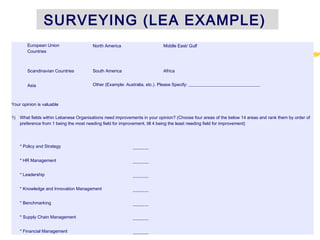
    European Union
Countries
    North America     Middle East/ Gulf          


    Scandinavian Countries   South America     Africa              
                                   
    Asia       Other (Example: Australia, etc.). Please Specify: ________________________________
Your opinion is valuable
1) What fields within Lebanese Organisations need improvements in your opinion? (Choose four areas of the below 14 areas and rank them by order of
preference from 1 being the most needing field for improvement, till 4 being the least needing field for improvement)
 
                                   
  * Policy and Strategy       _______                
                                   
  * HR Management         _______                
                                   
  * Leadership         _______                
                                   
  * Knowledge and Innovation Management _______                
                                   
  * Benchmarking         _______                
                                   
  * Supply Chain Management     _______                
                                   
  * Financial Management       _______                
SURVEYING (LEA EXAMPLE)
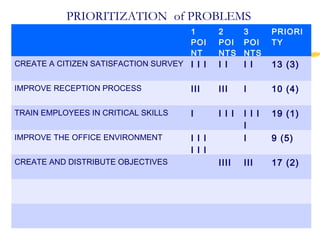
1
POI
NT
2
POI
NTS
3
POI
NTS
PRIORI
TY
CREATE A CITIZEN SATISFACTION SURVEY I I I I I I I 13 (3)
IMPROVE RECEPTION PROCESS III III I 10 (4)
TRAIN EMPLOYEES IN CRITICAL SKILLS I I I I I I I
I
19 (1)
IMPROVE THE OFFICE ENVIRONMENT I I I
I I I
I 9 (5)
CREATE AND DISTRIBUTE OBJECTIVES IIII III 17 (2)
PRIORITIZATION of PROBLEMS
FORCE FIELD ANALYSIS TO REVEAL IMPROVEMENT
OPPORTUNITIES FOR PUBLIC UNIVERSITY
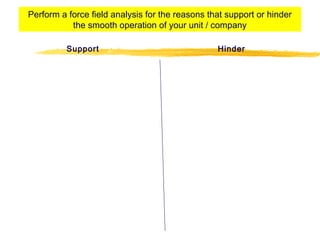
Perform a force field analysis for the reasons that support or hinder
the smooth operation of your unit / company
Support Hinder
The catch-ball approach
CATCHBALL EXAMPLE
A. Sales manager asks for 6% discount on the distribution
cost of the product so that he can increase sales by 30%
B. The distribution manager cannot obtain 6% reduction of
distribution cost, without serious decline of the service
quality.
C.The two parties meet to obtain consensus for a mutually
accepted solutions
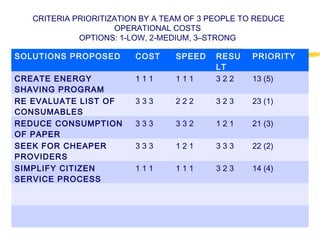
SOLUTIONS PROPOSED COST SPEED RESU
LT
PRIORITY
CREATE ENERGY
SHAVING PROGRAM
1 1 1 1 1 1 3 2 2 13 (5)
RE EVALUATE LIST OF
CONSUMABLES
3 3 3 2 2 2 3 2 3 23 (1)
REDUCE CONSUMPTION
OF PAPER
3 3 3 3 3 2 1 2 1 21 (3)
SEEK FOR CHEAPER
PROVIDERS
3 3 3 1 2 1 3 3 3 22 (2)
SIMPLIFY CITIZEN
SERVICE PROCESS
1 1 1 1 1 1 3 2 3 14 (4)
CRITERIA PRIORITIZATION BY A TEAM OF 3 PEOPLE TO REDUCE
OPERATIONAL COSTS
OPTIONS: 1-LOW, 2-MEDIUM, 3–STRONG
BAR CHART
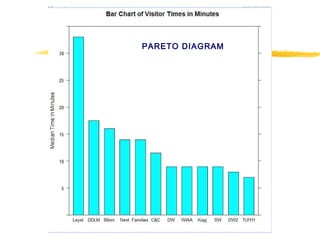
PARETO DIAGRAM
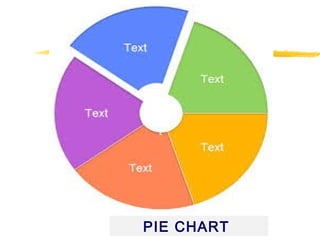
PIE CHART
PARETO DIAGRAM
OTHER TYPES OF SCATTER DIAGRAMS
SCATTER DIAGRAM
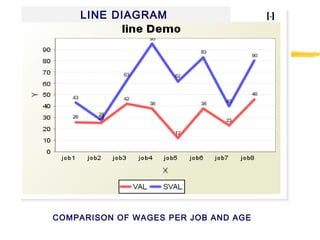
COMPARISON OF WAGES PER JOB AND AGE
LINE DIAGRAM
94
95
96
97
98
99
100
10/98
01/99
04/99
07/99
10/99
01/00
04/00
07/00
10/00
01/01
04/01
07/01
10/01
01/02
04/02
mm/yy
%
Figure 9.7 Branch availability
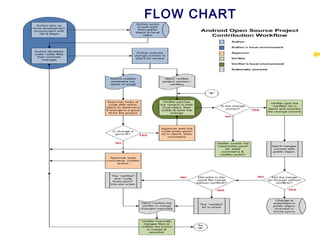
FLOW CHART
CONTROL CHART
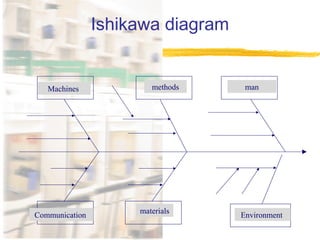
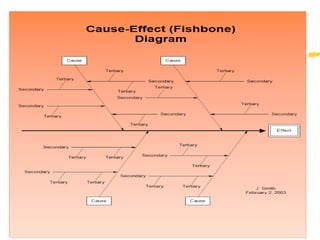
7 main categories of causes :
(Machines)
(Method)
(Material)
(Management)
[Men (People )]
[Milleau(Environment)]
(Measurement)
(Cause & Effect Diagram -Fishbone)
Ishikawa diagram
Εξοπλισμός Άνθρωποι
Επικοινωνία Υλικά Περιβάλλον
ΜέθοδοιMachines methods man
materials
EnvironmentCommunication
DRILL. Divide into 3 teams. Analyse on a flip chart
the causes of accidents in the streets of Beirut by
using the Ishikawa diagram
Symptom
MachinesManMetrics
MethodsMaterials
Environment
Managemnt
DRILL: DESCRIBE AS MANY IDEAS AS POSSIBLE
TO GO HOME WITHOUT COST
DRILL: DESCRIBE AS MANY USES AS POSSIBLE
FOR A PAPER CLIP
DRILL: DESCRIBE AS MANY IDEAS AS POSSIBLE
TO IMPROVE THE SERVICING EFFICIENCY OF THE
PUBLIC SECTOR
With your team identify the main questions you would
like to ask your “customers” or your colleagues so as
to create performance indicators.
Category Action Code
Complaints For behavior C1
For delay C2
For wrong certification C3
For wrong data C4
Requests For the process R1
For working hours R2
For time limits R3
For scope of authorities R4
Services provided Certifications S1
Information S2
audits S3
Decisions S4
Control sheet for the Public Sector to record the reasons of citizen phone calls.
Create your own
Problem analysis
Description
Symptoms
Proposed Actions
Expected Results
The main causes of the selected problem
1._______________________________________________________
2. _______________________________________________________
3. ________________________________________________________
4. ________________________________________________________
5. ________________________________________________________
6. ________________________________________________________
Solution evaluation
Problem _________________________________________________
___________________________________________________________
Solution ____________________________________________________
___________________________________________________________
Action Owner Resources
________________________________________________________
________________________________________________________
________________________________________________________
Expected results
direct Indirect
________________________________________________________
________________________________________________________
_________________________________________________________
What prevents us from becoming the best
Important solvabl
e
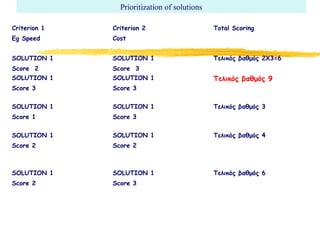
Prioritization of causes
Criterion 1
Eg Speed
Criterion 2
Cost
Total Scoring
SOLUTION 1
Score 2
SOLUTION 1
Score 3
Τελικός βαθμός 2Χ3=6
SOLUTION 1
Score 3
SOLUTION 1
Score 3
Τελικός βαθμός 9
SOLUTION 1
Score 1
SOLUTION 1
Score 3
Τελικός βαθμός 3
SOLUTION 1
Score 2
SOLUTION 1
Score 2
Τελικός βαθμός 4
SOLUTION 1
Score 2
SOLUTION 1
Score 3
Τελικός βαθμός 6
Prioritization of solutions
ΑCTION STEP RESOURCES
Resources
Action Plan
Proposed Solution
Action Who is responsible Target Completion Date
Expected results
PROJECT owner deliverabl
es
Criterion
EQA
Type of
improve
Start ΛΗΞΗ STATUS ΣΤΟΙΧΕΙΟ
ΣΤΡΑΤΗΓΙ
ΚΗΣ
Monitor the progress of the project

Total quality-management

  • 1.
    Total Quality Management TQM Advancedworkshop Anthony Spanos Accredited EFQM trainer For Excellence certifications and CSR. Accredited trainer European Business Ethics. GRI-G4 Sustainability reporting competent FOR MANAGERS OF ADVANCED ORGANIZATIONS INCLUDING HEALTH SECTOR AUGUST 2015
  • 2.
    What is theContinuous Improvement Process A systematic research for the causes of unwanted symptoms and the gradual therapy of the causes using specific tools, teamwork, innovation and communication
  • 3.
    Continuous Improvement steps 1.Detectsymptom (eg increased nosocomial infections) 2.Analyze potential causes (lack of systematic disinfection, no hands washing etc) 3.Locate most important causes 4.Locate potential solutions Select optimal solution (systematic disinfection) 5.Correct important causes (apply training of medical personnel, enforce cleanliness)
  • 4.
    1ST principle. We areaiming continuously at the improvement of the existing situation. CIP is a never ending process 2nd Principle of CIP : The customer decides what is Quality for him 3d principle . Everybody is responsible for the quality if his (her ) work. We are all quality managers 4th principle. Prevention is the key. Prevention comes before correction CIP Principles
  • 5.
    5th principle Everybody iscommitted and involved in idea generation, identification and resolution of problems through systematic teamwork. 6th principle . Team work relies on cooperation and recognition of performance as well as commitment and contribution. 7th principle. Everybody supports improvement efforts. Improvement is not a job for the few CIP Principles
  • 6.
    What is aproblem? Non mechanized patient acceptance fro treatment What is a symptom? Delay in taking in patient The automobile example
  • 7.
    A measurement systemis required Measurement in Health Sector : Examples• Mortality • Morbidity • Percentage of Nosocomial Infections • Percentage of complete cure of incoming patients • Percentage of improvement of incoming patients • Percentage of patients without cure • Satisfaction of patients from knowledgeable doctors • Satisfaction of patients from hospitality environment • Satisfaction of patients from acceptance and release processes • Number of medical personnel per patient • Required days of cure (bed occupation) per case • Effective capitalization of available beds
  • 8.
    Zero defects =“I do it right the first time” Each of 20 people caries out one given operation of the HEALTH SECTOR of case X. With a 3.5 % nonconformance rate for each of them, ONE product out of TWO, may be nonconforming. (one death every two patients) CAN WE ACCEPT A NON CONFORMING PRODUCT OUT OF TWO? 1 2 20
  • 9.
    QUALITY COST COC-P =Prevention, eg management of the quality function, quality studies, preventive checking of facilities, prepare and carry out reviews, purchase quality system, quality education, customers and suppliers order checking, resellers qualification, customers solvency survey, quality promotion and communication, other prevention expenses COC-E = Evaluation. Products and services qualifications, reception of purchased products and services, process proofing, controlled delivery program, inventory quality audit, quality audit, customer satisfaction survey, other evaluation expenses. CONC = Cost of non Conformance. Defects analysis, product or service modification, scrap, retouching, new test or inspection, inventory excess or shortage, inadequate loads, administrative order modification, inadequate training, installation cost higher than standard, trouble shooting, after installation, spare parts, late delivery, administrative delay, commercial offsets, other CONC expenses
  • 10.
    My strategy isthe creative mind of my people BILL GATES : Includes lots of innovation !!
  • 11.
    11 Our skilled, multicultural employeebase Our success depends on our people and its reputation for high service levels, expert knowledge and partnership approach. We aim to build on it by:  Increasing our understanding of our customers and solutions  Developing our skills and competencies  Making real our culture and values
  • 13.
    Would you saythat we are somehow uncoordinated? Includes Teamwork
  • 15.
    Example of continuousimprovement. The building of an orchestra
  • 16.
    A widely acceptedStrategy and Strategic objectives communicated to the people Via: •Presentations •Pamphlets •Internet •Team and personal objectives and targets •KPI’s •Training •Participation in decision making
  • 18.
    A measurement system Measurementin Health Sector : Examples• Mortality • Morbidity • Percentage of Nosocomial Infections • Percentage of complete cure of incoming patients • Percentage of improvement of incoming patients • Percentage of patients without cure • Satisfaction of patients from knowledgeable doctors • Satisfaction of patients from hospitality environment • Satisfaction of patients from acceptance and release processes • Number of medical personnel per patient • Required days of cure (bed occupation) per case • Effective capitalization of available beds
  • 19.
    Performance measurement frameworkPerformancemeasurement framework Locate Describe Measure Monitor Reporti KeyKey PerformancePerformance IndicatorsIndicators ImplementImplement StrategyStrategy Vision Mission Strategy StrategicStrategic ObjectivesObjectives
  • 20.
    Three critical componentsfor effective process of performance management Performance Management Infrastructure Performance Management Culture Performance Management Process Performance management cycle is continuous and consistent Culture that is based on performance accountability Logistic support and performance management administration Performance Management ComponentPerformance Management Component
  • 21.
    STRATEGY Plan and Execute Monitorand Evaluate Reward and Coach Set Measures and Target Performance Management CyclePerformance Management Cycle
  • 22.
    Relevant to Strategic Objectives DoesKPI have a linkage with the strategic objectives? Controlled performance Are the KPI achievements still under control? Manageable Can any action be taken to improve the performance? Simple Is the KPI easy to explain? Dependable Is the KPI not easy to manipulate? Directions for KPIsDirections for KPIs
  • 23.
    KPIKPI Family DimensionFamilyDimension Productivity Measures employee output (units/ transactions/ dollars), the uptime levels and how employees use their time (sales-to- assets ratio, dollar revenue from new customers, sales pipeline). Measures the ability to meet and/or exceed the requirements and expectations of the customer (customer complaints, percent returns, DPMO -- defects per million opportunities). Quality
  • 24.
    KPIKPI Family DimensionFamilyDimension Profitability Measures the overall effectiveness of the management organization in generating profits (profit contribution by segment/customer, margin spreads). Measures the point in time (day/week/ month) when management and employee tasks are completed (on-time delivery, percent of late orders). Timeliness
  • 25.
    KPIKPI Family DimensionFamilyDimension Process Efficiency Measures how effectively the management organization incorporates quality control, Six Sigma and best practices to streamline operational processes (yield percentage, process uptime, capacity utilization). Measures how effectively the management organization leverages existing business resources such as assets, bricks and mortar, investments (sales per total assets, sales per channel, win rate). Resource Utilization
  • 26.
    KPIKPI Family DimensionFamilyDimension Cost Savings Measures how successfully the management organization achieves economies of scale and scope of work with its people, staff and practices to control operational and overhead costs (cost per unit, inventory turns, cost of goods). Measures the ability of the management organization to maintain competitive economic position in the growth of the economy and industry (market share, customer acquisition/retention, account penetration). Growth
  • 27.
    KPI Category DimensionKPICategory Dimension DirectThe actual raw data value as measured (e.g., sales volume). Percent The comparison of the changes in performance of one value relative to the same value at a different time, geography, etc. (e.g., percentage change in sales vs. last year).
  • 28.
    KPI Category DimensionKPICategory Dimension Simple Ratio The comparison of one value relative to another to provide a benchmark for comparison of performance (e.g., average sales per day). Index A combination of several separate measures added together that result in an overall indicator of performance (e.g., (company sales growth)/ (industry sales growth) for a specific geography).
  • 29.
    Example of KeyProcesses and Associated MetricsCustomer Cycle Service Delivery Cycle Element Measure Element Measure Identify Potential Customers Customer Trading Base Collection Stops per Vehicle Selling Responsibly with Integrity Customer Survey Feedback Routing Misroutes Retaining Customers Retention Profile Sortation Missorts Determining Customer Satisfaction Customer survey Feedback Delivery On-Time Delivery Element Measure Element Measure Recruitment and Training People Survey Planning and Budgeting Financial Results Health and Safety Lost Time Accidents Controlling Financial Results Determination of People Satisfaction People Survey Invoicing Administration KPIs Communication People Survey Debt Collection Administration KPIs
  • 30.
    Process architecture Strategy and business planning Operational management MarketMarketMarketMarket Resource ManagementReporting Indivi- dual cus- tomer Indivi- dual cus- tomer Indivi- dual cus- tomer Indivi- dual cus- tomer Acquisition and order fulfillment Service 13 14 1 2 New market development 11 Human Resource Management 12 9 10 Planning and building of the production infrastructure 7 Product and innovation management 3 Customer segment management 4 Pricing and regulation management 5 Corporate communication 6 Operation of the production infrastructure 8 CORE or KEY PROCESSES
  • 31.
    Example of KeyProcesses and Associated Metrics Customer Cycle Service Delivery Cycle Element Measure Element Measure Identify Potential Customers Customer Trading Base Collection Stops per Vehicle Selling Responsibly with Integrity Customer Survey Feedback Routing Misroutes Retaining Customers Retention Profile Sortation Missorts Determining Customer Satisfaction Customer survey Feedback Delivery On-Time Delivery Element Measure Element Measure Recruitment and Training People Survey Planning and Budgeting Financial Results Health and Safety Lost Time Accidents Controlling Financial Results Determination of People Satisfaction People Survey Invoicing Administration KPIs Communication People Survey Debt Collection Administration KPIs
  • 32.
    Strategy and BalancedScorecardStrategy and Balanced Scorecard Mission – Why We Exist Vision – What We Want to Be Values – What’s Important to Us Strategy : Our Game Plan Strategy Map : Translate the Strategy Balanced Scorecard : Measure and Focus Strategic Outcomes Satisfied Shareholders Delighted Customers Excellent Processes Motivated Workforce
  • 33.
    Balanced Scorecard Example OUR VISION DIMENSIONCSF INDICATOR TARGET PROJECT Retain financial autonomy Retain leading position in The market and expand to new areas Develop HR Continuous business improvement Retain fame of the Organization. Corp Social responsibility Financial Customer Processes Learning Knowledge And Εxcellence
  • 34.
    The 4 Dimensionsof the Business Balanced Scorecard Objective Indicators targetsι projects Financial How will we appear to the management? How will we Objectives indicatorΔείκτες Target projects appear to the customers Customers How will we - Objective Indicators targets Projects overcome our self? processes How to retain objective indicators targets projects ability to innovate experience and innovation VISION MISSION
  • 35.
    Optimize HR Efficiency DriveLong term Shareholder Value Enhance People & Organizational Effectiveness Achieve HR Process Excellence Develop Strategic & Functional HR Competencies Build Strategic Employee Competencies Drive Organizational Performance Enhance Technology for HR Create Climate for HR Action HR Strategy Map TemplateHR Strategy Map Template Financial Customer HR Internal Process Learning & Growth Create Positive Work Environment Provide Quality HR Service Provide High Performance People
  • 36.
    4 Perspectives inBalanced Scorecard4 Perspectives in Balanced Scorecard If we succeed, how will we look to our shareholders? Financial Perspective To achieve our vision, how must we look to our customers? Customer Perspective To satisfy our customers, which processes must we excel at? Internal Perspective To achieve our vision, how must our organization learn and improve? Learning & Growth Perspective The Strategy
  • 37.
  • 38.
    CRITICAL SUCCESS FACTORSCRITICAL PERFORMANCE INDICATORS 4. HIGH MARKET SHARES 52% 2. HIGH EXPORTS 40% 3. COMPETITIVE COST UNDER 45% 1. HIGH QUALITY OF PRODUCTS LESS THAN 3% RETURNED WIHIN THE YEAR ECOLOGY OBTAIN ISO 14,000 INNOVATIONS 10 NEW PRODUCTS PER YEAR 180 VARIATIONS PER YEAR
  • 39.
    PROCESS OR PROCEDURE OWNER METRIC DESCRIPTION/ PERIODOF MEASUREMENT/ TARGET LINK TO P&S PROCESS ANALYSIS AND TARGET SETTING
  • 40.
    PROCESS OR PROCEDURE OWNER INDICATORTARGET FOR TERM, ACTUAL PERFORMANCE LINK TO P&S KEY- SUPPORTIVE- SUB ANALYSIS OF PROCESSES .............., UNIT .............. HOW TO DO WHO HOW, WHEN MEASURED THE BEEF ALIGNMEN T (DO THE RIGHT
  • 41.
    IMPROVEMENT OF PROCESSD1 PRODUCTION OWNER TARGET 2005 PERFOR MANCE 2005 ΒΜ D11 PRODUCE PARTS 500/hour Less than 10% defects 4.5% GE 6% D12 DEVELOP SUB ASSYS 93% succesfull D13 PAINT AND ENAMEL 350 sets per day Scarp less than 5% D14 FILL WITH FOAM Scrap less than 3% D15 ASSEMBLY First pass yield 97% PACK ΣΥΣΚΕΥΑΣΙΑ Sucesful 99% 500 per day Damaged less than 1% ANALYSIS OF PROCESS D1 TO SUB PROCESSES
  • 42.
    A working environmentsupporting free expression of thought and Innovation.
  • 44.
  • 45.
  • 46.
  • 47.
  • 50.
    IN TEAMS OFFIVE SPECIFY THE CHARACTERISTICS OF AN INNOVATIVE IDEAS SYSTEM TO IMPROVE THE PERFORMANCE OF YOUR UNIT
  • 51.
    There are alwayssolutions We have only to look for them
  • 52.
    The prerequisites ofthe CIP 1. LEADERSHIP COMMITTMENT 2. TRAINING 3. RECOGNITION 4. PARTICIPATION 5. SYSTEMATIC IMPROVEMENT 6. COMMUNICATION 8. THE EFFORT LASTS for EVER
  • 53.
    The essential areasto monitor in an organization: •KPI’s and reporting •People management •Customer management •Quality system, certified or not, Process management •Sustainability plan •Logistics •Strategic Plan
  • 54.
  • 55.
    METHODS / INDICATORSTO MEASURE THE RESULTS & ALIGNEMENT TO the CRITICAL BUSINESS OBJECTIVES, POLICY & STRATEGY. INCLUSION OF SYSTEMATIC LEARNING ACTIVITY, DEPLOYMENT OF LEARNING IMPROVEMENT ENGINE (3 STAGES) INPUT: SYSTEMATIC AND COORDINATED INPUTS FROM: METHODS TO PRIORITIZE FINDINGS & SELECT IMPROVEMENT ACTION. Incl. CAUSE ANALYSIS, ACTION PLANS, USE of BENCHMARKING LINKAGE TO BUSINESS OBJECTIVES, ALIGNMENT & REVIEW PERFORMANCE TARGETS IAW POLICY & STRATEGY. METHODS OF DEPLOYMENT OF IMPROVEMENT(S) INCLUDING MATERIALIZATION MECHANISMS (WORK TEAMS, COMMITTEES etc). LINKAGE TO EXISTING PROCESSES AND TOOLS, eg TO THE BBSC PROCESS: PROCESSING OF INPUTS, REACHING DECISION & INITIATING ACTION OUTPUT: HOW OUTPUT IS EVALUATED & REVIEW IS SYSTEMATICALLY PERFORMED Groups of STAKEHOLDERS VIA: SURVEYS, AUDITS, COMPLAINTS, LEGAL ACTION, CONSUMER ORGANIZATIONS, ASSESSMENTS, INNOVATIVE IDEAS, MEETINGS, PERFORMANCE MEASUREMENT, etc
  • 56.
    Τhe team memberscontribute : Specialization Skills Time compliance Performance of specific duties People generating ideas Advocates of the devil Decisive Good speakers Motivators
  • 58.
    The KAI-ZEN process ZeroDefects How to become Dantotsu ? Best of the Best
  • 59.
    5 stages toeliminate mistakes 1.Describe the situation –symptom 2. Correct temporarily. 3. Identify causes. 4. Apply corrective action .) 5. Review and improve..
  • 60.
    The technique of5 WHY’s 5 questions to reach the core cause 1.Why are citizens dissatisfied? Because we do not provide good service 2.Why are they dissatisfied with service? Because we delay to provide solutions. 3. Why do we delay? Because there is much bureaucracy. 4. Why there is much bureaucracy? Because the procedures are outdated 5. Why are the procedures outdated? Because there is no systematic process to reform proceduresα
  • 62.
    R esults A pproach Deployment A ssessment R eview
  • 63.
    THE DEMING CIRCLE 1SET TARGET S 2. COLLECT DATA 3. ANALYZE AND ASSUME 4. ACT AND STANDARDIZ E
  • 66.
    ISO 9001 andTHE DEMING CIRCLE
  • 67.
    Innovative ideas systems Aproven method for continuous improvement with the participation of people
  • 68.
    COMPLAINTS UNIT OWNER DATEAND TIME DESCRIPTION OF PROBLEM………………………………………………………………………………………………………………………………………………………………. ……………………………………………………………………………………………………………………………………………………………………………………………………………………….. RESPONSIBLE PERSON ACTION TAKEN BY WHOM CODING OF COMPLAINTS
  • 69.
    THE 4 PRINCIPELSOF O+M •ELIMINATE •COMBINE •AUTOMATE •SIMPLIFY
  • 70.
    Name of participantDate Department Description of problem Proposed solution and expected cost Expected Benefits Type of innovative idea Cost reduction customer satisfaction Safety Environment Quality improvement Strategic Decision of the evaluation committee Yes Later FORMAT OF INNOVATIVE IDEA PROPOSAL
  • 71.
    The Six Sigmaand DMAIC concept
  • 72.
  • 73.
    GB_B_01_V02_EN_Over view_6Sigma.ppt 7373 MG_021103 MG_040224 6SIGMA´s systematic approach is called DMAIC D efine M easure A nalyze I mprove C ontrol If it cannot be measured, it cannot be systematically improved! sustainability 1) Supplier/Input/Process/Output/Customer 2) Failure Mode and Effect Analysis • project charter • SIPOC1) • ... • measurement system analysis • data collection plan • ... • process mapping • data analysis • ... • creativity tools • FMEA2) • ... • control chart • standardization • ... process view AND data view
  • 75.
    The Kaoru IshikawaTools and Techniques
  • 76.
    CIP TOOLS WORK FLOWDIAGRAM BAR CHART CONTROL SHEET SCATTER DIAGRAM PARETO DIAGRAM LINE DIAGRAM FISHBONE CONTROL CHART
  • 77.
    CIP TECHNIQUES ATA GLANCE BRAINSTORMING PRIORITIZATIO N CONSENSUS USE OF CRITERIA FORCE FIELD ANALYSIS SURVEYING
  • 78.
    How Does ABrainstorm Work? 1. We select the subject 2. We ensure that all the team comprehends the problem 3. Every team member proposes an idea in turns 4. We do not criticize ideas 5. We record all proposed ideas. We make sure that all team members agree on the way their idea has been recorded
  • 79.
        EuropeanUnion Countries     North America     Middle East/ Gulf                                                                                   Scandinavian Countries   South America     Africa                                                       Asia       Other (Example: Australia, etc.). Please Specify: ________________________________ Your opinion is valuable 1) What fields within Lebanese Organisations need improvements in your opinion? (Choose four areas of the below 14 areas and rank them by order of preference from 1 being the most needing field for improvement, till 4 being the least needing field for improvement)                                         * Policy and Strategy       _______                                                       * HR Management         _______                                                       * Leadership         _______                                                       * Knowledge and Innovation Management _______                                                       * Benchmarking         _______                                                       * Supply Chain Management     _______                                                       * Financial Management       _______                 SURVEYING (LEA EXAMPLE)
  • 80.
    1 POI NT 2 POI NTS 3 POI NTS PRIORI TY CREATE A CITIZENSATISFACTION SURVEY I I I I I I I 13 (3) IMPROVE RECEPTION PROCESS III III I 10 (4) TRAIN EMPLOYEES IN CRITICAL SKILLS I I I I I I I I 19 (1) IMPROVE THE OFFICE ENVIRONMENT I I I I I I I 9 (5) CREATE AND DISTRIBUTE OBJECTIVES IIII III 17 (2) PRIORITIZATION of PROBLEMS
  • 81.
    FORCE FIELD ANALYSISTO REVEAL IMPROVEMENT OPPORTUNITIES FOR PUBLIC UNIVERSITY
  • 82.
    Perform a forcefield analysis for the reasons that support or hinder the smooth operation of your unit / company Support Hinder
  • 83.
  • 84.
    CATCHBALL EXAMPLE A. Salesmanager asks for 6% discount on the distribution cost of the product so that he can increase sales by 30% B. The distribution manager cannot obtain 6% reduction of distribution cost, without serious decline of the service quality. C.The two parties meet to obtain consensus for a mutually accepted solutions
  • 85.
    SOLUTIONS PROPOSED COSTSPEED RESU LT PRIORITY CREATE ENERGY SHAVING PROGRAM 1 1 1 1 1 1 3 2 2 13 (5) RE EVALUATE LIST OF CONSUMABLES 3 3 3 2 2 2 3 2 3 23 (1) REDUCE CONSUMPTION OF PAPER 3 3 3 3 3 2 1 2 1 21 (3) SEEK FOR CHEAPER PROVIDERS 3 3 3 1 2 1 3 3 3 22 (2) SIMPLIFY CITIZEN SERVICE PROCESS 1 1 1 1 1 1 3 2 3 14 (4) CRITERIA PRIORITIZATION BY A TEAM OF 3 PEOPLE TO REDUCE OPERATIONAL COSTS OPTIONS: 1-LOW, 2-MEDIUM, 3–STRONG
  • 86.
  • 87.
  • 88.
  • 89.
  • 90.
    OTHER TYPES OFSCATTER DIAGRAMS
  • 91.
  • 92.
    COMPARISON OF WAGESPER JOB AND AGE LINE DIAGRAM
  • 93.
  • 94.
  • 95.
  • 96.
    7 main categoriesof causes : (Machines) (Method) (Material) (Management) [Men (People )] [Milleau(Environment)] (Measurement) (Cause & Effect Diagram -Fishbone)
  • 97.
    Ishikawa diagram Εξοπλισμός Άνθρωποι ΕπικοινωνίαΥλικά Περιβάλλον ΜέθοδοιMachines methods man materials EnvironmentCommunication
  • 99.
    DRILL. Divide into3 teams. Analyse on a flip chart the causes of accidents in the streets of Beirut by using the Ishikawa diagram Symptom MachinesManMetrics MethodsMaterials Environment Managemnt
  • 100.
    DRILL: DESCRIBE ASMANY IDEAS AS POSSIBLE TO GO HOME WITHOUT COST
  • 101.
    DRILL: DESCRIBE ASMANY USES AS POSSIBLE FOR A PAPER CLIP
  • 102.
    DRILL: DESCRIBE ASMANY IDEAS AS POSSIBLE TO IMPROVE THE SERVICING EFFICIENCY OF THE PUBLIC SECTOR
  • 103.
    With your teamidentify the main questions you would like to ask your “customers” or your colleagues so as to create performance indicators.
  • 104.
    Category Action Code ComplaintsFor behavior C1 For delay C2 For wrong certification C3 For wrong data C4 Requests For the process R1 For working hours R2 For time limits R3 For scope of authorities R4 Services provided Certifications S1 Information S2 audits S3 Decisions S4 Control sheet for the Public Sector to record the reasons of citizen phone calls. Create your own
  • 105.
  • 106.
    The main causesof the selected problem 1._______________________________________________________ 2. _______________________________________________________ 3. ________________________________________________________ 4. ________________________________________________________ 5. ________________________________________________________ 6. ________________________________________________________
  • 107.
    Solution evaluation Problem _________________________________________________ ___________________________________________________________ Solution____________________________________________________ ___________________________________________________________ Action Owner Resources ________________________________________________________ ________________________________________________________ ________________________________________________________ Expected results direct Indirect ________________________________________________________ ________________________________________________________ _________________________________________________________
  • 108.
    What prevents usfrom becoming the best Important solvabl e Prioritization of causes
  • 109.
    Criterion 1 Eg Speed Criterion2 Cost Total Scoring SOLUTION 1 Score 2 SOLUTION 1 Score 3 Τελικός βαθμός 2Χ3=6 SOLUTION 1 Score 3 SOLUTION 1 Score 3 Τελικός βαθμός 9 SOLUTION 1 Score 1 SOLUTION 1 Score 3 Τελικός βαθμός 3 SOLUTION 1 Score 2 SOLUTION 1 Score 2 Τελικός βαθμός 4 SOLUTION 1 Score 2 SOLUTION 1 Score 3 Τελικός βαθμός 6 Prioritization of solutions
  • 110.
  • 111.
    Action Plan Proposed Solution ActionWho is responsible Target Completion Date Expected results
  • 112.
    PROJECT owner deliverabl es Criterion EQA Typeof improve Start ΛΗΞΗ STATUS ΣΤΟΙΧΕΙΟ ΣΤΡΑΤΗΓΙ ΚΗΣ Monitor the progress of the project

Editor's Notes

  • #12 (Needs validation by HR) We have an incredible amount of talent within this business and our aim is to ensure that, through working more effectively together, blending local knowledge with world class skills, we will not just meet but exceed our customers’ needs. By increasing our knowledge and understanding of our customers and the solutions we offer we will be able to do it. Our customers frequently tell us that one of the reasons why they choose to work with Amadeus is the skill and knowledge of our people and our partnership approach. By developing our skills and competencies, we can learn and adapt rapidly to the market changes, providing a better service. Most people say that the Amadeus culture is special - it’s a great place to work – but not many can define why. Our global culture and values exercise (which you will participate in later) will contribute to define that culture so we can nurture it as a key element in our future success. By making explicit these culture and values in our global communications and common internal process, we will bring them to life. All the mentioned above will have a direct impact on our business as it will allow us to increase our performance by sharing company goals and priorities, enabling us to be better equipped to respond effectively to the customers.