6
TOTAL QUALITY
MANAGEMENT
(TQM) BY
ADNAN JANJUA
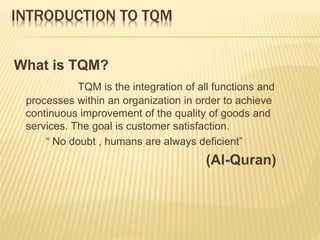
INTRODUCTION TO TQM
What is TQM?
TQM is the integration of all functions and
processes within an organization in order to achieve
continuous improvement of the quality of goods and
services. The goal is customer satisfaction.
“ No doubt , humans are always deficient”
(Al-Quran)
TQM
Total -> made up of the whole
Quality -> degree of excellence a product or
service provides
Management -> act, art or manner of planning,
controlling, directing,….
Therefore, TQM is the art of managing the whole to achieve
excellence.
Total Quality Management
A FUNDAMENTAL CONCEPT OF TQM
FROM BS 7850 - A ‘PROCESS’
 “A set of inter-related resources and activities
which transform inputs into outputs.” (ISO 8402).
 “Any activity that accepts inputs, adds values to
these inputs for customers, and produces outputs
for these customers. The customers may be either
internal or external to the organization.” (BS 7850)
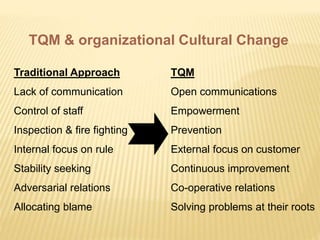
TQM & organizational Cultural Change
Traditional Approach
Lack of communication
Control of staff
Inspection & fire fighting
Internal focus on rule
Stability seeking
Adversarial relations
Allocating blame
TQM
Open communications
Empowerment
Prevention
External focus on customer
Continuous improvement
Co-operative relations
Solving problems at their roots
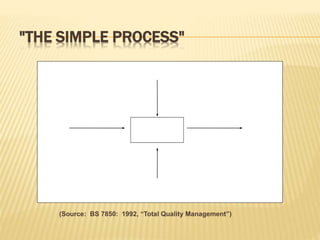
Controls
Process OutputsInputs
Resources
"THE SIMPLE PROCESS"
(Source: BS 7850: 1992, “Total Quality Management”)
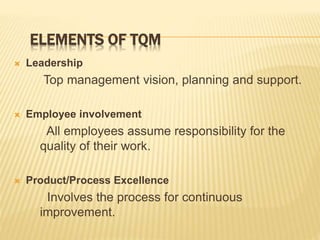
ELEMENTS OF TQM
 Leadership
Top management vision, planning and support.
 Employee involvement
All employees assume responsibility for the
quality of their work.
 Product/Process Excellence
Involves the process for continuous
improvement.
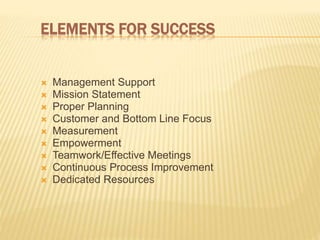
ELEMENTS FOR SUCCESS
 Management Support
 Mission Statement
 Proper Planning
 Customer and Bottom Line Focus
 Measurement
 Empowerment
 Teamwork/Effective Meetings
 Continuous Process Improvement
 Dedicated Resources
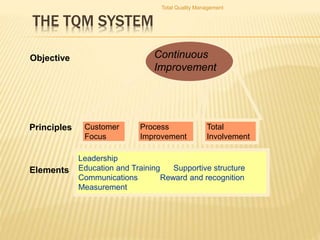
THE TQM SYSTEM
Total Quality Management
Customer
Focus
Process
Improvement
Total
Involvement
Leadership
Education and Training Supportive structure
Communications Reward and recognition
Measurement
Continuous
Improvement
Objective
Principles
Elements
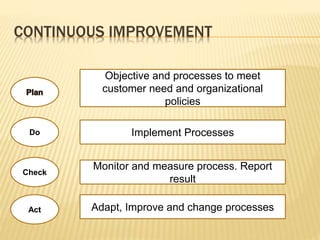
CONTINUOUS IMPROVEMENT
Do
Act
Check
Objective and processes to meet
customer need and organizational
policies
Implement Processes
Monitor and measure process. Report
result
Adapt, Improve and change processes
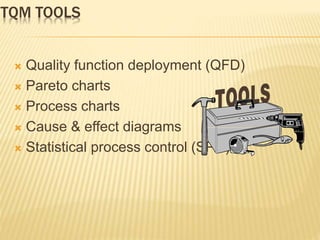
TQM TOOLS
 Quality function deployment (QFD)
 Pareto charts
 Process charts
 Cause & effect diagrams
 Statistical process control (SPC)
TOTAL QUALITY MANAGEMENT
SEVEN BASIC QUALITY
TOOLS
INTRODUCTION
 Quality tools are more specific - tools which
can be applied to solving problems in
improving quality in organizations,
manufacturing, or even in individual
processes.
 They were first emphasized by Kaoru
Ishikawa, professor of engineering at Tokyo
University and the father of “quality circles”.
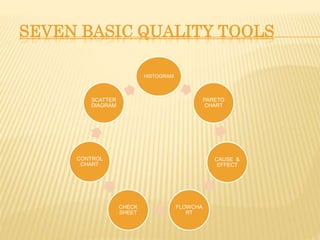
SEVEN BASIC QUALITY TOOLS
HISTOGRAM
PARETO
CHART
CAUSE &
EFFECT
FLOWCHA
RT
CHECK
SHEET
CONTROL
CHART
SCATTER
DIAGRAM
HISTOGRAMS
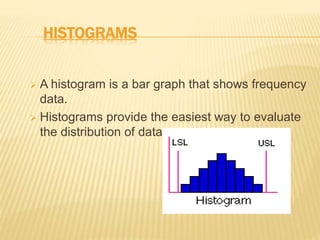
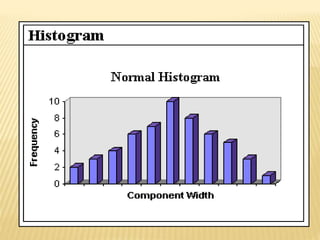
 A histogram is a bar graph that shows frequency
data.
 Histograms provide the easiest way to evaluate
the distribution of data.
PARETO CHART
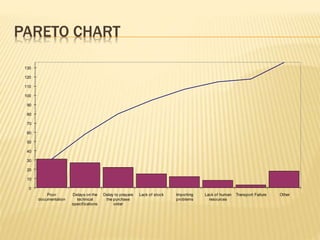
The Pareto Chart is a histogram ordered
by the frequency of result occurrences,
showing how many results were
generated by the type or category of the
identified cause.
The relative position of the occurrences
is used to guide corrective actions.
• The corrective actions must initially focus on the
problems that are causing the majority of defects.
PARETO CHART
0
10
20
30
40
50
60
70
80
90
100
110
120
130
Poor
documentation
Delays on the
technical
specifications
Delay to prepare
the purchase
order
Lack of stock Importing
problems
Lack of human
resources
Transport Failure Other
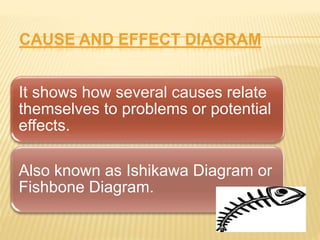
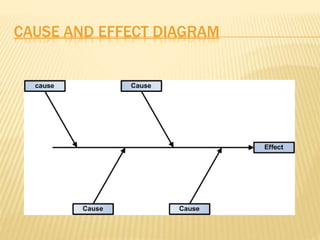
CAUSE AND EFFECT DIAGRAM
It shows how several causes relate
themselves to problems or potential
effects.
Also known as Ishikawa Diagram or
Fishbone Diagram.
CAUSE AND EFFECT DIAGRAM
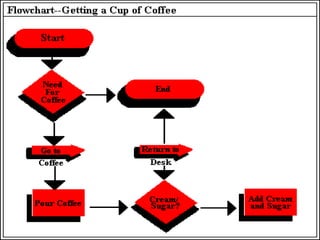
FLOWCHARTING
A flowchart is any chart that depicts how
several elements interact with each other
Here are a few flowcharting techniques that
are usually used in quality management
• Cause and Effect Diagram
• Systems or Process Flowcharts
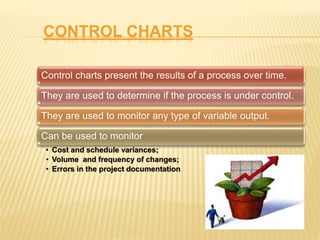
CONTROL CHARTS
Control charts present the results of a process over time.
They are used to determine if the process is under control.
They are used to monitor any type of variable output.
Can be used to monitor
• Cost and schedule variances;
• Volume and frequency of changes;
• Errors in the project documentation
CHECKLIST
It is a list with
previously defined
options that are
used as a guide to
control risks.
It allows a thorough
evaluation in a short
period of time.
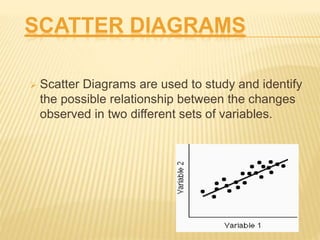
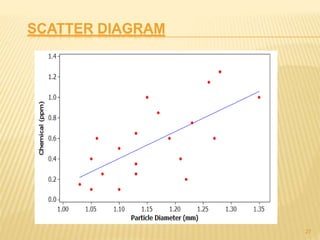
SCATTER DIAGRAMS
 Scatter Diagrams are used to study and identify
the possible relationship between the changes
observed in two different sets of variables.
SCATTER DIAGRAM
27
Tqm ppt

Tqm ppt

  • 1.
  • 2.
  • 3.
    INTRODUCTION TO TQM Whatis TQM? TQM is the integration of all functions and processes within an organization in order to achieve continuous improvement of the quality of goods and services. The goal is customer satisfaction. “ No doubt , humans are always deficient” (Al-Quran)
  • 4.
    TQM Total -> madeup of the whole Quality -> degree of excellence a product or service provides Management -> act, art or manner of planning, controlling, directing,…. Therefore, TQM is the art of managing the whole to achieve excellence. Total Quality Management
  • 5.
    A FUNDAMENTAL CONCEPTOF TQM FROM BS 7850 - A ‘PROCESS’  “A set of inter-related resources and activities which transform inputs into outputs.” (ISO 8402).  “Any activity that accepts inputs, adds values to these inputs for customers, and produces outputs for these customers. The customers may be either internal or external to the organization.” (BS 7850)
  • 6.
    TQM & organizationalCultural Change Traditional Approach Lack of communication Control of staff Inspection & fire fighting Internal focus on rule Stability seeking Adversarial relations Allocating blame TQM Open communications Empowerment Prevention External focus on customer Continuous improvement Co-operative relations Solving problems at their roots
  • 7.
    Controls Process OutputsInputs Resources "THE SIMPLEPROCESS" (Source: BS 7850: 1992, “Total Quality Management”)
  • 8.
    ELEMENTS OF TQM Leadership Top management vision, planning and support.  Employee involvement All employees assume responsibility for the quality of their work.  Product/Process Excellence Involves the process for continuous improvement.
  • 9.
    ELEMENTS FOR SUCCESS Management Support  Mission Statement  Proper Planning  Customer and Bottom Line Focus  Measurement  Empowerment  Teamwork/Effective Meetings  Continuous Process Improvement  Dedicated Resources
  • 10.
    THE TQM SYSTEM TotalQuality Management Customer Focus Process Improvement Total Involvement Leadership Education and Training Supportive structure Communications Reward and recognition Measurement Continuous Improvement Objective Principles Elements
  • 11.
    CONTINUOUS IMPROVEMENT Do Act Check Objective andprocesses to meet customer need and organizational policies Implement Processes Monitor and measure process. Report result Adapt, Improve and change processes
  • 12.
    TQM TOOLS  Qualityfunction deployment (QFD)  Pareto charts  Process charts  Cause & effect diagrams  Statistical process control (SPC)
  • 13.
    TOTAL QUALITY MANAGEMENT SEVENBASIC QUALITY TOOLS
  • 14.
    INTRODUCTION  Quality toolsare more specific - tools which can be applied to solving problems in improving quality in organizations, manufacturing, or even in individual processes.  They were first emphasized by Kaoru Ishikawa, professor of engineering at Tokyo University and the father of “quality circles”.
  • 15.
    SEVEN BASIC QUALITYTOOLS HISTOGRAM PARETO CHART CAUSE & EFFECT FLOWCHA RT CHECK SHEET CONTROL CHART SCATTER DIAGRAM
  • 16.
    HISTOGRAMS  A histogramis a bar graph that shows frequency data.  Histograms provide the easiest way to evaluate the distribution of data.
  • 18.
    PARETO CHART The ParetoChart is a histogram ordered by the frequency of result occurrences, showing how many results were generated by the type or category of the identified cause. The relative position of the occurrences is used to guide corrective actions. • The corrective actions must initially focus on the problems that are causing the majority of defects.
  • 19.
    PARETO CHART 0 10 20 30 40 50 60 70 80 90 100 110 120 130 Poor documentation Delays onthe technical specifications Delay to prepare the purchase order Lack of stock Importing problems Lack of human resources Transport Failure Other
  • 20.
    CAUSE AND EFFECTDIAGRAM It shows how several causes relate themselves to problems or potential effects. Also known as Ishikawa Diagram or Fishbone Diagram.
  • 21.
  • 22.
    FLOWCHARTING A flowchart isany chart that depicts how several elements interact with each other Here are a few flowcharting techniques that are usually used in quality management • Cause and Effect Diagram • Systems or Process Flowcharts
  • 24.
    CONTROL CHARTS Control chartspresent the results of a process over time. They are used to determine if the process is under control. They are used to monitor any type of variable output. Can be used to monitor • Cost and schedule variances; • Volume and frequency of changes; • Errors in the project documentation
  • 25.
    CHECKLIST It is alist with previously defined options that are used as a guide to control risks. It allows a thorough evaluation in a short period of time.
  • 26.
    SCATTER DIAGRAMS  ScatterDiagrams are used to study and identify the possible relationship between the changes observed in two different sets of variables.
  • 27.